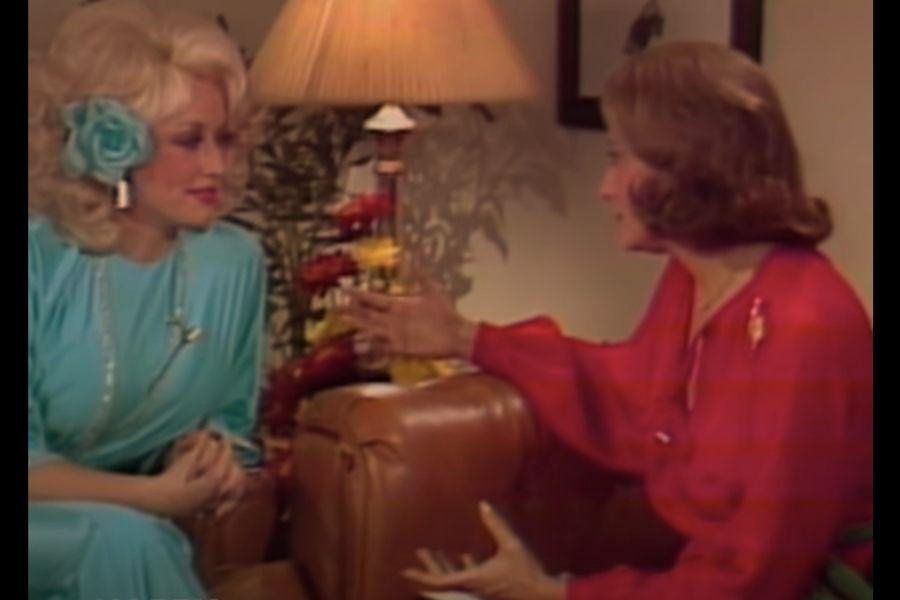
Watch Dolly Parton expertly handle Barbara Walters’ tacky questions in a 1977 interview

Proving Dolly has always been a model of grace, wit and self-assurance.

dolly parton, barbara walters
Photo credit: Happy Mag/YouTubeDolly Parton was the picture of grace in her 1977 interview with Barbara Walters.

Dolly Parton is a beloved icon whose appeal somehow bridges a diverse audience. Even people who aren’t big fans of her music admire her for her kindness, philanthropy and unflappability.

Barbara Walters is a now-retired broadcast journalist who gained international fame for her candid interviews with well-known figures. Though she was renowned for her interview techniques and willingness to ask tough questions, sometimes her questions could be somewhat tactless.


Put those two together 44 years ago and you get a shining example of Parton’s grace and wit in the face of tasteless questions about her looks, her breasts and criticisms lobbed at her. Parton has always been who she is and portrayed the outward appearances she wants to portray, and she calmly and deftly navigates Walters’ patronizing line of questioning with impressive poise.

Watch:

So much of Barbara Walters’ commentary and questioning comes across as condescending and judgmental, but Dolly Parton transforms that negativity into a positive portrayal of who she is, where she’s from and what she’s all about.

When Walters told her she was beautiful and didn’t need the wig and the make-up and the outrageous clothes, Parton told her it was a choice she’s making. “I don’t like to be like everybody else,” she said. “I would never stoop so low to be fashionable, that’s the easiest thing in the world to do.

“I’m very real as far as my outlook on life and the way I care about people and the way I care about myself and the things I care about. I just chose to do this, and show business is a money-making joke and I’ve just always liked telling jokes,” she added.

Walters asked her if she ever feels that she is a joke, since people make fun of her.

“Oh I know they make fun of me, but all these years the people have thought the joke was on me, but it’s actually on them,” said Parton. “I am sure of myself as a person. I am sure of my talent. I’m sure of my love for life and that sort of thing. I am very content, I like the kind of person that I am. So, I can afford to piddle around and do-diddle around with makeup and clothes and stuff because I am secure with myself.”

The questions about Parton’s breasts were particularly tacky, especially by today’s standards. But Parton handled it all beautifully. Her responses are a masterclass in grace and her self-assurance is a refreshing model for us all—especially now that we can see how she has stayed true to herself all these years. Anyone who has ever wondered why Dolly Parton’s appearance is what it is will learn a lot from this interview, and anyone who wants to learn how to maintain dignity and class in the face of inconsideration will learn a lot as well.


This article originally appeared on 12.8.21
  • She got fired from her bank job on the way home, sat on the train, said a prayer. Her phone rang 15 seconds later.
    Photo credit: CanvaA recently-fired woman holds a box of her belongings from work.

    She had just been let go from her job as a bank teller. The mistake was an $800 error she couldn’t fix, and when she came back to work her manager told her she was done. She got on the train home feeling “so sad,” as she put it, and cried.

    Then, instead of sitting with the loss, she prayed. Not a prayer asking for something, but one offering thanks. “God, thank you so much for allowing me to have this job for so long,” she said quietly. She put on a worship song.

    Fifteen seconds later, her phone rang.

    faith, job loss, viral, inspiration, TikTok
    A woman looks at her cell phone. Photo credit: Canva

    The man on the other end had a cheerful voice. His sister, he explained, had worked with her at the bank and spoken highly of her, perticularly her kindness and her service. Based on that, he thought she’d be a good fit for his company. She got the job that same day.

    The woman, who shares the story on TikTok under the handle @ashp_tv, posted about it in March and it spread quickly. The timing is the part that gets people because it’s not just that something good followed something hard, but how fast it happened, and that the call came specifically because someone had noticed how she’d treated people at the job she’d just lost.

    @ashp_tv

    Mustard seed faith STILL moves mountains. 🤍 #fyp #god #testimony #faith

    ♬ original sound – ASH P TV

    “All you need is faith,” she said. Whether you take that literally or as shorthand for something more like trust and openness, the story holds up either way.

    For more lifestyle content follow @ashp_tv on TikTok.

  • Tenant got a $2,500 check in the mail from an ex-landlord who sold the house.The note that came with it is something else.
    Photo credit: CanvaTwo women react to message with surprise.
    ,

    Tenant got a $2,500 check in the mail from an ex-landlord who sold the house.The note that came with it is something else.

    A former landlord tracked down every tenant they’d ever had after selling their house and mailed them each a check.

    Chris Robarge had rented a house after his divorce, his first place on his own during a hard stretch of his life. He paid his rent, eventually moved on, and didn’t think much more about it.

    Then, years later, his former landlord reached out asking for his current address. A day later, a check for $2,500 arrived in the mail with a handwritten note.

    The landlord had sold the house. And before keeping the profit, they tracked down every tenant who had ever lived there because, as the note explained, those monthly rent payments had helped pay off the mortgage. The tenants had contributed to the equity. It only seemed right to give some of it back.

    “While it’s not much, it’s yours,” the letter read. “It was a great house, and I’m glad that I was able to share it with you.”

    Chris posted about it on Facebook, where it spread quickly partly because people were so unused to a landlord story going this direction. He wrote that there’s a difference between people who talk about their values and people who actually live them, and that this was the clearest example of the latter he’d ever seen personally. “Do it off the clock, do it when no one is watching, do it always,” he wrote.

    kindness, housing, landlords, pay it forward, viral
    A man hands out cash to someone. Photo credit: Canva

    He kept $500 to fix his car. The rest he gave away to Black and Pink Massachusetts, to free fridges in Worcester, to OurStory Edutainment, and directly to people on the street who needed it. He turned an unexpected windfall into a chain of smaller ones.

    One Facebook commenter said she’d started reading the post braced for bad news like a surprise bill or some old debt being called in, and was so conditioned to that outcome that the actual ending genuinely shocked her. Which is maybe the most telling part of the whole story.

    You can follow Chris Robarge on Facebook.

  • Anne Hathaway praised after casually dropping Arabic phrase in interview
    Photo credit: Wikimedia CommonsHands writing in Arabic, left, and Anne Hathaway.

    During an interview with People promoting the upcoming The Devil Wears Prada 2, Anne Hathaway was asked how she navigates growing older. She noted the importance of taking self-care seriously, remaining curious, and appreciating being in a place where you can assess decisions made earlier in life.

    But it was what she said next, almost as an afterthought, that really got folks talking. 

    “I wanna have a long, healthy life. Inshallah, I hope so,” she casually but sincerely told her interviewer. The phrase, also spelled “insh’Allah,” translates to “if God wills” or “God willing,” and is deeply rooted in Islam.

    @people

    #AnneHathaway is embracing aging on her own terms and not getting swept up in the noise along the way. #WorldsMostBeautiful

    ♬ original sound – People Magazine

    However, it is also part of Arab culture in general. Religious or otherwise, people use it to convey resolute hope for the future while acknowledging that life follows its own plan.

    Bridge-building moment

    This ignited a positive frenzy online among Muslim and Arabic viewers, who were not only thrilled to hear the term used, but to hear it used correctly.

    Rather than being seen as performative, the overall consensus was that this was a refreshing, bridge-building moment across cultures.

    “Use it the way Anne Hathaway used it—honestly, humbly, in a moment when you genuinely want something good and know that wanting is only the beginning,” praised author Qasim Rashid. 

    Perhaps the timing of this interview has also contributed to its virality. Just weeks ago at Coachella, Sabrina Carpenter received backlash for her “this is weird” reaction when fans began engaging in the Zaghrouta, a celebratory, high-pitched ululation traditionally used in Arab cultures.

    So, for someone equally high-profile to actually promote rather than seemingly reject a piece of Arab culture has been viewed as a kind of karmic recompense.

    As HuffPost contributor Syeda Khaula Saad put it, “It just feels nice to be represented in mainstream media in an accepting, inclusive light. I hope that we get to see much more, insha’Allah.”

    And as she pointed out, recently another Arabic word was brought into the mainstream when Muslim Egyptian American actor Ramy Youssef taught Elmo to say “habibi” (meaning “my love” or “my friend”) on an episode of Sesame Street.

    This seemed to have a similarly profound impact. 

    “We have been dehumanized, portrayed in the worst way by the media for years.. I swear to GOD elmo saying ‘habibi’ made me teary and somehow healed the inner child that has been called the worst things for being different growing up,” one viewer wrote on Instagram. 

    It goes to show that when it comes to respecting other cultures, it doesn’t take a grand gesture. Even a word, when said correctly and with genuine intent, can extend an olive branch.

    Perhaps this wisdom can be especially applied to mainstream media, where negative stereotypes run rampant alongside baffling overcorrections. Sometimes, it really is as simple as making space for what exists beyond your own lived experience and engaging with it.

    Whether or not you agree that Hathaway executed this perfectly, may we all agree that the world could use more people looking to build bridges rather than reject what’s unfamiliar. 

  • A Gen Z passenger demanded his delayed flight take off immediately. When the gate agent heard why, he bought the man a ticket on a different airline.
    Photo credit: Canva(L) A man walking through an airport; (R) a plane take off in cold weather.
    ,

    A Gen Z passenger demanded his delayed flight take off immediately. When the gate agent heard why, he bought the man a ticket on a different airline.

    A gate agent who assumed the worst about an angry young passenger ended up spending $450 of his own money to get him home.

    A gate agent at an airport had a young man screaming at him that his flight needed to take off. The flight had been delayed due to weather. The agent gave his practiced apology and explained the situation. The young man kept pushing.

    The agent, who shares the story on Instagram Threads as @mr.freak_22_, had been doing this job long enough to develop a thick skin. He’d heard every version of the entitled passenger routine. He was preparing to hold the line.

    Then the young man told him why.

    A traveller delayed at an airport. Photo credit: Canva

    “You don’t understand. My mom is in hospice. The nurse just called. She has maybe hours left. I just need to hold her hand one last time.”

    The agent’s entire calculation changed. His own airline had nothing available. He pulled out his personal phone and started searching competitor flights. He found one for $450, leaving from another terminal. He looked at the young man, who was hyperventilating, and didn’t ask him for the money. He just bought the ticket.

    “I printed the boarding pass, shoved it into his hand, and said, ‘Run to Terminal B. Gate 12. Go.’”

    Man runs through an airport. Photo credit: Canva

    The young man ran.

    Two days later he called back and left a message. He’d made it in time.

    The agent posted about it because he wanted to push back on something he’d been thinking about. People assume gate agents are cold and robotic, just like people assume young men demanding things at airport counters are being entitled. Neither assumption held up that day. “Sometimes the rules don’t matter nearly as much as the reasons,” he wrote.

    You can follow the gate agent on Threads.

  • 12 years ago, Kenan Thompson told ‘SNL’ he’d never perform in drag again. It launched careers.
    Photo credit: @SaturdayNightLive on YouTubeSaying no said "yes" for several comedy stars.
    ,

    12 years ago, Kenan Thompson told ‘SNL’ he’d never perform in drag again. It launched careers.

    A refusal to portray women was the career nexus point of many Black women comedians.

    Since childhood, Kenan Thompson has practiced his craft as a comedic actor and sketch performer. As an adult, he’s been making audiences laugh at Saturday Night Live since 2003. During his tenure, he had been in drag lampooning Maya Angelou, Jennifer Hudson, and other Black women who were public figures. In 2013, he refused to portray a woman ever again on SNL. That line in the sand ended up launching many comedy careers.

    At the time, out of the 16 SNL cast members, there were only two other persons of color: Black comedian and actor Jay Pharoah, and Iranian-born American actress, Nasim Pedrad. This meant that either Thompson or Pharoah would have to don a wig and a dress if the show was spoofing a Black woman celebrity. As the longest running cast member on SNL, Thompson felt comfortable to publicly state that he wouldn’t portray a woman ever again. Pharoah backed him up and even pitched potential Black women comedians and producers.

    The audition that launched a new wave of comedians

    The move forced the producers to conduct a search for at least one Black female cast member by January 2014. The search led to Sasheer Zamata, who joined the cast until 2017. Since then, she’s gone on to other opportunities as a stand-up comedian and actress. Some of her roles include movies such as 2021’s The Mitchells vs. the Machines and Marvel and Disney+’s 2024 series Agatha All Along

    Even though Zamata claimed the spot on SNL, many of her fellow auditioners were noticed for other comedy jobs. After Zamata’s casting had been announced, the runner-up, Amber Ruffin, was almost immediately staffed as a writer for Late Night with Seth Meyers. Ruffin still currently works as a writer on the show while also getting other opportunities. She wrote her own sitcom, hosted her own comedy talk show, and participates as a talking head on Have I Got News For You.

    There was another future SNL all-star who wasn’t immediately cast, but hired on as a writer. However, she was promoted to a full cast member before the end of 2014. That person? Leslie Jones, who has since launched into film and television superstardom.

    Even though they didn’t get the job, many other funny Black women broke out at that audition. Tiffany Haddish would get recurring roles in TV shows like The Carmichael Show and star in the ultra-popular film, Girls Trip. Nicole Byer would have several live-action and voice-over roles while also hosting reality shows like Nailed It. In fact, Byer co-hosts a podcast with Zamata called Best Friends.

    It should be noted that these women likely would have found success without this SNL audition. Kenan Thompson would not and is not taking credit for their success. However, it is funny how refusing to wear a dress was one small push that created momentum in several different directions for so many talented people.

  • How Peg Bracken’s 1960’s ‘I Hate to Cook Book’ gave exhausted housewives permission to opt out
    Photo credit: CanvaPeg Bracken wrote a cookbook for women who felt tired of pretending that making dinner was the best part of their day.

    It’s 5:45 p.m. Your feet ache, the kids are hungry, and the idea of making dinner—again—feels like a personal attack. You open the fridge, close it again, and briefly consider disappearing into the couch. 

    That sense of dread? Women have wrestled with it for generations.

    In the early 1960s, the “ideal” American housewife supposedly lived for her time in the kitchen. Magazines showed smiling women in crisp aprons, beaming over from‑scratch casseroles and perfect party spreads. Ads promised that the right oven or cake mix would make home life “joyful.”

    peg, bracken, cookbook, feminism, 1960s
    Women have been held to impossible standards for generations. Canva

    Behind those glossy pages, a lot of women felt exhausted, underappreciated, and quietly furious.

    Into that pressure cooker walked Peg Bracken. With a martini in one hand and a can of cream of mushroom soup in the other, she did something radical for her time: she said, out loud, that she hated cooking. Then she wrote a cookbook for everyone who felt the same way.

    Her 1960 bestseller, The I Hate to Cook Book, did not offer easy recipes. It gave women at the time something much more powerful: permission to stop pretending that dinner was the highlight of their day.

    Who was Peg Bracken, really?

    Before she became a household name, Peg Bracken worked as an ad copywriter in Portland, Oregon. That job gave her a front‑row seat to the way media sold the “happy homemaker” myth: a smiling woman who kept a spotless house, raised perfect children, and produced beautiful meals night after night. 

    Bracken knew women like that didn’t exist. And if they did, they probably needed a nap. 

    peg, bracken, cookbook, feminism, 1960s
    The cover of Peg Bracken’s I Hate to Cook Book. Amazon

    At home, she struggled to balance marriage, motherhood, and an endless to-do list. The gap between what people told her she should feel about housework and what she felt—boredom, resentment, fatigue—grew too wide to ignore.

    So, she started talking about it with her friends. 

    Over lunch with a group of working women she jokingly called “the Hags,” Bracken and her friends swapped what she later called “shabby little secrets.” They admitted they didn’t want to spend hours in the kitchen. They confessed that they relied on canned soup, frozen vegetables, and boxed mixes. They traded recipes that kept their households fed with the least possible effort.

    Bracken collected the group’s favorite culinary shortcuts—and added her own, too—and wrapped everything up in her signature dry, self-aware humor. The result: a manuscript for The I Hate to Cook Book—a cookbook for women who felt tired of pretending that making dinner was the best part of their day.

    Men were not fans. Bracken’s then-husband read the manuscript and reportedly told her, “It stinks.” Six male editors also turned it down, insisting that women saw cooking as a sacred duty and didn’t want shortcuts.

    Nope! They guessed wrong. A woman editor took a chance on Peg Bracken, and when the book was published in 1960, it sold more than three million copies. All those “happy homemakers”? A lot of them turned out to be Hags at heart.

    Key contributions to culinary history

    From the first line of her cookbook—“Some women, it is said, like to cook. This book is not for them,” Peg Bracken signaled to the world her intentions. She did not teach readers how to make the perfect soufflé. Instead, she tried to help women get through the week

    In an era when ‘serious’ cookbooks pushed fancy technique and fresh ingredients, Bracken leaned into convenience. Her recipes called for condensed soups, frozen and canned vegetables, bouillon cubes, and powdered mixes. Dishes like ‘Stayabed Stew’ and ‘Skid Road Stroganoff’ took about 15 minutes to prepare. After that, the oven did the work while you lay in bed with a book or a box of tissues.

    While society equated womanhood with constant self-sacrifice, Bracken suggested another metric: Did everyone eat? Did you keep at least a shred of your sanity? If yes, then you are enough. That counted. 

    Most cookbooks published around this time sounded stern or reverent. Bracken’s writing sounded like a smart friend on the phone. 

    One famous instruction tells readers to let the dish cook “while you light a cigarette and stare sullenly at the sink.” Another recipe begins with a small shot of whiskey “for medicinal purposes.” She did not mock women who cooked for their families; she offered them comfort, support, and maybe a little laughter, when it seemed called for. 

    On the surface, women bought The I Hate to Cook Book for its recipes and advice. But beneath the cream-of-mushroom casseroles and Frito-laden specials lay an offer: to quietly challenge the idea that a woman’s highest calling meant crafting elaborate meals with a permanent smile. 

    Bracken rolled her eyes at the notion that adding an egg to a cake mix should satisfy a woman’s creative urge. She pointed instead to painting, writing, gardening, and studying as other ways women could use their minds. For women reading her at the kitchen table, that shift felt like a small revolution. Maybe nothing was ‘wrong’ with them. 

    Feminist perspectives and backlash

    Peg Bracken did not write manifestos or lead marches, but she identified something feminist writers later named: the crushing weight of unpaid domestic labor.

    A few years before The Feminine Mystique put words to ‘the problem that has no name,’ Bracken described a similar ache. She talked about the “dailiness” of cooking: the way the obligation hangs over a woman’s head from the moment she wakes up, the knowledge that no matter what else she does, dinner still looms.

    While ads and advice columns told women to find joy in that work, Bracken boldly asked: What if you didn’t? What would happen if you admitted that housework often felt boring, thankless, and overrated? 

    peg, bracken, cookbook, feminism, 1960s
    What would happen if you admitted that housework often felt boring, thankless, and overrated? Canva

    Not everyone welcomed that. Some traditional food writers and chefs dismissed Bracken’s canned‑soup cooking as an insult to ‘real’ food. At home, her husband’s “It stinks” line said plenty about how he felt watching his wife build a career—and a public persona—around not loving domesticity.

    Even some women felt torn. Those who genuinely loved to cook sometimes heard her embrace of ‘good enough’ as a knock on their craft. Others feared that shortcuts would trigger judgment from neighbors or in‑laws.

    But three million copies told a different story. The fight was never really about using canned soup versus scratch stock. It centered on who gets to define ‘good womanhood,’ and whether it was time for women themselves to redraw the lines.

    Highlights from The I Hate to Cook Book

    If you flip through The I Hate to Cook Book today, its recipes are clearly from a different time. Who makes celery-soup casseroles, or would want to eat processed mixes, anyway? 

    But underneath the midcentury pantry staples, there are themes and messages that still land even today. First, there’s the solidarity with women. Bracken writes as if she’s sitting at your kitchen table, not lecturing from a test kitchen. She assumes you’re tired, that you’re busy. She assumes that this—cooking a meal for your family every night—is not “the best part of your day” but work, and that you’d rather be doing anything else. 

    Second, she lowers the bar, deliberately. Again and again, she tells readers to stop torturing themselves with impossible standards. She advises against calculating the number of meals you’ll cook in a lifetime—“this only staggers the imagination and raises the blood pressure,” she jokes—and, instead, to take it day by day. One dinner at a time. 

    The “Stayabed Stew” is designed for days when you’re running on fumes, a dish that simmers in the oven while you stay in bed. It’s built around the promise that something hot and filling can appear with almost no effort from you. 

    Hootenholler Whisky Cake” starts with pouring yourself a shot of whiskey. A small joke, yes, but also a reminder: you are allowed to tend to yourself in the middle of tending to everyone else. 

    peg, bracken, cookbook, feminism, 1960s
    For many, Bracken’s cookbook doubled as a survival manual. Canva

    For readers who felt ambivalent or outright hostile toward cooking, Bracken’s book doubled as a survival manual. Simple recipes gave women options for dinner. Parsley and paprika did a lot of the heavy lifting. “Serviceable and done” became a valid and honorable goal. Taken together, these details sketch a woman who wasn’t trying to kill home cooking. She was simply carving a new path, one where feeding your family didn’t have to swallow your whole self. 

    That’s what makes Peg Bracken feel surprisingly modern. Her core insights were never actually about soup; they were about emotional relief. You don’t have to enjoy the labor on your plate just because someone told you it’s “supposed to be” your source of joy. 

    If the thought of making dinner tonight fills you with dread, Bracken’s legacy offers a small, compassionate shift. Maybe the “right” meal is the one that keeps you from crying into the cutting board. Maybe boxed mac and cheese or a rotisserie chicken on the counter is not a failure, but a wise use of the only energy you’ve got.

    Dinner doesn’t have to be perfect. You don’t either.

  • McDonald’s franchisee reveals secret science behind why their Coke tastes better than anyone else’s
    Photo credit: Schu/FlickrCoke fans say McDonald's soda is the best. A franchise owner reveals the behind-the-scenes secrets that explain why.

    Diet Coke is the new smoke break. Some people call it a “fridge cigarette,” a mid-afternoon burst of caffeine, carbonation, and flavor that gives stressed out and overworked adults a reason to live. OK, maybe that’s a little overdramatic. But people truly do love their Diet Coke and other Coke products.

    Dentists and doctors might caution about too much of the stuff, but the data doesn’t lie. Soda, and Diet Coke in particular, is still extremely popular. It may even be at or near its all-time peak appeal.

    And anyone who drinks the stuff regularly knows one thing to be true: McDonald’s has the best Coke products around. Bar none. But how?

    McDonald’s franchise owner takes us behind-the-scenes

    “Why is McDonald’s Coke better?”: This question has been asked and answered before, but never in such detail.

    McDonald’s even addresses it on their own website, a sure sign that they’re asked about this constantly. In an FAQ blog post from 2021, they write that they pre-chill the syrup and filter the water before combining. That’s how they ensure the highest quality.

    But, according to franchise owner “McFranchisee,” who posts behind-the-scenes secrets on X, it goes much deeper than that. They recently unfurled a brilliant and detailed thread on the exact science that makes McDonald’s Coke so dang delicious.

    McDonald’s has a deep partnership with Coca-Cola

    Simply put, one reason that McDonald’s Coke tastes so good is because the franchise gets serious special treatment thanks to a decades-old partnership.

    McFranchisee writes, “McDonald’s goes above and beyond to make their drinks elite. They even have their own division at [Coca-Cola headquarters]—no one else does.”

    A handshake deal in the ’50s solidified the partnership while both brands helped each other grow. One way McDonald’s gets the white glove treatment no other fast food chain gets? It’s Coca-Cola syrup is sometimes delivered in stainless steel tanks rather than the traditional plastic bags, which transfers less unwanted flavors into the syrup.

    Special equipment that keeps everything cold

    Your average restaurant keeps the soda syrup stored at room temperature, only to then mix it with cold water to create the final product. Not at McDonald’s.

    McFranchisee shares a video that shows the fast-food chain’s elaborate (and expensive) set up: copper tubing that carries the syrup is surrounded by a thick block of ice that cools it quickly before it mixes with water.

    “If you mix cold water with room temp syrup – you lose some carbonation & bite. This is the heart beat of the Diet Coke you love.”

    The owner adds that McDonald’s strives to keep both the syrups and carbonated cold water between 33 and 36 degrees Fahrenheit. that’s even colder than Coca-Cola’s official recommendation, and it’s a huge reason why the soda tastes so fresh and crispy.

    Ultra-filtered water

    Before tap water even touches the so-carefully-cared-for Coca-Cola syrups at McDonald’s, it’s filtered using some of the best existing technology in the world.

    McFranchisee explains that good filtration isn’t just about removing everything from tap water, though.

    “When we filter the water, we want to make sure there are still minerals in the water. If you take all the minerals out, there’s nothing for the carbonation to attach to. In some instances, we have to add minerals to the water to get the correct carbonation.”

    Anecdotally, customers say a cup of plain ice water from McDonald’s is some of the clearest and tastiest around. And speaking of ice…

    Special slow-melting ice

    If you didn’t even know “non-porous ice” was a thing, you’re not alone. Ice made in traditional trays and automatic freezers freezes from all directions at once, trapping air pockets and impurities inside the cubes.

    McDonald’s makes use of special, “directionally frozen” ice.

    Clearly Frozen, who makes a non-porous home icemaker, writes, “The directional freezing process pushes dissolved air, minerals and other impurities – even bacteria – out of your ice. … Clear ice cubes also melt more slowly than cloudy ice, so they keep your drink ice cold with much less dilution!”

    That’s why a McDonald’s Coke holds up so well on the drive home. The ice is specially engineered not to melt and dilute your drink.

    Wide-mouth straw

    The Coca-Cola drinking experience at McDonald’s wouldn’t be complete without just the right straw. McDonald’s straws, McFranchisee writes, are wider than most restaurants’.

    That means more soda-per-sip, for more flavor, and also a bigger burst of carbonation in your mouth at once. It heightens the experience.

    Finally, the partnership between McDonald’s and Coca-Cola means a Coke expert visits most restaurants every three months to re-calibrate everything and check the entire system.

    If you’re a Coke or Diet Coke lover and you seem to find yourself drawn to McDonald’s beverages like a moth to a flame, you’re not imagining it. There’s a lot of extremely complex and expensive science involved in delivering the most delicious soda possible. Now if they can only get those pesky ice cream machines to stay online.

  • Sunbather doesn’t budge when Harry and Meghan’s entourage has to walk around her. She’s the internet’s new hero.
    Photo credit: Mark Jones via Wikimedia Commons(L) Meghan Markle and Prince Harry; (R) A sunbather reads a book.
    ,

    Sunbather doesn’t budge when Harry and Meghan’s entourage has to walk around her. She’s the internet’s new hero.

    A beachgoer couldn’t be bothered by Prince Harry and Meghan Markle’s visit and the internet is absolutely obsessed with her: “The level of not giving a f* I dream of achieving.”

    When Prince Harry and Meghan Markle visited Bondi Beach on April 17, they were surrounded by the usual circus: paparazzi, crowds, bodyguards in matching uniforms, the whole production. One woman lay on her mat in the middle of it all, scribbling in her notebook, wearing sunglasses, and apparently not giving a single thought to any of it.

    A TikTok clip posted by News.com.au captured the moment as the Duke and Duchess of Sussex walked the beach during the final day of their Australian tour. Their entourage had to navigate around her. She did not look up. The royal couple’s eyes tracked her as they passed. She continued writing.

    News.com.au summed it up in their caption: “One woman’s complete indifference is peak Bondi attitude.”

    @news.com.au

    One woman’s complete indifference is peak Bondi attitude. #princeharry #meghanmarkle #bondibeach #sydney #royals

    ♬ original sound – News.com.au

    The internet agreed enthusiastically. “The level of not giving a f* I dream of achieving,” one commenter wrote. “Peak unbothered,” said another. “Well done to that lady for not giving a damn,” a Facebook commenter added.

    The coda that made the story perfect: a TikTok commenter recognized the woman as her sister and revealed she thought the crowd had gathered around an actor.

    Prince Harry, Meghan Markle, viral, Australia, celebrity
    Aerial view of Bondi Beach in Australia. Photo credit: Canva

    The visit itself was a quieter affair than Harry and Meghan’s 2018 Australian tour, when they were still working royals and the reception was considerably more ceremonial.

    This trip included stops to support volunteer first responders at the Bondi Surf Bathers’ Life Saving Club, a Masterchef Australia appearance, and promotion of Meghan’s As Ever lifestyle brand. The Guardian described it as less a royal tour than something else entirely. One woman on a beach mat seems to have agreed.

Culture

A Gen Z passenger demanded his delayed flight take off immediately. When the gate agent heard why, he bought the man a ticket on a different airline.

Family

Mom-to-be trusted her sister to film her labor and the ‘distorted’ result is an absolute laugh riot

Science

A man skipped his friend’s birthday dinner because the cheapest entree was $41 and people are rallying behind him

Pop Culture

12 years ago, Kenan Thompson told ‘SNL’ he’d never perform in drag again. It launched careers.