upworthy
Add Upworthy to your Google News feed.
Google News Button
Humor

Cat who walks onto the stage during orchestra concert becomes surprise star of the show

This was HIS moment.

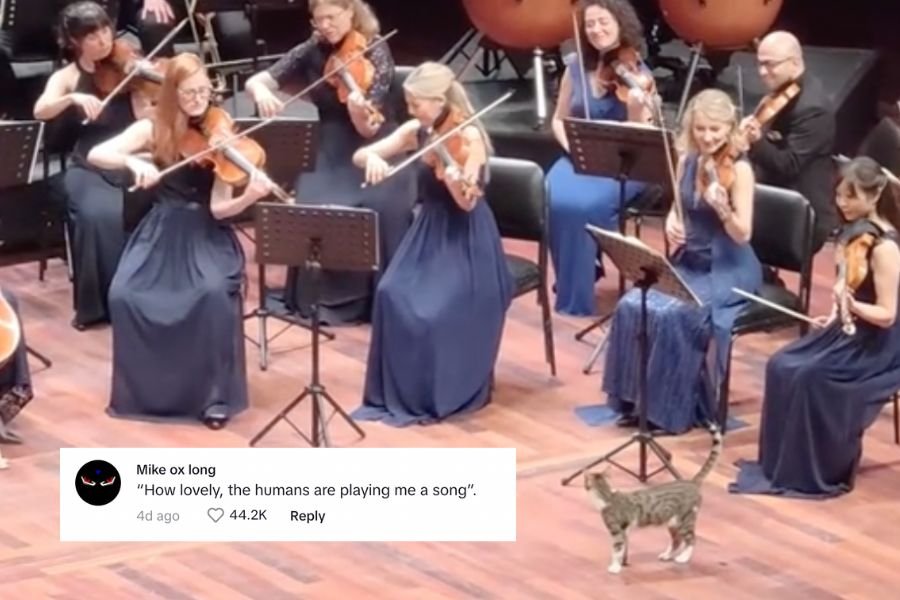
an orchestra playing on stage beside a small tabby cat with comment overlay that reads, "How lovely, the humans are playing me a song."
@abcnews/TikTok

Cats are stars, onstage and off.

Oh, what it must be like to be a cat. To never suffer from imposter syndrome, to take on foes at least twice your size without hesitation, to navigate the world like you’re on every VIP list in existence. What a glorious life indeed. Take this concert-crashing kitty, for example. During a live orchestra performance at the 52nd annual Istanbul Music Festival, a curious feline wandered up on stage without a care in the world—and of course it was all anybody could talk about.

In a clip shared to multiple social media platforms by several news outlets, including @abcnews on TikTok, we see the gray and white cat traipse onto the stage, as if drawn in by the whimsical tune being played.

Then, it literally catwalks across the stage, unbothered from beginning to end.

Watch:

@abcnews A curious cat wandered onto stage during a live orchestra performance at the 52nd Istanbul Music Festival. #turkey🇹🇷 #orchestra #catsoftiktok ♬ original sound - ABC News

Of course, as many viewers pointed out, this is an all-too-common sight in Istanbul, which, like many Muslim countries, holds a special place in its heart for felines. According to Catster, cats don’t have owners. Instead, they are taken care of by the entire community all around the city—from tea houses to ferries to public transport and beyond.

Istanbul even funds veterinary care for its stray cats, including spaying and neutering, emergency care, and a mobile Vetbus. It’s pretty much Kitty Heaven over there.

Besides commending Istanbul for its feline-friendly atmosphere, people also shared their delight for the cat who “stole the show.”

“He KNEW this was about him. HIS moment! Lol,” one person wrote.

Another added, “that’s his background music, and he’s off on a big adventure.”

Another tapped into the cat’s POV, writing, “How lovely, the humans are playing me a song.”

Some even offered their best cats puns.

“I think it was trying to find the ‘purr-cussion’ section,” one person quipped.

Another said, “That is an ARISTOCAT.”

Istanbul might go above and beyond for its cats, but the respect we have for feline audacity is strong just about everywhere in the world.


This article originally appeared last year.
ups, ups driver, delivery driver, ups deliveries, cookout, family, food, hospitality, kindness
Relaxed008/YouTube
UPS driver invited to family's cookout.

UPS drivers are always on the grind delivering packages around the clock—even on holidays. And one family took notice of the hard-working UPS driver in their neighborhood who had his nose to the grindstone as they enjoyed a cookout together. Rather than simply let him pass by, they decided to flag him down and extend an invite to join them in a move that proved community and hospitality are still alive and well.

TikToker @1fanto shared a touching video with his followers from Easter weekend where his family invited a UPS driver making rounds in their neighborhood to come to their cookout and 'make a plate.'


"Everybody family around here 😭," he captioned the video. "Everybody invited to the cookout.😂"

@1fanto

Everybody family around here 😭 #easter #cookout #wherethefunction

In the video, the UPS driver is seen standing in the family's driveway, and a group of cookout attendees warmly welcome him to join them. The uncle of @1fanto says to the driver, "You've been working hard all day man, you can go on in there!" He calls out for a woman named Stephanie to "take care of him!"

The UPS driver walks up the driveway, and they encourage him to go inside and get his fill as he enters the garage. After securing a plate of food and a drink, the driver walks back outside to mingle with guests, shaking hands with the uncle who invited him.

"You good?" the uncle asks, and the driver responds, "Yeah I'm good. They hooked me up. Thank you so much. Appreciate y'all for inviting me out." On his way back to his truck, the uncle encourages the driver to invite other workers to stop by as well.

- YouTube www.youtube.com

In a follow up video, @1fanto explained more about how the invite went down. He shares that the UPS driver was driving by the family's house on the Saturday before Easter, and at the time the family was enjoying a big fish fry cookout together. His uncle flagged the driver down, and he pulled over.

He shares that his uncle told the driver, "Go inside and get you a plate!" The driver asked him, "Are you sure?" But he reassured him, adding that the family made sure to ask the driver what he wanted and didn't want on his plate to "make sure he was good and got everything he needed".

"I saw it had a positive impact. That's what my family do. That's not something that we just do for social media," @1fanto shared. "That's something that we do on a regular basis that doesn't just happen when the camera's on. It happens when the camera's off, too. We're all equal. We all bleed the same."

ups, ups truck, united parcel service, ups delivery, ups deliveries, ups driver A UPS truck with package deliveries.Image via Wikipedia

Viewers had lots of positive things to say in the comment section.

"I am a UPS driver and that makes our day. People showing love to us"

"Your family represents the best of America🫶🏼 Your uncle is now all of our uncle."

"Working the holidays suck. But they made that man’s entire day. Love it."

"I love when people are nice for no reason. You’re so real ♥️thank you for being so kind."

"Being a delivery driver is grueling, often thankless work. It's awesome to see a family that remembers those hardworking folks are essential parts of our communities."

This article appeared last year. It has been updated.

eagles, eagles take it easy, rock songs, music theory, rhythms
Photo credit: Steve Alexander via Wikimedia Commons, Creative Commons Attribution-Share Alike 2.0, cropped (main image) /Photo credit: Canva, SkaHero42 from pixabay (text boxes)

Here's why you might struggle clapping along to the intro of Eagles' "Take It Easy."

Eagles’ debut single, the twangy 1972 anthem "Take It Easy," is a staple of classic rock radio—the perfect soundtrack to hand-cranking the windows down in your old car, feeling that summer air hit your face, and cruising a back road at sunset, all while tapping along on your steering wheel. But in that moment, you may have found yourself somewhat disoriented: When the drums kick in, it might sound like the breezy rhythm has done a backflip.

Why is this happening? Thanks to some helpful musicians on the Internet, we now have answers. Rest assured: If you ever find yourself singing "Take It Easy" karaoke or trying to clap along to an Eagles cover band, you won’t find yourself embarrassed and messing up the downbeat.


- YouTube www.youtube.com

Take it easy—it's not hard to re-train your ear

Desi Serna, a guitar instructor and music theory expert, addressed the "Take It Easy" confusion in a YouTube video, explaining this rhythmic confusion with plenty of technical detail. But let’s keep it simple: When you hear the song’s first prominent guitar strum, your brain might naturally interpret that as the downbeat (in this case, the "1" of the "1, 2, 3, 4"), but that’s not really what’s happening. If you try to clap along that way, you’ll be totally thrown off around the 14-second mark, as the full band crashes in.

But there’s an easy way to re-train your ear, even if you’re not trying to play the song on an instrument. As Serna shows in the clip, you just have to feel that first strum as a "pickup note"—in other words, those big chords are the beat just before the "1" (so something like this: "strum—1—and—2—and—3—and—4—strum—1…"). It makes total sense once you try it out.

This "Take It Easy" confusion has led to multiple explainer videos, including another from a drummer who describes the song as having a "deceptive drum intro." Their clip is short and to the point—perfect for anyone who wants to skip the music theory and get straight to the nitty gritty.

- YouTube www.youtube.com

"Thanks to you, I now see the light"

Lots of people reacted to Serna’s breakdown with a mixture of relief and elation. Here are some of the best comments:

"The remedy for the age old problem. Lol"

"Although I know what it should be, because I've always done it the other way, it still trips me up sometimes…"

"Been playing it wrong for 30 years"

"I’ve noticed this for years but was never able to figure out why the beat changed when the drums came in, thank you!!! Great video!

"THANK YOU for clearing this up!"

"One of my favorite songs man thank you"

"Thank you for breaking that down! That intro always sounded off to me but I never took the time to analyze it."

"That apparent rhythm change had always bothered me. Thank for making sense of it"

"I always sensed something to be rhythmically 'wrong' in this intro. Thanks to you I now see the light."

Of course, "Take It Easy" isn’t the only classic song with a puzzling intro rhythm. As guitarist Paul Davids shows in a YouTube video, you might also find yourself confused by The Beatles’ "Drive My Car" and James Taylor’s "Secret of Life," among others.

- YouTube www.youtube.com

crowd, unique, personality type, nonconformist
Photo Credit: Canva

A person stands out in a crowd.

So many of us have the desire to compartmentalize our personality traits into neat little boxes. "Oh, she's such an INFJ. Oh, he's such a Gemini." Some of it is rooted (well sort of) in psychology, such as the Myers-Briggs Type Indicator, based loosely on Jungian ideas. Others rely on arguably less scientific data like stars and "rising signs." Humans aren't usually that simple.

That said, there's still value in understanding one's own personality and inclinations. Here's a confession: I've taken countless personality tests because I just couldn't figure out if I was an extrovert or an introvert. Neither description quite fit, and as someone constantly trying to understand what makes me tick, this has been frustrating.


Turns out, there are other options. The term "ambivert" got popularized in the 1930s (after being coined by Edmund S. Conklin in 1923), and it refers to a person "who has features of both an introvert (someone who prefers to spend time alone) and an extrovert (someone who prefers to be with other people) in their personality."

@tedtoks

Replying to @Factura🛄 now knowing what an ambivert is, how would you describe yourself? #ambivert #introvert #extrovert #adamgrant #psychology #TEDTalk #worklife

But for those who still don't quite relate, meet the otrovert. Just recently, psychiatrist Rami Kaminski published The Gift of Not Belonging, in which he discusses his coined term to describe a whole new type of personality. In an Insta-reel captioned "What is an Otrovert?" Kaminski mentions the polarization of introverts and extroverts. "When Jung invented the terms extrovert and introvert, he saw them as two fundamental orientations of the personality. I see the otrovert in the same way. A personality trait that faces away from the group."

He continues, "Extroverts and introverts are inherently communal, while the otrovert is an outsider to the group. In itself, it is not a problem or condition, nor is it a diagnostic label. It simply means that while most people learn to develop a sense of belonging to a specific group through social conditioning, otroverts remain social but not communal."

In writer Sarjna Rai's piece, "Struggle to Fit the Mold? The 'Otrovert' Personality Explains Why" for Business Standard, they write: "Unlike introverts or extroverts, otroverts are not defined by where they draw their social energy. Instead, the concept captures people who constantly feel like outsiders, and tend to look in a different direction altogether, not necessarily aligned with the rest of the group."

While it's impossible to group people into perfect categories, Rai explains that Kaminski claims the main thing that sets otroverts apart is their "reluctance to conform to group norms."

Writer Avery White lists signs one might be an otrovert in the article "7 Signs You Might Be an Otrovert" for VegOut. Among them is preferring "high-signal conversations and low-maintenance relationships." They give this as an example: "You’ll happily spend three hours exploring one idea with one person—and then not speak for weeks without either of you taking it personally. In other words, low pressure, low expectations, high connection.

Another on the list—and this is a big one according to Kaminski—is: "You can look extroverted in public—yet feel fundamentally 'other.'" This is actually the crux of the term, and in fact, what Kaminski formed The Otherness Institute for: as their website says, "those who feel they don't belong."

The site also shares that recognizing aspects of this type in yourself and others (if it applies) will help "balance between your individuality and your function as part of the social matrix that determines your well-being. The experience of otherness in a togetherness-minded world can be emotionally bruising. Often misunderstood and misdiagnosed, otherness may lead individuals to feel strange, lonely, and unwelcome in groups. Left unidentified, otroverts' non-belonging can result in a frustrating, futile lifetime effort of trying to 'fit in.'"

Some Redditors are scrambling to figure out if they fit into this category. In the subreddit r/INTP (referencing one of the Myers-Briggs personality types), the OP asks, "Maybe I am an 'otrovert?'" Under this, they write, "Dr. Kaminski described the otrovert child as 'neurotypical, friendly, curious, well-adjusted, and often popular' yet 'they resist being pressured into group activities.'"

While this can seem inconsequential in childhood, joining the peer group "becomes critically important" in adolescence, said the psychiatrist, and teens "start to gauge their self-worth based on the group’s ranking of popularity (or unpopularity).'

"Membership in a group, no matter how lowly, is better than being an outsider," he added. "Otroverts, however, are comfortable with being outsiders and find it impossible to feel like insiders, regardless of how welcome they are.'

There are a handful of commenters who feel seen, but many push back, claiming the term could easily apply to other personality traits. One writes, "I think it's easy to resonate with this description... but as some warning noted, there aren't enough studies done about this term that people should be running to adopt it. I resonated with it after reading about it... But I have ADHD and persistent depressive disorder... both of which coincide with the descriptions of an otrovert."

Time will tell if this new term sticks, but for now, it's helping a lot of people feel more understood.

This article originally appeared last year.

cher, david letterman, late night, late night show, tv, celebrities, sexism, women, hollywood
Renan Katayama/Wikimedia Commons & Gotfryd, Bernard/Wikimedia Commons

David Letterman and Cher.

Cher had accomplished a laundry list of amazing feats by the time the 1980s rolled around. She'd hit number one on the Billboard Hot 100, had international number-one hits, starred on television and on Broadway, and established herself as an acclaimed actress. In 1988, she even won an Oscar for Best Actress for her role in Moonstruck.

But as of 1986, there was still one major thing she hadn't done: appear on Late Night with David Letterman.


It wasn't for lack of trying on Letterman's part. He'd been trying to get Cher on his show for years and, with the help of a hefty appearance fee, sealed the deal in 1986. The audience was excited. Letterman was excited. But when Cher finally walked out onstage, things didn't get off to the smoothest start.


cher, david letterman, late night, late night show, tv, celebrities, sexism, women, hollywood Cher was the biggest phenomenon on the planet for the better part of the '70s and '80s.Casblanca Records/Wikimedia Commons

After Letterman complimented how she smelled, Cher crossed her arms and deadpanned, "Is this as good as it gets?"

Letterman and the audience laughed it off, but the vibe was clearly tense from the get-go.

"I know you didn't want to come on here, so why, finally... did you decide to come on?" he asked

Cher laughed and joked that she only came on so she could pay an expensive hotel bill. "No, I don't know, because I thought that I would never want to do this show with you," she added.

"Why?" Letterman asked. "Because you thought I was a..."

"An a**hole," Cher bluntly said.

After Letterman riffed briefly on the audience reaction, Cher elaborated: "It was frightening because I see how you deal with your guests and sometimes it's really great and you seem to like them, but if you don't like them, you might as well take a picnic lunch."

From there, Letterman pivoted: "You look great... How many tattoos do you have?"

The interaction has since become an iconic moment, rewatched again and again over the past several decades. The official YouTube clip of the interview currently has more than three million views.

- YouTube www.youtube.com

Though beloved by his male fans, Letterman hasn't always had the greatest reputation for his treatment of guests, women in particular. This was a pattern that played out for years. Letterman was known to tease, and at times outright bully, certain guests more than others.

In a 1988 interview, he mocked Shirley MacLaine for her belief in past lives. During a 1986 sit-down with Farrah Fawcett, who appeared nervous and a bit loopy, Letterman had little trouble getting laughs at her expense. Even years later, interviews with Lindsay Lohan, Paris Hilton, and Jennifer Aniston were widely criticized as mean-spirited or gross. And in 1994, an interview with Madonna turned openly contentious, with both sides trading barbs.

But it wasn't just Letterman. The cruelty of late-night television reached something of a peak in the early 2000s, when hosts routinely mocked female stars like Britney Spears, who was struggling through a highly public mental health crisis. One notable exception was host Craig Ferguson, whose 2007 monologue stood out for its striking empathy in sharp contrast to many of his peers:

- YouTube www.youtube.com

Even today, women who appear on late-night shows often find themselves either the butt of the joke or an object of desire.

Research published in The Critical Review of Social Sciences Studies asserts, "Female guests often appear as spectacles for male hosts' humor rather than as authoritative contributors to public discourse. ... The quick-witted, often satirical male hosts discuss political and public affairs in ways that pose hegemonic challenges for female participants, limiting their discursive power."

It’s no wonder that Cher didn't exactly see the Letterman set as a safe space to let her guard down. And in typical Cher fashion, she made her feelings about Letterman clear right from the start. The exchange is an unforgettable moment that works as both a public call-out and an icebreaker. That night in 1986, Cher and Letterman ultimately went on to have a nice (if playfully combative) interview.

For his part, Letterman has since expressed regret about many aspects of his time hosting Late Night, including what he has described as a "toxic work environment" marked by "sexual favoritism" and scandals. It's hard not to wonder whether Cher picked up on those bad vibes at the time and chose to call them out in the only way she knew how, which is exactly why people still love her.

Culture

Why intergenerational 'culture buddies' could be the antidote to loneliness everywhere

Inside the program reconnecting Hamburg's students and seniors.

seniors, loneliness, germany, elders, students

Kulturisten Hoch Zwei provides the link between seniors and high school students.

Picture yourself at eighty-five. You live alone in a fourth-floor apartment in a busy city. You loved the theater in your youth, savoring the thrill as the lights dimmed and the crowd fell to a hush. Now, money is tight, sitting for hours is hard on your body, and perhaps most heartbreaking of all, you have no one to go with.

For millions of older adults around the world, this scenario is more than hypothetical; it's everyday life. Loneliness has become an increasingly widespread issue, affecting physical health as much as smoking or obesity. But in Hamburg, Germany, a remarkable social initiative is offering a different kind of remedy for loneliness among the elderly.


seniors, loneliness, germany, elders, students A high school volunteer with her senior "tandem." Photo credit: Kulturisten Hoch Zwei

This approach, often referred to as "social medicine," drives KULTURISTENHOCH2 (Culture to the Power of Two), a non-profit redefining aging, youth, and the transformative power of human connection.

Unpacking KULTURISTENHOCH2

At its heart, KULTURISTENHOCH2 (also known as KH2) is a "culture buddies" program with a simple, beautiful mission. The project pairs high school students with older neighbors living on low incomes to forge meaningful intergenerational connections.

The project was founded in 2016 by Christine Worth, a former marketing executive inspired by her family history. She remembers watching her father's world grow smaller due to dementia, aging, and isolation, and realized that getting older is an unaddressed social problem. Worth found that for many seniors, not having someone to share the day with was the biggest barrier to leaving the house.

seniors, loneliness, germany, elders, students KH2 makes leaving the house more accessible to senior citizens. Photo credit: Kulturisten Hoch Zwei

Through KH2, seniors are given a "VIP pass" to an unbelievable, culturally rich city. Paired with a local teenager, these elders enjoy free tickets to concerts, plays, and art exhibits, proving that a shared cultural experience can bridge even the largest age gaps.

How the program works

KH2 is designed to remove every barrier that might keep an older person at home, creating a safe, comfortable, and dignified experience from start to finish.

The pairing process

The initiative starts in local schools, where students sixteen and older volunteer to join KH2. These "young buddies" are paired with seniors ages 63 and older—many of whom are living on low incomes or with physical disabilities—within their district, allowing them to attend a wide range of cultural events free of charge.

Seniors are identified and registered as participants if they meet age and income requirements and express an interest in cultural participation.

seniors, loneliness, germany, elders, students Many "culture buddies" stay in contact after the program ends. Photo credit: Kulturisten Hoch Zwei

After matching, the student will contact the senior, coordinate logistics, and accompany them to selected events. Over time, many connections evolve into lasting relationships, with approximately 20% of "generational tandems" reportedly maintaining regular contact beyond the official program.

Door-to-door companionship

Tickets are provided free of charge by KultureLebe Hamburg e.V., a partner program that champions the belief that "culture is not a luxury, culture is food" and arranges free cultural experiences for people on low incomes.

The student arranges a meeting time and place, often picking the senior up from their home and, if requested, accompanying them door-to-door. Travel typically takes place via public transportation, with the student offering practical assistance along the way, such as navigating stairs, reading signage, and more.

Students commit to at least three cultural outings per school year, though many choose to volunteer more often.

Walking in their shoes

One of the most impactful aspects of KH2 is how it prepares the students. Before meeting their senior partners, teens receive specialized training designed to ensure the needs of older adults are met.

Beyond discussing aging and how to navigate communication with seniors, students wear a 77-pound "aging simulation suit," which restricts movement and vision. They are given "ear defenders" to simulate hearing loss and practice using wheelchairs and walkers to experience the physical challenges of older age and its practical challenges.

Cultural experiences for all

Events include a broad range of programs, including the theater, opera, orchestral events, cinema, gallery openings, and festivals. Here, culture serves as a natural "conversation starter" between generations, as shared performances and exhibitions open the door to exchanging perspectives and life stories.

While student participants receive certificates for their volunteer work, the real reward lies in personal growth. Through engaging with seniors from a different generation, they gain a deeper understanding of history, empathy, and human connection.

Sustaining and expanding KH2

The program started with three pilot schools and 37 seniors, and expanded quickly. By the end of 2019, around 165 students and 175 seniors were active in KH2, with more than 850 pairings activated across Hamburg.

seniors, loneliness, germany, elders, students KH2 provides students with excellent life skills and lasting connections. Photo credit: Kulturisten Hoch Zwei

Keeping KH2 running requires significant support. Around 25% of its funding comes from government agencies, with the remainder provided by private foundations, corporate sponsors, and grassroots fundraising efforts.

The science behind the magic of connection

Public health experts are increasingly recognizing that health extends beyond diet and exercise. A groundbreaking 2023 report from the World Health Organization (WHO) linked participation in arts and culture to tangible health benefits, including reduced depression, improved cognitive function, and even increased life expectancy.

"For too long we have seen Science and the Arts as separate endeavors," said Sir Jeremy Farrar, chief scientist at the WHO. "But these silos were not always so. Through much of human history, the creative interface of different disciplines has been a catalyst for both innovation and healing."

In this sense, KH2 functions as more than a community program; it serves as a preventative health strategy.

Creating lasting partnerships

In a society increasingly shadowed by loneliness and isolation, KH2 is grounded in the belief that real change happens through encounter and exchange. Through its life-changing cultural tandems, older adults regain mobility, confidence, and a renewed sense of belonging as active members of society.

By connecting two groups who might otherwise never meet—teenagers just beginning their lives and seniors reflecting on theirs—KH2 creates moments in which age quietly falls away, leaving two souls moved by art.