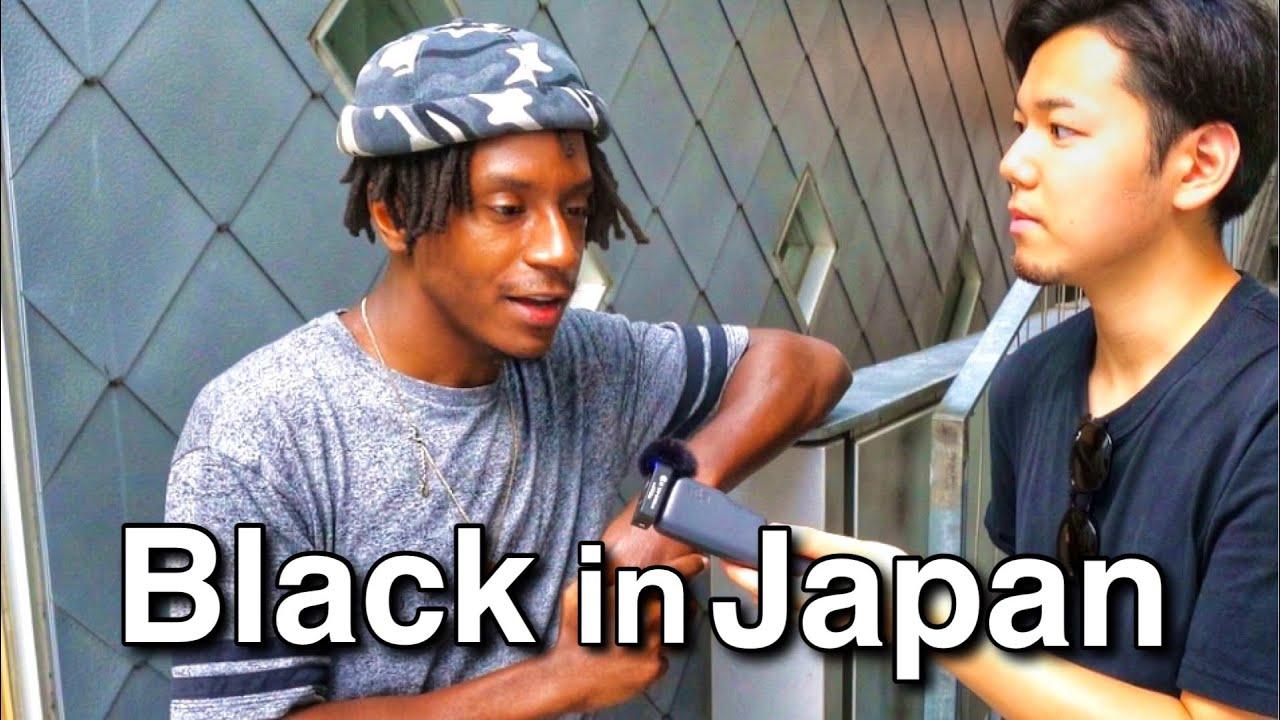
College student in Tokyo asks strangers, 'What's it like being Black in Japan?'
Japan is one of the world’s most racially homogeneous countries.

TAKASHii is a young college student in Tokyo who travels around the city having chats with random strangers he meets. His YouTube channel is filled with all sorts of candid, man-on-the-street type interviews, usually focused on one social topic question, usually beginning with “What’s it like…?"
The amateur journalist recently asked, “What’s it like being Black in Japan?” to people originally from America, Africa and Jamaica currently living there.
Japan is one of the world’s most racially homogeneous countries. As racism continues to be a huge issue in more diverse nations, how would being an even smaller minority affect quality of life?“When I first came here, I felt like a spectacle,” answered the first woman, an African American who had lived in Japan for six years teaching academic English. Though she noted, “it just feels like I would living anywhere else…people are just gonna look because they have this notion of Black people.”
TAKASHii then asked the young woman her opinion on young teenagers wearing dreadlocks in their hair. “Some people say ‘it’s appropriation’ and other people say ‘it's appreciation’. I personally don’t like it but I can’t make anybody do anything,” she replied.
As another African American, in Japan since 2016, put it: “In America they like Black people as a culture, not as a people. It’s kind of the same here.”
However, two women from Kenya shared a different view.
“In my opinion Japanese are very welcoming. And even the stares you get, it’s not malicious. People are just curious. And people are friendly. There are so many cases where I’ve been helped by Japanese strangers,” one noted.
She did add that Japanese people tended to “relate more” to Black Americans from consuming their music and movies, whereas the first thing that comes to mind when meeting a Black African is “the national parks and animals.”
The last interviewee, a man from Jamaica, came to Japan to escape his home and expand his world view.
“A lot of the time I forget what color I am,” he quipped, saying that “Japanese people are not outwardly racist, thank god.”
He also joked that some of the major “positive stereotypes” usually associated with Black people tended to work out in his favor. “They think I can play basketball, that I’m a good singer, or that I have these super star qualities.
“The more you interact with Japanese people and you enter their social circle, the more they treat you like one of them,” he added.
Our world is opening up in many ways. Perhaps by having more conversations like these, we can learn how to better build a more accepting society.
You can find even more of TAKASHii’s interviews here.- Korean war veteran reunites with Japanese love - Upworthy ›
- Penguins won't eat the cheap fish at Japanese aquarium - Upworthy ›
- At Japan's anti-procrastination cafe, writers can enjoy tea—and ... ›
- A guy's totally random text in the 1990s ended in marriage - Upworthy ›
- Japan's 'rice paddy art' blends modern technology and ancient crops to make living artwork - Upworthy ›
- Japanese volleyball player's serve hit a judge, and his extreme 'dogeza' apology went viral - Upworthy ›


A woman is getting angry at her coworker.via
A man with tape over his mouth.via
A husband is angry with his wife. via 
a man sitting at a desk with his head on his arms Photo by
Can a warm cup of tea help you sleep better? If you believe it, then yes. Photo by 
Three women sit on a blanket in the park. 
Two women engaging in a pleasant conversation inside a coffee shop
Two men engaging in a peaceful disagreement.
Resurfaced video of French skier's groin incident has people giving the announcer a gold medal
"The boys took a beating on that one."
Downhill skiing is a sport rife with injuries, but not usually this kind.
A good commentator can make all the difference when watching sports, even when an event goes smoothly. But it's when something goes wrong that great announcers rise to the top. There's no better example of a great announcer in a surprise moment than when French skier Yannick Bertrand took a gate to the groin in a 2007 super-G race.
Competitive skiers fly down runs at incredible speeds, often exceeding 60 mph. Hitting something hard at that speed would definitely hurt, but hitting something hard with a particularly sensitive part of your body would be excruciating. So when Bertrand slammed right into a gate family-jewels-first, his high-pitched scream was unsurprising. What was surprising was the perfect commentary that immediately followed.
This is a clip you really just have to see and hear to fully appreciate:
- YouTube youtu.be
It's unclear who the announcer is, even after multiple Google inquiries, which is unfortunate because that gentleman deserves a medal. The commentary gets better with each repeated viewing, with highlights like:
"The gate the groin for Yannick Bertrand, and you could hear it. And if you're a man, you could feel it."
"Oh, the Frenchman. Oh-ho, monsieurrrrrr."
"The boys took a beating on that one."
"That guy needs a hug."
"Those are the moments that change your life if you're a man, I tell you what."
"When you crash through a gate, when you do it at high rate of speed, it's gonna hurt and it's going to leave a mark in most cases. And in this particular case, not the area where you want to leave a mark."
Imagine watching a man take a hit to the privates at 60 mph and having to make impromptu commentary straddling the line between professionalism and acknowledging the universal reality of what just happened. There are certain things you can't say on network television that you might feel compelled to say. There's a visceral element to this scenario that could easily be taken too far in the commentary, and the inherent humor element could be seen as insensitive and offensive if not handled just right.
The announcer nailed it. 10/10. No notes.
The clip frequently resurfaces during the Winter Olympic Games, though the incident didn't happen during an Olympic event. Yannick Bertrand was competing at the FIS World Cup super-G race in Kvitfjell, Norway in 2007, when the unfortunate accident occurred. Bertrand had competed at the Turin Olympics the year before, however, coming in 24th in the downhill and super-G events.
As painful as the gate to the groin clearly as, Bertrand did not appear to suffer any damage that kept him from the sport. In fact, he continued competing in international downhill and super-G races until 2014.
According to a 2018 study, Alpine skiing is a notoriously dangerous sport with a reported injury rate of 36.7 per 100 World Cup athletes per season. Of course, it's the knees and not the coin purse that are the most common casualty of ski racing, which we saw clearly in U.S. skier Lindsey Vonn's harrowing experiences at the 2026 Olympics. Vonn was competing with a torn ACL and ended up being helicoptered off of the mountain after an ugly crash that did additional damage to her legs, requiring multiple surgeries (though what caused the crash was reportedly unrelated to her ACL tear). Still, she says she has no regrets.
As Bertrand's return to the slopes shows, the risk of injury doesn't stop those who live for the thrill of victory, even when the agony of defeat hits them right in the rocks.