upworthy
Add Upworthy to your Google News feed.
Google News Button
Heroes

A unique voice at a London subway stop remains as an act of kindness to a grieving widow

Is someone cutting onions in here?

A unique voice at a London subway stop remains as an act of kindness to a grieving widow

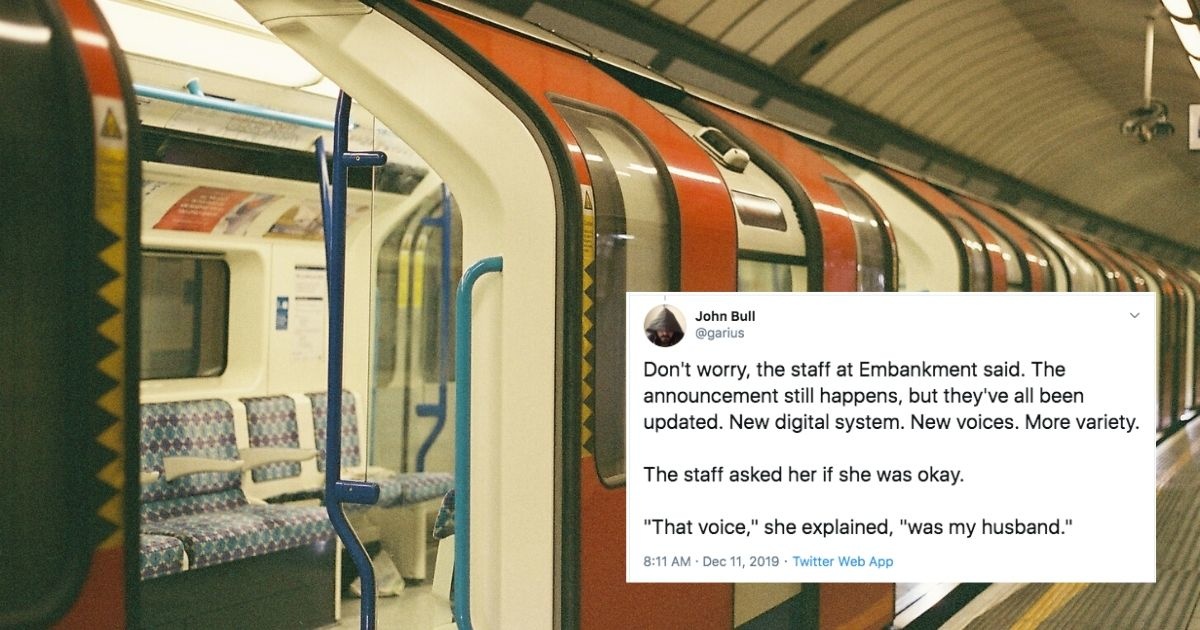
If you travel on the subway in the London Underground, you'll hear various automated recordings of instructions and announcements for passengers. But at one stop, one instruction stands out from the rest—a unique voice warning people to "Mind the gap."

It's not actually new. The same voice issued the same warning for decades, but was replaced in 2012 when the Underground installed a new digital system.

Weeks later, though, it was back. Why? Because kind Underground workers wanted to help a grieving widow who missed hearing her late husband's voice.


The story of the voice at the Embankment Tube station was shared on Twitter by writer and historian John Bull, and its pure sweetness has people everywhere "cutting onions."

Bull introduced the story about "London, trains, love and loss, and how small acts of kindness matter," then wrote in a long thread:

"Just before Christmas 2012, staff at Embankment Tube station were approached by a woman who was very upset.

She kept asking them where the voice had gone. They weren't sure what she meant.

The Voice?

The voice, she said. The man who says 'Mind the Gap.'

Don't worry, the staff at Embankment said. The announcement still happens, but they've all been updated. New digital system. New voices. More variety.

The staff asked her if she was okay.

'That voice,' she explained, 'was my husband.'

The woman, a GP called Dr Margaret McCollum, explained that her husband was an actor called Oswald Laurence. Oswald had never become famous, but he HAD been the chap who had recorded all the Northern Line announcements back in the seventies.

And Oswald had died in 2007.

Oswald's death had left a hole in Margaret's heart. But one thing had helped. Every day, on her way to work, she got to hear his voice.

Sometimes, when it hurt too much, she explained, she'd just sit on the platform at Embankment and listen to the announcements for a bit longer.

For five years, this had become her routine. She knew he wasn't really there but his voice - the memory of him - was.

To everyone else, it had just been another announcement. To HER it had been the ghost of the man she still loved.

And now even that had gone.

The staff at Embankment were apologetic, but the whole Underground had this new digital system, it just had to be done. They promised, though, that if the old recordings existed, they'd try and find a copy for her.

Margaret knew this was unlikely, but thanked them anyway.


In the New Year, Margaret McCollum sat on Embankment Station, on her way to work.

And over the speakers she heard a familiar voice. The voice of a man she had loved so much, and never thought she'd hear again.

'Mind the Gap' Said Oswald Laurence.

Because it turned out a LOT of people at Embankment, within London Underground, within @TfL and beyond had lost loved ones and wished they could hear them again.

And they'd all realised that with luck, just this once, for one person, they might be able to make that happen.

Archives were searched, old tapes found and restored. More people had worked to digitize them. Others had waded through the code of the announcement system to alter it while still more had sorted out the paperwork and got exemptions.

And together they made Oswald talk again."

According to an article in the Metro, Margaret was also given a CD of Oswald's voice recordings. Beautiful.

Such stories of human connection and kindness are what renew our faith in humanity and remind us that a little kindness can go a long way.

Now pardon me while I go replace my box of tissues.


This article originally appeared on 12.18.19

parenting, teens, raising teens, teen hangout, high school, game night for teens, activities for teens, parenthood

Amy White explains how her house became "the house" for her teens.

I grew up in "the house." In high school, my home was the designated place where my friends gathered, sometimes in big groups, sometimes just my small core squad. My three best friends spent the night there almost every Friday and/or Saturday night for four years straight. We devoured Totino's frozen pizzas by the dozen, inhaled soda, and laid waste to any snacks or leftovers that were brave enough to survive in the kitchen. Not only that, but my house was pretty small — four teenage boys took up a lot of space in the living room (the whole thing) and made a lot of noise playing video games deep into the night. It must have driven my parents and older brothers crazy. It's a wonder anyone put up with it.

Or so I thought when I was younger. When I became a parent myself, I started to understand a little more why my mom and dad were so willing to host and feed all my friends and me every single weekend. Why the outrageous grocery bill and constant chaos in the house were probably a small price to pay.


Mom explains how to make your house 'the house' where teenagers hang

One mom has perfectly encapsulated the value of turning your home into "the house" for your kids and their friends, and exactly how she did it for her family.

teens, teen house, teens hanging out, teens having fun, teenagers Teens hanging out in a living room.via Canva/Photos

Amy White shared a reel on Instagram showing her college-aged son hanging in her dining room with a group of friends playing cards. The text overlay reads "What makes your kids' high school friends want to come over, play cards & spend the night on their College Christmas Break." I think most parents can agree that we want our kids to keep coming home as long as possible! So how exactly did White pull this off?

Her explanation in the caption was spot-on.

First, White says that you have to start early. Become "the hang out house" in high school or even earlier. Then you have a better chance of holding onto the mantle into your kid's college years.


Next, be ready to stock the house with snacks and drinks, and don't make a fuss when your kid's friends have at it. "The kids knew we had food," she writes, "BUT they also knew I didn't care what they had. They knew they could eat anything in my pantry and fridge."

Third, and this is a big one, don't mistake being the "cool house" for being "the house." Some parents choose to allow their underage kids and friends to drink alcohol under their supervision, but you don't have to bend your morals and the law to lure the squad over to your place. Pizza and Coke is plenty to keep most teens happy. "We were not the house that served alcohol or even allowed the kids to bring alcohol to our house. And Guess What?? The kids still came and wanted to hang at our house!"

teens, teen house, teens hanging out, teens having fun, teenagers Teenagers eating pizza.via Canva/Photos

Fourth, always say Yes (as often as possible, anyway) when your kids want to have friends over. "They know my answer is 99% of the time YES," White writes. "You have to have your kids take the leadership of offering your home and if your home was 'open' to their friends in high school, they know it will be 'open' to their friends in college."

As a bonus tip, White pleas with parents not to worry about the mess having friends over makes. "I love a clean house and organization, BUT I would much rather have a crazy messy house for the kids where memories are made than a quiet house with nothing going on just to keep my house 'clean.'"

Should parents allow teens to drink at home?

There's an age-old debate over whether parents should allow teens to drink at home because it's better than if they do is unsupervised or keep their home dry as a bone. A recent study out of the University of Buffalo found that kids who grew up drinking at home had a greater chance of having addiction problems when they got older. "A robust relationship was found between parental permission to use alcohol during adolescence and increased alcohol use frequency and quantity, alcohol use disorder symptoms, and alcohol-related harms in young adulthood," the study says.

White writes, "It's worth being 'the house', so let go of control & get to know your kids friends." Commenters agreed.

White's video went viral to the tune of 8.5 million views and hundreds of comments. Parents shared their own experiences of what it's like being the default hang out house.

"Our house was the high school hangout for my son and friends... every weekend... I loved it!! Miss it now that they are all college graduates and have moved away. I love seeing them when they do come home for the holidays"

"A wise man once said don't be the house with the alcohol. Be the house with the food."

"Amy 1000% agree!!! My house is full of teenagers on the weekends and I love every bit of it. Even though I wake up to a kitchen that looked much different from when I left it"


teens, teen house, teens hanging out, teens having fun, teenagers Teenagers eating pizza.via Canva/Photos

"We never allowed alcohol, drugs, bad language, always respectful, and guess what, our house was always the house where the kids hung out. First my daughter, then my son. Through grade school, high school, then when my kids went out of state for college their college friends would come spend a couple weeks during the summer. I always thought of it this way, I loved knowing my kids friends and, who knows, maybe some of those kids, especially during the younger years, just maybe those kids just needed an adult to care. Anyway, it was always fun to have them here!"

"It used to crack me up when my daughter would bring over a bunch of her friends (girls and boys) in high school and instead of hanging out in the family room they all wanted to crowd into either the kitchen with me or our tiny office and happily share all the gossip with me."

Experts say that knowing your kids' friends, and their parents, can have huge benefits. Not only will it bring you the peace of mind of knowing where your kid is and who they're with when they get to those crucial high school years, it has been shown to tangibly improve kids ability to create positive relationships and problem-solve collaboratively. Plus, it can actually be really fun! Kids and teens are the funniest, silliest, most interesting people on the planet. Having a house full of them is messy and loud, but it's always a good time.

One caveat: "don’t feel bad if your house isn’t the chosen house," one commenter reminds us. "Just be happy your kid has a good group of friends and be thankful they have somewhere safe to hang out."

This article originally appeared last year.

Christopher Robin; Christopher Robin Milne; A.A. Milne; Winnie the Pooh; Disney buys Winnie the Pooh
Marcus Adams National Portrait Gallery (1928)/Wikimedia Commons

The real-life Christopher Robin accepted a tiny payment from Disney that's still changing lives.

Winnie the Pooh is a timeless children's classic that transcends generations. But younger audiences may not know that the bear's human friend, Christopher Robin, was based on an actual child by the same name. Author A.A. Milne wrote the children's book Winnie the Pooh as a collection of stories in 1926 about a boy and his imaginary friends, who were all based on his son's stuffed toys, except Owl and Rabbit (whom the elder Milne made up).

Christopher Robin Milne was thrilled to be a character in his father's popular book when he was six, but once he reached the age of 10, things took a turn. The young Milne wanted to be seen as separate from the imaginative little boy in the book, but the world wouldn't let him, which led to deep resentment. His complicated relationship with the chubby little cubby fueled his estrangement from his famous father and resulted in him not wanting the royalties later in life.


The estrangement with his family ran deep, extending far beyond his father for decades. According to a recent interview on Nostalgia Tonight, Gyles Brandreth, a friend of the late Christopher Robin, explains that the younger Milne's perception began to change about being immortalized in a children's book after he went to boarding school.

Christopher Robin; Christopher Robin Milne; A.A. Milne; Winnie the Pooh; Disney buys Winnie the Pooh A.A. Milne in 1922Unknown author, Library of Congress (1922)/Wikimedia Commons

"Then, when he went away to boarding school people began to tease him. He was Christopher Robin, and then when he joined the army and after the Army and after University, and he was in his life, trying to get a job. He would go to interviews and people would say, 'Oh, your name's Milne. Are you by any chance related to the famous writer?' or 'Your initials are CRM. You must be Christopher Robin. How's Winnie the Pooh?' and that infuriated him," Brandreth told Nostalgia Tonight. "He got to the stage where he really couldn't stand it. And in fact, he accused his father of building his reputation by standing on a small boy's shoulders. And the father and son eventually fell out. And there, the family became a divided family."

Christopher Robin's relationship became more strained with his parents when he decided to marry his first cousin, Lesley de Selincourt. While the two didn't know each other before dating, as their families were estranged, it still prompted intense criticism and more of a rift. The couple left London to live in the country away from everyone else, including the overshadowing presence of an imaginary bear obsessed with honey.

Christopher Robin; Christopher Robin Milne; A.A. Milne; Winnie the Pooh; Disney buys Winnie the Pooh Christopher Robin's childhood stuffed animalsSpictacular (talk · contribs)/Wikimedia Commons

The young couple had no interest in the elder Milne's money from the books, so when A.A. Milne died in 1956, Christopher Robin wanted nothing to do with Pooh Properties Trust set up by his father. Christopher Robin managed the trust and was one of the original five recipients. While he handled all of the royalties, he didn't use any of it, including after Disney began paying royalties into the trust after acquiring licensing rights from Stephen Slesinger Inc., the company of an American literary agent Milne signed with. Slesinger purchased the merchandising rights for $1,000 in 1930. By 1961, nearly 10 years after Slessinger died, his wife sold the rights to Disney.

The animation giant agreed to pay a portion of royalties to Stephen Slesinger Inc., while still paying royalties to Pooh Properties Trust. Pooh Properties didn't sell the literary rights to Disney at the time, though Christopher Robin's relationship with the bear remained complicated. All while dealing with business around the trust he didn't want, the younger Milne and his wife were caring for their daughter, who was born with cerebral palsy. In 1980, the reluctant heir sold a portion of the estate to create a separate trust to care for his daughter, Clare.

Christopher Robin; Christopher Robin Milne; A.A. Milne; Winnie the Pooh; Disney buys Winnie the Pooh A.A. Milne with his son Christopher Robin and Pooh Bear, at Cotchford Farm, their home in SussexHoward Coster (1926)/Wikimedia Commons

In 2001, Pooh Properties Trust agreed to sell the literary rights to Disney for $350 million. Though Christopher Robin sold his portion of the estate and no longer received royalties from Disney, the portion he set aside for Clare continues to provide today. The Clare Milne Trust supports people living with disabilities by providing charities that serve disabled individuals who live in Devon and Cornwall, England.

Joy

People from around the globe share 15 signs that someone is obviously an American

"An Italian told me that Americans walk confidently in the wrong direction."

tourists, american tourists, us tourists, vacation, american style

Americans on vacation.

One of the fun things about traveling to different countries is that you not only get to learn about other cultures, but you also learn some things about your own. Americans who travel abroad often learn that people around the world appreciate them for being open, friendly, and good at spreading hope and optimism.

On the other hand, people in other countries can often tell when an American is coming from a mile away because they speak loudly, whether indoors or outdoors. Americans also have a very peculiar body language and are known to lean on things when they have to stand for an extended period.


A Reddit user posed a question in the AskReddit subforum to learn more about how Americans stand out abroad: What's an "obvious" sign that someone is American? The post received more than 35,000 responses, with an overwhelming number of commenters noting that Americans are all smiles and love to make small talk, something most people appreciate.

According to Redditors, here are 15 "obvious" signs that someone is American:

1. They have a unique confidence

"An Italian told me that Americans walk confidently in the wrong direction."

"Been taught to walk fast, and look worried.. People think you know what you're doing."

2. They're friendly

"I worked as a cashier in a tourist place in Paris, I always recognised Americans because they were kinda friendly to me and they always left tips."

"I guess there are worse things than friendly and generous."


3. Time = distance

"If someone asks how far away something is, an American will tell how you long it takes to get there as opposed to a physical distance."

"It actually pisses off some Americans to give a distance in miles, unless they're calculating gas mileage. In some places, you have to give with and without traffic options. I think it's more valuable info in time than in distance."

4. Grinning at strangers

"The gentle grins you give to strangers if you make eye contact with them as you pass by, at least in the Midwest. was not well received in Germany."

"I dated a European man here in the US. When we walked together, every time I made eye contact with someone on our path I would smile at them, and they would always smile back. Boyfriend was so confused at all these strangers smiling at me. Kept asking if I knew all these people. It was hilarious."


5. They like personal space

"How much personal space they give themselves. Americans like at LEAST an arm's length."

"We're conditioned to fill spaces evenly. I noticed when i worked delivery, spending lots of quality time on elevators that for every new person that enters, everybody shuffles to even things out. Similar thing plays out in social gatherings and bars. Not sure if that's universal or not, but I find it interesting. I think the size of our personal bubbles is because our spaces are generally much larger because we've got the space (heh) to build bigger buildings, sidewalks, roads etc. Might also explain why we're louder. Used to filling larger spaces with volume."

Body language expert Joe Navarro says that among Americans, the social zone for acquaintances and casual interactions is four to 12 feet, while family and close friends stand 1.5 to four feet apart. The intimate zone, for those closest to us, ranges from the skin to about 18 inches.


6. They lean

"According to the CIA, when training to be a spy, you have to unlearn how to lean. Americans tend to lean on things when standing still."

All of this is true, according to Jonna Mendez, the former chief of disguise at the CIA, who has shared some of her tips and tricks for making Americans seem more European. "So we would de-Americanize you," Mendez told NPR. "They think that we are slouchy, a little sloppy. And they think that they can almost see that in our demeanor on the street because they stand up straight. They don't lean on things."


7. They don't have an indoor voice

"I've lived in America for 25 years, and it still irritates me that instead of lowering their voices in restaurants so everyone can hear, Americans just scream over each other and make their restaurants as loud as clubs."

"For some reason, my otherwise smart and wonderful American friends will speak in the same volume, diction, and speed regardless of any outside factor unless specifically asked."

8. Dessert for breakfast

"In my homestay in London, I was told that I was 'so American' for enjoying a piece of cake for breakfast (not frosted cake, but like a nuts and dried fruit spiced coffeecake kind of thing). Apparently, that's exclusively for like a 4 pm snack, and breakfast is more of a savory meal."

"A lot of American breakfast items in my mind are desserts (pancakes, muffins, waffles, etc.). It doesn't mean I won't eat them, but it's kinda weird to do so."

9. They wear their clothes differently

"A British man once told me he knew I was American because I was wearing a baseball cap backwards."

"An Italian told me they could tell I was American because I wore my sunglasses on the top of my head when I wasn't using them."


10. Exposed soles

"While visiting Turkey, I was told that I looked American because I was sitting with one leg across the other, and the bottom of my shoe was exposed. Apparently, it's rude idk."

"In a lot of places outside of the US, showing the bottom of your shoe is rude."

11. Tactical gear

"Tactical sunglasses."

"I'm in the US, and virtually anything marketed towards men has the word 'tactical' in front of it."

12. They love small talk

"I'm from California (though a smallish town), and we wave to neighbors on our road, even if we haven't met, and start conversations in the grocery line with people if the opportunity presents itself. Also, smiling and saying hello to someone you happen to walk by and make eye contact with is quite normal. We are a social species, it would be so weird not to be friendly, even to strangers, for me, and I'm not even that social of a person."

"What really gets me to it is not that Americans do small talk constantly, but the fact that they are so good and fast at it. I mean, I say 'yeah, it's hot,' and they reply with some interesting fact or make a connection to their hometown. I feel less of myself after this. They must have some small talk class in school or some sh*t."

13. They like to point

"I've always observed my US friends like to point at stuff while walking and say what it is…. We were out walking around Amsterdam recently and they were like 'hey look it's a smoke shop'…. 'Oh look a sex shop'…. 'Oh hey, it's a prostitute' …. 'Look at the canal'…. 'Wow it's another prostitute'….. 'another canal' etc etc. It was like watching Netflix with Audio Descriptions turned on."

"You know that little voice inside your head, your internal monologue? Americans seem to monologue their thoughts."


14. Optimism and enthusiasm

"Dunno in all context, but Americans in Europe stand out with their ceaseless optimism and enthusiasm."

"I'm reminded a lot of Ted Lasso. Everyone I know (all Americans) loves the show. I wonder what kind of European fan base it has."

"Americans are so positive and have such a thirst for life. It sickens me."

15. They eat while walking

"When I lived in Europe, people said only Americans eat while walking. I'd be eating a bagel or something on the way to work or class, and multiple people asked if I was American lol."

"Jay Leno said on Top Gear, I think it was, that Americans are also the only people who eat while driving. I don't do this, but I constantly see people who do, haha, especially in LA, where people spend a lot of time in their cars."

Pop Culture

At just 17, Twiggy had a spectacular comeback when Woody Allen director tried to humiliate her

“Her retort was perfect, cheeky, funny, and totally deflected him. Well done, Twiggs."

twiggy, woody allen, twiggy woody allen, twiggy interview, 60s fashion, 60s icons, celebrity news

Twiggy (left) Woody Allen (right)

Ah, the '60s! In 1967, the world was Twiggy’s oyster. The English model, whose look and style had become emblems of the Swinging Sixties—think big eyes, a pixie cut, lots of mascara, and androgynous looks—had evolved from a promising teen icon into an international superstar. Her power was undeniable, her zeal for life, irreplaceable.

Yet, when director Woody Allen, 31 at the time, met the young star for a live interview, he clearly sought to knock her down a peg.


In front of the live studio audience, he asked her: “What are your views on serious matters?” At the time, the 17-year-old Twiggy was on her first visit to the United States. Her face crumbled; her lips twisted up, and her eyes looked nervous as she replied, “Like what?”

- YouTube www.youtube.com

“Like, who’s your favorite philosopher?” Allen said, his voice dripping with condescension.

Her eyes lit up in surprise. She laughed, charmingly, in what could almost pass for delight, before admitting, “I haven’t got one. I don’t know any.” She then stuck her tongue out, before adding: “Who’s yours?”

Everything stayed still for a second before Allen, now the surprised one, fumbled around and sheepishly retorted, “Oh, I don’t know. I like them all." At this point in the interview, Twiggy realized what was going on and zeroed in with the accuracy and confidence of a hawk circling its prey. Before Allen could finish speaking, she asked, “Who?”

Meekly, Allen said, “You know, all your basic philosophers…”

This time, Twiggy was ready, almost eager for his reply. “Who?” she shot back like a bullet.

“I don’t know, I just,” began Allen, before Twiggy quipped, “But I don’t know their names. What are their names?”

The uncomfortable clip ends (which you can see below) with Allen looking dumbfounded at the camera, and Twiggy in the background, coquettish as ever, sticking her tongue out.

Like many others, when I saw this interview for the first time, I thought ‘Wow, what a badass Twiggy is.” Women face this type of misogyny all the time: timid, cowardly men who are insecure about their intelligence, taunting them about what they know or do not know in order to feel better about themselves. It’s horrible to get caught in such a trap. Which makes Twiggy’s gracefulness—the deftness in maneuvering through such an encounter—all the more impressive and delightful.

On YouTube, where the clip was reshared by Igor Aleshin, the comments are filled with admirers of the British fashion star.

“Her retort was perfect, cheeky, funny, and totally deflected him. Well done, Twiggs,” writes @dianesilva1078.

From @mariachalke7905: “How perfectly she deflected his arrogance, but with good humor. He was already showing his colors.”

Then, from @TessaBlackwell-re8jx: “I love how the light dawns in her eyes, like, ‘Oh, you want to play like THAT. And then, it’s all on.”

Twiggy reflects, nearly 60 years later

In a more recent resurfaced clip, a now 75-year-old Twiggy remembers that fateful day. While doing press for director Sadie Frost’s 2024 documentary about her, Twiggy revealed that everything wasn’t effortless and cheeky for her that day. “He was trying to make me look stupid,” she told reporters. “My heart sank. I remember looking at him, pleading with my eyes for him to stop. If I was the age he was there, in my 30s, I would have never behaved like that towards someone who was only 17.”

@itsthespotlight Twiggy spoke out on her uncomfortable encounter with director Woody Allen at her premiere last night to DailyMail. In the 1967 interview, Allen attempted to humiliate her by asking who her favourite philosopher was in front of a studio audience, on her first trip to the US. 🎥 DailyMail
♬ original sound - The Spotlight

Lessons to be learned

Although it’s terrible, the way Woody Allen behaved towards Twiggy—publicly trying to shame a teenager—it’s nice to know that feeling scared and insignificant can really look like this: confident, badass, and undeniably cool. There are so many moments that we stop ourselves from speaking up, from doing the right thing, from asking to be treated with respect, because we’re afraid. But Twiggy as powerfully demonstrates, both in 1967 and now, that rebellion and change can feel scary. And that’s OK.

This article originally appeared last year.

baby boomer, older generation, old people, boomer panic, generations

Boomer panic is real.

If you have Boomers in your life, you may have noticed a tendency that seems a bit baffling. Despite being older and theoretically wiser, our elders can sometimes become anxious over seemingly small things.

In a video posted in September 2023, TikToker @myexistentialdread used the phrase “Boomer panic” to explain how Baby Boomers (1946 to 1964) can quickly become unhinged when faced with the most minor problems. It all started when she visited a Lowe’s hardware store and encountered a Boomer-aged woman working at the check-out stand.


“I had a dowel that didn’t have a price tag on it, whatever, so I ran back and took a photo of the price tag. And as I was walking back towards her, I was holding up my phone… because I had multiple dowels and that was the one that didn’t have the price tag on it,” she said in the video. “And she looks at me and she goes, ‘I don’t know which one that is,’ and she starts like, panicking.” The TikToker said that the woman was “screechy, panicking for no reason.”

boomers, baby boomers, aging, getting older, emotional regulation Older people can become frustrated over seemingly small things.Photo credit: Canva

Many people raised by Boomers understood what she meant by "Boomer panic." "Boomer panic is such a good phrase for this! Minor inconvenience straight to panic," the most popular commenter wrote. And while there was some unfortunate boomer-bashing in the comments, some younger people tried to explain why the older folks have such a hard time regulating their emotions: “From conversations with my mother, they weren’t allowed to make mistakes and were harshly punished if they did.” The TikToker responded, “A lot of people mentioned this, and it breaks my heart. I think you’re right,” Myexistentialdread responded.

A follow-up video by YourTango Editor Brian Sundholm tried to explain Boomer panic in an empathetic way.

“Well, it's likely that there actually was a reason the woman started panicking about a seemingly meaningless problem,” Sundholm said. “Most of us nowadays know the importance of recognizing and feeling our emotions.” Sundholm then quoted therapist Mitzi Bachman, who says that when people bottle up their emotions and refuse to express them, it can result in an "unhinged" reaction.

TikToker Gabi Day shared a similar phenomenon she noticed with her Boomer mom; she called the behavior “anxiety-at-you.”

Day’s Boomer mother was “reactive,” “nervous,” and “anxious” throughout her childhood. Now, she is still on edge with Day’s children. “She's immediately like gasping and just really like exaggerated physical reactions, and then, of course, that kind of startles my kid,” Day said. “Again, I know that this comes from a place of care. It's just a lot,” she continued.

There is a significant difference in emotional intelligence and regulation between how Boomers were raised and how younger generations, such as Gen X, millennials, and Gen Z, were brought up. Boomers grew up when they had to bottle up their feelings to show their resilience. This can lead to growing anger, frustration with situations and people, chronic stress, and anxiety—all conditions that can lead to panicky, unhinged behavior.

Ultimately, Sundholm says that we should sympathize with Boomers who have difficulty regulating their emotions and see it as an example of the great strides subsequent generations have made in managing their mental health. “It may seem a little harsh to call something 'Boomer panic,' but in the context of how many of them were raised, it makes a lot of sense,” Sundholm says. “It also underlines the importance of emotional regulation skills and teaching them to future generations. And maybe most important, having compassion for those who never had a chance to learn them.”

boomers, baby boomer, genreations, compassion, emotional regulation Having compassion for older generations can go a long way. Photo credit: Canva

Psychotherapist Jennifer Gerlach LCSW writes about the emotional reality of how Boomers were brought up and why they deserve our compassion:

"The progeny of the Greatest Generation. Their youth was a time of prosperity where appearances, 'keeping up with the Joneses,' was quite important. Although many of the years following are graced by stereotypes of openness and expression, parenting practices reflected more of a 'toughness' than most used today. Phrases like 'quit crying or I’ll give you something to cry about' reflected negative reactions to emotional expression. The concept of trauma only reached some 'capital T' traumas—sexual assault and war. Many things that we know can be traumatic today were not treated as such. Psychotherapy was stigmatized and kept secret."

When we know more about where people from other generations came from, it's easier to understand and find compassion for them.

This article originally appeared in March.