

8 classes that should be required for all students before they hit adulthood
If we want to prepare kids for adult life, we've got some glaring gaps to fill.
Why aren't we teaching students the things they really need to know as adults?
I remember sitting in advanced algebra and trigonometry class in high school wondering if I was really ever going to use any of what I was learning. Math at that level meant nothing to me in a practical sense. I planned to study English and education to become an English teacher, so I couldn't imagine why I'd need to learn the ins and outs of trig.
As it turned out, some of what I learned came in handy in the functions class I was required to take to fulfill my math requirement in college. But again, I found myself sitting in class with zero idea of why I was learning this level of math and suspecting that I was never going to actually use that knowledge in my adult life.
Now I'm a middle-aged adult and I can say with absolute certainty that I was right. In 27 years, I have not used anything I learned in functions. Not once. Not even a little bit. I agonized my way through that class to eek out a B-minus and to promptly forget everything I'd learned because it was utterly useless to me.
To be clear, higher math isn't useless—it's amazing. It was just completely useless to me.
You know what would have been useful? Learning about financing a car or a mortgage or understanding how and why and where to invest money. In all that time I was doing trigonometric proofs and calculating polynomial functions, I could have been learning all the various real-life math-related decisions I'd have to make as an adult.
I see the same thing happening with my kids in high school and college. It totally makes sense for students who are interested in going into math and science fields to take math beyond basic algebra and geometry, but for those who aren't—why bother? There are so many more valuable things for them to take the time to learn—things that every single person really needs a basic knowledge of, such as:
Basic Psychology/Mental Health Maintenance
Every one of us has a brain and mental health is an issue for a huge percentage of people. According to the World Health Organization, 1 in 4 people globally will be affected by a mental health disorder at some point in their lives. Even those of us who don't struggle with mental illness benefit from learning about how our minds work, gaining strategies for managing our thoughts, emotions and behaviors, and understanding why people do the things they do.
How many people would have been saved by learning how to spot a narcissist before getting into a relationship with one? How many people could mitigate an anxiety spiral right when it starts because they learned to recognize the signs earlier? How many people would appreciate the support and understanding of everyone having a basic understanding of their mental health disorders?
Basic Sociology/Human Behavior
Similarly, every one of us lives in a society. Understanding social connections, relationships, and group behavior might just come in handy. If we don't understand the causes and consequences of human behavior, we're going to be confused by society at best and allow or enable atrocities to occur at worst.
From learning how cults and conspiracy theories work to recognizing how our prejudices can blind us to reality, sociology has useful knowledge we all need to internalize.
Media Literacy
If we're going to be bombarded with media 24/7, we'd better know how to process it. Understanding how journalism works, what makes a source credible, how information can be skewed and how to recognize misinformation and disinformation is vital. What is bias and how can it be mitigated? How can we recognize when an outlet values accuracy?
So many of the problems the U.S. is facing currently are due to people watching or listening to dubious news sources. Mandatory media literacy courses would (hopefully) go a long way toward changing that.
The Stock Market and Other Investments
I underestimated how much I'd need to know about the stock market when I was younger. None of that economic stuff interested me, but I wish I understood it better now.
But really, it's investing in general that we need to understand more about when we're younger, especially since starting young is the No. 1 best advice any financial advisor will give you.
How Banking, Credit, and Credit Cards Work
Every single one of us uses a bank or credit union and credit is a huge part of adult life. And yet, most people I know have had to piece together how credit and credit cards actually work through advice from friends and family and good old trial and error, sometimes with devastating consequences.
Taxes
Good gracious, right? Not just how to do taxes, but what taxes get used for.
Financial literacy is what I'm saying. We need mandatory financial literacy classes. (In 2022, Florida became the first state to require personal finance education to graduate, so yay Florida.) I think I was required to take economics in high school, but it was much more high-level economic theory than personal finance. We need personal finance first, then the bigger picture.
First Aid/Safety/Self-Defense
Most of us probably got some first aid and/or CPR training in health class, but how comprehensive was it? Did it include infant CPR? Do we know how to recognize if someone is having a stroke? Signs of infection?
What about basic everyday safety, like why you shouldn't leave a car running in a garage or common household fire dangers or how to spot asbestos?
Self-defense seems like a no-brainer. Basically, a "How to Stay Alive and Keep Others Alive" course that includes most everything you need to know to protect yourself and your loved ones on a daily basis.
Navigating our Healthcare and Health Insurance System
Ugh. I've been an adult for almost three decades and everything about our healthcare system confuses and frustrates me. Maybe if we required schools to teach young people how it works, it would shine a big spotlight on how ridiculously and unnecessarily complicated it is because no one could possibly explain it in a way that's understandable. Maybe that would push lawmakers to actually do something about it, because honestly, it's just a gigantic mess.
There are surely others, but those are the major subjects that come to mind as vital after being an adult for a long while and seeing what my own kids need to have a decent grasp on as they make their way into the world. And honestly, there are some classes that adults should be required to take well into adulthood. Parenting classes, for example. Or local government and voting.
All subjects and courses have value to some people, but if we want students to be prepared for adulthood, we should make sure they are given the vital knowledge and skills every person actually needs and will use.
This article originally appeared three years ago.
- How one self-defense class changed this woman's life forever ... ›
- Why back-to-school lists are so long and specific. And what's up with ... ›
- States are starting to require mental health classes for all students ... ›
- Man lists 8 things you should be doing as an adult - Upworthy ›
- Woman argues that you're not an adult until 36. It makes sense. - Upworthy ›
- Florida teacher fired for giving zeros to students who didn't turn in assignments - Upworthy ›
- People shared the adult problems "nobody prepared you for" and here are the 21 most relatable answers - Upworthy ›
- Only 4 percent of Americans can answer these 7 financial questions correctly - Upworthy ›
- 11 money lessons from smart women who learned the hard way - Upworthy ›
- Generation Jones and Gen X get nostalgic about typing class - Upworthy ›
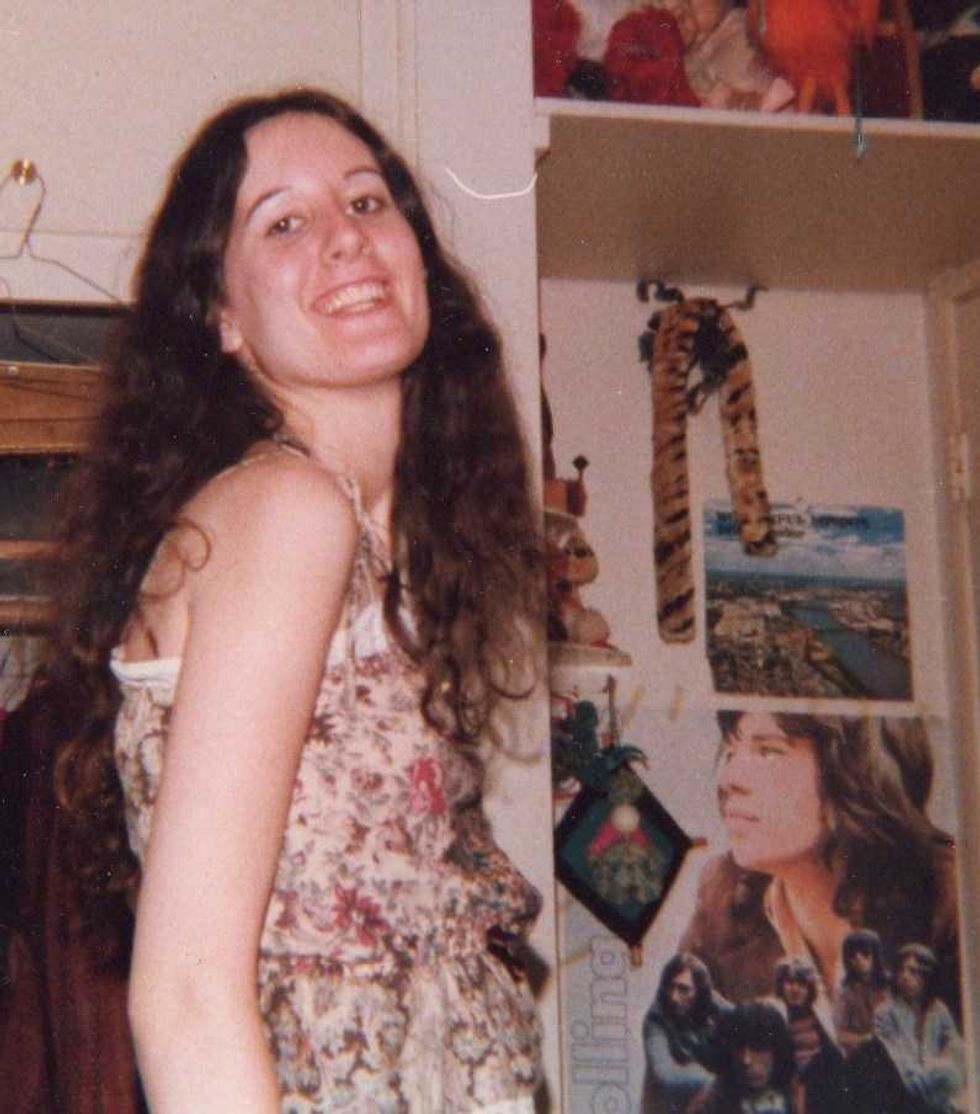 A Generation Jones teenager poses in her room.Image via Wikmedia Commons
 An office kitchen.via
  An angry man eating spaghetti.via


An Irish woman went to the doctor for a routine eye exam. She left with bright neon green eyes.
It's not easy seeing green.
Did she get superpowers?
Going to the eye doctor can be a hassle and a pain. It's not just the routine issues and inconveniences that come along when making a doctor appointment, but sometimes the various devices being used to check your eyes' health feel invasive and uncomfortable. But at least at the end of the appointment, most of us don't look like we're turning into The Incredible Hulk. That wasn't the case for one Irish woman.
Photographer Margerita B. Wargola was just going in for a routine eye exam at the hospital but ended up leaving with her eyes a shocking, bright neon green.
At the doctor's office, the nurse practitioner was prepping Wargola for a test with a machine that Wargola had experienced before. Before the test started, Wargola presumed the nurse had dropped some saline into her eyes, as they were feeling dry. After she blinked, everything went yellow.
Wargola and the nurse initially panicked. Neither knew what was going on as Wargola suddenly had yellow vision and radioactive-looking green eyes. After the initial shock, both realized the issue: the nurse forgot to ask Wargola to remove her contact lenses before putting contrast drops in her eyes for the exam. Wargola and the nurse quickly removed the lenses from her eyes and washed them thoroughly with saline. Fortunately, Wargola's eyes were unharmed. Unfortunately, her contacts were permanently stained and she didn't bring a spare pair.
- YouTube youtube.com
Since she has poor vision, Wargola was forced to drive herself home after the eye exam wearing the neon-green contact lenses that make her look like a member of the Green Lantern Corps. She couldn't help but laugh at her predicament and recorded a video explaining it all on social media. Since then, her video has sparked a couple Reddit threads and collected a bunch of comments on Instagram:
“But the REAL question is: do you now have X-Ray vision?”
“You can just say you're a superhero.”
“I would make a few stops on the way home just to freak some people out!”
“I would have lived it up! Grab a coffee, do grocery shopping, walk around a shopping center.”
“This one would pair well with that girl who ate something with turmeric with her invisalign on and walked around Paris smiling at people with seemingly BRIGHT YELLOW TEETH.”
“I would save those for fancy special occasions! WOW!”
“Every time I'd stop I'd turn slowly and stare at the person in the car next to me.”
“Keep them. Tell people what to do. They’ll do your bidding.”
In a follow-up Instagram video, Wargola showed her followers that she was safe at home with normal eyes, showing that the damaged contact lenses were so stained that they turned the saline solution in her contacts case into a bright Gatorade yellow. She wasn't mad at the nurse and, in fact, plans on keeping the lenses to wear on St. Patrick's Day or some other special occasion.
While no harm was done and a good laugh was had, it's still best for doctors, nurses, and patients alike to double-check and ask or tell if contact lenses are being worn before each eye test. If not, there might be more than ultra-green eyes to worry about.