
upworthy
Add Upworthy to your Google News feed.
Google News Button
Joy

10 awkward friendships you probably have—we all have a #9.

Not all friendships are meant to last forever.

Comic with stick figures
via Wait But Why and used with permission

The ten types of friends

When you're a kid, or in high school or college, you usually don't have to work too hard on your friendships. Friends just kind of happen.

For a bunch of years, you're in a certain life your parents chose for you, and so are other people, and none of you have that much on your plates, so friendships inevitably form. Then in college, you're in the perfect friend-making environment, one that hits all three ingredients sociologists consider necessary for close friendships to develop: “proximity; repeated, unplanned interactions; and a setting that encourages people to let their guard down and confide in each other." More friendships happen.

Maybe they're the right friends, maybe they're not really. But you don't put that much thought into any of it — you're still more of a passive observer.

But once student life ends, the people in your life start to shake themselves into more distinct tiers.

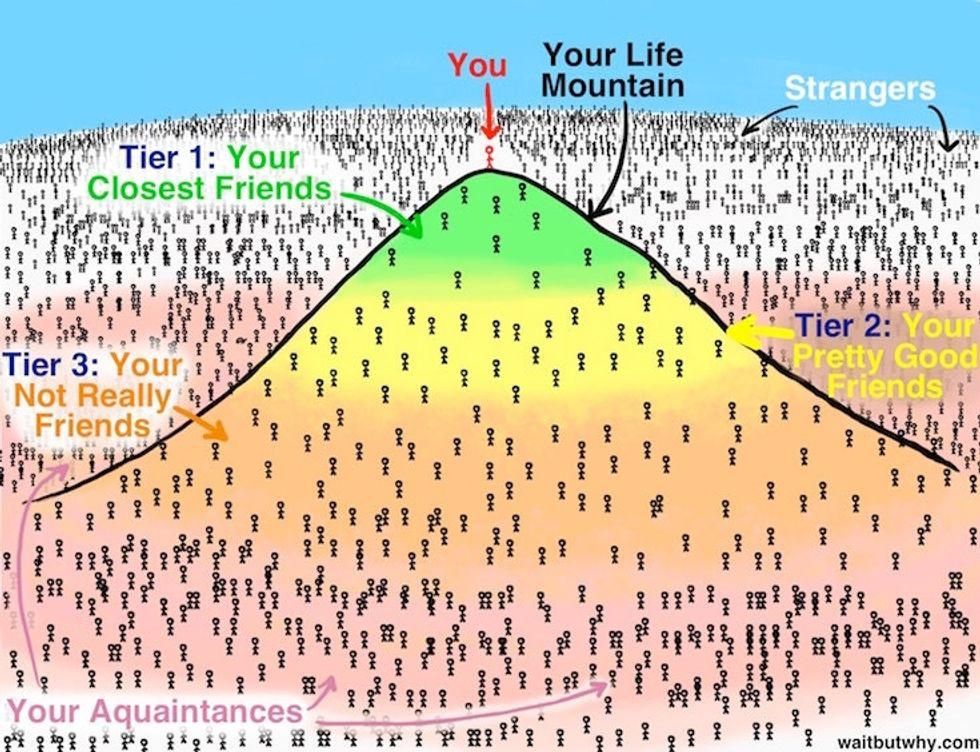
It looks something like this mountain:
Infographic of a mountain

Visual interpretation of where friends fall on the mountain of “You."

via Wait But Why post and used with permission.

At the top of your life mountain, in the green zone, you have your Tier 1 friends—the people who feel like brothers and sisters.

These are the people closest to you, the ones you call first when something important happens, the ones you love even when they suck, who make speeches at your wedding, whose best and worst sides you know through and through, and whose relationship with you is eternal; even if you go months or years without hanging out, nothing has changed when you find yourself together again.

Unfortunately, depending on how things went down in your youth, Tier 1 can also contain your worst enemies, the people who can ruin your day with one subtle jab that only they could word so brilliantly hurtfully, the people you feel a burning resentment for, or jealousy of, or competition with. Tier 1 is high stakes.

Below, in the yellow zone, are your Tier 2 friends: your Pretty Good friends.

Pretty Good friends are a much calmer situation than your brothers and sisters on Tier 1. You might be invited to their wedding, but you won't have any responsibilities once you're there. If you live in the same city, you might see them every month or two for dinner and have a great time when you do, but if one of you moves, you might not speak for the next year or two. And if something huge happens in their life, there's a good chance you'll hear it first from someone else.

Toward the bottom of the mountain in the orange zone, you have your Tier 3 friends: your Not Really friends.

You might grab a one-on-one drink with one of them when you move to their city, but then it surprises neither of you when five years pass and drink #2 is still yet to happen. Your relationship tends to exist mostly as part of a bigger group or through the occasional Facebook Like, and it doesn't even really stress you out when you hear that one of them made $5 million last year. You may also try to sleep with one of these people at any given time.

The lowest part of Tier 3 begins to blend indistinguishably into your large group of acquaintances (the pink zone): those people you'd stop and talk to if you saw them on the street or would maybe email for professional purposes but whom you'd never hang out with one-on-one. When you hear that something bad happens to one of these people, you might be sad but not too affected.

Finally, acquaintances gradually blend into the endless world of strangers.

And depending on who you are and how things shook out in those first 25 years, the way your particular mountain looks will vary.

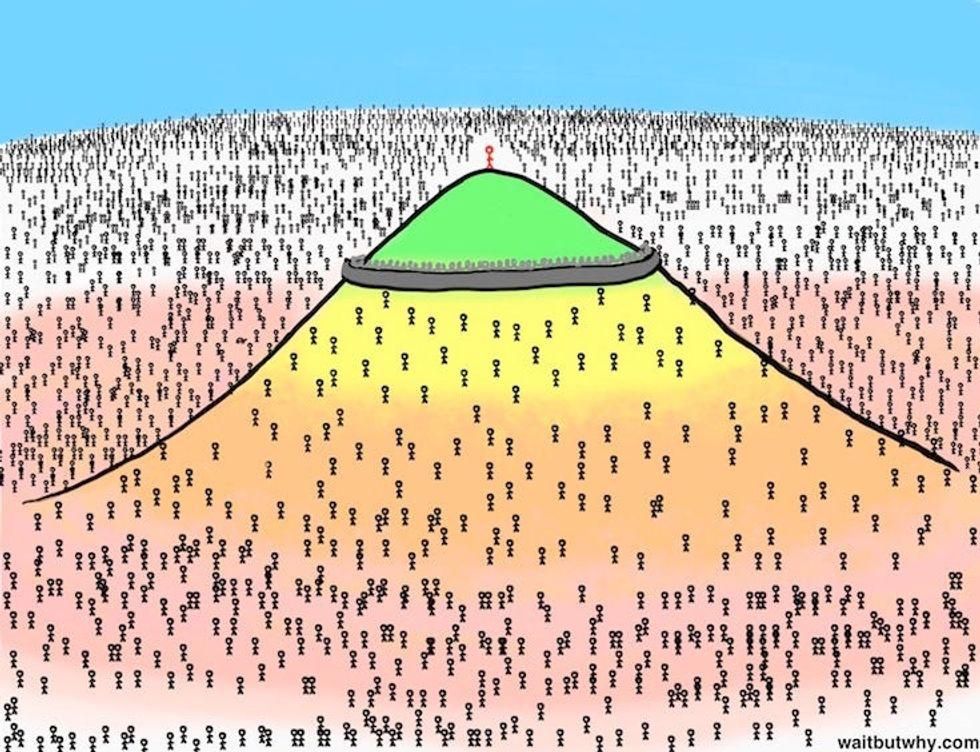
For example, there's Walled-Off Wally:
Comic of a lone person on top of a mountain

Some people keep a barrier up between acquaintances.

via Wait But Why post and used with permission.

And Phony Phoebe, who tries to be everyone's best friend and ends up with a lot of people mad at her:
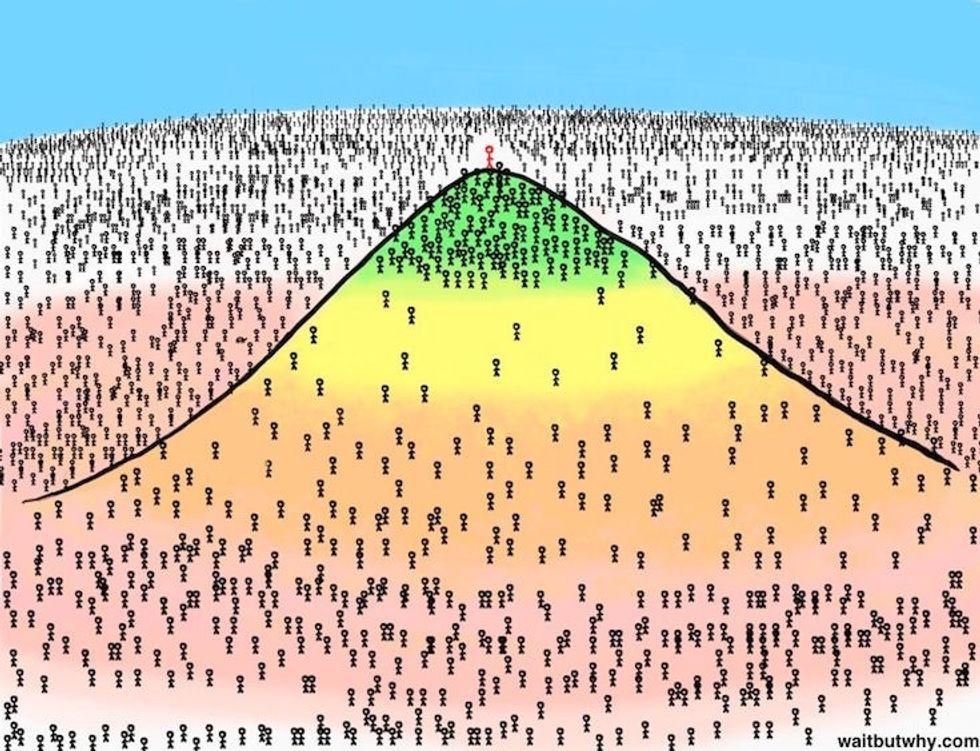
Comic of a mountain with a lot of people at the top

The life of the party.

via Wait But Why post and used with permission.

Even Unabomber Ulysses has a mountain:
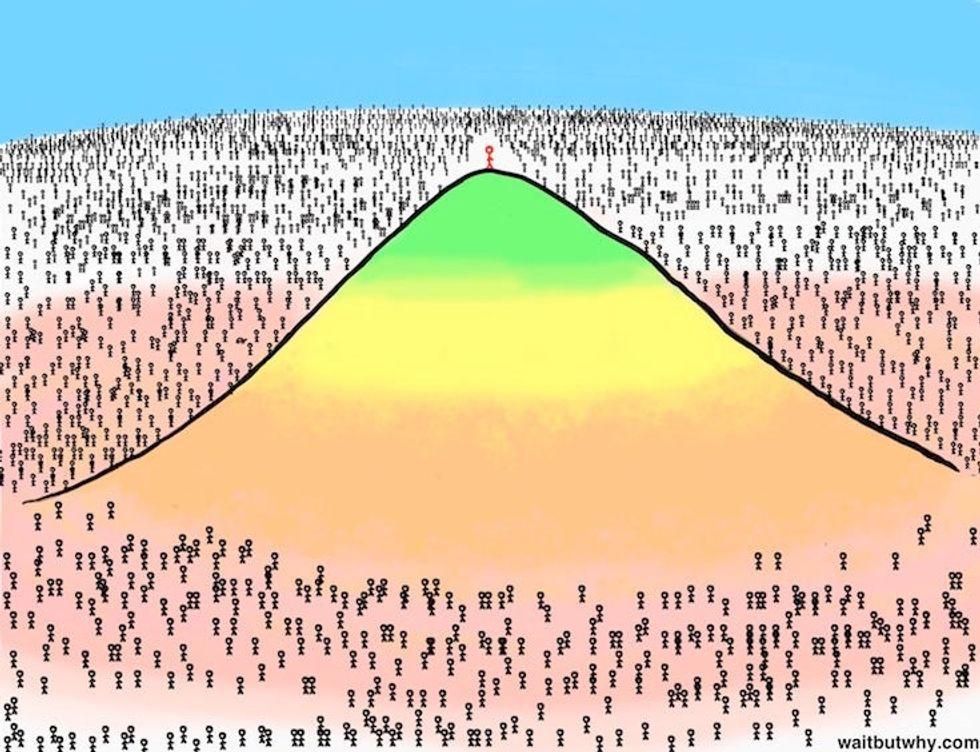
Comic of a mostly empty mountain with one person at the top

Hermits exist.

via Wait But Why post and used with permission.

Whatever your particular mountain looks like, eventually the blur of your youth is behind you, the dust has settled, and there you are living your life.

Then one day, usually around your mid or late 20s, it hits you: It's not that easy to make friends anymore.

Sure, you'll make new friends in the future—at work, through your spouse, through your kids—but you won't get to that Tier 1 brothers level, or even to Tier 2, with very many of them because people who meet as adults don't tend to get through the 100+ long, lazy hangouts needed to reach a bond of that strength. As time goes on, you start to realize that the 20-year frenzy of not-especially-thought-through haphazard friend-making you just did was the critical process of you making most of your lifelong friends.

And since you matched up with most of them A) by circumstance, and B) before you really knew yourself yet, the result is that your Tier 1 and Tier 2 friends—those closest to you—fall in a very scattered way on what I'll call the Does This Friendship Make Sense? Graph:
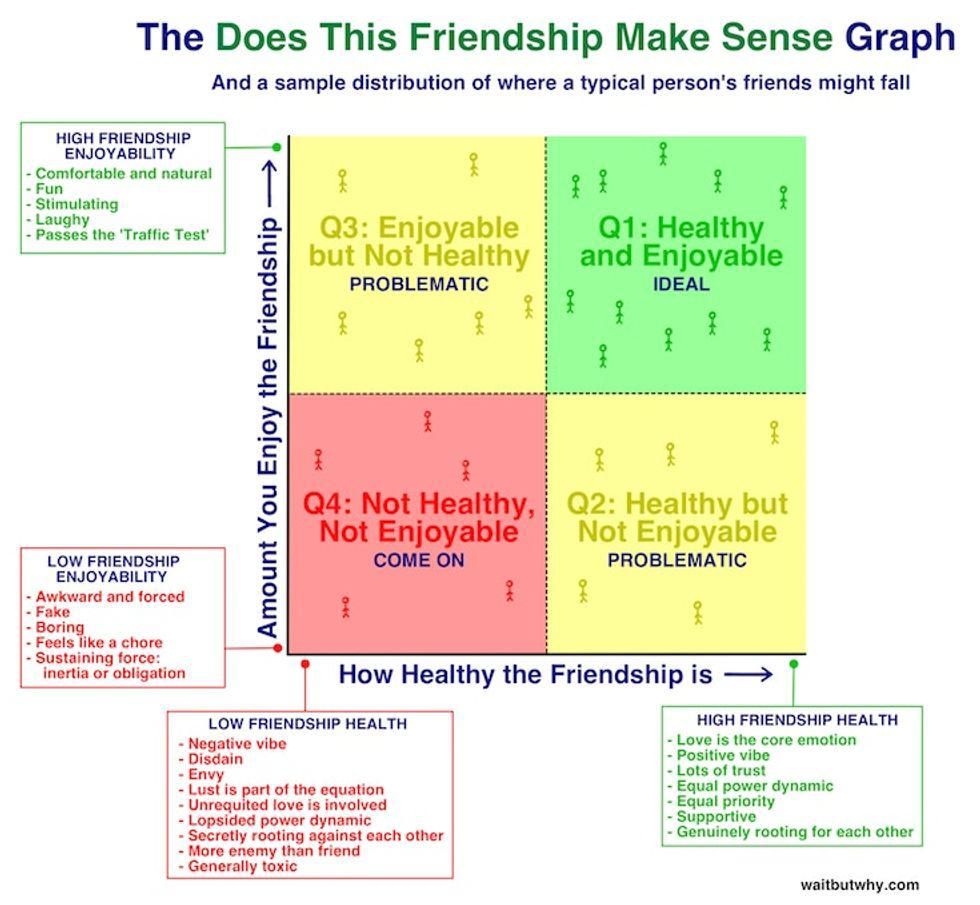
Graph

The friendship graph.

via Wait But Why post and used with permission.

So, who are all those close friends in the three non-ideal quadrants?

As time goes on, most of us tend to have fewer friends in Quadrants 2 through 4 because A) people mature, and B) people have more self-respect and higher standards for what they'll deal with as they get older. But the fact is, friendships made in the formative years often stick, whether they're ideal or not, leaving most of us with a portion of our Tier 1 and Tier 2 friendships that just don't make that much sense. We'll get to the great, Quadrant 1 friendships later in the post, but in order to treat those relationships properly, we need to take a thorough look at the odd ones first.

Here are 10 common ones:

1. The non-question-asking friend
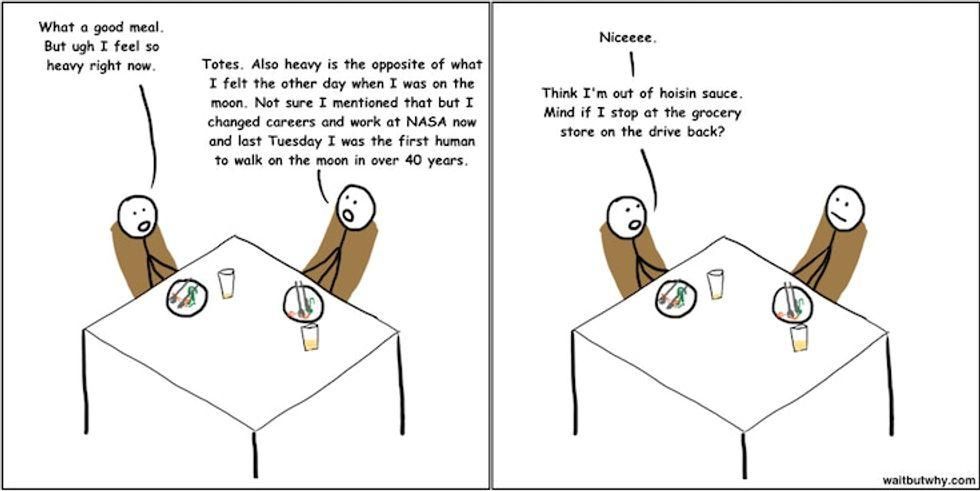
Comic of two people at dinner

Odd moments that happen between friends.

via Wait But Why post and used with permission.

You'll be having a good day. You'll be having a bad day. You'll be happy at work. You'll quit your job. You'll fall in love. You'll catch your new love cheating on you and murder them both in an act of incredible passion. And it doesn't matter, because none of it will be discussed with The Non-Question-Asking Friend, who never, ever, ever asks you anything about your life. This friend can be explained in one of three ways:

  1. He's extremely self-absorbed and only wants to talk about himself.
  2. He avoids getting close to people and doesn't want to talk about either you or himself or anything personal, just third-party topics.
  3. He thinks you're insufferably self-absorbed and knows if he asks you about your life, you'll talk his ear off about it.

Giving you the benefit of the doubt here, we're left with two possibilities. Possibility #1 isn't fun at all and this person should not be allowed space on Tier 1. The green part of the mountain is sacred territory, and super self-absorbed people shouldn't be permitted to set foot up there. Put him on Tier 2 and just be happy you're not dating him.

Possibility #2 is a pretty dark situation for your friend, but it can actually be fun for you. I have a friend who I've hung out with one-on-one about four times in the last year, and he has no idea Wait But Why exists. I've known him for 14 years and I'm not sure he knows if I have siblings or not. But I actually enjoy the shit out of this friend—sure, there's a limit on how close we'll ever be, but without ever spending time talking about our lives, we actually end up in a lot of fun, interesting conversations.

2. The friend in the group you can't be alone with under any circumstances

Comic of three stick people having a conversation

Why have relationships when there is a phone around?

via Wait But Why post and used with permission.

In almost every group of friends, there's one pair who can't ever be alone together. It's not that they dislike each other—they might get along great—it's just that they have no individual friendship with each other whatsoever. This leaves both of them petrified of the lumbering elephant that appears in the room anytime they're alone together. They're way too on top of shit to ever end up in the car alone together if a group is going somewhere in multiple cars, but there are smaller dangers afoot—like being the first two to arrive at a restaurant or being in a group of three when the third member goes to the bathroom.

The thing is, sometimes it's not even that these people couldn't have an individual friendship—it's just that they don't, and neither one has the guts to try to make that leap when things have gone on for so long as is.

3. The non-character-breaking friend you have to be “on" with
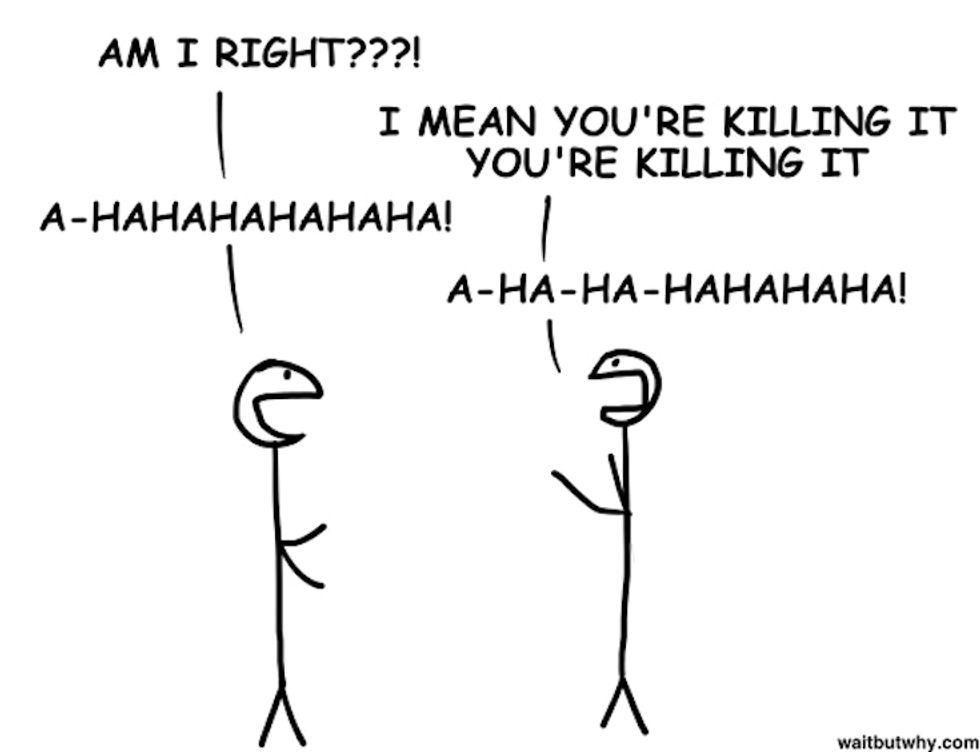
Comic of stick people laughing together

Controlled intimacy and distancing through language.

via Wait But Why post and used with permission.

This is a friend who's terrified of having an earnest interaction, and as such, your friendship with him is always in some kind of skityou always have to be on when you're interacting.

Sometimes the skit is that you both burst out laughing at everything constantly. He can only exist with you in “This is so fucking hilarious, it's too much!" mode, so you have to be in some kind of joke-telling or sarcastic mode yourself at all times or he'll become socially horrified.

Another version of this is the “always and only ironic" friend, who you really bum out if you ever break that social shell and say something earnest. This type of person hates earnest people because someone being earnest dares him to come out from under his ironic safety blanket and let the sun touch his face, and no fucking thanks.

A third example is the “You're great, I'm great, ugh why is everyone else so terrible and not great like us" friend. Of course, she doesn't really think you're perfectly great at all—if she were with someone else, you'd be one of the voodoo dolls on the table to be dissected and scoffed at. The key here is that the two of you must be on a team at all times while interacting. The only comfortable mode for this person is bonding with you by building a little pedestal for you both to stand on while you criticize everyone else. You can either play along and everything will go smoothly, even though you'll both despise yourselves and each other the whole time, or you can commit the ultimate sin and have the integrity to disagree with the friend or defend a non-present party the friend criticizes. Doing this will shatter the fragile team vibe and make the friend recoil and say something quietly like, “Hm ... yeah ... I guess." The friend now respects you for the first time and will also criticize you extra hard next time she's playing her pedestal game with a different friend.

What these all have in common is the friend has tall walls up, at least toward you, and so she builds a little skit for you two to hang out in to make sure any authentic connection can be avoided. Sometimes that person only does this out of her own social anxiety and can become a great, authentic friend if you can just stomp through the ice. Other times, the person is just hopelessly scared and closed off and there's no hope and you have to get out.

In any case, I can't stand these interactions and am in a full panic the entire time they're happening.

4. The double-obligated friendship
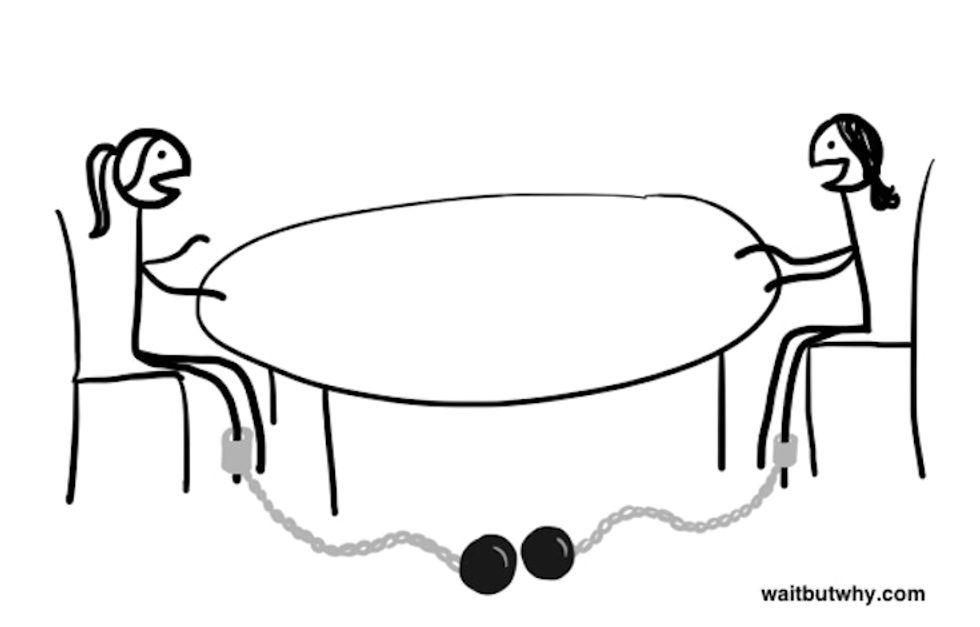
Comic of two men chatting a table with balls and chains around their legs

I think we need a bigger table.

via Wait But Why post and used with permission.

Think of a friend you get together with from time to time, which usually happens after a long and lackluster email or text exchange during which you just can't find a time that works for both of you — and you're never really happy when these plans are being made and not really psyched when you wake up and it's finally on your schedule for that day.

Maybe you're aware that you don't want to be friends with that person, or maybe you're delusional about it — but what you're most likely not aware of is that they probably don't want to see you either.

There are lopsided situations where one person is far more interested in hanging out than the other (we'll get to those later), but in the case we're talking about here, both parties often think it's a lopsided situation without realizing that the other person actually feels the same way — that's why it takes so long to schedule a time. When someone's excited about something, they figure out how to get it into their schedule; when they're not, they figure out ways to push it farther into the future.

Sometimes you don't think hard enough about it to even realize you don't like being friends with the person, and other times you really like the idea or the aesthetic of being friends with that particular person — being friends with them is part of your Story. But even in cases where you're perfectly lucid about your feelings, since neither of you knows the other feels the same way and neither has the guts to just cut things off or move it down a tier, this friendship usually just continues along for eternity.

5. The half-marriage

Two stick people each holding a half of a heart

An ego boost through controlling the relationship.

via Wait But Why post and used with permission.

Somewhere in your life, you're probably part of a friendship that would be a marriage if only the other person weren't very, very, extremely not interested in that happening. 1 for 2 on yes votes — just one vote away — so close.

You might be on either side of this — and either way, it's one of the least healthy parts of your life. Fun!

If you're on the if only side of things, probably the right move is to get your fucking shit together? Ya know? This friendship is one long, continuous rejection of you as a human being, and you're just wallowing there in your yearning like a sobbing little seal. Plus, duh, if you gather your self-respect and move on with your life, it'll raise their perception of your value and they might actually become interested in you.

If you're on the Oh yeah, definitely not side of the situation, here's what's happening: There's this suffering human in the world, and you know they're suffering, and you fucking love it, because it gives your little ego a succulent sponge bath every time you hang out with them. You enjoy it so much you probably even lead them on intentionally, don't you — you make sure to keep just enough ambiguity in the situation that their bleeding heart continues to lather your ego from head to toe at your whim.

Both of you — go do something else.

6. The historical friend
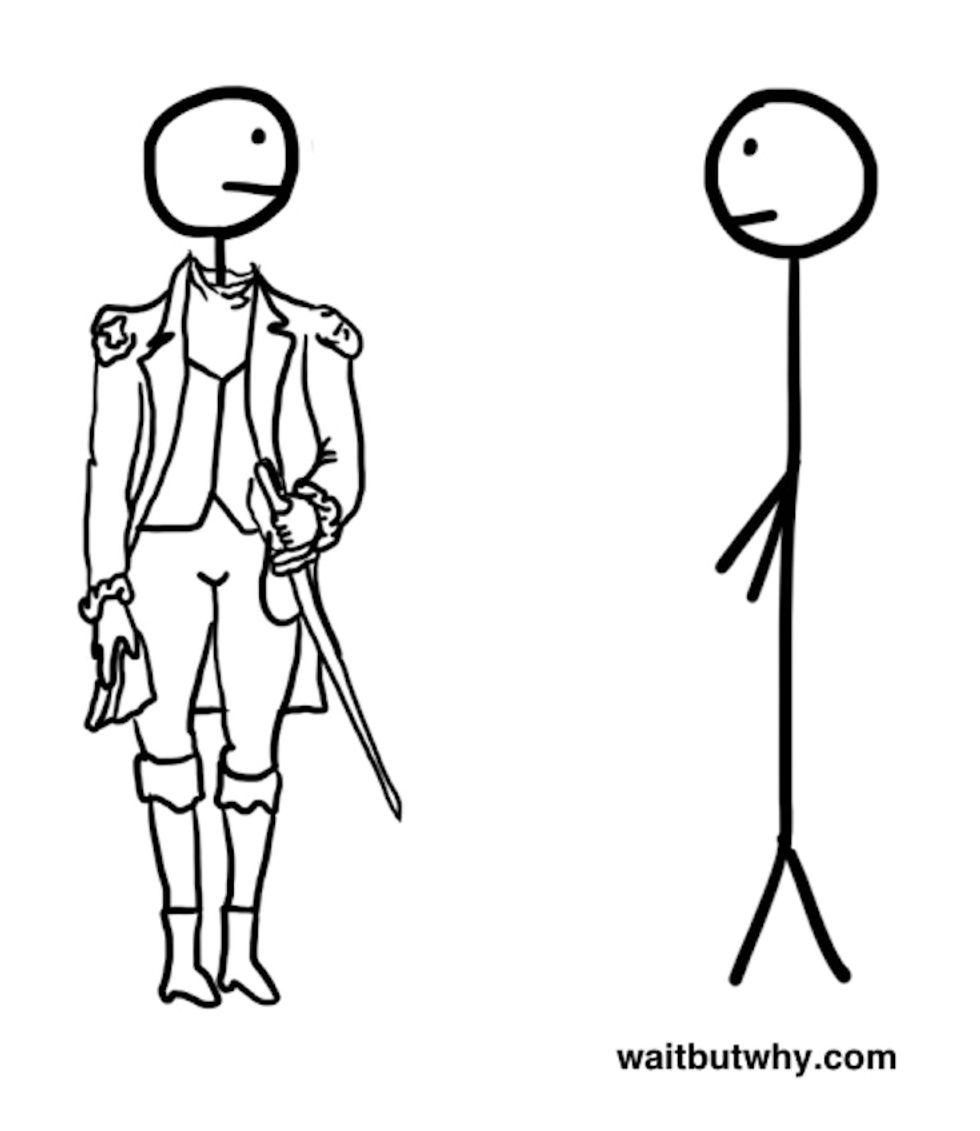
Stick person in historical garb beside a regular stick person

We met in kindergarten.

via Wait But Why post and used with permission.

A Historical Friend is someone you became friends with in the first place because you met when you were little and stayed friends through the years, even though you're a very weird match. Most old friends fall somewhat into this category, but a true Historical Friend is someone you absolutely would not be friends with if you met them today.

You're not especially pleased with who they are, and they feel the same way about you. You're not each other's type one bit. Unfortunately, you're also extremely close friends from when you were four, and you're both just a part of each other's situation forever, sorry.

7. The non-parallel life paths friendship
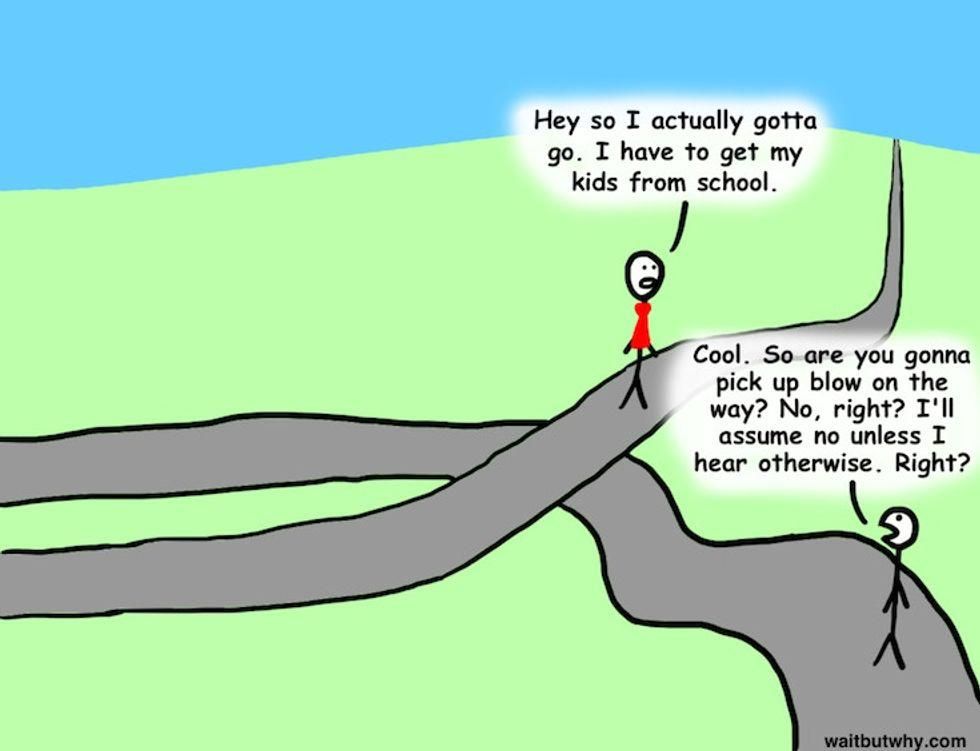
Two stick people on opposite paths

Looking for love in all the wrong places.

via Wait But Why post and used with permission.

Throughout childhood and much of young adulthood, most people your age are in the same life stage as you are. But when it comes to advancing into full adulthood, people do so at widely varying paces, which leads to certain friends suddenly having totally different existences from one another.

Anyone within three years of 30 has a bunch of these going on. It's just a weird time for everyone. Some people have become Future 52-year-olds, while others are super into being Previous 21-year-olds. At some point, things will start to meld together again, but being 30-ish is the friendship equivalent of a kid going through an awkward pubescent stage.

There are darker, more permanent Non-Parallel Life Path situations. Like when Person A starts to become a person who rejects material wealth, partially because she genuinely feels that pursuing an artistic path matters more and partially because she needs a defense mechanism against feeling envious of richer people, and Person B's path makes her scoff at people who pursue creative paths, partially because she genuinely thinks expressing yourself is an inherently narcissistic venture and partially because she needs a defense mechanism against feeling regretful that she never pursued her creative dreams — these two will have problems.

They may still like each other, but they can't be as close as they used to be — each of their lives is a bit of a middle finger at the other's choices, and that's jst awkward for everyone. It's not always that bad — but to survive an Off-Line Life Situation, friends need to be really different people who don't at all want the same things out of life.

8. The frenemy
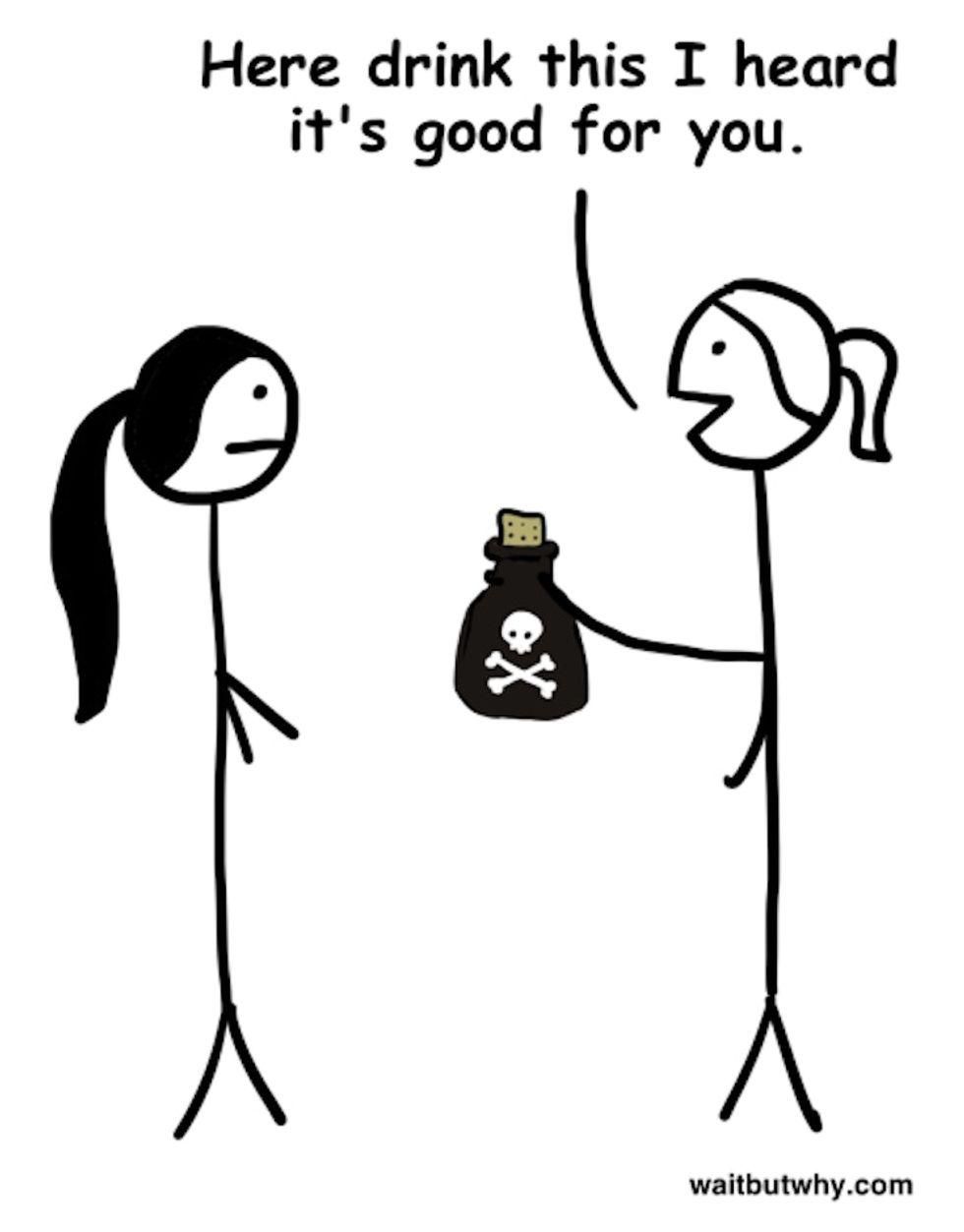
One stick person offers another stick person poison pretending it's safe

This is awful. Taste it.

via Wait But Why post and used with permission.

The Frenemy roots very hard against you. And I'm not talking about the friends that will feel a little twinge of pleasure when they hear your big break didn't pan out after all or that your relationship is in bad shape. I'm not even talking about someone who secretly roots against you when they're not doing so well at some area of life and it hurts them to see you do better. Those are bad emotions, but they can exist in people who are still good friends.

I'm talking about a real Frenemy — someone who really wants bad things for you. Because you're you.

You and the Frenemy usually go way back, have a very deep friendship, and the trouble probably started a long time ago. There's a lot of complex psychology going on in these situations that I don't fully understand, but my hunch is that a Frenemy's resentment is rooted in his own pain, or his own shortcomings, or his own regret — and for some reason, your existence stings them in these places hard.

A little less dark but no less harmful is a bully situation where a friend sees some weakness or vulnerability in you and she enjoys prodding you there either for sadistic reasons or to prop herself up.

A Frenemy knows how to hurt you better than anyone because you're deeply similar in some way and she knows how you're wired. She'll do whatever she can to bring you down any chance she gets, often in such a subtle way it's hard to see that it's happening.

Whatever the reason, if you have a Frenemy in your life, kick her toxic ass off your mountain, or at least kick her down the mountain — just get her off of Tier 1. A Frenemy has about a 10th of the power to hurt you from Tier 2 as she does from Tier 1.

9. The Facebook celebrity friend
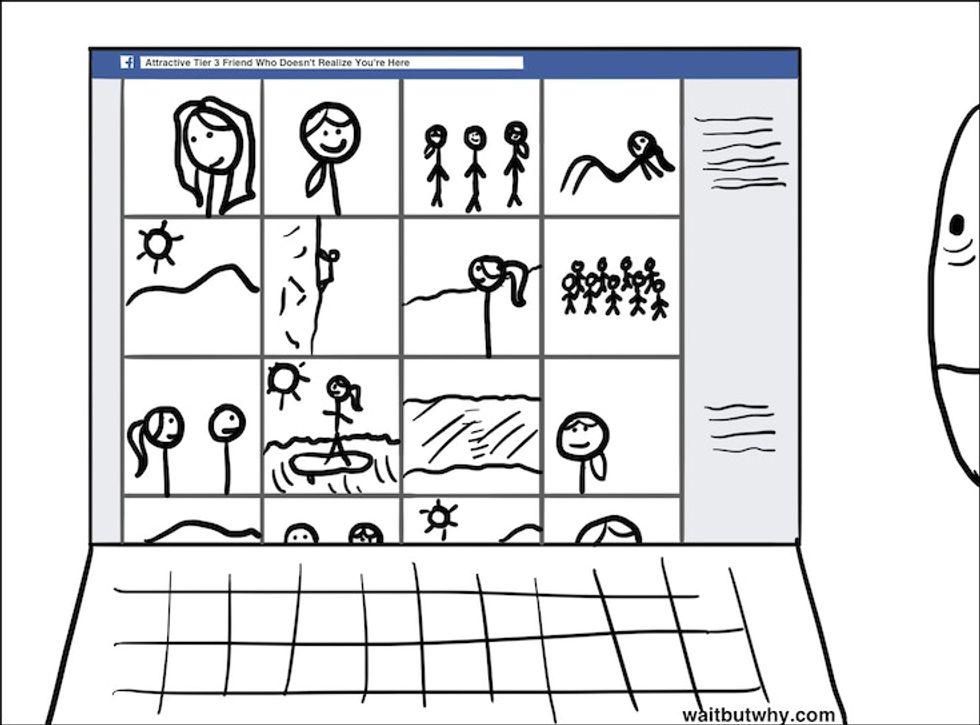
Comic of a computer with photo grid

What’s happening on social media?

via Wait But Why post and used with permission.

This person isn't a celebrity to anyone other than you, you creep. You know exactly who I'm talking about — there are a small handful of people whose Facebook page you're uncomfortably well-acquainted with, and those people have no idea that this is happening. On the plus side, there are people out there you haven't spoken to in seven years who know all about the new thing you're trying with your hair, since it goes both ways.

This is a rare Tier 3 friend, or even an acquaintance, who qualifies as an odd friendship because you found a way to make it unhealthy even though you're not actually friends. Well done.

10. The lopsided friendship
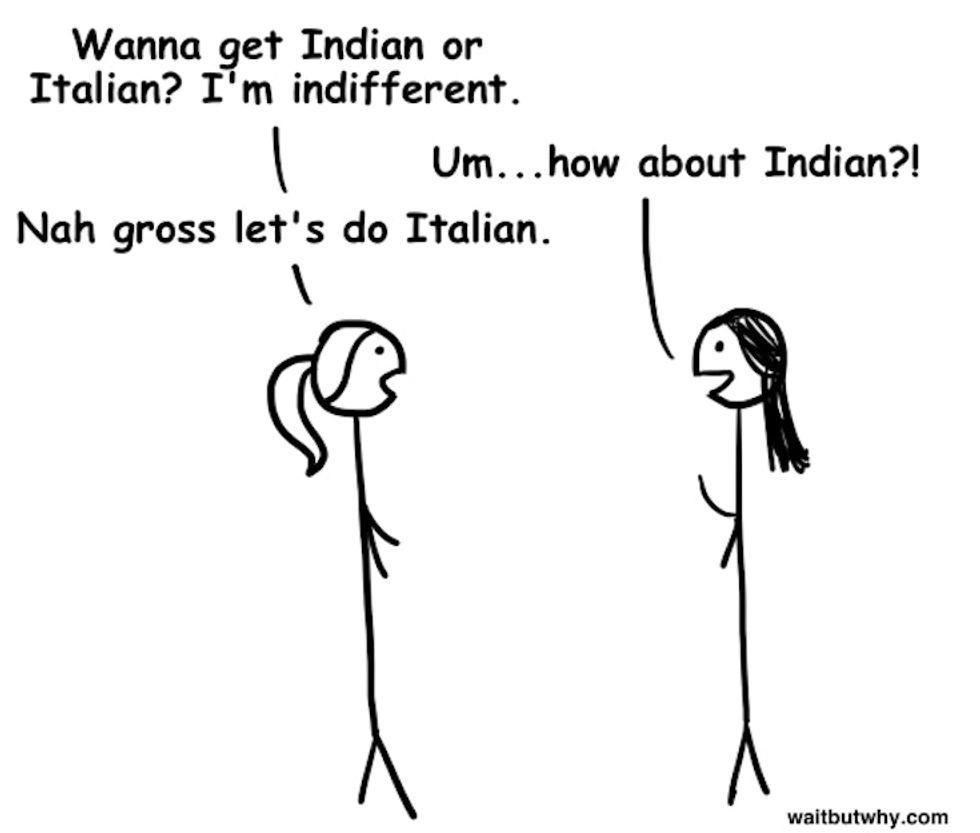
Two stick women discussing dinner

Can I make all the decisions... that was rhetorical.

via Wait But Why post and used with permission.

There are a lot of ways a friendship can be lopsided: Someone can be higher on their friend's mountain than vice versa. Someone can want to spend more time with a friend than vice versa. One member can consistently do 90% of the listening and only 10% of the talking, and in situations where most of the talking is about life problems, what's happening is a one-sided therapy situation, with a badly off-balance give-and-take ratio, and that's not much of a friendship—it's someone using someone else.

And then there's the lopsided power friendship. Of course, this is a hideous quality in many not-great couples, but it's also a prominent feature of plenty of friendships.

A near 50/50 friendship is ideal, but anything out to 65/35 is fine and can often be attributed to two different styles of personality. It's when the number gap gets even wider that something less healthy is going on—something that doesn't reflect very well on either party.

There are some obvious ways to assess the nature of a friendship's power dynamic: Does one person cut in and interrupt the other person while they're talking far more than the other way around? Is one person's opinion or preference just kind of understood to carry more weight than the other's? Is one person allowed to be more of a dick to the other than vice versa?

Another interesting litmus test is what I call the “mood determiner test." This comes into play when two friends get together but they're in very different moods — the idea is, whose mood “wins" and determines the mood of the hangout. If Person A is in a bad mood, Person B is in a good mood, and Person B reacts by being timid and respectful of Person A's mood, leaving the vibe down there until Person A snaps out of it on her own — but when the moods are reversed, Person B quickly disregards her own bad mood and acts more cheerful to match Person A's happy mood — and this is how it always goes — then Person A is in a serious power position.

But hey, not all friendships are grim.

In the Does This Friendship Make Sense graph above, the friendships we just discussed are all in Quadrants 2, 3, or 4 — i.e., they're all a bit unenjoyable, unhealthy, or both. That's why this has been depressing. On the bright side, there's also Quadrant 1—all the friendships that do make sense.

No friendship is perfect, but those in Quadrant 1 are doing what friendships are supposed to do: They're making the lives of both parties better. And when a friendship is both in Quadrant 1 of the graph and on Tier 1 of your mountain, that friendship is a rock in your life.

Rock friendships don't just make us happy — they're the thing (along with rock family and romantic relationships) that makes us happy.

Investing serious time and energy into those is a no-brainer long-term life strategy. But in the case of most people over 25—at least in New York— I think A) not enough time is carved out as dedicated friend time, and B) the time that is carved out is spread too thin, and too evenly, among the Tier 1 and Tier 2 friendships in all four quadrants. I'm definitely guilty of this myself.

There's something I call the Perpetual Catch-Up Trap. When you haven't seen a good friend in a long time, the first order of business is a big catch-up — you want to know what's going on in their career, with their girlfriend, with their family, etc., and they want to catch up on your life. In theory, once this happens, you can go back to just hanging out, shooting the shit, and actually being in the friendship. The problem is, when you don't make enough time for good friends, seeing them only for a meal and not that often — you end up spending each get-together catching up, and you never actually get to just enjoy the friendship or get far past the surface. That's the Perpetual Catch-Up Trap, and I find myself falling into it with way too many of the rocks in my life.

There are two orders of business right now:

First, think about your friendships, figure out which ones aren't in Quadrant 1, and demote them down the mountain. I'm not suggesting you stop being friends with those people—you still love them and feel loyal to them, and old friends are critical to hold onto—but if the friendships aren't that healthy or enjoyable, they don't really deserve to be in your Tier 1, and you probably shouldn't be in theirs. Most importantly, doing this clears up time to...

Second, dedicate even more time to the Quadrant 1, Tier 1 rocks in your life. If you're in your mid-20s or older, your current rocks are probably the only ones you'll ever have. Your rock friendships don't warrant two times the time you give to your other friends—they warrant five or 10 times!

Your rocks deserve serious, dedicated time so you can stay close. So go make plans with them.


This article was written by Tim Urban and originally published on Wait But Why. It originally appeared here nine years ago.

time off requests, pto, sick leave, gen z manager, manager positions, asking for time off

This Manager thinks PTO is for vacation, not "life changing events."

What does it take to be a good boss? You can answer this a million different ways—by being a clear communicator, earning employee trust, providing constructive feedback, and fostering a positive and supportive work environment while also being open to feedback and recognizing your team's contributions—but really, it all seems to stem from respecting your employees as fellow human beings.

Part of that means acknowledging that these employees have lives that are, frankly, more important to them than the job, and not penalizing them for it. One manager, and Gen Zer no less, seems to fully understand this basic principle, and folks are applauding her for it.


Elizabeth Beggs, who manages a five-person team for a packaging distribution company in Virginia, recently made a TikTok sharing which time-off requests she “rejects. ”You’ll see why “rejects” is in quotes shortly.

One example: when a female rep notified Beggs that she was likely having a miscarriage. After the team member asked how she can file for time off to see to the issue, Beggs immediately responded, “Girl, go to the doctor! We’re not submitting time off for that!”

In Beggs’ mind, PTO is for “vacation,” not medical emergencies. What a concept.

@bunchesofbeggs

Edited to clarify- 1. My team is all salary. 2. These examples are not all recent or from my current position. 3. My team works hard and hits thier KPIs above and beyond. Time off is meant to recharge and be used how you need it, not to handle life changing events #mangers #corporate #genzmanagers #sales #vetstocorporate #veterans

Beggs went on to explain a couple more situations, like when one employee—a parent—was “up all night” with their sick kid. And her last one wasn’t even negative—she had an employee who wanted to work a half-day to do something nice for their anniversary.

“Seriously, if any of these triggered anyone, then you need to evaluate how you run your team as a manager,” she concluded.

By and large, the response to Beggs’ management style has been overwhelmingly positive, and people seem to find it completely refreshing.

“You are not a manager, you’re a LEADER,” one person wrote.

@bunchesofbeggs

Everything you do should be to better your team, not to make your life easier #leadership #ownership #corporatelife #veteran #military

Another said, “The better you treat your employees, the more loyal they will be and the better work they will put out. Most people do not understand how management works.”

A few noted how this attitude seems to be more present among younger leaders. One person commented, "millennial manager here. My team members are human first, employees second. Like just go do what you want but get the work done too.”

Another joked that “Boomer managers could NEVER.”

Beggs would later clarify this doesn’t mean she doesn't have clear productivity expectations for her team (who work on salary). Perhaps if she had a team member not making their KPIs (key performance indicators), there would be an additional conversation surrounding time off, but there is still an inherent respect as a fellow human being. Which, to her, means treating bona fide time off as a way to “recharge and be used how you need it, not to handle life changing events.”

@bunchesofbeggs

If you’re planning does not account for people being human- it’s bad planning #genzleaders #armyvet #militaryvet #genz #corporatelife #corporate #manager #timeoff

Younger generations might get labeled “lazy” or “entitled,” but they are also the ones fighting to change the status quo so that we all may be treated less like cogs in the machine, and more like actual human beings. Its leaders like Beggs who show that operating in new ways doesn't compromise productivity—it, in fact, enhances it. We might not be able to change the global standard overnight, but we certainly aren’t going to get to a better place without leaders who choose to serve their community rather than a bottom line.

This article originally appeared in March.

Michelle Obama, George Clooney, Kamala Harris, gen jones, generation jones

Generation Jones includes Michelle Obama, George Clooney, Kamala Harris, Keanu Reeves and more.

Did you know there are folks who don't quite fit into the main generational categories? That's boomers, Gen X, millennials, Gen Z and the up-and-coming Gen Alpha, of course. Sometimes, someone born a few months too early or late can make a world of difference in how they see the world. These in-betweeners, sometimes called "cuspers," are members of microgenerations that straddle two of the biggies.

"Xennial" is the nickname for those who fall on the cusp of Gen X and millennial, but there's also a lesser-known microgeneration that straddles Gen X and baby boomers. The folks born from 1954 to 1965 are known as Generation Jones, and they got thrust into the spotlight as Vice President Kamala Harris (born in 1964) became a presidential hopeful in 2024.


generations, gen jones, boomers, gen x, on the cusp between gen x and baby boomer Generation Jones was born between 1954 and 1965.Photo credit: Canva

Like President Obama before her, Harris is a Gen Jonesernot exactly a classic baby boomer but not quite Gen X. Born in October 1964, Harris falls just a few months shy of official Gen X territory. But what exactly differentiates Gen Jones from the boomers and Gen Xers that flank it?

"Generation Jones" was coined by writer, television producer and social commentator Jonathan Pontell to describe the decade of Americans who grew up in the '60s and '70s. As Pontell wrote of Gen Jonesers in Politico:

"We fill the space between Woodstock and Lollapalooza, between the Paris student riots and the anti-globalisation protests, and between Dylan going electric and Nirvana going unplugged. Jonesers have a unique identity separate from Boomers and GenXers. An avalanche of attitudinal and behavioural data corroborates this distinction."

Pontell describes Jonesers as "practical idealists" who were "forged in the fires of social upheaval while too young to play a part." They are the younger siblings of the boomer civil rights and anti-war activists who grew up witnessing and being moved by the passion of those movements but were met with a fatigued culture by the time they themselves came of age. Sometimes, they're described as the cool older siblings of Gen X. Unlike their older boomer counterparts, most Jonesers were not raised by WWII veteran fathers and were too young to be drafted into Vietnam, leaving them in between on military experience.

Gen Jones gets its name from the competitive "keeping up with the Joneses" spirit that spawned during their populous birth years, but also from the term "jonesin'," meaning an intense craving, that they coined—a drug reference but also a reflection of the yearning to make a difference that their "unrequited idealism" left them with. According to Pontell, their competitiveness and identity as a "generation aching to act" may make Jonesers particularly effective leaders:

"What makes us Jonesers also makes us uniquely positioned to bring about a new era in international affairs. Our practical idealism was created by witnessing the often unrealistic idealism of the 1960s. And we weren’t engaged in that era’s ideological battles; we were children playing with toys while boomers argued over issues. Our non-ideological pragmatism allows us to resolve intra-boomer skirmishes and to bridge that volatile Boomer-GenXer divide. We can lead."

@grownupdish

I found my people and we are Generation Jones! Get ready to re-live our childhoods and follow for more. #grownupdish #midlife #midlifewomen #boomer #babyboomer #generationx #genx #1963 #over50 #generationjones #generationalmarketing #adulting #greenscreen

However, generations aren't just calculated by birth year but by a person's cultural reality. Some on the cusp may find themselves identifying more with one generation than the other, such as being culturally more Gen X than boomer. And, of course, not everyone fits into whatever generality they happened to be born into, so stereotyping someone based on their birth year isn't a wise practice. Knowing about these microgenerational differences, however, can help us understand certain sociological realities better as well as help people feel like they have a "home" in the generational discourse.

As many Gen Jonesers have commented, it's nice to "find your people" when you haven't felt like you've fit into the generation you fall into by age. Perhaps in our fast-paced, ever-shifting, interconnected world where culture shifts so swiftly, we need to break generations into 10 year increments instead of 20 to 30 to give everyone a generation that better suits their sensibilities.

This article originally appeared last year and has been updated.

Education & Information

This surprising map reveals the real value of $100 in each state

Your purchasing power can swing by nearly 25 percent from state to state.

cheapest states, cost of living, finances, cost of living, $100

Map represents the value of 100 dollars across America.

As the cost of living in large cities continues to rise due to inflation, tariffs, and other economic factors, more and more people are realizing that the value of a dollar in the United States is a very relative concept. For decades, cost of living indices have sought to address and benchmark the inconsistencies in what money will buy, but they are often so specific they prevent a holistic picture or the ability to "browse" the data based on geographic location.

Each year, the Tax Foundation addresses many of these shortcomings using the most recent Bureau of Economic Analysis data to provide a familiar map of the United States overlaid with the relative value of what $100 is "worth" in each state. In recent years, they've further updated their data so that you can break down the value of your money across every single metro area in the United States. It's an incredibly valuable tool for the many people considering (or who have already acted and migrated from states like California to Florida), Texas and other states with friendly state taxes rates and more affordable housing options.


The map quantifies and presents the cost of living by geography in a brilliantly simple way. For instance, if you're looking for a beach lifestyle but don't want to pay California prices, try Florida, which is about as close to "average"—in terms of purchasing power, anyway—as any state in the Union. If you happen to earn (or luck) your way into Silicon Valley tax brackets, head to Hawaii, D.C., or New York. You'll burn through your money in no time. And in some of those places like Hawaii, there are quality of life measurements that often exceed raw purchasing power.

So, where does your dollar go the furthest in 2025? The financial planning site GoBankingRates.com compiled its own list of cash purchasing power across each state and found that in California, you get the least bang for your buck: only $87.42 in real purchasing power for every $100 of cash. The average person in California makes $96,344 annually, one of the higher income levels in the country. However, just living in California on average costs residents a staggering $86,408, leaving the average person with little flexibility for long-term financial planning projects like retirement, saving for a new home, or even buying a new car.

At the other end of the spectrum is Arkansas, where your dollar goes the furthest. In fact, that $100 bill burning a hole in your proverbial wallet is in fact worth more than its technical value, with a real value of $113.49. On top of that, the cost of living is only $37,067, less than half of that in California. Further, the average cost of a new home in Arkansas is $208,743, less than one-third of a new home in California. Not coincidentally, in 2023, Arkansas was the top destination for people moving to another state within the United States, followed by Texas.

family, moving, income, finances, $100 Family moving into a new home. Canva Photos.

How about Florida, which has received outsized attention in recent years for its overt efforts to draw residents from California and other states with higher costs of living? According to the most recent data, Florida is in fact much closer to California than Arkansas, coming in only in 40th place on the GoBankingRates rankings, with $100 in cash only being worth $96.55. However, the annual cost of living is still only slightly more than half of that in California, coming in at $53,505. And if you're looking to buy some real estate, the average home is valued at $404,924. That's still well outside the purchasing power of many Americans, but with built-in advantages such as warm weather and one of the top-ranked state education system in America, it's obvious why so many people, especially those with families, are choosing Florida over California in recent years.

florida, cost of living, finances, $100, education Driving Road Trip GIF by Rosen Hotels & Resorts Giphy

According to U.S. News and World Report's data analysis, California only has the nation's 23rd best education system and is ranked a paltry 37th overall in their state rankings. It's quite a contrast for a state that bills itself on the promise of opportunity, natural wonder, and positive lifestyle options. And with 2025's wildfires (as well as an annually-worsening wildfire season), the constant threat of earthquakes, and other factors, California clearly has challenges beyond economics if it wants to remain one of the more attractive states in the nation.

Of course, those numbers are always in flux, and political leaders in California have promised concrete reforms in order to address the state's high cost of living compared with the value of its social and emergency services. If you want proof of how quickly things can change, look at a similar analysis of the value of $100 in each state from 2015:

- YouTube youtu.be

However, those negative statistical trends aside, California continues to have an incredible pull on our collective imagination. Four hundred twenty-three thousand, one hundred ninety-four Americans left their state for California according to the most recent data in 2023, placing it in third behind our previously mentioned top two states, Arkansas and Texas.

So, it's clear there are a number of factors that determine the best place to live in America. When it comes to raw purchasing power, you cannot beat Arkansas. But there's so much else to consider: public resources like education and healthcare, job opportunities (you probably won't make nearly as much in Arkansas as you might in California) and other factors such as proximity to family, friends, and personal interests.

There's no doubt America is rapidly changing and that includes what people value the most when they decide where to live. In uncertain economic times, the face of America will likely change radically in the coming years with the political, economic, and social landscape shifting in meaningful ways.

This article originally appeared in August.

aging, before-and-after photos, jan langer, aging process, photos of old people

Jan Langer's incredible photos are timeless.

Czech photographer Jan Langer's portrait series "Faces of Century" shows them in a different light: as human beings aged by years of experience, but at their deepest level, unchanged by the passing of time. In the series, Langer juxtaposes his portraits with another portrait of the subject from decades earlier. He recreates the original pose and lighting as closely as he can — he wants us to see them not just as they are now, but how they have and haven't changed over time. That is the key to the series.

These are the rare faces of people who have lived through two world wars, a cavalcade of regimes, and the rush of advancements in modern life. These photos, and the stories of the lives lived by the people in them, show not only the beauty of aging, but how even as we age, we still remain essentially ourselves.


All photos by Jan Langer.


1. Prokop Vejdělek, at age 22 and 101


aging, photos, older people with their younger selves, aging process, 100 years old Prokop Vejdělek, at age 22 and 101via Jan Langer/Aktualne

Vejdělek is a former metallurgical engineer who will never forget the taste of warm fresh goat's milk.


2. Bedřiška Köhlerová, at age 26 and 103


via Jan Langer/Aktualne

Originally born in Merano, Italy, Köhlerová wishes to visit Italy one more time.


3. Ludvík Chybík, at age 20 and 102


via Jan Langer/Aktualne

Chybík is a former postal carrier and says he will never forget the route he worked every day.


4. Vincenc Jetelina, at age 30 and 105


via Jan Langer/Aktualne

Jetelina spent eight years in prison after World War II. Now, he just wants to live the rest of his life in peace.


5. Antonín Kovář, at age 25 and 102


via Jan Langer/Aktualne

Kovář is a former musician whose daughter comes to visit him every day. He wishes to play the clarinet once more.


6. Anna Vašinová, at age 22 and 102


via Jan Langer/Aktualne

Vašinová will always remember the day her husband was taken away by the Nazis. She wishes to be reunited with him after death.

7. Stanislav Spáčil, at age 17 and 102


via Jan Langer/Aktualne

Spáčil was an electrical engineer throughout his life and thinks that it's too early in his life to think about the past.


8. Anna Pochobradská, at age 30 and 100

via Jan Langer/Aktualne

Pochobradská was a farmer. She now lives a quiet life and is thankful that her daughter visits her every weekend.


9. Antonín Baldrman, at age 17 and 101


via Jan Langer/Aktualne

Baldrman was a clerk early in life and keeps up with current events by reading the newspaper.


10. Marie Burešová, at age 23 and 101


via Jan Langer/Aktualne

Burešová loves talking to her family and wishes to have them all together again.


11. Vlasta Čížková, at age 23 and 101


aging, photos, older people with their younger selves, aging process, 100 years old via Jan Langer/Aktualne

Čížková cooked in the dining room at the airport in the small village of Vodochody. She'll never forget reciting her own poetry at wedding ceremonies.


12. Ludmila Vysloužilová, at age 23 and 101


aging, photos, older people with their younger selves, aging process, 100 years old via Jan Langer/Aktualne

Vysloužilová stays active every day by chopping wood, shoveling snow, and doing work around her house.


The photographer Langer was initially inspired to document the lives of elderly people because of what he saw as the media's lack of coverage of them. He decided to focus on people over the age of 100 — a very rare demographic indeed. The 2020 U.S. Census recorded 80,139 people aged 100 or older, a 50.2% increase from the 53,364 centenarians counted in 2010. As our aging population continues to increase, and technology evolves along with it, it's likely these incredibly photo essays will become far more common. But for now, they are an incredible reminder of how precious and valuable life is, sometimes especially when we reach our golden years.

“One should live every single moment according to their best knowledge and conscience because one day we will see clearly what has a real value," Langer says of what he learned from his subjects while photographing them.

The series was originally part of a story that Langer did for the Czech news outlet aktuálně.cz. You can see more photos from the portrait sessions by following the link.

This article originally appeared seven years ago.

Conservation

A juice company dumped orange peels in a national park. This is what it looks like today.

12,000 tons of food waste and 28 years later, this forest looks totally different.

natural wonder, nature, experiments, costa rica, oranges, orange peels, national park, climate, planet
Image via Dan Jansen

A before and after view of the experiment

In 1997, ecologists Daniel Janzen and Winnie Hallwachs approached an orange juice company in Costa Rica with an off-the-wall idea. In exchange for donating a portion of unspoiled, forested land to the Área de Conservación Guanacaste — a nature preserve in the country's northwest — the park would allow the company to dump its discarded orange peels and pulp, free of charge, in a heavily grazed, largely deforested area nearby.

One year later, one thousand trucks poured into the national park, offloading over 12,000 metric tons of sticky, mealy, orange compost onto the worn-out plot. The site was left untouched and largely unexamined for over a decade. A sign was placed to ensure future researchers could locate and study it.


16 years later, Janzen dispatched graduate student Timothy Treuer to look for the site where the food waste was dumped.

Treuer initially set out to locate the large placard that marked the plot — and failed.


natural wonders, nature, recycling, conservation, environment, oranges, orange peels, dumps The first deposit of orange peels in 1996. Photo by Dan Janzen.


"It's a huge sign, bright yellow lettering. We should have been able to see it," Treuer says. After wandering around for half an hour with no luck, he consulted Janzen, who gave him more detailed instructions on how to find the plot.

When he returned a week later and confirmed he was in the right place, Treuer was floored. Compared to the adjacent barren former pastureland, the site of the food waste deposit was "like night and day."


Environment, natural wonder, natural miracles, nature, oranges, planet, conservation The site of the orange peel deposit (L) and adjacent pastureland (R). Photo by Leland Werden.


"It was just hard to believe that the only difference between the two areas was a bunch of orange peels. They look like completely different ecosystems," he explains.

The area was so thick with vegetation he still could not find the sign.

Treuer and a team of researchers from Princeton University studied the site over the course of the following three years.

The results, published in the journal "Restoration Ecology," highlight just how completely the discarded fruit parts assisted the area's turnaround.

According to the Princeton School of International Public Affairs, the experiment resulted in a "176 percent increase in aboveground biomass — or the wood in the trees — within the 3-hectare area (7 acres) studied."

The ecologists measured various qualities of the site against an area of former pastureland immediately across the access road used to dump the orange peels two decades prior. Compared to the adjacent plot, which was dominated by a single species of tree, the site of the orange peel deposit featured two dozen species of vegetation, most thriving.


natural wonder, nature, environment, conservation, oranges, orange peels Lab technician Erik Schilling explores the newly overgrown orange peel plot. Photo by Tim Treuer.


In addition to greater biodiversity, richer soil, and a better-developed canopy, researchers discovered a tayra (a dog-sized weasel) and a giant fig tree three feet in diameter, on the plot.

"You could have had 20 people climbing in that tree at once and it would have supported the weight no problem," says Jon Choi, co-author of the paper, who conducted much of the soil analysis. "That thing was massive."

- YouTube www.youtube.com

Recent evidence suggests that secondary tropical forests — those that grow after the original inhabitants are torn down — are essential to helping slow climate change.

In a 2016 study published in Nature, researchers found that such forests absorb and store atmospheric carbon at roughly 11 times the rate of old-growth forests.

Treuer believes better management of discarded produce — like orange peels — could be key to helping these forests regrow.

In many parts of the world, rates of deforestation are increasing dramatically, sapping local soil of much-needed nutrients and, with them, the ability of ecosystems to restore themselves.

Meanwhile, much of the world is awash in nutrient-rich food waste. In the United States, up to half of all produce in the United States is discarded. Most currently ends up in landfills.


natural wonder, nature, conservation, environment, planet, oranges, orange peels The site after a deposit of orange peels in 1998. Photo by Dan Janzen.


"We don't want companies to go out there will-nilly just dumping their waste all over the place, but if it's scientifically driven and restorationists are involved in addition to companies, this is something I think has really high potential," Treuer says.

The next step, he believes, is to examine whether other ecosystems — dry forests, cloud forests, tropical savannas — react the same way to similar deposits.

Two years after his initial survey, Treuer returned to once again try to locate the sign marking the site.

Since his first scouting mission in 2013, Treuer had visited the plot more than 15 times. Choi had visited more than 50. Neither had spotted the original sign.

In 2015, when Treuer, with the help of the paper's senior author, David Wilcove, and Princeton Professor Rob Pringle, finally found it under a thicket of vines, the scope of the area's transformation became truly clear.


natural wonder, nature, environment, environmental miracle, planet, oranges, orange peels The sign after clearing away the vines. Photo by Tim Treuer.


"It's a big honking sign," Choi emphasizes.

19 years of waiting with crossed fingers had buried it, thanks to two scientists, a flash of inspiration, and the rind of an unassuming fruit.

This article originally appeared eight years ago.