upworthy
Add Upworthy to your Google News feed.
Google News Button
Joy

10 awkward friendships you probably have—we all have a #9.

Not all friendships are meant to last forever.

Comic with stick figures
via Wait But Why and used with permission

The ten types of friends

When you're a kid, or in high school or college, you usually don't have to work too hard on your friendships. Friends just kind of happen.

For a bunch of years, you're in a certain life your parents chose for you, and so are other people, and none of you have that much on your plates, so friendships inevitably form. Then in college, you're in the perfect friend-making environment, one that hits all three ingredients sociologists consider necessary for close friendships to develop: “proximity; repeated, unplanned interactions; and a setting that encourages people to let their guard down and confide in each other." More friendships happen.

Maybe they're the right friends, maybe they're not really. But you don't put that much thought into any of it — you're still more of a passive observer.

But once student life ends, the people in your life start to shake themselves into more distinct tiers.

It looks something like this mountain:
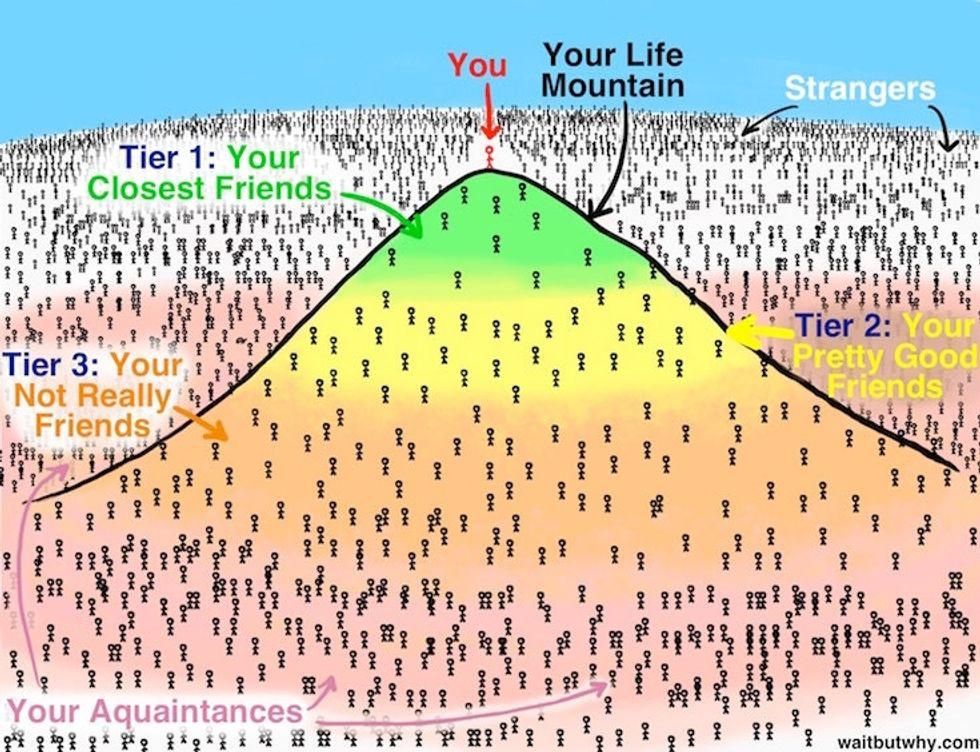
Infographic of a mountain

Visual interpretation of where friends fall on the mountain of “You."

via Wait But Why post and used with permission.

At the top of your life mountain, in the green zone, you have your Tier 1 friends—the people who feel like brothers and sisters.

These are the people closest to you, the ones you call first when something important happens, the ones you love even when they suck, who make speeches at your wedding, whose best and worst sides you know through and through, and whose relationship with you is eternal; even if you go months or years without hanging out, nothing has changed when you find yourself together again.

Unfortunately, depending on how things went down in your youth, Tier 1 can also contain your worst enemies, the people who can ruin your day with one subtle jab that only they could word so brilliantly hurtfully, the people you feel a burning resentment for, or jealousy of, or competition with. Tier 1 is high stakes.

Below, in the yellow zone, are your Tier 2 friends: your Pretty Good friends.

Pretty Good friends are a much calmer situation than your brothers and sisters on Tier 1. You might be invited to their wedding, but you won't have any responsibilities once you're there. If you live in the same city, you might see them every month or two for dinner and have a great time when you do, but if one of you moves, you might not speak for the next year or two. And if something huge happens in their life, there's a good chance you'll hear it first from someone else.

Toward the bottom of the mountain in the orange zone, you have your Tier 3 friends: your Not Really friends.

You might grab a one-on-one drink with one of them when you move to their city, but then it surprises neither of you when five years pass and drink #2 is still yet to happen. Your relationship tends to exist mostly as part of a bigger group or through the occasional Facebook Like, and it doesn't even really stress you out when you hear that one of them made $5 million last year. You may also try to sleep with one of these people at any given time.

The lowest part of Tier 3 begins to blend indistinguishably into your large group of acquaintances (the pink zone): those people you'd stop and talk to if you saw them on the street or would maybe email for professional purposes but whom you'd never hang out with one-on-one. When you hear that something bad happens to one of these people, you might be sad but not too affected.

Finally, acquaintances gradually blend into the endless world of strangers.

And depending on who you are and how things shook out in those first 25 years, the way your particular mountain looks will vary.

For example, there's Walled-Off Wally:
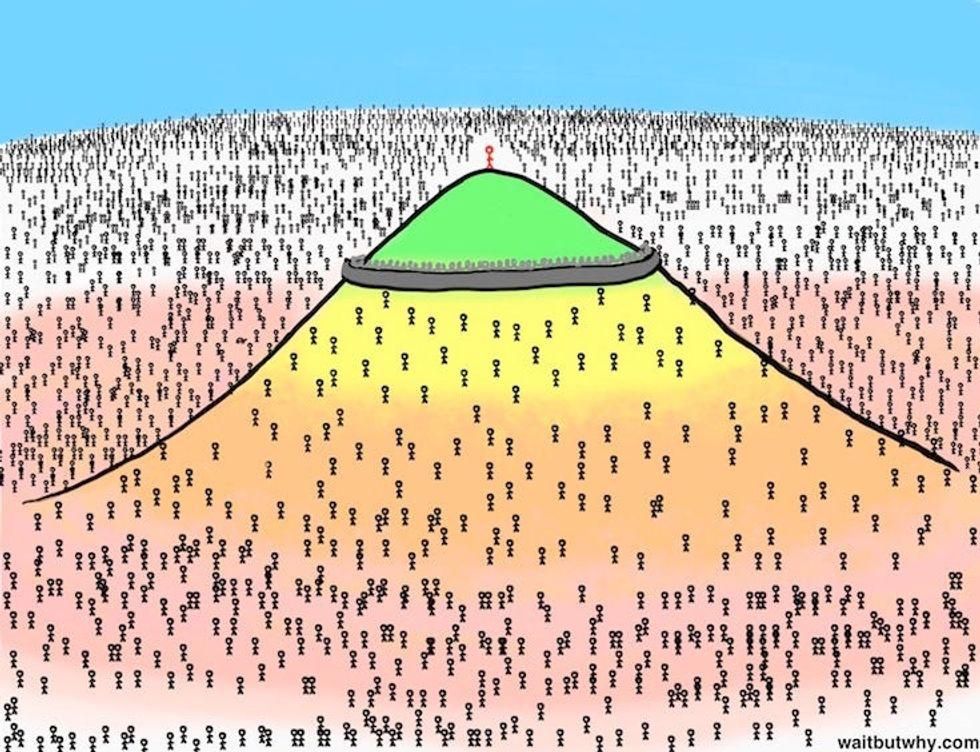
Comic of a lone person on top of a mountain

Some people keep a barrier up between acquaintances.

via Wait But Why post and used with permission.

And Phony Phoebe, who tries to be everyone's best friend and ends up with a lot of people mad at her:
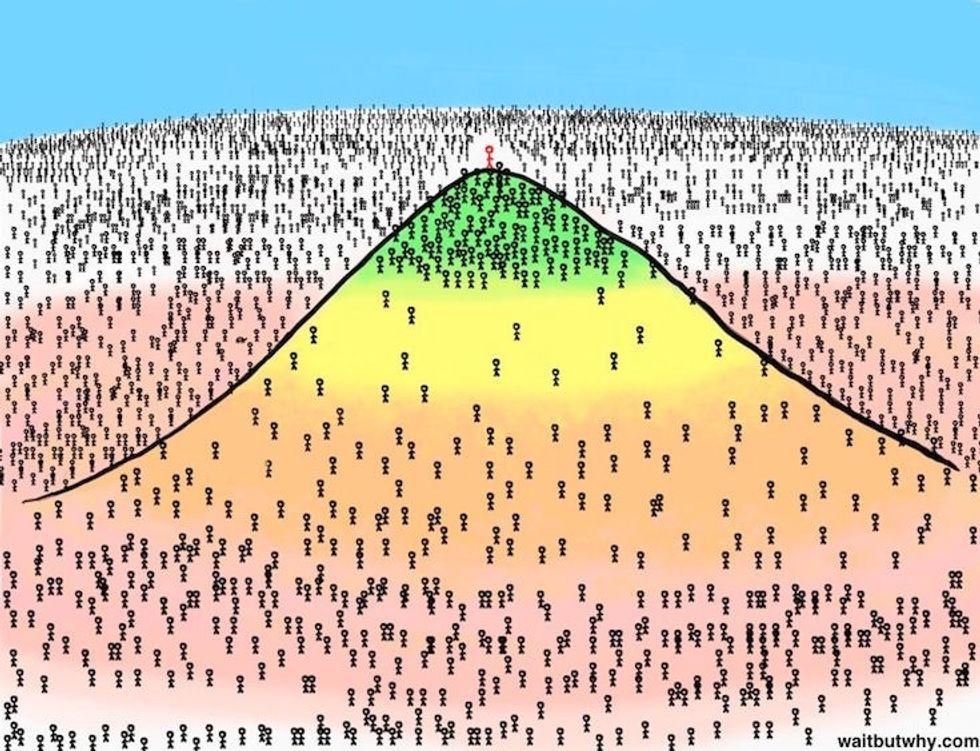
Comic of a mountain with a lot of people at the top

The life of the party.

via Wait But Why post and used with permission.

Even Unabomber Ulysses has a mountain:
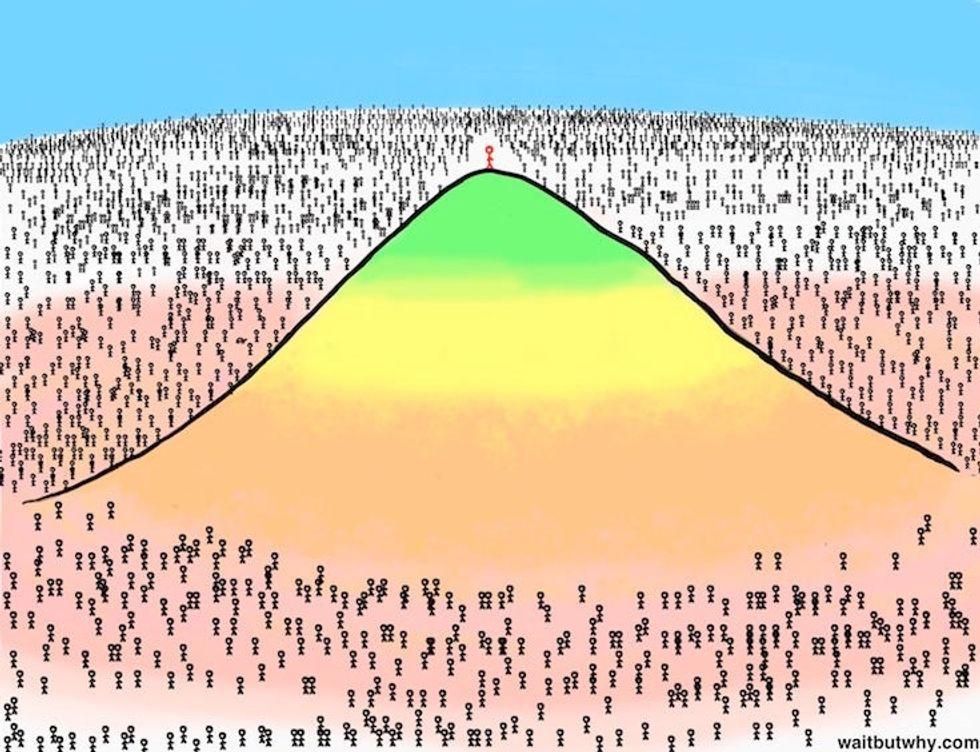
Comic of a mostly empty mountain with one person at the top

Hermits exist.

via Wait But Why post and used with permission.

Whatever your particular mountain looks like, eventually the blur of your youth is behind you, the dust has settled, and there you are living your life.

Then one day, usually around your mid or late 20s, it hits you: It's not that easy to make friends anymore.

Sure, you'll make new friends in the future—at work, through your spouse, through your kids—but you won't get to that Tier 1 brothers level, or even to Tier 2, with very many of them because people who meet as adults don't tend to get through the 100+ long, lazy hangouts needed to reach a bond of that strength. As time goes on, you start to realize that the 20-year frenzy of not-especially-thought-through haphazard friend-making you just did was the critical process of you making most of your lifelong friends.

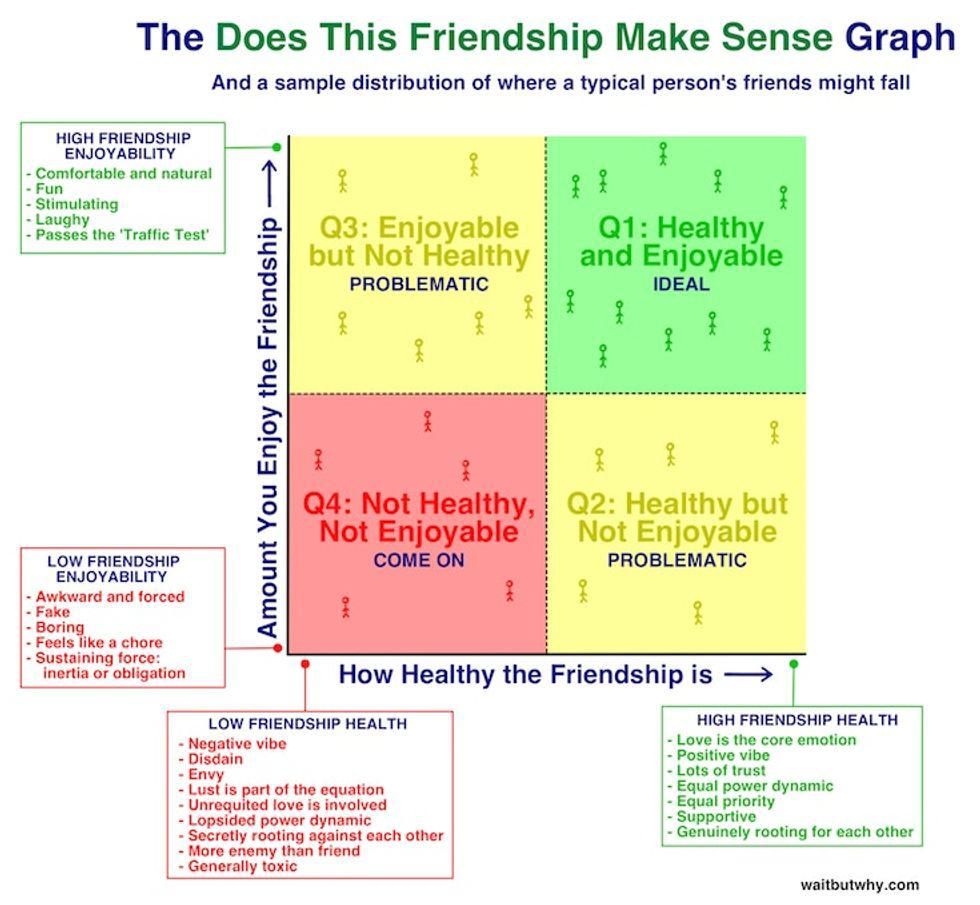
And since you matched up with most of them A) by circumstance, and B) before you really knew yourself yet, the result is that your Tier 1 and Tier 2 friends—those closest to you—fall in a very scattered way on what I'll call the Does This Friendship Make Sense? Graph:
Graph

The friendship graph.

via Wait But Why post and used with permission.

So, who are all those close friends in the three non-ideal quadrants?

As time goes on, most of us tend to have fewer friends in Quadrants 2 through 4 because A) people mature, and B) people have more self-respect and higher standards for what they'll deal with as they get older. But the fact is, friendships made in the formative years often stick, whether they're ideal or not, leaving most of us with a portion of our Tier 1 and Tier 2 friendships that just don't make that much sense. We'll get to the great, Quadrant 1 friendships later in the post, but in order to treat those relationships properly, we need to take a thorough look at the odd ones first.

Here are 10 common ones:

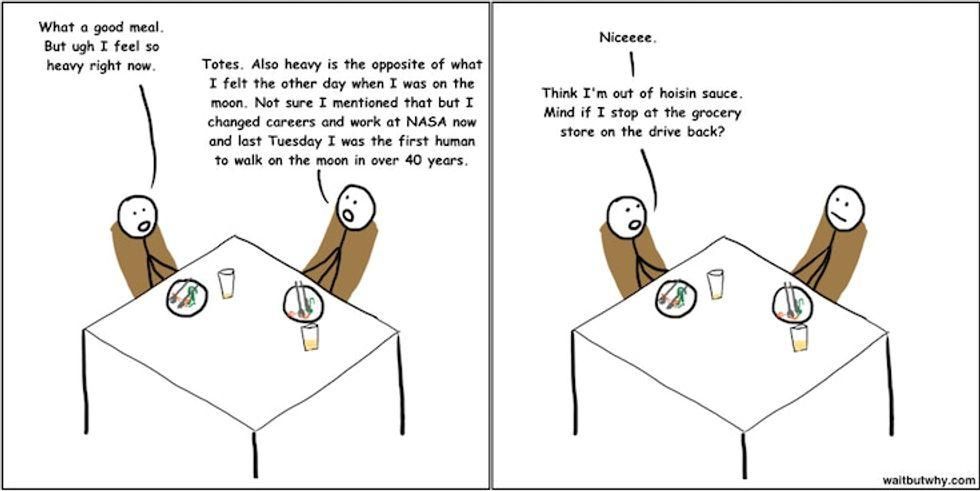
1. The non-question-asking friend
Comic of two people at dinner

Odd moments that happen between friends.

via Wait But Why post and used with permission.

You'll be having a good day. You'll be having a bad day. You'll be happy at work. You'll quit your job. You'll fall in love. You'll catch your new love cheating on you and murder them both in an act of incredible passion. And it doesn't matter, because none of it will be discussed with The Non-Question-Asking Friend, who never, ever, ever asks you anything about your life. This friend can be explained in one of three ways:

  1. He's extremely self-absorbed and only wants to talk about himself.
  2. He avoids getting close to people and doesn't want to talk about either you or himself or anything personal, just third-party topics.
  3. He thinks you're insufferably self-absorbed and knows if he asks you about your life, you'll talk his ear off about it.

Giving you the benefit of the doubt here, we're left with two possibilities. Possibility #1 isn't fun at all and this person should not be allowed space on Tier 1. The green part of the mountain is sacred territory, and super self-absorbed people shouldn't be permitted to set foot up there. Put him on Tier 2 and just be happy you're not dating him.

Possibility #2 is a pretty dark situation for your friend, but it can actually be fun for you. I have a friend who I've hung out with one-on-one about four times in the last year, and he has no idea Wait But Why exists. I've known him for 14 years and I'm not sure he knows if I have siblings or not. But I actually enjoy the shit out of this friend—sure, there's a limit on how close we'll ever be, but without ever spending time talking about our lives, we actually end up in a lot of fun, interesting conversations.

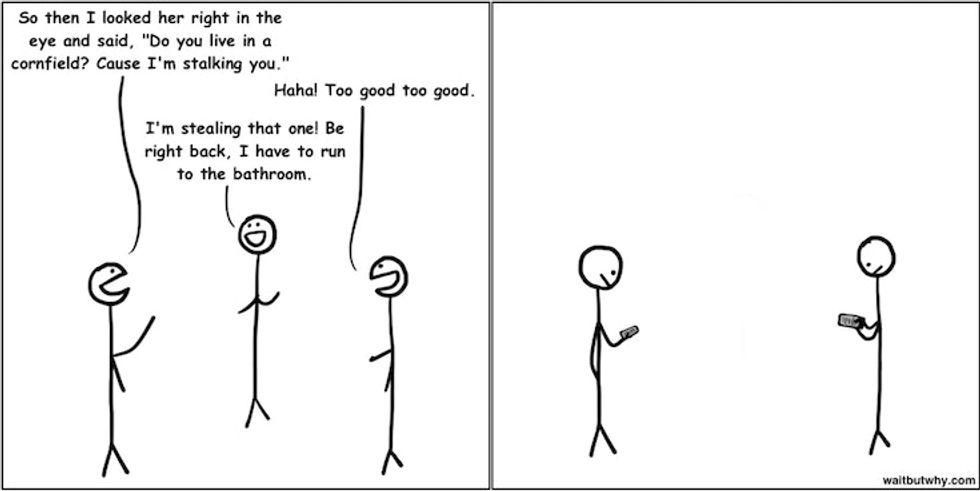
2. The friend in the group you can't be alone with under any circumstances
Comic of three stick people having a conversation

Why have relationships when there is a phone around?

via Wait But Why post and used with permission.

In almost every group of friends, there's one pair who can't ever be alone together. It's not that they dislike each other—they might get along great—it's just that they have no individual friendship with each other whatsoever. This leaves both of them petrified of the lumbering elephant that appears in the room anytime they're alone together. They're way too on top of shit to ever end up in the car alone together if a group is going somewhere in multiple cars, but there are smaller dangers afoot—like being the first two to arrive at a restaurant or being in a group of three when the third member goes to the bathroom.

The thing is, sometimes it's not even that these people couldn't have an individual friendship—it's just that they don't, and neither one has the guts to try to make that leap when things have gone on for so long as is.

3. The non-character-breaking friend you have to be “on" with
Comic of stick people laughing together

Controlled intimacy and distancing through language.

via Wait But Why post and used with permission.

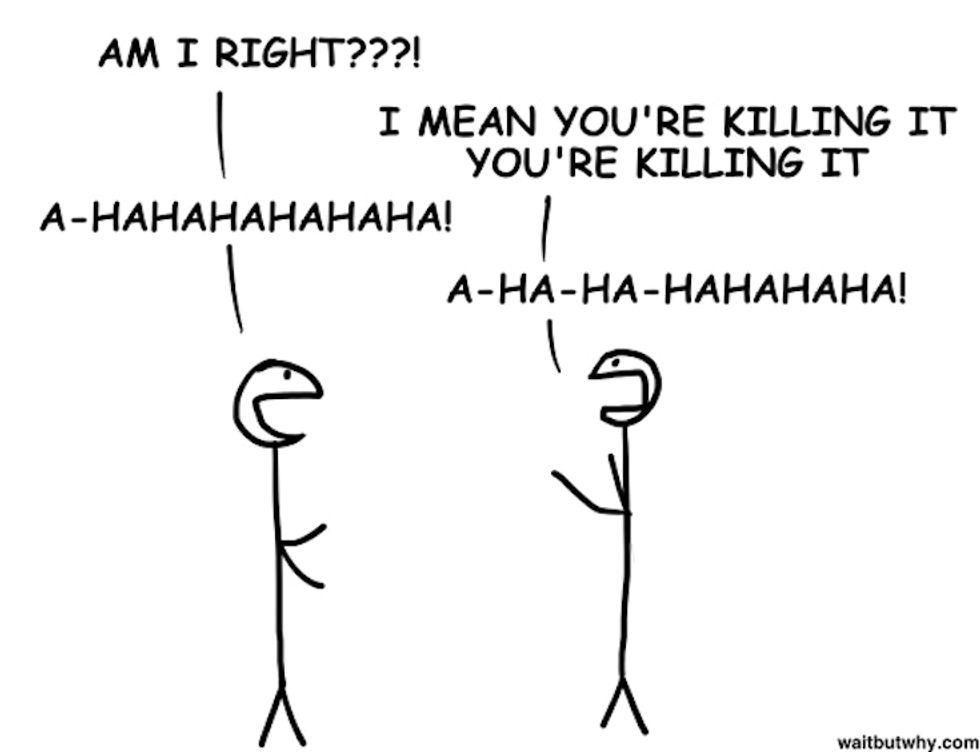
This is a friend who's terrified of having an earnest interaction, and as such, your friendship with him is always in some kind of skityou always have to be on when you're interacting.

Sometimes the skit is that you both burst out laughing at everything constantly. He can only exist with you in “This is so fucking hilarious, it's too much!" mode, so you have to be in some kind of joke-telling or sarcastic mode yourself at all times or he'll become socially horrified.

Another version of this is the “always and only ironic" friend, who you really bum out if you ever break that social shell and say something earnest. This type of person hates earnest people because someone being earnest dares him to come out from under his ironic safety blanket and let the sun touch his face, and no fucking thanks.

A third example is the “You're great, I'm great, ugh why is everyone else so terrible and not great like us" friend. Of course, she doesn't really think you're perfectly great at all—if she were with someone else, you'd be one of the voodoo dolls on the table to be dissected and scoffed at. The key here is that the two of you must be on a team at all times while interacting. The only comfortable mode for this person is bonding with you by building a little pedestal for you both to stand on while you criticize everyone else. You can either play along and everything will go smoothly, even though you'll both despise yourselves and each other the whole time, or you can commit the ultimate sin and have the integrity to disagree with the friend or defend a non-present party the friend criticizes. Doing this will shatter the fragile team vibe and make the friend recoil and say something quietly like, “Hm ... yeah ... I guess." The friend now respects you for the first time and will also criticize you extra hard next time she's playing her pedestal game with a different friend.

What these all have in common is the friend has tall walls up, at least toward you, and so she builds a little skit for you two to hang out in to make sure any authentic connection can be avoided. Sometimes that person only does this out of her own social anxiety and can become a great, authentic friend if you can just stomp through the ice. Other times, the person is just hopelessly scared and closed off and there's no hope and you have to get out.

In any case, I can't stand these interactions and am in a full panic the entire time they're happening.

4. The double-obligated friendship
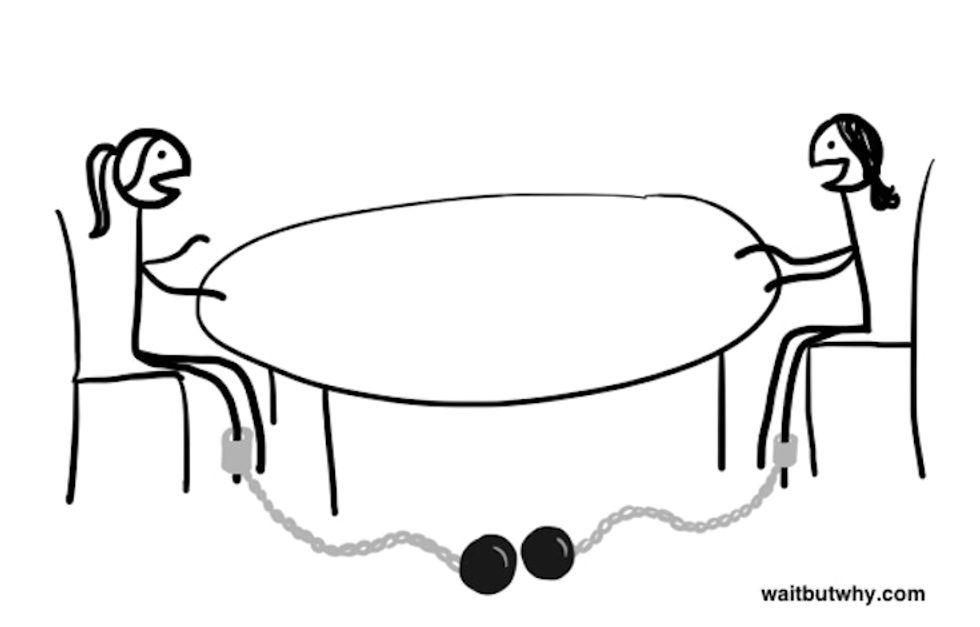
Comic of two men chatting a table with balls and chains around their legs

I think we need a bigger table.

via Wait But Why post and used with permission.

Think of a friend you get together with from time to time, which usually happens after a long and lackluster email or text exchange during which you just can't find a time that works for both of you — and you're never really happy when these plans are being made and not really psyched when you wake up and it's finally on your schedule for that day.

Maybe you're aware that you don't want to be friends with that person, or maybe you're delusional about it — but what you're most likely not aware of is that they probably don't want to see you either.

There are lopsided situations where one person is far more interested in hanging out than the other (we'll get to those later), but in the case we're talking about here, both parties often think it's a lopsided situation without realizing that the other person actually feels the same way — that's why it takes so long to schedule a time. When someone's excited about something, they figure out how to get it into their schedule; when they're not, they figure out ways to push it farther into the future.

Sometimes you don't think hard enough about it to even realize you don't like being friends with the person, and other times you really like the idea or the aesthetic of being friends with that particular person — being friends with them is part of your Story. But even in cases where you're perfectly lucid about your feelings, since neither of you knows the other feels the same way and neither has the guts to just cut things off or move it down a tier, this friendship usually just continues along for eternity.

5. The half-marriage
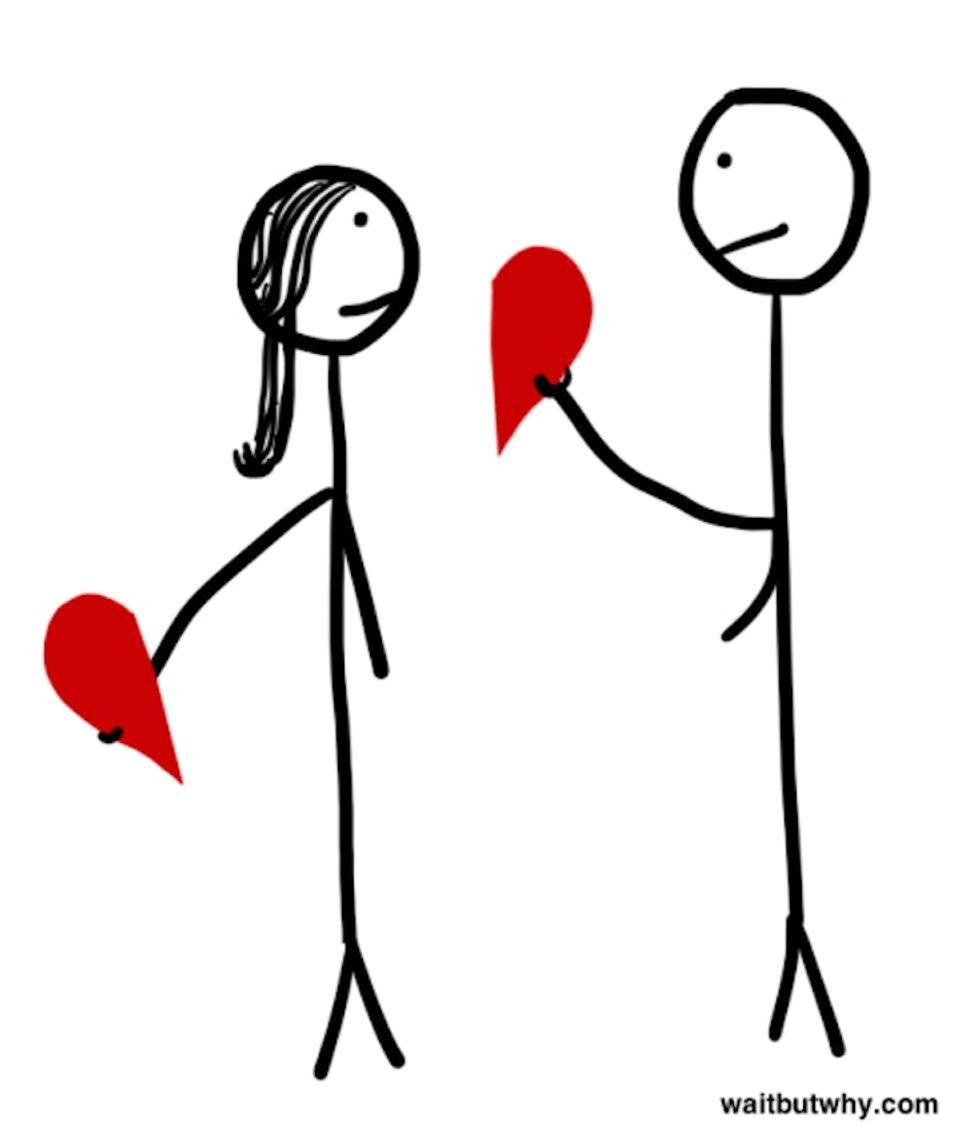
Two stick people each holding a half of a heart

An ego boost through controlling the relationship.

via Wait But Why post and used with permission.

Somewhere in your life, you're probably part of a friendship that would be a marriage if only the other person weren't very, very, extremely not interested in that happening. 1 for 2 on yes votes — just one vote away — so close.

You might be on either side of this — and either way, it's one of the least healthy parts of your life. Fun!

If you're on the if only side of things, probably the right move is to get your fucking shit together? Ya know? This friendship is one long, continuous rejection of you as a human being, and you're just wallowing there in your yearning like a sobbing little seal. Plus, duh, if you gather your self-respect and move on with your life, it'll raise their perception of your value and they might actually become interested in you.

If you're on the Oh yeah, definitely not side of the situation, here's what's happening: There's this suffering human in the world, and you know they're suffering, and you fucking love it, because it gives your little ego a succulent sponge bath every time you hang out with them. You enjoy it so much you probably even lead them on intentionally, don't you — you make sure to keep just enough ambiguity in the situation that their bleeding heart continues to lather your ego from head to toe at your whim.

Both of you — go do something else.

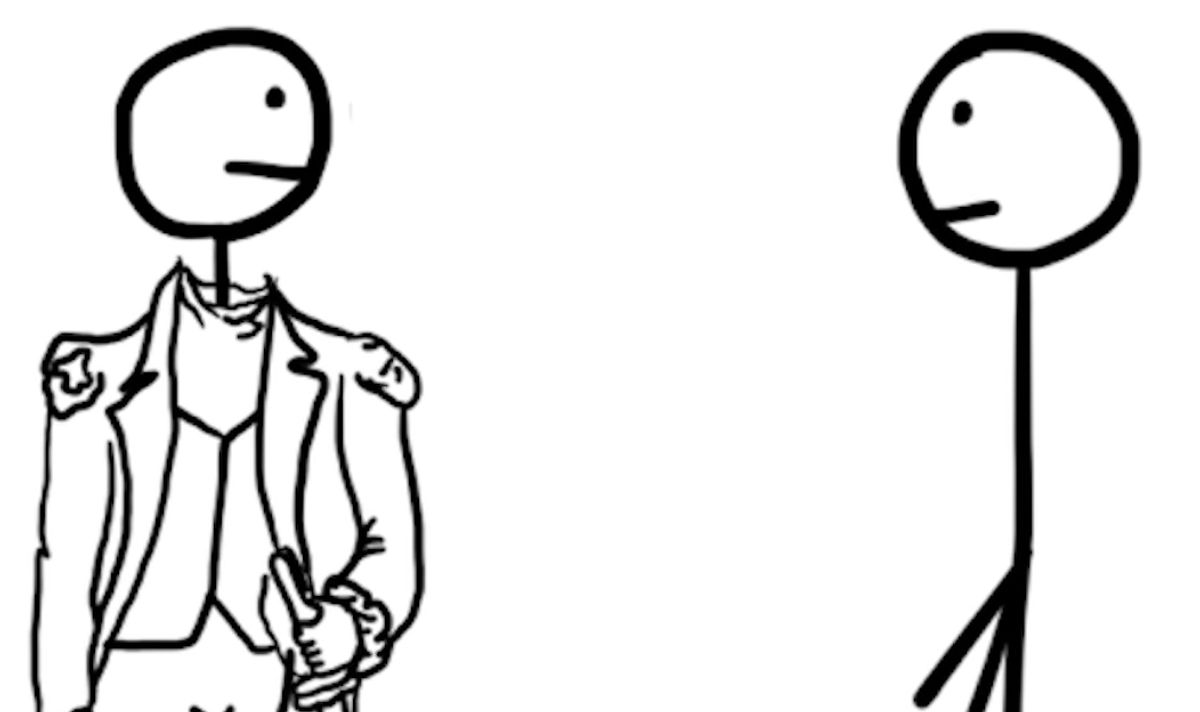
6. The historical friend
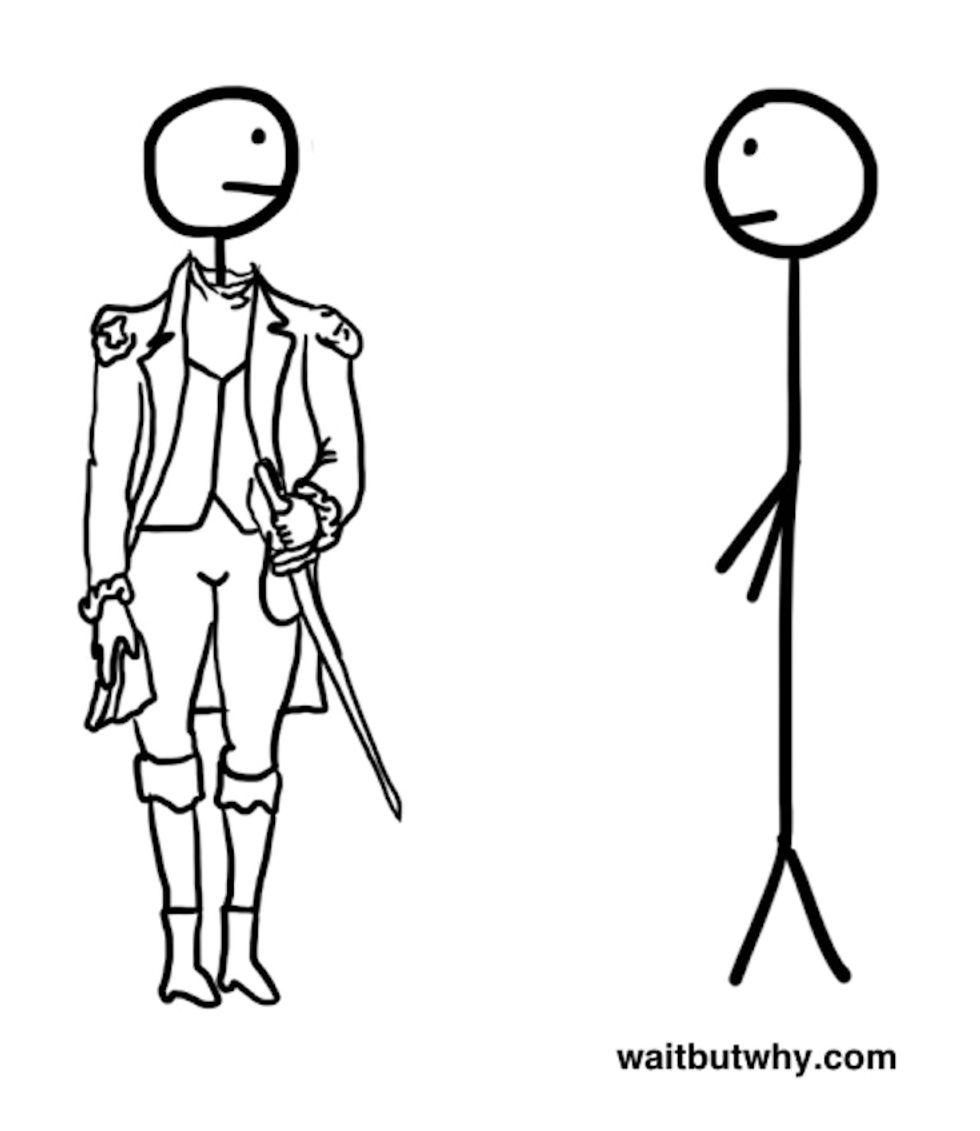
Stick person in historical garb beside a regular stick person

We met in kindergarten.

via Wait But Why post and used with permission.

A Historical Friend is someone you became friends with in the first place because you met when you were little and stayed friends through the years, even though you're a very weird match. Most old friends fall somewhat into this category, but a true Historical Friend is someone you absolutely would not be friends with if you met them today.

You're not especially pleased with who they are, and they feel the same way about you. You're not each other's type one bit. Unfortunately, you're also extremely close friends from when you were four, and you're both just a part of each other's situation forever, sorry.

7. The non-parallel life paths friendship
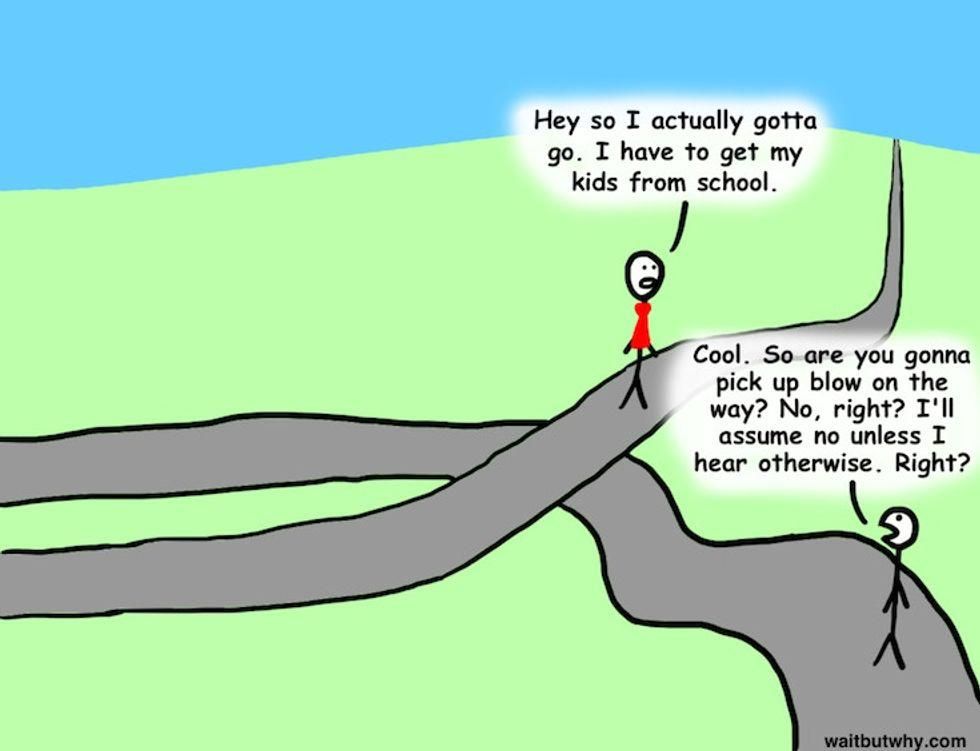
Two stick people on opposite paths

Looking for love in all the wrong places.

via Wait But Why post and used with permission.

Throughout childhood and much of young adulthood, most people your age are in the same life stage as you are. But when it comes to advancing into full adulthood, people do so at widely varying paces, which leads to certain friends suddenly having totally different existences from one another.

Anyone within three years of 30 has a bunch of these going on. It's just a weird time for everyone. Some people have become Future 52-year-olds, while others are super into being Previous 21-year-olds. At some point, things will start to meld together again, but being 30-ish is the friendship equivalent of a kid going through an awkward pubescent stage.

There are darker, more permanent Non-Parallel Life Path situations. Like when Person A starts to become a person who rejects material wealth, partially because she genuinely feels that pursuing an artistic path matters more and partially because she needs a defense mechanism against feeling envious of richer people, and Person B's path makes her scoff at people who pursue creative paths, partially because she genuinely thinks expressing yourself is an inherently narcissistic venture and partially because she needs a defense mechanism against feeling regretful that she never pursued her creative dreams — these two will have problems.

They may still like each other, but they can't be as close as they used to be — each of their lives is a bit of a middle finger at the other's choices, and that's jst awkward for everyone. It's not always that bad — but to survive an Off-Line Life Situation, friends need to be really different people who don't at all want the same things out of life.

8. The frenemy
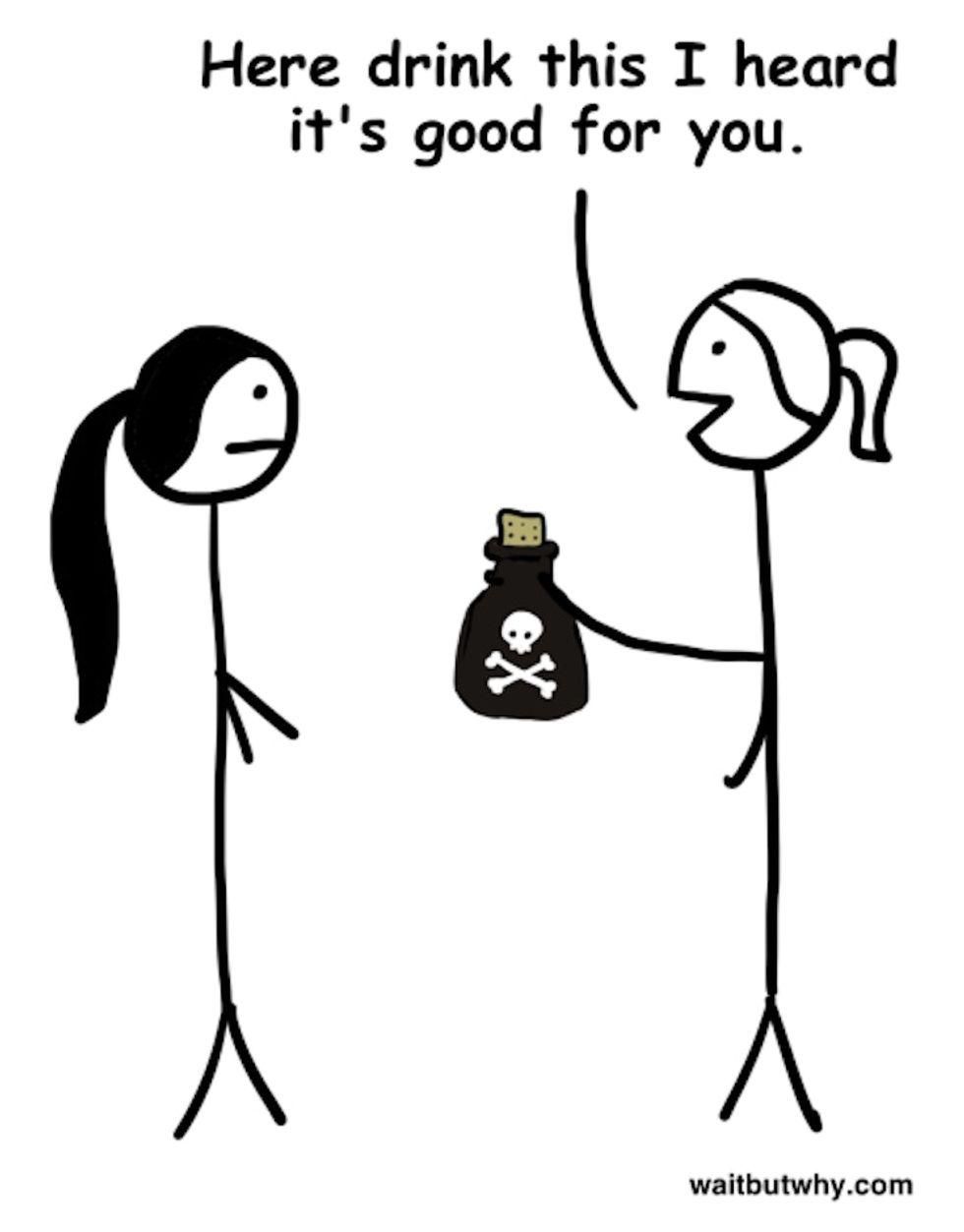
One stick person offers another stick person poison pretending it's safe

This is awful. Taste it.

via Wait But Why post and used with permission.

The Frenemy roots very hard against you. And I'm not talking about the friends that will feel a little twinge of pleasure when they hear your big break didn't pan out after all or that your relationship is in bad shape. I'm not even talking about someone who secretly roots against you when they're not doing so well at some area of life and it hurts them to see you do better. Those are bad emotions, but they can exist in people who are still good friends.

I'm talking about a real Frenemy — someone who really wants bad things for you. Because you're you.

You and the Frenemy usually go way back, have a very deep friendship, and the trouble probably started a long time ago. There's a lot of complex psychology going on in these situations that I don't fully understand, but my hunch is that a Frenemy's resentment is rooted in his own pain, or his own shortcomings, or his own regret — and for some reason, your existence stings them in these places hard.

A little less dark but no less harmful is a bully situation where a friend sees some weakness or vulnerability in you and she enjoys prodding you there either for sadistic reasons or to prop herself up.

A Frenemy knows how to hurt you better than anyone because you're deeply similar in some way and she knows how you're wired. She'll do whatever she can to bring you down any chance she gets, often in such a subtle way it's hard to see that it's happening.

Whatever the reason, if you have a Frenemy in your life, kick her toxic ass off your mountain, or at least kick her down the mountain — just get her off of Tier 1. A Frenemy has about a 10th of the power to hurt you from Tier 2 as she does from Tier 1.

9. The Facebook celebrity friend
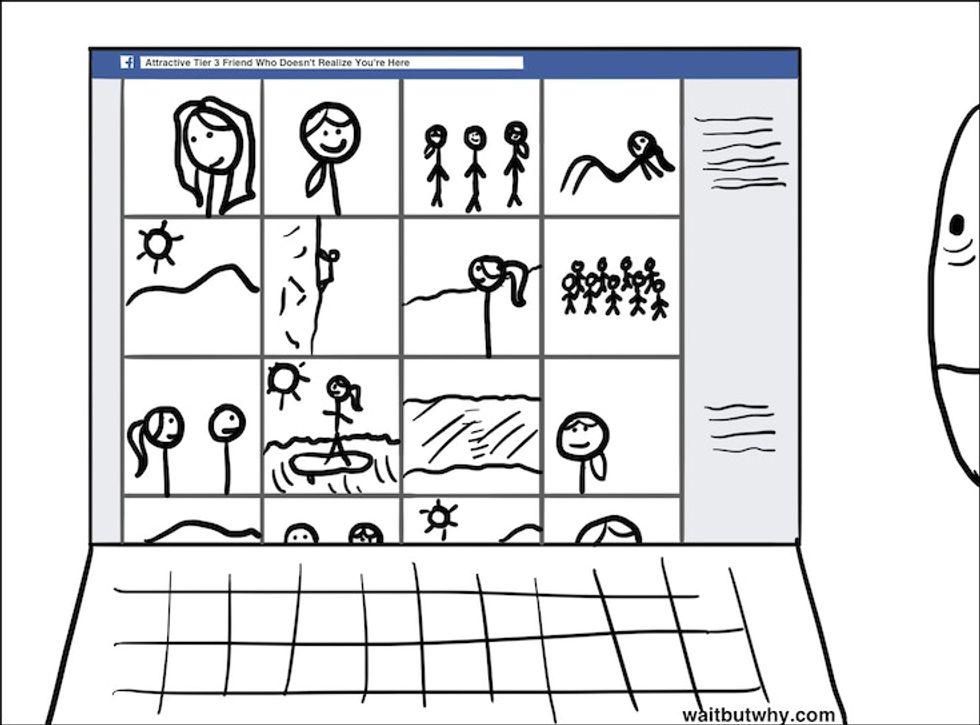
Comic of a computer with photo grid

What’s happening on social media?

via Wait But Why post and used with permission.

This person isn't a celebrity to anyone other than you, you creep. You know exactly who I'm talking about — there are a small handful of people whose Facebook page you're uncomfortably well-acquainted with, and those people have no idea that this is happening. On the plus side, there are people out there you haven't spoken to in seven years who know all about the new thing you're trying with your hair, since it goes both ways.

This is a rare Tier 3 friend, or even an acquaintance, who qualifies as an odd friendship because you found a way to make it unhealthy even though you're not actually friends. Well done.

10. The lopsided friendship
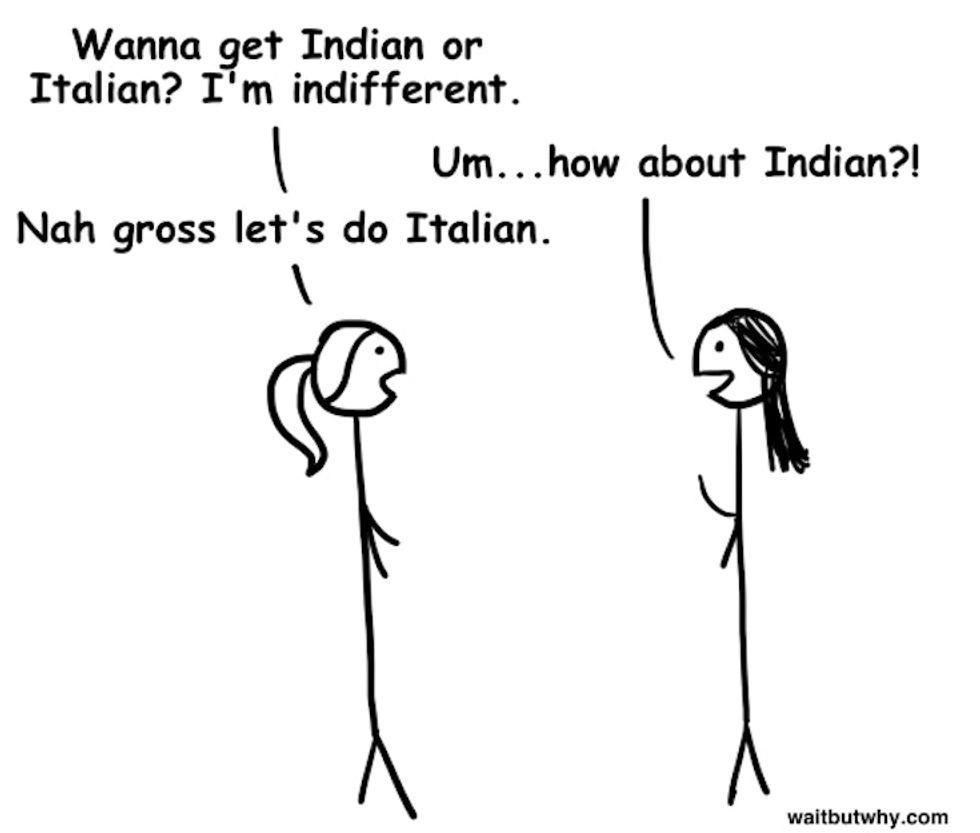
Two stick women discussing dinner

Can I make all the decisions... that was rhetorical.

via Wait But Why post and used with permission.

There are a lot of ways a friendship can be lopsided: Someone can be higher on their friend's mountain than vice versa. Someone can want to spend more time with a friend than vice versa. One member can consistently do 90% of the listening and only 10% of the talking, and in situations where most of the talking is about life problems, what's happening is a one-sided therapy situation, with a badly off-balance give-and-take ratio, and that's not much of a friendship—it's someone using someone else.

And then there's the lopsided power friendship. Of course, this is a hideous quality in many not-great couples, but it's also a prominent feature of plenty of friendships.

A near 50/50 friendship is ideal, but anything out to 65/35 is fine and can often be attributed to two different styles of personality. It's when the number gap gets even wider that something less healthy is going on—something that doesn't reflect very well on either party.

There are some obvious ways to assess the nature of a friendship's power dynamic: Does one person cut in and interrupt the other person while they're talking far more than the other way around? Is one person's opinion or preference just kind of understood to carry more weight than the other's? Is one person allowed to be more of a dick to the other than vice versa?

Another interesting litmus test is what I call the “mood determiner test." This comes into play when two friends get together but they're in very different moods — the idea is, whose mood “wins" and determines the mood of the hangout. If Person A is in a bad mood, Person B is in a good mood, and Person B reacts by being timid and respectful of Person A's mood, leaving the vibe down there until Person A snaps out of it on her own — but when the moods are reversed, Person B quickly disregards her own bad mood and acts more cheerful to match Person A's happy mood — and this is how it always goes — then Person A is in a serious power position.

But hey, not all friendships are grim.

In the Does This Friendship Make Sense graph above, the friendships we just discussed are all in Quadrants 2, 3, or 4 — i.e., they're all a bit unenjoyable, unhealthy, or both. That's why this has been depressing. On the bright side, there's also Quadrant 1—all the friendships that do make sense.

No friendship is perfect, but those in Quadrant 1 are doing what friendships are supposed to do: They're making the lives of both parties better. And when a friendship is both in Quadrant 1 of the graph and on Tier 1 of your mountain, that friendship is a rock in your life.

Rock friendships don't just make us happy — they're the thing (along with rock family and romantic relationships) that makes us happy.

Investing serious time and energy into those is a no-brainer long-term life strategy. But in the case of most people over 25—at least in New York— I think A) not enough time is carved out as dedicated friend time, and B) the time that is carved out is spread too thin, and too evenly, among the Tier 1 and Tier 2 friendships in all four quadrants. I'm definitely guilty of this myself.

There's something I call the Perpetual Catch-Up Trap. When you haven't seen a good friend in a long time, the first order of business is a big catch-up — you want to know what's going on in their career, with their girlfriend, with their family, etc., and they want to catch up on your life. In theory, once this happens, you can go back to just hanging out, shooting the shit, and actually being in the friendship. The problem is, when you don't make enough time for good friends, seeing them only for a meal and not that often — you end up spending each get-together catching up, and you never actually get to just enjoy the friendship or get far past the surface. That's the Perpetual Catch-Up Trap, and I find myself falling into it with way too many of the rocks in my life.

There are two orders of business right now:

First, think about your friendships, figure out which ones aren't in Quadrant 1, and demote them down the mountain. I'm not suggesting you stop being friends with those people—you still love them and feel loyal to them, and old friends are critical to hold onto—but if the friendships aren't that healthy or enjoyable, they don't really deserve to be in your Tier 1, and you probably shouldn't be in theirs. Most importantly, doing this clears up time to...

Second, dedicate even more time to the Quadrant 1, Tier 1 rocks in your life. If you're in your mid-20s or older, your current rocks are probably the only ones you'll ever have. Your rock friendships don't warrant two times the time you give to your other friends—they warrant five or 10 times!

Your rocks deserve serious, dedicated time so you can stay close. So go make plans with them.


This article was written by Tim Urban and originally published on Wait But Why. It originally appeared here nine years ago.

Pop Culture

All In: 5 Ways This Week

From the silly to the sentimental, there are so many ways people like to go “all in” on something. Here are our five favorite examples we found this week across the internet.

5 ways people are going "All In" this week
True

When you hear the words “all in,” what do you think? You might picture a Dancing with the Stars trend gone viral or maybe bridesmaids who fully supportive of the bride's favorite movie (and recreates an iconic scene). Whatever you picture, the idea is the same: Someone who does something with 100 percent total commitment. Going “all in” means giving your all—going completely over the top, no second guessing, no holding back. Just full-throttle enthusiasm, with some flair and creativity thrown in. And when people go “all in,” something truly special usually happens as a result.


The internet abounds with examples of people giving it their all—whatever it is. In this roundup, we’ve found the very best examples of people going “all in”—moments where passion, creativity, and commitment take center stage. Some are sentimental, some are silly, but all of them are a reminder that giving 100 percent is truly the only way to leave a mark on this world. Get ready: These folks didn’t just show up, they went all in.


1. An Iconic "snow-coaster"

One thing about going all in - it can be crazy and childish at times. That’s something that makes going all in special, connecting with that side of you that takes things less seriously in order to have some fun. Shira Goldstone and her husband took to that mindset when it started snowing in their backyard. Shira’s husband picked up planks of wood (and whatever other tools are required) and within the same night, in the falling snow, built a “snow-coaster” for the two of them to play on.

2. A Truck That's Feeding It's Community

You already know our friends at All In—they’ve got some seriously tasty snacks that are not only healthy and affordable (scroll to the bottom of this article to see how you can snag a free bar), they help fund food banks, gardens, community fridges, meal programs, and other amazing things

For Giving Tuesday, All In teamed up with Fresh Truck, a weekly mobile market that brings fresh and affordable produce to neighborhoods in the Boston area. Fresh truck hosts weekly markets, pop-up events, and an online storefront, all to help strengthen communities who need it the most. They’re going all in on local nutrition and food access, and we’re here for it.


3. All In on Madam Morrible

I’m always all in on a good TikTok trend. This week, I’m going to share with you a classic that has come out of the Wicked franchise and the incredible actress Michelle Yeoh.

Michelle, who plays Madame Morrible in the Wicked movies, is an outstanding actress. She’s known for iconic films like Everything, Everywhere, All At Once, as well as Crazy Rich Asians and Star Trek. But her legacy might be this one quote, which she’s said in interviews countless times, and now people can’t stop making videos with the phrase “Madame Morrible, M.M…flip it around, W.W. Wicked Witch!”

You might have to take a look at how people are going all in yourself, the sound has taken off with already 14.3K videos, and the variations are unstoppable...defying all odds and maybe even...defying gravity?

4. Spotify Wrapped: All in on "Coconut Mall"

TikTok · Ale

www.tiktok.com

There’s nothing better than finding a song that hits just right and gets you feeling productive. For some people, it’s lofi beats. For others, it’s orchestra music. For TikTok user @aleinmotion, it was the “coconut mall” song from the Mario Kart racing soundtrack. Ale never realized how much she listened to the song until it became #1 on her Spotify Wrapped. Sometimes you’ll be surprised by what you love most, and I’m thinking this is one of those moments for Ale.

5. A Family Prank Everyone Enjoys

This girl said her boyfriend had an ugly hat, so her family decided to go all in on supporting him instead. This is when love and humor come together, a perfect prank that actually made the boyfriends day…and taught his girlfriend that nothing is really that serious! They even got the daughter her very own hat as well, and she looked happy to wear it!

As someone who grew up with a dad who always wore floppy hats to protect him from the sun, I understand the embarrassment. Maybe it’s time I go all in and show my support with a matching hat and white long sleeve sun shirt!

Snag your free (!!) snack bar here while this deal lasts. Simply sign up with your phone number, pick up your favorite flavor of an All In bar at Sprouts, and then text a picture of your receipt through Aisle. They’ll Venmo or PayPal you back for the cost of one bar. Enjoy!

kitten, cute kitty, cute aggression, cuteness, baby cat

There's nothing like a kitten to bring out the cuteness aggression.

It's hard to explain the all-consuming adorableness of a kitten to someone who's never had one. Yes, we all see how cute they are in photos and videos, but falling in love, in real life, with a kitten of your own is a whole other level of swoon. Every single thing they do is cute. Every yawn. Every stretch. Every pounce. Don't even get me started on sneezes.

How many times have we seen the classic "didn't want a cat" story of a "not a cat person" falling hard and fast for a kitten? It happens. And a viral video of a man who is unable to contain himself over his new kitten's cuteness perfectly encapsulates what that looks like.


kitten, orange tabby, cute kitty, cute aggression, cuteness Kittens are the cutest. Photo credit: Canva

"Well, I'm just going to explode, aren't I?" the man says to the woman behind the camera before going on and on about how he'd step in front of a bullet for the kitten.

"Look at that cute little boy," he says as the small orange tabby lies curled up in a blanket. "Yeah, that's mine forever now. That's mine forever. And he comes before you, now. He's mine."

@waif8chimney

So I guess I’d die for this kitty🤝

The pacing around with energy to burn. The "cute patootie bobooty." The "I'm literally going to explode" moving right into the "I'm going to eat him," and "I would die for you." The fact that they just met and he's already up to his eyeballs in gushy, smushy love. It's all so relatable to those of us who've gone off the deep end after adding a tiny furry feline to our family.

People in the comments shared the sentiment.

"I got a kitten a week ago and it literally pains me to leave her everyday. She’s all i think about 😭"

"The overstimulated pacing is so real.😂😂"

"Every second of this was the correct response."

"I just got two and the overload of emotions is beyond words."

"12 years later and I still talk about my cat like this 😂"

"The amount of times I tell her 'I'd shmurder for you!!'"

"The cuteness aggression is completely appropriate! 'Cutie-patootie-bobootie, I'm gonna eat em.'"

kitten, orange tabby, cute kitty, cute aggression, cuteness Grrrr, wook at his widdle paws and his widdle whiskers. Photo credit: Canva

Cute aggression is a real thing

Lots of people mentioned "cuteness aggression" in the comments, and that's exactly what we're witnessing in the video. When you feel so overwhelmed by the cuteness of something that you want to squish it, squeeze it, bite it, or even eat it? That's cute aggression, a term coined by social psychologist Oriana Aragon in 2014.

"Cute aggression seems to be a mechanism to manage the overload of positive feelings we can get when we interact with something too cute for us to handle," says Associate Professor Lisa A. Williams, a social psychologist from the University of New South Wales. "In other words, to counter an overwhelming barrage of positive feelings, we seek to tamp it down – and weirdly enough, that can play out as an aggressive inclination."

@sadiebreann_

unreal #cutenessaggression #motherhood #newborn #newbaby #motherhoodunplugged #motherhoodunfiltered #sahm #momlife #sahmsoftiktok #baby

It's not actually aggression in the strictest sense, as the impulse comes along with a strong feeling of wanting to protect the cute little animal, child, or whatever is causing the explosion of feeling. Like, you might feel a strong urge to bite your baby, but you would never actually bite your baby. You might want to squish your kitten or hug your puppy as tight as you can, but you wouldn't because you know it would harm them.

It's a weird contrast of feelings, but it's common. And it's hard to explain to people who don't experience it. Interestingly, Aragon says that those who do experience cute aggression also tend to experience other dimorphous expressions of positive emotion, which includes crying when happy. "People who, you know, want to pinch the baby's cheeks and growl at the baby are also people who are more likely to cry at the wedding or cry when the baby's born or have nervous laughter," she told NPR.

Whatever we call it, the urge to bite the baby or squish the kitten is real for many of us who feel totally seen in these videos.

postal workers, mailman, mail carrier, usps, mail, handwriting, package delivery, delivery driver

The remote mail processing facility that deciphers our sloppy chicken-scratch addresses.

ALT HL: When mail addresses are too hard to read, they get sent to this strange and fascinating facility

ALT HL: The crack team of 800 specialists that works around the clock to decipher sloppy handwriting on US mail


Our handwriting is getting worse. More and more of our writing and communications are being done digitally, and young people, in particular, are getting a lot less practice when it comes to their calligraphy. Most schools have stopped teaching cursive, for example, while spending far more time on typing skills.

And yet, we still occasionally have to hand-address our physical mail, whether it's a holiday card, a postcard, or a package.

We don't always make it easy on the postal service when they're trying to decipher where our mail should go. Luckily, they have a pretty fascinating way of dealing with the problem.

The U.S. Postal Service sees an unimaginable amount of illegible addresses on mail every single day. To be fair, not all of it comes down to sloppy handwriting. Labels and packaging can get wet, smudged, ripped, torn, or otherwise damaged, and that makes it extremely difficult for mail carriers to decipher the delivery address.

You'd probably imagine that if the post office couldn't read the delivery address, they'd just return the package to the sender. If so, you'd be wrong. Instead, they send the mail (well, at least a photo of it) to a mysterious and remote facility in Salt Lake City, Utah called the U.S Postal Service Remote Encoding Center.

According to Atlas Obscura, the facility is open 24 hours per day. Expert workers take shifts deciphering, or encoding, scanned images of illegible addresses. The best of them work through hundreds per hour, usually taking less than 10 seconds per item. The facility works through over five million pieces of mail every day.

Every. Single. Day.

- YouTube www.youtube.com

The process of encoding the mail is very cool. The electronic system the encoders—called "keyers"—use is connected to real conveyer belts full of mail all over the country.

The local mail distributors are counting on the REC to properly process the illegible mail items before they get dumped off the conveyer belt and into a bin that must be sorted by hand.

Time is of the essence! That's why the best keyers process an address about every four seconds. Like a library, there's no talking or extra noise allowed in the work room. It's important that the keyers have the utmost focus at all times.

Not all of the items that come through the REC are the result of bad or damaged handwriting, by the way. Sometimes, the handwriting is highly stylized. That's why posters displaying cursive letters are hung in every cubicle, next to coding sheets that list state abbreviations, cities, etc.

At one point, there were 55 similar sites all across the United States. But improvements in software that can automatically read addresses and the lower volume of handwritten mail and letters going out means the Salt Lake City facility is the last one standing.

The REC currently employs about 800 people, but the facility is processing less and less mail every year.

Even still, the human keyers are the last line of defense when AI, machine-learning, and fancy algorithms fail. The technology will continue to improve, but human intuition and judgment simply can't be replaced in the toughest cases.

- YouTube www.youtube.com

What happens if the keyers at the USPSREC can't decipher an address? All is not lost.

A local postal worker would retrieve the mail from the "reject bin" and do his or her best to figure it out upon closer, physical inspection. If that fails, the mail would likely be returned to its original sender.

However, some postal workers have been known to go above and beyond to deliver mail. One famous viral story out of Iceland shows a sender that hand-doodled a map on the outside of a letter in lieu of an address—and it worked.

In recent years, there's been a lot of supposed "concern" about the U.S. Postal Service not being profitable and losing money each year. It is self-funded and receives no funds from American tax dollars.

Amid talks of the USPS's "broken business model," it's easy to forget that mail and package delivery is an essential public service. It keys our economy, our communities, and our democracy.

The postal service is in danger of being shut down or privatized, but that would be a major disservice to the postal workers and Encoding Center keyers who work tirelessly to make sure mail gets delivered on time to the right place.

Science

Video of a 1949 kitchen design has people drooling over its brilliant features

Can we bring back some of these "step saving" design elements?

1949 step saving kitchen, 1950s, vintage kitchen, functional kitchen design, home economics

People are fascinated by the features in this 1949 kitchen design.

Modern kitchens are pretty epic in the historical scheme of things. We have refrigerators that dispense ice, cold water, and even hot water. We have faucets that turn on and off with a touch. We have garbage disposals, automatic trash-can lids, and pot-filling faucets over stoves—all manner of modern conveniences that might make us assume that today's kitchens are superior to every era that came before.

In some ways, they are. But a video from the National Archives demonstrating the features of a 1949 step-saving kitchen design has some of us rethinking just how much. The video was put out by the United States Department of Agriculture’s Home Economics division and it details every part of this efficient kitchen design:


- YouTube www.youtube.com

No wonder kitchens from that era feel small compared to most new homes today. Modern kitchens tend to be sprawling but far less functional. This design may be small, but it’s mighty.

The movie itself is a bit of a time capsule—not only in the cabinetry and clothing styles, but in the clear assumption that only women would be using the kitchen. On one hand, it’s great that work traditionally viewed as "women’s work" became the focus of innovation aimed at making life easier. On the other hand, it’s interesting to see how much has changed around gender roles since the 1940s.

But why did the government even make a video like this in the first place? Why would the government even care about kitchen design?

kitchen design, home design, functional kitchen, interior design, kitchens Design 3D GIF Giphy

It all began with a push for science and innovation in the late 19th and early 20th centuries.

As food historian Sarah Wassberg Johnson wrote, "This kitchen design is the culmination of several decades of work studies. During the Progressive Era, American interest in science began to increase, and scientific theories were applied to everything from factories to households. The Efficiency Movement was part of this application of scientific principles to everyday life. Led by mechanical engineer Frederick Winslow Taylor, the movement posited that everyday life, from industry to government to households, were plagued by inefficiencies, which wasted time, energy, and money."

This movement, known as "Taylorism," spilled over into the home economics movement, which eventually became of interest to the U.S. government. A USDA report published in 1948 explained the push for efficient kitchen design:

"To help homemakers reduce time and work involved in kitchen activities, the Bureau is designing and preparing construction drawings for kitchens, with different arrangements of equipment — the U, L, broken U and L, and parallel-wall types of arrangement. They are designed to reduce walking, stooping, and stretching to a minimum, in accordance with accepted principles of work simplification."

And that's how we ended up with this glorious video.

Many people cheered for the features of this nearly 80-year-old kitchen design:

"Wow! That is an amazing well thought out kitchen. And we think we are modern today. That kitchen was has way more features than our kitchen today!" – @TheCrystalLion1

"I say I want an old time kitchen all the time! Everything was so functional." –@LizSmit97381516

"Yeah, that is pretty amazing! I would be completely happy with this." – @TexasAris

"I have a garbage pail and potato drawer like this. Love it. Our kitchen is brand new tho. I requested these things. Also a full size pull out pantry, 15 inches wide and 6 ft tall. Hideaway kitchen utensils vertical pullout 6 inches wide, full size microwave drawer. Modern kitchens can be amazing or terrible." – @NativeNoticer

Some people have expressed concern about bugs in those potato and onion bins, but someone who grew up in that era noted that potatoes and onions were such daily staples that families went through them quickly:

"We kept things real clean and, no, that was never a problem - the potatoes and onions were gone through on pretty much a weekly basis. We normally figured 1/2 an onion per person per day and a potato per person. We had a small family. Grandfather, grandmother, Uncle, Mom, myself, and a kid that no one wanted - 6 people; that is 6 potatoes and 3 onions a day or a 20# bag of each a week. And they were used as hash browns, potato pancakes, baked potatoes, sautéed onions in dishes (all dishes) and of course fried potatoes and french fries. They were pretty much a staple. We also had flour bins, two types - cooking and baking, and also two different kinds of sugar. There was baked bread and a pie or cake every single day and always biscuits. And everything was from scratch. All vegetables were prepared before cooking and did not come from cans and had only when in season, same with fruits. We did can some items but not many." – @DannerFoundati1

Naturally, times change, the way we use our homes changes, and new innovations often replace the old for good reason. But there may be some things we can learn from an era when function and efficiency were prioritized over Instagrammable spaces. What good is a beautiful kitchen if it's cumbersome to use?

Love Stories

Penn Badgley compares romantic relationships to gardening, and the metaphor is spot on

He beautifully illustrates the difference between falling in love and being in love.

penn badgley, joe from you, botanical garden, gardening, flowers

Penn Badgley's botanical garden analogy is resonating with people.

Poets and philosophers have been using metaphors and analogies to try to define love for millennia, so it seems like we would have heard them all by now. But Penn Badgley, whose role as serial killer Joe in the TV series You couldn't be further from his real-life persona, has shared a metaphor for relationships that is hitting home.

Badgley has been married to his wife, Domino, since 2017, and he shared on the Mighty Pursuit Podcast some thoughts on the difference between falling in love and being in a real, long-term relationship. He explained that the initial experience of falling in love is "a total dream state that does not last."


"It's like the 'falling in love' energy," he says, "and if you go real hard and fast, then you'll burn through it quickly, and if you go slow it might last two years." But the physiological addiction of love, the infatuation period, always comes to an end. "And then, what are you left with?" he asks.

He talks about allowing your partner to be a whole person, with qualities that might be unattractive or uninteresting or imperfect. "Love on those terms is completely different," he says.

"You know, you go to the Brooklyn Botanical Gardens. It's gorgeous. Being in love—falling in love—is like walking through the Brooklyn Botanical Gardens. Maybe you've gotten a free ticket. You walk in, you're like, 'Wow, this is beautiful.'"

garden, flowers, brooklyn botanical gardens, gardening metaphor, beautiful garden Bluebells at the Brooklyn Botanical Gardens. Rhododendrites/Wikimedia Commons

"I think being in a relationship is more like being a gardener at the Botanical Gardens," Badgley says. "It's like, you know how this all works. And you got to do some work, but that should be joyful, because you're making it beautiful. You go from being a passive person visiting a garden exhibit to becoming a master gardener. You really have to understand things about the soil, just the diversity of the plants that affect one another."

"The ecosystem of one person's interior and another is like that," he continues. "It's like the interaction of ecosystems. They have to find balance. And when they do, there's this really lovely, new kind of perfection."

The analogy is a powerful one that might help people who may be familiar with the falling in love experience but not so skilled in the being in a relationship part. Falling in love is passive enjoyment. Being in a relationship is learning how to create beauty and maintain it, building skills and understanding as you go.

"So many people these days want the botanical garden without putting in the gardening work. I love this analogy🪴🪏💚."

"Wow the way he explained this is so mesmerizing and relatable."

"His example of garden/nature is perfect; relationship/your partner is sacred. It shouldn't be treated as anything less."

"This is a very good analogy, most just want to visit daily vs becoming a gardner."

"The garden comparison was brilliant, very bright man who knows the hardships and struggles of a relationship but learning how to navigate through it to make it something meaningful and beautiful!!!"

"Hearing a man talk about relationships in this way gives me hope."

For relationships to work, having a comprehensive view of what love means and how you and your partner's "ecosystems" work together is super helpful. Love may not be simple or easy, but when you're dedicated to learning the skills to nurture it, you can go beyond just enjoying the pretty scenery and work to co-create something even more beautiful.

Watch the full Penn Badgley interview on Mighty Pursuit here:

- YouTube www.youtube.com

doorbell, millennials, comedian, strangers, generational differences
Photo credit: Canva, Africa images (left, cropped) / Khosro (right, cropped)

Millennials bond over their doorbell anxiety.

If you’re a Millennial who reacts to a knock on the door like it's a "jump scare" from a horror flick, you’re not alone. Comedian Jake Lambert nailed that particular form of anxiety in a new Instagram video titled "how different generations react to the doorbell," in which he acts out stereotypical responses from Boomers, Gen X, Millennials, and Gen Z.

The Boomer reaction is simply asking, reasonably, "Who’s that?" and walking over to the door. For Gen X, it’s wondering, "Who’s that?" and checking the security camera. The Gen Z move is apparently ignoring the sound entirely. But only Millennials, according to Lambert, react to a doorbell with genuine fear—in this case, appearing totally stunned and sliding off the couch into a puddle on the floor. The clip is hilarious, but it also appears to have touched a nerve. A large chunk of the top comments come from that demographic, with people pointing out the video’s accuracy.


Millennials say doorbell phobia is real

Here are some highlights from the flood of responses:

"Look, Millennials were locked up in the house alone when our parents were at work, we were told under NO circumstance were we to open the door for stranger’s. 🚪#strangerdanger⚠️"

"100% accurate on millennial 😂❤️"

"Millennial here. I definitely hide immediately and try not to make any noise"

"Millennials are not home ever unless you text first and give them hours notice. Facts."

"Yep, as a millennial, I can confirm that if I'm not expecting anything or anyone, there's no way I'm answering the door. The same applies to phone calls. Leave me alone. I don't exist. You don't need my time, and I yours."

"Millennial here. I've even removed my doorbell 😂"

"Millennial running quickly to the bathroom to hide hoping I wasn’t seen. I thought it was just me 😭"

"Millennials were latch key kids who were left home alone and told to never answer the door under any circumstances. We weren’t even supposed to let anyone see we were home alone, hence staying away from windows, closing the blinds, staying silent, etc. That was a large part of our childhood."

"And we stuck to it! 😂"

"Millennials are so anxiously traumatized 😂 I love us!"

"I'm a millennial and I feel so seen, but also attacked.😂"

"That millennial was quite accurate if I could disappear completely I would😂💯"

Safe spaces for this specific Millennial anxiety

This isn’t the only online safe space where Millennials have expressed their knock/ring stress. Ethan Lapierre (@Withethanlap) spoke "for all Millennials" in a funny and fascinating video, saying, "If someone rings the doorbell, we’re basically treating it like it’s a home invasion."

What’s interesting, Lapierre says, is a perceived shift in how this generation has interacted with that particular sound: "It’s so crazy because, growing up, someone ringing the doorbell was exciting. It meant one of your friends was coming over to see if you could go play or someone was selling, like, wrapping paper or Girl Scout cookies, you know?...Now [when] someone rings the doorbell, it’s like panic and anger. It’s like, 'Who even knows where I live? Who has the audacity to ring my doorbell right now?’ You start asking yourself, 'Do I even have the capacity to have a face-to-face conversation with another human?'"

But this response, Lapierre says, is "insane" because of how many Millennials were raised: "[A]ll of us are very well-versed in small talk, in pleasantries. That’s how we grew up. But somewhere along the line, we started needing a head’s up before you came to our house. Like 'Text me, call me, send a carrier pigeon—I don’t care. Just let me know before you come over.’ Because, for some reason, that ringing of the doorbell or that knock at the door is triggering a fight-or-flight response. It’s so wild because we grew up answering landlines without hesitation, but now we treat the doorbell ring like it’s a jump scare."

"I have no desire to open the door when I don't know who it is"

This same topic even launched a thread on the /Millennials subreddit' user rethinkingfutures wrote that they don’t answer the door unless they know someone is coming over. "Do other millennials not answer the door if they don’t know who it is? Even with a peep hole?" they asked. "I have no desire to open the door when I don’t know who it is or if I’m not expecting anyone. It’s not even that I’m a single woman who lives alone; I just hate answering the door for people whose arrival I’m not anticipating."

Lambert even touched on a similar topic in a video about how different generations show up to people’s houses. "Millennials will have hoped that the plans would've been canceled," he says in the clip. "There’s no reason that a millennial will ever actually want to come to your house…They will arrive late, but they will text you to let you know they're on their way, just as they're about to get into the shower. And a millennial will never knock on your door. You'll just get a text either saying 'here' or 'outside,' and that's your cue to go and let them in."

- YouTube www.youtube.com