
upworthy
Add Upworthy to your Google News feed.
Google News Button
Joy

10 awkward friendships you probably have—we all have a #9.

Not all friendships are meant to last forever.

Comic with stick figures
via Wait But Why and used with permission

The ten types of friends

When you're a kid, or in high school or college, you usually don't have to work too hard on your friendships. Friends just kind of happen.

For a bunch of years, you're in a certain life your parents chose for you, and so are other people, and none of you have that much on your plates, so friendships inevitably form. Then in college, you're in the perfect friend-making environment, one that hits all three ingredients sociologists consider necessary for close friendships to develop: “proximity; repeated, unplanned interactions; and a setting that encourages people to let their guard down and confide in each other." More friendships happen.

Maybe they're the right friends, maybe they're not really. But you don't put that much thought into any of it — you're still more of a passive observer.

But once student life ends, the people in your life start to shake themselves into more distinct tiers.

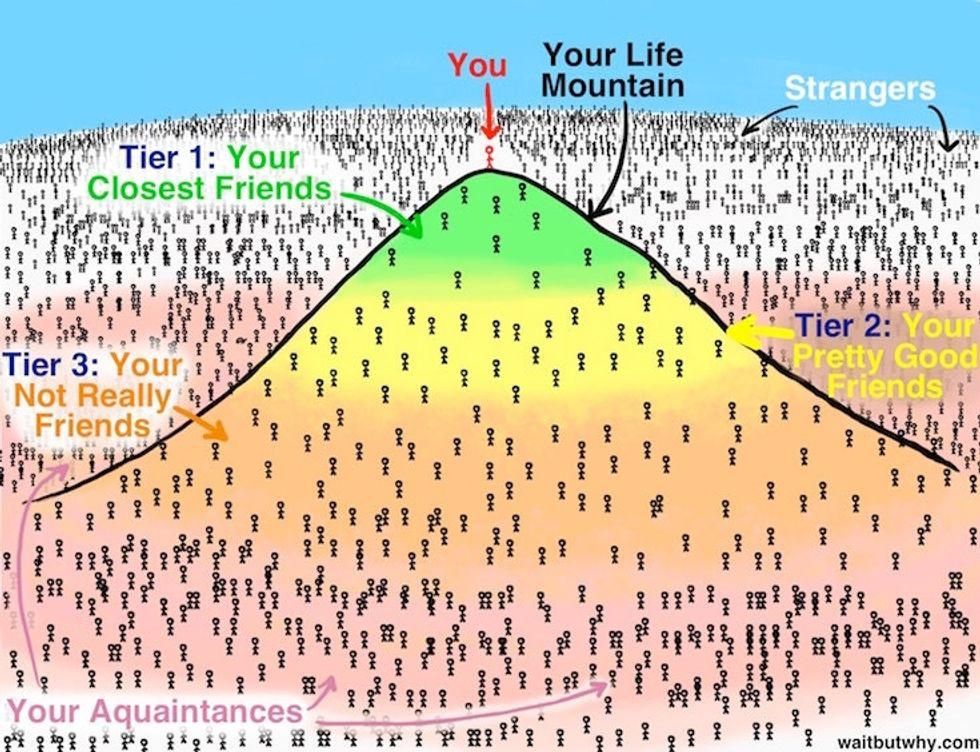
It looks something like this mountain:
Infographic of a mountain

Visual interpretation of where friends fall on the mountain of “You."

via Wait But Why post and used with permission.

At the top of your life mountain, in the green zone, you have your Tier 1 friends—the people who feel like brothers and sisters.

These are the people closest to you, the ones you call first when something important happens, the ones you love even when they suck, who make speeches at your wedding, whose best and worst sides you know through and through, and whose relationship with you is eternal; even if you go months or years without hanging out, nothing has changed when you find yourself together again.

Unfortunately, depending on how things went down in your youth, Tier 1 can also contain your worst enemies, the people who can ruin your day with one subtle jab that only they could word so brilliantly hurtfully, the people you feel a burning resentment for, or jealousy of, or competition with. Tier 1 is high stakes.

Below, in the yellow zone, are your Tier 2 friends: your Pretty Good friends.

Pretty Good friends are a much calmer situation than your brothers and sisters on Tier 1. You might be invited to their wedding, but you won't have any responsibilities once you're there. If you live in the same city, you might see them every month or two for dinner and have a great time when you do, but if one of you moves, you might not speak for the next year or two. And if something huge happens in their life, there's a good chance you'll hear it first from someone else.

Toward the bottom of the mountain in the orange zone, you have your Tier 3 friends: your Not Really friends.

You might grab a one-on-one drink with one of them when you move to their city, but then it surprises neither of you when five years pass and drink #2 is still yet to happen. Your relationship tends to exist mostly as part of a bigger group or through the occasional Facebook Like, and it doesn't even really stress you out when you hear that one of them made $5 million last year. You may also try to sleep with one of these people at any given time.

The lowest part of Tier 3 begins to blend indistinguishably into your large group of acquaintances (the pink zone): those people you'd stop and talk to if you saw them on the street or would maybe email for professional purposes but whom you'd never hang out with one-on-one. When you hear that something bad happens to one of these people, you might be sad but not too affected.

Finally, acquaintances gradually blend into the endless world of strangers.

And depending on who you are and how things shook out in those first 25 years, the way your particular mountain looks will vary.

For example, there's Walled-Off Wally:

Comic of a lone person on top of a mountain

Some people keep a barrier up between acquaintances.

via Wait But Why post and used with permission.

And Phony Phoebe, who tries to be everyone's best friend and ends up with a lot of people mad at her:

Comic of a mountain with a lot of people at the top

The life of the party.

via Wait But Why post and used with permission.

Even Unabomber Ulysses has a mountain:

Comic of a mostly empty mountain with one person at the top

Hermits exist.

via Wait But Why post and used with permission.

Whatever your particular mountain looks like, eventually the blur of your youth is behind you, the dust has settled, and there you are living your life.

Then one day, usually around your mid or late 20s, it hits you: It's not that easy to make friends anymore.

Sure, you'll make new friends in the future—at work, through your spouse, through your kids—but you won't get to that Tier 1 brothers level, or even to Tier 2, with very many of them because people who meet as adults don't tend to get through the 100+ long, lazy hangouts needed to reach a bond of that strength. As time goes on, you start to realize that the 20-year frenzy of not-especially-thought-through haphazard friend-making you just did was the critical process of you making most of your lifelong friends.

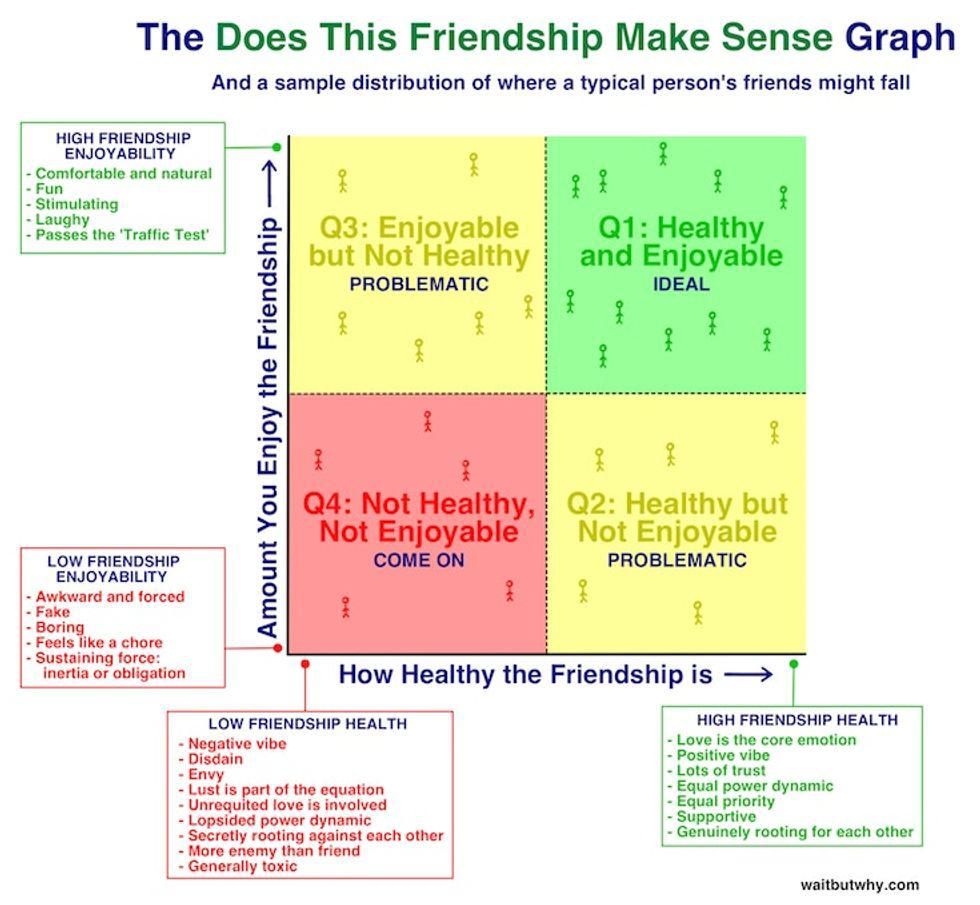
And since you matched up with most of them A) by circumstance, and B) before you really knew yourself yet, the result is that your Tier 1 and Tier 2 friends—those closest to you—fall in a very scattered way on what I'll call the Does This Friendship Make Sense? Graph:
Graph

The friendship graph.

via Wait But Why post and used with permission.

So, who are all those close friends in the three non-ideal quadrants?

As time goes on, most of us tend to have fewer friends in Quadrants 2 through 4 because A) people mature, and B) people have more self-respect and higher standards for what they'll deal with as they get older. But the fact is, friendships made in the formative years often stick, whether they're ideal or not, leaving most of us with a portion of our Tier 1 and Tier 2 friendships that just don't make that much sense. We'll get to the great, Quadrant 1 friendships later in the post, but in order to treat those relationships properly, we need to take a thorough look at the odd ones first.

Here are 10 common ones:

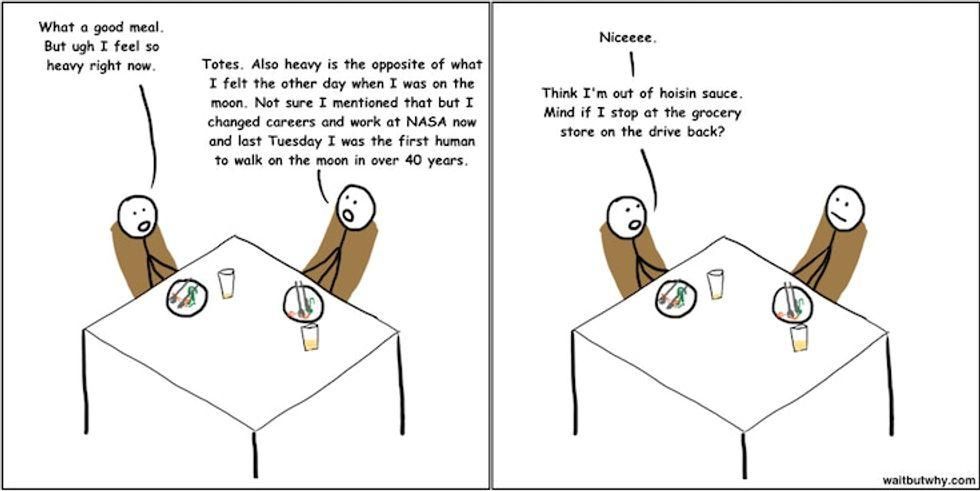
1. The non-question-asking friend
Comic of two people at dinner

Odd moments that happen between friends.

via Wait But Why post and used with permission.

You'll be having a good day. You'll be having a bad day. You'll be happy at work. You'll quit your job. You'll fall in love. You'll catch your new love cheating on you and murder them both in an act of incredible passion. And it doesn't matter, because none of it will be discussed with The Non-Question-Asking Friend, who never, ever, ever asks you anything about your life. This friend can be explained in one of three ways:

  1. He's extremely self-absorbed and only wants to talk about himself.
  2. He avoids getting close to people and doesn't want to talk about either you or himself or anything personal, just third-party topics.
  3. He thinks you're insufferably self-absorbed and knows if he asks you about your life, you'll talk his ear off about it.

Giving you the benefit of the doubt here, we're left with two possibilities. Possibility #1 isn't fun at all and this person should not be allowed space on Tier 1. The green part of the mountain is sacred territory, and super self-absorbed people shouldn't be permitted to set foot up there. Put him on Tier 2 and just be happy you're not dating him.

Possibility #2 is a pretty dark situation for your friend, but it can actually be fun for you. I have a friend who I've hung out with one-on-one about four times in the last year, and he has no idea Wait But Why exists. I've known him for 14 years and I'm not sure he knows if I have siblings or not. But I actually enjoy the shit out of this friend—sure, there's a limit on how close we'll ever be, but without ever spending time talking about our lives, we actually end up in a lot of fun, interesting conversations.

2. The friend in the group you can't be alone with under any circumstances

Comic of three stick people having a conversation

Why have relationships when there is a phone around?

via Wait But Why post and used with permission.

In almost every group of friends, there's one pair who can't ever be alone together. It's not that they dislike each other—they might get along great—it's just that they have no individual friendship with each other whatsoever. This leaves both of them petrified of the lumbering elephant that appears in the room anytime they're alone together. They're way too on top of shit to ever end up in the car alone together if a group is going somewhere in multiple cars, but there are smaller dangers afoot—like being the first two to arrive at a restaurant or being in a group of three when the third member goes to the bathroom.

The thing is, sometimes it's not even that these people couldn't have an individual friendship—it's just that they don't, and neither one has the guts to try to make that leap when things have gone on for so long as is.

3. The non-character-breaking friend you have to be “on" with
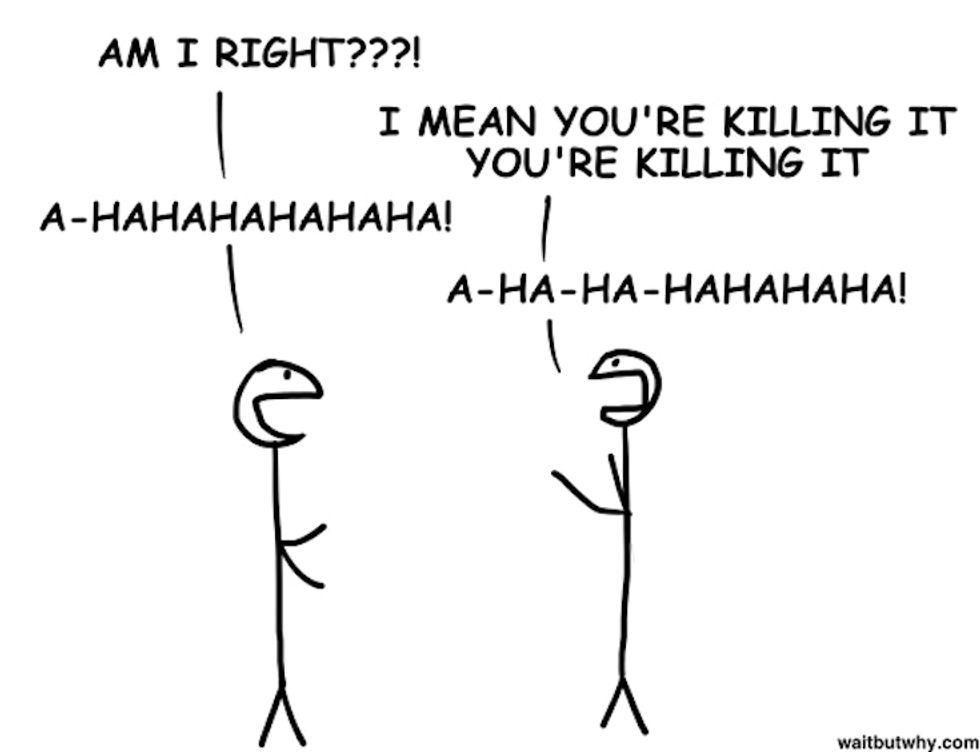
Comic of stick people laughing together

Controlled intimacy and distancing through language.

via Wait But Why post and used with permission.

This is a friend who's terrified of having an earnest interaction, and as such, your friendship with him is always in some kind of skityou always have to be on when you're interacting.

Sometimes the skit is that you both burst out laughing at everything constantly. He can only exist with you in “This is so fucking hilarious, it's too much!" mode, so you have to be in some kind of joke-telling or sarcastic mode yourself at all times or he'll become socially horrified.

Another version of this is the “always and only ironic" friend, who you really bum out if you ever break that social shell and say something earnest. This type of person hates earnest people because someone being earnest dares him to come out from under his ironic safety blanket and let the sun touch his face, and no fucking thanks.

A third example is the “You're great, I'm great, ugh why is everyone else so terrible and not great like us" friend. Of course, she doesn't really think you're perfectly great at all—if she were with someone else, you'd be one of the voodoo dolls on the table to be dissected and scoffed at. The key here is that the two of you must be on a team at all times while interacting. The only comfortable mode for this person is bonding with you by building a little pedestal for you both to stand on while you criticize everyone else. You can either play along and everything will go smoothly, even though you'll both despise yourselves and each other the whole time, or you can commit the ultimate sin and have the integrity to disagree with the friend or defend a non-present party the friend criticizes. Doing this will shatter the fragile team vibe and make the friend recoil and say something quietly like, “Hm ... yeah ... I guess." The friend now respects you for the first time and will also criticize you extra hard next time she's playing her pedestal game with a different friend.

What these all have in common is the friend has tall walls up, at least toward you, and so she builds a little skit for you two to hang out in to make sure any authentic connection can be avoided. Sometimes that person only does this out of her own social anxiety and can become a great, authentic friend if you can just stomp through the ice. Other times, the person is just hopelessly scared and closed off and there's no hope and you have to get out.

In any case, I can't stand these interactions and am in a full panic the entire time they're happening.

4. The double-obligated friendship
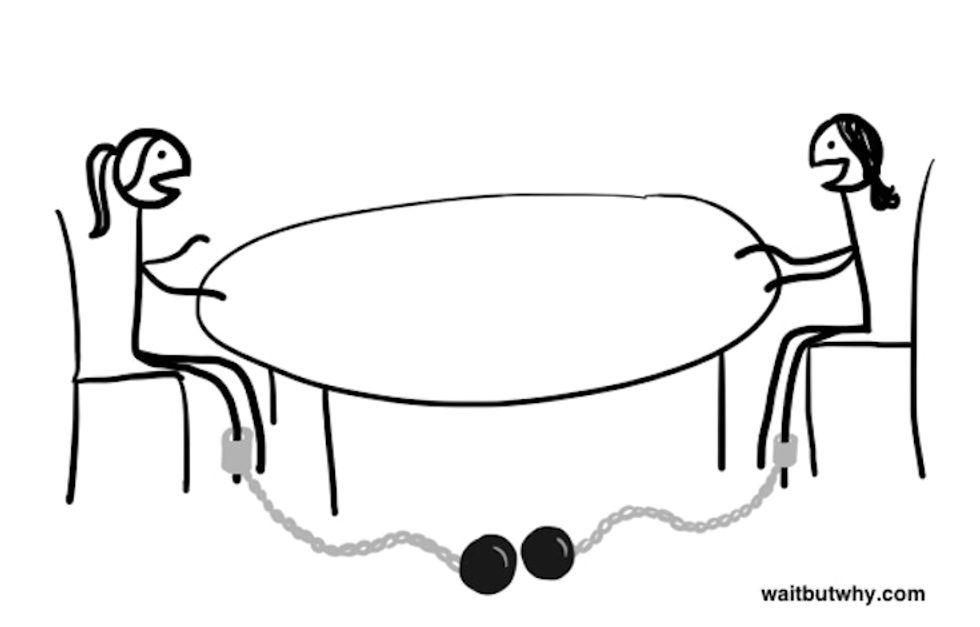
Comic of two men chatting a table with balls and chains around their legs

I think we need a bigger table.

via Wait But Why post and used with permission.

Think of a friend you get together with from time to time, which usually happens after a long and lackluster email or text exchange during which you just can't find a time that works for both of you — and you're never really happy when these plans are being made and not really psyched when you wake up and it's finally on your schedule for that day.

Maybe you're aware that you don't want to be friends with that person, or maybe you're delusional about it — but what you're most likely not aware of is that they probably don't want to see you either.

There are lopsided situations where one person is far more interested in hanging out than the other (we'll get to those later), but in the case we're talking about here, both parties often think it's a lopsided situation without realizing that the other person actually feels the same way — that's why it takes so long to schedule a time. When someone's excited about something, they figure out how to get it into their schedule; when they're not, they figure out ways to push it farther into the future.

Sometimes you don't think hard enough about it to even realize you don't like being friends with the person, and other times you really like the idea or the aesthetic of being friends with that particular person — being friends with them is part of your Story. But even in cases where you're perfectly lucid about your feelings, since neither of you knows the other feels the same way and neither has the guts to just cut things off or move it down a tier, this friendship usually just continues along for eternity.

5. The half-marriage

Two stick people each holding a half of a heart

An ego boost through controlling the relationship.

via Wait But Why post and used with permission.

Somewhere in your life, you're probably part of a friendship that would be a marriage if only the other person weren't very, very, extremely not interested in that happening. 1 for 2 on yes votes — just one vote away — so close.

You might be on either side of this — and either way, it's one of the least healthy parts of your life. Fun!

If you're on the if only side of things, probably the right move is to get your fucking shit together? Ya know? This friendship is one long, continuous rejection of you as a human being, and you're just wallowing there in your yearning like a sobbing little seal. Plus, duh, if you gather your self-respect and move on with your life, it'll raise their perception of your value and they might actually become interested in you.

If you're on the Oh yeah, definitely not side of the situation, here's what's happening: There's this suffering human in the world, and you know they're suffering, and you fucking love it, because it gives your little ego a succulent sponge bath every time you hang out with them. You enjoy it so much you probably even lead them on intentionally, don't you — you make sure to keep just enough ambiguity in the situation that their bleeding heart continues to lather your ego from head to toe at your whim.

Both of you — go do something else.

6. The historical friend
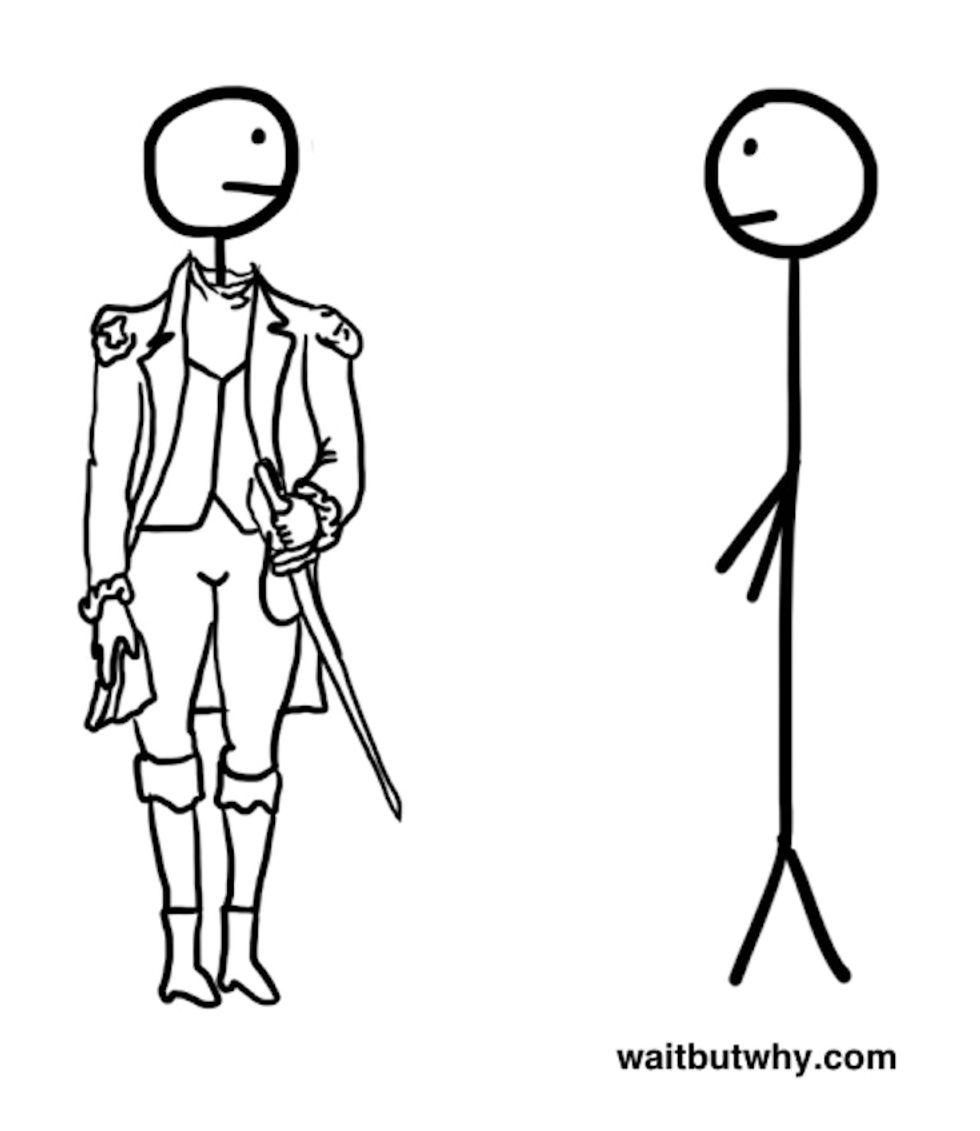
Stick person in historical garb beside a regular stick person

We met in kindergarten.

via Wait But Why post and used with permission.

A Historical Friend is someone you became friends with in the first place because you met when you were little and stayed friends through the years, even though you're a very weird match. Most old friends fall somewhat into this category, but a true Historical Friend is someone you absolutely would not be friends with if you met them today.

You're not especially pleased with who they are, and they feel the same way about you. You're not each other's type one bit. Unfortunately, you're also extremely close friends from when you were four, and you're both just a part of each other's situation forever, sorry.

7. The non-parallel life paths friendship
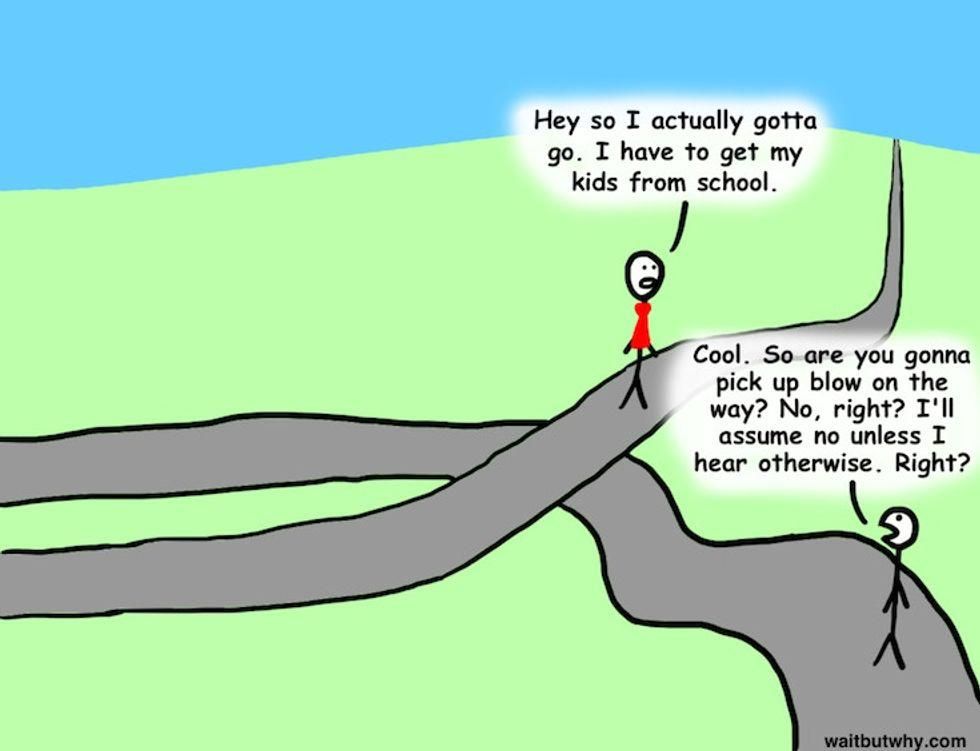
Two stick people on opposite paths

Looking for love in all the wrong places.

via Wait But Why post and used with permission.

Throughout childhood and much of young adulthood, most people your age are in the same life stage as you are. But when it comes to advancing into full adulthood, people do so at widely varying paces, which leads to certain friends suddenly having totally different existences from one another.

Anyone within three years of 30 has a bunch of these going on. It's just a weird time for everyone. Some people have become Future 52-year-olds, while others are super into being Previous 21-year-olds. At some point, things will start to meld together again, but being 30-ish is the friendship equivalent of a kid going through an awkward pubescent stage.

There are darker, more permanent Non-Parallel Life Path situations. Like when Person A starts to become a person who rejects material wealth, partially because she genuinely feels that pursuing an artistic path matters more and partially because she needs a defense mechanism against feeling envious of richer people, and Person B's path makes her scoff at people who pursue creative paths, partially because she genuinely thinks expressing yourself is an inherently narcissistic venture and partially because she needs a defense mechanism against feeling regretful that she never pursued her creative dreams — these two will have problems.

They may still like each other, but they can't be as close as they used to be — each of their lives is a bit of a middle finger at the other's choices, and that's jst awkward for everyone. It's not always that bad — but to survive an Off-Line Life Situation, friends need to be really different people who don't at all want the same things out of life.

8. The frenemy
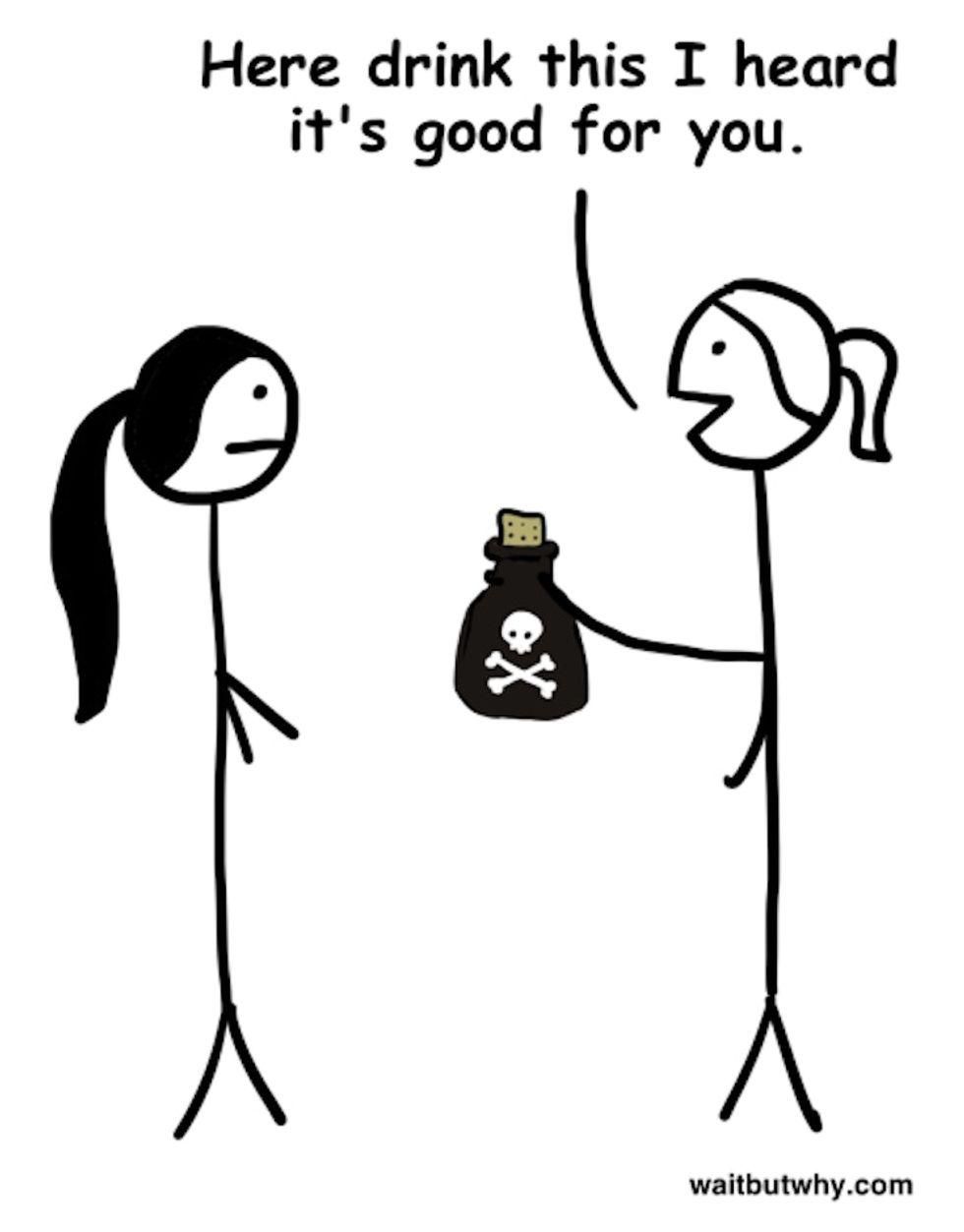
One stick person offers another stick person poison pretending it's safe

This is awful. Taste it.

via Wait But Why post and used with permission.

The Frenemy roots very hard against you. And I'm not talking about the friends that will feel a little twinge of pleasure when they hear your big break didn't pan out after all or that your relationship is in bad shape. I'm not even talking about someone who secretly roots against you when they're not doing so well at some area of life and it hurts them to see you do better. Those are bad emotions, but they can exist in people who are still good friends.

I'm talking about a real Frenemy — someone who really wants bad things for you. Because you're you.

You and the Frenemy usually go way back, have a very deep friendship, and the trouble probably started a long time ago. There's a lot of complex psychology going on in these situations that I don't fully understand, but my hunch is that a Frenemy's resentment is rooted in his own pain, or his own shortcomings, or his own regret — and for some reason, your existence stings them in these places hard.

A little less dark but no less harmful is a bully situation where a friend sees some weakness or vulnerability in you and she enjoys prodding you there either for sadistic reasons or to prop herself up.

A Frenemy knows how to hurt you better than anyone because you're deeply similar in some way and she knows how you're wired. She'll do whatever she can to bring you down any chance she gets, often in such a subtle way it's hard to see that it's happening.

Whatever the reason, if you have a Frenemy in your life, kick her toxic ass off your mountain, or at least kick her down the mountain — just get her off of Tier 1. A Frenemy has about a 10th of the power to hurt you from Tier 2 as she does from Tier 1.

9. The Facebook celebrity friend
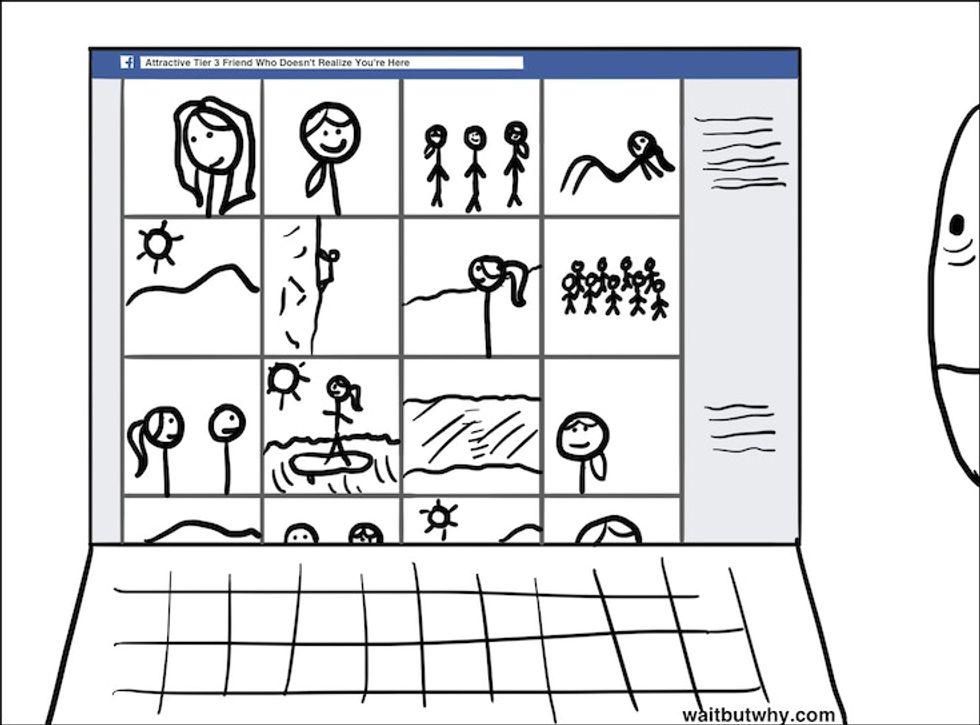
Comic of a computer with photo grid

What’s happening on social media?

via Wait But Why post and used with permission.

This person isn't a celebrity to anyone other than you, you creep. You know exactly who I'm talking about — there are a small handful of people whose Facebook page you're uncomfortably well-acquainted with, and those people have no idea that this is happening. On the plus side, there are people out there you haven't spoken to in seven years who know all about the new thing you're trying with your hair, since it goes both ways.

This is a rare Tier 3 friend, or even an acquaintance, who qualifies as an odd friendship because you found a way to make it unhealthy even though you're not actually friends. Well done.

10. The lopsided friendship
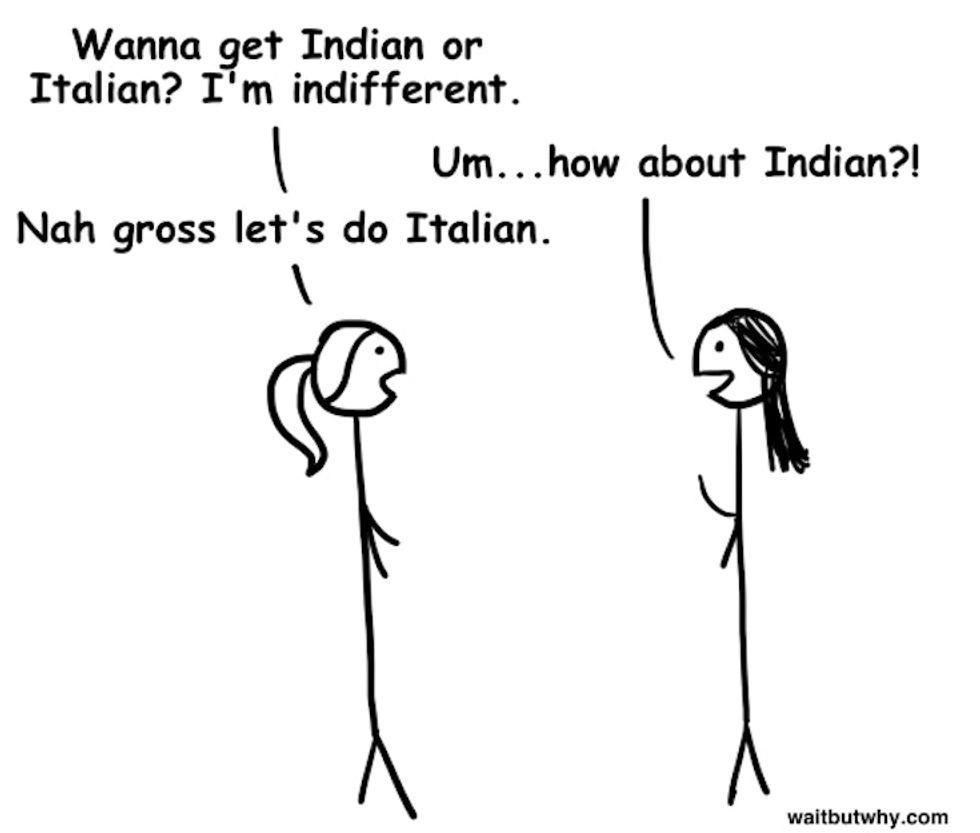
Two stick women discussing dinner

Can I make all the decisions... that was rhetorical.

via Wait But Why post and used with permission.

There are a lot of ways a friendship can be lopsided: Someone can be higher on their friend's mountain than vice versa. Someone can want to spend more time with a friend than vice versa. One member can consistently do 90% of the listening and only 10% of the talking, and in situations where most of the talking is about life problems, what's happening is a one-sided therapy situation, with a badly off-balance give-and-take ratio, and that's not much of a friendship—it's someone using someone else.

And then there's the lopsided power friendship. Of course, this is a hideous quality in many not-great couples, but it's also a prominent feature of plenty of friendships.

A near 50/50 friendship is ideal, but anything out to 65/35 is fine and can often be attributed to two different styles of personality. It's when the number gap gets even wider that something less healthy is going on—something that doesn't reflect very well on either party.

There are some obvious ways to assess the nature of a friendship's power dynamic: Does one person cut in and interrupt the other person while they're talking far more than the other way around? Is one person's opinion or preference just kind of understood to carry more weight than the other's? Is one person allowed to be more of a dick to the other than vice versa?

Another interesting litmus test is what I call the “mood determiner test." This comes into play when two friends get together but they're in very different moods — the idea is, whose mood “wins" and determines the mood of the hangout. If Person A is in a bad mood, Person B is in a good mood, and Person B reacts by being timid and respectful of Person A's mood, leaving the vibe down there until Person A snaps out of it on her own — but when the moods are reversed, Person B quickly disregards her own bad mood and acts more cheerful to match Person A's happy mood — and this is how it always goes — then Person A is in a serious power position.

But hey, not all friendships are grim.

In the Does This Friendship Make Sense graph above, the friendships we just discussed are all in Quadrants 2, 3, or 4 — i.e., they're all a bit unenjoyable, unhealthy, or both. That's why this has been depressing. On the bright side, there's also Quadrant 1—all the friendships that do make sense.

No friendship is perfect, but those in Quadrant 1 are doing what friendships are supposed to do: They're making the lives of both parties better. And when a friendship is both in Quadrant 1 of the graph and on Tier 1 of your mountain, that friendship is a rock in your life.

Rock friendships don't just make us happy — they're the thing (along with rock family and romantic relationships) that makes us happy.

Investing serious time and energy into those is a no-brainer long-term life strategy. But in the case of most people over 25—at least in New York— I think A) not enough time is carved out as dedicated friend time, and B) the time that is carved out is spread too thin, and too evenly, among the Tier 1 and Tier 2 friendships in all four quadrants. I'm definitely guilty of this myself.

There's something I call the Perpetual Catch-Up Trap. When you haven't seen a good friend in a long time, the first order of business is a big catch-up — you want to know what's going on in their career, with their girlfriend, with their family, etc., and they want to catch up on your life. In theory, once this happens, you can go back to just hanging out, shooting the shit, and actually being in the friendship. The problem is, when you don't make enough time for good friends, seeing them only for a meal and not that often — you end up spending each get-together catching up, and you never actually get to just enjoy the friendship or get far past the surface. That's the Perpetual Catch-Up Trap, and I find myself falling into it with way too many of the rocks in my life.

There are two orders of business right now:

First, think about your friendships, figure out which ones aren't in Quadrant 1, and demote them down the mountain. I'm not suggesting you stop being friends with those people—you still love them and feel loyal to them, and old friends are critical to hold onto—but if the friendships aren't that healthy or enjoyable, they don't really deserve to be in your Tier 1, and you probably shouldn't be in theirs. Most importantly, doing this clears up time to...

Second, dedicate even more time to the Quadrant 1, Tier 1 rocks in your life. If you're in your mid-20s or older, your current rocks are probably the only ones you'll ever have. Your rock friendships don't warrant two times the time you give to your other friends—they warrant five or 10 times!

Your rocks deserve serious, dedicated time so you can stay close. So go make plans with them.


This article was written by Tim Urban and originally published on Wait But Why. It originally appeared here nine years ago.

old letter, 1959, tony trapani, letter, secret letters, love letter, love stories, dads, fatherhood, father and son, parents, parenting
via SHVETS production/Pexels and Suzy Hazelwood/Pexels
Tony Trapani discovers a letter his wife hid from him since 1959.

Writing a letter is truly a lost art form, and many young people will never know the joy of it. You had to choose your words carefully and say everything you wanted to say. Once you sent it off, there was no way to be sure it was delivered. No way to know if it had been opened or read. You couldn't take it back or send it again. You just put it in the mailbox and hoped for the best. It was excruciating and magical all at the same time.

One story of a letter never delivered has captured the hearts of readers everywhere. A heart-warming local news story gone viral for the best reasons.


Tony Trapani and his wife were married for 50 years despite the heartache of being unable to have children. "She wanted children,” Trapani told Fox 17. "She couldn't have any. She tried and tried." Even though they endured the pain of infertility, Tony's love for his wife never wavered and he cherished every moment they spent together.

letter, secret letters, love letter, love stories, dads, fatherhood, father and son, parents, parenting Tony Trapani received the most important letter of his life, but he didn't see it for 50 years Photo by Álvaro Serrano on Unsplash

After his wife passed away when Tony was 81 years old, he undertook the heartbreaking task of sorting out all of her belongings. In particular was a mountain of papers stuffed into filing cabinets. Trapani diligently went through every single one.

That’s when he stumbled upon a carefully concealed letter in a filing cabinet hidden for over half a century.

The letter was addressed to Tony and dated March 1959, but this was the first time he had seen it. His wife must have opened it, read it and hid it from him. The letter came from Shirley Childress, a woman Tony had once been close with before his marriage. She reached out, reminiscing about their past and revealing a secret that would change Tony's world forever.

"Dear Tony, I bet you are surprised to hear from me after so many years. I was just thinking about you tonight like so many other nights. But I thought I would write you and find out how you are," the letter reads. "Tony, please don't be angry or surprised to hear this. I have a little boy. He is five-years- old now - grey eyes and beautiful black hair. What I am trying to say Tony is he is your son."


"Please, Tony if you can find it in your heart to forgive me, please come and see him," Shirley wrote in the letter. "Every day he asks me where is his daddy and believe me Tony I can't even answer him anymore. I would be forever grateful to you if you would just see him. ... I'll close now hoping and praying you will answer. P.S. His name is Samuel Duane."

Now, Tony faced the fact that he had a son that would be around 60 years old and he set out to find him.

For over a year, Trapani’s sister tried to track down the mysterious Samuel Duane Childress, until she finally contacted his wife, Donna.

Tony and Samuel met in January 2015 and he felt like a new dad. After meeting his father, Samuel said his mother told him she sent the letter, but Tony never responded. "Why my wife didn't tell me," said Trapani, "I don't know. She wanted children. She couldn't have any. She tried and tried."

It's easy to understand why it may have been hard for Trapani's late wife, Dolly, to pass along that sort of news. Though we'll never know what exactly must have been in her heart and mind when she hid the letter all those years ago.

"I always asked my mom, I said, 'Well what does he look like?'' Samuel said. "She said, 'Well, go look in the mirror."

The two met and caught up on a lifetime of memories with the understanding that they could never change the past. "Just to know him now is so important to me. It's going to fill that void," Samuel said.

But just to be sure, Tony took a paternity test to ensure they were father and son. Stunning everyone involved, the test came back negative. Tony was not the father.


letter, secret letters, love letter, love stories, dads, fatherhood, father and son, parents, parenting Tony and Samuel didn't waste time thinking about what might have been if he'd seen the letter earlier. Photo by Ire Photocreative on Unsplash

The news upset Tony and Samuel, but they still had a unique bond. They shared a relationship with Samuel’s mother and both have been on an incredibly wild ride after Tony found the mysterious letter.

“They're keeping that bond,” Donna said. “That paper doesn't mean anything to him. That bond has been made—and we're going to move on from here.”

Tony Trapani passed away in 2017, leaving him just two short years to connect with the man he once believed to be his son. If he'd seen the letter earlier, maybe they would have had more time. But that's all in the past, and by all accounts the men treasured the time they got together, and the relationship that they did have — not the one they wished for.

This article originally appeared earlier this year. It has been updated.

Community

Uber driver with Tourette's goes viral sharing her unforgettable interactions with riders

"Honesty, humor, and human connection can change the way the world sees Tourette’s."

uber driver, passenger, ride share, tourette syndrome

A woman drives an Uber. A passenger gets in.

Not all heroes wear capes, but some do drive Uber. Jeanna DiVietro is one such hero who has a big laugh, infectious positivity, and the ability to be so vulnerable that she puts many of her passengers at ease. In fact, some seem to become "unexpected friends" in just five minutes flat.

The thing is, DiVietro has Tourette Syndrome, which presents in tics, both physical and vocal. Rather than letting that be a barrier for her, she uses it as a way to educate others. With the rider's permission, of course, she films the interactions and shares them on social media to reach a larger audience.


And she's simply delightful while doing it. In many videos, she has at least one passenger sitting in the front seat and explains to them that she has Tourette Syndrome. In one clip, there's a woman up front when one of DiVietro's tics causes her to scream. They both wind up laughing, with the passenger exclaiming, "This is the best Uber ride ever!" Our driver responds, "Oh yay, I'm so excited!" This is followed by the yelling of "Wh--e!" and again they both laugh. "You're not a wh--e," she assures the rider, who jokingly quips back, "I might be!"

Here's where DiVietro begins to educate. She shares, "I've always had a great attitude with Tourette Syndrome. I just want to help other people have a good attitude too. So that way they can accomplish things that they never thought they were ever able to accomplish. Look at me, I'm an Uber driver, traveling nationwide. I'm also a photographer." She then screams, "Click click b---h!" to which our understanding passenger laughs, "Did you get the picture? Was it my good side?"

The comments are completely understanding and supportive. This clip alone has nearly half a million likes and thousands of comments. One person suggests, "She needs a full-on SERIES!"

Another admits, " This is an Uber ride I would love! My husband says I'm not supposed to laugh, it's rude. Is it considered rude? Because this is hilarious." DiVietro puts her at ease, writing, "No it's not rude, because I too am laughing!"

One person even asks, "Wait are you the lady who picked up a passenger who also had Tourette's? That was the best video!" DiVietro answers, "Yes I am and thank you!"

It turns out the clip in question involved a man in Evansville whom she notes did not, in fact, have the disorder but was "playing along." But, she shares, she "was not offended one bit." They seemed to have an ultimate blast.

Another heartwarming clip shows DiVietro, having presumably explained that she has Tourette Syndrome to a young man, laughing uproariously when he mishears "Tourette's" it as "T-Rex." "I need to Google 'how do I help T-Rex?'" She then explains the correct word, which leads them to finding their inner dinosaurs and roaring a few times.

The passenger tells her that he's a rapper (CEO DEE) and she's incredibly supportive, immediately asking where she can listen to his music. Once again, the comment section doesn't disappoint. They link to his Instagram and share it with DiVietro.

Others in the comments focus on the dinosaur of it all. "This is so funny. The dinosaur impersonation took me out." Another notes that is seems to be a lovely plutonic connection "What do you get when you put a guy with the munchies and a female "t-rex" in the same car? A beautiful friendship."

Currently, there's a fan-funded documentary in the making. According to DiVietro's website, it will document her life in and out of Uber across the South and the Midwest. "This isn’t just a road trip. It’s a movement to show that honesty, humor, and human connection can change the way the world sees Tourette’s."

As exemplified by DiVietro's vocal tics, Tourette's is one type of tic disorder. According to their informational website Tourette.org, it's "a neurodevelopmental disorder that affects children, adolescents and adults. The condition is characterized by sudden, involuntary movements and/or sounds called tics. Tics can range from mild/inconsequential to moderate and severe, and are disabling in some cases."

Tourette Syndrome is explained. www.youtube.com, Tourette Association of America

DiVietro doesn't let this disorder define her. On the contrary, she uses it to sparkle and clearly make beautiful connections. The hope is that she is able to inspire others to do the same.

time off requests, pto, sick leave, gen z manager, manager positions, asking for time off

This Manager thinks PTO is for vacation, not "life changing events."

What does it take to be a good boss? You can answer this a million different ways—by being a clear communicator, earning employee trust, providing constructive feedback, and fostering a positive and supportive work environment while also being open to feedback and recognizing your team's contributions—but really, it all seems to stem from respecting your employees as fellow human beings.

Part of that means acknowledging that these employees have lives that are, frankly, more important to them than the job, and not penalizing them for it. One manager, and Gen Zer no less, seems to fully understand this basic principle, and folks are applauding her for it.


Elizabeth Beggs, who manages a five-person team for a packaging distribution company in Virginia, recently made a TikTok sharing which time-off requests she “rejects. ”You’ll see why “rejects” is in quotes shortly.

One example: when a female rep notified Beggs that she was likely having a miscarriage. After the team member asked how she can file for time off to see to the issue, Beggs immediately responded, “Girl, go to the doctor! We’re not submitting time off for that!”

In Beggs’ mind, PTO is for “vacation,” not medical emergencies. What a concept.

@bunchesofbeggs

Edited to clarify- 1. My team is all salary. 2. These examples are not all recent or from my current position. 3. My team works hard and hits thier KPIs above and beyond. Time off is meant to recharge and be used how you need it, not to handle life changing events #mangers #corporate #genzmanagers #sales #vetstocorporate #veterans

Beggs went on to explain a couple more situations, like when one employee—a parent—was “up all night” with their sick kid. And her last one wasn’t even negative—she had an employee who wanted to work a half-day to do something nice for their anniversary.

“Seriously, if any of these triggered anyone, then you need to evaluate how you run your team as a manager,” she concluded.

By and large, the response to Beggs’ management style has been overwhelmingly positive, and people seem to find it completely refreshing.

“You are not a manager, you’re a LEADER,” one person wrote.

@bunchesofbeggs

Everything you do should be to better your team, not to make your life easier #leadership #ownership #corporatelife #veteran #military

Another said, “The better you treat your employees, the more loyal they will be and the better work they will put out. Most people do not understand how management works.”

A few noted how this attitude seems to be more present among younger leaders. One person commented, "millennial manager here. My team members are human first, employees second. Like just go do what you want but get the work done too.”

Another joked that “Boomer managers could NEVER.”

Beggs would later clarify this doesn’t mean she doesn't have clear productivity expectations for her team (who work on salary). Perhaps if she had a team member not making their KPIs (key performance indicators), there would be an additional conversation surrounding time off, but there is still an inherent respect as a fellow human being. Which, to her, means treating bona fide time off as a way to “recharge and be used how you need it, not to handle life changing events.”

@bunchesofbeggs

If you’re planning does not account for people being human- it’s bad planning #genzleaders #armyvet #militaryvet #genz #corporatelife #corporate #manager #timeoff

Younger generations might get labeled “lazy” or “entitled,” but they are also the ones fighting to change the status quo so that we all may be treated less like cogs in the machine, and more like actual human beings. Its leaders like Beggs who show that operating in new ways doesn't compromise productivity—it, in fact, enhances it. We might not be able to change the global standard overnight, but we certainly aren’t going to get to a better place without leaders who choose to serve their community rather than a bottom line.

This article originally appeared in March.

time, neil degrasse tyson, time flies, perception of time. clock, science,

A clock and Neil deGrasse Tyson.

When you’re a kid, time passes a lot more slowly than when you’re an adult. At the age of seven, summer seems to go on forever, and the wait from New Year’s Day to Christmas feels like a decade. As an adult, time seems to go faster and faster until one weekend you’re putting up your Christmas lights though you swear you just took ‘em down a month ago.

Why does time seem to speed up as we get older? Astrophysicist Neil deGrasse Tyson recently explained the phenomenon in a video posted to Instagram. He also offered tips on how to slow the passage of time as you age. DeGrasse Tyson is one of the most popular science communicators in the world and the host of 2014's Cosmos: A Spacetime Odyssey and 2020’s Cosmos: Possible Worlds.


Why does time appear to speed up as we get older?


“When you're young, everything is new. Your brain is constantly recording fresh memories, and the more memory your brain stores, the longer the experience feels. But then something changes. As you get older, routines take over. Your brain stops saving so much detail. It switches to autopilot because everything feels familiar and predictable,” deGrasse Tyson explains. “And when your brain stores fewer new memories, your perception of time compresses. That's why childhood feels long, and adulthood feels like a blur.”


Steve Taylor, PhD, author of many best-selling books including Time Expansion Experience, The Leap, and Spiritual ScienceThe Leap, and Spiritual Science, agrees with deGrasse Tyson.

“This is mainly because, as children, we have so many new experiences, and so process a massive amount of perceptual information,” Taylor writes at Psychology Today. “Children also have an unfiltered and intense perception of the world, which makes their surroundings appear more vivid. However, as we get older, we have progressively fewer new experiences. Equally importantly, our perception of the world becomes more automatic. We grow progressively desensitized to our surroundings. As a result, we gradually absorb less information, which means time passes more quickly. Time is less stretched with information.”

How do we make time slow down?

There’s something a little depressing about the idea that time speeds up as we age because we have fallen into predictable routines. The good news is that we can break this cycle by changing our habits and having new experiences. The more novel information we can process and the less routine our lives become, the slower time will move.

DeGrasse Tyson believes that with some change in our behaviors, we can get back to longer summers and Christmases that aren’t perpetually around the corner.

“You can actually slow time down again. Do something unfamiliar,” deGrasse Tysons says. "Travel somewhere new. Break a routine you've repeated for years. Learn a skill your brain hasn't mapped yet. Because the more new memories your brain forms, the slower time feels as it passes. So if life feels like it's accelerating, it's not your age. It's your brain, and you can reboot it.”

christmas, holidays, christmas gifts, nostalgia, 60s, 70s, 80s, 90s, tickle me elmo, easy bake oven, chatty cathy
Kevin Labianco/Flickr, Rochelle Lockridge/Flickr, Bradross63/Wikimedia Commons

Adults share the nostalgic "must-have" Christmas gifts from their youths.

Christmas as a kid was the absolute best: crafting your wish list with care; the anticipation as presents began to appear under the tree; the lights, the cookies. It was pure magic. Though the holidays are still special in their own way once you're grown, most of us would love a chance to feel like a little kid again on Christmas morning.

One small way adults are recapturing that nostalgia is by remembering the most in-demand, highly anticipated toys and games from their childhood—the ones every kid wanted for Christmas. The ones that had Mom and Dad standing outside Toys R Us at 5 a.m. The ones that prompted panicked reports on the evening news about toy shortages and checkout line mayhem.


Here are 11 of the hottest toys of all time that topped Christmas lists in the 50s, 60s, 70s, 80s, 90s, and even early 2000s.

1. Baby All Gone

This doll, released in 1991, was pure witchcraft for kids who saw the commercials on TV. You could make it drink milk or eat cherries which would then just...disappear.

"It is sweet how a simple toy like Baby All Gone can bring back warm memories, because those disappearing milk and cherries remind us of a time when childhood felt magical and full of small joys," one user wrote on X.

"I never understood where the cherries went. Did they go in the mouth or the spoon? Perplexed," added another.

All we know is that we wanted it.

2. Easy-Bake Oven

In 1963, the toy company Kenner changed the game when they released the Easy-Bake Oven and allowed kids to cook their own brownies and cakes with a small lightbulb. The original design came in turquoise and yellow, and sold out during its first holiday season. The demand was so high that the company tripled production for the next year.

Simply put, everyone wanted one.

"I remember the way the pastries tasted. Even to this day. And how disappointed I became when it took so long to bake. But the smell....I'm pretty sure I still remember how it smells," one user wrote on Reddit.

- YouTube www.youtube.com

3. Tickle Me Elmo

Perhaps the wildest Christmas toy craze of all time, Tickle Me Elmo was actually released in the summer of 1996. It didn't became a phenomenon until shortly after Thanksgiving, when a feature on Rosie O'Donnell and news reports of low stock prompted panicked parents to risk life and limb to get their hands on one.

By the end of Christmas that year, and after many injuries and in-store brawls, Tyco had sold over a million Tickle Me Elmos.

"That year only one kid in my class got one and they brought it to school to show everyone. Apparently they were extremely hard to find and their parents waited outside a store before they opened just to get one," a user wrote on Reddit.

christmas, holidays, christmas gifts, nostalgia, 60s, 70s, 80s, 90s, tickle me elmo, easy bake oven, chatty cathy Tickle Me Elmo changed Christmas as we know it in the 90s.Kevin Labianco/Flickr

4. Chatty Cathy

Long before Tickle Me Elmo hit the scene, and way before the term "Chatty Cathy" was used to refer to someone who couldn't stop talking, kids in the '50s and '60s were falling all over themselves to get a hold of this talking doll. Chatty Cathy was the original pull-string doll, coming pre-programmed with seven different talking phrases. This was big news at the time.

One Reddit user reports never giving up on her dream of owning a Chatty Cathy, and finally finding one at an antique mall many years later:

from Dolls


5. A rock tumbler

Rock tumblers, which could magically transform rocks you found in your backyard into shiny gems or egg-smooth pearls, became hugely popular in the 1960s. They were a staple of every toy catalog for decades, but parents were often wary because they could be expensive and loud (especially in the early days). A kid could dream, though.

"I never did get that dang rock tumbler. I circled it so many times in the JCPenney Christmas catalog (it was the 80s), that I remember the paper nearly being torn through," a Redditor wrote.

6. Barbie Dreamhouse / Malibu Barbie Beach House

Barbie was released in the late 1950s, but the craze really went to the next level in 1962 when the first Barbie Dreamhouse came out. The Museum of Arts and Design writes that Barbie's pad was different from anything else on the market at that time:

"While other dollhouses of the time featured baby rooms and kitchens, Barbie’s house was in a league of its own. It looked like a modern studio apartment in NYC—complete with sleek modernist furniture, a TV console, a record player, and even a bookshelf stocked with fiction and Encyclopedia Britannica, showcasing Barbie’s love for learning! Barbie’s walls proudly displayed college pennants, proving she was educated and ambitious. She even had a fabulous dressing area and closet—because we know Barbie is all about fashion."

It wasn't until decades later that Barbie decided to move to the beach in Malibu, getting a whole new playset as a result. One Redditor writes that the Beach House was their dream house, but sadly, it was not meant to be:

"[I always wanted] a Malibu Barbie Beach House. We were a military family and it wouldn't have made all the moves"

- YouTube www.youtube.com

7. Moon Shoes

There's not much to say about Moon Shoes. If you came of age at a time where you saw the commercial on TV, you know all you need to know about them. "Kid-powered anti-gravity" shoes? Sold! What kid wouldn't be obsessed?

Most of us were not lucky enough to get our hands on a pair of Moon Shoes, sadly. Whether it was the price tag or the high likelihood of injury, a lot of parents had to say No.

"Moon shoes. [Dang] did I want some moon shoes. Growing up we were really tight in money. Only necessary items with a few wants if we could afford it," one user writes.

- YouTube www.youtube.com

8. Power Wheels

Power Wheels are the ultimate "everyone wanted it, nobody got it," Christmas present. If you grew up in the '80s or '90s, you knew precisely one kid who had one, and they were the envy of everyone at school.

Released in 1984, the early models cost between $129 and $150 to start. That would be a whopping $375 in today's money—definitely steep for most families. But all '80s and '90s kids dreamed of cruising down the street in their very own mini Jeep.

from The1980s


9. Furbies

One of the few toy crazes that lived up to the Tickle Me Elmo madness of 1996, Furbies took the world by storm in 1998.

Where Tickle Me Elmo seemed to be mostly driven by news and product scarcity, a lot of kids really, genuinely wanted a Furbie—they could talk to you, after all, gradually transitioning from speaking their own gibberish language to speaking English. They could even communicate with each other.

There were even rumors that China and other countries were using Furbies to spy on Americans, and the NSA actually banned Furbies from its properties. Sadly, those stories kept a lot of eager kids from realizing their holiday dreams:

"I wanted one but I wasn't allowed one, my Mom believed the 'OMG DEY R SPYING DEVICES!!!!' stories that the news was pushing at the time," wrote on Redditor.

- YouTube www.youtube.com


10. Joe Namath Electric Football Game

Before there was Playstation and Xbox and John Madden football, there was Joe Namath. The vibrating, magnetic foosball-like game may not look like much by today's standards, but kids in the '60s got hours and hours of joy out of it.

"OK, old timer here," one Redditor wrote. "The must get present was the old 'electronic' football game where the big metal field vibrated the little players chaotically around the field."

"My parents bought one of these for me for Christmas in the early 70s. I was in 2nd grade at the time. By the time I hit junior high school, my friends and I played this all the time," a YouTube commenter added.


- YouTube www.youtube.com

11. Hi Heidi doll

Another hit from the '60s, Heidi's selling point was that she could wave and came in her own little pocketbook. Ah, simpler times!

One Redditor shares a harrowing story behind never getting her own Hi Heidi in the '60s:

"I wanted one soooo bad. My dad's company had a Christmas party when I was a kid, and they had a show in an auditorium with a glass display case. At the end of the show, they called up the kids in the order of their dads' importance (president, vp, management, workers) and we got to choose a gift from the case. When it was my turn, the only Hi Heidi dolls that were left were black ones, and they wouldn't let me, a little blonde girl, have one. I was so upset, and ended up with a hula hoop, instead. Never did get a Hi Heidi."

- YouTube www.youtube.com

We've barely scratched the surface of the hottest "must-have" Christmas gifts in history. Adults all over social media continue to go gaga over erector sets, tether race cars, Polly Pocket, Tamogatchi, Teddy Ruxpin, and more.

It's amazing how the commercials, catalog spreads, or TV jingles for these toys can take you right back to Christmas morning. It's fun to remember a time when our biggest dreams were to play, bake, or jump high in the sky with anti-gravity boots. Celebrating with our own kids or the children in our lives is one small way we can recapture a little bit of that magic year after year.