upworthy
Add Upworthy to your Google News feed.
Google News Button
Pop Culture

Younger people are admitting baby boomers got these 17 things right

"Kids shouldn't be on phones or iPads all the time. It makes them weird."
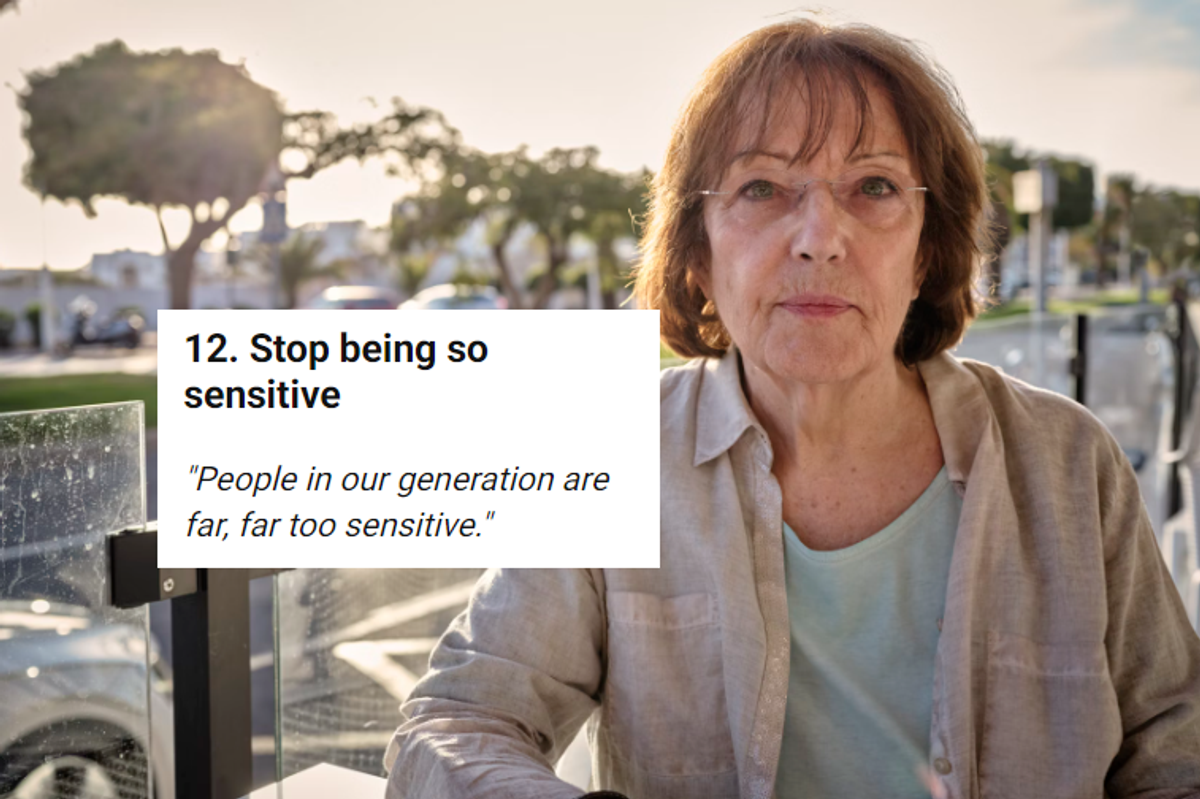
an older woman standing outside looking stern beside overlay of comment that reads, "12. Stop being so sensitive"

Baby boomers didn't get everything wrong.

In recent years, baby boomers have often been the target of criticism from younger generations. The most common accusations are that boomers are selfish and don’t care about leaving ample resources (whether financial or environmental) to subsequent generations. They also come under fire for not being able to acknowledge that it was easier for people of their generation to come of age when things were more affordable and life was a lot less competitive.

However, we should also understand that many of today’s problems are not the boomers’ doing, especially when it comes to the issues that stem from entitled children and technology run amok. In hindsight, there’s something to be said about the importance boomers placed on self-reliance, letting kids be kids, and having a healthy skepticism towards technology.

In the end, each generation contributes to the tapestry of society in its unique way, whether good or bad, even baby boomers. This became evident after a Reddit user named Youssef4573 asked the AskReddit subforum: ‘What is something you can say ‘I'm with the boomers on this one’ about?” Over 4,700 people responded to the prompt, and the most prevalent problems mentioned by the younger generations were overreliance on technology, the modern world’s lack of human touch, and how Gen Xers and millennials have raised their children.

Here are 17 things that younger people are “with the boomers” about.

1. Public filming

"Just because I’m in public doesn’t mean I want to be filmed. Yeah, I know legally you can, but common courtesy people." — Jayne_of_Canton

2. Customer service

"I want to talk to a person in customer service, not a machine." — lumpy_space_queenie

"And also a person that actually works at the company I bought the product from, not a teenager at an outsourced call center with a script to follow and who answers calls for 15 different companies on the same day." — Loive.

3. Turn up the dialog

"For the love of all that is holy, can we fix the audio in movies so that the music and sound FX aren’t drowning out the dialogue?" — Caloso

"And the action sequences don’t burst your eardrums or the dialogue is whispers." — Whynottry-again

4. Bring back buttons

"No, I don't need everything in my car to be electronic. Some stuff needs buttons." — LamborghiniHEAT

"This was the big thing for me in my last car - trying to adjust volume or change songs while driving is way more dangerous when it’s all touch screen. Thankfully my current car has physical knobs for everything." — GeekdomCentral

5. App overload

"Every store/service does not need an app." — BigDigger324

"I was standing at a car rental counter at an airport (boomer here) to rent a car. My daughter’s car broke down on the way to pick me up. While standing at the counter, with a customer service rep right there and not busy, I had to log in to their site, create an account, and reserve a car. It seemed ridiculous and it took a long time, filling in my license information and all that. This was last September." — Cleanslate

6. Bring back DIY

"Learning DIY skills is crucial. I had basically zero DIY skills when I bought my house because I had lived in apartments for so long and I've had to learn a lot. YouTube tutorials are absolutely clutch." — JingleJongleBongle

7. Turn off the speakerphone

"I hated this when I worked at Walmart. So many of my coworkers would talk on speaker or watch TikTok at full volume. It's just trashy imo, nobody wants to hear your media." — WhiteGuy1x

"I work at an emergency medical office and holy sh*t the amount of people that sit in a quiet, peaceful lobby and just have the LOUDEST conversations on their phone…. Speaker or otherwise. Not to mention the people that still watch sh*t without headphones. Like do you not see the plethora of other people around you that you’re disturbing?" — Cinderpuppins

8. Ban QR code menus

"I think menus should be tangible." — Limp-Management9684

"QR codes kill the vibe. We’re all on our phones constantly throughout the day and then when you go to spend some quality time with someone, it’s another excuse to whip out the phone and stare at it. There’s an intimacy to a physical menu. You’re looking at what the other person is reading, you’re each pointing to parts of the menu. You’re noticing the lighting of the restaurant. QR codes feel chintzy and kill the ambiance completely." — VapeDerp420

9. Stop subscriptions

"When I was your age, you only had to pay for a video game once to own it." — CattonCruthby

10. Free the children

"A kid in 2024 should have the same freedom to exist unsupervised and move about their community independently as a boomer did growing up." — PixelatedFish

"The world is safer than it's ever been and people are more scared than ever. I blame true crime and local news." ⲻ Unhappyhippo142

11. Kids need to touch grass

"Kids shouldn't be on phones or iPads all the time. It makes them weird." — Ubstantial_Part_952

"The same could be said about most adults." — DrunkOctopus

12. Stop being so sensitive

"People in our generation are far, far too sensitive. Don't get it twisted; empathy is, by and large, a good thing and it takes some serious doing for me to say it's gone too far. But collectively, we've become people willing to throw every last bit of energy fighting against every slight and making sure our pet cause gets top billing to the point of fighting amongst each other even if we're in almost complete agreement otherwise. Emotional energy - like any other kind of energy - is very much a finite resource. Whereas boomers could at least generally agree to disagree and get on with things (obvious cross-wielding exceptions doth apply). Culturally, we've lost sight of the adage of 'winning the battle, losing the war.'" — almighty_smiley

13. Stop delivery

"Food delivery services are a complete ripoff; if you use them regularly, you’re terrible with money. Get off my lawn." — VapeDerp420

14. Parking meters

"So rather than throwing a few coins in your meter, you have to now get your license plate #, get your meter number, go to the meter station, stand in line with everyone waiting to pay their meter, then you're set. It's an unnecessary amount of extra steps. I don't carry cash much anymore, but I can hide a small amount of coin in my car to quickly pay a meter." — Luke5119

15. Kids should know their place

"Not letting your children rule the roost. When did it become acceptable to let your kids back-talk to you, slap you, climb all over shi*t in public places? As we've raised ours, I've witnessed so many parents around us just let these behaviors slide. It's kind of sad when I'm the one saying things like, "Did I just hear you just say that to your mom?!?!?!?! That is not ok. You go and apologize right now!!". Then I get this stunned "deer in headlights" look back that tells me they aren't used to someone calling them out on their behavior." — Cobblestone-Villain

16. Pride in ownership

"Seems that a lot of boomers have pride of ownership and enjoy maintaining what they have." — Awkward_Bench123

17. Don't follow leaders

"My dad (a solid boomer) has been saying that ALL politicians are crooks since he became disenchanted with politics around the Nixon era. He was starry-eyed before that, trying to make social change, yada yada. He still votes, but holds his nose. Can’t say I disagree with him." — Thin_white_duchess


This article originally appeared last year.

Science

Her groundbreaking theory on the origin of life was rejected 15 times. Then biology proved her right.

Lynn Margulis had the audacity to challenge Darwin. And we're lucky she did.

lynn margulis, lynn margulis symbiosis, biology, scientific breakthroughs, darwin, darwinism, women in science
Facts That Will Blow Your Mind/Facebook

A photo of Lynn Margulis.

Throughout her prolific and distinguished career, biologist Lynn Margulis made several groundbreaking contributions to science that we take for granted as common knowledge today. For example, she championed James E. Lovelock’s “Gaia concept,” which posited that the Earth self-regulates to maintain conditions for life.

But by far, her most notable theory was symbiogenesis. While it was first written off as “strange” and “aesthetically pleasing” but “not compelling,” it would ultimately prevail, and completely rewrite how we viewed the origin of life itself.


In the late 1960s, Margulis wrote a paper titled "On the Origin of Mitosing Cells," that was quite avant-garde. In it, she proposed a theory: that life evolved through organisms merging together to become inseparable.

In essence, cooperation is the driver of life, not competition and domination. This directly went against Darwin’s “survival of the fittest” principle that was considered gospel in scientific circles. Margulis’ paper was rejected by fifteen journals before getting accepted into the Journal of Theoretical Biology.

- YouTube www.youtube.com

Time would be on Margulis’ side, however. By the late ‘70s and early ‘80s, research proved that the two major building blocks of plants and animals, chloroplasts and mitochondria were at one time independent bacteria. This solidified the fact that on a biological level, connection trumps autonomy for longevity. And now that fact is written in textbooks, with no real story of the adversity it overcame to get there.

While it is customary for most new scientific theories to be met with criticism, especially those that completely shift the current narrative, many have noted that sexism played a key part in Margulis’ initial lack of acceptance. On more than one occasion, she herself had hinted that women were seen as mothers and wives first, and scientists second. She recalled that while married to fellow scientist Carl Sagan that “Carl would finish his sentence, unperturbed” while she was expected to “handle all the duties of a 1950s housewife, from washing dishes to paying the household bills.”

And yet, Margulis would have other ideas that were controversial that had nothing to do with her gender. Most famously, she did not believe that AIDS was caused by HIV, and instead believed it was cause by a syphilis-causing type of bacteria, despite there already being decades of research proving otherwise. That view was seen as an endorsement of AIDS denialism, which undermined prevention and treatment effort. Then later in life, Margulis became a vocal proponent of 9/11 conspiracy theories suggesting government involvement the in Twin Towers attacks.

And yet, perhaps this is one of those “you gotta take the good with the bad” situations. Margulis’ inherent contrarian nature gave us both these unfounded, even harmful stances, in addition to entirely new paradigms that altered our understanding of life itself.

And if nothing else, it illuminated the need for science to include multiple points of view in order to unlock the truth. It seems life is, after all, about coming together.

leo tolstoy, diary, horse, writer, famous journal entries
Public domain

Leo Tolstoy as a young man in 1848 (left), Tolstoy as an old man on a horse (right)

Leo Tolstoy's War and Peace and Anna Karenina are widely regarded as literary masterpieces, but Tolstoy wrote a lot more than just epic novels in his lifetime. The prolific author produced novellas, short stories, plays, folk tales, parables, and multiple books' worth of philosophical essays. He also kept a diary, which includes one of the shortest and most relatable stories of all time.

On January 25, 1851, the 23-year-old Tolstoy, who had not yet published any of his great works, wrote a two-sentence entry:


"I've fallen in love or imagine that I have; went to a party and lost my head. Bought a horse which I don't need at all."

It's a tale as old as time. You're young, you show up at an event, and love (or something like it) smacks you upside the head out of nowhere. As a result, you momentarily lose your mind and do something totally illogical and impulsive. So many people have been there, and it's somehow comforting to see someone so well known experience it so long ago.

At the same time, there's the hilarity of not quite knowing whether he's referring to falling in love with a woman or with a horse, because it really could be either. We know he loved horses. But did he meet a woman who made him lose his mind so much that he impulsively bought a horse? Or was he introduced to a horse he fell in love with at first sight?

There's also a delightful irony in a writer known for the length of his largest work (War and Peace is over 1,000 pages) telling such a concise story. Just two sentences, and people are like, "Yep, totally relatable."

Other famous brief diary entries throughout history

Aaron Burr, the famous slayer of Alexander Hamilton, once wrote in his private journal about blowing a wad of money:

"London, February 1, 1812. Have spent 14 shillings and 6 pence magnificently; i.e., like an ass."

That was not a lone entry, but rather the first line of one, and still quite notable on its own.

People tend to venerate famous historical figures to the point of forgetting they were still just human beings, as susceptible to the human condition as the rest of us. But this diary entry from Charles Darwin, the "father of evolution," having a bad day is a good reminder:

"But I am very poorly today and very stupid and hate everybody and everything."

And President Theodore Roosevelt famously wrote one of the most tragically brief diary entries on February 14, 1884, after his wife and mother both died within hours of one another. He wrote a large "X" at the top of the page, followed by the words, "The light has gone out of my life."

teddy roosevelt, u.s. president, diary entry, theodore roosevelt, history, famous diary entries Theodore Roosevelt's diary entry after his wife and mother died within hours of each other. upload.wikimedia.org

And perhaps the shortest famous diary entry of them all came from King Louis XVI of France on July 14, 1789. That was the day the Bastille was stormed, kicking off the French Revolution, and the king simply wrote, "Rien," which translates to "Nothing." The entry has often been pointed out as a funny bit of irony, or even as proof of how out of touch the king was with his subjects, but in reality, it was simply an indication that he hadn't gone hunting that day. Still pretty wild in hindsight, though.

Is diary keeping a lost art?

It used to be common for people to keep written diaries or journals, but that habit has largely fallen by the wayside in favor of digital archives and social media. We can now look back through our phones' camera rolls to recall what we did, and when and where we did it. But is that the same thing? Are we missing the written expression of our thoughts and feelings in real time?

Perhaps. A 2006 study of 107 young adults found that spending 15 minutes journaling twice in one week appeared to improve mental health. Participants were split into three groups: one asked to journal about a stressful event, one asked to draw, and a control group. Those who journaled saw a significant reduction in symptoms such as depression, anxiety, and hostility, especially if they were already distressed. Most of the participants had seldom journaled before.

Many other studies have confirmed the mental and emotional benefits of keeping a journal. Perhaps it's time for the ancient habit to make a comeback?

discussion, debate, disagreement, conversation, communication, curiosity

How do you get someone to open their minds to another perspective?

The diversity of humanity means people won't always see eye to eye, and psychology tells us that people tend to double down when their views are challenged. When people are so deeply entrenched in their own perspectives they're refusing to entertain other viewpoints, what do we do?

Frequently, what we do falls into the "understandable but ineffective" category. When we disagree with someone because their opinion is based on falsehoods or inaccurate information, we may try to pound them with facts and statistics. Unfortunately, research shows that generally doesn't work. We might try to find different ways to explain our stance using logic and reasoning, but that rarely makes a dent, either. So often, we're left wondering how on Earth this person arrived at their perspective, especially if they reject facts and logic.


According to Stanford researchers, turning that wondering into an actual question might be the key.

discussion, debate, disagreement, conversation, communication, curiosity Questions are more effective than facts when it comes to disagreements.Photo credit: Canva

The power of "Tell me more."

Two studies examined how expressing interest in someone's view and asking them to elaborate on why they hold their opinion affected both parties engaged in a debate. They found that asking questions like, "Could you tell me more about that?” and ‘‘Why do you think that?" made the other person "view their debate counterpart more positively, behave more open-mindedly, and form more favorable inferences about other proponents of the counterpart’s views." Additionally, adding an expression of interest, such as, ‘‘But I was interested in what you’re saying. Can you tell me more about how come you think that?” not only made the counterpart more open to other viewpoints, but the questioner themselves developed more favorable attitudes toward the opposing viewpoint.

In other words, genuinely striving to understand another person's perspective by being curious and asking them to say more about how they came to their conclusions may help bridge seemingly insurmountable divides.

discussion, debate, disagreement, conversation, communication, curiosity Asking people to elaborate leads to more open-mindedness.Photo credit: Canva

Stanford isn't alone in these findings. A series of studies at the University of Haifa also found that high-quality listening helped lower people's prejudices, and that when people perceive a listener to be responsive, they tend to be more open-minded. Additionally, the perception that their attitude is the correct and valid one is reduced.

Why curiosity works

In some sense, these results may seem counterintuitive. We may assume that asking someone to elaborate on what they believe and why they believe it might just further entrench them in their views and opinions. But that's not what the research shows.

Dartmouth cognitive scientist Thalia Wheatley studies the role of curiosity in relationships and has found that being curious can help create consensus where there wasn't any before.

“[Curiosity] really creates common ground across brains, just by virtue of having the intellectual humility to say, ‘OK, I thought it was like this, but what do you think?’ And being willing to change your mind,” she said, according to the John Templeton Foundation.

discussion, debate, disagreement, conversation, communication, curiosity Curiosity can help people get closer to consensus. Photo credit: Canva

Of course, there may be certain opinions and perspectives that are too abhorrent or inhumane to entertain with curious questions, so it's not like "tell me more" is always the solution to an intractable divide. But even those with whom we vehemently disagree or those whose views we find offensive may respond to curiosity with more open-mindedness and willingness to change their view than if we simply argue with them. And isn't that the whole point?

Sometimes what's effective doesn't always line up with our emotional reactions to a disagreement, so engaging with curiosity might take some practice. It may also require us to rethink what formats for public discourse are the most impactful. Is ranting in a TikTok video or a tweet conducive to this shift in how we engage others? Is one-on-one or small group, in-person discussion a better forum for curious engagement? These are important things to consider if our goal is not to merely state our case and make our voice heard but to actually help open people's minds and remain open-minded in our own lives as well.

shirtzenpantz, thrift store, portland, rocks, science, fun science, science experiment, wholesome, positive news
via @shirtzenpantz/Instagram

Day 5 of Christosphere's journey vs Day 200

When Portland-based Owen Gail isn’t selling thrifted clothing at his Shirtzenpantz store, he’s outside kicking rocks. Well, one rock in particular—a granodiorite named “Christosphere.”

Christosphere didn’t start off living up to his name. In fact, 200 days ago, he was 800 grams heavier, and much more angular. Attempting to bring a little bit of attention to his newly secured, yet fairly tucked away new brick-and-mortar, Gail recorded himself kicking Christosphere every day to see if that would make him perfectly round.


To say that Christopshere has been on a journey would be an understatement. He’s been kicked a whopping 210 collective miles across nine states, and was even thrown into the Detroit Lake on day 96. Gail apparently had a connection with the Detroit Lake Dam, which uses a special filter to collect rocks, so Christopshere was eventually recovered.

By day 200, nearly anyone would say that Christopshere, now with no edges to speak of, is indeed a sphere simply by looking at him. But to really put it to the test, Gail gathered 15 of Oregon’s “finest sphere experts” to discuss, Socratic-seminar style, as to whether or not that was an accurate assessment. Though two videos of the discussions have been posted so far, Christosphere’s fate remains hanging in the balance.

Regardless, Christopshere has proven to be a worthy mascot for Shirtzenpantz, due to his Internet fame. According to local news outlet Willamette Week, tourists come specifically seeking him out, and poems about him are offered for a discount. Business has been so good, thanks in part to Christopshere, that Gail and his twin brother were able to open up another location with a different gimmick: the “world’s largest” pair of pants.

Gail is now uniquely tasked with employing another person to kick an angular, volleyball-sized new “twin” to Christosphere in an attempt to get it to spherical proportions as well.

But beyond being a thoroughly weird and entertaining science experiment, (and an extremely clever marketing tactic), Christopshere is providing a bit of inspiration, especially back in May 2025 when Gail’s grandmother (and Shirtzenpantz regular), Juanita likened Christopshere’s journey to something incredibly human.

“This rock is in transition, just like many of you might be. Or like me, I'm transitioning to being old,” she said in the clip, holding Christopshere in her hands. “But here’s the thing: Before you become something different, you have a time when you are confused and maybe you don't know what day it is or what you want to do when you graduate from college and everyone is on your case.

“Take that time when you're being kicked around and decide that is part of the process,” she wisely concludes.

That’s right. Come for the rock kicking, stay for the heartwarming elderly wisdom. You’ll be in good company.

“Never knew when i started following the rock-kicking page that i’d be in my room sobbing at 1am some random wednesday night listening to grammy doling out actual wisdom about life 😭”

“I needed that. I can be a Katiesphere.”

“All right so here's my journey. I watched whatever video was day five of you kicking this rock around. That was fed to me by the algorithm. I was like all right what else does he got? So I went to your most recent which is this video that I'm commenting on. You just took me on one hell of a journey sir. I did not expect to get schooled. Give that old lady a hug for me.”

“What began as a stupid rock being kicked has become something I did not anticipate. I was not ready for such a deep and profound moment.”

You honestly never know what delightful, lucky, and insightful surprises are in store simply by following your whimsy. Perfect circle or not, Christopshere is offering a perfect lesson.

Joy

Americans share the stereotypical foods non-Americans think they eat in gobs, but never really do

"They bring up deep fried butter when nobody I know has EVER ate it."

american food, americans, americans eating, american diet, favorite american food

Two women eat cheeseburgers from a plate.

American food is filled with staples that are part of a thoroughly American diet. A 2025 YouGov survey on the most popular American dishes reported the following as the top five beloved foods in the U.S.: French fries; mashed potatoes; hamburgers; steak and baked potatoes; and cheeseburgers.

While most of these are indeed "stereotypical" American foods, non-Americans may often assume a lot about what Americans really eat. Grilled cheese? You bet. But fried butter? Think again. Kind of like how Americans think Chicken Parm is Italian.


In an enlightening conversation on Reddit, Americans were quick to correct non-Americans about the stereotypical foods they assume Americans adore. Here's what they had to say:

- YouTube www.youtube.com

"When people talk about food in the US (especially when calling it unhealthy) they bring up deep fried butter when nobody I know has EVER ate it. Even my dad, who, has traveled around a lot and eaten tons of stuff, has never had a bite." - velmiraZ

"Fruitcake enters the chat. And sloooooooowly digests, since who knows how long it's been sitting around…" - inter-realm

"Mayonnaise is eaten, even in what I'd consider large amounts here (potato salad, macaroni salad etc.), but I never understood why we got the stereotype for it. Every time I've been to Europe I've had to freaking scrape globs of mayo off of things I've ordered, and I like mayo. And absolutely nothing compares to the amount of mayo used in East Slavic countries. I've enjoyed those foods don't get me wrong, but every time I see 'Americans and their mayonnaise' I'm like ????" - currymuttonpizza

"I am from the states and in the 50's gelatin-based molded salads was a thing. My grandma in law makes Jello salads for every occasion. The worst was Jello with frozen peas, mayo, maraschino cherries, carrots and cheese. The ones that are just Jello and fruit are typically edible. I seriously never knew this was an actual thing until I married into a midwestern family." - flyislandbird, Difficult_Walk_6657

@marcosfunhouse

He has RISEN #vintage #recipe #easter #jello #jello4jesus

"Every time I see one of those pics of an 'American Food Section' from a European grocery store, they always have marshmallow fluff. I don't think I've ever used marshmallow fluff other than maybe making Rice Krispie Treats once or twice." - kywildcat44

"Spray cheese. I don't think I've ever eaten it, and can't remember ever seeing it in anyone's home. Someone is buying it, because it's available in stores, but it's not a commonly consumed food for most people." - kinetic_cheese

"In the US, it's probably Twinkies. I know people use the word Twinkies to cover a bunch of snack cakes, but I don't actually know anyone who's eaten a Twinkie in the last year." - Old_Studio_6079

"Mine is more City specific but Chicago and Deep Dish Pizza. It's really not that popular of a choice for most people. It's good once in a long while but 98% of the time myself and most others prefer a thin tavern style pizza. Deep Dish is really only popular with tourists." - wellohwellok

"Any of the novelty deep fried fair food. Oreos, twinkies, etc. You really only see them at fairs, and people have maybe one. I was with some friends and we split a fried Oreo between 3 people because we wanted to see what it tasted like, but one bite was enough." - DoMBe87

- YouTube www.youtube.com

"From the US: Sh*t on a Shingle, aka chipped beef on toast. It's a depression era struggle meal, and while I'm sure some people here do eat it, I never have and I've never met anyone who has, and I grew up in a poor part of the US." - Visible_Amphibian570

"Another American but coming from Iowa, corn. Sweet corn is great, but we don't really eat it constantly. Usually my family had it as a 'summer's almost over' treat. Most corn is dent corn which is used for flour, animal feed, and other corn products but directly, you can't just waltz into a field and eat it from the cob. Unless its sweet corn, which is more a small scale treat than industrial agriculture." - -Im_In_Your_Walls-

"It's not a USA think but a Colorado thing: Rocky Mountain Oysters. You often find them on the appetizer menu of restaurants that serve game meats like elk and bison. But we Coloradans mostly don't eat them, we just order them for out-of-state visitors and tell them they're a Colorado delicacy." - HudsonBunny

"Hamburgers and hotdogs. For us anyway, it's more an occasional cookout food, attending a live ball game food, or convenience on a road trip or rest stop, but not something we eat daily or even weekly." - BustThaScientifical