
Reusable cloth Christmas bags are all the rage, saving wrapping time, money and the planet

They’re also way cozier than the 2 million pounds of wrapping paper that ends up in landfills every year.

cloth christmas present bags
People are moving to cloth gift bags as a lot of wrapping paper can't be recycled. Photo credit: Amazon

As an Amazon Associate, Upworthy may earn proceeds from items purchased that are linked to this article, at no additional cost to you.

Wrapping paper is a delightful invention, with all of its fun patterns and colors and wrapping methods, all in service of keeping gifts a surprise.

It’s also a total environmental blight, unfortunately. Most wrapping paper is one-time use only, as what makes it pretty and shiny and durable are usually plastics that can’t be separated from the paper for recycling. So into the landfill it goes, to the tune of 2.3 million pounds a year, according to Popular Science.

You can try to reuse wrapping paper, of course, but have you ever seen a kid tear into a Christmas present? You can try wrapping with simple brown paper, which is recyclable, but doesn’t feel particularly festive. You could buy eco-friendly wrapping paper, shelling out a pretty penny for something that’s still going to have to be purchased again and again.

OR you can go a whole new route by ditching the paper altogether and going for the truly old-fashioned, easy peasy solution of cloth gift bags that you either purchase or make yourself. If you think that sounds like a bit of a stretch, hold the judgment until you see how utterly adorable these bags are.


Cloth bags save so much time and headache compared to paper wrapping. Weirdly shaped gifts no longer matter as long as they fit in the bag. They also save you money over time if you use them for your household’s gifts and store them away with your holiday decorations each year. If you make them yourself, you can choose any color or pattern theme you want, but there are plenty of readymade coordinated options out there now to go with any decor.

And no, kids don’t care—in fact, they will probably appreciate the fact that their gift wrap is eco-friendly and they may even get nostalgic about seeing the familiar wrappings each year. (Our family has used cloth to wrap for presents for years, and our kids have actually developed favorites.)

Here’s a simple example—a mix of classic red-and-white patterns in assorted sizes for a bright, classic look. How lovely would a stash of these look all gathered under the tree?

red and white cloth gift bags
Red and white always works for Christmas. <a href="https://amzn.to/3v7H1fh">Amazon</a>

What if you went with a classy gold theme for this year’s decor and want the presents under the tree to match for a perfectly Instagrammable Christmas morning? Here’s a similar set in a gold-and-white pattern.

gold and white gift bags
Go for the gold with this set of Christmas gift bags. <a href="https://amzn.to/3RN1miF">Amazon</a>

Maybe you’re going for more of a cozy, casual, log cabin-y feel for your holiday. Plenty of plaid in Christmas colors right here.

plaid christmas gift bags
Cozy, cozy flannel bags with Christmas sayings on them <a href="https://amzn.to/41uzwuX">Amazon</a>

If you’re more drawn to the classic, Norman Rockwell, Christmases-of-yore vibe, check out these nostalgic Christmas prints:

vintage christmas cloth bags
These gift bags look like a throwback to "It's a Wonderful Life." <a href="https://amzn.to/3GRMMjP">Amazon</a>

Maybe you’re a modern maven with monochromatic merry-making methodologies. Or perhaps you’d like to be able to reuse your bags at other times of the year, too. These black-and-white babies might just do the trick.
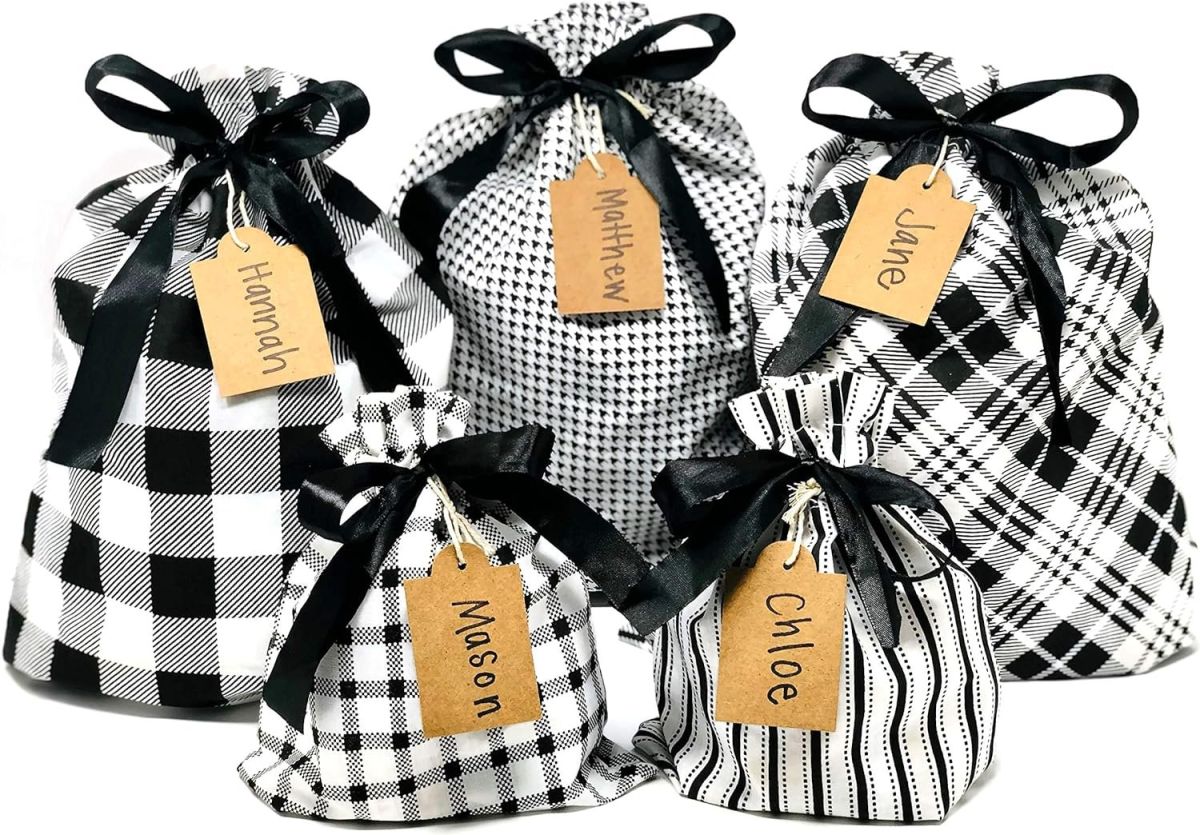
black and white gift bags
These black-and-white bags could be used for any occasion. <a href="https://amzn.to/3RNXj5O">Amazon</a>

How about a standard-Christmas-wrapping-paper look, only as cloth Christmas gift bags instead?

mix of colorful Christmas bags
Get your colorful Christmas on. <a href="https://amzn.to/41wgTHa">Amazon</a>

Or maybe you don’t want a distinctively Christmas feel at all, but rather a mix of pretty, festive bags that could be used for the holidays or any time of year. There’s a whole assortment to choose from here to go with whatever your particular color theme might be.

mix of cloth bag patterns
Christmas bags don't have to be Christmas-themed.. <a href="https://amzn.to/3NABeVY">Amazon</a>

Or maybe you want the opposite—just blatantly Christmas-y images in bright, bold colors plastered all over everything. Here ya go:

assortment of colorful christmas gift bags
So many Christmas gift bag options <a href="https://amzn.to/3Rw8VsI">Amazon</a>

There’s just no shortage of options for cloth gift bags that are worth investing in to save time, money and the environment. Just be sure to check sizes so there are no surprises, grab a wide assortment and then revel in the fact that you’ll never get a paper cut or have to search for another roll of tape while wrapping presents for your family again.


  • A landmark new study shows that 45 percent of older adults cognitively improve as they age
    A senior couple working out.Photo credit: Canva
    ,

    A landmark new study shows that 45 percent of older adults cognitively improve as they age

    “What we found is that improvement in later life is not rare, it’s common.”

    Most people assume that by the time you hit your 60s, you’ve reached the point of continuous mental and physical decline. The mind just isn’t as sharp, and the body becomes overtaken by inflammation, stiff joints, and brittle bones. However, a new study from Yale University says that, for the most part, this is only true for those who believe it.

    A new study published in the journal Geriatrics found that when researchers followed 11,000 participants over the age of 65 for up to 12 years, 45% of them improved in either the mental or physical domains, with some improving in both. About 28% improved physically, and 32% improved mentally. To determine whether the participants improved or declined, they completed a global mental performance assessment and a walking test.

    “Many people equate aging with an inevitable and continuous loss of physical and cognitive abilities,” lead author Becca R. Levy, an international expert on psychosocial determinants of aging health, said in a statement. “What we found is that improvement in later life is not rare, it’s common, and it should be included in our understanding of the aging process.”

    When it comes to aging, attitude is everything

    The researchers hypothesize that the major reason some people show improvements is their beliefs about aging. Those who have a more positive view of the aging process were much more likely to show improvements in their mental and physical health. Those with negative views on aging were much less likely to show any improvement.

    It makes sense because if you believe that you can improve after the age of 65, you’re much more likely to try. If you think that you can or cannot improve your health over the age of 65, you’re probably right.

    “Our findings suggest there is often a reserve capacity for improvement in later life,” Levy said. “And because age beliefs are modifiable, this opens the door to interventions at both the individual and societal level.”

    seniors, geriatrics, working out, exercise, happy women
    A group of older women exercising. Photo credit: Canva

    How to stay mentally and physically fit after 65

    Improvement after 65 requires regularly performing age-appropriate mental and physical exercises. The Centers for Disease Control and Prevention recommends at least 150 minutes of moderate-intensity physical activity per week, which can be divided into about 22 minutes a day.

    Here are exercises that can help people age well:

    1. Brisk walking

    Studies show that walking is great for seniors’ mental and physical health and can help reduce the chances of developing cardiovascular problems as well as cognitive issues, including dementia and Alzheimer’s.

    walking, working out, exercise, aging, seniors,
    A group of people walking. Photo credit: Canva

    2. Resistance exercises

    Resistance exercises, or strength training, can help prevent muscle loss and improve metabolic health. They’re also known to elevate mood and improve sleep quality. Examples of strength training exercises include light weights, squats, and standing push-ups against a wall.

    3. Meditative movements

    Mental and physical exercises such as tai chi and yoga have been shown to improve health in older adults. They are great for flexibility, mental sharpness, and muscle strength. The combination of mindfulness, breathing, and movement benefits both the body and mind.

  • A relatively unknown eating disorder is on the rise as Millennials warn about ‘2000s skinny’
    A woman standing in front of a mirror.Photo credit: Canva
    ,

    A relatively unknown eating disorder is on the rise as Millennials warn about ‘2000s skinny’

    Recently, adolescent girls have taken to social media to flaunt that they’re “2000s skinny,” while the women who lived through it are sounding the alarm. The days of people being encouraged to embrace their natural curves seem to be over, as many now strive to make themselves smaller. Wellness culture is morphing into something dangerous,…

    Recently, adolescent girls have taken to social media to flaunt that they’re “2000s skinny,” while the women who lived through it are sounding the alarm. The days of people being encouraged to embrace their natural curves seem to be over, as many now strive to make themselves smaller.

    Wellness culture is morphing into something dangerous, resulting in unrealistic body standards. Celebrities like Demi Lovato, Britney Spears, and Lindsay Lohan were called fat when they were still adolescents in the early 2000s. Back then, it wasn’t uncommon to see hip, collarbone, and chest bones protruding on the red carpet—or even in a local high school.

    2000s skinny, heroin chic, diet culture, wellness influencers, eating disorders, orthorexia
    A woman measures her waist. Photo credit: Canva

    There was a name for it back then: “heroin chic.” The term was “used to describe an ultra-thin, waifish body, as well as a style of fashion photography that glamorized a skeletal figure,” Percival Fisher Jr., a psychotherapist, writes for DetoxRehabs.net.

    In that era, teen girls—much like their favorite young celebrities—were developing eating disorders and body dysmorphia. Raven-Symoné has said she underwent two breast reductions and liposuction before the age of 18 due to fat-shaming. Lovato, Taylor Swift, and Lohan have also shared that they struggled with eating disorders earlier in their careers.

    2000s skinny, heroin chic, diet culture, wellness influencers, eating disorders, orthorexia
    Skinny woman refuses food on a plate. Photo credit: Canva

    Teen girls were doing all they could to make themselves as small as possible because that was suddenly the beauty standard. Now it’s back. The trend is catching on, in part thanks to wellness influencers who stress “clean eating” to achieve physical and mental fitness. Advice about keeping daily calories under 1,200 or doing juice cleanses to maintain a low weight is showing up in the algorithm.

    In a video uploaded to social media, a very thin woman poses for the camera. The text overlay on the video reads, “If you think 800–1,200 calories a day is starvation, just know that the 2000-calorie diet was made up by the elite who prey on kids.” James Cappola, a fitness coach, responded to the video by calling out the dangerous misinformation and warning about the risks of anorexia and orthorexia.

    Personal trainers, nutritionists, dietitians, and Millennials are among the chorus shouting into the void. But it may be too late. With social media, fear-based nutrition advice, and the re-emergence of heroin chic converging, orthorexia is on the rise.

    Orthorexia is a relatively unknown eating disorder that has not yet been included in the Diagnostic and Statistical Manual of Mental Disorders, Fifth Edition as an official diagnosis. The National Eating Disorder Association describes the disorder as an obsession with healthy eating. “People with orthorexia become so fixated on so-called ‘healthy eating’ that they actually damage their own well-being and experience health consequences such as malnutrition and/or impairment of psychosocial functioning,” the association explains.

    The warnings from older adults and experts online don’t seem to stop teen girls from showing off their extreme thigh gaps. When a new video of a girl getting down to a size 00 goes up, a Millennial adjusts her messy bun and shares the war stories of her adolescence.

    In a TikTok video, wellness entrepreneur Autumn Clayman says, “Everyone is getting freakishly thin online. This trend needs to stop. This trend needs to stop. We’re right back to early 2000s skinny—it’s freaky. It’s scary, and people aren’t considering what this trend is going to do to their bodies long term.”

    @autumnclaymann

    anyone else feel similarly about this topic?

    ♬ original sound – Autumn Clayman

    After disclosing that she used to struggle with an eating disorder, Clayman shares her concern about people going to extremes to be thin. She then explains how extreme undereating is “disrupting their hormones, bone density drops, they go through mood issues, so more anxiety, depression, thyroid slows down, fertility drops, chronic stress, gut and digestion issues, skin issues, blood sugar issues, just all the things.”

    A man who goes by the name Brandon Ruins Everything on TikTok explains something younger people may not know about the trend: “People are talking about bringing back 2000s skinny, and I don’t think y’all realize that 2000s skinny isn’t a body type. It’s a goalpost that keeps moving. You will never be skinny enough to be 2000s skinny.”

    Getting healthy and being comfortable in your body are admirable goals. The way you do it—and the reasons you’re doing it—matter. Changing your body to fit a trend can lead to unhealthy expectations and behaviors, as concerned voices have pointed out. Hopefully, the ultra-skinny trend fades as quickly as it returned.

  • Research reveals the trick to being more likable after screwing up in public
    A woman who made a mistake.Photo credit: Canva

    Even the coolest of the cool cannot escape the occasional social faux pas. Whether it’s putting your foot in your mouth at a dinner party, tripping in public and spilling coffee on yourself, or screwing something up at work, we all mess up from time to time. The good news is that every mistake is an opportunity to recover. This begs the question: What’s the best way to react when you’ve made a mistake?

    Historically, people have thought that the best way to respond to a mistake is to express honest embarrassment. Feeling sheepish about your mistake is a great way to show others that you understand social norms and simply fell a bit short on this occasion. You blush, cast your eyes downward, and whisper a small “My bad” or “Sorry about that,” with a shrug of your shoulders.

    mistake, embarrassment, laughing, social psychology, people skills
    A woman facepalms. Photo credit: Canva

    What’s the best way to respond to making a public mistake?

    However, research shows that the best way to recover after screwing up publicly is to laugh at yourself. A new study from the Cornell University SC Johnson School of Business involving 3,000 participants found that laughing at yourself can make you more likable than showing embarrassment.

    “Our findings suggest that people often overestimate how harshly others judge their minor social mistakes,” said study co-author Övül Sezer, PhD, of the Cornell University SC Johnson School of Business, according to Neuroscience News. “For minor, harmless blunders, laughing at yourself can signal social confidence, reduce tension, and communicate that the mistake was accidental.”

    Why is it better to laugh at yourself than to show embarrassment?

    Laughing at yourself shows that you are socially confident and downplays the mistake in others’ eyes. Plus, people who can laugh at themselves are seen as warmer and more competent. The humor serves as a “reset button,” de-escalating the collective feeling of awkwardness.

    mistake, embarrassment, laughing, social psychology, people skills
    A woman falls while ice skating. Photo credit: Canva

    On the other hand, when people appear embarrassed and apologetic after a mistake, others often see their reaction as excessive. This can come across as inauthentic or socially awkward. Often, people exaggerate their level of embarrassment to show that they understand what they did was inappropriate. Ironically, in trying to take the sting out of a cringeworthy moment by appearing embarrassed, they actually end up looking more awkward.

    “What’s interesting is that embarrassment was often perceived as excessive,” Sezer said. “Observers tended to think that actors who displayed embarrassment were feeling more embarrassed than the situation warranted, while laughing signaled that they recognized the mistake was minor.”

    Beyond the social situation itself, feeling embarrassed can be bad for our mental health.

    “Some people can shake off their embarrassment when they make a mistake or violate a social norm,” Psychology Today noted. “Others who fear the disapproval of the group might be consumed by shame.”

    The researchers added an important caveat to their results: If you are going to laugh off an embarrassing moment, it must be harmless. If your actions hurt someone, laughing things off can backfire in a big way, making you appear selfish and uncaring. “What’s important is calibrating the reaction to the seriousness of the mistake,” Sezer said.

    We’re all bound to make a mistake from time to time. The good news is that every mistake presents an opportunity to recover and potentially make ourselves look even better than before. The key is to give your ego a rest and have a big laugh at your own expense. Most likely, people will find you more likable because you had the confidence to let your guard down.

  • 10 signs you’re a quiet introvert in group chats, according to psychology
    Are you an introvert who struggles with group chats? Photo credit: Canva

    You open your phone to a group chat flooded with 47 unread messages. Instantly, anxiety hits. By the time you compose a thoughtful reply, the conversation has rushed three topics ahead. The moment is lost. You close the app, feeling left out.

    If this sounds familiar, you’re not alone. Introverts make up one-third to one-half of the population, but our conversation norms—both online and off—are designed for extroverts.

    Susan Cain, author of the bestselling book Quiet: The Power of Introverts in a World That Can’t Stop Talking, calls this phenomenon the “New Groupthink.” It’s a culture that favors constant collaboration and rapid-fire replies over stillness and deep thought. We live in a world that measures contribution by the number of messages sent, and it’s easy to feel like you’re falling behind when you go silent.

    But what if this isn’t about falling behind? What if silence is just a different way of engaging? If you’ve ever wondered why you go quiet in group chats, consider these 10 signs you might be an introvert.

    1. You process before you share

    While extroverts type as they think, introverts think before they type. When forming their responses, introverts rely more on long-term memory than working memory—the brain’s active workspace where information is juggled and processed in real time. Extroverts might talk through ideas out loud; introverts process information through slower, deeper neural pathways designed for accuracy and nuance.

    texting, group, chats, introverts, psychology
    Unlike their extroverted counterparts, introverts take time to think about their responses before firing off a text. Photo credit: Canva

    As Cain describes in her book, introverts “listen more than they talk, think before they speak, and often feel as if they express themselves better in writing than in conversation.”

    In a group chat setting, this internal processing means you might mentally prepare a response, revise it, overthink the timing (can’t be too quick or too slow, right?), and then decide the conversation has already moved on without you. The perfect response you crafted vanishes before you hit send.

    2. Surface-level banter drains you

    For introverts, not all conversations are created equal. You might find endless small talk, quick memes, and emoji reactions tiresome, and yearn for messages with more substance. That’s because introverts crave depth—a meaningful exchange that explores an idea, a feeling, or a genuine problem.

    @thewadeempire

    How would you react in this situation? I already interact too much with some of my coworkers on a daily basis so please leave me out the group chat. Thanks #groupchat #introverts #workgossip

    ♬ original sound – TheWadeEmpire

    Research published in the Journal of Personality and Social Psychology found that serious conversations are more enjoyable than people expect, yet we consistently underestimate others’ interest in them. For introverts, this inclination toward depth isn’t a personality quirk—it’s a fundamental part of how they communicate.

    3. You observe everything

    If you’re quiet in the group chat, it doesn’t mean you’re not paying attention. Introverts are sharp readers of context: they notice shifts in tone, track emotional undercurrents, and pick up on what’s not being said as much as what is. This ability to observe and accurately synthesize group dynamics is one of the most underappreciated traits in online communication.

    group, chats, introverts, communication, context
    Introverts are sharp readers of context—everything that’s not being said. Photo credit: Canva

    Psychologist Daniel Goleman found that empathy is a core component of emotional intelligence, and that quiet people often exhibit greater empathy because they listen more deeply. So while you may not be contributing messages to the group chat, you’re still playing an active role—picking up on subtle cues, like a shift in someone’s tone.

    4. Group chats drain your social battery

    Group chats require a lot of mental and social energy as you process multiple conversations, competing personalities, shifting group dynamics, and implicit social cues all at once. That’s an enormous cognitive load, especially compared to one-on-one conversations, where your focus can be directed toward a single person without all the noise.

    If you feel overwhelmed, muting the chat might not be a bad idea. You need to manage—and maintain—your energy well.

    5. You refuse to break the silence with noise

    You won’t send a message just to be seen. While some group chat members are happy to drop a fire emoji or send an “lol” to stay visible, introverts tend to hold back unless they have something substantial to contribute. They’re committed to authentic communication.

    introverts, texting, conversation, group, chats
    Introverts are intentional with their messages. Photo credit: Canva

    Blake Griffin Edwards, a licensed marriage and family therapist, explains it this way: “Introverts must think it out before they are able to talk it out very well.”

    As a result, your communication style is built on intention rather than impulse. You may send fewer messages, but when you do, they’re more meaningful.

    6. Group chats can feel overwhelming, even for good writers

    Here’s a paradox many introverts recognize: writing often feels more natural than speaking. Text removes the social pressure of real-time performance, giving you space to choose your words carefully. Yet despite being text-based, group chats can still trigger overstimulation.

    @kisama_

    For the people who always get cut off in group conversations 🗣️ #introvert #publicspeaking #motivation

    ♬ original sound – Ki$ama

    The problem lies with pace. A group chat doesn’t move at the same speed as a thoughtful email chain or a journal entry. It’s fast and unpredictable—like a live conversation—which creates the same timing pressures introverts face in verbal group settings. Hans Eysenck’s foundational theory of introversion suggests that introverts have a higher baseline level of cortical arousal, meaning they reach sensory overload faster than extroverts when external stimulation—like a flood of notifications—keeps escalating.

    7. You tune into how others are feeling

    You’re not just reading the words in a thread—you’re reading between the lines. As an introvert, you probably notice delicate emotional shifts, like a person’s messages becoming shorter, a joke that falls flat, or silence from someone who’s usually chatty. This emotional sensitivity is a strength, but it can also make group chats feel more burdensome than expected.

    emotional, texting, group, chats, introverts
    Emotional sensitivity can feel like a burden in group chats. Photo credit: Canva

    In The Mirror, Katie Oborn observed that introverts “pick up on unspoken emotions and subtle shifts in conversation and tone.” That level of awareness means introverts are often the first to notice when something is off.

    8. You don’t bend to the pressure to perform

    Group chats carry an implicit social pressure: respond quickly, be entertaining, stay visible. For emotionally independent introverts, that pressure can feel crushing. People who resist the pull to perform in group settings often have a strong internal compass about what matters to them and why. They won’t chime in for the sake of it, and they won’t be dragged into drama just because the group demands a response.

    9. Constant notifications break your focus

    For introverts, great thinking often happens when you’re alone. There’s research to support this: studies consistently link solitude to improved emotional regulation, creativity, and decision-making. When a group chat keeps pinging you—interrupting a reading session, the workday, or a quiet moment—it fragments the kind of deep focus and flow state introverts depend on.

    texting, group, chats, messages, interruptions
    A woman looking at her phone, concerned. Photo credit: Canva

    Studies from Microsoft Research confirm that instant message notifications slow task performance and make it more likely you’ll lose your train of thought. For introverts, who need more time to process information, these interruptions can be even more costly. The “ping” of a phone notification can disrupt deep focus.

    10. You engage on your own terms

    Introverts often contribute based on sincerity and trust rather than social obligation. When they do speak up, they usually bring something worth reading.

    Scroll through your messages, and you might notice a pattern—either in yourself or in your introverted friends. Long periods of silence often lead to a single, valuable message that adds meaning to the conversation. That’s what strategic participation looks like: waiting for the right moment, then contributing something meaningful.

    Embracing your strength

    For introverts, hanging back and staying quiet in a group chat isn’t withdrawal. It’s a form of meaningful participation that favors observation, thoughtful processing, and intentional engagement over simply making noise.

    If you recognize these signs in yourself and want to start engaging more on your own terms, these small shifts can help:

    • Try preparing your thoughts before or at the start of a lively group conversation.
    • Remember, writing is your natural way in. A thoughtfully crafted message at the right moment can carry more weight than a dozen impulsive replies.
    • Feel free to set notification boundaries without guilt.
    • When you’re ready to chime in, trust your timing and insight.

    As Susan Cain reminds us, being the loudest in the chat doesn’t mean having the best ideas. The quietest voice may actually be paying the closest attention—and when their words are shared deliberately, they can shift the entire conversation.

  • The little paper emoji on your phone has words on it and people are stunned at what it says
    A screen with variuos emojisPhoto credit: Canva

    Go ahead and pull up the paper emoji on your iPhone. The little white page, the one that looks completely blank from a distance. Now zoom in.

    There’s a letter in there. It’s addressed to someone named Katie. It’s signed by someone named John Appleseed. And it has been sitting inside that emoji, invisible to most people, since iOS 5.

    Instagram user Ella (@el_michelle1) posted a video zooming in on the emoji in December 2025, and it spread rapidly, racking up millions of views from people who could not quite believe they’d been sending that little icon around for years without knowing what was written on it. As LADbible reported in its coverage of the discovery, the reaction split neatly between people who immediately recognized the text and people who absolutely did not.

    Those who recognized it knew it right away. The letter contains the full text of Apple’s “Think Different” campaign, which ran from 1997 to 2002 and became one of the most celebrated advertising moments in the company’s history. It reads, in part: “Here’s to the crazy ones. The misfits. The rebels. The troublemakers. The round pegs in the square holes. The ones who see things differently.” The letter ends: “Take care, John Appleseed.”

    Per Emojipedia, which documents the design details of every emoji across platforms, the text has been embedded in Apple’s paper emoji since the icon was introduced. It’s not just the paper emoji, either. As Creative Bloq noted, the same hidden text shows up in Apple’s notebook, memo, scroll, and clipboard emojis, and the receipt emoji contains a partial reference with the words “misfits,” “square pegs,” and “round holes” listed as line items.

    The name “John Appleseed” is Apple’s longstanding demo persona, used across its software and marketing materials for decades. As for Katie, nobody outside Apple knows for certain. The name varies slightly across emoji versions, appearing as “Kate,” “Katie,” or “Dear Katie” depending on which icon you’re looking at.

    It’s worth noting that Apple isn’t the only platform hiding things in its emoji designs. As Emojipedia documents, Samsung’s version of the clipboard emoji was once addressed “Dear Samsung,” and Facebook’s clipboard features what appears to be a small table of first names and dates, possibly birthdays.

    The response to Ella’s video captured something genuine: the strange pleasure of discovering that something you’ve looked at hundreds of times contained a message you never noticed. “Attention to detail is insane,” one commenter wrote. Another said: “I love when developers leave such tokens of their own in the things they built.” A third simply wanted to know: “Who is Katie?”

    Apple, characteristically, has not said.

    You can follow Ella (@el_michelle1) on Instagram for lifestyle content.

    This article originally appeared earlier this year.

  • Job recruiter says people will never get hired if they keep getting this easy interview question wrong
    A career coach warns against relying on AI to answer job interview questions.Photo credit: Canva

    As workers struggle to land good jobs and employers struggle to find ideal candidates in the ever-changing job market, a new trend is emerging. Many applicants are turning to artificial intelligence to give them an edge—with mixed results at best. Because interviews are one of the most stressful parts of the job search, it’s become common for folks to input questions into ChatGPT to find the “perfect” response. However, a former recruiter warns that this is a bad idea, noting that you end up “sounding so fake” when using it.

    Former recruiter turned career coach Madeline Mann showed an example of why ChatGPT shouldn’t be used to answer written interview questions. In a TikTok video, Mann shared a ChatGPT response to the question, “Why did you leave your last role?” ChatGPT replied with the following:

    “I decided to move from independent work to a team environment so I can build deeper lifecycle expertise and learn from a strong mission-driven leadership team.”

    @selfmademillennial

    It is common to use AI to help write your job interview answers, but often they are sounding too verbose and not human. If you are reading your interview answers from a script, you are likely to be rejected in the job interview and not get the job offer. Here is an example of how to sound more normal and like a coworker during a hiring process. Follow for more job interview tips, and job search strategies! #jobsearch #jobsearchtips #jobinterviewtips #jobinterview

    ♬ original sound – Madeline Mann

    Did that sound like something a human would say? Mann argued that ChatGPT used so much professional jargon that it sounded like a robot wrote it (because it did). Mann said that in interviews, it’s best to “sound like a coworker.”

    “If you do not already sound like their coworker, they will have trouble picturing you as their coworker, and they won’t give you the job offer,” said Mann.

    Mann said that a better response would be a quick and simple: “After freelancing for X years, I really missed being on a team.” She said that a reply like that is sincere, direct, and more like how a person would normally speak to a coworker. She added that if you were to use AI for interview responses, you should edit them down and remove any “bungle” to “talk like a person.”

    AI experts and employers weigh in

    Upworthy spoke to AI pros, business leaders, and recruiters about using artificial intelligence for job interviews. The majority arrived at the same conclusion: If you choose to use AI, it can be a useful tool for interview preparation. However, it shouldn’t sub in to do the actual interview for you.

    “AI can be a useful tool for preparing for an interview,” said Megan Sweeney, public relations director at the American Staffing Association. “However, at the end of the day, the interviewer still needs to know you’re capable of doing the job.”

    “If a company requests written interview questions, then using AI as a starting point is fair game in my book,” said Russell Taris, an expert on how managers can best use AI in the workplace. “The key statement, though, is ‘as a starting point.’”

    “Candidates should use AI to organize their thoughts and firm up their language, but the examples and experiences need to be their own,” said Taris. “Managers can now tell right away when someone submits a response straight from ChatGPT without any editing. Smart candidates use AI the way you’d use a good friend who happens to be a great editor.”

    Authenticity is key

    “The problem is being authentic,” said Magical Brands CEO Mark Coffie. “Candidates who prepare and deliver scripted, overly polished answers tend to fail when asked questions spontaneously. You can use AI to outline your ideas but speak and answer questions in your own voice. That’s different from reading something generated. Interviews are a testing of judgment, communication, and problem-solving…Technology cannot substitute for that.”

    “Using AI to pressure test your answers ahead of time can truly benefit candidates,” said Taris. “Run your ‘Why did you leave your last role?’ answer through it and ask it to poke holes, or practice your ‘greatest weakness’ answer until it’s specific and honest. The best answers I hear in interviews aren’t the most polished; they’re the ones where the candidate clearly thought it through beforehand and can go deeper, if needed. AI is one of the best prep tools available right now, and most candidates aren’t taking advantage of it.”

    “Using AI for interview prep is helpful, but you will be the one being evaluated,” concluded Sweeney.

  • Expert shares the simple small talk mistake almost everyone makes—and how to fix it
    A group of friends having a chat.Photo credit: via Canva/Photos
    ,

    Expert shares the simple small talk mistake almost everyone makes—and how to fix it

    “It’s a natural impulse—we want to relate, to show we understand.”

    You might be shocked to learn that many people don’t like making small talk. Surprise, right? They either believe it’s beneath them to talk about mundane subjects or don’t see the benefit of discussing the weather, sports, or television with people they hardly know.

    However, these folks are missing a very valuable form of interaction that can help them with their love lives, friendships, and careers. They also remove themselves from situations where they can elevate small talk to something more valuable and meaningful.

    Jefferson Fisher, a Texas personal injury attorney and communications expert, has become massively popular on Instagram—with nearly 6 million followers—for sharing tips “to help people argue less and talk more.” While promoting his new book, The Next Conversation: Argue Less, Talk More, Fisher discussed the number one problem people have while making small talk.

    What’s the biggest mistake people make during small talk?

    “They unknowingly turn the conversation back to themselves too quickly,” Fisher tells Parade. “It’s a natural impulse—we want to relate, to show we understand. But what often happens is that we hijack the conversation.”

    “For example, someone says, ‘I just got back from a trip to Italy,’ and instead of asking about their experience, we jump in with, ‘Oh, I’ve been to Italy several times, it’s great.’ It’s well-meaning, but it can come across as dismissive,” Fisher said. “Instead, focus on them. Ask open-ended questions like, ‘That’s wonderful, what was your favorite part?’ Small talk isn’t about impressing people, it’s about making them feel seen and heard.”

    Fisher’s advice echoes that of the great Dale Carnegie, author of the 1936 classic How to Win Friends and Influence People. In the book, Carnegie says, “To be interesting, be interested.” Carnegie’s advice is counterintuitive because we are taught to believe that being likable means dominating conversations and entertaining the other person. However, Carnegie thinks that people who are generous listeners tend to make a better first impression.

    How to be more likable

    Researchers at Harvard University found that when you ask someone a question, people will like you more if, after they answer, you ask them two more follow-up questions. So, if you ask, “Where did you go last summer?” And they reply, Italy, you can follow that up with two questions about their favorite city and the restaurant they’ll never forget. Then, you can tell them that you’ve been there, too.

    “We identify a robust and consistent relationship between question-asking and liking,” the study’s authors write. “People who ask more questions, particularly follow-up questions, are better liked by their conversation partners.”

    conversation, small talk, chatting, discussion, communication
    Two people have a conversation. Credit: Fauxels/Pexel

    People will take a shine to you after you ask a few questions because it shows that you are listening and interested in what they say. “Follow-up questions are an easy and effective way to keep the conversation going and show that the asker has paid attention to what their partner has said,” the researchers write.

    While at first, it may take a little practice to ask follow-up questions instead of turning the conversation to your experiences and opinions, it should take some pressure off the need to be interesting. Now, instead of trying to wow people with your stories, all you have to do is listen to theirs, and they’ll like you all the more for it.


    This article originally appeared last year. It has been updated.

  • Body language expert explains how the winner of ‘The Traitors’ spotted liars and how to do it yourself
    Rob Rausch and Vanessa Van Edwards.Photo credit: Peacock on YouTube/Wikimedia Commons

    In the latest season of the popular reality game show The Traitors, Rob Rausch emerged as the winner and the sole surviving Traitor. One reason he won was because he was able to see through the lies of his fellow competitors. A body language expert explained how Rausch was able to read people and win the entire cash prize.

    Vanessa Van Edwards said that Rausch was able to discern who was lying to him and who was telling the truth while showing a clip from the show. In the Traitors clip, Rausch explained his strategy for trying to win the dagger prize through a game that required him to find who had it by asking questions.

    @vvanedwards

    Is Rob Rausch really a human lie detector? A human lie detector reacts! 👀 #robrausch #traitors #liedetector #react #behavioralscience

    ♬ Pick (Blowout, pop-up, adsorption) 2(819462) – Koi

    What is baselining?

    Rausch explained that he was able to be a “human lie detector.” He would ask questions that he already knew the answers to and monitor his competitors’ responses. He would then ask whether the person had the dagger, watching how they responded to determine whether they were lying. After observing competitor Natalie Anderson’s responses, Rausch concluded that she was lying and had the dagger.

    On TikTok, Van Edwards explained that Rausch was using a technique called “baselining.” Baselining involves making mental notes of a person’s baseline behaviors when they are speaking comfortably and truthfully. If you notice a person displaying atypical behavior when answering a question, it could be a sign that they’re lying, uncomfortable, or conveying a specific nonverbal response.

    For example, if a person who doesn’t normally touch others when speaking to them suddenly touches you, that could indicate extra interest. In contrast, if someone who is known for touching people while speaking to them doesn’t touch you, they could be hiding something. In the case of The Traitors, Van Edwards said Rausch interpreted Anderson’s lip purse in response to his question as an indication that she was lying.

    How baselining can help day-to-day life

    Being able to baseline a person’s behavior can be helpful both professionally and personally. Professionals consider it one of the cornerstones of negotiation in business because both sides of a deal are likely withholding information. Much like in a game of poker, business professionals aren’t showing their “full hand” and are looking for “tells” before contracts are signed.

    In terms of home life, baselining a family member can be especially helpful when communicating with children. This isn’t in a business negotiation or interrogation sense, though. Noticing a loved one’s common behaviors when speaking and seeing aberrations could indicate that something is wrong. You could approach them privately to ask if anything is making them feel uncomfortable and offer help. This way, you’re spotting their lies not to confront them, but to let them know they’re seen and that you’re someone they can trust.

    Whatever your reasoning, baselining is a useful skill for reading people. In Rausch’s case, it helped him win hundreds of thousands of dollars.

Wholesome

Women’s wrestling champion earns praise for going easy on a terrified new wrestler

Family

Mom shares daughter’s epic response to girls who bullied her, and people are applauding

Wholesome

A woman was surprised with a party bus for her 60th birthday. She immediately took it to see her own mom battling dementia.

Identity

A woman didn’t think she had an accent. A linguist proved her wrong with just one word.