

Video explains the one reason Americans can't have quaint, walk-up apartments like Europeans do
We want our walkability back.
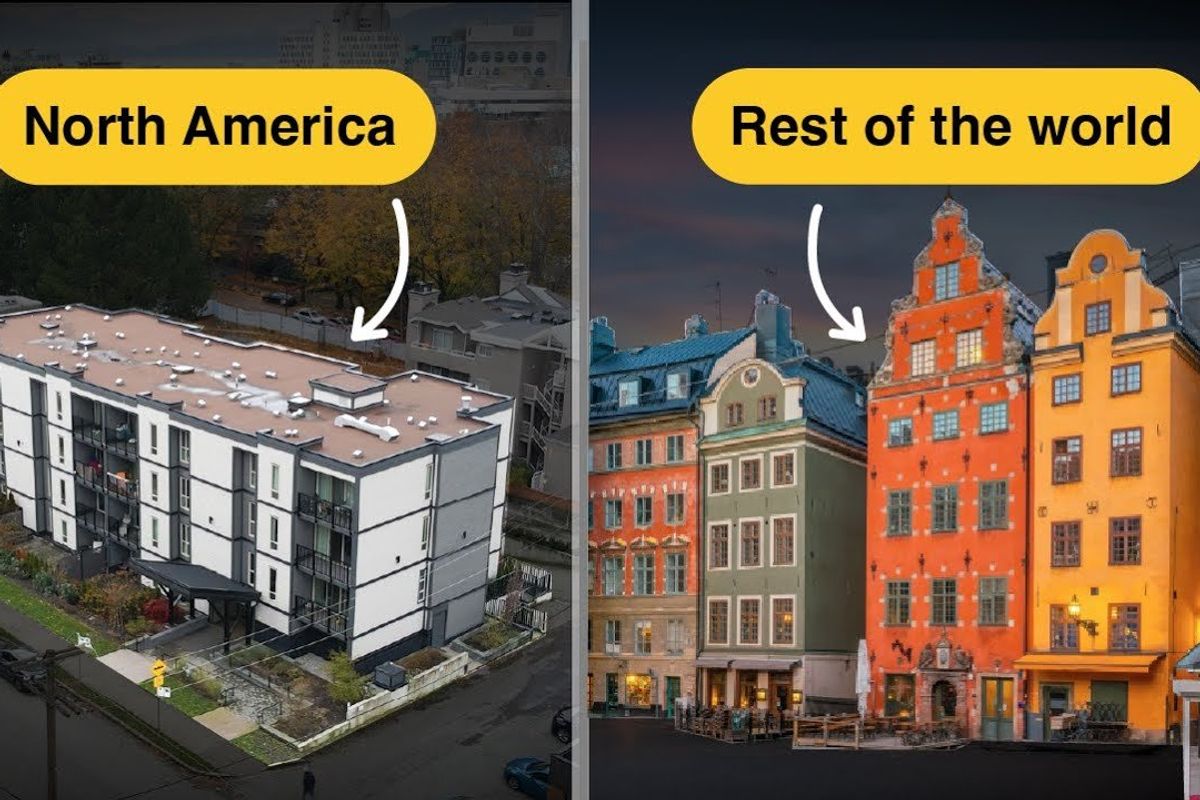
Why North American can't build nice apartments.
One of the most beautiful features of old European neighborhoods are the rows of quaint, walk-up apartments that are the backbone of walkable neighborhoods. They help create a community where people can exit their front door and walk to a local café or market without getting in their car.
Unfortunately, these neighborhoods are hard to find in the United States, where these types of apartment buildings are exceedingly rare. Why is that? In the video below, About Here’s founder, Uytae Lee, explains why regulations in North America have made these quaint walk-up apartments, known by architects as point access blocks, nearly impossible to build.
Uytae Lee is an urban planner and videographer passionate about sharing stories about our cities.
“Quaint, walk-up apartments … are a beloved feature in cities around the world,” Lee says in his video entitled “Why North Americans Can’t Have Nice Apartments.” “They’re inviting and full of character. But, here in North America, they are not allowed to be built today. Instead, our departments are big and imposing, often stretching across the entire block and the reason why it really comes down to one reason: staircases.”
Why North America Can't Build Nice Apartments
The problem is that one stairway in a point access block allows access to all apartments. This became a problem in the late 1800s when fires were commonplace in urban areas worldwide and people were more likely to die in a fire with only one exit route. So, in the U.S. and Canada, they created new regulations that made it so all buildings over 2 to 3 stories had to have two staircases to allow them to exit during a fire.
“Staircases take up a lot of space and fitting two of them in a small building means that there is much less usable floor space on every floor,” Lee says in the video. “As a result, developers here construct much larger buildings so that the staircases and hallways take up a much smaller proportion of the overall building. It's why apartments in North America, in general, are much bigger and wider than their European counterparts.”
But there are fires in Europe, too. Why did they stop short of requiring multiple staircases in apartment buildings on the other side of the Atlantic Ocean? Instead of changing the floorplans on new buildings, Europeans opted to require fireproof materials in new building construction. A big reason why the U.S. and Canada opted for larger buildings over fireproofing was because they had better access to materials and the new direction aligned with the move towards suburban sprawl.
The two-staircase regulations in the U.S also made it harder to build units greater than one bedroom because the buildings needed long hallways which reduced the number of layout options.
The current housing crisis has many rethinking the regulations that require apartment buildings to have two stairways in North America. Many urban planners believe that modern-day demands mean we should return to building more point access block buildings, but this time with modern fire-retardant materials.
In some cities, such as Seattle, Washington, lawmakers have repealed staircase mandates and begun building point access block housing to ease the crisis.
“Now, if all this makes you a bit nervous, I get it. After all, these codes are about our safety. But I do want to mention that these codes do change over time as our technology and our understanding of safety evolves,” Lee finishes the video. “It’s important that we discuss and update these rules as our world changes.”
This article originally appeared two years ago.
- 28-year-old buys cruise ship apartment because it's less than renting and he can see the world ›
- An ad telling people to visit the 'G-spot of Europe' sparked controversy. Now it's actually boosting tourism. ›
- Map showing number of Polish people willing to accept Ukrainian ... ›
- Europeans ask Americans about life in the US. Here's are their answers. - Upworthy ›
- 15 American realities that feel like luxuries to Europeans - Upworthy ›
- Europeans playfully roast an American abroad for her 'primitive' fork and knife skills - Upworthy ›

 A Generation Jones teenager poses in her room.Image via Wikmedia Commons
 A van travels down the road.
  A person plays the guitar.
  A man smiles.
  A damaged vehicle sits on the side of a road.


 Welcome to North Carolina State Line!
 Smiling together: "The Lord Willing and the Creek Don’t Rise."
 Surprised cat faces an idiom shock!
 Feeling under the weather with a warm cup in hand.
 "Fluffy biscuits and a sassy Southern saying!"
 Two women in a park having a tense conversation.
 "Tight pants, revealing every curve and thought."
 "Bright as a Box of Black Crayons" - a humorous twist on brightness.