upworthy
Add Upworthy to your Google News feed.
Google News Button
Science

The winners of the Underwater Photographer of the Year contest were announced and they are incredible

From rare river dolphins to abandoned aircrafts, there's an entire world to explore just below the water's surface.

underwater photography
Kat Zhou/UPY 2023 (USA), Shane Gross/UPY 2023 (Canada)

There's an entire universe down there.

Space might be considered the final frontier, but right here on planet Earth, entire universes remain unexplored beneath the water’s surface.

Every year, the prestigious Underwater Photographer of the Year contest highlights stunning images from all over the world that offer a small glimpse into this mysterious world, reminding us of its breathtaking beauty, fascinating wildlife and—perhaps most important of all—the need to respect and care for its resources.

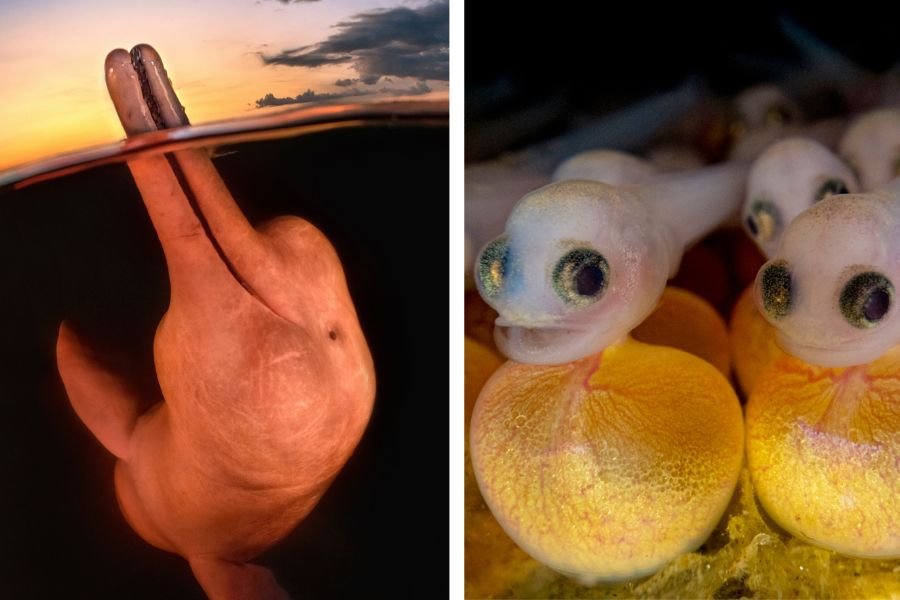
American photographer Kat Zhou won the title for 2023. (Technically, she also won Up & Coming Photographer of the Year—way to go, Zhou.) Her image of a rare Amazon river dolphin, captured at the perfect moment of smiling while poking its nose out from under the water, rose to the top in a sea of 6,000 entries. Due to river contamination and being killed or injured by fishermen, the species is listed as vulnerable in certain areas by the World Wildlife Organization, making this apparently happy interaction all the more impactful.

As judge Alex Mustard wrote, “In dark, tannic waters, Kat has created a striking composition capturing this rarely photographed and vulnerable species at the perfect moment…By far the best image we've ever seen of this species.”

Zhou also explained the river dolphin’s folklore in her entry.


Underwater Photographer of the Year 2023 Winner: “Boto Encantado” by Kat Zhou (USA)

Brazilian Amazon

river dolphin

“Boto Encantado” by Kat Zhou

Kat Zhou/UPY 2023 (USA)

“There’s a legend among locals in the Amazon that river dolphins, or 'botos,' can transform into handsome men known as 'boto encantado' at night to seduce women. Though I did not witness this elusive boto transformation, at dusk I was enchanted by these beautiful mammals in a different way. After seeing how botos would sometimes bring their beaks above water, I knew I want a split shot at sunset. Though the water was so dark that I was shooting blind, this dolphin gave me a perfect pose and smile!

As indigenous communities settled by rivers in the Amazon, river dolphins began living in closer proximity to human populations, even making use of food scraps. Frequent dolphin sightings led to tales like boto encantado, but there’s a darker side to the legend, as it was often used to excuse pregnancies after women were assaulted or forced into prostitution. While botos are generally revered as mythical creatures, many scorned husbands have killed dolphins because of these stories. Furthermore, many river dolphins have also been killed for use as fish bait. Though there have been bans on this practice, it has not been eradicated. With this, alongside even bigger impacts like mercury poisoning due to the gold mining industry and large development projects that have disrupted the river ecosystems, I fear that one day botos will truly become no more than mythical creatures.” – Kat Zhou

Take a look below at the winners from other categories:

Wide Angle Winner: “Fade” by J. Gregory Sherman (USA)

Stingray City, Cayman Islands

stingrays

“Fade” by J. Gregory Sherman

J. Gregory Sherman/UPY 2023 (USA)

“My dive partner and I chartered a boat to arrive at Stingray City on Grand Cayman before dawn so as to capture the morning light and undisturbed sand ripples. Just as the sun broke the horizon, a line of southern stingrays headed straight for me and I captured this image as they glided across the sand. Using a large dome port allowed me to create a split image showing the intensely colorful dawn sky contrasted against the nearly monochromatic stingrays and sand beneath the surface chop.” – Gregory Sherman

Wrecks Winner: “Engine with a Saddle” by Brett Eldridge (USA)

Point Loma, California

wrecked planes

“Engine with a Saddle” by Brett Eldridge

Brett Eldridge/UPY 2023 (United States)

“We were out scanning targets in June when we saw a very small, but promising sonar blip 230 feet deep. I geared up and jumped in hoping for something special. After some searching, my heart started racing when I first saw fish then the propeller of an almost completely intact, single-engine WW II airplane! It turned out to be a F8F-1 Bearcat, a rare aircraft that Neil Armstrong famously once said was his favorite and has been described as 'An Engine With a Saddle.' Alone on the first dive with limited bottom time, I took enough photos to build a 'draft' model and identify the wreck. Needing a better photogrammetry model for the UPY contest and with deadlines quickly approaching, I booked December 19th and crossed my fingers. We fortunately had epic conditions and I got the photos I needed. It was my last dive of 2022.” – Brett Eldridge

Behavior Winner: “Make Love Not War” by Yury Ivanov (Indonesia)

Tulamben, Bali

octopus

“Make Love Not War” by Yury Ivanov

Yury Ivanov/UPY 2023 (Indonesia)

“A couple of coconut octopuses 'making love' (mating). I knew that I can find this species of Octopus at one of dive sites near Tulamben village (Bali, Indonesia) and they are active only at night time in that place. I dive there only after 7pm hoping to photograph something unique – their mating. I've done more than 30 night dives at the dive site and finally I got lucky. The photo shows the end of their love.” – Yury Ivanov

Portrait Winner: “The Trunk” by Suliman Alatiqi (Kuwait)

Phuket, Thailand
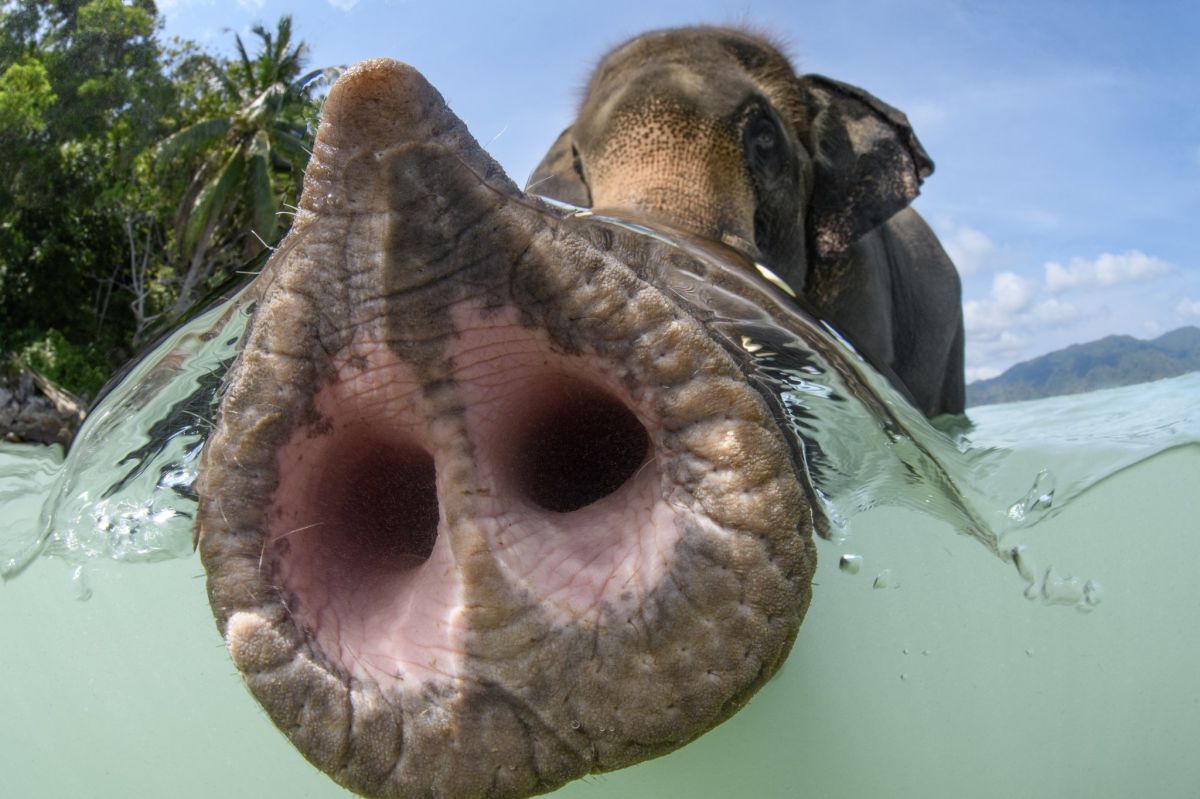
elephant

“The Trunk” by Suliman Alatiqi

Suliman Alatiqi/UPY 2023 (Kuwait)

“The elephant's trunk is one of the most distinctive anatomical features in the natural world and this photo aims to emphasize it. Luckily, he was curious about my camera and was happy to feel it out which gave me the opportunity to capture this perspective despite otherwise bad conditions for an over-under photo (choppy water and poor visibility). In my first attempts, the nostrils were not fully lit because of how close they were to the lens (which was necessary for the intended photographic effect). So I returned at a specific time window when I thought the sun’s angle would be optimal and managed to fully light the nostrils. This added a lot more detail to the key part of the image without which the photo would not be as effective.” – Suliman Alatiqi

Save Our Seas Foundation Marine Conservation Photographer of the Year 2023 Winner: “Hopeless” by Alvaro Herrero (Spain)

Baja California, Mexico
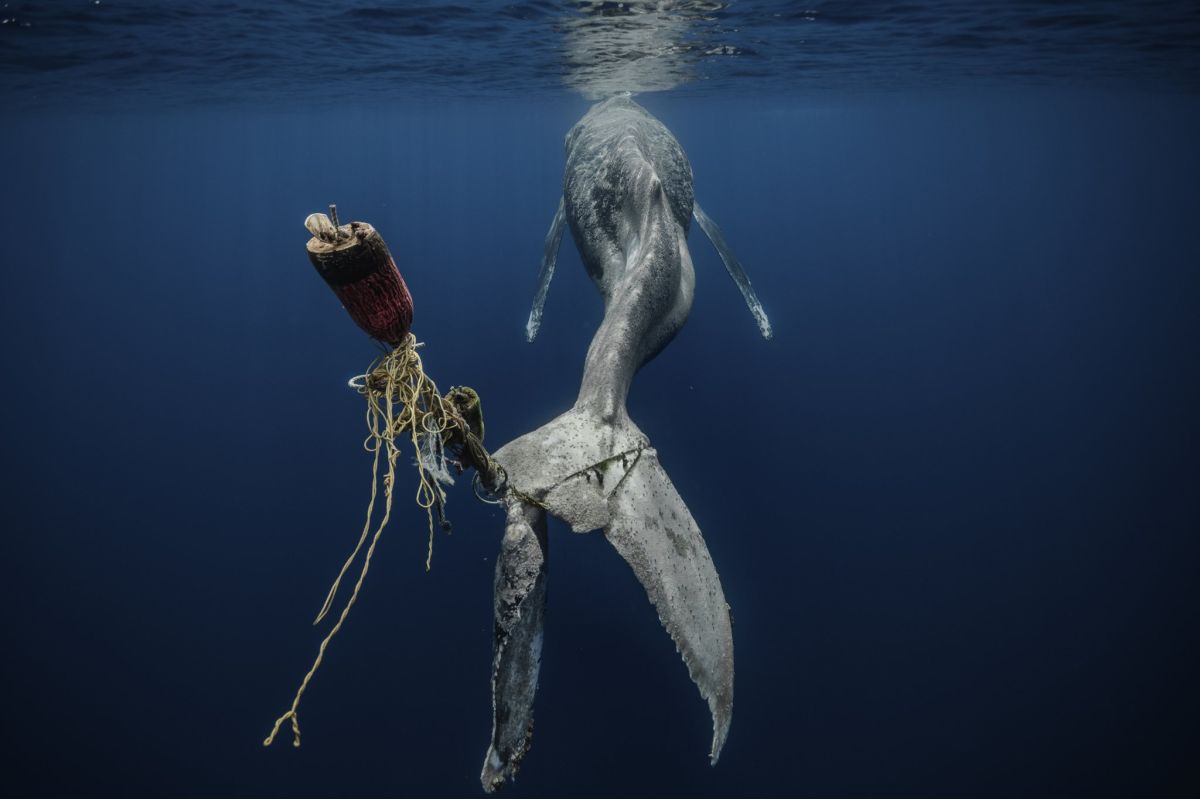
whale

“Hopeless” by Alvaro Herrero

Alvaro Herrero/UPY 2023 (Spain)

“A humpback whale dies a slow, painful and agonizing death after having its tail entangled in a ropes and buoys, rendering its tail completely useless. A reflection of what not only our oceans are suffering, but also our planet, the product of man's selfishness and lack of responsibility. Taking this photograph was, for me, the saddest moment I've experienced in the ocean. Especially because I have spent so much time with humpbacks underwater, experiencing eye contact, interactions, and seeing with my own eyes how they are sentient and intelligent beings. But I'm 'happy' to being able to capture that moment and show the world what is happening, what we are doing. I really hope this image make us aware , open our eyes and drive us in to make real changes.” – Alvaro Herrero

Black & White Winner: “El Blanco – The White One” by Don Silcock (Australia)

Península Valdés, Argentina

whale photos

“El Blanco – The White One” by Don Silcock

Don Silcock/UPY 2023 (Australia)

“The image was taken on the last morning of a five-day trip to Peninsula Valdés in Argentina, in August 2022, under a special permit to enter the water with the Southern Right Whales that gather there between June and December each year. The mother, who can be seen in the background, accepted our presence and allowed the calf to interact with us. It was very playful but careful not to hit us with its tail and seemed to be really enjoying it all – almost as much as we were! White calves are very rare and referred to locally as 'El Blanco' or the white one!

Peninsula Valdés is an incredibly important safe haven and breeding ground for the Southern Right Whales of the southern Atlantic and Argentina has done an excellent job of managing it. It was, without doubt, my best ever underwater experience!” – Don Silcock

Compact Winner: “Klunzinger's Wrasse In Motion” by Enrico Somogyi (Germany)

Marsa Alam, Egypt

underwater photography

“Klunzinger's Wrasse In Motion” by Enrico Somogyi

Enrico Somogyi/UPY 2023 (Germany)

“When I was snorkeling in Marsa Alam I saw countless Klunzinger's Wrasses. One of them was particularly curious and very interested in my lens. I was able to take some good classic wide angle pictures. After a while I figured it would be a good idea to try a long exposure. So I set my camera to the smallest aperture f11, the ISO value to 64 and the exposure time to 1/13s. For this picture, I moved the camera forward a bit while the shutter was released. This created the zoom effect in the lower part of the image. I was very happy with the result.” – Enrico Somogyi

Macro Winner: "Unsung" by Shane Gross (Canada)

Location: Vancouver Island, Canada
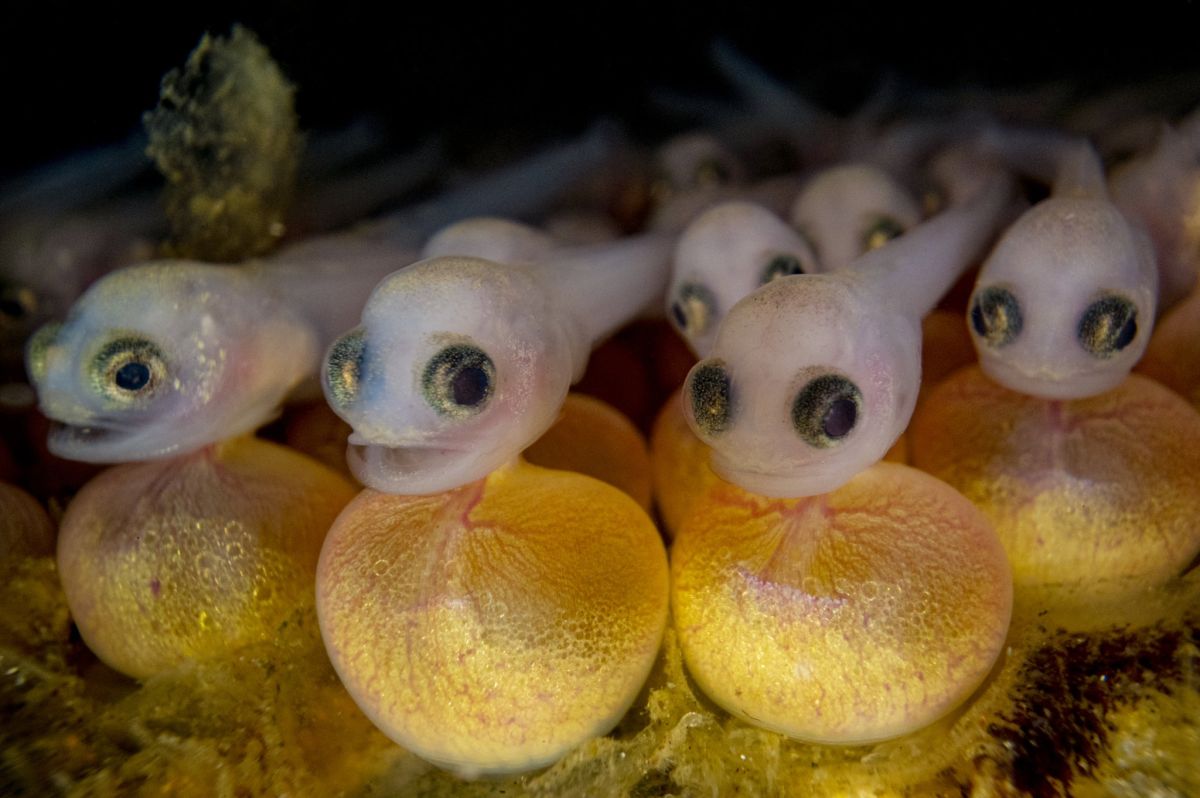
baby fish photograph

“Unsung” by Shane Gross

Shane Gross/UPY 2023 (Canada)

“Walking along a rocky shoreline we would peer under rocks using a probe lens and my camera's LCD screen to check for plainfin midshipman nests. Once found I would lay on top of the barnacle-covered rocks, cutting my elbows, trying to compose images of fish most people have never heard of despite having one of the most interesting lifecycles of any animal. Plainfin midshipman are deep water fish that travel to the intertidal zone to spawn. The males sing to attract females and she will lay as many eggs as his singing deserves before moving on to the next singer. Now, the male has a chance to fertilize the eggs, but only if he is not beaten to the punch by a sneaker male who looks like a female. The singer male will then guard the nest never knowing the kids may not be his. Drama!” – Shane Gross

There are even more incredible images swimming around on the UPY website. You can even download a free yearbook featuring all the winning images and their captivating stories here.


Once a refugee seeking safety in the U.S., Anita Omary is using what she learned to help others thrive.
Pictured here: Anita Omary; her son, Osman; and Omary’s close friends
True

In March 2023, after months of preparation and paperwork, Anita Omary arrived in the United States from her native Afghanistan to build a better life. Once she arrived in Connecticut, however, the experience was anything but easy.

“When I first arrived, everything felt so strange—the weather, the environment, the people,” Omary recalled. Omary had not only left behind her extended family and friends in Afghanistan, she left her career managing child protective cases and supporting refugee communities behind as well. Even more challenging, Anita was five months pregnant at the time, and because her husband was unable to obtain a travel visa, she found herself having to navigate a new language, a different culture, and an unfamiliar country entirely on her own.


“I went through a period of deep disappointment and depression, where I wasn’t able to do much for myself,” Omary said.

Then something incredible happened: Omary met a woman who would become her close friend, offering support that would change her experience as a refugee—and ultimately the trajectory of her entire life.

Understanding the journey

Like Anita Omary, tens of thousands of people come to the United States each year seeking safety from war, political violence, religious persecution, and other threats. Yet escaping danger, unfortunately, is only the first challenge. Once here, immigrant and refugee families must deal with the loss of displacement, while at the same time facing language barriers, adapting to a new culture, and sometimes even facing social stigma and anti-immigrant biases.

Welcoming immigrant and refugee neighbors strengthens the nation and benefits everyone—and according to Anita Omary, small, simple acts of human kindness can make the greatest difference in helping them feel safe, valued, and truly at home.

A warm welcome

Dee and Omary's son, Osman

Anita Omary was receiving prenatal checkups at a woman’s health center in West Haven when she met Dee, a nurse.

“She immediately recognized that I was new, and that I was struggling,” Omary said. “From that moment on, she became my support system.”

Dee started checking in on Omary throughout her pregnancy, both inside the clinic and out.

“She would call me and ask am I okay, am I eating, am I healthy,” Omary said. “She helped me with things I didn’t even realize I needed, like getting an air conditioner for my small, hot room.”

Soon, Dee was helping Omary apply for jobs and taking her on driving lessons every weekend. With her help, Omary landed a job, passed her road test on the first attempt, and even enrolled at the University of New Haven to pursue her master’s degree. Dee and Omary became like family. After Omary’s son, Osman, was born, Dee spent five days in the hospital at her side, bringing her halal food and brushing her hair in the same way Omary’s mother used to. When Omary’s postpartum pain became too great for her to lift Osman’s car seat, Dee accompanied her to his doctor’s appointments and carried the baby for her.

“Her support truly changed my life,” Omary said. “Her motivation, compassion, and support gave me hope. It gave me a sense of stability and confidence. I didn’t feel alone, because of her.”

More than that, the experience gave Omary a new resolve to help other people.

“That experience has deeply shaped the way I give back,” she said. “I want to be that source of encouragement and support for others that my friend was for me.”

Extending the welcome

Omary and Dee at the Martin Luther King, Jr. Vision Awards ceremony at the University of New Haven.

Omary is now flourishing. She currently works as a career development specialist as she continues her Master’s degree. She also, as a member of the Refugee Storytellers Collective, helps advocate for refugee and immigrant families by connecting them with resources—and teaches local communities how to best welcome newcomers.

“Welcoming new families today has many challenges,” Omary said. “One major barrier is access to English classes. Many newcomers, especially those who have just arrived, often put their names on long wait lists and for months there are no available spots.” For women with children, the lack of available childcare makes attending English classes, or working outside the home, especially difficult.

Omary stresses that sometimes small, everyday acts of kindness can make the biggest difference to immigrant and refugee families.

“Welcome is not about big gestures, but about small, consistent acts of care that remind you that you belong,” Omary said. Receiving a compliment on her dress or her son from a stranger in the grocery store was incredibly uplifting during her early days as a newcomer, and Omary remembers how even the smallest gestures of kindness gave her hope that she could thrive and build a new life here.

“I built my new life, but I didn’t do it alone,” Omary said. “Community and kindness were my greatest strengths.”

Are you in? Click here to join the Refugee Advocacy Lab and sign the #WeWillWelcome pledge and complete one small act of welcome in your community. Together, with small, meaningful steps, we can build communities where everyone feels safe.

This article is part of Upworthy’s “The Threads Between U.S.” series that highlights what we have in common thanks to the generous support from the Levi Strauss Foundation, whose grantmaking is committed to creating a culture of belonging.

quiet, finger over lips, don't talk, keep it to yourself, silence

A woman with her finger over her mouth.

It can be hard to stay quiet when you feel like you just have to speak your mind. But sometimes it's not a great idea to share your opinions on current events with your dad or tell your boss where they're wrong in a meeting. And having a bit of self-control during a fight with your spouse is a good way to avoid apologizing the next morning.

Further, when we fight the urge to talk when it's not necessary, we become better listeners and give others a moment in the spotlight to share their views. Building that small mental muscle to respond to events rather than react can make all the difference in social situations.


argument, coworkers, angry coworkers, hostile work enviornment, disagreement A woman is getting angry at her coworker.via Canva/Photos

What is the WAIT method?

One way people have honed the skill of holding back when they feel the burning urge to speak up is the WAIT method, an acronym for the question you should ask yourself in that moment: "Why Am I Talking?" Pausing to consider the question before you open your mouth can shift your focus from "being heard" to "adding value" to any conversation.

The Center for The Empowerment Dynamic has some questions we should consider after taking a WAIT moment:

  • What is my intention behind what I am about to say?
  • What question can I ask to better understand what the other person is saying?
  • Is my need to talk an attempt to divert the attention to me?
  • How might I become comfortable with silence rather than succumb to my urge to talk?

tape over muth, sielnce, be quiet, mouth shut, saying nothing A man with tape over his mouth.via Canva/Photos

The WAIT method is a good way to avoid talking too much. In work meetings, people who overtalk risk losing everyone's attention and diluting their point to the extent that others aren't quite sure what they were trying to say. Even worse, they can come across as attention hogs or know-it-alls. Often, the people who get to the heart of the matter succinctly are the ones who are noticed and respected.

Just because you're commanding the attention of the room doesn't mean you're doing yourself any favors or helping other people in the conversation.

The WAIT method is also a great way to give yourself a breather and let things sit for a moment during a heated, emotional discussion. It gives you a chance to cool down and rethink your goals for the conversation. It can also help you avoid saying something you regret.

fight, spuse disagreement, communications skills, upset husband, argument A husband is angry with his wife. via Canva/Photos

How much should I talk in a meeting?

So if it's a work situation, like a team meeting, you don't want to be completely silent. How often should you speak up?

Cary Pfeffer, a speaking coach and media trainer, shared an example of the appropriate amount of time to talk in a meeting with six people:

"I would suggest a good measure would be three contributions over an hour-long meeting from each non-leader participant. If anyone is talking five/six/seven times you are over-participating! Allow someone else to weigh in, even if that means an occasional awkward silence. Anything less seems like your voice is just not being represented, and anything over three contributions is too much."

Ultimately, the WAIT method is about taking a second to make sure you're not just talking to hear yourself speak. It helps ensure that you have a clear goal for participating in the conversation and that you're adding value for others. Knowing when and why to say something is the best way to make a positive contribution and avoid shooting yourself in the foot.

Health

Psychologists say there are 4 types of introverts. These are the personality traits of each one.

The four types of introverts: Social, Thinking, Anxious, and Restrained.

introvert, introvers, types of introverts, introverted, introvert types, 4 introvert types

A woman sits in a chair reading a book.

Introverts can have many personality stereotypes. Many people assume they are quiet homebodies who prefer alone time, but not all introverts are the same.

Psychologist Jonathan M. Cheek, along with his colleagues Jennifer Grimes and Julie Norem at Wellesley College, presented findings in a 2011 study identifying four types of introverts: Social, Thinking, Anxious, and Restrained (STAR).


"Many people assume introversion is fixed, but introversion is on a spectrum," Chloë Bean, a somatic trauma therapist in Los Angeles, told Upworthy.

- YouTube www.youtube.com

Essentially, there is no one-size-fits-all type of introvert.

"It can shift depending on life phase, your stress level, burnout, support system, and trauma history," Bean said. "What looks like 'being introverted' is sometimes the nervous system doing it's job, protecting you especially when you're feeling overwhelmed or need to connect with yourself more."

Four types of introverts

In an interview with The Cut, Cheek explained that these introvert "types" are more like "shades," and that introverts are often a mix of each one. Here's what you need to know about each type of introvert:

introvert, introverts, being introverted, social introvert, introverts hanging out Three women sit on a blanket in the park. Photo credit: Canva

Social introverts

Bean noted that social introverts may be selective about who they connect with. They enjoy spending time with others but need downtime to recover.

"They prefer to stay home with a book or a computer, or to stick to small gatherings with close friends, as opposed to attending large parties with many strangers," Cheek explained.

How to tell if it's you:

"You may tend to lose a lot of energy when socializing in large groups even when they're fun and prefer one-on-one time," said Bean. "You may feel more regulated with one person at a time, as you can feel overstimulated with more than one person at a time."

Thinking introverts

Thinking introverts are internally rich, deep, and active but appear quiet on the outside, Bean noted. They spend a lot of time reflecting, imagining, creating, or analyzing.

"You're capable of getting lost in an internal fantasy world," Cheek said. "But it's not in a neurotic way, it's in an imaginative and creative way."

How to tell if it's you:

"You feel energized and excited by ideas but you feel exhausted when there is constant feedback and stimulation externally," Bean explained. "You need time to be with your thoughts to come to your conclusion so staying with your inner voice and process is supportive because you can get easily distracted by others' thoughts and opinions."

@onlyjayus

The 4 Types Of Introverts

Anxious introverts

Bean said that anxious introverts deal with anxiety and avoidance driven by fear, as the body anticipates rejection or not being accepted socially.

How to tell if it's you:

"You might replay conversations, dread upcoming plans and cancel them when the tension and anxiety gets too strong," Bean shared. "This is often less about your personality and more about your nervous system feeling dysregulated by thoughts about socializing."

Restrained introverts

Restrained introverts are highly observant, take time to warm up to others, and are cautious about who they spend their energy with, Bean explained.

How to tell if it's you:

"It might take you some time to feel like you can trust others and feel safe enough to speak up," Bean said. "You might also avoid being put on the spot or being the center of attention."

sleep, sleep tricks, sleeping techniques, science, scientific research, placebo effect, placebo

Tired man (left); energized man (right)

The benefits of getting a good night's sleep are too vast to name. Sleep is as essential for our brains as food and water are for our bodies. If you're not getting enough, sleeping better has been shown to elevate your mood, improve your memory, and even boost your physical health. And then there's the obvious: when you don't sleep well, you'll have less energy and generally perform worse on tasks that require any kind of effort or thought.

However, we're all human, and, sometimes, humans sleep terribly. Your infant might wake you up, or a car alarm might go off outside, interrupting your regularly-scheduled REM. It's not always our fault when we don't sleep well, but there might be an interesting way to fix it.


A study from 2014 may have demonstrated the existence of something called "placebo sleep," or tricking your brain into believing you slept better than you did.

sleep, sleep tricks, sleeping techniques, science, scientific research, placebo effect, placebo a man sitting at a desk with his head on his arms Photo by Vitaly Gariev on Unsplash

The placebo effect, of course, has been studied relentlessly over the years and has shown that the human body can do amazing, almost impossible things, when the brain gets on board. The classic example is when symptoms of disease get measurably better after a patient takes a "fake" pill. Another study out of Harvard showed that people who were told their jobs qualified as exercise showed improved health and fitness markers compared to people who did the same job. Placebos even work when the person knows they're taking a placebo. It's called an "honest placebo" and is considered a legitimate, ethical treatment method for many ailments.

The researchers in 2014 wanted to find out if the placebo effect could also apply to sleep. So, they lectured a group of participants about the importance of REM sleep and how it can effect cognitive functioning. The participants were then split into two groups and monitored overnight while they slept. The next morning, one group was told they achieved 28.7% REM sleep, which is terrific, and the other group was told they only spent 16.2% of their sleep time in REM, which is below average. The numbers, however, were complete fiction.

Stunningly, the participants who believed they achieved top quality sleep performed better the next day on a series of arithmetic and word association tests compared to the other groups.

In their conclusion, the authors wrote, "These findings supported the hypothesis that mindset can influence cognitive states in both positive and negative directions, suggesting a means of controlling one's health and cognition."

According to Smithsonian Magazine, follow up experiments confirmed the findings.

The key to feeling great and performing as if you had a great night's sleep may lie in simply believing that you did.

There are a lot of ways to "placebo your sleep" in order to generate that belief. For starters, you can adopt a new routine or technique or even supplement in order to prime your brain.

John Cline Ph.D. asserts for Psychology Today that the popularity of sleeping aids like melatonin may be tied less to the fact that they work, and more to the fact that people believe they work. But you don't need to take any supplements or medications. Having a slow evening wind down with a book and an herbal tea, trying a new sleeping position, or practicing some measured breathing might work just as well. Or, rather, they might work precisely because you believe they will.

sleep, sleep tricks, sleeping techniques, science, scientific research, placebo effect, placebo Can a warm cup of tea help you sleep better? If you believe it, then yes. Photo by Dana Ciurumelea on Unsplash

You could take the concept a step further and alter your morning routine on nights you know for a fact you didn't sleep well. Perhaps it's by using a new coffee brand, doing some stretches before getting out of bed, or meditating before starting your day. Anything that you truly believe might help make you more alert and focused may just work.

One viral social media sleep trend capitalizes on this research perfectly. Researchers have shown that forcing your mouth into a smile has been shown to improve your mood. Turns out, similarly, you may be able to get sleepy by pretending to be super tired. Psychologist Erica Terblanche calls it the "alpha bridge," and it involves gently closing your eyes, fluttering them open just a tad, and then closing them again as you relax and breath. It simulates the feeling of "nodding off" and is said to create the alpha brainwaves that transition your brain from wakefulness to sleep. It's another clever way of tricking your own brain.


@erica.terblanche

Here's a skill to help you fall asleep on an airplane or anywhere else for that matter. . Its called going over the Alpha Bridge. #EricaTerblanche #ThriveGuru #motivation #sleeping

It sounds cheesy, but the power of mindset and positive thinking is truly tremendous. Our beliefs and thought patterns can greatly influence our body, our behavior, and our mood. Sometimes, our mindset can even be stronger than actual reality. Now we have the data to prove that it applies to our precious sleep, too.

conflict resolution, conflict resolution for kids, finding common ground, conversation tips, ending an argument, substitute teacher
via @brightsignslearning/TikTok, used with permission

A teacher shared how encouraging her student to find common ground instantly stopped an argument

Tennessee-based educator Shelby Rideout was substituting for a third-grade class when she noticed two young girls, who were otherwise “really sweet, fun, kind,” start arguing with one another. The solution she found to instantly ease that conflict was surprisingly simple.

She encouraged them to “Look for some common ground.”


Without missing a beat, the girls were able to make one connection after another (“Jesus” and “Ethiopian food,” in this case) without any further guidance from Rideout. Within minutes, they went from bickering to “hootin’ and hollerin’ and laughing.”

Rideout shared this story to her TikTok, with the message that: “It is literally that simple. I feel like we’re a world where everyone is looking for a problem…why not look for how to get along?”

“I don't care if it’s just that you both like peaches,” she quipped. “That’s a start. That’s how we start.”

In an interview with Today, Rideout even argued that this method of finding common ground is how we ease conflict in the adult world. “Whether someone leans left or right,” she said, “most people are motivated by the same goal: to make things better.”

Several viewers even proved this point by sharing some of their own positive anecdotes that came from incorporating this mindset into their everyday lives.

“I was an elected official for 24 years. I used a version of your solution often, especially with elected officials of the other party,” one person wrote.

Another added: “I made a conscious decision to befriend a co-worker who I was really struggling with. I started going out of my way to extend extra kindness to them. We now get along beautifully!”

In this day and age, it’s easy to forget that most people are not as far apart as they think. Thankfully, they just need a starting point that reminds them of their shared humanity.

If you want to try Rideout’s "common ground" approach in your own life, here are a few simple ways to start.

conflict resolution, conflict resolution for kids, finding common ground, conversation tips, ending an argument, substitute teacher Two women engaging in a pleasant conversation inside a coffee shopPhoto credit: Canva

First, ask open-ended questions. Instead of focusing on what you disagree about, ask about hobbies, favorite foods, music, or weekend plans. Shared interests often appear quickly when the conversation is relaxed.

Second, listen for common values. Even when opinions differ, people often care about the same underlying goals, such as safety, fairness, family, or community. Naming those shared values can shift the tone of a conversation.

Third, keep it small. Common ground does not have to be profound. Maybe you both love a certain coffee shop. Maybe you both dread Monday mornings. Small points of connection can build trust over time.

Fourth, lead with kindness. A smile, a compliment, or a moment of patience can make someone more willing to meet you halfway. Kindness often opens the door to connection.

Finally, remember that, as Rideout mentioned, common ground is a beginning, not a solution to every problem. You can still disagree. You can still set boundaries. But starting from a place of shared understanding makes it easier to move forward with respect.

conflict resolution, conflict resolution for kids, finding common ground, conversation tips, ending an argument, substitute teacher Two men engaging in a peaceful disagreement.Photo credit: Canva

Bottom line: Rideout’s classroom moment is a reminder that the tools for better communication are often simple and accessible. Two third graders found their way back to laughter by naming what they shared. Adults can do the same.

shhh, quiet, zip it, mouth closed, say nothing, be quiet

A woman zipping up her lips.

There are times to speak up, moments when it’s best to say nothing, and opportunities be very considerate in your response. But when you’re on the receiving end of a back-handed compliment, a foolish remark, or a coworker takes you down a peg, and your emotions are up, it can be hard to have a thoughtful response. Often, we say something we shouldn’t.

How is it that some folks fly off the handle and say things they’ll later regret, while others can stay calm and remove themselves from the situation or take the high ground? One way to be less impulsive with your words is to use the “name it to tame it” neuroscience hack, originally coined by author and psychiatrist Dr. Dan Siegel. When used properly, it allows you to step back from the moment and choose the best response in a challenging situation.


shhh, quiet, zip it, mouth closed, say nothing, be quiet A man saying "be quiet."via Canva/Photos

How to use the ‘name it to tame it’ hack

When someone upsets you, the first thing to do is to go inside yourself and describe the emotion that you feel in your body. Are you angry? Are you sad? Are you afraid? Do you feel rejected? Are you disappointed? The moment you name the emotion, it will begin to subside and give you the emotional and mental room to respond to the person who caused the negative emotion, rather than impulsively reacting.

How to respond to a reactive emotion so you don’t fly off the handle:

Event happens:

1. Your body stiffens up

2. You feel an intense emotion

3. You examine the emotion and give it a name: “My body is telling me I am angry.”

4. You should feel the emotion beginning to subside

5. Choose your response instead of being impulsive

shhh, quiet, zip it, mouth closed, say nothing, be quiet A woman zipping up her mouth.via Canva/Photos

Why does ‘name it to tame it’ work?

“Name it to tame it” works because, when we have a strong emotional reaction, our lizard brain kicks in, and we go into fight, flight, or freeze mode. The lizard brain is not known for giving thoughtful and strategic responses to challenging situations. When we name the emotion, our prefrontal cortex, or the thinking brain, kicks in. The thinking brain looks at the situation and says, “Alright, we don’t need to run or fight here. It's best to give a strategic response.”

When we tune into the negative emotions by naming them, they relax because they feel heard, like when a child has hurt their knee or a loved one has real concern and you gives them undivided attention. Once the emotions are named, they are tamed. Then, you are more likely to respond to the negative person with grace and speak from the best part of yourself.

Dr. Dan Siegel, who coined the phrase “Name it to tame it,” explains the brain science behind the technique in the video below. He does a great job of explaining how it allows us to transfer our thoughts from the downstairs brain (the lizard brain) to the upstairs brain (the thinking brain), so we can calm down and respond appropriately to the situation.

- YouTube www.youtube.com