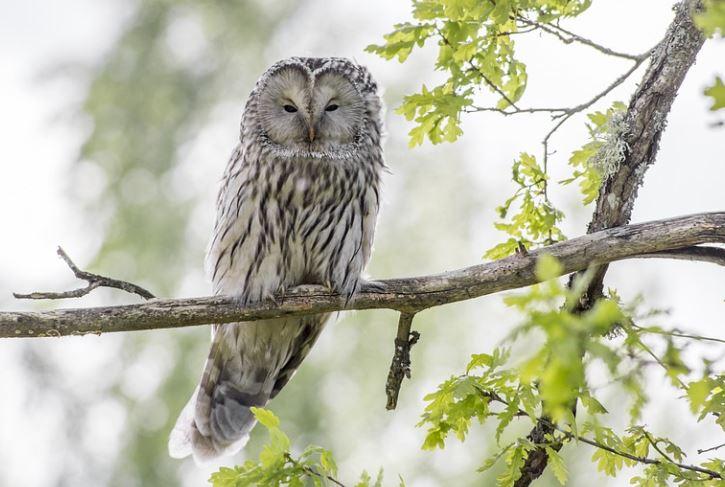
A series of break-ins in an upscale neighborhood in Oak Bay, British Columbia, are not what they seem. On two separate occasions, homeowners thought they were the victims of home invasions when, in fact, they were being visited by a mischievous owl.
The first “break-in” happened Nov. 10 when police received a 911 call from a homeowner in distress. “Sure enough we found the perpetrator perched on a very expensive leather couch in the living room,” Oak Bay Police Constable Steven Twardy told CTV News.
The officers were able to escort the owl out of the home after chasing it with brooms. The constable named the owl “Winky” because it tended to close one eye. It appears to have suffered some type of injury.
Three days later, a woman was checking in on her friend’s home when she found it seemingly ransacked. “Pictures off the walls, vases on the floor and lamps and stuff,” Tina Gaboury told CTV. However, it wasn’t a burglar but Winky the owl who had hit up another Oak Bay home.
“I was walking around thinking it was a home invasion, then out of the corner of my eye I caught a glimpse of an owl hanging on a chandelier in the living room,” Gaboury said.
No one knows how Winky has been entering the homes though some believe the feathered felon may be getting in through the chimney. But the big question is, when will Winky strike next?
CTV has been on top of the story and posted this pun-tastic report.

An Operation Smile volunteer reverses an oxygen mask so a child with a cleft condition can blow a bubble for the first time in Guadalajara, Mexico. (Operation Smile Photos)
For thousands of children born with cleft conditions, Operation Smile provides simple, playful tools—like bubbles—to strengthen the skills they need to speak and thrive.
While a bottle of bubbles might seem out of place in a hospital setting, you might be surprised to learn that, for thousands of children around the world born with cleft lip and palate, they can be a helpful tool in comprehensive cleft care. Lilia, who was born with cleft lip and palate in 2020, is one of the many patients who received this care.
As a toddler, Lilia underwent two surgeries to treat cleft lip and palate with Operation Smile’s surgical program in Puebla, Mexico. Because of Operation Smile’s comprehensive care, it wasn’t long before her personality transformed: Lilia went from a quiet and withdrawn toddler to an exuberant, curious explorer, babbling, expressing herself with a variety of sounds, and engaging with others like any child her age.
Lilia is now a healthy five-year-old, with the same cheerful attitude and boundless energy. Her progress is the result of care at every level, from surgery to speech therapy to ongoing support at home—but it’s also evidence that small, sustained interventions throughout it all can make a meaningful difference.
Lilia at age 1, before surgery, and at age 5, 4 years post-surgery
Cleft Conditions: A Global Problem
Since 1982, Operation Smile has provided cleft lip and cleft palate surgeries to more than 500,000 patients worldwide with the help of generous volunteers and donors. Cleft conditions are congenital conditions, meaning they are present at birth. With cleft lip and palate, the lip or the roof of the mouth do not form fully during fetal development. Cleft conditions put children at risk for malnutrition and poor weight gain, since their facial structure can make feeding challenging. But cleft conditions can have an enormous social impact as well: Common difficulties with speech can leave kids socially isolated and unable to meet the same developmental milestones as their peers.
Surgery is a vital step in treating cleft conditions, but it’s also just one part of a much larger solution. Organizations like Operation Smile emphasize the importance of multi-disciplinary teams that provide comprehensive, long-term care to patients across many years. This approach, which includes oral care, speech therapy, nutritional support, and psychosocial care, not only aids in physical recovery from surgery but also helps children develop the skills and confidence to eat easily, speak clearly, and engage in everyday life. This ensures that each patient receives the full range of support they need to thrive.
Marie, 11 months, with her mother at Operation Smile Madagascar before her cleft surgery (Operation Smile Photos)
A Playful (and Powerful) Solution
Throughout a patient’s care, simple tools like bubbles can play a meaningful role from start to finish.
Immediately before surgery, children are often in a new and unfamiliar environment far from home, some of them experiencing a hospital setting for the first time. When care providers or loved ones blow bubbles, it’s a simple yet effective technique: Not only are the children soothed and distracted, the bubbles also help create a sense of joy and playfulness that eases their anxiety.
Milagros Rojas, a volunteer speech therapist in Peru, using bubbles in a screening with a patient. (Operation Smile Photos)
In speech therapy, bubbles can take on an even more important role. Blowing bubbles requires controlled airflow, as well as the ability to form a rounded “O” shape with the lips, which are skills that children with cleft conditions may struggle to develop. Practicing these skills with bubbles allows children to gently strengthen their facial muscles, improve breath control, and support the motor skills needed for speech development. Beyond that, blowing bubbles can help kids connect with their parents or providers in a way that’s playful, comforting, and accessible even for very young patients.
Finally, bubbles often follow patients with cleft conditions home in the “smile bags” that each patient receives when the surgical procedure is finished. Smile bags, which help continue speech therapy outside of the hospital setting, can contain language enrichment booklets, a mirror, oxygen tubing, and bubbles. While regular practice with motor skills can help with physical recovery, small acts of play help as well, giving kids space to simply enjoy themselves and join in on what peers are able to do.
Bubbles at Home and Beyond
Today, because of Operation Smile’s dedication to comprehensive cleft care, Lilia is now able to make friends and speak clearly, all things that could have been difficult or impossible before. Instead of a childhood defined by limitation, Lilia—and others around the world—can look forward to a childhood filled with joy, learning, discovery, friends, and new possibilities.
CTA: Lilia’s life was changed for the better with the care she received through Operation Smile. Find out how you can make an impact in other children’s lives by visiting operationsmile.org today.
It’s a common kindness among pet owners to leave their fur babies some kind of background noise whenever they’re gone for extended periods of time. It’s such a popular practice that YouTube and Spotify have dedicated playlists for soothing and stimulating pets while we’re away doing human things. And hey, if it eases our guilt in the process, that’s a win-win.
But do our pets actually appreciate this gesture in the way we hope? The only accurate answer is, of course, that it depends—not only on which species we’re dealing with, such as cats vs. dogs, but also on the genre of music.
Dogs might really dig soft tunes
One United Kingdom-based behavioral study found that, for dogs at least, classical music produced a calming effect. Of the two other genres tested, heavy metal had, perhaps unsurprisingly, an agitating effect, while pop had no observable effect. Sorry, Britney Spears.
Interestingly, a CD playing a human conversation also seemed to have no effect. Of course.
However, another study that used heart monitors to measure the effect different styles of music had on dogs’ heart rates suggested that, like humans, dogs have individual music preferences. In this study, reggae and soft rock “showed the highest positive changes.” One thing to consider, though, is that different breeds of dogs have different resting heart rates, which might influence how they respond to certain styles of music.
Moving on to cats. While there are far fewer feline-centric studies, the data at first glance might suggest that they aren’t quite as musically inclined as their canine counterparts.
Of course, this could be because cats are more attuned to certain frequencies, making what they “hear” very different from what is experienced by dog or human ears. Researchers who relied heavily on music that fell within a cat’s preferred frequency range found that cats reacted significantly more positively to it than to classical music. Some even rubbed up against the speaker—the ultimate sign of cat approval.
Fun fact: that special cat music, composed by David Teie, was turned into an album that can be purchased here.
What about TV?
As for television shows, the general consensus is that rather than providing entertainment, they serve as a source of comforting familiarity for pets. However, there aren’t enough studies to confirm this either way. And considering what we’ve already mentioned about responses to certain frequencies, it stands to reason that most human shows don’t necessarily register in the same way. Of course, we’ve all seen how dogs react to episodes of Bluey, so…
And if these things mask unpleasant outside noises—like fireworks, horns, planes, etc.—that might otherwise cause anxiety, then perhaps that’s all the benefit pet owners need.
At the end of the day, leaving on music or TV might be less about creating the perfect enrichment experience and more about offering a little comfort—to both our pets and ourselves—while we’re away. Some animals may completely ignore it. Others may perk up at a familiar voice or settle down when soft music starts playing. A lot of figuring that out comes from attentively and lovingly observing how your fur babies respond as individuals. Luckily, that’s a task most pet owners will gladly take on.
Those daily habits can be extremely specific, as evidenced by one cat owner’s “Q-tip jail” TikTok video. “Note for pet sitter,” the overlay text from @nothoughtsjustsushi reads, “bedtime routine includes putting him in jail, and the prisoner gets one Q-tip nightly.”
The “putting him in jail” part means pinning the cat between two open doors. The human then slips a Q-tip through the crack between the doors as the kitty “prisoner” eagerly grabs it. Seriously quirky:
As weird as this is, it’s not much weirder than the many other examples cat owners and pet sitters shared in the comments:
“As a pet sitter I once had a client tell me I needed to pretend to water her cat or else she’ll yowl and scream at me😭 the cat even had her own plant pot she’d be in when I started to do my rounds of watering.”
“Explaining to the pet sitter my cat needs her alone tub time but DO NOT turn on the water. She just likes to sit in there, unbothered.”
“My cat will scream at me when I go in my room until I lay on the bathroom floor and let her loaf ✨next to me✨. That’s it, that’s her favorite thing.”
“Mine likes to sing in the bathtub for the resonance. And it has to be a bath tub! She doesn’t do it if it’s just a shower stall. It’s something we look for in an apartment now, very important.”
“Mine has to sing the song of her people before we lay down at night. It basically consists of her walking a lap around the house howling to oblivion. Only then will she hop in bed and go to sleep.”
“My cat will only sit on the couch with me if I put a blanket over her. She does not want to be seen, but she wants to hang out.”
“When I had my cat, every morning before work I would put on eyeliner. One morning I pretend put eyeliner on her and told her “all done so pretty” and it BECAME routine. She would promptly sit by the mirror and Scream if I forgot to do it, or until it was done.”
“My cat loves raw asparagus. He will stand in front of the fridge and yell at me until I figured out what he wanted. He plays with it like prey, then he eats it.”
“My sister’s cat gets on top of the fridge and screams until he gets a teaspoon of shredded cheese to eat while he looks down on everyone.”
“My cat demands I cradle her like an infant while I am on the toilet. She will scream and jump on the sink and knock things over until I get her.”
“My cat has to have bathtub time.. every night when my mom goes to shower, she runs into the bathroom, and you have to flip hairbands in the bathtub so she can play with them while mom showers (the shower and bath are separate).”
“Orange cat here! He patiently puts his hand on mine and looks at me until I pick both his hands up ‘to hold hands.’ He never misses a day. He only does this with me. If im going to be busy all day I go ahead and say let’s hold hands. He absolutely trained me to do this. I have to idea how it started.”
People ask how cat owners figure these things out, and most cat owners don’t have a clear answer. With cats, you just do random things to see what happens, and suddenly something sticks. You can’t predict what it will be, so you do have to be careful. That fun little entertainment and enrichment experiment might just turn into a routine you can’t escape.
Not that most would change a thing. These oddities are what make life with cats so delightful.
Cat owners’ relationships with their cats run the gamut from “Fine, I’ll reluctantly feed you and clean your litter box” to “You are my favorite living creature on Earth, and I would die for you nine times over.” But even those of us who adore our kitties might playfully annoy them sometimes, not to be mean, but because cats are fun to mess around with.
People have been sharing videos of “rage baiting” their cats, a tongue-in-cheek term for intentionally annoying them in some way. For instance, a cat owner might pet a cat where it just cleaned itself, gently but repeatedly poke it, put it down really, really slowly, or whatever this is:
Obviously, actually enraging a cat is neither kind nor wise. But where is the line between playful interaction and actual torment? Some cats inexplicably enjoy the most random things, after all. So when does banter turn into bullying, and what are the signs that you’ve taken it too far with your feline friend?
Julia Specht, cat behavior consultant and founder of Park Slope Paws, tells Upworthy that a cat owner’s intent matters a lot less than the impact.
“I think every human can remember a time when someone was good-naturedly teasing them, but it made them feel afraid or angry or alone,” she said. “Cats can’t know what your intention is; they’re not capable of that tertiary-level thought. All they know is that you’re doing something unpleasant that they don’t like.”
Often, cats will walk away if you do something they don’t like. But not always. Specht advises paying attention to a cat’s body language to determine whether it is stressed.
“Are their ears back? Is their tail swishing? If so, they’re not happy. Maybe they’re not lashing out at you, but you’re not helping your relationship,” Specht said. “If they do lash out (by biting or swatting), hide from you, or avoid you, then you’re doing some serious damage to your relationship.”
Cats can get overstimulated, even from fun play, but especially from things we might do to “rage bait” them. PetMD writes that a sudden change in demeanor can signify overstimulation and is a sign to stop what you’re doing.
So what can you do to entertain both yourself and your cat in a way that doesn’t cause it stress?
“Fortunately for us humans, cats have incredible comedic timing,” said Specht. “There are all kinds of things you can do with your cat that will be both hilarious for you and enjoyable for them. Think about ways you can play with them, or give them fun enrichment activities like boxes or tissue paper. (Have you ever seen a cat attack a sheet of bubble wrap? I highly recommend it.) These activities also help make your relationship with your cat better in the long run.”
Other ideas for playing with your cat in ways that are both fun and engaging include toys on poles that you can drag around for it to chase, giving it catnip, or buying or building puzzle toys or structures that hide treats, like the ones featured in this video from Cats Protection:
Cats provide plenty of humor simply by being cats and doing cat-friendly things. As Specht tells Upworthy, “You don’t have to annoy your cat to get them to do something funny. They’ll do that on their own, if you give them the opportunity to.”
Wise people often advise us to put our dreams into action. It’s a nice thought, and possible, if, say, your dream is to buy a new blender. But how practical is it when our dreams involve enormous mansions in foreign countries?
Sometimes it just takes a little imagination, gumption, cooperation, and a dash of magic, which is exactly what just over 300 women happened to have when they pooled together to buy Château de Béduer and later, L’Abbaye-Château in the French countryside. They dreamt big and turned a little “what if” into an incredible reality.
It all began when Leah Lykins, her mother Philippa Girling, and Girling’s friend Lynda Coleman stumbled upon a French property online. What if, somehow, they could fix it up? The three began turning the wheels to make it happen. In a piece for Marie Claire, writer Kathryn Madden shares, ” Their vision was to create a place where women and people who identify as women could just be.”
On a TikTok posted to their Camp Chateau page, we see stunning photos of a French castle and videos of women drinking wine in luscious vineyards. The chyron reads, “POV: You bought a medieval chateau with your best friend, eldest daughter and 300 other women. And now you’ve created space for women to gather and embrace, celebrate and lift one another up. Freely. Joyfully. Wholeheartedly.”
The clip explains what the camp embodies. “Camp Chateau is not just a picturesque summer camp located in France. It is a testament to female empowerment and community. Founded by women for women, Camp Chateau celebrates the essence of what summer camp can offer – friendship, adventure, and personal growth in a supportive environment.”
The Instagram site Nurtle (@therealnurtle) added some context, sharing, “More than 300 women pooled around $2.3 million to buy a 1,000-year-old château in southern France, creating a women-only retreat known as Camp Château. The project was funded through a shared ownership model, where participants collectively contributed to the purchase and restoration.”
As for what people get if they book a stay: “The château hosts six-day, all-inclusive stays where guests can shape their own experience, from organized activities like kayaking and workshops to simply spending time on the grounds. Camp Château has since expanded beyond a single property, with plans to host thousands of participants across multiple locations in the coming years.”
The clip spawned many comments, some of which seem inspired to follow in their footsteps. “This sounds so magical and wonderful,” writes one Instagrammer. Some even offer their services: “Can I be your chef starting in September?”
The Camp Château official website explains what’s in store at their different properties. Château de Béduer, they share, “has a storied past of remarkable women and is nearly 800 years old. It has 20 acres of stunning grounds and gardens for catching a quiet moment or playing outdoors.” On the premises of the 13th-century chateau, they also include a more modern 19th-century farmhouse.
Their more recently acquired location, the L’Abbaye-Château de Camon, sits “atop one of France’s official plus beaux villages. This former Benedictine abbey-turned-château is steeped in nearly a thousand years of history.”
Traveler Victoria Goyet shared with Business Insider that attending the camp at age 75 changed her life. “When I returned and told a friend about my experience, I said attending camp made me stop, re-center, and think about my life and what I want to do. I don’t know how many years I have left, but I’m closer to the end than the beginning. Camp made it clear to me that it’s important I start making time for things I want to do.”
Beagles are one of the most popular dog breeds for people looking for a pet. Most years, they rank among the top 10 breeds in America. It’s easy to see why: the American Kennel Club (AKC) describes beagles as “loyal” companions that are often “happy-go-lucky.” They get along well with kids and other dogs and are generally considered easygoing.
Sadly, that gentle temperament has made beagles a common choice for companies that conduct animal testing.
Rescued lab beagle gets a second chance and sees the sun for the first time
Luckily, there are plenty of people who want to save these beagles from a life spent behind bars in a lab.
Meracle Paws is one such organization. They specialize in rescuing senior dogs, which are in especially great need of love and care. It’s far easier to find homes for puppies and younger dogs. Senior rescues are often left behind in shelters and at rescue organizations.
But that doesn’t make the rescues any less meaningful. The team behind Meracle Paws recently took to Instagram to share a brief but emotionally overwhelming moment following a large release of dogs bred for research.
“We’ve carried 1000 Lab beagles out of that place [Ridglan Farms] into freedom. Today so many of them were seniors… dogs who spent their entire lives in cages breeding puppies for experiments and testing,” the caption read. “This sweet senior mama had never touched grass, breathed fresh air, or felt the sun on her face. Today I held her while she lifted her head to the sky and tasted sunshine with her little tongue for the very first time. I don’t think I’ll ever forget this moment for the rest of my life.”
The video is only a few seconds long, but the look on the sweet dog’s face says it all. This tiny moment was years in the making.
Video goes viral, and commenters are extremely moved
Ridglan Farms in Wisconsin is a breeder that specializes in “purpose bred beagles for biomedical research.” For years, rescue groups lodged complaints and allegations of horrific animal cruelty against the facility.
Just recently, the long battle finally came to an end. Legal pressure and intense protests ultimately convinced the organization to release many of its dogs. KAAL-TV reports that more than 1,500 beagles were freed in the operation. Ridglan Farms, which has agreed to surrender its license to avoid prosecution, has denied mistreating the dogs.
Commenters on Meracle Paws’ post were overjoyed by the news:
“Breaks my heart for all these babies but especially when I see the older ones. So much hell for so long … thank you for giving them a chance to enjoy the life they always should have had”
“This vid of her smelling the air and face towards the sun is everything”
“I’ve lived a very long life and watching this sweet soul discover kindness for the first time brought tears to my eyes”
“can’t stop crying, this is so incredibly moving and beautiful..what joy and grace you have brought to this gentle soul!!”
The cruel irony of beagles is that their adorable, cuddly, and forgiving demeanor makes them prime targets for abuse.
The Beagle Freedom Project quotes one anonymous lab technician: “They won’t fight back. They let us do anything we want to them, that’s why we like beagles.”
An uncomfortable reality is that animal research is sometimes considered a necessary evil in scientific progress, particularly in developments that help us better understand human diseases or create medications that could ease people’s suffering.
The Ridglan Farms case reached the federal level, with both HHS Secretary Robert F. Kennedy Jr. and NIH Director Jay Bhattacharya getting involved. New York Rep. Nick Langworthy, who also advocated for the closure of Ridglan Farms, wrote in a letter: “This issue is not about opposing scientific progress; it is about ensuring that federally funded research reflects both ethical standards and scientific advancement.”
The sweet senior beagle featured in Meracle Paws’ videos helps put a face to the cause. Watching her, and the others, touch grass and feel sunlight for the first time is heartbreaking, but more importantly, joyful and hopeful. It’s a cause well worth continuing to fight for so that more moments like this one can happen.
Many of these beagles from Ridglan Farms are still in need of help or homes. You can learn more about how to help or adopt them here.
In 2022, eighty-one-year-old Harry Smith, who uses an electric wheelchair, was walking his beloved nine-year-old beagle mix, Sarah Jane, near a lake in Port St. Lucie, Florida, when the pleasant jaunt took a turn for the worse. Smith says that the left wheel of the chair “grabbed and spun me” and he wound up rolling down a grass embankment into the water. Smith can’t swim, could barely keep his head above the water, and without immediate help would have drowned.
Sarah Jane began to bark loudly, capturing the attention of Edward Suhling, 58, who was working on a trailer with Aby “Jacob” Chacko, 49. “Sensing his owner was in trouble, his dog began to bark loudly, which alerted two bystanders across the street,” the Port St. Lucie police department wrote in a Facebook post.
At first, Suhling thought the dog was being attacked by an alligator. Then he saw Smith’s head poking out of the water. Suhling and Chacko ran over to the pond, flagging down a police officer along the way.
Harry was out walking his dog, Sarah Jane, when his wheel got caught in the mulch, turning him around and down into the pond.
Neighbors heard Sarah Jane barking and Harry yelling “HELP!” @PSLPolice were flagged down.
“As soon as I got here I saw the wheelchair and the dog and I recognized that’s Harry and I know he can’t walk,” Chacko said. Smith was in terror fighting for his life in the pond. “My legs don’t work,” he said. “I can’t push.”
“The dog was splashing in the water,” Suhling said. “So we both ran over here and I jumped in the water, and my buddy grabbed his arms and I grabbed his legs and we got him up on shore.”
After Smith was safely out of the water, the police officer administered medical attention and he was cleared to go home. Unfortunately, his wheelchair didn’t work, so the officer pushed him back to his home.
The Port St. Lucie Police Department later called Suhling, Chacko, and Sarah Jane heroes on its Facebook page. “We are thankful for Mr. Smith’s dog and the two bystanders that helped save his life!” the police department wrote on Facebook. “And as the saying remains true…A man’s best friend is his dog.
“She’s such a good dog,” Smith later said about Sarah Jane. “Everybody in this neighborhood loves her, they all look out for her.” After the pair made it home safely, Smith was sure to give his dog a treat. “I love her, always have, always will,” he said.
Why dogs know when their owners are in danger
While the dog’s heroics are pretty amazing, Sarah Jane knew that Smith was in danger and sprang into action for a couple of reasons. A lot of dogs have a strong fear of water. Not all of them love it like Labradors. If Sarah Jane was afraid of the water, she would have sensed her guardian was in serious danger.
Secondly, a 2020 study from Arizona State University tested whether dogs will help if they think their owner is in trouble. For the study, owners called out to the dog while appearing to be trapped inside a box. The dogs often attempted to free their owners after hearing them cry for help.
Beagles are known for being active and adventurous, but are they good swimmers? According to a vet-reviewed article at Dogster, Beagles aren’t known for their love of water, and if they can swim, it doesn’t mean that they enjoy it. They can learn how to swim, but they aren’t natural swimmers.
The story of Sarah Jane and her guardian Harry Smith proves, once again, that we just don’t deserve dogs.
This article originally appeared four years ago. It has been updated.
Have you ever watched a person who has only ever had dogs try to interact with a cat? When dog-only people encounter cats, the result can be a mix of entertaining, bewildering, and, occasionally, a bit dangerous.
Obviously, cats are not dogs, and treating a cat as if it was a dog may or may not go well for you. So, if you’re one of those dog lovers who find themselves at a loss for what to do with a cat when you’re around one, here are some things to know that may save you some scratches or humiliation.
Ditch the high energy, embrace a sense of aloofness
Dogs are often eager. Cats are usually aloof. With many dogs, the more excited you act, the more they’re like, “Hey, you my friend! We best buds! Let’s play and hang out!”
Approaching a cat with high energy puts them on edge. They might see you as a threat and become aggressive. Or they will simply “peace out” and leave the room. The best thing you can do if you want to make them comfortable is ignore them.
Let them come to you
If you absolutely must approach a cat (because they’re just irresistibly cute), do so very slowly. But it’s really best to just sit on the floor and wait for them to come to you. Don’t try to force it. They might ignore you completely at first, or they might immediately come right up and start rubbing on you. There’s no way to know, so just wait.
Rubbing on you might mean ‘go ahead and pet me.’ But it might not.
If a cat rubs up against you, that’s a good sign. If you’re new to them, it means they’re already comfortable with you. But it’s not necessarily an open invitation to pet them, either. Cats are fickle. Before you get too excited and go in for some pets…
Cats are big on smell. Before your hand touches their fur, they want to know what they’re dealing with. Try holding out a finger or two for them to sniff, preferably coming from below their head instead of above. After they’ve smelled you, they might stick around for pets, or they might not. If they do…
Don’t pet them like a dog
No to head pats. Yes to chin and cheek scratches. No to belly rubs unless their human gives you the green light. (Most cats will destroy your hand if you try to rub their belly, but some love it.) No to hard strokes down their back, at least at first. Cats all have different touch preferences, so gently trying around their chin, cheeks, shoulders, and back is the best way to start.
Happy Cats Haven shared these signs to watch for that indicate a cat might not like the way you’re petting it:
Restlessness
Skin rippling
Ears flattening or flicking
Tail thumping or thrashing
Turning head toward the petting
Your hands are not toys
Playing with cats can be a blast. They are predators with excellent hunting skills, so play involves stalking, chasing, and attacking. But to save yourself some painful scratches, use a laser pointer or a cat toy on a string, not your hand. (They’re not likely to actually play with your hand anyway. And if they do, you might regret it.)
Don’t put your face near a cat that doesn’t know you
Even if the cat is lying perfectly contentedly next to you. Even if you’ve had some positive interactions. Not even if the owner says, “Oh, he doesn’t scratch.” The only time our generally docile cat has scratched or bit someone was when a child put their face up to his when he was curled up on a chair. This is one place where the advice for dogs goes equally for cats. Faces and unfamiliar animals don’t mix.
Don’t try to pick it up
Some cats are fine being picked up. Many cats are not. Most cats will not take kindly to some stranger trying to manhandle them, which is (probably) how they view you trying to pick them up. Bodily autonomy is important for our feline friends. Don’t violate it. Sit on a chair or sofa and see if they’ll climb onto your lap, but don’t pick them up to make it happen. Very few cats will respond well to that.
Staring a cat in the eyes can be a sign of aggression, which can stress them out. However, if you do make eye contact, try a very slow, sleepy-eyed blink or two and then look away. Slow blinks are a sign of affection.
But honestly, not looking at them at all might make them more likely to approach you. Again, cats like aloofness.
If a cat deigns to let you pet it, scratch it, play with it, or otherwise interact with it, you may feel like you have been specially chosen. Embrace the feeling, because that’s exactly what has happened.
Babies are really adaptable, and the same can be said for baby animals. It’s likely because they just don’t know any other way of life, so they just go with what they’re given and, miraculously, make it work. Even knowing that, however, it’s still hard to imagine a kitten getting around without their front legs.
Cats essentially use everything from their whiskers to their tails to balance, so how would one walk without two of it’s four legs? The answer is, carefully at first. Duck is a rescued kitten who, unfortunately, had to have both of her front legs completely amputated. While she was wobbly at first, she quickly adapted.
Meet Duck, the wonder cat
Duck’s human, Cody, shares her daily shenanigans on his Instagram page aptly named Purrasic Duck, which has amassed over half a million followers. In 2020, he told Duck’s story to The Dodo, revealing how she was rescued and how, against all odds, she developed her agile moves. If you’re having a hard time picturing a two-legged cat on the run, it looks a lot like a furry velociraptor chasing a laser pointer.
“I ended up naming her Duck because she kinda waddled. She’d kinda take it slow, she waddled trying to figure out her balance,” Cody told The Dodo.
Before long, Duck was off to play with her much larger dog brothers. Her pug brother even offers her a little assistance in the face cleaning area since Duck doesn’t have paws to do it herself. She returns the favor by cleaning his face too. It’s an adorable relationship, but if you want to see a furry velociraptor chase after cat toys, you’ll need to watch the video below.
Cody met Duck when she was found and brought into his sister’s animal clinic. “She was probably chilling in a car engine and her legs got caught up, and she survived that!” Cody can be heard saying as a voice over in the video. At first, Cody’s sister brought her over as a potential foster, but after just one day, Cody decided to keep her for himself. “When I met her, I just fell in love immediately,” he said.
Duck has no shortage of friends to play with at home, either. In addition to her dog brothers, Cody rescues and either keeps or fosters plenty of baby animals, from chickens, turtles, and opossums to a raccoon, a squirrel, and of course, more dogs and cats. Duck also has a sister named Goose, who’s an adorable gray kitty with just one eye. Here they are hanging out together:
Today, Duck is no longer a baby and has gotten this two-legged life down pat. She’s living happily with dad Cody and her many, many, many animal siblings and friends. On her social media pages, Cody includes a useful link for other pet parents, rescuers, and fosterers with recommended products to help make the rescue and rehoming process easy for everyone. Check it out here.
Cody has got quite the rescue menagerie going and it’s so inspiring.
This article originally appeared three years ago. It has been updated.