

People can't get enough of this Italian preschooler's classically Italian rant
Her inflections and gesticulations are just too much.
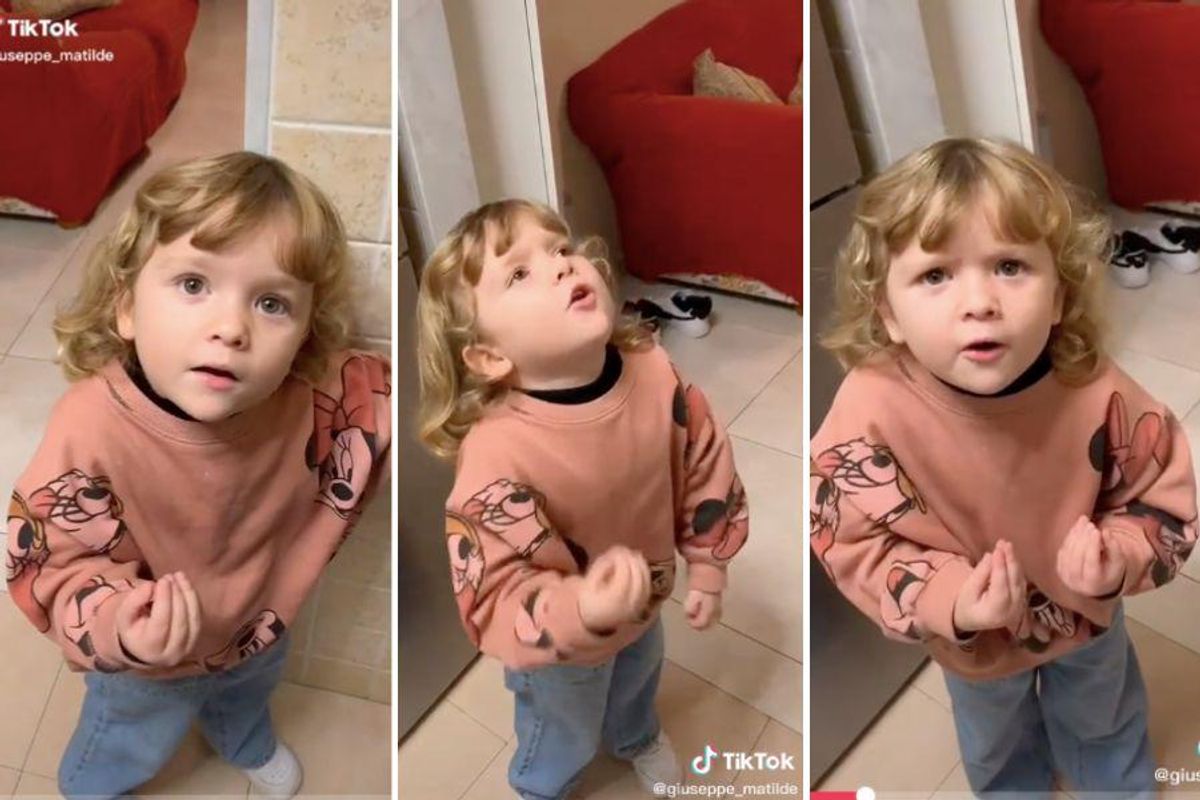
An Italian preschooler's Italian rant has people in stitches.
All people have a need to communicate, but the way we do that varies greatly from place to place. Every culture has its own communication peculiarities that make our human family delightfully diverse.
Not only do humans speak thousands of languages around the world, but we also engage in culturally specific speaking styles, speech patterns, and body language—some of which are immediately identifiable.
Case in point: the Italian "finger purse" known in Italian as Mano a borsa.
Italians are known for speaking with their hands. Italian hand gestures can vary between northern and southern Italy, but one of the most universally recognizable is the pinched fingers or "finger purse." That's the gesture in which the tips of the fingers and the thumb are pressed together (forming a purse shape) and pointed upward, often in a repeated back-and-forth or up-and-down motion, sometimes with one hand and sometimes with both. Along with the rhythm of punctuated emphasis on certain words, especially when speaking passionately, the finger purse is often used to convey a question with a sense of annoyance, exasperation, or confusion.
It's a gesticulation most of us associate with a classic Italian grandma or grandpa, but when you see it coming from a tiny little Italian person, it's utterly hilarious.
A viral video, originally shared by (now-deleted user) @guiseppe_matilde on TikTok, shows a preschooler engaging in a passionate rant that is unmistakably Italian, both in the actual language she's speaking and in her hand gestures.
According to Italian speakers in the comments, the little girl is conveying a story about how someone commented negatively about her wearing a miniskirt. User @u/shykawaii_shark on Reddit shared:
"Rough translation for English speakers. Not a literal translation, I made it easier to comprehend
Mother: What kind of sense does that make!
Daughter: They told me 'What sense does going out with a miniskirt make?' Like, think for yourself! I can wear my miniskirt, and you mind your own business!
Mother: Exactly!
Daughter: Think about your own miniskirt, not mine!"
Got a feisty little feminist here.
As adorable as this video is, it's also an example of how culture gets passed on from generation to generation. An Australian study found that young humans across different cultures imitate adults in ways that animals don't. Animals will imitate adult behavior to the extent that it's efficient and necessary to perform a task, whereas humans will mimic even silly or frivolous behaviors that have no purpose whatsoever.
“Animals focus on getting the job done,” Mark Nielsen, a psychologist at the University of Queensland in Brisbane, Australia, told Science. “Humans seem to almost forget about the outcome and copy everything we see.”
That mimicry of unnecessary actions may contribute to the complexity of human cultures. After all, it's not really necessary to do the finger purse to make a point, but Italians do it anyway. Little Italians pick it up from adult Italians, and so the classic Italian communication style is passed on.
And thank goodness it is, because babies gesturing in Italian is absolutely adorable.
This article originally appeared two years ago.
- Couple who took engagement photos at Olive Garden are now getting a free honeymoon in Italy ›
- 5-year-old Italian piano prodigy rocks Mozart at international competition and holy cow ›
- In 1972, an Italian singer wrote a hit song with English-sounding gibberish and it's so trippy ›
- 7 shifts in body language that can make you more likeable - Upworthy ›
- Questions to ask your kids about school - Upworthy ›
- Dog's silly sitcom worthy friendship with a life-sized duck - Upworthy ›
- Former FBI agent shares common body language myths - Upworthy ›
- Italian husband shocked on tour of American high school - Upworthy ›
- Baby talking gibberish in a Scouse accent is an adorable window into language learning - Upworthy ›
- 3-step Harvard conversation trick makes shy people more likable - Upworthy ›

 A Generation Jones teenager poses in her room.Image via Wikmedia Commons
 An office kitchen.via
  An angry man eating spaghetti.via
 Gif of baby being baptized
 Woman gives toddler a bath Canva


An Irish woman went to the doctor for a routine eye exam. She left with bright neon green eyes.
It's not easy seeing green.
Did she get superpowers?
Going to the eye doctor can be a hassle and a pain. It's not just the routine issues and inconveniences that come along when making a doctor appointment, but sometimes the various devices being used to check your eyes' health feel invasive and uncomfortable. But at least at the end of the appointment, most of us don't look like we're turning into The Incredible Hulk. That wasn't the case for one Irish woman.
Photographer Margerita B. Wargola was just going in for a routine eye exam at the hospital but ended up leaving with her eyes a shocking, bright neon green.
At the doctor's office, the nurse practitioner was prepping Wargola for a test with a machine that Wargola had experienced before. Before the test started, Wargola presumed the nurse had dropped some saline into her eyes, as they were feeling dry. After she blinked, everything went yellow.
Wargola and the nurse initially panicked. Neither knew what was going on as Wargola suddenly had yellow vision and radioactive-looking green eyes. After the initial shock, both realized the issue: the nurse forgot to ask Wargola to remove her contact lenses before putting contrast drops in her eyes for the exam. Wargola and the nurse quickly removed the lenses from her eyes and washed them thoroughly with saline. Fortunately, Wargola's eyes were unharmed. Unfortunately, her contacts were permanently stained and she didn't bring a spare pair.
- YouTube youtube.com
Since she has poor vision, Wargola was forced to drive herself home after the eye exam wearing the neon-green contact lenses that make her look like a member of the Green Lantern Corps. She couldn't help but laugh at her predicament and recorded a video explaining it all on social media. Since then, her video has sparked a couple Reddit threads and collected a bunch of comments on Instagram:
“But the REAL question is: do you now have X-Ray vision?”
“You can just say you're a superhero.”
“I would make a few stops on the way home just to freak some people out!”
“I would have lived it up! Grab a coffee, do grocery shopping, walk around a shopping center.”
“This one would pair well with that girl who ate something with turmeric with her invisalign on and walked around Paris smiling at people with seemingly BRIGHT YELLOW TEETH.”
“I would save those for fancy special occasions! WOW!”
“Every time I'd stop I'd turn slowly and stare at the person in the car next to me.”
“Keep them. Tell people what to do. They’ll do your bidding.”
In a follow-up Instagram video, Wargola showed her followers that she was safe at home with normal eyes, showing that the damaged contact lenses were so stained that they turned the saline solution in her contacts case into a bright Gatorade yellow. She wasn't mad at the nurse and, in fact, plans on keeping the lenses to wear on St. Patrick's Day or some other special occasion.
While no harm was done and a good laugh was had, it's still best for doctors, nurses, and patients alike to double-check and ask or tell if contact lenses are being worn before each eye test. If not, there might be more than ultra-green eyes to worry about.