In the heart of the opioid crisis, a compassionate approach to treatment is saving lives.
One West Virginia city has lost so much in the opioid epidemic — but the tide may be turning. West Virginia suffers from the highest rate of fatal overdoses in America. And Huntington, West Virginia, is often referred to as the epicenter of the opioid epidemic. In December 2017, the state’s governor called in the…
One West Virginia city has lost so much in the opioid epidemic — but the tide may be turning.
West Virginia suffers from the highest rate of fatal overdoses in America. And Huntington, West Virginia, is often referred to as the epicenter of the opioid epidemic. In December 2017, the state’s governor called in the National Guard to help address the crisis, declaring, “We have to stop this terrible drug epidemic. We have to. If we don’t, it will cannibalize us.”
A new program is helping: In Huntington, city officials are finding success with the new Quick Response Team (QRT) program that follows up with overdose survivors within 72 hours of their ODs to help ensure they get the necessary help. The teams include a police officer, a paramedic, and — perhaps most importantly — a mental health specialist.
Advocates of the new approach say having these teams arrive to offer compassion, instead of just the punitive threat of law enforcement, is building trust and a solutions-based approach between officials and those struggling with addiction.
“For so many years, we didn’t see the patients being receptive,” said Connie Priddy, a coordinator with the program. “And now, because we’re working on changing how we approach it, their way of accepting us has changed.”
The numbers speak for themselves: Since the program started, Huntington has seen its repeat overdose statistics cut in half. It’s such an impressive feat that other cities in the state are about to test out their own versions of the program.
Huntington’s approach to drug overdoses is having a ripple effect.
The state government has taken notice of Huntington’s success story. In December 2017, they approved a four-year pilot program with a grant of $10 million to expand the services to other cities in the state. $1 million of that has gone toward purchasing and distributing naloxone, which treats narcotic overdose, to first responders statewide.
“The ultimate priority of this legislation … is to engage individuals with treatment options at every opportunity thereby reducing future overdoses,” said Department of Health and Human Resources Cabinet Secretary Bill J. Crouch.
It could expand to the federal level as well. In May, U.S. Surgeon General Jerome Adams visited Huntington and praised the program. “I came to Huntington because it’s one of the best stories in the United States in terms of recovery,” he said. “If we can turn around overdose numbers here, we can do it anywhere.”
Huntington Chief of Police Hank Dial talks about the 6-month-old Quick Response Team (QRT), to make contact with people within 72 hours of overdose to offer support, access to treatment: pic.twitter.com/Ipdmi7pfof— Aprile Rickert (@Aperoll27) June 27, 2018
Addiction is a complex challenge, but it’s also a very human one.
There’s no one solution to preventing and treating addiction. Education, mental health health care, and even exercise can all play vital roles.
The compassion shown by the quick response teams in Huntington is building trust between law enforcement officials and those at risk. West Virginia’s health commission has acknowledged that preventing and treating addiction is challenging.
Getting people into treatment gives both sides a better chance to overcome the many aspects of addiction. It’s more effective and less expensive than simply punishing people.
And until the opioid crisis is solved, cities across the country need all the help they can get.
A single door can open up a world of endless possibilities. For homeowners, the front door of their house is a gateway to financial stability, job security, and better health. Yet for many, that door remains closed. Due to the rising costs of housing, 1 in 3 people around the world wake up without the security of safe, affordable housing.
Since 1976, Habitat for Humanity has made it their mission to unlock and open the door to opportunity for families everywhere, and their efforts have paid off in a big way. Through their work over the past 50 years, more than 65 million people have gained access to new or improved housing, and the movement continues to gain momentum. Since 2011 alone, Habitat for Humanity has expanded access to affordable housing by a hundredfold.
A world where everyone has access to a decent home is becoming a reality, but there’s still much to do. As they celebrate 50 years of building, Habitat for Humanity is inviting people of all backgrounds and talents to be part of what comes next through Let’s Open the Door, a global campaign that builds on this momentum and encourages people everywhere to help expand access to safe, affordable housing for those who need it most. Here’s how the foundation to a better world starts with housing, and how everyone can pitch in to make it happen.
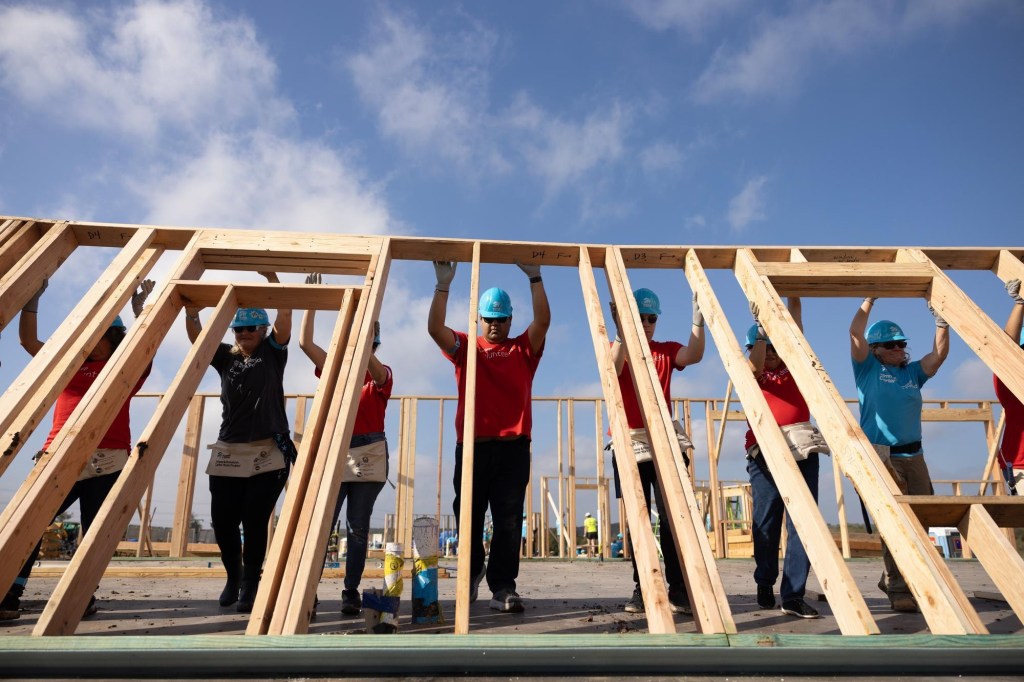
Volunteers raise a wall for the framework of a new home during the first day of building at Habitat for Humanity’s 2025 Carter Work Project.
Globally, almost 3 billion people, including 1 in 6 U.S. families, struggle with high costs and other challenges related to housing. A crisis in itself, this also creates larger problems that affect families and communities in unexpected ways. People who lack affordable, stable housing are also more likely to experience financial hardship in other areas of their lives, since a larger share of their income often goes toward rent, utilities, and frequent moves. They are also more likely to experience health problems due to chronic stress or environmental factors, such as mold. Housing insecurity also goes hand-in-hand with unstable employment, since people may need to move further from their jobs or switch jobs altogether to offset the cost of housing.
Affordable homeownership creates a stable foundation for families to thrive, reducing stress and increasing the likelihood for good health and stable employment. Habitat for Humanity builds and repairs homes with individual families, but it also strengthens entire communities as well. The MicroBuild® Initiative, for example, strengthens communities by increasing access to loans for low-income families seeking to build or repair their homes. Habitat ReStore locations provide affordable appliances and building materials to local communities, in addition to creating job and volunteer opportunities that support neighborhood growth.
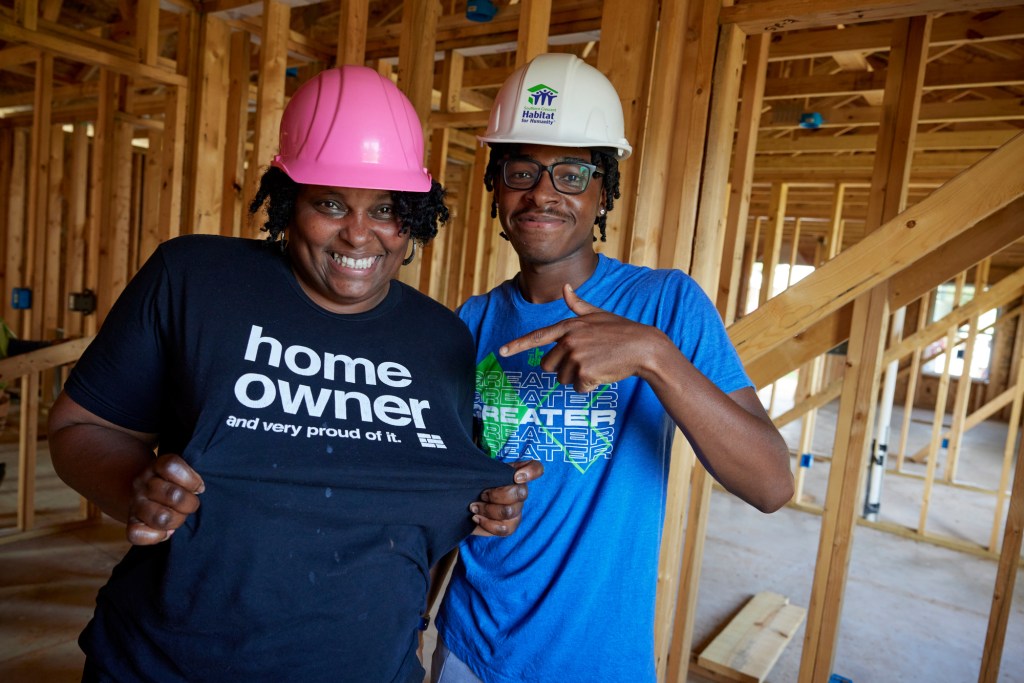
Marsha and her son pose for a photo while building their future home with Southern Crescent Habitat for Humanity in Georgia.
Everyone can play a part in the fight for housing equity and the pursuit of a better world. Over the past 50 years, Habitat for Humanity has become a leader in global housing thanks to an engaged network of volunteers—but you don’t need to be skilled with a hammer to make a meaningful impact. Building an equitable future means calling on a wide range of people and talents.
Here’s how you can get involved in the global housing movement:
Speaking up on social media about the growing housing crisis
Volunteering on a Habitat for Humanity build in your local community
Travel and build with Habitat in the U.S. or in one of 60+ countries where we work around the globe
Join the Let’s Open the Door movement and, when you donate, you can create your own personalized door
Every action, big and small, drives a global movement toward a better future. A safe home unlocks opportunity for families and communities alike, but it’s volunteers and other supporters, working together with a shared vision, who can open the door for everyone.
Every parent knows the struggle of looking through their phone’s photo library only to realize they are missing from almost every single frame. We are the ones behind the lens, capturing the first steps, the messy faces, and the playground triumphs, but we rarely have proof that we were actually there. As PEOPLE reported, one mother in England recently received a beautiful remedy to this “invisible parent” problem from a complete stranger.
Elizabeth Green (@likedbyliz), a nurse and mother of two, was enjoying a rare day off at the park with her children, Will and Nora. While she was focused on playing with them on the slide, she noticed another woman nearby who seemed to be giving her children instructions to “get back up there.” Before Green could wonder what was happening, the woman approached her and asked to airdrop a few files.
When Green opened her phone, she was stunned. The stranger had captured several high-quality, candid photos of Green immersed in play with her toddlers. These weren’t the posed, “everyone look at the camera and smile” shots that parents usually fight for. They were authentic glimpses of motherhood in motion.
The gesture struck a deep chord with Green, who shared the photos on TikTok to thank the “random mom” for her kindness. The video has since resonated with millions of parents who feel the same longing to be documented in their daily lives. Green noted that while her husband makes a real effort to take photos of her with the kids, there is something uniquely special about a third-party perspective catching a moment you didn’t even know was happening.
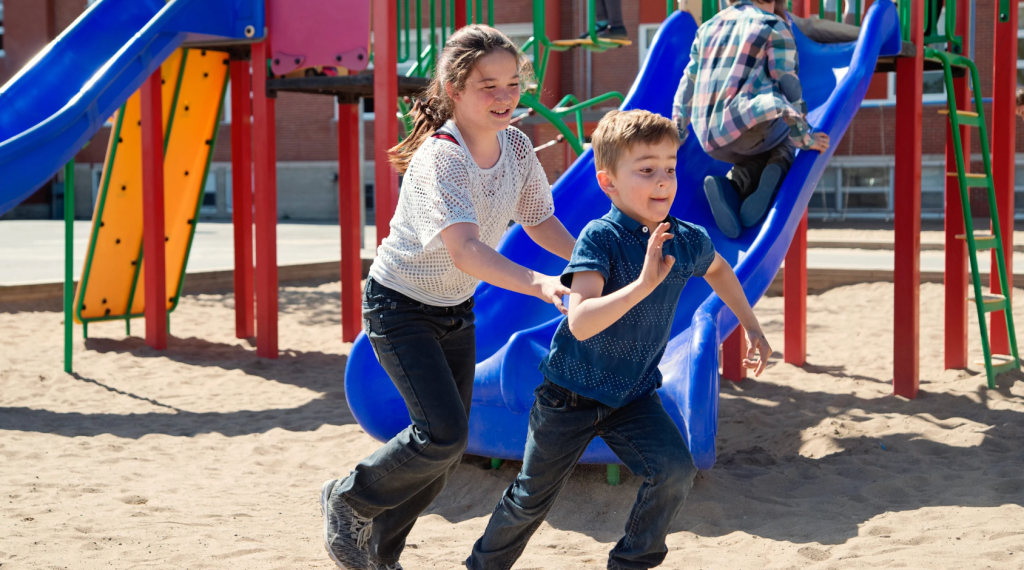
Kids playing at an outdoor playground. Photo credit: Canva
Psychologists often talk about the power of “core memories,” those significant experiences that help shape a child’s sense of security and love. According to a study published in PMC, the quality of time parents spend with their children is a primary driver of long-term well-being. By capturing these images, the stranger didn’t just give Green a few photos, she gave her a permanent record of the “quiet” love that builds those memories.
The comment section of Green’s video quickly became a digital support group for parents. One user shared a story of an older man who nervously approached her at a library to share a photo he took of her with her baby, while a single mother commented that she would “sob” if someone did the same for her.
It is a simple act of service that costs nothing but a few seconds of time, yet it provides a lifetime of value. In a world where we are often told to mind our own business, this “random mom” proved that sometimes, the best thing you can do is notice someone else’s joy and make sure they have a way to remember it.
For more fun parenting videos, follow @likedbyliz on TikTok.
Stepmoms get a bad cultural reputation that most of them don’t deserve. The wicked stepmother is such a durable myth that it takes something pretty extraordinary to cut through it. This cut through.
At her dad’s wedding, a 15-year-old named Alex stood up to give a toast and proceeded to say something that made the bride cry before she’d barely gotten started. The clip was shared on TikTok by wedding videographer Sky Cinema Films (@skycinemafilms) and has since been watched more than 42 million times across a three-part series.
Alex started by saying the first word that came to mind when she thought of Beth was “affectionate.” Then: “She doesn’t have one mean bone in her body.” For Beth, hearing her stepdaughter-to-be say that out loud, in front of everyone, was already too much. You could see it on her face.
Alex went on to describe watching her parents’ divorce and what it felt like to suddenly have the concept of a “stepmom” become real. It was unsettling at first, she said. Then Beth showed up, and that changed. Beth became a partner in crime, a safe space, someone she could tell anything. They’d go shopping together. They’d commiserate about their glasses. The little things, stacked up, had turned into something that mattered.
Then came the line that the internet has not been able to shake: “Usually, divorce is hard. But this made it worth it.”
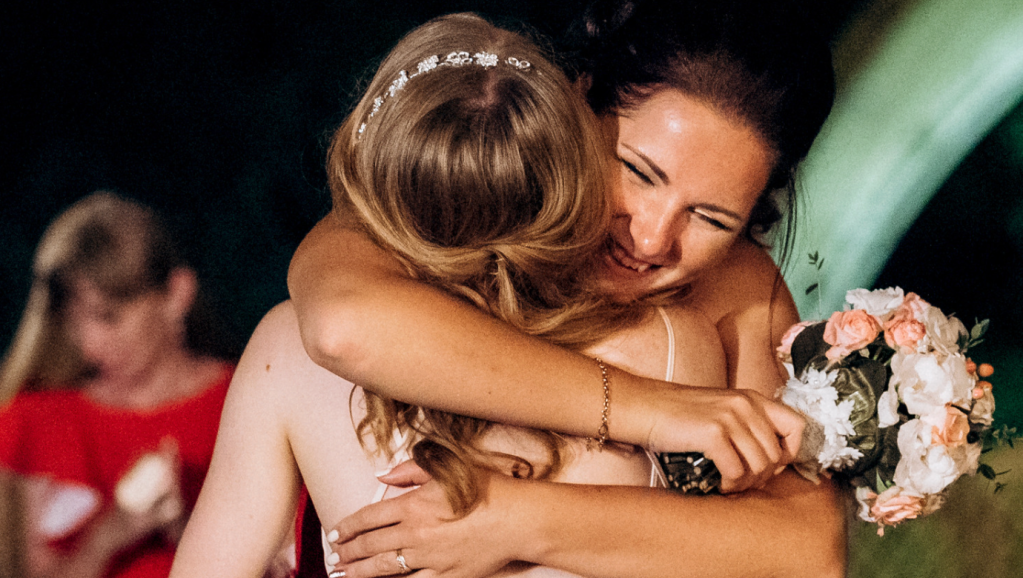
A woman hugs the bride at her wedding. Photos: Canva
She closed by saying something that holds up outside of weddings too. “Family isn’t always defined by last names or blood; it’s defined by love and commitment. I know Beth isn’t my mom, but I know she will always be there whenever I need her.”
Children of divorce carry a particular kind of weight, like the loyalty conflicts, the shifting households, the feeling of being torn in two directions at once. What Alex was describing, without quite naming it, was what it felt like to have that weight lifted by someone who didn’t have to do it. Beth chose this. She chose to show up, consistently, for a kid who wasn’t hers by birth, until the kid couldn’t imagine the family without her.
That’s what the 42 million views are really about.
You can follow Sky Cinema Films at @skycinemafilms on TikTok.
A grandmother always felt her middle granddaughter Lindsay, 15, looked slightly different from the rest of the family because she had blonde, curly hair, while the rest of her siblings’ hair was dark “I thought genetics was being weird and I love her,” she wrote.
But things became serious after Lindsay’s parents “banned” her from taking things a step further and getting a DNA test. If the family was sure their daughter was theirs, why would they forbid her from seeking clarity in the situation? After the parents laid down the law, the situation started to seem a little suspicious. “I told my son and [daughter-in-law] that there was something fishy around her birth she needed to know. They denied it and told me to leave it alone,” the grandma wrote.
Lindsay wouldn’t give up her quest. She approached her biology teacher, who admitted that it was “odd” for her to have such different traits. This confusion was too much for Lindsay, so she went to her grandmother for help. “She came to me distressed, asking me to buy a DNA test since she needs to know,” the grandmother wrote.
The grandmother’s post about her secret DNA test went viral. Photo credit: Canva
The DNA test that changed everything
The grandmother purchased a DNA test and it proved their suspicions. “Long story short, she is not her mother’s kid,” the grandmother wrote. “My son got someone else pregnant and her bio mom gave her up.”
The interesting thing was that Lindsay was a middle child. So, the dad had a baby with another woman while he was with his wife. This revelation begs the question: How did the family suddenly have a baby out of nowhere without people being suspicious?
“They were on the other side of the country when she was born, and I met Lindsay when she was about 6 months old. Really not hard to hide the whole thing,” the grandmother wrote. “Our family has a history of miscarriages, so it’s common to drop news about a baby late in the pregnancy. They did the same with their oldest and didn’t think anything about it.”
The big revelation has caused friction in the family. The family no longer talks to the grandmother, which makes Lindsay even more furious about the situation.Should the grandmother have taken such drastic steps if she knew what could happen if her suspicions were true? The commenters on Reddit overwhelmingly supported the grandmother’s decision. The big reason was that Lindsay needed to know her family history for medical reasons.
“Your son and his wife suck for lying to her until she is 15 about something so important and trying to keep lying to her even after she obviously started to question things. There are medical reasons a person might need to know what their genetics are/are not, and if you hadn’t helped her, she would have found out some other way,” Shake_Speare423 wrote.
Another commenter noted that protecting the parents’ lie wasn’t nearly as important as Lindsay’s mental health.
“People have a right to know their genetic heritage. Lying about adoption is linked to increased suicidal ideation, anxiety, and depression. You put her safety and comfort ahead of your son’s preferences. Parental rights do not have greater value than a child’s right to access comprehensive medical care, and hiding an adoption does precisely that. Maybe some things, like a child staying healthy, should matter more than a parent’s right to lie, gaslight and manipulate their child as they see fit,” RemembrancerLirael added.
Reddit took the grandmother’s side
The commenters overwhelmingly supported the grandma for putting herself into an uncomfortable situation to protect her granddaughter’s mental and physical health. However, one commenter noted that she could have gone about it in a less polarizing way.
“Bit out of the norm for the responses here, but you should have gone through your son [and daughter-in-law] and convinced them. Told them that the biology teacher had highlighted that she had traits that didn’t make sense, etc. and convinced them that Lindsey would find out either way,” PhilMcGraw wrote. “It would have allowed them to find a way to tell her without it being forced on them angrily. A DNA test is the absolute worst way to be told. I’m sure they would have much rather told her than let her find out by a DNA test if that is what was coming.”
This article originally appeared three years ago. It has been updated.
There has been a growing discussion over the last couple of years, mostly initiated by Millennial parents, that their Baby Boomer parents aren’t there for their children. It’s believed that the absentee Boomer grandparent phenomenon stems from the generation’s financial success. In retirement, Boomers have more options to travel and pursue their interests than earlier generations did, which often chose to spend more time with family.
A common excuse among some grandparents is that they “did their time” as parents and don’t want to spend their golden years raising the next generation. Others will blame their children for refusing to foster a relationship between grandparents and grandchildren.
However, TikTok user Helen Devoted Granny, a grandmother in Devon, England, is going viral for being brutally honest: “I think it’s always the grandparents’ responsibility.”
Helen’s TikTok page expresses the joy of being a devoted grandparent while questioning those who aren’t there for their grandchildren.
Who is responsible for the grandparent-grandchild relationship?
“I think it’s always the grandparents’ responsibility,” Helen said in a video. “And as a devoted granny, I’ll explain why I think it’s the grandparents responsibility to always reach out, to be the one saying, ‘Well, can we help with this? Can we come and visit? Can we take them there? Is there anything you’d like me to do? Do you need some support this week? Do you need some support next week? These are my days off.’ Blah, blah, blah.”
She added, “That’s what I do. I’m a devoted granny, and I feel very strongly about this. And I don’t think kids should be the ones. Your children shouldn’t be the ones who need to facilitate that relationship. It’s up to the grandparents to do that.”
Helen also has some strong words for grandparents who don’t want to raise kids anymore because they believe that “it’s their time” now.
“I think if grandparents are coming back with things like, ‘Well, it’s our time now, it’s our time now.’ No, it’s not,” Helen said. “It’s your time to help your kids because it’s really difficult when your children are small. The help that you give them is so needed, and it’s so appreciated that, honestly, it’s your time to be with your grandchildren and to help in every way you can.”
The folks in the comments overwhelmingly agreed
Commenters applauded Helen, many of whom were upset that their parents never put any effort into building a relationship with their children.
“I recently read the following: ‘Active grandparents never want to stop being parents, while uninvolved grandparents never really wanted to be parents in the first place.’ This statement struck a chord,” Azucar wrote.
“I agree. No support or effort = no relationship,” Naarah added.
Kermy said that it’s all about priorities, which are easy to see: “If Grandparents can work out how to order expensive gadgets online, buy new cars and book holidays, they are more than capable of picking up the phone and contacting the grandkids themselves.”
Helen’s TikTok is a clear example of a truth in life: when people care about something, they take initiative. They don’t wait for other people to give them permission. In the end, no matter what side you take in the discussion, her message is clear: relationships don’t build themselves. When it comes to family, those who show up and take initiative are always going to be the ones who matter most.
Confession: I am not a neat freak, but I’ve always aspired to be one. I love neat and tidy spaces and envy those who have a natural knack for keeping their homes perpetually guest-ready. Because I live in a normal-messy home, I appreciate it when people say “No one’s house is tidy all the time!” but I also know it’s not true. There are people with always-tidy houses. I personally know multiple people whose homes never, ever devolve into cluttered chaos, whose kitchen sinks are always free of dishes, whose tables are never cluttered with stuff and whose master bedrooms look like hotel rooms.
Knowing that it is possible, I’ve spent years observing my naturally neat friends and family to understand what gives them the seemingly superhuman ability to keep their homes clean 24/7. As one might assume, some of it comes down to a fastidiousness and rigid adherence to routines that some of us simply do not possess. Some of it has to do with how often people are home and how much their home actually gets used. However, those things aside, I’ve figured out a handful of “secrets” in the form of minor habits and mindsets that we messier folks who yearn to be neater can glean from the naturally tidy.
Messy people think of ‘cleaning up’ as a separate task
Neat people see it as an inherent part of every activity.
Though it’s largely unconscious, we all have ways of thinking through completing any activity, from the first step to the last step. Take eating, for example. For a naturally messier person, “eating” starts with preparing the food and ends with swallowing your last bite. Cleaning up is not an inherent part of the eating process—it’s seen as something separate, an activity that has its own beginning and end, its own time frame, its own energy expenditure, etc.
For a naturally neat person, however, eating means preparing the food, eating the food, and then cleaning up whatever mess you made. That’s the whole cycle of eating. When you see cleaning up as part of the eating process, eating doesn’t “end” until the dishes are finished and the kitchen is clean. Without cleaning up, the eating activity is simply incomplete.
For some people, this sounds like a “duh” revelation. For some of us, it’s a life-changing mindset shift.
Messy folks tend to overestimate how much time cleanup takes
Neat people don’t
Struggling to accurately estimate how much time a task will take is called “time blindness,” and it’s a common ADHD trait. But even those of us without ADHD can misjudge how long a task will take and form habits around our erroneous assumptions or perceptions.
For instance, I used to put off unloading the dishwasher because it seemed like a huge chore. All those dishes having to go to all those different cabinets—surely that was something that took a significant chunk of time to do. My brain had it labeled as a “big task” and therefore something I needed to carve out time for.
Then I timed myself doing it one day. Not rushing at all, just casually unloading a full dishwasher. It took less than 3 minutes, which was a fraction of the amount of time my brain had assigned to the task. Did I feel silly having subconsciously made a mountain out of a molehill? Yes. Did finding out it only took 3 minutes change how I viewed that chore and make it so I didn’t procrastinate it anymore? Also yes.
For someone who is a little messy, in the future, they can budget time for the entire task. It probably takes around an hour and 10 minutes to cook a meal for a family and eat it. Loading the dishwasher only takes about 10 minutes at most, so budget an hour and 20 minutes instead of an hour and ten.
Neat people don’t put off small cleaning/tidying tasks that they know only take a minute or two. Messy people can utilize timers to help them figure out what those are, because surprisingly, most tasks don’t take as long as you think they will.
Messy people think of cleaning as all or nothing
Neat people utilize tiny time chunks for mini maintenance
A messy person will pop something in the microwave for two minutes and then zone out or stare at it while it cooks. A neat person will pop something in the microwave and then use those two minutes to wipe down the counter, unload the dishwasher, or sweep the kitchen floor. They’ll fold laundry while watching a show and go put it away during a commercial break. They utilize small snippets of time to do little cleaning tasks, which all add up to maintaining a neat and tidy space without having to take big chunks of time to organize or clean.
Think of it as two minutes here and there, when there is nothing else to do, instead of taking up the entire morning on Saturday, when you could be out having fun.
Messier folks tend to overlook little messes here and there, so they build up until suddenly there’s an overwhelming mess to deal with. It helps to think of cleaning and tidying not as one big chore that is either done or not done, but rather as a conglomeration of tiny tasks that can be done any time you have a minute or two. Eventually, using tiny time chunks to mini-clean becomes habitual.
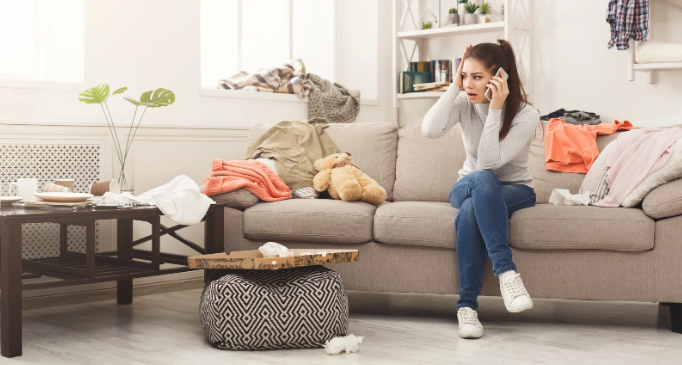
Woman in a messy room talking on the phone. Photo credit: Canva
Mess makers set things down
Neat people put things back
“Clean up as you go” is a mantra to internalize if you aspire to have a perpetually neat home. If a neat person is baking, they will take out an ingredient, measure what they need, then put that ingredient back where they got it. They do this every time, so when the baked good gets put in the oven, all that’s left to do is clean the dishes they used in prep (which is, of course, seen as an inherent part of the baking task). And this isn’t just in the kitchen. They do the same thing with their toiletries in the bathroom, their clothes when choosing an outfit, etc. Everything gets put back rather than put down, preventing a mess from the get go.
If a messy person is baking, they’ll take out an ingredient, measure what they need, and then set the ingredient down on the counter. Once the baked good gets put in the oven, there’s then a whole counter full of ingredients and dish mess to clean up. And because “cleaning up” is seen as a separate task, there’s a gearing up of energy that’s required as well as a separate time commitment, which makes procrastination more likely.
The key here is to recognize that putting things back where you got them really doesn’t take any more time than setting them down but saves tons of time and work later.
Messy people have more things than places
Neat people have more places than things
“A place for everything and everything in its place” is a mantra that neat people live by religiously and messy folks may not even realize is possible. If a neat person doesn’t have a place for something, they find one or make one by getting rid of something else. If a messy person doesn’t have a place for something, it sits on a table or countertop or entryway or some other placeholder for an indeterminate amount of time, often moving from surface to surface before eventually being shoved in a drawer or closet to be dealt with later.
Part of living like a neat person is being honest with yourself about the space you have and embracing inflow and outflow of things that enables you to live comfortably in that space. Messy people almost always have too much stuff for their space and therefore not enough places to put things. (This is true no matter how large or small your home is, sorry to say.) Neat people keep things pared down so that everything can have its own place. Regular purging of excess stuff and not holding onto things “just in case” is a huge key to staying neat and tidy.
I can’t say that I perfectly implement all of these things all the time, but I can say that being aware of these mindsets and habits and attempting to live more like my “neat freak” loved ones has made a big difference in my home and how I feel about living in it.
This article originally appeared two years ago. It has been updated.
A woman going out on an early morning run is showing everyone what being a good father looks like. Social media fitness influencer Orey shared a TikTok praising her father’s protection and motivation to achieve her goals.
“I have whatever the opposite of daddy issues are because my dad drives behind me during my 5 A.M. runs to make sure that I’m safe,” said Orey in the video’s caption. In the video, Orey gives her dad a fist bump through the open driver’s seat window before running off into the dark streets as her dad monitors her from his car.
Most outdoor joggers prefer to get their run in early in the morning to avoid traffic and pedestrians that would clog up city streets. It’s also a more comfortable time to run for people who live in warmer climates that get significantly hotter during the day, such as in Los Angeles where Orey resides. Unfortunately, though, such runs aren’t always safe.
Running outdoors when it’s dark can be risky, especially for women. There have been several news stories over the years about primarily female runners being harassed or assaulted while alone on the streets or in a park. While there should be a conversation on how to permanently ensure the safety of the public while they exercise, it’s currently necessary to actively find ways to protect yourself. Or, in Orey’s case, reflect upon how special it is that someone steps up for you.
What other people shared in the comments
The commenters on Orey’s TikTok shared similar stories from their parents:
“My dad finds parking in the Bronx for me and moves his car when I come home. ”
“I didn’t have my dad, but my mom would follow me to work when I would have to be there at 5 A.M. to open and stay until another employee showed up.”
“My dad would walk to the beach a block from our house at 2 A.M. after his night shift to check on me on my night ‘walk’ and walk me home…I was in my 30s. ”
Orey has built a following on TikTok by sharing relatable and accessible videos of her fitness journey, especially with running:
Parents often protect their children through limitations, even when they’re grown. They might say, “Don’t do that at night,” or “That’s too dangerous of a commute,” or “You could get hurt; best to forget about it.” While well-intentioned, that approach can create a boundary in the relationship and a lack of trust in an offspring’s ability to be independent. If Orey’s dad had that mentality, it could create resentment from Orey and he would still be worried for her if she decided to run before dawn.
Why participation beats protection
Instead, Orey’s dad did something great parents do—he participated. It’s special when anyone inconveniences themselves to support their loved one’s goals. If he was going to feel restless knowing that his daughter was going to run at 5 a.m., might as well go along with her, right?
Supportive and participatory phrases might sound like, “Let me drive you there and back,” “Let’s make a plan together in case the worst happens,” or “Can I do it with you?” This approach not only creates peace of mind for the parent but also strengthens the bond with the child as a wonderful side benefit. And it isn’t just applicable for parents and their kids, but also between spouses, partners, and friends, too. You not only help keep them safe as they pursue their goals but are actively there when they achieve them.
It’s an unfortunate reality that safety is never 100% guaranteed, but providing protection in tandem with support creates something special between loved ones. That alone is worth an early alarm each morning.
This article originally appeared two years ago. It has been updated.
Parent-teacher conferences are considered a crucial tool in a child’s education and development. They help both parents and teachers get on the same page about a student’s progress, strengths, and areas where improvement is needed. What’s more, it helps parent maintain a participating role in this aspect of their child’s life, making them hopefully feel supported and cared for.
That said, with all the mandatory activities that parents today have to manage on top of their work and other household responsibilities…not to mention all the various ways parents are constantly inundated with information from schools…it’s understandable why some parents might question whether or not these one-on-ones are actually necessary. Or at the very least…if it could be sent in an email.
The video that started the controversy
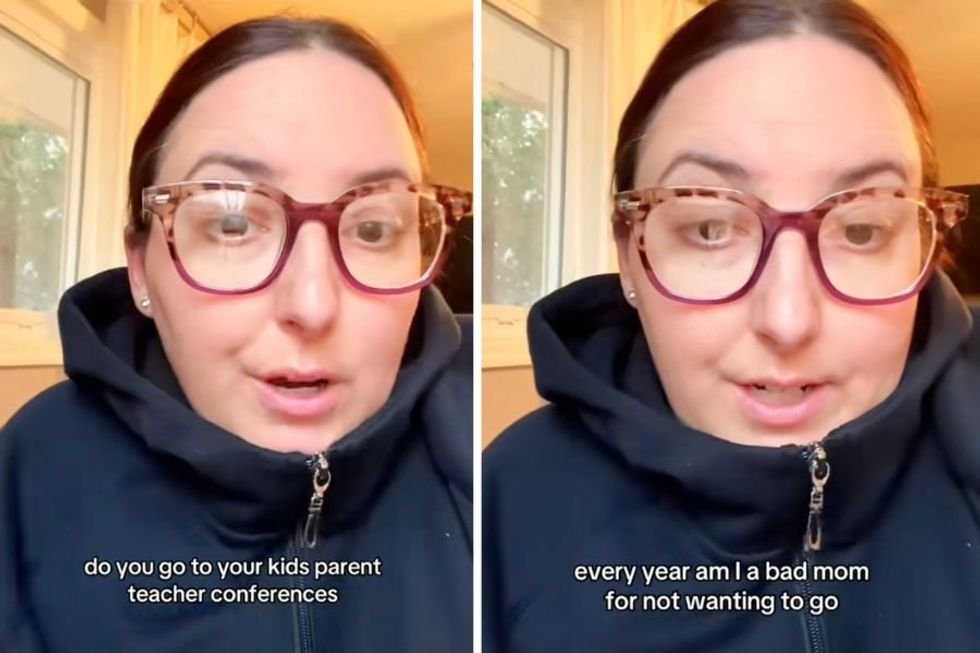
For mom Tatiana (@mamasreadingjournal), the dread of having to go to her kid’s parent–teacherconference was so strong that she posted a TikTok video asking if other moms and dads felt the same way. “Do you go to your kid’s parent-teacher conferences every year? Am I a bad mom for not wanting to go? Like I’m gonna go, but I really don’t wanna go, you know?” she asked in the clip, just before quipping, “sorry if his teacher finds this, it’s not you, I swear, it’s me, I’m lazy.”
Considering Tatiana is already in communication with her kid’s teacher through an app, she also couldn’t help but wonder why “this can’t be an email?” A very, very relatable thought for anyone in the 21st century. Tatiana’s confession was met with…a lot of concern. Clearly, people do, in fact, feel pretty strongly about this topic. And a common point brought up was how a child might feel if their parent doesn’t show an interest in their education in this particular way.
The comments did not hold back
“Your child is worth the effort, showing up to things like this is showing up for them,” one person wrote.
Another asked, “I guess the question is why aren’t you interested in learning from your child’s teacher about how their learning journey is going, if they’re a good friend to their classmates, etc? I see how it can be an inconvenience but being a parent means being involved in their life at school as well.”
A few teachers also weighed in, who admitted that even they didn’t exactly love parent-teacher conferences. Still, one advised, “always go. As a teacher it builds the connection we have with the parent, helps communication to overall support the child.”
Another teacher was a little more blunt, saying, “Girl, we don’t want to go! But you create so much work for us if you don’t go. We gotta document so many attempts of trying to get you in. Also, your kid wants you to go. I see HS kids sad that their parents don’t care to go. It’s important I swear.”
The conversation didn’t stop there
There was even a heated sidebar debate as to which parent, if only one, should be attending said parent-teacher conference: the stay-at-home-parent (SAHP), or the parent who works. Some argued that the SAHP should be the one to go as part of their at-home responsibilities. Others argued that SAHPs are the ones in regular correspondence with teachers, and therefore it’s the other parent that needs to get caught up.
But all moral judgments aside, this mom wasn’t necessarily saying she planned on skipping out. She was merely sharing a feeling that quite honestly a lot of folks can probably relate to. Even the most involved parent on the planet could get overwhelmed with the ever increasing amount of random school events that seem more or less mandatory. That goes double for parents who already have demanding schedules or social anxiety, which has to describe at least 99.9% of parents, right? It more so sounds like she was looking for commiseration than anything else.
To that point, Tatiana did make a follow-up video sharing that she “did not know” that not attending a parent-teacher conference results in more work for the teacher. She assumed it meant they’d “get to go home earlier if I didn’t go.” Honestly, fair assumption.
She also clarified that she did in fact go to the conference, and had always planned to go. However, she tells Upworthy that “outta my 15 minute slot we talked about my kid’s actual performance for maybe two minutes. Even my husband was shocked how much we chitchatted vs discussing actual grades and progress.”
But regardless, while she still feels that there’s “too much weight” put on this particular event, she will “go every year with bells on.”
“A mom who’s willing to accept feedback and adjust their attitude. We love to see it,” one astute viewer said.
This goes to show a few things. One, it’s a reminder of how so many aspects of education could stand for a revamp to fit with modern times. Two, productive conversations really can lead to better understanding. And three, parenting comes with going to a lot of things that you’d really rather not go to. Be it a parent-teacher conference or a Peppa Pig pop-up.
Not to mention, it can almost always be an email instead.
This article originally appeared two years ago. It has been updated.
Kids say a lot of hilarious things. It starts when they’re little and are just learning how to talk and string sentences together, and the unintentional comedy continues all the way into the overdramatic and angsty teen years.
As parents, we often wish we could remember these little nuggets of gold forever. Now, a new trend is turning teens’ most emotional and unhinged words into unforgettable earworms.
One mom turns texts into unbelievably catchy pop-punk song
Mandi Mansour, a hairstylist from San Diego, recently posted a Reel on Instagram of herself rocking out in the car while singing along to a song of her own creation.
The lyrics? Her own teenager’s frantic and melodramatic text messages.
It’s amazing to watch how messages like “Can I get Canes or Taco Bell? I know you said no, but I’m starving,” and “Can I have ten bucks? … Can I have seven dollars?” become such a catchy and convincing song. Of course, old early-2000s emo is the only musical style perfectly suited to capture the frantic angst, and the final product is honestly a banger. (The vocal run during “seven dollars” is absolutely priceless.)
A great detail from the video is how Mansour is driving and singing the lyrics without even looking at the screen. She’s clearly listened to her personalized song on repeat dozens of times and can’t seem to get enough of it.
Video is part of a trend making clever use of an AI music app
Mansour’s video isn’t the only one like it, not even close. These “emo songs” have become a huge viral trend over the last couple of weeks, with parents using the AI music app Suno (and similar ones) to turn these “lyrics” into full-blown songs, usually in the pop-punk genre.
It’s hard to say exactly where the trend originated, but Marcus Leshock, a reporter for WGN-TV, was one of the early prominent participants. Hundreds of thousands of parents followed suit shortly after.
Trend has parents asking: “Do we have the same kid?”
No matter how many clips you watch, all texts from the teenagers seem to fall into two buckets: wanting food and asking for money.
The series is an amazing glimpse inside the mind of the modern American Gen Z or Gen Alpha kid. It’s all Starbucks, açaí bowls, Raising Cane’s chicken—all fast food, really—e-bikes, and, of course, the classic requests for cash.
This is one of the first times we have such thoroughly documented evidence of how teens and preteens really think. About 85% of 11- to 13-year-olds have a cell phone capable of texting, with many getting their first phone under the age of 10.
Simply put, we’re in the frontier days of kids being able to text directly with their parents at all times. And the results are definitely something these moms and dads will want to remember when their kids are grown and self-sufficient.
Thanks to these infectious and unforgettable choruses, they most certainly will.
Turning texts into emo songs is really the best kind of AI trend. It draws humor from real-life experiences that connect all of us (well, all of us with moody teens), and uses a little assist from the technology to make it memorable and fun.
No one’s trying to top the Billboard charts here, but the commonalities between the songs really go to show that none of us are in it alone. Raising a teenager is tough, exhausting work—but it’s bringing parents all over social media a lot of comfort to know the challenges they’re dealing with are extremely common.
And those big feelings and dramatic outbursts just so happen to be perfect fodder for the type of songs many of us grew up loving.