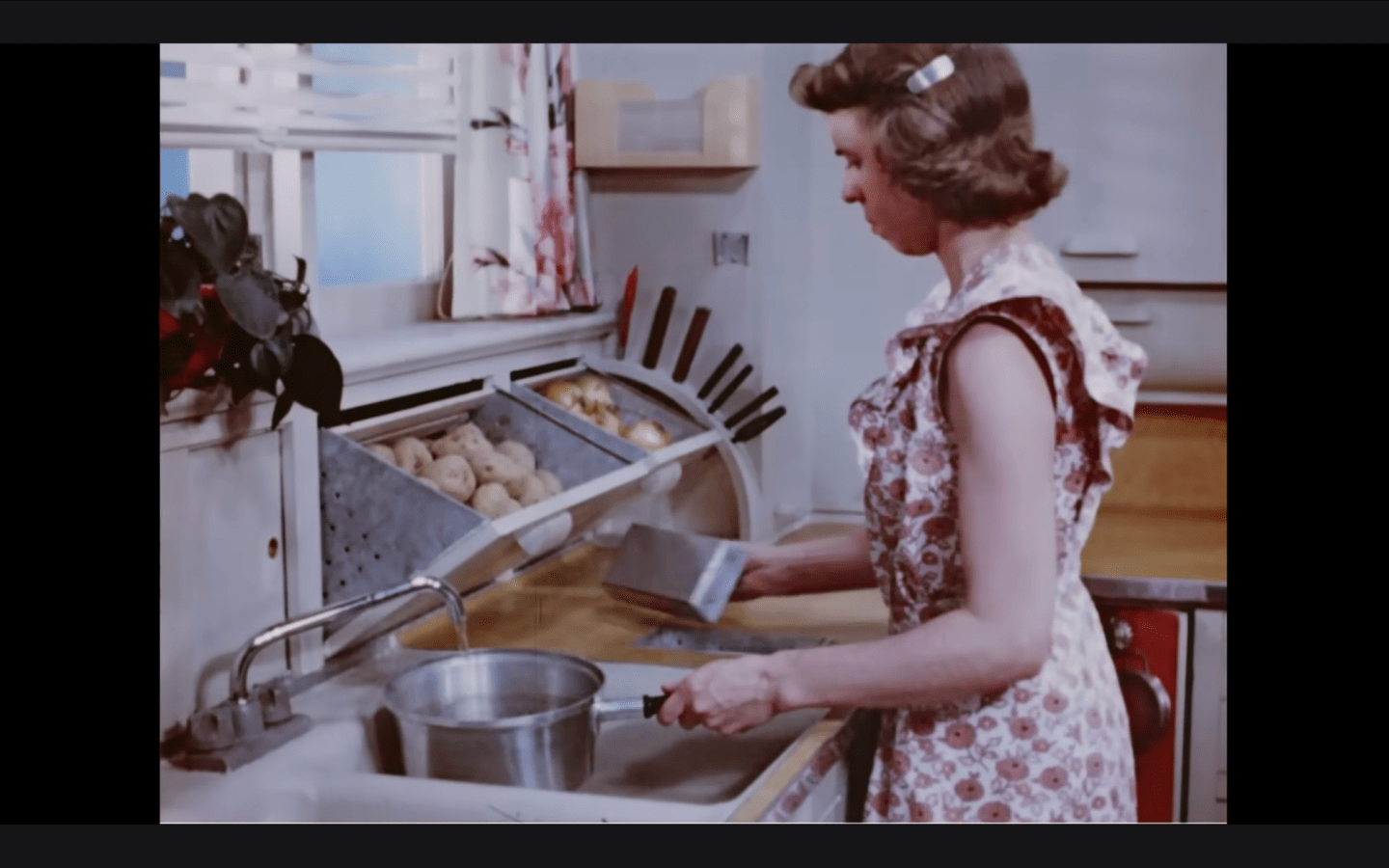
Modern kitchens are pretty epic in the historical scheme of things. We have refrigerators that dispense ice, cold water, and even hot water. We have faucets that turn on and off with a touch. We have garbage disposals, automatic trash-can lids, and pot-filling faucets over stoves, all manner of modern conveniences that might make us assume that today’s kitchens are superior to every era that came before.
In some ways, they are. But a video from the National Archives demonstrating the features of a 1949 step-saving kitchen design has some of us rethinking just how much. The video was put out by the United States Department of Agriculture’s Home Economics division and it details every part of this efficient kitchen design:
No wonder kitchens from that era feel small compared to most new homes today. Modern kitchens tend to be sprawling but far less functional. This design may be small, but it’s mighty.
The movie itself is a bit of a time capsule, not only in the cabinetry and clothing styles, but in the clear assumption that only women would be using the kitchen. On one hand, it’s great that work traditionally viewed as “women’s work” became the focus of innovation aimed at making life easier. On the other hand, it’s interesting to see how much has changed around gender roles since the 1940s.
So why did the government make this video?
But why did the government even make a video like this in the first place? Why would the government even care about kitchen design?
It all began with a push for science and innovation in the late 19th and early 20th centuries.
As food historian Sarah Wassberg Johnson wrote, “This kitchen design is the culmination of several decades of work studies. During the Progressive Era, American interest in science began to increase, and scientific theories were applied to everything from factories to households. The Efficiency Movement was part of this application of scientific principles to everyday life. Led by mechanical engineer Frederick Winslow Taylor, the movement posited that everyday life, from industry to government to households, were plagued by inefficiencies, which wasted time, energy, and money.”
This movement, known as “Taylorism,” spilled over into the home economics movement, which eventually became of interest to the U.S. government. A USDA report published in 1948 explained the push for efficient kitchen design:
“To help homemakers reduce time and work involved in kitchen activities, the Bureau is designing and preparing construction drawings for kitchens, with different arrangements of equipment: the U, L, broken U and L, and parallel-wall types of arrangement. They are designed to reduce walking, stooping, and stretching to a minimum, in accordance with accepted principles of work simplification.”
And that’s how we ended up with this glorious video.
People are obsessed with this old design
Many people cheered for the features of this nearly 80-year-old kitchen design:
“Wow! That is an amazing well thought out kitchen. And we think we are modern today. That kitchen was has way more features than our kitchen today!” – @TheCrystalLion1
“I say I want an old time kitchen all the time! Everything was so functional.” – @LizSmit97381516
“Yeah, that is pretty amazing! I would be completely happy with this.” – @TexasAris
“I have a garbage pail and potato drawer like this. Love it. Our kitchen is brand new tho. I requested these things. Also a full size pull out pantry, 15 inches wide and 6 ft tall. Hideaway kitchen utensils vertical pullout 6 inches wide, full size microwave drawer. Modern kitchens can be amazing or terrible.” – @NativeNoticer
What about the potato and onion bins?
Some people have expressed concern about bugs in those potato and onion bins, but someone who grew up in that era noted that potatoes and onions were such daily staples that families went through them quickly:
“We kept things real clean and, no, that was never a problem – the potatoes and onions were gone through on pretty much a weekly basis. We normally figured 1/2 an onion per person per day and a potato per person. We had a small family. Grandfather, grandmother, Uncle, Mom, myself, and a kid that no one wanted – 6 people; that is 6 potatoes and 3 onions a day or a 20# bag of each a week. And they were used as hash browns, potato pancakes, baked potatoes, sautéed onions in dishes (all dishes) and of course fried potatoes and french fries. They were pretty much a staple. We also had flour bins, two types – cooking and baking, and also two different kinds of sugar. There was baked bread and a pie or cake every single day and always biscuits. And everything was from scratch. All vegetables were prepared before cooking and did not come from cans and had only when in season, same with fruits. We did can some items but not many.” – @DannerFoundati1
Naturally, times change, the way we use our homes changes, and new innovations often replace the old for good reason. But there may be some things we can learn from an era when function and efficiency were prioritized over Instagrammable spaces. What good is a beautiful kitchen if it’s cumbersome to use?
This article originally appeared last year. It has been updated.