upworthy
Add Upworthy to your Google News feed.
Google News Button
Science

It feels like time accelerates as we get older. An easy 60-second fix can help slow it down.

Some fascinating research shows that our perception of time may be linked to the length of our heartbeats.

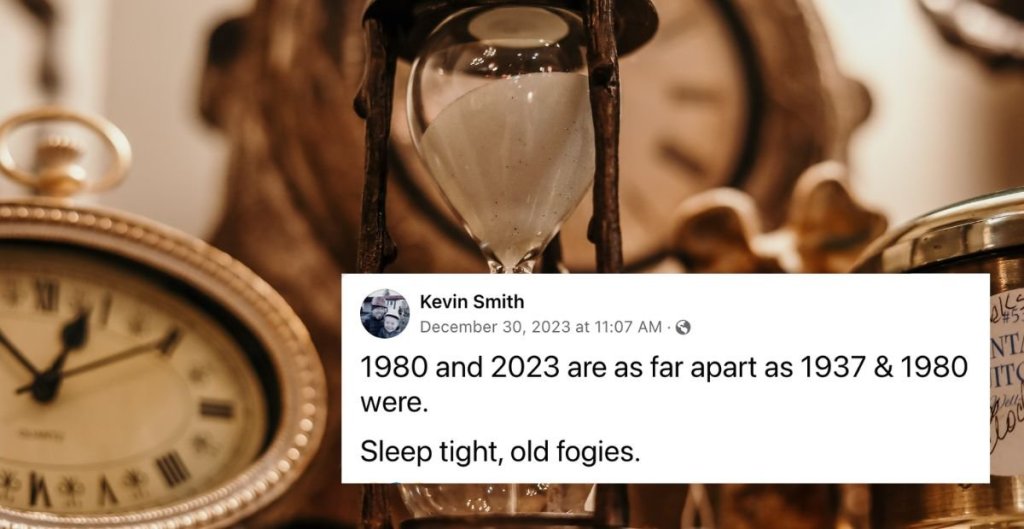
hourglass and clocks with screenshot of post saying 1980 and 2023 are as far apart as 1937 and 1980
Jordan Benton/Canva

Time accelerates as we get older, but there are some interesting ways we can slow it down.

Imagine this scenario, if you will: You're scrolling along, minding your own business on the internet, when this little nugget comes across your timeline: "1980 and 2023 are as far apart as 1937 and 1980. Sleep tight, old fogies!"


Wait, what? Your first reaction is, "That can't be right," so you pull out the calculator and do the math yourself—several times because you're sure you must've missed a number somewhere each time. You remember how long ago 1937 seemed in 1980, and there's absolutely no way that much time passed between 1980 and 2023. Buy you're wrong. As the warped reality of time washes over you, you sit in stunned silence, contemplating the existential crisis you've just been thrown into.

Why does time work this way? Why does it seem to get faster and faster and condense to make decades seem shorter and shorter as we age? And perhaps more importantly, how the heck do we stop time from feeling like a runaway freight train?

Here are a few theories about what creates the freight train phenomenon and what to do about it.

Time perception is relative—and kids perceive it differently

"Time flies when you're having fun" is a saying for a reason. Time also drags when you're doing drudgery work and feels like it stands still in moments of significance. And yet the ticking of seconds as they go by doesn't change tempo. We measure it with steady, unchanging beats, but how it feels changes constantly.

kids playing, time passing, perception of time Time moves more slowly for kids.Photo credit: Canva

This relativity exists in every passing moment, but it also exists in the bigger picture as well. The years felt like they passed by much more slowly when we were children, and by middle age, they feel like they pass in the blink of an eye. The pandemic gave us an even greater sense of this relativity as disruptions to our normal routines and the stress associated with the COVID-19 years messed with our sense of time. (On an odd side note, surveys show that our time perception during the pandemic varied a lot from place to place—people in some parts of the world felt that time moved more slowly, while others felt time moved more quickly.)

According to a 2023 Hungarian study published in Nature Scientific Reports, very young children perceive time differently than older children and adults. Researchers split 138 people into three age groups—pre-kindergarten, school-age and adults 18 and over—and showed them two videos of the same duration, one that was "eventful" and one that was "uneventful." Interestingly, the pre-K group perceived the eventful video to be longer, while the older children and adults saw the uneventful video as longer.

The way the study participants described the length of the videos in gestures was also telling. Young children were much more likely to use vertical hand gestures, connoting volume or magnitude, to indicate a length of time than the other two age groups. School-aged kids and adults tended to use horizontal gestures, indicating time as linear, increasing with age.

Our neural processing slows down as we age

Professor Adrian Bejan has a theory based on how neurons process signals. As we age, our neural networks increase in size and complexity and, as a result, process visual information at a slower rate. That slower processing means we create fewer mental images each second than we did when we were younger, thereby making time seem to slow down.
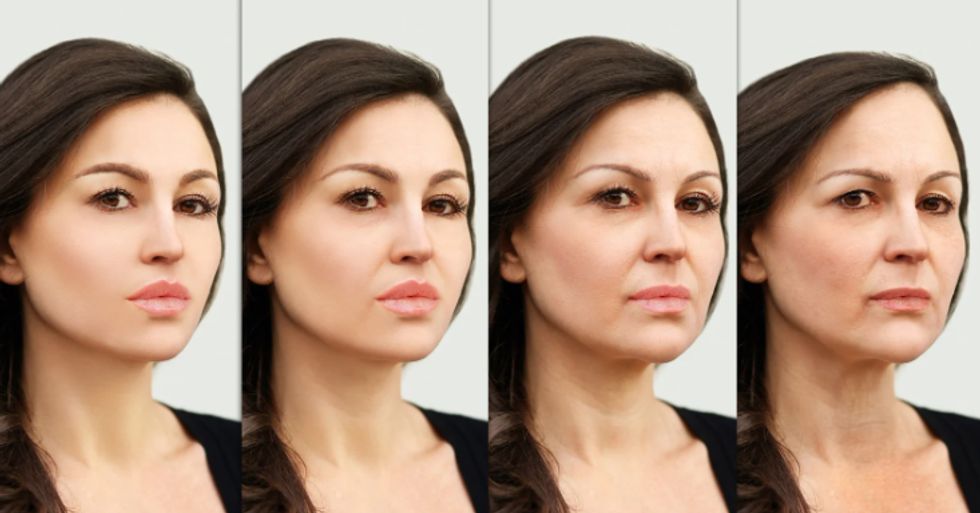
time, time perception, science of time, aging, neural processing, youth, lifespans, female aging, woman's face over the years A woman slowly ages over about 15 years. assets.rebelmouse.io

“People are often amazed at how much they remember from days that seemed to last forever in their youth, Bejan shared with Harvard University. "It’s not that their experiences were much deeper or more meaningful; it’s just that they were being processed in rapid fire.”

In other words, processing the same number of mental images we did in our youth takes longer now, somewhat counterintuitively making time seem to pass more quickly. So goes the theory, anyway.

It might simply be about time-to-life ratios

Another popular theory about why time feels different as a child than it does as an adult is the ratio of any given day, week or year to the amount of time we've been alive. To a 5-year-old, a year is 20% of their entire life. For a 50-year-old, a year only is 0.2% of their life, so it feels like it went by much more quickly.

hands, clocks, passage of time, age aging, old age, time perception, time flies An elderly person's hands holding a small clock.Photo credit: Canva

It's also a matter of how much change has happened in that year. A year in the life of a 5-year-old is full of rapid growth and change and learning and development. A year in the life of a 50-year-old probably isn't a whole lot different than when they were 48 or 49. Even if there are major life changes, the middle-aged brain isn't evolving at nearly the same rate as a child. A 50-year-old looking back at the past year will have a lot fewer changes to process than a 5-year-old, therefore the year will seems like it went by a lot faster.

“Our perception of days, weeks, years and that kind of time seems to be especially influenced by our perspective: Are we in the moment experiencing it, or are we looking backward on time?” psychology professor Cindy Lustig told the University of Michigan.

The key to slowing it all down? Be mindful of the present moment.

Lustig has a point. When we are in the moment, our perception of time is much different than when we look back. So, being fully conscious in the present moment can help us rein in the freight train effect.

One way to do that is to be mindful of your physical existence in this moment. Feel your heart beating. Feel your breath going in and out. Cornell University psychology professor Adam Anderson, Ph.D., conducted a study that found our perception of time may be linked with the length of our heartbeats. (Study participants were fitted with electrocardiograms and asked to listen to a brief audio tone. They perceived the tone as longer after a longer heartbeat and shorter after a shorter one.) He suggests starting a stopwatch, closing your eyes and focusing on your breathing for what you think feels like a minute. Then, check your time to see how accurate your estimation was.

Breathe World Series GIF by MLB Giphy

“This can give you a sense of how much your experience of your body is related to your experience of time,” Anderson told WebMD. “It will help teach you to enjoy the pure experience of time.”

You can also use focused breathing to purposely slow down your heart rate, and thus slow down your time perception. “We show that slow heart rates—that is, a longer duration between heartbeats—dilates time, slowing it down," Anderson said.

We can also alter our perception of time by taking in novel experiences, such as traveling to new places. According to Steve Taylor, author of Making Time: Why Time Seems To Pass at Different Speeds and How to Control It, people who go on adventurous trips report that their vacations feel longer than those who choose a predictable destination. You can also make small changes to your daily routine, such as trying new foods or taking a new route home from work to take in some new stimuli and slow your perception of time.

A study in 2024 found that people who do intense exercise experience a time warp, feeling like they exercised longer than they really did, so if you want to temporarily slow down time, you can push your body hard during a workout.

- YouTube youtu.be

Finally, try to take in the world the way you did as a small child. Take note of life's wonders. Engage fully in whatever you're doing. Notice details and take mental pictures as much as you can. Time goes by fast when we're distracted, so training our attention on the here and now can help. Ultimately, we can strive to perceive time more like we did when we were little, in its full depth and magnitude instead of a narrow, straight line.

This article originally appeared last year.

Gen Z; Millennials; technology; cell phones; social media; teens and technology; teens social media

Gen Z is the first generation less cognitively capable than their parents. Denmark has the solution.

Nearly every parent hopes their child will be better off than they are: smarter, more secure, and more well-adjusted. Many parents see this as a stamp of successful parenting, but something has changed for children growing up today. While younger generations are known for their empathy, their cognitive capabilities seem to be lagging behind those of previous generations for the first time in history.

Dr. Jared Cooney Horvath, a teacher turned cognitive neuroscientist who focuses on human learning, appeared before Congress to discuss concerns about cognitive development in children. In his address to the members of Congress, he says, "A sad fact that our generation has to face is this: our kids are less cognitively capable than we were at their age. Since we've been standardizing and measuring cognitive development since the late 1800s, every generation has outperformed their parents, and that's exactly what we want. We want sharper kids."


kids, intelligence, sharp kids, generations, education, cognitive abilities Student smiling in a classroom, working on a laptop.Photo credit: Canva

Horvath explains that the reason this happens is that each generation has gone to school longer than the previous generation. Gen Z is no exception to the longer duration of time spent in school, but they're the first ones who aren't meeting this normal increase in cognitive development. According to the cognitive neuroscientist, the decline is due to the introduction of screens in the classroom, which started around 2010.

"Across 80 countries, as Jean was just saying, if you look at the data, once countries adopt digital technology widely in schools, performance goes down significantly. To the point where kids who use computers about five hours per day in school for learning purposes will score over two-thirds of a standard deviation less than kids who rarely or never touch tech at school," Horvath reveals.

In most cases, the decline in performance doesn't result in better strategies. The neuroscientist shares that the standardized testing has been adjusted to accommodate lower expectations and shorter attention spans. This is an approach that educators, scientists, and researchers went to Capitol Hill to express wasn't working. But not every country is taking the approach of lowering standards to meet lowered cognitive ability. Denmark went in the opposite direction when it realized their students were slipping behind.

France24 recently interviewed educators in Denmark following their seemingly novel approach to students struggling with cognitive development. Since the beginning of the 2025/2026 school year, Denmark has not only been having students turn in their cellphones, but they've also taken tablets, laptops, and computers out of the classroom. No more digital learning for the majority of the school day. Danes went old school by bringing back physical textbooks, workbooks, and writing assignments. The results have been undeniable. Even the students can't seem to deny the success of the countrywide shift in educational approach.

"I think the biggest issue has been that, because we kind of got rid of the books and started using screens instead, that we've noticed that a lot of the kids have trouble concentrating, so it's pretty easy to swipe with three fingers over to a different screen and have a video game going, for example, in class," Copenhagen English teacher, Islam Dijab tells France24.

Now, instead of computers being part of every lesson, Denmark uses computers very sparingly and with strict supervision. One student says that it has been nice not having screen time at school because she loves to read and write. But it wasn't just the lack of attention span children were developing, they were also developing low self-esteem and poor mental health due to the amount of time spent on devices.

kids, intelligence, sharp kids, generations, education, cognitive abilities Students focused and ready to learn in the classroom.Photo credit: Canva

The data showing the negative impact of screens on teens' brains has prompted a nationwide change in Denmark that extends outside of the classroom. Afterschool activities are eliminating or extremely limiting electronic use. There is also a national No Phone Day that encourages everyone to put away their devices for the day, and Imran Rashid, a physician and digital health expert, is petitioning parliament to ban social media use for children under the age of 15. The no phone movement in Denmark is a nationwide effort that hopes to right the ship before another generation feels the effects.

Matthew McConaughey, Dazed and Confused, 90s movies, ted danson, ted danson podcast, woody harrelson, movies, pop culture

Matthew McConaughey in Dazed and Confused (1993)

One might not call David Wooderson from Dazed and Confused a wholesome character. Iconic? Timelessly quotable and effortlessly cool? Sure. But wholesome? That’s a stretch. And yet, the childhood memory that helped Matthew McConaughey create that star-making role is just that: wholesome.

While appearing on the Jan. 7 episode of the Where Everybody Knows Your Name podcast hosted by Ted Danson and Woody Harrelson, McConaughey shared how he actually landed the role, and it’s about as classic a Hollywood story as you can get.


Apparently, one of McConaughey's film school classmates worked as a bartender for the rooftop bar at the Hyatt. One night, McConaughey went to visit this friend, who informed him that casting director Don Phillips was sitting close by.

McConaughey went over to talk to Phillips, and the two hit it off. Perhaps a little too well, because, McConaughey recalls, “Three and half hours later, we get kicked out” after a conversation about golf led to Phillips hopping onto a table to demonstrate his swing.

- YouTube www.youtube.com

While sharing a cab home, Phillips asked McConaughey, “Hey, you ever done any acting?” to which he answered honestly: “I said, ‘Yeah, I was in a Miller Light commercial. I don't know if you consider that acting. Maybe it was more of a modeling job.’ ”

Still, Phillips thought he “might be right” for the role of Wooderson in a Richard Linklater coming-of-age film titled Dazed and Confused. Knowing only that the character was someone “out of high school, but he still likes the high school girls,” McConaughey showed up at 9:30 a.m. the next morning to a script and a handwritten note that read, “Hey, Matthew, great night last night. I read this part. You might be right for it.”

Skimming the script, McConaughey found that now-immortal words, “That's what I love about them high school girls, man. I get older, but they stay the same age.” He instantly knew that was a “launchpad line.”

During the two weeks leading up to the audition while McConaughey was “trying to figure” the true spirit of his character, he was struck by a memory of picking up his older brother Pat from school with his mom while his car was at the shop.

“We're driving through the campus and I'm looking out the back end of that wood-paneled station wagon. I'm looking for Pat. . . . And as we’re going by, about 200 yards away, I see this shadowed figure leaning against the shady wall in the smoking section,” McConaughey recalled.

He continued, “I can see the ember of this lazy finger cigarette hanging on these two hands. This guy's leaning against the wall with his left leg, boot heel up against the wall, smoking. And I went, it’s my brother.” Not wanting his big brother to get in trouble for smoking, little McConaughey let his mother keep driving. Somehow, Pat got home on his own.

“In my 10-year-old eyes, my 17-year-old brother, who was my hero, in that shot from 200 yards away, he was cooler than James Dean. He was 9 feet tall. He was the coolest man. Now, that's who I based Wooderson on,” McConaughey gushed. “That wasn't who my brother was, but that, in my 10-year-old eyes, that's who it was.”

Matthew McConaughey, Dazed and Confused, 90s movies, ted danson, ted danson podcast, woody harrelson, movies, pop culture Matthew McConaughey and Shawn Andrews in Dazed and Confused (1993)Facebook

From that point, McConaughey had a solid anchor. When he showed up for the audition, he was ready. He even improvised everyone’s favorite “Alright, alright, alright” line. When Harrelson and Danson asked if McConaughey ever tires of people saying it to him, he replied with an adamant, “Hell no.”

It’s always amazing to hear what tiny spark sets off someone’s creativity, isn’t it? What a great reminder that life provides an endless supply of inspiration.

Watch the full episode of Where Everybody Knows Your Name below:

- YouTube www.youtube.com

likable, likable person, likable people, conversation, conversation tips

Likable people say these things during conversations to build better relationships.

Making friends and developing deeper, stronger relationships starts with good conversation. Sometimes that means small talk at work, while other times it's the kind of conversation that really takes off at a party.

Some people are naturals when it comes to easy, flowing conversation—especially highly likable people, who tend to attract others and often hold the key to mastering genuine conversation. From their gestures to the way they articulate questions, there's a lot others can learn from them.


Communication experts who spoke to Upworthy say there are 10 things highly likable people do during conversations to build stronger relationships.

- YouTube www.youtube.com

1. They listen without distraction

Listeners often make the best conversationalists.

"That means not looking at your phone or scanning around the room to see who you want to talk to next," says Kerri Garbis, CEO and founder of Ovation Communication. "Focus on the person in front of you only. Make eye contact. This fosters a relationship because when you are fully present, it signals respect, interest, and helps others feel valued versus like they are competing for your attention."

2. They collect data

Being inquisitive about what people need during conversations is key to building stronger relationships.

"If you take a moment to ask your colleague or even friend, 'What are you worried about? What's the biggest concern facing you right now?' you can get great data on how you can help them - in a way that taps into something urgent and top of mind for them," says Kate Mason, PhD, an executive communications coach and author of Powerfully Likeable: A Woman's Guide to Effective Communication. "They'll remember your thoughtfulness and the actions you took."

3. They balance the conversation

Highly likable people never make it all about themselves.

"Sometimes conversations can be 'lopsided' where it's more about the other person than about you," says Rob Volpe, a communication expert and author of Tell Me More About That: Solving the Empathy Crisis One Conversation at a Time. "While that can be okay, you aren't there to be their therapist. Sometimes the context and topic may make it off balance, but if it continues and you aren't feeling seen yourself, feel free to say something like 'I'd love to share my thoughts on this' or 'May I share something I'm dealing with at the moment?'"

4. They mirror their conversation partner

Taking cues from body language can foster deeper relationships.

"It's a subtle way to make someone comfortable because they recognize themself in your actions," says Jennifer Anderson, a communication expert who works with entrepreneurs. "Your energy should match the energy of your counterpart. Think relaxing-in-lounge-chair energy vs. about-to-deliver-a-presentation energy. Those are two very different conversations. If you paired them up, there's definitely about to be some awkwardness."

- YouTube www.youtube.com

5. They skip pre-planned questions

While coming to conversations prepared with questions may help you feel less anxious, highly likable people usually don't use them.

"Often people have questions in their back pocket, like about the weather or sports, but the most likeable people in the room are those who can be present in conversations and ask follow-ups based on what someone is talking about," Garbis says. "This builds a relationship by making conversations feel relational and not transactional."

6. They are self-aware

Highly likable people are masters of self-awareness, especially during conversations.

"Self-awareness of your judgment is key to building relationships," Volpe says. "We all carry biases which can block our view of the person standing in front of us. When you catch yourself being judgmental, have some grace with yourself and get curious about the other person as well as where your judgment is coming from. This clears one of the biggest obstacles to having empathy with others."

7. They respond with affirmation

Highly likable people make others feel seen and heard.

"No matter what is coming out of the person's mouth, make it clear that you're not judging or competing with them," Garbis notes. "If they say: 'I went skiing this weekend,' don't jump in and say that you also went skiing. Say something like, 'Wow, that sounds exciting, tell me more about that.' You can respond with validating statements like: 'That makes sense, or I can see why you're so good at that, or I can see why that matters to you.' This reduces defensiveness and nervousness, and it makes people feel safe to be themselves and creates relationships faster."

@justaskjefferson

it’s been great catching up! #communicationtips #communicationskills

8. They remain calm

Bringing a sense of calm rather than chaos to a conversation can put everyone at ease.

"Calm is the most powerful communication flex you can do," Mason says. "If you can stay calm, especially in a heated conversation, you actually end up looking trustworthy, reliable and unruffled - all very powerful things to be remembered for."

9. They remember names

Highly likable people personalize conversations by using the other person's name.

"Never ever tell people you are terrible at remembering names," Garbis explains. "This will tank the conversation because it signals you don't matter, nothing you say matters, and that you aren't worth remembering. It makes a person mentally check out of the conversation. Use good tricks like repeating a person's name at the beginning and again at the end. If you forgot by the end, say something like, 'It was so fun to hear about your skiing adventure. By the way, I'm Kerri, it was so nice to meet you, and can you remind me of your name? I don't want to forget it?' They'll be so grateful you repeated your name too!"

10. They use humor where they can

Finally, highly likable people make sure to infuse conversations with laughter.

"It's a great connector," Anderson notes. "Don't try to be a standup comic, just find the lighthearted observations and details that you can share in conversations. Humor is never a weapon; judgy and mean-spirited comments convey weakness, not confidence. You'll risk alienating your conversation partner if you come in with a full roast of your friends or coworkers. If all else fails, everyone loves a Dad Joke."

biscuit, biscuits, british biscuit, cookie, american biscuit

British people call cookies "biscuits," which are different from what Americans call biscuits.

Although we both speak English, British people and American people have different words for certain things. One major difference is the word "biscuit."

For British people, "biscuit" is used to describe what Americans call "cookies." One curious American on Reddit posed the question: "what do British people call biscuits?"


The simple question led to an entire discourse on British baked goods, and Brits offered their best explanation on how they define them.

- YouTube www.youtube.com

First things first: the Brits on Reddit made it clear that they also have cookies.

"All cookies are biscuits, but not all biscuits are cookies. To British people, a cookie is a specific type of biscuit," one Redditor explained.

Another Brit broke down the difference between what they consider a "biscuit" and "cookie": "We have shaped, mostly flatter, slightly harder biscuits (like nice biscuits, tea biscuits, and things like custard creams that are two biscuits with a sweet filling), but we do also have cookies that are what comes to mind when you think of cookies," they shared. "The softer, not form shaped, irregular circular cookies with chocolate chips etc."

@british_ash_

Cookie vs Biscuit 🍪 In the UK a cookie is a particular type of biscuit with a high butter and sugar content so the dough melts during cooking giving a crispy edge with a softer centre. All cookies are biscuits BUT not all biscuits are cookies 🍪 In America, biscuits are sinilar to UK scones 🍪 #learnenglish #englishteacher #studyenglish #visituk #london #biscuit #cookie

British 'biscuits' vs. American 'biscuits'

So, what do Brits call those flaky biscuits Americans douse with gravy? Unfortunately, these type of biscuits don't really exist in Great Britain.

"We actually don't have a version of the American biscuits here, nor (as far as I am aware) the white gravy with the sausage meat. We have some white sauces, but we don't do white gravy as a standard, nationwide thing," one British Redditor explained. Another added, "American biscuits are unknown outside of North America. Most Britons have likely never eaten one."

However, British scones are very close to American biscuits. "People are saying scones and the biggest difference between the two is texture and ratio of ingredients. Scones have less butter and are usually more dense. Biscuits have more butter and have buttermilk creating more levity," one Redditor explained.

Another added, "I had a classmate who came from Britain and he once called them 'butter/cheese scones'. And I was like these things are nothing like scones. And he was like, 'It's a quick bread using baking powder as the leavening. The difference is it's savory'. And I was like........ Okay fine."

However, another Brit argued that American biscuits are more like British dumplings.

"The nearest thing to the US biscuits are savoury British dumplings which are often made from suet and used in casseroles," they shared.


@seasonedbf

It’s been years and we still can’t get “IT’S BISCUITS” out of our head @VICTOR KUNDA #seasoned #ukvsusa #popeyes #onthisday

So what do British people call biscuits?

It may be underwhelming, but the consensus is: "American biscuits."

"'American biscuits' … 'they really eat them with gravy?' Most Brits who have heard of American style biscuits are aware that they aren’t scones but unless they’ve actually tasted them tend to have difficulty conceptualizing the difference," one British Redditor explained.

Another added, "I lived in England for 13 years. They have no idea what an American biscuit is. It simply does not exist over there. I looked. It’s like asking an American what we call Haggis."

This commenter clarified: "We probably call American biscuits - 'American biscuits' because we don’t have an equivalent here. Like how we do with American football."

blind, visually impaired, eyesight, vision loss, glasses, AI, ai glasses, technology, accessibility, meta glasses

An elderly woman driving a car.

When actress Kat Conner Sterling isn't in front of the camera, she often finds herself behind it. With a social media following of hundreds of thousands to appease, Sterling has found a surprising star: her mother.

Sterling's mother, Charlotte, has been the focal point of many hit reels and posts, partly due to her colorful personality and partly because she has been blind since she was a teenager.


According to Newsweek, Charlotte, 64, began losing her sight when she was just 17 due to a rare genetic disease. Her vision quickly deteriorated and she became legally blind before her eyesight worsened further with the onset of glaucoma and retinitis pigmentosa. Charlotte says she can only see shades of light and dark and sometimes make out the shapes of common objects, but otherwise, she is "totally blind." Despite having many decades to adapt, it's challenging for Charlotte to do many everyday tasks independently.

In a recent TikTok post, however, Kat shared how her mother's life was about to change in a big way thanks to a new pair of AI-powered glasses. In one video clip, Charlotte is shown getting dressed and visiting an eye doctor to have the glasses fitted and tested.

"They never said blind people can't be cute," Charlotte says, as Kat helps her apply makeup.

In the optometrist's chair, Charlotte puts on the glasses and asks them to access the menu for the restaurant the women are planning to visit for lunch. She then asks the glasses to recommend the "best food to get there."

Meta's AI glasses, along with other AI-powered eyewear, don't enhance a person's eyesight, per se. Instead, they feature a small camera that can take in images and videos from the outside world and translate those visuals into spoken text that only the wearer can hear. The glasses are also Bluetooth-enabled, allowing them to connect to a smartphone's data connection to access the internet.

In the next clip, mother and daughter visit a grocery store, where Charlotte holds a bag of chocolate chips and asks the glasses to read the packaging aloud. In the caption, Kat explains that her mom hasn't been able to grocery shop independently in decades.

"I was excited to think there might finally be something that could give me a slice of independence, rather than constantly relying on friends and family to help me understand what I'm seeing," Charlotte tells Newsweek.

After testing the technology on a few more items, Charlotte gives an enthusiastic thumbs-up. "Yay, yay, yay!" she says.

@katconnersterling_

#ai #disability #accessibility #mom #artificialintelligence

Kat's videos of her mother testing out the glasses have received millions of views and thousands of supportive comments. In a world where AI is polarizing at best and harmful at worst, many viewers found the footage incredible:

"I despise AI for nonessential use, but I will always support AI usage for good. This is amazing!"

"This is what AI should be used for. Not as a search engine but as medical assistance and medical research."

"My opinion on ai just changed"

"This is the only use of ai i'll accept, we should advocate for this more it really does have the potential to help so many people"

"The only AI in our society should be helping us make life easier not harder. this is an amazing use for AI glasses"

In another clip, Charlotte uses the glasses to get a description of the food served to her at a restaurant. She then has the glasses help her find the Diet Coke dispenser on a soda machine.

She's still getting used to the device and the technology, and so far is only scratching the surface of what's possible.


@katconnersterling_

something cool. We did not expect this response. The messages, the stories, the encouragement… it’s been overwhelming in the best way. People working in disability programs want to share this with their teams. Others are reaching out hoping this could help them or someone they love. It’s reached way more people than we ever imagined. Definitely inspiring us to make more content! Stay tuned #momsoftiktok #ai #technology #disability #accessibility

An essay in Ability Magazine shares another blind user's experience with Meta's AI Ray-Ban glasses. Writer Gina Velasquez describes how the glasses help her orient herself in public, physical spaces:

"Sitting in a waiting room at the massive Mount Sinai Hospital, the Meta glasses not only accurately identified the location as a hospital waiting room, it also described the furniture, the reception area and the patients sitting in chairs. When I asked for the location address, it answered and went on to tell me about the hospital wing I was in and other departments it contained. The Ray-Bans gave me more information about where I was than I've ever received from the companions who've helped me attend my appointments."

She also shares an anecdote from podcaster Ed Fischler, who uses AI glasses to "read" non-braille books to his three-year-old grandson—something that wouldn't have been possible without the technology.

Velasquez also notes that using a service called Be My Eyes, a real human volunteer can tap into the camera on her glasses to add a human touch by offering descriptions, assisting with visual tasks, and more.

There are downsides, of course, as with any technology. AI has many limitations, including inaccuracies and hallucinations, so it may not be safe to rely on AI glasses to read prescription labels or help you cross a busy street, for example. Some users also have privacy concerns with companies like Meta having access to a camera they wear for several hours a day.

But overall, AI glasses have received positive marks from the accessibility community.

As for Kat, she's thrilled for her mom. The two are extremely close, and it's been incredibly fulfilling for Kat to see her mother regain even the slightest bit of independence in her daily life.

Of their trip to the grocery store, Kat says, "It felt strange not standing right beside her reading everything, but it was such a meaningful and welcome change for both of us. I even left her in an aisle for a few minutes while she browsed on her own, with the glasses reading everything to her."

They hope the technology will continue to improve, becoming less clunky and more accurate over time. But for many people like Charlotte, the glasses are already making a positive difference.