upworthy
Add Upworthy to your Google News feed.
Google News Button
Education

Have you ever heard of the Ludlow Massacre? You might be shocked when you see what happened.

It's important to know your history.

ludlow massacre, colorado history, woody guthrie

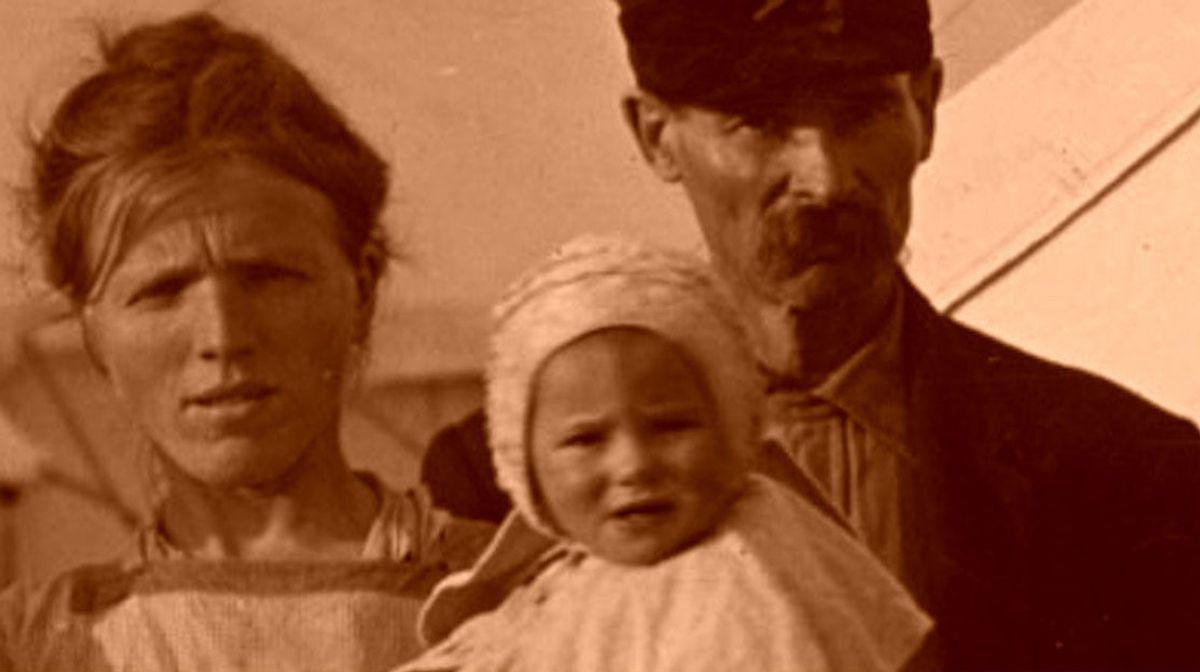
Strikers, Ludlow Tent Colony, 1914.


The early 1900s were a time of great social upheaval in our country. During the years leading up to the Ludlow Massacre, miners all around the country looking to make a better life for themselves and their families set up picket lines, organized massive parades and rallies, and even took up arms. Some died.

It's always worth considering why history like this was never taught in school before. Could it be that the powers that be would rather keep this kind of thing under wraps?


Here is Woody Guthrie's tribute to the good people who fought in the battles of Ludlow to help make a better tomorrow for everyone — you can just start the video and then start reading, if you wish:

Coal Country, Colorado

100 years ago, the Rocky Mountains were the source of a vast supply of coal. At its peak, it employed 16,000 people and accounted for 10% of all employed workers in the state of Colorado. It was dangerous work; in just 1913 alone, the mines claimed the lives of over 100 people. There were laws in place that were supposed to protect workers, but largely, management ignored those, which led to Colorado having double the on-the-job fatality rate of any other mining state.

It was a time of company towns, when all real estate, housing, doctors, and grocery stores were owned by the coal companies themselves, which led to the suppression of dissent as well as overinflated prices and an extreme dependence on the coal companies for everything that made life livable. In some of these, workers couldn't even leave town, and armed guards made sure they didn't. Also, if any miner or his family began to air grievances, they might find themselves evicted and run out of town.
strike, economy, money works, Union parade

Strikers, Ludlow Tent Colony, 1914.

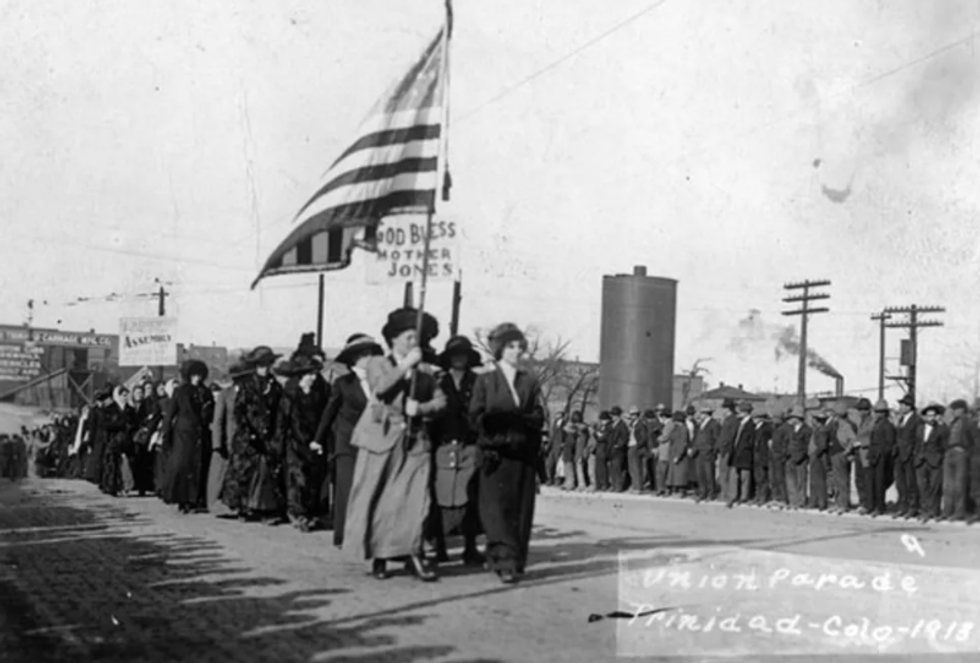
Union Parade, Trinidad, Colorado, 1913. Images via Colorado Coal Field War Project/University of Denver Library.

The Union

The United Mine Workers of America (UMWA) had been organizing for many years in the area, and this particular company, Colorado Fuel and Iron, was one of the biggest in the West — and was owned by the Rockefeller family, notoriously anti-union.

Put all this together, and it was a powder keg.
The Ludlow colony, 1914 massacre, Colorado Coal Field War

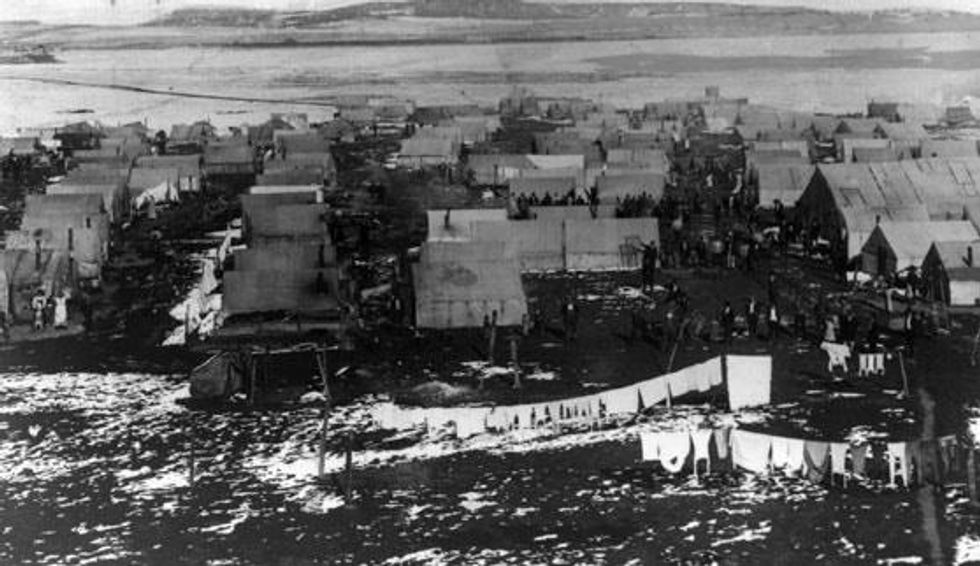
The Ludlow Colony before the massacre, 1914.

Photo from Youtube video.
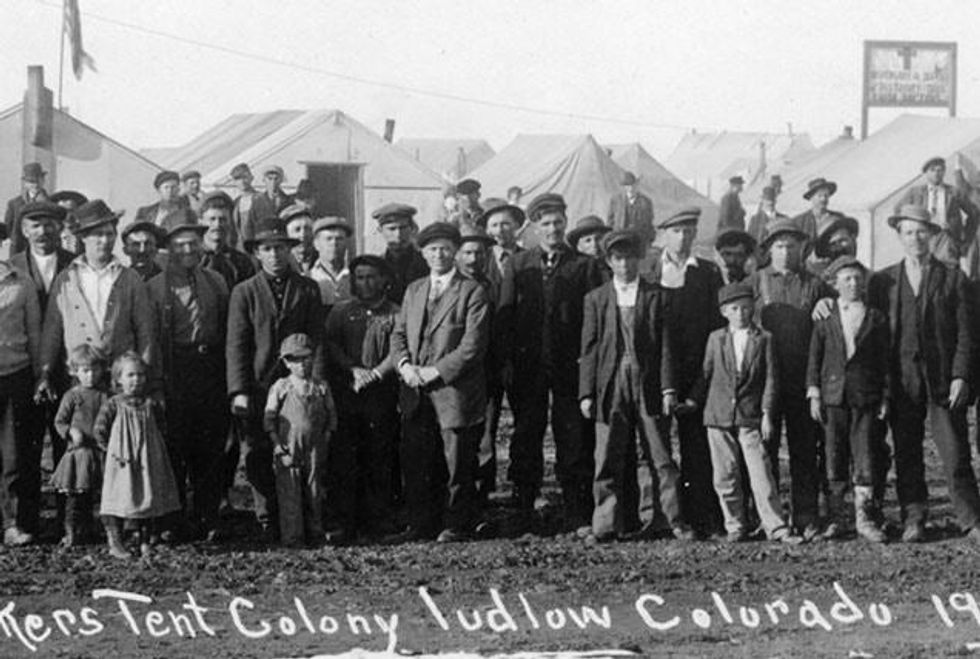
tent colony, mining, miners

Strikers, Ludlow Tent Colony, 1914.

Photo from Youtube video.
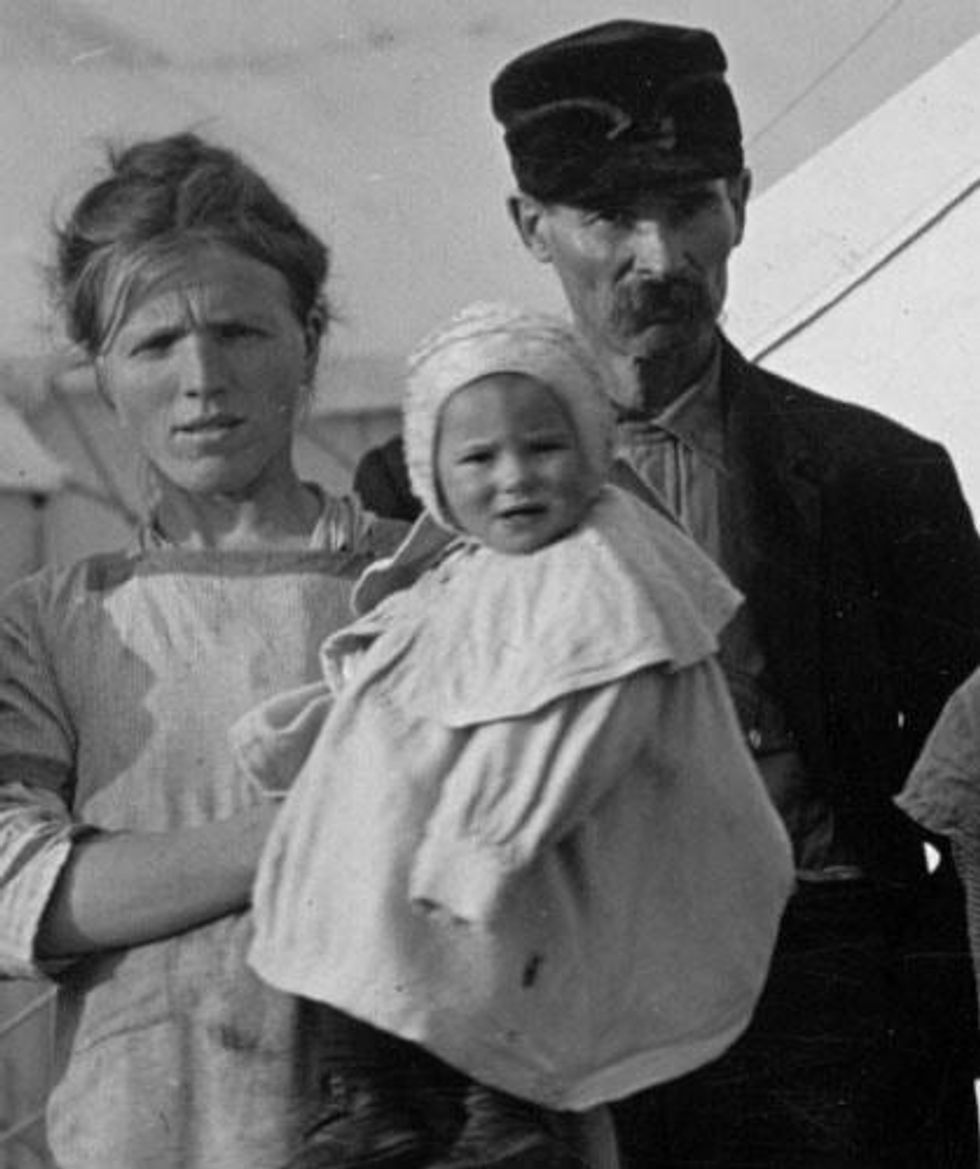
families, National Guard, unions

Strikers, Ludlow Tent Colony, 1914.

Photo from Youtube video.

Strike!

When a strike was called in 1913, the coal company evicted all the miners from their company homes, and they moved to tent villages on leased land set up by the UMWA. Company-hired guards (aka “goons") and members of the Colorado National Guard would drive by the tent villages and randomly shoot into the tents, leading the strikers to dig holes under their tents and the wooden beams that supported them.

Why did the union call for a strike? The workers wanted:

  1. (equivalent to a 10% wage increase),
  2. Enforcement of the eight-hour work day,
  3. Payment for "dead work" that usually wasn't compensated, such as laying coal car tracks,
  4. The job known as “Weight-checkmen" to be elected by workers. This was to keep company weightmen honest so the workers got paid for their true work,
  5. The right to use any store rather than just the company store, and choose their own houses and doctors,
  6. Strict enforcement of Colorado's laws, especially mine safety laws.
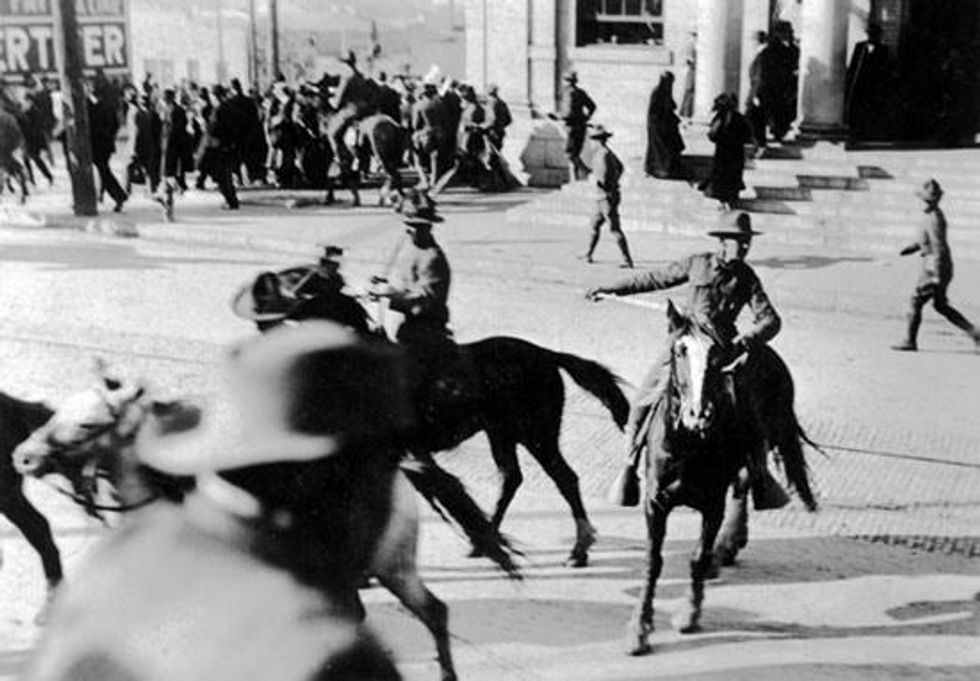
calvary, Trinidad, striking women

Cavalry charge on striker women in nearby Trinidad.

Photo from Youtube video.
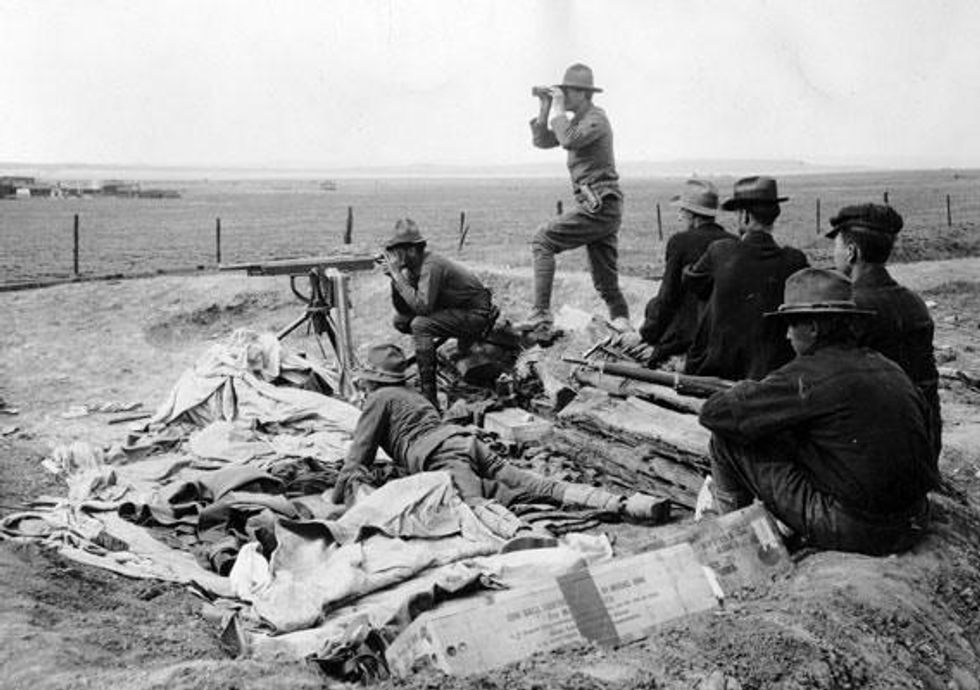
UMWA, Rocky Mountains, President Woodrow Wilson

Militia and private detectives or mine guards, Ludlow.

Photo from Youtube video.

The Powder Keg Explodes

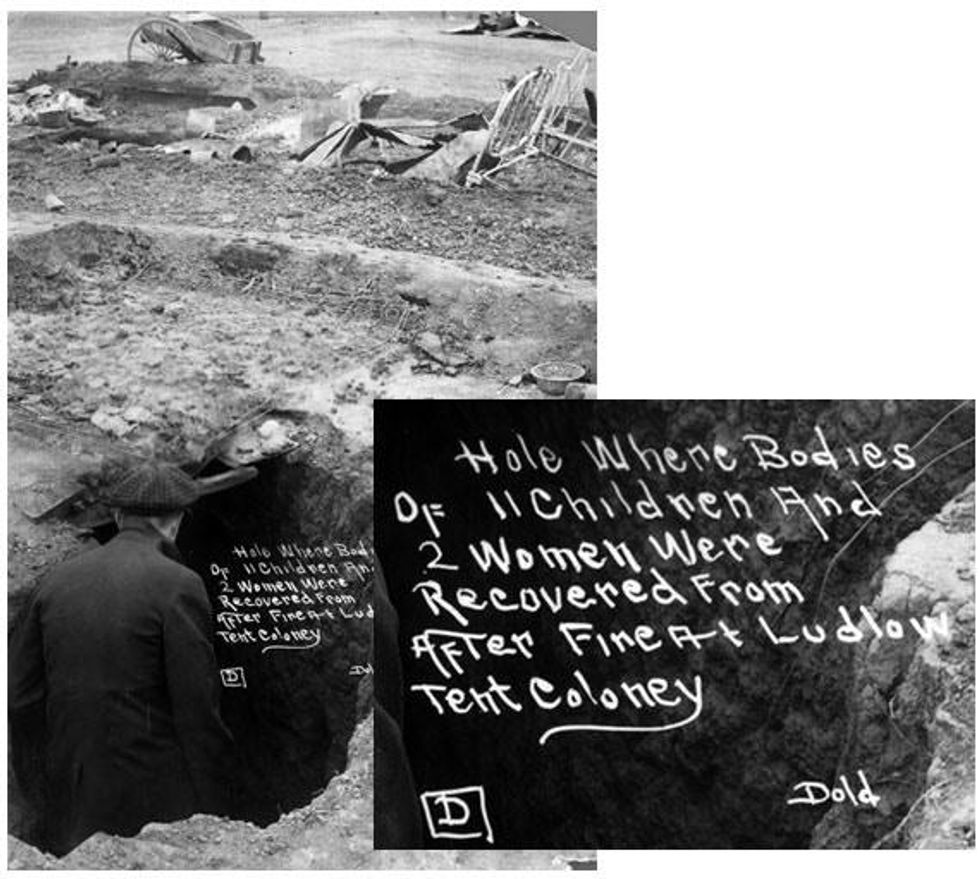
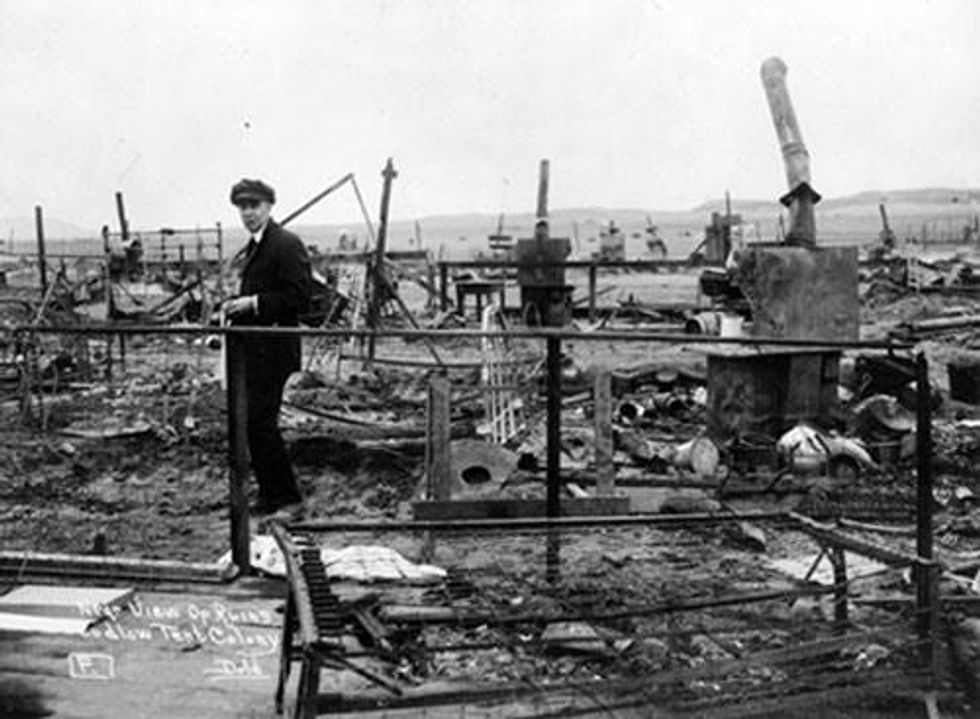
The attacks from the goons continued, as did the battles between scabs (strikebreakers) and the miners. It culminated in an attack on April 20, 1914, by company goons and Colorado National Guard soldiers who kidnapped and later killed the main camp leader and some of his fellow miners, and then set the tents in the main camp ablaze with kerosene. As they were engulfed, people inside the tents tried to flee the inferno; many were shot down as they tried to escape. Some also died in the dugouts below the burning tents. In the first photograph below, two women and 11 children died in the fire directly above them. A day that started off with Orthodox Easter celebrations for the families became known as the Ludlow Massacre.
Woody Guthrie, child labor laws, worker rights

The "Death Pit."

Photo from Youtube video.
colony, coal country, University of Denver

Rear view of ruins of tent colony.

Photo from Youtube video.
funeral procession, Louis Tikas, Greek strikers

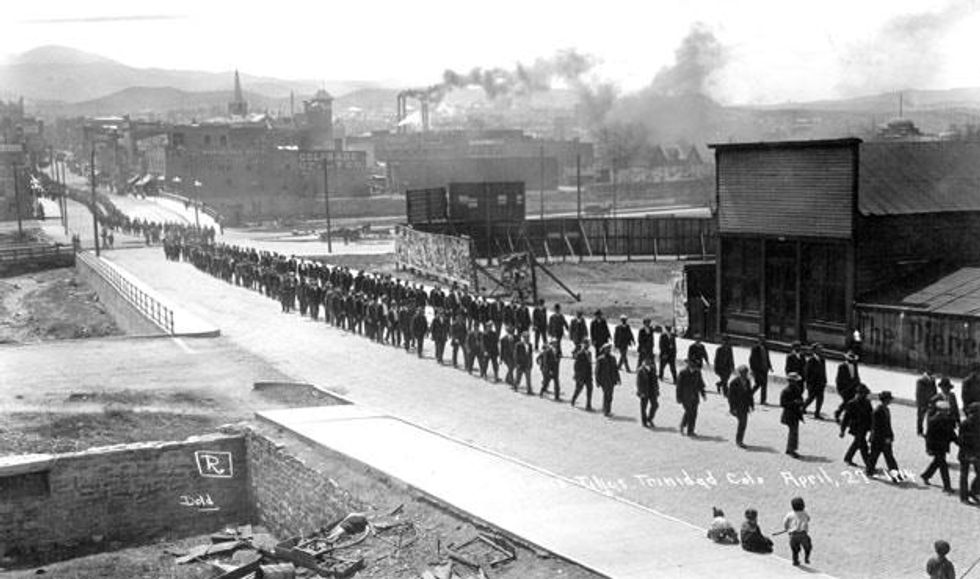
Funeral procession for Louis Tikas, leader of Greek strikers.

Photo from Youtube video.

The 10-Day War

The miners, fresh off the murders of their friends and family members, tried to get President Woodrow Wilson to put a stop to the madness, but he deferred to the governor, who was pretty much in the pocket of the mine companies.

So the miners and those at other tent colonies quickly armed themselves, knowing that many other confrontations were coming. And they went to the mines that were being operated by scabs and forced many of them to close, sometimes setting fire to the buildings. After 10 days of pitched battle and at least 50 dead, the president finally sent in the National Guard, which promptly disarmed both sides.

Union Victory

While close to 200 people died over the course of about 18 months before and after the battles at Ludlow and the union ultimately lost the election, the Ludlow Massacre brought a congressional investigation that led to the beginnings of child-labor laws and an eight-hour workday, among other things.

But it also brought national attention to the plight of these miners and their families, and it showed the resilience and strength that union people could display when they remained united, even in the face of extreme corporate and government violence. Historian Howard Zinn called it "the culminating act of perhaps the most violent struggle between corporate power and laboring men in American history." And the primary mine owner, John D. Rockefeller Jr., received a lot of negative attention and blame for what happened here.
monuments, April 20, 1914, coal miners, revolution

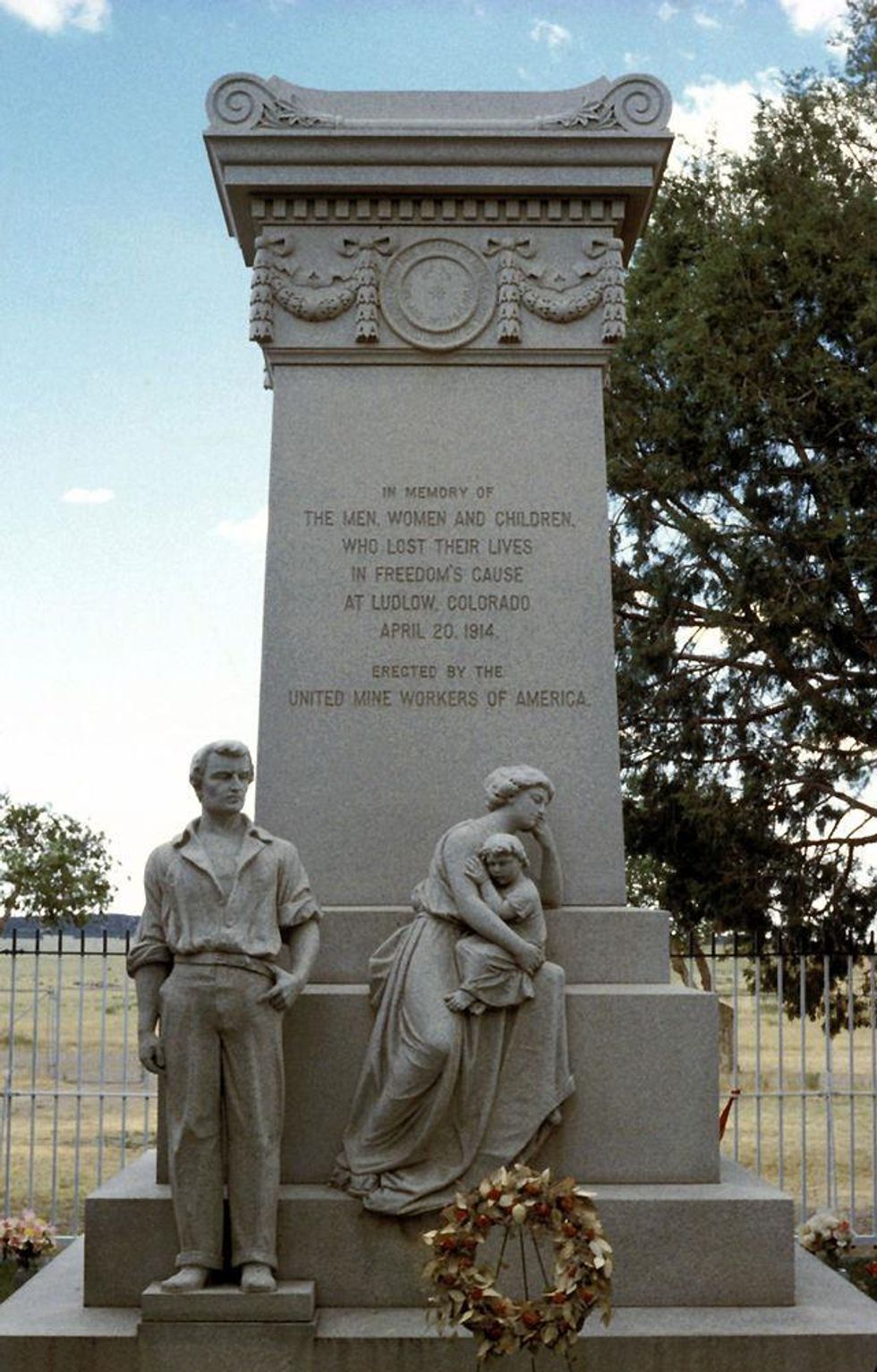
The UMWA is still a solid union today, and there is a monument in Colorado to those who died in the Ludlow Massacre.

Image by Mark Walker/Wikimedia Commons.

This article was written by Brandon Weber and originally appeared on 08.14.14


kids, school, school days, school week, schedule, 4 day week
Unsplash

Many school districts are moving to a 4-day week, but there are pros and cons to the approach.

American kids have fewer school days than most other major countries as it is, which poses a big challenge for families with two working parents. In a system designed for the "classic" stay-at-home mom model, it's difficult for many modern families to cover childcare and fulfill their work obligations during the many, many holidays and extra days off American children receive in school.

Some school districts, in fact, are ready to take things one step further with even fewer instructional days: for better or for worse.


Whitney Independent School District in Texas recently made news when it decided to enact a four-day week heading into the 2025 school year. That makes it one of dozens of school districts in Texas to make the change and over 900 nationally.

The thought of having the kids home from school EVERY Friday or Monday makes many parents break out in stress hives, but this four-day school week movement isn't designed to give parents a headache. It's meant to lure teachers back to work.

Yes, teachers are leaving the profession in droves and young graduates don't seem eager to replace them. Why? For starters, the pay is bad—but that's just the beginning. Teachers are burnt out, undermined and criticized relentlessly, held hostage by standardized testing, and more. It can be a grueling, demoralizing, and thankless job. The love and passion they have for shaping the youth of tomorrow can only take you so far when you feel like you're constantly getting the short end of the stick.

School districts want to pay their teachers more, in theory, but their hands are often tied. So, they're getting creative to recruit the next generation of teachers into their schools—starting with an extra day off for planning, catch-up, or family time every week.

Teachers in four-day districts often love the new schedule. Kids love it (obviously). It's the parents who, as a whole, aren't super thrilled.

- YouTube www.youtube.com

So far, the data shows that the truncated schedule perk is working. In these districts, job applications for teachers are up, retirements are down, and teachers are reporting better mental well-being. That's great news!

But these positive developments may be coming at the price of the working parents in the communities. Most early adopters of the four-day week have been rural communities with a high prevalence of stay-at-home parents. As the idea starts to take hold in other parts of the country, it's getting more pushback. Discussions on Reddit, Facebook, and other social media platforms are overrun with debate on how this is all going to shake up. Some parents, to be fair, like the idea! If they stay-at-home or have a lot of flexibility, they see it as an opportunity for more family time. But many are feeling anxious. Here's what's got those parents worried:

The effect on students' achievement is still unclear.

The execution of the four-day week varies from district to district. Some schools extend the length of each of the four days, making the total instructional time the same. That makes for a really long day, and some teachers say the students are tired and more unruly by the late afternoon. Some districts are just going with less instruction time overall, which has parents concerned that their kids might fall behind.

A study of schools in Iowa that had reduced instructional days found that five-days-a-week students performed better, on average.

Four-day school weeks put parents in a childcare bind.

Having two working parents is becoming more common and necessary with the high cost of living. Of course—"school isn't daycare!" But it is the safe, reliable, and educational place we send our kids while we we work.

Families with money and resources may be able to enroll their kids in more academics, extracurriculars, sports, or childcare, but a lot of normal families won't be able to afford that cost. Some schools running a four-day week offer a paid childcare option for the day off, but that's an added expense and for families with multiple kids in the school system, it's just not possible.

kids, school, school days, school week, schedule, 4 day week In a 4-day model, kids often (but not always) receive less instructional time. Photo by Ivan Aleksic on Unsplash

This will inevitably end with some kids getting way more screentime.

With most parents still working five-day weeks, and the cost of extra activities or childcare too high, a lot of kids are going to end up sitting around on the couch with their iPad on those days off. Adding another several hours of it to a child's week seems less than ideal according to expert recommendations.

Of course there are other options other than paid childcare and iPads. There are play dates, there's getting help from family and friends. All of these options are an enormous amount of work to arrange for parents who are already at capacity.

Working four days is definitely a win for teachers that makes the job more appealing. But it doesn't address the systemic issues that are driving them to quit, retire early, or give up their dreams of teaching all together.

@5th_with_ms.y

Replying to @emory here are my thoughts on my 4day work week as a teacher✨ #foryou #fyp #fypシ #foryoupage #foryoupageofficiall #teachersoftiktokfyp #teachersoftiktok #teachertok #teachersbelike #teachertiktok #tik #tiktok #viralllllll #teachertoks #teaching #teacher #tok #viralvideo #teacherlife #viral #trendy #teacher #teaching #worklifebalance #worklife #publicschool #publiceducation #school #student

A Commissioner of Education from Missouri calls truncated schedules a "band-aid solution with diminishing returns." Having an extra planning day won't stop teachers from getting scapegoated by politicians or held to impossible curriculum standards, it won't keep them from having to buy their own supplies or deal with ever-worsening student behavior.

Some teachers and other experts have suggested having a modified five-day school week, where one of the days gets set aside as a teacher planning day while students are still on-site participating in clubs, music, art—you know, all the stuff that's been getting cut in recent years. Something like that could work in some places.

In any case, the debate over a shortened school week is not going away any time soon. More districts across the country are doing their research in preparation for potentially making the switch.

Many parents don't theoretically mind the idea of their busy kids having an extra day off to unwind, pursue hobbies, see friends, catch up on projects, or spend time as a family. They're also usually in favor of anything that takes pressure off of overworked teachers. But until we adopt a four-day work week as the standard, the four-day school week is always going to feel a little out of place.

This article originally appeared in February. It has been updated.

Joy

Man ordering steak for dog's last meal is stunned by restaurant staff’s kind response

The staff knew something was wrong when he said he didn't need any sides with the steak.

cheddar's scratch kitchen. black labrador, dogs, rainbow bridge, steak, steak house

A Cheddar's Scratch Kitchen and a black Labrador (representative image).

There are a few things that are harder than saying goodbye to a pet; it can be as difficult as losing a close friend or family member. But for some reason, many people feel that they are not supposed to grieve as deeply for the loss of a pet as they do for a human. That’s why the kindness shown by the staff at Cheddar’s Scratch Kitchen in Saint Joseph, Missouri, is so extraordinary.

CousinHomer, a country musician in Missouri, was faced with the terrible decision to put down his 13-year-old dog, Bella, so he wanted her last meal to be something truly special: a “big, juicy steak.” The staff at the restaurant asked him what he wanted for sides, and CousinHomer said he just wanted the steak. “They told me it would be the same price with or without them, so I might as well get them. I explained to them that I was having my dog, Bella, put to sleep later that day, and I wanted her last meal to be a nice, juicy steak,” CousinHomer said in his video.


@clevelandclinic

Five-finger breathing is a simple but powerful breathing technique that induces deep relaxation — and you can do just about anywhere! 🖐️ Unlike other types of breathwork, five-finger breathing is a multisensory experience where you concentrate on more than just your breath. You also focus on the movement and sensation of one hand touching another, slowly and with intentionality. This helps your brain enter a state of deep relaxation, which causes it to release endorphins.

An incredible act of kindness

“When I showed up at the restaurant about 30 minutes later to pick up her food, the manager handed me the bag of food and said, ‘We are so sorry about your dog. This meal is on us.’ I really couldn't believe it. It was so nice of them,” CousinHomer said. However, when he got home, he saw that they had done something even more special: the entire staff had signed a card that read: "Our deepest sympathy in the loss of your best friend. She'll be waiting for you over the Rainbow Bridge."


“So I just want to publicly say, thank you, Cheddar's, for being so kind and thoughtful. It really meant the world to me,” CousinHomer concluded his video. But that wasn’t the end of the story. CousinHomer asked people to tag Cheddar’s in the post, so they know how many saw their act of kindness. Cheddar’s followed up with another act of kindness, which CousinHomer documented in a follow-up video.

@cousinhomer

CHEDDAR’S Restaurant Did It AGAIN. Wow!! (A Must See). #cheddars #cheddarsscratchkitchen #rainbowbridge #steakdinner #compassion @Cheddar’s

After Cheddar’s was flooded with people tagging them in the story, they sent CousinHomer a branded fleece that he can wear like a snuggie. “May comfort wrap around you like a warm Honey Butter Croissant. Your Cheddar’s family is here for you, Cousin,” the company wrote in the comments.

Why the loss of a pet hurts so much

Losing a pet can be just as hard as losing a human loved one, but there is one thing that's uniquely painful about putting down a pet. No matter how much we know we made the right decision, it still won’t stop us from ruminating over it.

“You do that because emotional pain hurts just like physical pain. And we are hard-wired to recognize pain as a teacher,” Sarah Hoggan, a pet loss grief advocate, said in a TED Talk. “Our body has reflexes that will pull our hand off a hot stove. We have pulled ourselves to safety even before we know the burn has occurred. Unfortunately, no such instant rescue mechanism exists for emotional pain. That means we need to study the events that led to the pain, to try to learn something from it and avoid it in the future.”

Ultimately, CousinHomer is going to be in a period of grief for quite a while, but it’s nice to know that there are a whole lot of people who recognized his pain and let him know that it was completely warranted to need some love after the death of a pet. At a moment when you have to make an incredibly difficult decision, having people understand your pain can make all the difference.

- YouTubeyoutu.be

This article originally appeared last year
millennials, boomer parents, buying a house, real estate, first home
Images via Canva/Photodjo, Andy Dean Photography

Millennials are frustrated with their Boomers parents about real estate.

Millennials trying to buy homes in today's economy are up against a rock and a hard place. Unlike for their Boomer parents, the dream of buying a home continues to feel further away.

According to the National Association of Realtors (NAR), Millennials "continue to be fenced out of home ownership." The organization reported that in 2024, the average age of first time home ownership rose to 38 years old, up from 35 years-old just the year before. "First-time buyers face high home prices, high mortgage interest rates and limited inventory, making them a decade older with significantly higher incomes than previous generations of buyers," Jessica Lautz, NAR deputy chief economist and vice president of research, said in a November 2024 press release.


Millennials are airing their frustrations amongst each other in the Reddit thread r/Millennials, sharing their stories and experiences with their Boomer parents—with many calling Boomers "out of touch."

@thejennifink

The disconnect with reality is real but I can’t stop bringing it up. #housingmarket #zillow #realestate #boomers #millennials #millennialsoftiktok #home

One Millennial wrote, "This topic is like hitting a dead horse, but I just needed to rant. Back story, I work out at a gym with people who are our parents age, and of the boomer generation. I overheard them saying, 'we bought our first home for $65,000. I’m sure kids these days are only paying $125,000 for that same house'. When they said that, I burst out laughing. How are they so out of touch? It drives me nuts."

Another Millennial replied, "Willful ignorance. Takes four seconds to go on Zillow and find out that’s bullsh*t 😆."

And another shared, "I'm not kidding... when I showed my dad actual data on itemized COL inflation, he said that 'the data just says that but that doesn't mean it's real'.... This is a guy that I would normally consider smart and with it. When it comes to these kinds of topics of societal degradation, he can't accept it. He is willfully ignorant to things being worse now for me than they were for him at my age."

@mel_owens

& invent a time machine. #boomer #homeowner #housingmarket #homebuying #comedy

Others explained how they attempted to explain to their Boomer parents how expensive homes currently are. Another shared, "Last Christmas, the sibs and I collectively managed to remember all the addresses we had lived in in our childhoods and Zillowed all of them to show our parents. All are still standing. All were built in the 70s. All are rural or suburban/small towns. Parents were astounded at what these 50+ year houses are going for today, especially compared to what they paid for them 30-40 years ago."

Millennials added their conversations with parents who got defensive. One wrote, "I legit just had this same conversation! They say 'complain when it’s 14% interest' excuse me, your house was 60k and dad was making 40, don’t piss on me and tell me it’s raining. That fancy 250k house is now like 600k…get a grip, average house is 438k."

Another shared, "My dad still gives me a hard time about renting, constantly tells me how I should invest in a house. I sat him down one day and opened up a mortgage calculator, showed him how with the current interest rates it just wasn't gonna happen- he seemed to get it. For a little bit anyways haha. I saw him last month and he told me again how rent is wasted money yadda yadda."

- YouTube www.youtube.com

How Millennials can have conducive home ownership talks with Boomer parents

Millennials can have healthy and productive conversations with their Boomer parents when discussions about buying a home become tense or uncomfortable, Aly Bullock, LMFT, a licensed marriage and family therapist with Paired, tells Upworthy.

Here are three things Millennials can say to their parents during these tough talks:

Phrase #1: "I understand that we have different views on this, and that's okay with me."

Bullock explains, "This acknowledges that you understand their POV and you are still willing to stick with your own opinion. It is a very gentle way of setting a boundary and letting them know you are comfortable having different opinions."

Phrase #2: "I would love to hear you out, and my request is that in return you respect my right to make a personal decision even if it does not align with what you've shared."

"Even when their kids are grown, parents still love the chance to influence their children," says Bullock. "This phrase lets your parents know that you would love to hear their opinion, you welcome it, AND reminds them gently that you are grown and they should offer you similar respect."

Phrase #3: "This conversation seems to keep causing tension between us, and I'd rather focus on something we have in common right now. Can we set it aside for a bit?"

According to Bullock, "This acknowledges the tension without placing blame. It gives the adult child an opportunity to stop the conversation before it deteriorates further, while emphasizing the positive pieces of the relationship."

Finally, she notes that it may take placing boundaries around these conversations. "Remember that you don't have to tell your parents everything. Some things are better left unsaid," says Bullock. "The truth is that parents change as they age and may or may not be able to cope well with generational differences or unmet expectations. Try to have compassion for them as you decide which things to keep to yourself in order to protect your own mental health."

This article originally appeared last year.

flags, countries, world, patriotism, nationalism

What's the difference between patriotism and nationalism?

Patriotism can feel like a loaded term sometimes, as the meaning can range in people's minds from a basic love of country to a fierce loyalty one is willing to die for. What constitutes "country" can also impact how we perceive of patriotism, as there's a difference between the land, the people, the ideals, and the current government.

And then there's nationalism, which may sound like the same thing but isn't. So what's the difference? Episcopal priest Joseph Yoo shared his thoughts on what separates patriotism from nationalism, and people are appreciating having the key differences laid out so clearly.


@joseph.yoo

Nationalism vs. Patriotism #yourEpiscoPal #YourKoreanFather #nationalism #patriotism #LanguageLearning

"Patriotism is love," Yoo begins. "It's gratitude. It's saying, 'I care about my country enough to tell the truth about it, to celebrate what's good and work to fix what's broken."

"Nationalism, that's idolatry," he continues. "It says my nation is the nation above critique, above others, God's favorite. And once you slap God's seal of approval on your own flag, congratulations, you've just made your country a 'golden calf.'"

He explained the patriotism results in activism like that of John Lewis crossing the Edmund Pettus Bridge to demand that the country live up to its professed ideals. Nationalism results in tragedies like the January 6th invasion of the Capitol, where Confederate flags and crosses were seen in the same mob.

"Patriotism says, 'I love my family enough to admit when we've messed up, and I will help us grow," Yoo says." Nationalism says, 'My family is perfect, everyone else is trash, and if you disagree you are out."

"One is honest love. The other is toxic possession," he says. "One builds. One bullies."

Yoo concluded with a biblical point: "Jesus never called us to worship a flag, only to love our neighbor."

It's important to differentiate between patriotism and nationalism because the latter has become a bit of a lightning rod in the political discourse. Some use it as a pejorative term, while others have embraced it as something totally acceptable or even positive. When the definitions are muddied, it causes confusion.

American flags, united states, america, patriotism, nationalism Flags can be a symbol of both patriotism and nationalism.Photo credit: Canva

Of course, Yoo is not the sole authority on what these words mean, but his thoughts are aligned with what the neutral arbiters of definitions say they mean.

Dictionary.com has an entire page discussing the terms, defining patriotism as "devoted love, support, and defense of one’s country; national loyalty,” and nationalism as "the policy or doctrine of asserting the interests of one’s own nation viewed as separate from the interests of other nations or the common interests of all nations," ultimately leading to how the two words are used:

"Patriotism generally has a positive connotation. It’s used for various positive sentiments, attitudes, and actions involving loving one’s country and serving the great good of all its people.

Nationalism generally has a negative connotation. It’s used for political ideologies and movements that a more extreme and exclusionary love of one’s country—at the expense of foreigners, immigrants, and even people in a country who aren’t believed to belong in some way, often racial and religious grounds."

flags, countries, world, patriotism, nationalism Love of one's country is nice. But there's a difference between patriotism and nationalism. Photo credit: Canva

Britannica also has a whole page about the two words, with this basic synopsis of the differences:

"Patriotism is a feeling of attachment and commitment to a country, nation, or political community, and its conception has roots tracing back to Greek and Roman antiquity. It is associated with the love of law and common liberty, the search for the common good, and the duty to behave justly toward one’s country. Nationalism, on the other hand, is a more modern ideology that emerged in the 18th century, focusing on the individual’s loyalty and devotion to the nation-state, often surpassing other individual or group interests."

And then there are some famous takes on patriotism:

“I love America more than any other country in the world and, exactly for this reason, I insist on the right to criticize her perpetually.”
― James Baldwin

“Patriotism is supporting your country all the time and your government when it deserves it.”
― Mark Twain

mark twain, author, patriotism, nationalism, democracy Mark Twain had quite a bit to say about patriotism. Giphy

“Patriotism means to stand by the country. It does not mean to stand by the president or any other public official, save exactly to the degree in which he himself stands by the country. It is patriotic to support him insofar as he efficiently serves the country. It is unpatriotic not to oppose him to the exact extent that by inefficiency or otherwise he fails in his duty to stand by the country. In either event, it is unpatriotic not to tell the truth, whether about the president or anyone else.”
― Theodore Roosevelt

“The difference between patriotism and nationalism is that the patriot is proud of his country for what it does, and the nationalist is proud of his country no matter what it does; the first attitude creates a feeling of responsibility, but the second a feeling of blind arrogance that leads to war.”

― Sydney J. Harris

There's nothing wrong with loving your country, but anything taken to excess and exclusion isn't healthy. Nationalism is excessive and exclusive in its very nature, and while patriotism can be weaponized, when kept in check it's what keeps people striving to make their homelands the best that they can be for everyone who lives there.

This article originally appeared last year

Gen Alpha; Gen Z; millennials; life in 80s; 80s life; 1980s; Oregon trail generation

Teacher asks 7th graders about the 80s. Their answers have us howling.

Gen Zers joke that their parents were born in the 1900s as a way to teasingly make it seem like their parents are much older than they actually are. But the kids coming up behind them are either really good at sarcasm or they actually believe the 80s were more like the 1780s. A 7th grade teacher asked her class full of Gen Alphas what they thought the worst part of the 80s was, and no one was prepared for their answers.

When most people think about the 80s, they think of big hair teased and sprayed to the gods. Bright colors, roller skates, and people walking around with giant boomboxes on their shoulders (as if everyone wanted to hear their music choices) are also at the top of the list for things that represent the 80s. But when thinking of the worst part of that decade, the lack of things like GPS, cell phones, and search engines would probably be at the top of that list.


Gen Alpha; Gen Z; millennials; life in 80s; 80s life; 1980s; Oregon trail generation Retro vibes with bold colors and music! 🎶✨ #80sFashionPhoto credit: Canva

Gen Alpha has other ideas about the worst part of the 80s. If you lived through that decade, you may want to remove your hat so you can scratch your head. The teacher who goes by Meliciousmo on social media recently uploaded the prompt and her students' answers on TikTok, giving viewers a chuckle.

One kid answers the prompt with, "No electricity. No good food." It's starting out pretty questionably, but let's give him the benefit of the doubt by assuming his family watches a lot of Little House on the Prairie and his centuries are mixed up. The next kid's response will probably nail it.

Well, maybe not. Through a few spelling errors, the response explains that the worst part about the 80s is that they didn't have cars. Yes, this sweet summer child surmised that life was tough because cars didn't exist, so walking everywhere or riding a horse and buggy was imperative. Obviously, this is false, because there were cars in the 80s. They had seatbelts in them for decoration, and kids would slide across the backseat when their dad turned a corner too fast as their mom reflexively extended a stiff arm to stop them from flying out of the car.

Gen Alpha; Gen Z; millennials; life in 80s; 80s life; 1980s; Oregon trail generation Confused expression with a questioning gesture.Photo credit: Canva

Clearly, some of the students were exposed to either 80s movies or TV shows because a couple of answers were spot on. One student wrote that running out of hairspray was the worst thing about the 80s, while another said, "People listening to other people's phone calls." Yikes. They're right. There were no cell phones, so there were no Bluetooth devices, so everyone was privy to your private conversation. Another child said nothing was bad about the 80s because "they had cool clothes, music, people, and hair." Those are big facts, kid.

But other suggestions included having to walk through rivers because of the lack of buses, or the worst part of the 80s: the Cold War.

@meliciousmo Every Friday I ask my students a fun question. This was today’s with some of their responses. 🤦🏼♀️#teachersoftiktok #funnyanswers #genx #middleschool ♬ Don't Stop Believin' (2024 Remaster) - Journey

One person writes, "There’s[sic] like 3 kids who know the 1980s are not the same as the 1780s. LOL."

Another laughs, "Gosh I’m still tired from walking through all the rivers to school."

Someone else thinks the generational gap between parents has something to do with it, "Some of these are spot on…some think we’re over 100 years old! You can tell who has Gen X parents and who has Millennial parents!"

Gen Alpha; Gen Z; millennials; life in 80s; 80s life; 1980s; Oregon trail generation Students eagerly participate in a classroom discussion.Photo credit: Canva

Book It pizza party anyone? (Or was that the 90s?) Either way, someone is proposing that iconic classic, writing, "Ok so some good ones, shoulder pads, people listening in to phone calls and hair spary[sic] are all legit. Give those kids a classic 80s pizza paety[sic]!! As for WW2, no tv, cars, and the great depression. Well those kids need a new history book lol."

Another person adds a pressure that only those who were adults in the 80s could appreciate, saying, "I didn't even grow up in the 80s and I KNOW it was writing a check at the grocery store with four people behind you and the person behind you had a full belt. The pressure must have been CRIPPLING."

This article originally appeared last year