upworthy
Add Upworthy to your Google News feed.
Google News Button
Joy

TikTok star's fans raise $144,000 for 'guardian angel' Uber driver who stood by her after robbery

Raul Torres is a guardian angel.
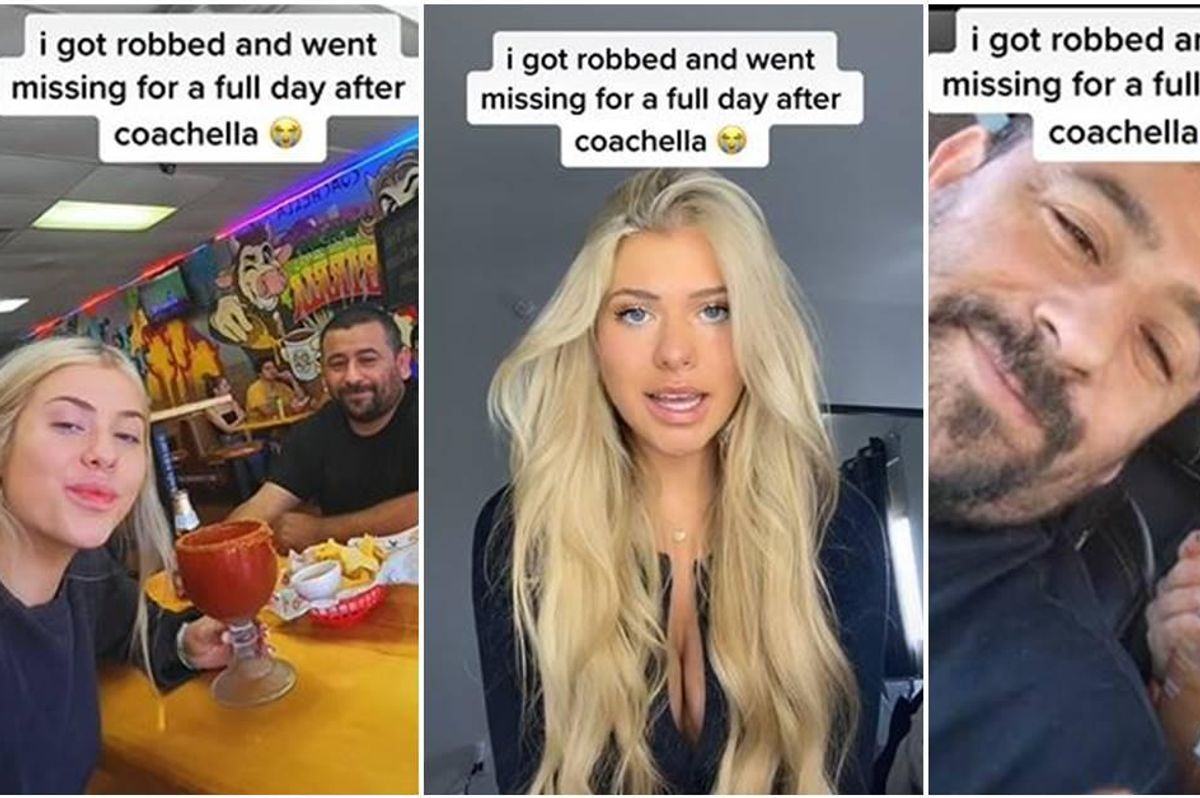
becca moore, raul torres, coachella

Becca Moore and Raul Torres having margaritas.

Becca Moore is a popular TikToker with over 800,000 followers who's known for her funny, laid-back takes on dating. Like any influencer-type she was at the Coachella music and arts festival in Indio, California recently. While she was at Coachella, she was robbed of her phone, rental car keys and wallet.

“I went to Coachella this weekend and I thought this guy was kinda hitting on me but then he just robbed me,” Becca says at the beginning of her three-minute TikTok video with over 3 million views. After the festival, she was left with no ride, money, or means to get in contact with friends and family. She was stranded in the desert.

Becca’s friend’s hotel called her an Uber so she could get to a local store to buy a new phone.

The driver she was incredibly lucky to be connected with was a lot more than a guy with a car in a time of need, he was a guardian angel named Raul Torres from Fresno, California, six hours north of Indio.


“A normal Uber driver takes you to a place and then drops you off. He insisted on coming in with me and making sure that I was going to have a ride after that,” Becca said.

The store wasn’t able to get her a new phone because she didn’t have access to her current plan. But Raul wouldn’t give up, so he took her to the local police station where they were able to locate the Airbnb where the thief was staying. The police let them into the room and they searched it but couldn’t find the phone.

@becccamooore

the uber driver that saved me from going missing is @buds4u559!! 😭 after spending the day w him he told me his daughter is a senior in high school & is having a hard time going through chemo. i made a gofundme, he could’ve left me and didn’t have to help me the way he did! I’d love to help his fam give his daughter a normal end to her senior year of high school this year (prom!!) i’m putting it in my bio!!


After the big let-down, Becca and Raul decided to take a break from their quest and refresh their spirits with some margaritas, on Raul. “Just because he’s an angel on this Earth,” Becca said in her TikTok video.

While the two bonded over drinks, Raul told Becca his daughter had been battling cancer and that’s why he’s been working as an Uber driver.

“He told me all he wants is for his daughter to have a normal end to her senior year, and to be able to go to big events like prom and graduation,” Becca said.

Raul also revealed that his father had cancer as well.

His revelations put Becca's troubles in perspective and made his decision to drop his driving for the day to help Becca all the more incredible.

@becccamooore

thank god he refused to leave me 😭 raul’s tiktok is @buds4u559. also you can donate to the fam in my bio!! thank you all for your donations and generosity. you today, me tomorrow!! #TipsForRaul

After the final slurps of their margaritas, Becca still wasn’t sure how she’d get home. But Raul wouldn’t give up. “We’re getting your phone,” he exclaimed.

He drove her back to the thief’s Airbnb where she found the phone sitting on top of the outside gate.

Becca believes the robber abandoned the phone after realizing the police were involved. Then, Raul helped Becca get a rental car so she could get home. Before saying their goodbyes, the two had spent eight hours together.

"Raul ended his Uber shift that morning to spend his day helping me, expecting nothing in return,” she said in her TikTok video. So she used her considerable audience to ask followers to help contribute to a GoFundMe page for Raul and his family. Over the first 4 days, the campaign has raised over $144,000.

"When I was in the car with him it seemed like we were both so focused on my situation. We were only talking about me getting a phone and like things that did not matter. And he completely glazed over the fact that his daughter and his dad were the ones that needed help," she admitted.

On Friday, April 29, Raul's dad passed away from cancer.

The story of Becca and Raul is a great reminder that no matter how big our troubles seem, it’s always important to put them in perspective.


This story originally appeared on 05.03.22

Health

From trials to treatments: one family's journey with "Brittle Bone Disease"

For Alex and his family, osteogenesis imperfecta spans four generations — and Shriners Children’s has been there every step of the way with life-changing care.

Four generations, one diagnosis: A family’s lifelong journey with “Brittle Bone Disease”
True

Like his mom, grandma and great-grandma before him, Alex was born with a condition called osteogenesis imperfecta, otherwise known as “brittle bone disease.” For every family member before him, the condition meant a lifetime of broken bones, hospital visits, and constant worry — but that story is now changing. With the support from Shriners Children’s™, Alex is experiencing a level of freedom and quality of life that former generations had only hoped for.


A family affair

Alex’s family’s story began in 1934, when his great-grandmother June started fracturing her bones at the age of 10. June would be nearly a teenager before she received a diagnosis of osteogenesis imperfecta — and, with that, she became one of the first patients with the condition to be treated at Shriners Children’s.

June’s daughter, Wanda, was diagnosed with the same condition at Shriners Children’s shortly before she was born in 1955. Like her mother, Wanda spent a significant part of her childhood in the hospital, often watching her siblings line up outside the hospital window to wave and wish her luck between surgeries.

When Wanda’s daughter was born, Chandra spent years undergoing treatment at Shriners Children’s for osteogenesis imperfecta, like her mother and grandmother before her. Experiencing more than 200 fractures in her early years, she was unable to walk before age 22 — but no less determined to make life better for others with her condition. Chandra donated her bone marrow to be used in a study, and the results contributed to the OI protocols and treatment that are now the standard of care all over the world. Best of all, this study would go on to benefit her own son, Alex.

Care that feels like family

While her treatment journey was challenging, Chandra also cherished her experience at Shriners Children’s. “The staff was like family to me,” she said.

Shriners Children’s has been providing that same level of professional care for families across the country. Founded in 1922 — just two years before June was born — Shriners Children’s has been providing specialty care to children with a wide variety of complex conditions, such as orthopedics, burn injuries, cleft lip and palate, and others.

But Shriners Children’s doesn’t provide this care alone. All services are made possible by generous donors. Through their giving, patients are able to access specialty care as well as adaptive equipment, long-term rehab, surgeries, and more. In one year alone, Shriners Children’s performed more than 24,000 life-changing surgeries, as well as 446,000 procedures. On top of that, they delivered tens of thousands of prosthetic and orthotic devices for patients in need and welcomed an additional 62,000 patients on top of that.

Hope for a new generation

With Chandra’s bone marrow donation, along with the compassionate care he was able to receive through Shriners Children’s, Alex is now able to live a life his family only dreamt of. To treat his condition, Alex receives infusions that regulate calcium levels in his blood and slow bone breakdown.

“When Alex started walking between one and two years old, I was shocked,” Chandra said. “The fact that he was able to walk, even run, and knowing I had a part to do with that, makes my heart happy.”

Without consistent treatment, Alex’s family believes he might still be spending most of his time in the hospital, facing broken bones and countless fractures. Instead, the compassionate care he receives has given him a bright future — and has made Chandra eternally grateful.

“Shriners [Children’s] is amazing with him,” she said. “I love Shriners [Children’s] so much.”

Shriners Children’s helps children heal and thrive so they can chase their dreams. Learn more about how they’re making it possible and share this article to inspire others to join you. Shriners Children’s relies on generous donors to make a difference.

Donate today during the 3X Match Challenge to make 3X the life-changing impact for patients.

black lab, dog walker, dog walker near me, dog walker ap, neighbors, good news, pets, feel good news

black lab (left. Handwritten letter (right)

If you've lived your whole life with a dog, a home has to feel pretty empty without one. Your heart has to feel like there's something missing as well. When Jack McCrossan, originally from Scotland, moved to Bristol, England with his three friends, they were bummed out to learn that their landlord didn't allow dogs.

So when they saw a beautiful black Sheprador (a German Sheppard Lab mix) in their neighbor's window, they knew that had to become buddies with her. They wrote the dog's owner, Sarah Tolman, a letter asking to arrange a play date with the dog. "If you ever need someone to walk him/her, we will gladly do so," they wrote.


"If you ever get bored (we know you never will, but we can dream), we are more than happy to look after him/her. If you want to come over and bring him/her to brighten our day, you are more than welcome. If you want to walk past our balcony windows so we can see him/her, please do," the letter continued.

"We hope this doesn't come too strong, but our landlord won't allow pets, and we've all grown up with animals. The adult life is a struggle without one," they wrote. "Yours sincerely, The boys from number 23," the letter concluded.

Soon after, the boys in 23 received a response from the dog herself, Stevie Ticks, accepting the offer. However, it may have been written by her human, Sarah Tolman. In the letter, Stevie shares a bit about herself, saying she's two years and four months old, was adopted in Cyprus, and that she's "very friendly and full of beans." (The boys shouldn't worry about a gassy hound, in England, "full of beans" means lively.)

"I love meeting new people and it would be great if we can be friends. I must warn you that the price of my friendship is 5 x ball throws a day and belly scratches whenever I demand them," the letter continued. A few days later, the boys got to meet Stevie.

"Meeting Stevie was great!" McCrossan told Buzzfeed. "She was definitely as energetic as described. We got to take her for a walk and she wouldn't stop running!"

Tolman thought the boys' letter was a fantastic gesture in an era where, quote often, neighbors are strangers. "In a day and age where people don't really know or speak to their neighbors, it was really nice for them to break down that barrier," she said. After the story went viral, she saw it as an opportunity for people to share their love of dogs with the world. "My mother and I are amazed at all the love we've received from around the world these past few days," Tolman wrote as Stevie. "If you have a doggo in your life, share that love with those around you."

A lot has changed since this story first warmed hearts around the globe. The boys have since moved away, but as of September 2024, Stevie is around 8 years old and still living her best life. Recently, she even made it to the doggie wall of fame at her local coffee shop.

In the years since this story first went viral, pet-sharing and neighbor dog borrowing have actually become more common, especially in cities where landlords restrict pets. Several platforms (like BorrowMyDoggy) and community groups now exist to pair dog owners with trusted neighbors who want occasional playtime, walks, or dog-sitting without having to own a pet. It’s a small but growing trend that reflects how deeply animal companionship is needed—even for people who can’t adopt a dog full-time. In many apartment buildings, these kinds of informal arrangements help reduce loneliness, build community, and give non-owners the emotional benefits of living with pets.

Just goes to show the power of a dog's love…even if that dog isn't your own.

This article originally appeared six years ago.

words, english, etymology, language, idioms, words and phrases, catchphrases, linguistics, dialect, old english

Did you know these common idioms contain words that otherwise wouldn't exist?

Language is so fun. Though English has technically existed for well over a thousand years, today's modern version of the language is nearly unrecognizable from its roots in Old and Middle English. Over time, words and phrases evolve and transform in both pronunciation and meaning. New words are created, and many older words die out.

Some antiquated words, however, manage to survive the passage of time even if they're not regularly used in everyday conversation or writing. How can they hold on without ever actually being used? By being "fossilized."


"A fossil word is a word that appears primarily in the context of a specific phrase. Words can become fossilized either because they grow antiquated or because they're replaced by other words in common speech. But the phrase in which they appear remains," says author and etymologist Jess Zafarris in a TikTok video:

@jesszafarris

Fossil words! #fossilwords #etymology #grammar #language #idioms #history #wordnerd #battle #religion #edutok #etymologytok #linguistics

This definition makes the term "Fossil Words" make perfect sense. Imagine an ancient bone or tooth that, instead of withering away in the open air, gets embedded into rock and soil and is thus preserved. Similarly, we use many of these extremely old and outdated words regularly, but in the context of these idioms and phrases even though we likely have little idea what they mean on their own or where they come from.

Here are a few of the most common and fascinating fossil words:

1. Ado - as in, "Without further ado."

"Ado" is a Middle English word from the 1200s meaning "fuss, bustle, or activity." It's rarely used outside of this specific phrase or in the title of the Shakespeare play Much Ado About Nothing.

2. Bate - as in, "With bated breath"

"Bate" (not bait) is another 800-year-old Middle English word that's a shortening of the word "abate" which means to suppress or diminish.

3. Vicarious - as in, "Living vicariously"

Zafarris says "vicarious" has been fossilized multiple times. Originally of Latin origin, "vicariously" initially was used to describe dying, mostly in the case of "Jesus dying vicariously for humanity's sins." Later, the phrase "living vicariously" became popularized. You can do other things vicariously, of course, but it's pretty rare to hear the word outside of this phrase.

4. Figment - as in, "A figment of your imagination"

This word comes from Middle English in the 15th century and refers to something "made up," or "a fable." You might hear of something being a "figment" of someone's mind, psyche, dreams, or imagination, but rarely anything else.

5. Avail - as in, "To no avail"

"Avail" is an old one, tracing back to the 14th century. It means "advantage toward attainment of a goal or purpose." The verb form sometimes circulates, as in "to avail yourself of" meaning "to take advantage of."

6. Moot - as in, "A moot point"

You guessed it: more Middle English. "Moot" actually has a fairly specific origin, which Merriam-Webster explains: "The adjective moot followed a few centuries behind the noun moot, which comes from mōt, an Old English word meaning 'assembly.' Originally, moot referred to an Anglo-Saxon deliberative assembly that met primarily for the administration of justice. By the 16th century, functioning judicial moots had diminished, the only remnant being moot courts, academic mock courts in which law students could try hypothetical cases for practice."

These days, points and arguments are often the only things that can be moot, or not worthy of further discussion.

Animated GIF Giphy

7. Petard - as in, "Hoisted by your own petard"

You can blame Shakespeare (again) for this catchy idiom, which few people know the true meaning of. In the strictest sense, a "petard" is a firework or explosive. Merriam-Webster breaks down the idiom's origin from Hamlet: "'For 'tis the sport to have the enginer / Hoist with his own petar.' Hoist in this case is the past participle of the verb hoise, meaning 'to lift or raise,' and petar(d) refers to an explosive device used in siege warfare. Hamlet uses the example of the engineer (the person who sets the explosive device) being blown into the air by his own device as a metaphor for those who schemed against him being undone by their own schemes."

8. Lam - as in, "On the lam"

"Lam" came about in the 1500s to describe a sudden or hurried escape, usually from law enforcement. You'll rarely hear the word outside the phrase "on the lam," although it's sometimes used as a verb: "Lam it," meaning "to flee quickly."

9. Shebang - as in, "The whole shebang"

"Shebang" is much more recent compared to many of the words on this list, first being used in the late 1800s according to Merriam-Webster. It means "everything involved in what is under consideration," which makes the phrase the "whole shebang," a little bit... redundant. That's probably why you rarely hear about only "part of the shebang."

10. Vim - as in, "Vim and vigor"

"Vim" is simply an outdated word for having high energy and enthusiasm. It's rare, but not unheard of, to see it used without being attached to "vigor" as well.

11. Wreak - as in, "Wreak havoc"

"Wreak" is an extremely old (12th century) word meaning "to cause or bring about," but what's brought about is almost always bad. You can wreak havoc, destruction, chaos, and not much else. That's because its etymological origins are tied to ideas of anger and vengeance.

12. Fro - as in, "To and fro"

Old English meaning back or away, and not, as is commonly believed, "from."

13. Bide - as in, "Bide your time"

"Bide" comes from Middle English meaning "to stay, linger, wait expectantly, hope for, undergo." Technically, there are other things you can bide, but time is by far the most common these days.

14. Beck - as in, "At your beck and call"

"Beck," of course, is closely related to the more modern "beckon," which is a hand signal or nod used to get someone's attention or draw them closer to you. Beckon is still used but "beck" is pretty much extinct outside of this fossilized form.

15. Amok - as in, "Run amok"

We might say, "The kids are running amok in the house!" these days, but in the 1600s "amok" had a much more specific, and violent, meaning. According to Merriam-Webster, a person (usually a man) afflicted with "amok" would..."Attack bystanders in a frenzy, killing everyone in sight until he collapsed or was himself killed."

Fossil words also include a subcategory of words that aren't really words at all, but have evolved and morphed only within the context of a specific phrase. For example:


@pbsdigitalstudios

Let’s examine some not-so-extinct words with @Dr. Erica Brozovsky! Did any of these surprise you? Let us know what you think in the comments, and catch up on full episodes of Otherwords by heading to PBS Storied on YouTube! #words #english #fossilwords #history #shakespeare @PBS

16. Tarnation - as in, "What in tarnation?!"

"Tarnation" is not really a proper word that exists outside of this specific usage. Etymologists say it originated in the 1700s as an alternation of "darnation" combined with "tarnal," which was a mild profanity at the time.

17. Druthers - as in, "If I had my druthers..."

How about this one: "I'd rather..." -> "I'd ruther" -> "Druther"... A word created out of dialect, "Druthers" refers to the thing you'd rather, or ruther, have.

18. Caboodle - as in, "The whole kit and caboodle"

"Boodle" is an old word of Dutch origin meaning "a crowd, lot, bunch, or bundle." The ca- or ka- in front of boodle was likely added for fun alliteration (to go with "kit" ) when the phrase became widely adopted in the 1800s.

19. Nother - as in, "A whole nother"

"Nother" is not actually a word in the common, modern sense. The word "another" was split into two parts, with "whole" inserted in the middle, for emphasis in the 19th century—similar to something like fan-freaking-tastic, which is known as a tmesis.

Another fun fact: Sometimes fossilized words get confused for their more modern derivatives and variations. For example, the expression is "champing at the bit," but people often write it as "chomping." This is known as an eggcorn.

Now you know that when using these everyday idioms, even if they've become overused and cliche, you're actually helping to keep a part of English history alive. Well done!

Pets

Man's unique gift for naming cats has strangers asking him to name their kittens

Hersberry, O'dis, Nuffin—watch how "Unc" comes up with his adorable names.

kittens, cats, pets, naming cats, naming kittens

What would Unc name these kitties?

"The Naming of Cats is a difficult matter, it isn't just one of your holiday games…" – T.S. Eliot

One of the best parts of getting a new pet is choosing a name for them. Unlike children, who have conscious feelings about their names and may object to off-the-wall choices at some point, a pet presumably couldn't care less what the humans in their lives call them. A dog could be named Fred, Red, or Potatohead and be none the wiser. We've seen cats with names that go far beyond the norm even for pet names, like Parking Lot, Crunchwrap Supreme, and Missile Launcher (Missy for short) among other creative monikers.


But if any animals were going to care about what we name them, surely it would be our finicky feline friends. And one man, whom we'll call Unc (for his @UncGotThaMunchies handle), seems to have a gift for giving kitties very special (or rather, "pecial") names. Unc has become the father of 13 kitties, and his naming of cats has become a bit of a viral phenomenon.

@uncgotthamunchies

#cat #cats #catsoftiktok #kitten #kittensoftiktok

First, there's Blackaroni and Cheese, a black and orange kitten pair that people are just gaga over. But Unc has begun a whole movement of naming kitties in a "berry pecial" way, with Hersberry leading the way. Why Hersberry? Because her's berry pecial to Unc, of course.

@uncgotthamunchies

#cats #cat #kitten #kittens #catsoftiktok

Among the other kittens, we have another pair named Thor and Lowkey (yes, spelled Lowkey) and another orange kitty that Unc named Midas, "because there Midas well be no other kitties on the whole planet."

@uncgotthamunchies

#cat #catsoftiktok #kitten #kittens #kittensoftiktok

People have become so enamored with these cute and clever kitty names that some have started asking Unc to help them name their own kittens. One person shared a photo of their adorable orange kitten and asked if Unc could name him because they couldn't think of a good name. Unc didn't disappoint.

"When people see dis kitty right here," he said in a response video. "They will say, 'Oh, dis kitty is so beautiful. Oh, dis kitty is so pecial.' So I think his name should be O'dis." Then he explained all the nickname benefits of the name O'dis and how special this name would make the kitty feel.

@uncgotthamunchies

Replying to @glitterdiamondsparkles #greenscreen #cat #catsoftiktok #kitten #kittens

Someone else shared a photo of their fuzzy little tabby kitten, writing, "First I saw your Hersberry video then Midas and now the universe sent us a kitten and we can't think of a name for her. Can you help name her??" Unc responded with a video saying that he'd had a premonition as he was laying around looking at kitties on TikTok that a beautiful little girl kitty was going to come to him needing a name, and he should have the name ready for her when he saw her. Watch how that played out:

@uncgotthamunchies

Replying to @megan_elizabeth__ #greenscreen #cat #catsoftiktok #kitten #kittensoftiktok

Did he choose a perfect name or what? The kitten's owner responded in the comments and said, "Won’Da it is!! 🥰 Thank you!!"

Unc got another orange kitten sent to him with a name request. This one got the name Nuffin:

@uncgotthamunchies

Replying to @Raegan Schafer #greenscreen #cats #cat #kittens #kittensoftiktok

"Because there is nuffin on dis Earf more cuter than this kitty. And there is nuffin on dis Earf that I would not do for this kitty. And there is nuffin on this whole Earf that could keep me from loving this kitty," explained Unc. Of course.

People are loving watching Unc name other people's kitties, with multiple people calling him a walking green flag.

"There is nuffin on this earf as precious as you naming kitties 😍😂🫶🏼," wrote one commenter.

"There is nuffin I love more than a man who loves his kitties as much as you do!!"

"Another perfect name!!! My sister is adopting a kitty today and I’ve been telling her about your names and how you come up with them. It’s great. 🥰"

Ultimately, the way Unc interacts with his kitties is what keeps people coming back. There's something so endearing about the mutual affection between him and the whole lot of them. Not all cats are sweet and snuggly, but Unc's kitties seem to be quite affectionate. People with more standoffish cats may be wondering why this man's cats and kittens are so loving. Well, here you go:

@uncgotthamunchies

#cat #catsoftiktok #kitten #kittensoftiktok #kittens

So berry, berry pecial. You can follow Unc on TikTok.

maikon alves, agt, dance, robot dance, dance tutorials, tiktok dance, agt dance
Maikon Alves | Instagram

Some people have such amazing control of their bodies

If you're a dance enthusiast, or just anyone who appreciates great artistry, meet Maikon Alves, a dancer from Brazil turns heads on social media with moves so fluid and robotic that people around question if he's human.

In one particularly viral video, Alves dances to "Boom Boom Pow" by the Black Eyed Peas—to say his moves are impressive would be an understatement. Alves pops his chest to the beat while slowly stepping in place making it look like he's gliding from move to move. Some movements are crisp and sharp like a robot while others are so fluid it's nearly unbelievable that it could be coming from a human.


While the man's moves do look slightly out of this world, he is indeed a real person, or at least he appears to be in other videos on his page.

Comments ranged between being in awe of his abilities and questioning if he was human.

"Loved. I like how everything is in sync - from the music to the moves to face expressions. 👏👏👏 and your cool personal style," one person writes.

"Doesn’t even look real it’s that good..!! Love this," someone says.

"You will be the dance instructor for the children of our AI overlords someday," a commenter thinks.

"Nah, this is God-level pop-locking," someone compliments.

Even Nicole Scherzinger, actress, singer and former member of the pop group and dance ensemble, Pussycat Dolls gave Alves praise saying, "you are a legend!"

Alves' uncanny robot dance even made its way to season 19 of America's Got Talent. His audition routine included pretending to play the Violin and a fun moonwalk to robotic themed music.

Gotta hand it to folks like Alves, who remind us all what amazing feats the human body is capable of, and how dance can instantly spark joy. Whether you're the one performing the moves or not.

To catch even more of his nifty routines, follow Alves on Instagram.

This article originally appeared last year. It has been updated.

baking, 350 degrees, 350 degrees Fahrenheit, maillard reaction, baking chemistry

This is why recipes call for ovens to be set at 350 degrees Fahrenheit when baking.

The holidays are all about baking. From delicious Christmas cookies to pies to extravagant dinner feasts, the oven is used a ton during this time of year.

And if you've ever made a recipe that requires the oven, you've probably noticed it tells you to preheat it to 350 degrees Fahrenheit. But why?


It's a question that people on Reddit were curious about, too. One person posed the question: "How did 350 degrees become such a standard in all thing baking and roasting etc…?"

- YouTube www.youtube.com

From a scientific standpoint, 350 degrees Fahrenheit is recommended because of something called the Maillard reaction, which was discovered by French chemist Louis-Camille Maillard in 1912. Essentially, the Maillard reaction is a chemical reaction that takes place in food between 280 and 330 degrees Fahrenheit.

"The Maillard reaction is responsible for the formation of desirable sensory qualities such as flavor, aroma, color, and texture in cooked and thermally processed foods, in addition to the improvement of nutritional value and shelf life of foods," a 2025 study published in the journal Foods explains.

@thecaketoonist

#oventemperature #recipe #tipsforbakers #centigrade #farhenheit #lol #dessert #jokesforbakers #foodtok #BakingOfTikTok #BakeTok #BakersOfTiktok #tiktokbaker #AmateurBaker #HobbyBaker #BakingForFun #FunnyBaking #CakeLOL #funnyfood #funnywomen #CakeOfTikTok #FunnyBaker #thecaketoonist


So there is a lot of chemistry that takes place while food is cooking in an oven at 350 degrees Fahrenheit.

"The real specifics of the Maillard reaction occur when an amino acid (which forms the backbone of proteins) reacts with a reducing sugar (such as glucose and fructose) to produce a 'browning' type reaction," Nicholas Gillitt, chief science officer at the David H. Murdock Research Institute, told PBS. "The products of this reaction have all sorts of flavors and aromas depending on the individual compounds that end up reacting. And because eating food is a very sensory experience, these products usually enhance the palatability, taste and/or smell of the food enticing us to eat and enjoy."

Modern ovens can also be finicky. As one Redditor explained, "There is a magical reaction called the Maillard reaction that happens up to 330 degrees, its what makes roast food so delicious. Most ovens are a bit inconsistent, so to make sure the Maillard reaction happens as much as it can, the oven is set higher."

- YouTube www.youtube.com

Plus, caramelization, the sugar-breaking process that creates browning, begins at about 320 degrees Fahrenheit, according to the University of San Diego. This is why cookies become golden brown when done and have that oh-so-yummy taste.

Baking in an oven set to 350 degrees Fahrenheit not only helps prevent burning but also allows the necessary chemical reactions to fully develop. It's essentially the baking "sweet spot" temperature.

"Yeah the big deal is going higher to like 375 or 400 things will start burning or crisping too quickly," another Redditor added. "Which sounds good (and can be!) but the vast majority of things meant to be baked are big thick items that need to be cooked evenly. That's why they're to be baked in the first place. Maybe there's a more ideal 'perfect' temp to do it but 350 is pretty darn close to it and is a significant number."