

As an asexual woman, finding my place in the queer community wasn't as simple as it sounds

Nervously, I reached into my purse and pulled out my ID, flashing it to the bouncer. It was 6 p.m. and I'd just come from work. My roommates were supposed to meet me, but they were always late, and tonight was no exception. So, it was with a pounding heart that I faced the crowd alone, trying to find the least threatening person to approach.
It was my first Democratic Socialists of America (DSA) meeting, specifically for those in the LGBT community, and I thought I'd found my people. Queer and political, sign me up. But as I took a closer look at those milling around, I realized that the space didn't look that different from what I was used to. I was still in the minority, because of both my race and gender. I was still being talked at by men who thought they knew more than me. I was still around people who seemed to assume that everyone wanted sex.
One of the only other women in the group came up to me and said "It's good to see another one of us here." "Another what?" I asked, a bit confused. "Another lesbian," she replied easily, as if it were obvious.
But that was not true. I'm not a lesbian. I'm asexual. And I had thought that coming to a group geared toward LGBT individuals—the full acronym being LGBTQIA+, where the A stands for asexual (also known as "ace")—would have allowed me the opportunity to meet others who identified similarly.
After figuring out that I was asexual, I thought finding community would be easier
I'd done all the hard work of figuring out that I was ace—I thought that finding a community would be easier. After years of internalizing heteronormativity, of consuming various movies and books where sex and relationships were presented as the ultimate goals, it was no wonder that it took me such a long time to realize that I didn't want that. And even longer still to accept and embrace that part of my identity, to realize that there were others who felt the same way. There was a whole community out there if I could just find them.
With the DSA LGBT event, I finally thought that I had. It turned out that it wouldn't be that simple. I kept attending events with queer and LGBT+ labels attached to them, hoping that I'd find someone who would understand. But I was realizing that just because we shared the queer label did not mean that we shared experiences. Many understood being different, sure, but not the difference that I felt. They still experienced sexual attraction, just not of the heteronormative variety. Sometimes, these spaces were even more sexualized as people felt comfortable expressing themselves in ways they couldn't in everyday life.
To find other ace people, I had to look elsewhere
When I was unable to find the community I was searching for by going to in-person events, I turned to the internet. Once I knew the terminology, I was able to search on various social media sites. I started following a blog on Tumblr that posted about ace topics. I began to see others post about experiences that mirrored my own.
It was on Instagram that I found a community of ace individuals in New York, where I live. They posted various resources for asexuals and even hosted monthly events. What I'd so desperately wanted earlier, an in-person community, was suddenly within my grasp. The page posted about a new support group for asexuals, and I decided to go.
What struck me first was that the room was diverse—there were a lot of non-cis men and a lot of POC folks. The organizers were women of color. As people began to share their stories, I felt a sense of calm envelop my body—I had found people who understood me. They had been uncomfortable in high school because they didn't understand everyone's desire to have sex. They had faced challenges navigating dating when sexual intimacy was something that may not even be on the table. They were older and wiser and made me feel like it was all going to be alright.
I may not feel like I belong in all queer spaces, but I've found a queer space that fits me. This space, and the people in it, provide me with the confidence to live my life authentically, to embrace the ace part of my identity. And when I inevitably encounter those who don't understand me, I know I've got a place to go for support.
- No Sexual Desire? No Problem! XOXO, The Asexual Movement ... ›
- A comic that debunks myths about asexuality. - Upworthy ›
- A comic that debunks myths about asexuality. - Upworthy ›

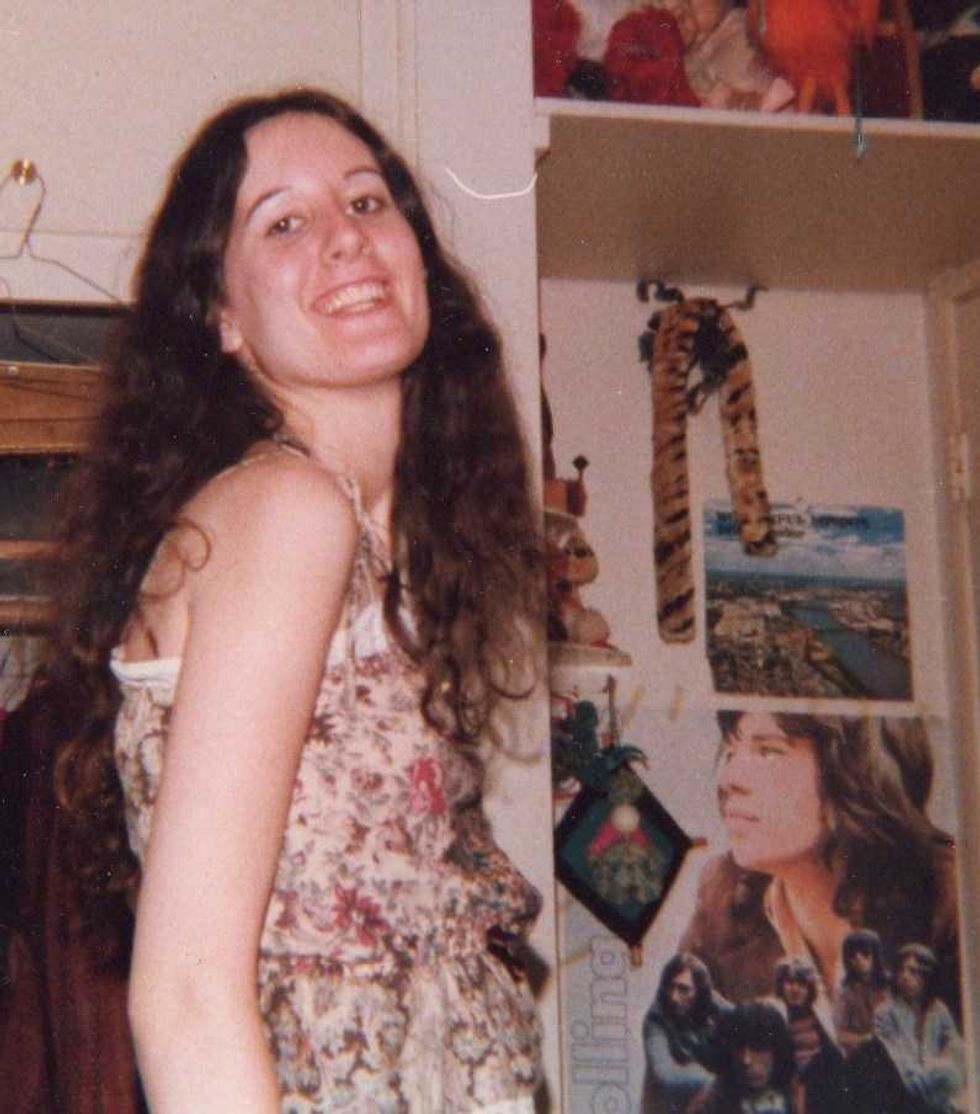 A Generation Jones teenager poses in her room.Image via Wikmedia Commons
 An office kitchen.via
  An angry man eating spaghetti.via
 At least it wasn't Bubbles.
  You just know there's a person named Whiskey out there getting a kick out of this.


An Irish woman went to the doctor for a routine eye exam. She left with bright neon green eyes.
It's not easy seeing green.
Did she get superpowers?
Going to the eye doctor can be a hassle and a pain. It's not just the routine issues and inconveniences that come along when making a doctor appointment, but sometimes the various devices being used to check your eyes' health feel invasive and uncomfortable. But at least at the end of the appointment, most of us don't look like we're turning into The Incredible Hulk. That wasn't the case for one Irish woman.
Photographer Margerita B. Wargola was just going in for a routine eye exam at the hospital but ended up leaving with her eyes a shocking, bright neon green.
At the doctor's office, the nurse practitioner was prepping Wargola for a test with a machine that Wargola had experienced before. Before the test started, Wargola presumed the nurse had dropped some saline into her eyes, as they were feeling dry. After she blinked, everything went yellow.
Wargola and the nurse initially panicked. Neither knew what was going on as Wargola suddenly had yellow vision and radioactive-looking green eyes. After the initial shock, both realized the issue: the nurse forgot to ask Wargola to remove her contact lenses before putting contrast drops in her eyes for the exam. Wargola and the nurse quickly removed the lenses from her eyes and washed them thoroughly with saline. Fortunately, Wargola's eyes were unharmed. Unfortunately, her contacts were permanently stained and she didn't bring a spare pair.
- YouTube youtube.com
Since she has poor vision, Wargola was forced to drive herself home after the eye exam wearing the neon-green contact lenses that make her look like a member of the Green Lantern Corps. She couldn't help but laugh at her predicament and recorded a video explaining it all on social media. Since then, her video has sparked a couple Reddit threads and collected a bunch of comments on Instagram:
“But the REAL question is: do you now have X-Ray vision?”
“You can just say you're a superhero.”
“I would make a few stops on the way home just to freak some people out!”
“I would have lived it up! Grab a coffee, do grocery shopping, walk around a shopping center.”
“This one would pair well with that girl who ate something with turmeric with her invisalign on and walked around Paris smiling at people with seemingly BRIGHT YELLOW TEETH.”
“I would save those for fancy special occasions! WOW!”
“Every time I'd stop I'd turn slowly and stare at the person in the car next to me.”
“Keep them. Tell people what to do. They’ll do your bidding.”
In a follow-up Instagram video, Wargola showed her followers that she was safe at home with normal eyes, showing that the damaged contact lenses were so stained that they turned the saline solution in her contacts case into a bright Gatorade yellow. She wasn't mad at the nurse and, in fact, plans on keeping the lenses to wear on St. Patrick's Day or some other special occasion.
While no harm was done and a good laugh was had, it's still best for doctors, nurses, and patients alike to double-check and ask or tell if contact lenses are being worn before each eye test. If not, there might be more than ultra-green eyes to worry about.