upworthy
Add Upworthy to your Google News feed.
Google News Button
Pop Culture

People are sharing the adult problems that 'nobody prepared you for' and they're so true

Here are 21 of the most relatable.
being an adult, adult lessons, growing up
via PixaBay

Being an adult is tough.

Nothing can ever fully prepare you for being an adult. Once you leave childhood behind, the responsibilities, let-downs and setbacks come at you fast. It’s tiring and expensive, and there's no easy-to-follow roadmap for happiness and success. A Reddit user asked the online forum, “What’s an adult problem nobody prepared you for?” and there were a lot of profound answers that get to the heart of the disappointing side of being an adult.

One theme that ran through many responses is the feeling of being set adrift. When you’re a kid, the world is laid out as a series of accomplishments. You learn to walk, you figure out how to use the bathroom, you start school, you finish school, maybe you go to college, and so on.

However, once we’re out of the school system and out from under our parents’ roofs, there is a vast, complicated world out there and it takes a long time to learn how it works. The tough thing is that if you don’t get a good head start, you can spend the rest of your life playing catch-up.

Then, you hit middle age and realize that life is short and time is only moving faster.

Adulthood also blindsides a lot of people because we realize that many adults are simply children who grew older. The adult world is a lot more like high school than a teenager could ever imagine.

The Reddit thread may seem a bit depressing at first, but there are a lot of great lessons that younger people can take to heart. The posts will also make older people feel a lot better because they can totally relate.

Being an adult is hard, exhausting and expensive. But we’re all in this together and by sharing the lessons we’ve learned we can help lighten each other's load just a bit.

Here are 21 of the most powerful responses to the question: “What is an adult problem nobody prepared you for?”

1. Lack of purpose

"Lack of purpose. All your young life you are given purpose of passing exams and learning, then all of a sudden you are thrown into the world and told to find your own meaning," — Captain_Snow.

2. No bed time

"You can stay up as late as you want. But you shouldn't," — geek-fit

3. Friendships

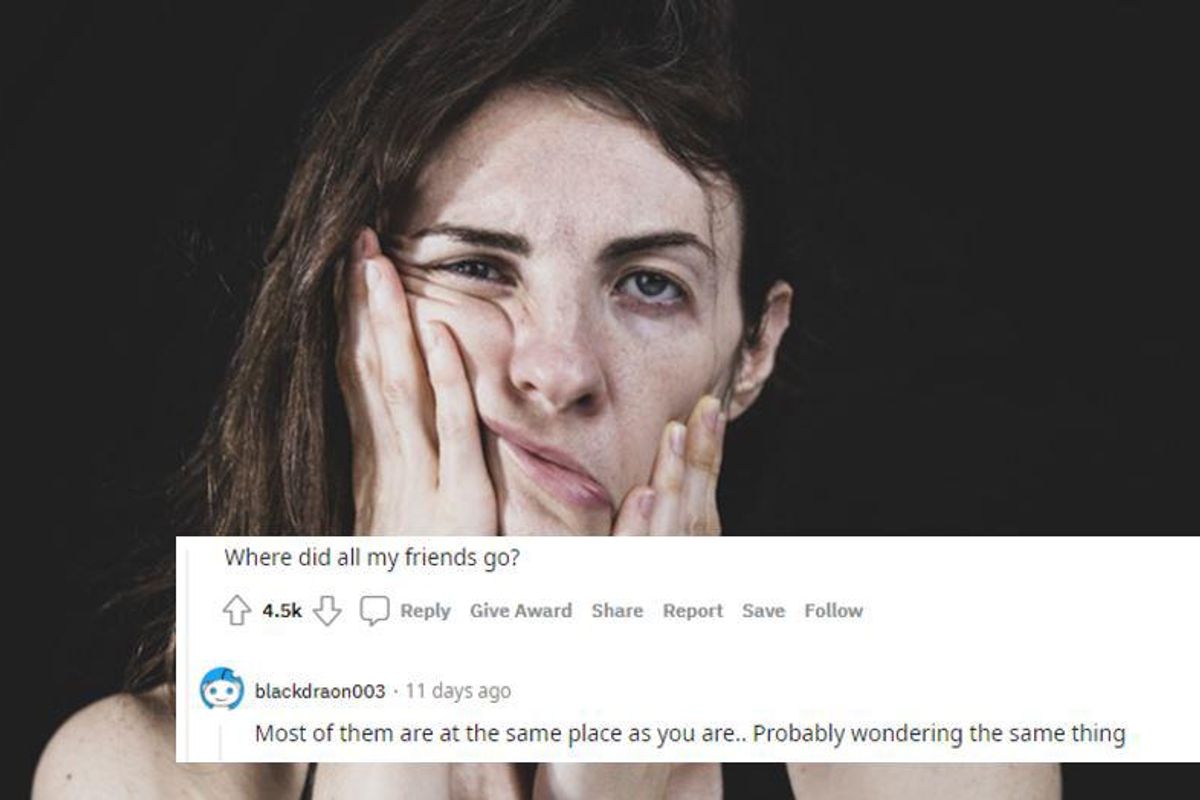
"Where did all my friends go?" — I_Love_Small_Breasts

Most of them are at the same place as you are ... Probably wondering the same thing," — Blackdraon003

4. Bodily changes

"I'm closer to fifty than forty, would have been nice to be better prepared for some of the ways your body starts to change at this point that don't normally get talked about. For instance your teeth will start to shift from general aging of your gums," — dayburner.

5. People don't change

"Didnt know that other adults have the emotional intelligence of teenagers and its almost impossible to deal with logically," — Super-Progress-6386

6. Money

"$5K is a lot to owe, but not a lot to have," — Upper-Job5130

7. Our parents age, too

"Handling the decline and death of your parents," - Agave666

8. Free time

"Not having a lot of free-time or time by myself," — detective_kiara

9. No goals

"Not having a pre-defined goal once I was out of college. Growing up my goals were set for me: get through elementary school! then middle school! Then high school, and get into college and get a degree, then get a job, and then...? Vague "advance in your career, buy a house, find a spouse, have a kid or multiple, then retire." At 22 I had no idea how to break that down more granularly," — FreehandBirdlime

10. Constant upkeep

"Life is all about maintenance. Your body, your house, your relationships, everything requires constant never ending maintenance," — IHateEditedBGMusic

11. Exhaustion

"Being able to do so many things because I'm an adult but too tired to do any of them," — London82

12. Loneliness

"Being an adult feels extremely lonely," — Bluebloop0

13. Dinner

"Having to make dinner every. Fucking. Day," — EndlesslyUnfinished

14. Time changes

"The more life you’ve lived, the faster time seems to go," — FadedQuill

15. You're responsibile, even if you didn't mean it

"You are held to account for bad behaviour for which you are negligent even if you had no intention to cause harm. As a lawyer, I see this all the time. People don't think they're responsible for mistakes. You are," — grishamlaw

16. Work is like high school

"The intricacies of workplace politics," — Steve_Lobsen writes. "

"When you're in school, you think that you won't have to deal with gossiping and bullying once you leave school. Unfortunately, that is not true," — lady_laughs_too_much

17. Nowhere to turn

"How easy it is to feel stuck in a bad situation (job, relationship, etc) just because the cost and effort of getting out can seem daunting. And sometimes you just have to accept a figurative bowl full of shit because you can't afford to blow up your life," — movieguy95453

18. The happiness question

"Figuring out what makes you happy. Everyone keeps trying to get you to do things you're good at, or that makes you money, but never to pursue what you enjoy," — eternalwanderer5

19. Constant cleaning

"The kitchen is always dirty. You’ll clean it at least three times every day," — cewnc

20. Life costs money

"One adult problem nobody prepared me for is how expensive everything is. I always thought that as an adult I would be able to afford the things I wanted, but it turns out that's not always the case! I've had to learn how to budget and save up for the things I want, and it's been a difficult process," — Dull_Dog_8126

21. Keeping above water

"All of it together. I was relatively warned about how high rent is, car bills and repairs, how buying healthy food is expensive as hell but important for your health, how to exercise and save what you can, my parents did their best to fill in my knowledge about taxes and healthcare and insurance that my schooling missed, about driving and cleaning a household, about setting boundaries at work but working hard and getting ahead if you can, about charity and what it means to take care of a pet and others, about being a good partner if you were lucky enough to have one, about how dark and messed up the world is when you just read the news and what all that means to me and my community… I was reasonably warned about all of it.

"No one could have ever prepared me for how hard doing all of it at the same time and keeping your head above that water would actually be," — ThatNoNameWriter


This article originally appeared two years ago.

old letter, 1959, tony trapani, letter, secret letters, love letter, love stories, dads, fatherhood, father and son, parents, parenting
via SHVETS production/Pexels and Suzy Hazelwood/Pexels
Tony Trapani discovers a letter his wife hid from him since 1959.

Writing a letter is truly a lost art form, and many young people will never know the joy of it. You had to choose your words carefully and say everything you wanted to say. Once you sent it off, there was no way to be sure it was delivered. No way to know if it had been opened or read. You couldn't take it back or send it again. You just put it in the mailbox and hoped for the best. It was excruciating and magical all at the same time.

One story of a letter never delivered has captured the hearts of readers everywhere. A heart-warming local news story gone viral for the best reasons.


Tony Trapani and his wife were married for 50 years despite the heartache of being unable to have children. "She wanted children,” Trapani told Fox 17. "She couldn't have any. She tried and tried." Even though they endured the pain of infertility, Tony's love for his wife never wavered and he cherished every moment they spent together.

letter, secret letters, love letter, love stories, dads, fatherhood, father and son, parents, parenting Tony Trapani received the most important letter of his life, but he didn't see it for 50 years Photo by Álvaro Serrano on Unsplash

After his wife passed away when Tony was 81 years old, he undertook the heartbreaking task of sorting out all of her belongings. In particular was a mountain of papers stuffed into filing cabinets. Trapani diligently went through every single one.

That’s when he stumbled upon a carefully concealed letter in a filing cabinet hidden for over half a century.

The letter was addressed to Tony and dated March 1959, but this was the first time he had seen it. His wife must have opened it, read it and hid it from him. The letter came from Shirley Childress, a woman Tony had once been close with before his marriage. She reached out, reminiscing about their past and revealing a secret that would change Tony's world forever.

"Dear Tony, I bet you are surprised to hear from me after so many years. I was just thinking about you tonight like so many other nights. But I thought I would write you and find out how you are," the letter reads. "Tony, please don't be angry or surprised to hear this. I have a little boy. He is five-years- old now - grey eyes and beautiful black hair. What I am trying to say Tony is he is your son."


"Please, Tony if you can find it in your heart to forgive me, please come and see him," Shirley wrote in the letter. "Every day he asks me where is his daddy and believe me Tony I can't even answer him anymore. I would be forever grateful to you if you would just see him. ... I'll close now hoping and praying you will answer. P.S. His name is Samuel Duane."

Now, Tony faced the fact that he had a son that would be around 60 years old and he set out to find him.

For over a year, Trapani’s sister tried to track down the mysterious Samuel Duane Childress, until she finally contacted his wife, Donna.

Tony and Samuel met in January 2015 and he felt like a new dad. After meeting his father, Samuel said his mother told him she sent the letter, but Tony never responded. "Why my wife didn't tell me," said Trapani, "I don't know. She wanted children. She couldn't have any. She tried and tried."

It's easy to understand why it may have been hard for Trapani's late wife, Dolly, to pass along that sort of news. Though we'll never know what exactly must have been in her heart and mind when she hid the letter all those years ago.

"I always asked my mom, I said, 'Well what does he look like?'' Samuel said. "She said, 'Well, go look in the mirror."

The two met and caught up on a lifetime of memories with the understanding that they could never change the past. "Just to know him now is so important to me. It's going to fill that void," Samuel said.

But just to be sure, Tony took a paternity test to ensure they were father and son. Stunning everyone involved, the test came back negative. Tony was not the father.


letter, secret letters, love letter, love stories, dads, fatherhood, father and son, parents, parenting Tony and Samuel didn't waste time thinking about what might have been if he'd seen the letter earlier. Photo by Ire Photocreative on Unsplash

The news upset Tony and Samuel, but they still had a unique bond. They shared a relationship with Samuel’s mother and both have been on an incredibly wild ride after Tony found the mysterious letter.

“They're keeping that bond,” Donna said. “That paper doesn't mean anything to him. That bond has been made—and we're going to move on from here.”

Tony Trapani passed away in 2017, leaving him just two short years to connect with the man he once believed to be his son. If he'd seen the letter earlier, maybe they would have had more time. But that's all in the past, and by all accounts the men treasured the time they got together, and the relationship that they did have — not the one they wished for.

This article originally appeared earlier this year. It has been updated.

death, dying, hospice, fear of dying, hospice nurse, mortality, aging, seniors, spirituality, visions, visioning
via Canva Photos

A nurse explains how 'visioning' 3-4 weeks before death works.

Death is something, like it or not, we all must face. It's the final mystery, and it's totally normal to feel scared of the impending process. Experts say a few things can help, including using our fear to live a purposeful life and even making jokes, or using 'gallows humor'. One bit of good news is that we tend to get a little bit less afraid of death as we age. But in general, it helps to not shy away from death completely. Learning and talking about it is actually a good thing.

A new video by a hospice nurse shows an excellent reason for people to feel comfortable facing the unknown. Julie McFadden posts videos helping to demystify the dying process and bring comfort to people with a loved one in hospice care, or who may be dying themselves. Her profile reads, "Helping understand death to live better and die better." McFadden is also the author of the bestselling book, “Nothing to Fear.”


Hospice Nurse Julie has earned over half a million subscribers and has witnessed over a hundred deaths. In a recent video, she reveals that people are often comforted by friends and relatives who have passed away in their final days.

She says that when people begin experiencing these visions, it’s a sign that they will be passing away within a few weeks.

"Here's one sign that someone is close to death that most people don't believe happens,” Julie begins the video.

- YouTubewww.youtube.com

"Usually a few weeks to a month before someone dies, if they're on hospice, they will start seeing dead loved ones, dead relatives, dead pets. This happens so often that we actually put it in our educational packets that we give to patients and their families when they come on hospice so they aren't surprised or scared when it happens,” she continues.

The experience is called visioning; although no one knows how or why it happens, it’s common among all her patients.

"We don't know why it happens, but we see it in definitely more than half of our patients," she continues.

People often believe that the visions are caused by a lack of oxygen to the brain. However, Julie says that isn’t true. “Because when it does happen, most people are alert and oriented and are at least a month from death, so they don't have low oxygen," she said.

The good news is that the visioning experience is almost always comforting for those who are nearing the end.


death, dying, hospice, fear of dying, hospice nurse, mortality, aging, seniors, spirituality, visions Dying patients may be visited 3-4 weeks before death by loved ones, deceased spouses, or even dead pets. Photo by Anirudh on Unsplash

It often involves relatives who 'come from the other side' to let them know everything will be okay and encourage them to let go and pass away. People also experience being taken on journeys with loved ones or having sensory experiences from the past, such as smelling their grandmother's perfume or father’s cigar.

These visitors can also appear several at a time. Patients might report the room feeling 'crowded' like they are being joined by many people at once. It's possible they may be visited by 'spirits' or people they don't know, though that's less common.

Christopher Kerr, a CEO of Hospice & Palliative Care, an organization that provides palliative care in Buffalo, New York, says that the relatives that often appear in these visions are people who protected and comforted the dying parent when they were alive. So, they may see a parent who nurtured them but not one they feared.

Kerr has extensively studied the mysterious phenomena that happen when people die but has no real explanation for why the visioning experience happens. “I have witnessed cases where what I was seeing was so profound, and the meaning for the patient was so clear and precise, that I almost felt like an intruder,” he told BBC Brazil. “And trying to decipher the etiology, the cause, seemed futile. I concluded that it was simply important to have reverence, that the fact that I could not explain the origin and process did not invalidate the experience for the patient.”

In a more in-depth video, Hospice Nurse Julie shares a real video of a dying woman experience visioning. It's extremely powerful:

- YouTubewww.youtube.com

Again, experts agree that once your loved one begins experiencing these visions, it's likely that they will pass on in the next 3-4 weeks. Remember that they are not a symptom to be treated or a concern to be addressed, as long as they aren't causing distress. They are simply a comforting sign of things to come.

It's comforting to know that for many, the final days of life may not be filled with pain and fear but instead with a sense of peace and joy. While we may never fully understand the reasons behind these mysterious visions, if they bring calm during such a daunting time, we can simply be grateful for their presence. They’re kind of like life, in general. In the end, we may not really know what it was all about, but we can be happy that it happened.

This article originally appeared last year. It has been updated.

time off requests, pto, sick leave, gen z manager, manager positions, asking for time off

This Manager thinks PTO is for vacation, not "life changing events."

What does it take to be a good boss? You can answer this a million different ways—by being a clear communicator, earning employee trust, providing constructive feedback, and fostering a positive and supportive work environment while also being open to feedback and recognizing your team's contributions—but really, it all seems to stem from respecting your employees as fellow human beings.

Part of that means acknowledging that these employees have lives that are, frankly, more important to them than the job, and not penalizing them for it. One manager, and Gen Zer no less, seems to fully understand this basic principle, and folks are applauding her for it.


Elizabeth Beggs, who manages a five-person team for a packaging distribution company in Virginia, recently made a TikTok sharing which time-off requests she “rejects. ”You’ll see why “rejects” is in quotes shortly.

One example: when a female rep notified Beggs that she was likely having a miscarriage. After the team member asked how she can file for time off to see to the issue, Beggs immediately responded, “Girl, go to the doctor! We’re not submitting time off for that!”

In Beggs’ mind, PTO is for “vacation,” not medical emergencies. What a concept.

@bunchesofbeggs

Edited to clarify- 1. My team is all salary. 2. These examples are not all recent or from my current position. 3. My team works hard and hits thier KPIs above and beyond. Time off is meant to recharge and be used how you need it, not to handle life changing events #mangers #corporate #genzmanagers #sales #vetstocorporate #veterans

Beggs went on to explain a couple more situations, like when one employee—a parent—was “up all night” with their sick kid. And her last one wasn’t even negative—she had an employee who wanted to work a half-day to do something nice for their anniversary.

“Seriously, if any of these triggered anyone, then you need to evaluate how you run your team as a manager,” she concluded.

By and large, the response to Beggs’ management style has been overwhelmingly positive, and people seem to find it completely refreshing.

“You are not a manager, you’re a LEADER,” one person wrote.

@bunchesofbeggs

Everything you do should be to better your team, not to make your life easier #leadership #ownership #corporatelife #veteran #military

Another said, “The better you treat your employees, the more loyal they will be and the better work they will put out. Most people do not understand how management works.”

A few noted how this attitude seems to be more present among younger leaders. One person commented, "millennial manager here. My team members are human first, employees second. Like just go do what you want but get the work done too.”

Another joked that “Boomer managers could NEVER.”

Beggs would later clarify this doesn’t mean she doesn't have clear productivity expectations for her team (who work on salary). Perhaps if she had a team member not making their KPIs (key performance indicators), there would be an additional conversation surrounding time off, but there is still an inherent respect as a fellow human being. Which, to her, means treating bona fide time off as a way to “recharge and be used how you need it, not to handle life changing events.”

@bunchesofbeggs

If you’re planning does not account for people being human- it’s bad planning #genzleaders #armyvet #militaryvet #genz #corporatelife #corporate #manager #timeoff

Younger generations might get labeled “lazy” or “entitled,” but they are also the ones fighting to change the status quo so that we all may be treated less like cogs in the machine, and more like actual human beings. Its leaders like Beggs who show that operating in new ways doesn't compromise productivity—it, in fact, enhances it. We might not be able to change the global standard overnight, but we certainly aren’t going to get to a better place without leaders who choose to serve their community rather than a bottom line.

This article originally appeared in March.

Community

Uber driver with Tourette's goes viral sharing her unforgettable interactions with riders

"Honesty, humor, and human connection can change the way the world sees Tourette’s."

uber driver, passenger, ride share, tourette syndrome

A woman drives an Uber. A passenger gets in.

Not all heroes wear capes, but some do drive Uber. Jeanna DiVietro is one such hero who has a big laugh, infectious positivity, and the ability to be so vulnerable that she puts many of her passengers at ease. In fact, some seem to become "unexpected friends" in just five minutes flat.

The thing is, DiVietro has Tourette Syndrome, which presents in tics, both physical and vocal. Rather than letting that be a barrier for her, she uses it as a way to educate others. With the rider's permission, of course, she films the interactions and shares them on social media to reach a larger audience.


And she's simply delightful while doing it. In many videos, she has at least one passenger sitting in the front seat and explains to them that she has Tourette Syndrome. In one clip, there's a woman up front when one of DiVietro's tics causes her to scream. They both wind up laughing, with the passenger exclaiming, "This is the best Uber ride ever!" Our driver responds, "Oh yay, I'm so excited!" This is followed by the yelling of "Wh--e!" and again they both laugh. "You're not a wh--e," she assures the rider, who jokingly quips back, "I might be!"

Here's where DiVietro begins to educate. She shares, "I've always had a great attitude with Tourette Syndrome. I just want to help other people have a good attitude too. So that way they can accomplish things that they never thought they were ever able to accomplish. Look at me, I'm an Uber driver, traveling nationwide. I'm also a photographer." She then screams, "Click click b---h!" to which our understanding passenger laughs, "Did you get the picture? Was it my good side?"

The comments are completely understanding and supportive. This clip alone has nearly half a million likes and thousands of comments. One person suggests, "She needs a full-on SERIES!"

Another admits, " This is an Uber ride I would love! My husband says I'm not supposed to laugh, it's rude. Is it considered rude? Because this is hilarious." DiVietro puts her at ease, writing, "No it's not rude, because I too am laughing!"

One person even asks, "Wait are you the lady who picked up a passenger who also had Tourette's? That was the best video!" DiVietro answers, "Yes I am and thank you!"

It turns out the clip in question involved a man in Evansville whom she notes did not, in fact, have the disorder but was "playing along." But, she shares, she "was not offended one bit." They seemed to have an ultimate blast.

Another heartwarming clip shows DiVietro, having presumably explained that she has Tourette Syndrome to a young man, laughing uproariously when he mishears "Tourette's" it as "T-Rex." "I need to Google 'how do I help T-Rex?'" She then explains the correct word, which leads them to finding their inner dinosaurs and roaring a few times.

The passenger tells her that he's a rapper (CEO DEE) and she's incredibly supportive, immediately asking where she can listen to his music. Once again, the comment section doesn't disappoint. They link to his Instagram and share it with DiVietro.

Others in the comments focus on the dinosaur of it all. "This is so funny. The dinosaur impersonation took me out." Another notes that is seems to be a lovely plutonic connection "What do you get when you put a guy with the munchies and a female "t-rex" in the same car? A beautiful friendship."

Currently, there's a fan-funded documentary in the making. According to DiVietro's website, it will document her life in and out of Uber across the South and the Midwest. "This isn’t just a road trip. It’s a movement to show that honesty, humor, and human connection can change the way the world sees Tourette’s."

As exemplified by DiVietro's vocal tics, Tourette's is one type of tic disorder. According to their informational website Tourette.org, it's "a neurodevelopmental disorder that affects children, adolescents and adults. The condition is characterized by sudden, involuntary movements and/or sounds called tics. Tics can range from mild/inconsequential to moderate and severe, and are disabling in some cases."

Tourette Syndrome is explained. www.youtube.com, Tourette Association of America

DiVietro doesn't let this disorder define her. On the contrary, she uses it to sparkle and clearly make beautiful connections. The hope is that she is able to inspire others to do the same.

time, neil degrasse tyson, time flies, perception of time. clock, science,

A clock and Neil deGrasse Tyson.

When you’re a kid, time passes a lot more slowly than when you’re an adult. At the age of seven, summer seems to go on forever, and the wait from New Year’s Day to Christmas feels like a decade. As an adult, time seems to go faster and faster until one weekend you’re putting up your Christmas lights though you swear you just took ‘em down a month ago.

Why does time seem to speed up as we get older? Astrophysicist Neil deGrasse Tyson recently explained the phenomenon in a video posted to Instagram. He also offered tips on how to slow the passage of time as you age. DeGrasse Tyson is one of the most popular science communicators in the world and the host of 2014's Cosmos: A Spacetime Odyssey and 2020’s Cosmos: Possible Worlds.


Why does time appear to speed up as we get older?


“When you're young, everything is new. Your brain is constantly recording fresh memories, and the more memory your brain stores, the longer the experience feels. But then something changes. As you get older, routines take over. Your brain stops saving so much detail. It switches to autopilot because everything feels familiar and predictable,” deGrasse Tyson explains. “And when your brain stores fewer new memories, your perception of time compresses. That's why childhood feels long, and adulthood feels like a blur.”


Steve Taylor, PhD, author of many best-selling books including Time Expansion Experience, The Leap, and Spiritual ScienceThe Leap, and Spiritual Science, agrees with deGrasse Tyson.

“This is mainly because, as children, we have so many new experiences, and so process a massive amount of perceptual information,” Taylor writes at Psychology Today. “Children also have an unfiltered and intense perception of the world, which makes their surroundings appear more vivid. However, as we get older, we have progressively fewer new experiences. Equally importantly, our perception of the world becomes more automatic. We grow progressively desensitized to our surroundings. As a result, we gradually absorb less information, which means time passes more quickly. Time is less stretched with information.”

How do we make time slow down?

There’s something a little depressing about the idea that time speeds up as we age because we have fallen into predictable routines. The good news is that we can break this cycle by changing our habits and having new experiences. The more novel information we can process and the less routine our lives become, the slower time will move.

DeGrasse Tyson believes that with some change in our behaviors, we can get back to longer summers and Christmases that aren’t perpetually around the corner.

“You can actually slow time down again. Do something unfamiliar,” deGrasse Tysons says. "Travel somewhere new. Break a routine you've repeated for years. Learn a skill your brain hasn't mapped yet. Because the more new memories your brain forms, the slower time feels as it passes. So if life feels like it's accelerating, it's not your age. It's your brain, and you can reboot it.”