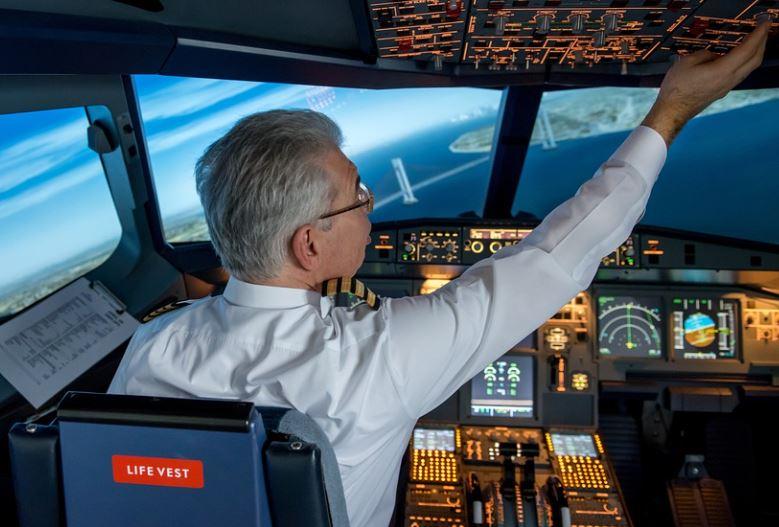
Experienced 747 pilot reveals the worst time of day for anxious people to fly
The less turbulance, the better.

A pilot flying over New York City.
It’s normal to get a little nervous before boarding an airplane. Hurtling through the air at 600 miles per hour, 30,000 feet off the ground isn't a natural human experience. According to Stratos Jet Charters, up to 40% of all people experience some anxiety when it comes to flying.
The good news is that they have little reason to be afraid. Only one in 20 million flights result in a passenger’s death. Whereas the average American's lifetime odds of dying in a car crash are 1 in 101.
I think that solves the "Should we fly or drive?" debate.
But if you still are more afraid of traveling on a plane than the ride in a taxi to the airport, here’s something to ease your mind. If you want to avoid turbulence, book a flight in the morning. “The heating of the ground later causes bumpier air, and it’s much more likely to thunderstorm in the afternoon,” Jerry Johnson, a pilot from Los Angeles, told Reader's Digest.
If you experience turbulence, there’s no need to worry; planes are designed to handle changes in air currents. The only time to be concerned about turbulence is if you’re standing on the plane and could fall while walking back to your seat or waiting in line for the bathroom.
Travelers looking for the smoothest place to sit on a plane should choose a seat near a wing. “The bumpiest place to sit is in the back. A plane is like a seesaw. If you’re in the middle, you don’t move as much,” pilot Patrick Smith told Reader's Digest.
On the ultra-rare occasion of a plane crash, the safest spot to sit is the emergency exit. "Always offer to sit by the emergency exits because—as long as you're able-bodied—I think probably the best seats are the ones closest to the exits,” 747 pilot Nick Eades told LADbible.
"Then if there is an abandoned take-off [or] there is catastrophic failure, you can either help people out or be the first to get out of the airplane yourself. You're in a very good position,” Eades continued. "It's common sense, if you think about it."
If the anxiety you feel around flying has more to do with cost than personal safety, a scientific study found that prices are usually at their lowest three weeks to two months before a flight, with average prices hitting rock bottom 44 days before departure.
“Prices will be lowest three to six weeks before your trip, rising rapidly in the last three weeks before departure date,” deal-finding site Hopper told Forbes.
But if you’re going to book your flight outside of that window, sooner is a lot worse than farther out. “Travelers who wait to book their flights within three weeks of travel dates can risk paying double, or even triple the amount,” CheapAir.com wrote in its Annual Flight Report. “If you have an emergency or unexpected trip, you’ll likely pay about $150 more than you would if you shopped in the prime booking window.”






a man sitting at a desk with his head on his arms Photo by
Can a warm cup of tea help you sleep better? If you believe it, then yes. Photo by 
A woman is getting angry at her coworker.via
A man with tape over his mouth.via
A husband is angry with his wife. via 
Three women sit on a blanket in the park. 
Two women engaging in a pleasant conversation inside a coffee shop
Two men engaging in a peaceful disagreement.
Resurfaced video of French skier's groin incident has people giving the announcer a gold medal
"The boys took a beating on that one."
Downhill skiing is a sport rife with injuries, but not usually this kind.
A good commentator can make all the difference when watching sports, even when an event goes smoothly. But it's when something goes wrong that great announcers rise to the top. There's no better example of a great announcer in a surprise moment than when French skier Yannick Bertrand took a gate to the groin in a 2007 super-G race.
Competitive skiers fly down runs at incredible speeds, often exceeding 60 mph. Hitting something hard at that speed would definitely hurt, but hitting something hard with a particularly sensitive part of your body would be excruciating. So when Bertrand slammed right into a gate family-jewels-first, his high-pitched scream was unsurprising. What was surprising was the perfect commentary that immediately followed.
This is a clip you really just have to see and hear to fully appreciate:
- YouTube youtu.be
It's unclear who the announcer is, even after multiple Google inquiries, which is unfortunate because that gentleman deserves a medal. The commentary gets better with each repeated viewing, with highlights like:
"The gate the groin for Yannick Bertrand, and you could hear it. And if you're a man, you could feel it."
"Oh, the Frenchman. Oh-ho, monsieurrrrrr."
"The boys took a beating on that one."
"That guy needs a hug."
"Those are the moments that change your life if you're a man, I tell you what."
"When you crash through a gate, when you do it at high rate of speed, it's gonna hurt and it's going to leave a mark in most cases. And in this particular case, not the area where you want to leave a mark."
Imagine watching a man take a hit to the privates at 60 mph and having to make impromptu commentary straddling the line between professionalism and acknowledging the universal reality of what just happened. There are certain things you can't say on network television that you might feel compelled to say. There's a visceral element to this scenario that could easily be taken too far in the commentary, and the inherent humor element could be seen as insensitive and offensive if not handled just right.
The announcer nailed it. 10/10. No notes.
The clip frequently resurfaces during the Winter Olympic Games, though the incident didn't happen during an Olympic event. Yannick Bertrand was competing at the FIS World Cup super-G race in Kvitfjell, Norway in 2007, when the unfortunate accident occurred. Bertrand had competed at the Turin Olympics the year before, however, coming in 24th in the downhill and super-G events.
As painful as the gate to the groin clearly as, Bertrand did not appear to suffer any damage that kept him from the sport. In fact, he continued competing in international downhill and super-G races until 2014.
According to a 2018 study, Alpine skiing is a notoriously dangerous sport with a reported injury rate of 36.7 per 100 World Cup athletes per season. Of course, it's the knees and not the coin purse that are the most common casualty of ski racing, which we saw clearly in U.S. skier Lindsey Vonn's harrowing experiences at the 2026 Olympics. Vonn was competing with a torn ACL and ended up being helicoptered off of the mountain after an ugly crash that did additional damage to her legs, requiring multiple surgeries (though what caused the crash was reportedly unrelated to her ACL tear). Still, she says she has no regrets.
As Bertrand's return to the slopes shows, the risk of injury doesn't stop those who live for the thrill of victory, even when the agony of defeat hits them right in the rocks.