upworthy
Add Upworthy to your Google News feed.
Google News Button
Family

Dad writes heartbreaking message after the death of his son

"Hug your kids. Don’t work too late. "

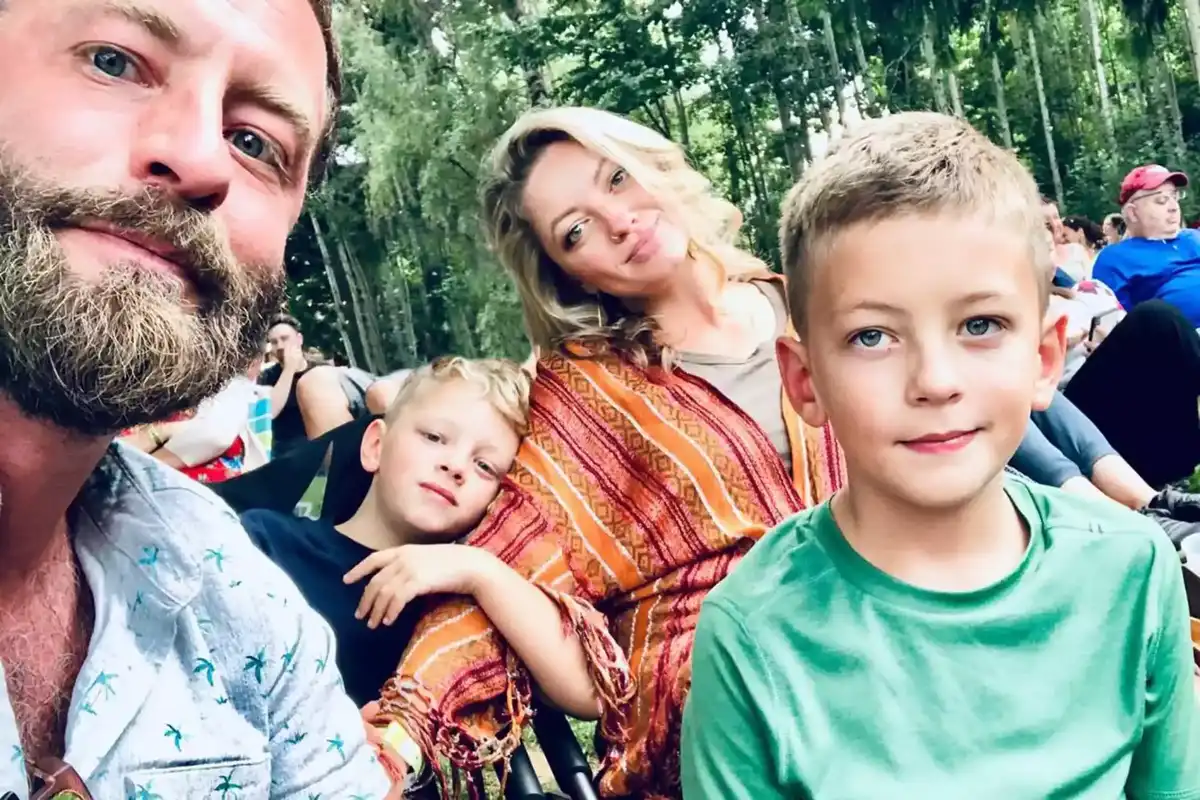
Young family takes a photo outside

J.R. Storment and his family.

A dad from Portland, Oregon, has taken to LinkedIn to write an emotional plea to parents after he learned that his son had died during a conference call at work. J.R. Storment encouraged parents to spend less time at work and more time with their kids after his son's death.

In his open letter posted on September 3, 2019, Storment explains that his son, Wiley, passed away during his sleep as a result of complications from his mild epilepsy. He then goes on to blast himself for not spending enough time with his son, and encourages other parents to take more time off work.

Young family takes photo in the snow

J.R. Storment and his family

via Facebook

Storment starts by explaining that the day his son passed away started like any other:

"Eight years ago, during the same month, I had twin boys and co-founded Cloudability. About three months ago Cloudability was acquired. About three weeks ago we lost one of our boys."

"When I got the call I was sitting in a conference room with 12 people at our Portland office talking about PTO policies. Minutes earlier, I had admitted to the group that in the last 8 years I'd not taken more than a contiguous week off."

That's when Storment received a call from his distraught wife.

"My wife and I have an agreement that when one of us calls, the other answers. So when the phone rang I stood up and walked to the conference room door immediately."

"I was still walking through the door when I answered with 'Hey, what's up?'"

"Her reply was icy and immediate: 'J.R., Wiley is dead.'"

"'What?' I responded incredulously."

"'Wiley has died.' she reiterated."

"'What?! No.' I yelled out, 'No!'"

"'I'm so sorry, I have to call 911.'"

Storment goes on to explain the chaos that happened next.

"That was the entire conversation. The next thing I know I'm sprinting out the front door of the office with my car keys in hand, running ferociously across the street and muttering 'oh F**k. oh F**k. oh F**k.' Half way down the block I realize I don't have the opener to my parking garage. Running back into the lobby, I all but shout "Someone drive me! Somebody drive me!" Thankfully, a helpful colleague did."

Storment made it home, but not yet knowing the cause of death, police were treating the house as a possible crime scene. The heartbroken father was unable to see his son for two and a half hours.

"When the medical examiner finally finished his work, we were allowed in the room. An eerie calm came over me. I laid down next to him in the bed that he loved, held his hand and kept repeating, 'What happened, buddy? What happened?'"

"We stayed next to him for maybe 30 minutes and stroked his hair before they returned with a gurney to take him away. I walked him out, holding his hand and his forehead through the body bag as he was wheeled down our driveway. Then all the cars drove away. The last one to leave was the black minivan with Wiley in it."
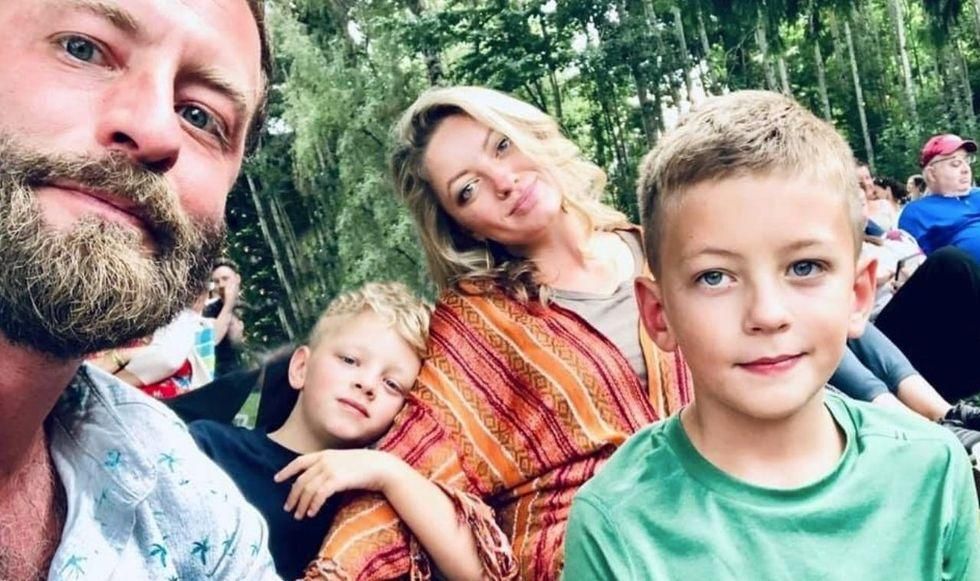
Young family takes photo outside.

J.R. Storment with his wife and sons.

via LinkedIn

Storment goes on to explain his son's dreams and aspirations, and the difficulty he had signing his son's death certificate.

"Wiley was obsessed with starting a business. One day it was a smoothie stand, the next it would be a gallery, then a VR headset company, then a 'coder', then a spaceship building company. In each of these scenarios he was the boss. His brother (and sometimes us) were invited to work for—not with— him and were each assigned jobs. In the gallery scenario, Wiley informed Oliver that he would be manning the cash register."

"Around 5 years old, Wiley decided he was going to get married as an adult. By 6 he had identified the girl, holding her hand at recess on the first day of kindergarten. Over the next two years as we moved from Portland to London to Hawaii, he kept in touch with her by handwritten letter. Not long before we moved back to Portland, the two agreed (by letter) to marry. She beat him to the punch and asked him. He accepted. Happily, he got to see her twice after we moved back to Portland in June."

"One of the countless difficult moments of this month was signing his death certificate. Seeing his name written on the top of it was hard. However, two fields further down the form crushed me. The first said: 'Occupation: Never worked' and the next: 'Marital Status: Never married.' He wanted so badly to do both of those things. I feel both fortunate and guilty to have had success in each."
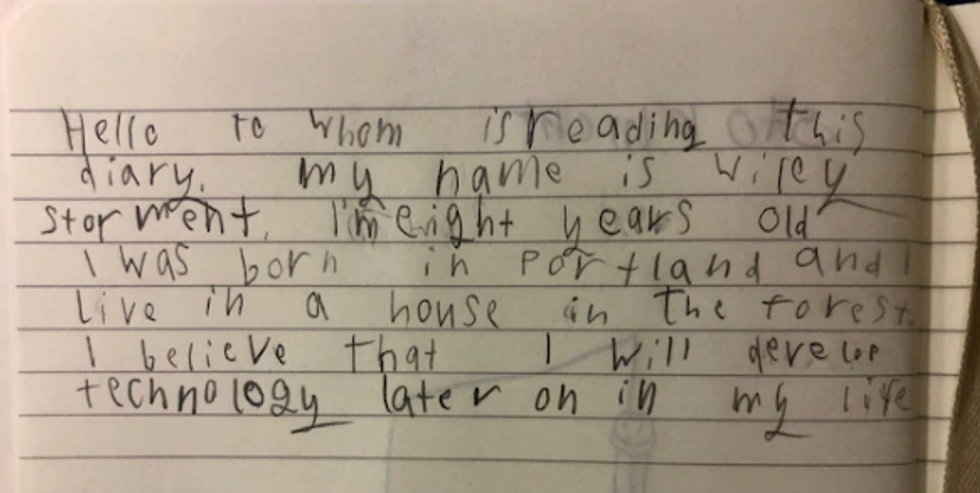
A handwritten diary entry

Wiley wrote his plans down in his diary.

via LinkedIn

Storment then criticises himself for spending too much time at work. And while it sounds that Wiley got to live an amazing life, Storment only wishes he could have done more with him.

"Over the last three weeks I have come up with an endless stream of things I regret. They tend to fall into two categories: things I wish I had done differently and things I'm sad not to see him do. My wife is constantly reminding me of all the things he did do: Wiley went to 10 countries, drove a car on a farm road in Hawaii, hiked in Greece, snorkeled in Fiji, wore a suit to a fantastic British prep school every day for two years, got rescued from a shark on a jet ski, kissed multiple girls, got good enough at chess to beat me twice in a row, wrote short stories and drew comics obsessively."

Storment hadn't checked on the boys the morning of the tragedy because he had to get up early for meetings, a decision he seems to regret.

"Around 5:40am, the next morning I woke up for a series of back to back meetings. I did a Peloton ride, took an analyst call from my home office, one with a colleague on the drive to work, then the rest at the office. None seem that important now. I left that morning without saying goodbye or checking on the boys."
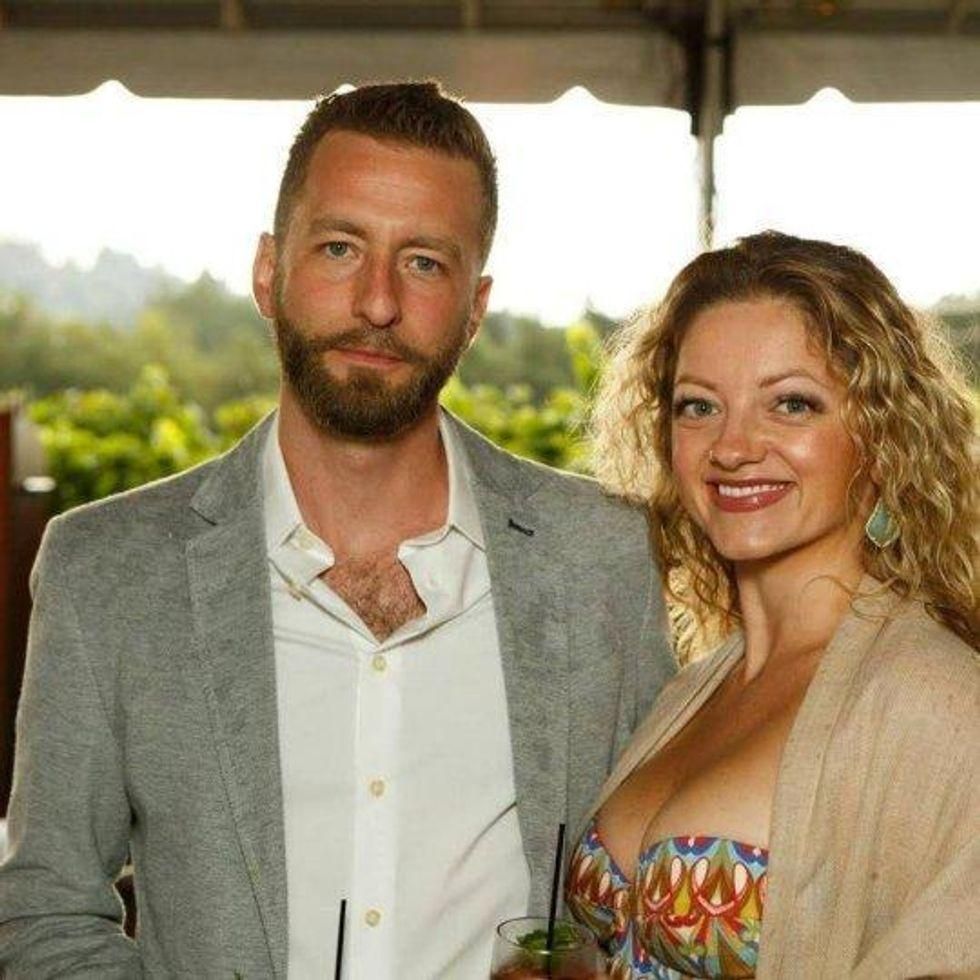
A couple smile for a photo

J.R. Storment and his wife.

Via Facebook

Storment has a simple message for parents:

"Many have asked what they can do to help. Hug your kids. Don't work too late. A lot of the things you are likely spending your time on you'll regret once you no longer have the time. I'm guessing you have 1:1 meetings on the books with a lot of people you work with. Do you have them regularly scheduled with your kids? If there's any lesson to take away from this, it's to remind others (and myself) not to miss out on the things that matter."

"The big question is how to return to work in a way that won't leave me again with the regrets I have now. To be honest, I've considered not going back. But I believe in the words of Kahlil Gibran who said, 'Work is love made visible.' To me, that line is a testament to how much we gain, grow and offer through the work we do. But that work needs to have a balance that I have rarely lived. It's a balance that lets us offer our gifts to the world but not at the cost of self and family."

"While I sat writing this post, my living son, Oliver, came in to ask for screen time. Instead of saying the usual 'no', I stopped writing and asked if I could play with him. He was happily surprised by my answer and we connected in a way I would have formerly missed out on. Small things matter. One silver lining from this tragedy is the improving relationship I have with him."

"Our family has gone from having two units of two (the parents and the twins) to now being a triangle of three. That's a big adjustment for a family that has always been four. Oliver's brilliant reply when we discussed the shape of our new family: 'But Papa, the triangle is the strongest shape.' By some sad and beautiful irony, Oliver has met three sets of 8-year-old twins in our new neighborhood since Wiley passed."

"I've learned to stop waiting to do the things the kids ask for. When we sold the business I gave each of the boys a $100 dollar bill. They decided to pool their money to buy a tent for camping. But we didn't make it happen before Wiley died. Another regret. So, after the first round of family visits after his death, I took Jessica and Oliver to REI to get gear and we left town quickly to camp near Mt. St. Helens."

"Somehow, we got to the wilderness without enough cash to cover the campground fee and had a slight panic. Jessica then realized that Wiley's $100 bill was still in his seat pocket. He got to spend his money on camping after all. Collectively, the family said a big, 'Thanks, buddy' out-loud to him. It was one of many bittersweet moments we will experience for the rest of our lives. Each happy time brings with it the sadness that he doesn't get to experience it."

"One of Wiley's happy times was listening to music and dancing. Damn, could that kid dance. He loved the Oregon Country Fair and the year before we left for London, we listened to a band there play a version of 'Enjoy yourself (It's later than you think)'. The words stuck with me that day three years ago and painfully so now:"


"You work and work for years and years, you're always on the go

You never take a minute off, too busy makin' dough

Someday, you say, you'll have your fun, when you're a millionaire

Imagine all the fun you'll have in your old rockin' chair

Enjoy yourself, it's later than you think

Enjoy yourself, while you're still in the pink

The years go by, as quickly as a wink

Enjoy yourself, enjoy yourself, it's later than you think"


This article originally appeared four years ago.

old letter, 1959, tony trapani, letter, secret letters, love letter, love stories, dads, fatherhood, father and son, parents, parenting
via SHVETS production/Pexels and Suzy Hazelwood/Pexels
Tony Trapani discovers a letter his wife hid from him since 1959.

Writing a letter is truly a lost art form, and many young people will never know the joy of it. You had to choose your words carefully and say everything you wanted to say. Once you sent it off, there was no way to be sure it was delivered. No way to know if it had been opened or read. You couldn't take it back or send it again. You just put it in the mailbox and hoped for the best. It was excruciating and magical all at the same time.

One story of a letter never delivered has captured the hearts of readers everywhere. A heart-warming local news story gone viral for the best reasons.


Tony Trapani and his wife were married for 50 years despite the heartache of being unable to have children. "She wanted children,” Trapani told Fox 17. "She couldn't have any. She tried and tried." Even though they endured the pain of infertility, Tony's love for his wife never wavered and he cherished every moment they spent together.

letter, secret letters, love letter, love stories, dads, fatherhood, father and son, parents, parenting Tony Trapani received the most important letter of his life, but he didn't see it for 50 years Photo by Álvaro Serrano on Unsplash

After his wife passed away when Tony was 81 years old, he undertook the heartbreaking task of sorting out all of her belongings. In particular was a mountain of papers stuffed into filing cabinets. Trapani diligently went through every single one.

That’s when he stumbled upon a carefully concealed letter in a filing cabinet hidden for over half a century.

The letter was addressed to Tony and dated March 1959, but this was the first time he had seen it. His wife must have opened it, read it and hid it from him. The letter came from Shirley Childress, a woman Tony had once been close with before his marriage. She reached out, reminiscing about their past and revealing a secret that would change Tony's world forever.

"Dear Tony, I bet you are surprised to hear from me after so many years. I was just thinking about you tonight like so many other nights. But I thought I would write you and find out how you are," the letter reads. "Tony, please don't be angry or surprised to hear this. I have a little boy. He is five-years- old now - grey eyes and beautiful black hair. What I am trying to say Tony is he is your son."


"Please, Tony if you can find it in your heart to forgive me, please come and see him," Shirley wrote in the letter. "Every day he asks me where is his daddy and believe me Tony I can't even answer him anymore. I would be forever grateful to you if you would just see him. ... I'll close now hoping and praying you will answer. P.S. His name is Samuel Duane."

Now, Tony faced the fact that he had a son that would be around 60 years old and he set out to find him.

For over a year, Trapani’s sister tried to track down the mysterious Samuel Duane Childress, until she finally contacted his wife, Donna.

Tony and Samuel met in January 2015 and he felt like a new dad. After meeting his father, Samuel said his mother told him she sent the letter, but Tony never responded. "Why my wife didn't tell me," said Trapani, "I don't know. She wanted children. She couldn't have any. She tried and tried."

It's easy to understand why it may have been hard for Trapani's late wife, Dolly, to pass along that sort of news. Though we'll never know what exactly must have been in her heart and mind when she hid the letter all those years ago.

"I always asked my mom, I said, 'Well what does he look like?'' Samuel said. "She said, 'Well, go look in the mirror."

The two met and caught up on a lifetime of memories with the understanding that they could never change the past. "Just to know him now is so important to me. It's going to fill that void," Samuel said.

But just to be sure, Tony took a paternity test to ensure they were father and son. Stunning everyone involved, the test came back negative. Tony was not the father.


letter, secret letters, love letter, love stories, dads, fatherhood, father and son, parents, parenting Tony and Samuel didn't waste time thinking about what might have been if he'd seen the letter earlier. Photo by Ire Photocreative on Unsplash

The news upset Tony and Samuel, but they still had a unique bond. They shared a relationship with Samuel’s mother and both have been on an incredibly wild ride after Tony found the mysterious letter.

“They're keeping that bond,” Donna said. “That paper doesn't mean anything to him. That bond has been made—and we're going to move on from here.”

Tony Trapani passed away in 2017, leaving him just two short years to connect with the man he once believed to be his son. If he'd seen the letter earlier, maybe they would have had more time. But that's all in the past, and by all accounts the men treasured the time they got together, and the relationship that they did have — not the one they wished for.

This article originally appeared earlier this year. It has been updated.

teacher, student, gifted student, high school class, instruction,

A teacher helping a student.

In the 1960s, psychologist Julian Stanley realized that if you took the best-testing seventh graders from around the country and gave them standard college entry exams, those kids would score, on average, about as well as the typical college-bound high school senior. However, the seventh graders who scored as well or better than high schoolers, Stanley found, had off-the-charts aptitude in quantitative, logical, and spatial reasoning. In other words, they were gifted.

In the 1970s, Stanley and his team launched a full-scale study, identifying many of America's gifted kids and tracking them throughout their lives.

The study, called the Study of Mathematically Precocious Youth never ended and is now more than 50 years in the making. It has followed countless kids from middle school into their careers as some of America's top politicians, scientists, CEOs, engineers, and military leaders. Needless to say, a lot has changed with how students are today compared to 50 years ago.


Stanley passed away in the mid-2000s, but psychologist David Lubinski helped bring the study to Vanderbilt University in the 1990s, where he now co-directs it with Camilla P. Benhow.

It's not a stretch to call this the biggest and most in-depth study on intellectual "precociousness." The results of the study thus far are both fascinating and genuinely surprising—a deeply insightful look into the minds and lives of brilliant children.

students, teachers, classroom, paying attention, school books, class in session A teacher in front of her class.Photo by National Cancer Institute on Unsplash


1. Some of what we used to think about gifted kids turned out to be wrong.

Ever heard the saying "early to ripe, early to rot"? It basically means doing "too much" to foster a kid's special talents and abilities at too young an age could actually cause harm in the long term. That's not even remotely true, at least not according to Lubinski.

That might be an outdated example. But Lubinksi says there are plenty of other misconceptions still alive today, like the idea that gifted kids are so smart that they'll "find a way" to excel even if those smarts aren't nurtured and developed.

Not so fast. "They're kids," he explains. "They need guidance. We all need guidance."


- YouTube www.youtube.com

2. Intelligence is not the same as passion.

Quick, what's the "smartest" career you can think of? Doctor? Scientist?

While you do have to be pretty brilliant to work in medicine or science, those are far from the only career paths gifted kids choose later in life. "Quantitatively, gifted people vary widely in their passions," Lubinski says. Many of the students in the study did end up pursuing medicine, but others went into fields like economics or engineering. Others still were more gifted in areas like logical or verbal reasoning, making them excellent lawyers and writers.

"There are all kinds of ways to express intellectual talent," Lubinski explains.

When it comes to doing what's best for a gifted student, it's just as important for parents and educators to know what the student is passionate about rather than pigeonholing them in traditionally "smart" fields and registering them in a bunch of STEM courses.


students, teachers, classroom, paying attention, school books, class in session Students taking a test.via Canva/Photos

3. Hard work definitely still matters.

Measuring a student's aptitude, their natural abilities, is only one part of the equation when it comes to determining how successful they'll be in life. Aptitude scores can identify a particularly strong natural skill set but tell us very little about how hard that person might work to excel in that field.

Effort, Lubinski says, is a critical factor in determining how far someone will go in life. "If you look at exceptional performers in politics, science, music, and literature, they're working many, many hours," he says. (And for the record, there are a lot more important things in life than just career achievement, like family, friends, and overall happiness.)

The idea that hard work still matters aligns with the 10,000-hour rule, popularized by journalist Malcolm Gladwell in his book Outliers: The Story of Success. The 10,000-hour rule suggests that some of the world's greatest innovators, including Bill Gates, The Beatles, and Robert Oppenheimer, excelled in their endeavors because they had 10,000 hours of practice.


students, teachers, classroom, paying attention, school books, class in session Students around a computer.via Canva/Photos

4. Regardless of aptitude, every kid deserves to be treated as though they were gifted.

The study's focus is specifically on kids within a specific range of intellectual ability, but Lubinski is careful to note that many of its findings can and should be applied to all students. For example, the children in the study who were allowed to take more challenging courses aligned with their skills and interests ultimately achieved more than those who were not afforded the same opportunity.

"You have to find out where your child's development is, how fast they learn, what are their strengths and relative weaknesses and tailor the curriculum accordingly," Lubinski says. "It's what you would want for all kids."

It may sound a bit like a pipe dream, but it's a great starting point for how we should be thinking about the future of education in America.

This article originally appeared eight years ago.

time, neil degrasse tyson, time flies, perception of time. clock, science,

A clock and Neil deGrasse Tyson.

When you’re a kid, time passes a lot more slowly than when you’re an adult. At the age of seven, summer seems to go on forever, and the wait from New Year’s Day to Christmas feels like a decade. As an adult, time seems to go faster and faster until one weekend you’re putting up your Christmas lights though you swear you just took ‘em down a month ago.

Why does time seem to speed up as we get older? Astrophysicist Neil deGrasse Tyson recently explained the phenomenon in a video posted to Instagram. He also offered tips on how to slow the passage of time as you age. DeGrasse Tyson is one of the most popular science communicators in the world and the host of 2014's Cosmos: A Spacetime Odyssey and 2020’s Cosmos: Possible Worlds.


Why does time appear to speed up as we get older?


“When you're young, everything is new. Your brain is constantly recording fresh memories, and the more memory your brain stores, the longer the experience feels. But then something changes. As you get older, routines take over. Your brain stops saving so much detail. It switches to autopilot because everything feels familiar and predictable,” deGrasse Tyson explains. “And when your brain stores fewer new memories, your perception of time compresses. That's why childhood feels long, and adulthood feels like a blur.”


Steve Taylor, PhD, author of many best-selling books including Time Expansion Experience, The Leap, and Spiritual ScienceThe Leap, and Spiritual Science, agrees with deGrasse Tyson.

“This is mainly because, as children, we have so many new experiences, and so process a massive amount of perceptual information,” Taylor writes at Psychology Today. “Children also have an unfiltered and intense perception of the world, which makes their surroundings appear more vivid. However, as we get older, we have progressively fewer new experiences. Equally importantly, our perception of the world becomes more automatic. We grow progressively desensitized to our surroundings. As a result, we gradually absorb less information, which means time passes more quickly. Time is less stretched with information.”

How do we make time slow down?

There’s something a little depressing about the idea that time speeds up as we age because we have fallen into predictable routines. The good news is that we can break this cycle by changing our habits and having new experiences. The more novel information we can process and the less routine our lives become, the slower time will move.

DeGrasse Tyson believes that with some change in our behaviors, we can get back to longer summers and Christmases that aren’t perpetually around the corner.

“You can actually slow time down again. Do something unfamiliar,” deGrasse Tysons says. "Travel somewhere new. Break a routine you've repeated for years. Learn a skill your brain hasn't mapped yet. Because the more new memories your brain forms, the slower time feels as it passes. So if life feels like it's accelerating, it's not your age. It's your brain, and you can reboot it.”

Joy

Pizza guy makes split-second decision that saves a woman's life, then gets best reward possible

His quick-thinking is a perfect example of successful bystander prevention.

joey grundl, pizza guy saves life, milwaukee heroes, heroes, rewards, domino's pizza, bystander prevention, sa, da, domestic abuse, positive news

Joey Grundl, Milwaukee pizza guy.

Editor's Note: This story discusses suicide. If you are having thoughts about taking your own life, or know of anyone who is in need of help, the 988 Suicide & Crisis Lifeline is a United States-based suicide prevention network of over 200+ crisis centers that provides 24/7 service via a toll-free hotline with the number 9-8-8. It is available to anyone in suicidal crisis or emotional distress.

Joey Grundl, who was working as a pizza delivery driver for a Domino's Pizza in Waldo, Wisconsin, was hailed as a hero for noticing a kidnapped woman's subtle cry for help. It's a timeless story that continues to resonate with people today. In 2018, the deliveryman was sent to a woman's house to deliver a pie when her ex-boyfriend, Dean Hoffmann, opened the door. Grundl looked over his shoulder and saw a middle-aged woman with a black eye standing behind Hoffmann. She appeared to be mouthing the words: "Call the police."


"I showed up, it was a normal delivery, and saw this middle-aged couple," Grundl, 24, told NBC News. "I gave him his pizza, and then I noticed behind him was his girlfriend," Grundl told WITI Milwaukee. "She pointed to a black eye that was quite visible. She mouthed the words, 'Call the police.'" When Grundl got back to his delivery car, he called the police. When the police arrived at the home, Hoffmann tried to block the door, but eventually let the police into the woman's home.

joey grundl, pizza guy saves life, milwaukee heroes, heroes, rewards, domino's pizza, bystander prevention, sa, da, domestic abuse, positive news Dean Hoffmann's mugshot. via WITI Milwaukee

After seeing the battered woman, Hoffmann was arrested, and she was taken to the hospital for her wounds. Earlier in the day, Hoffmann arrived at the house without her permission and tried to convince her to get back into a relationship with him. He then punched her in the face and hog-tied her with a vacuum power cord.

"If you love me, you will let me go," she pleaded, but he reportedly replied, "You know I can't do that." He also threatened to shoot both of them with a .22 caliber firearm he kept in his car. The woman later told authorities that she feared for her life.

- YouTube www.youtube.com

According to the National Coalition Against Domestic Violence, one in three women and one in four men will experience physical violence by an intimate partner in their lifetime. Stories like this highlight not only the dangers victims face behind closed doors but also the crucial role everyday people can play in recognizing when something is wrong.

A day later, Grundl was seen on TV telling his heroic story, wearing a hoodie from Taylor Swift's "Reputation Tour" and her fans quickly jumped into action, tagging Swift in photos of the hero. Grundl already had tickets to go to an upcoming Swift concert in Arlington, Wisconsin, but when Swift learned of the story, she arranged to meet Grundl backstage and they took a photo together.

"She … she knew who I was," Grundl jokingly tweeted after the concert. "I'm thoroughly convinced Taylor gave me a cold."

"This has been one of the most exciting weeks of my life," Grundl said. "I'm legitimately getting emotional and I almost never get like this. But as the likely most memorable week of my entire life comes to an end … I guess I can really say … I'm doing better than I ever was."

- YouTube www.youtube.com

Hoffmann was found guilty of kidnapping, suffocating, harming, and intimidating his girlfriend and was sentenced to 28 years in prison. It was his first criminal charge. During the trial, his victim told the jury that she was "deathly afraid" of Hoffmann. In 2023, after being transferred to Waupun Correctional Institute in Wisconsin, Hoffmann died by suicide after 9 days in solitary confinement. Hoffman has a history of bipolar disorder and suicidal ideation, and his death has raised questions over whether the facility was equipped to deal with severe mental health issues.

How anyone can help someone in danger: a quick bystander guide

joey grundl, pizza guy saves life, milwaukee heroes, heroes, rewards, domino's pizza, bystander prevention, sa, da, domestic abuse, positive news Nonverbal cues are often the only safe way a victim can communicate.Photo credit: Canva

1. Notice the quiet signals.

A bruise. A fearful glance. Someone trying to mouth “help.” Domestic-violence experts say these nonverbal cues are often the only safe way a victim can communicate that something’s wrong.This story originally appeared six years ago.

2. Put your safety (and theirs) first.

Advocates stress that directly confronting an abuser can escalate danger for everyone involved—especially the victim.

3. Call for help from a safe distance.

Get authorities involved while keeping yourself out of harm’s way. Bystander-intervention programs consistently rank this as the safest choice.

4. Remember the “Distract, Delegate, Direct” method.

This widely taught approach helps people intervene without putting themselves in danger:

  • Distract if it’s safe.
  • Delegate to police, security, or others.
  • Direct only in clearly safe, public, low-risk moments.

5. Know the modern silent distress signal.

The now-famous “Signal for Help” (palm up, thumb tucked, fingers folded) has already saved lives when victims used it to alert bystanders discreetly.

6. Trust the person, and trust your gut.

If someone gives even a tiny sign that they’re in trouble, believe them. Victims often minimize their danger out of fear, trauma, or control by the abuser. A single person taking them seriously can be life-saving.

7. Know that leaving is the most dangerous moment.

Experts say up to 75% of domestic-violence homicides occur when the victim is attempting to leave.This is why safe, indirect intervention is so important. Sudden confrontation can put them at even higher risk.

8. Share resources. They matter more than you think.

A hotline number. A shelter website. A text line. These small acts create opportunities for survivors to reach out when the moment is right.

Stories like Joey’s show that you don’t need a uniform or a badge to change the course of someone’s life. Sometimes heroism looks like being observant, trusting your instincts, and making a phone call.

This story originally appeared six years ago. It has been updated.