Artists made these 40 chalk portraits honoring each passenger and crew member of Flight 93

September 11, 2021 marks the twentieth anniversary of the 9/11 terrorist attacks. Two decades, yet in many ways it still feels like yesterday. We’ll never know how much worse the attack could have been, how many more buildings would have been hit if flights had not been grounded after two planes hit the World Trade…

Array
Photo credit: Flight 93 National Memorial/FacebookArray

September 11, 2021 marks the twentieth anniversary of the 9/11 terrorist attacks. Two decades, yet in many ways it still feels like yesterday.

We’ll never know how much worse the attack could have been, how many more buildings would have been hit if flights had not been grounded after two planes hit the World Trade Center and another hit the Pentagon. But we do know that the heroic acts of passengers and crew members on Flight 93 prevented one attack, likely on the U.S. Capitol or the White House.

After learning about the attacks in New York, passengers and crew aboard Flight 93 realized they were part of a planned attack and took matters into their own hands. A group of them stormed the cockpit and foiled the plan. The terrorists ended up crashing the plane in a rural area of Westmoreland County, Pennsylvania, east of Pittsburgh. No one survived the crash.


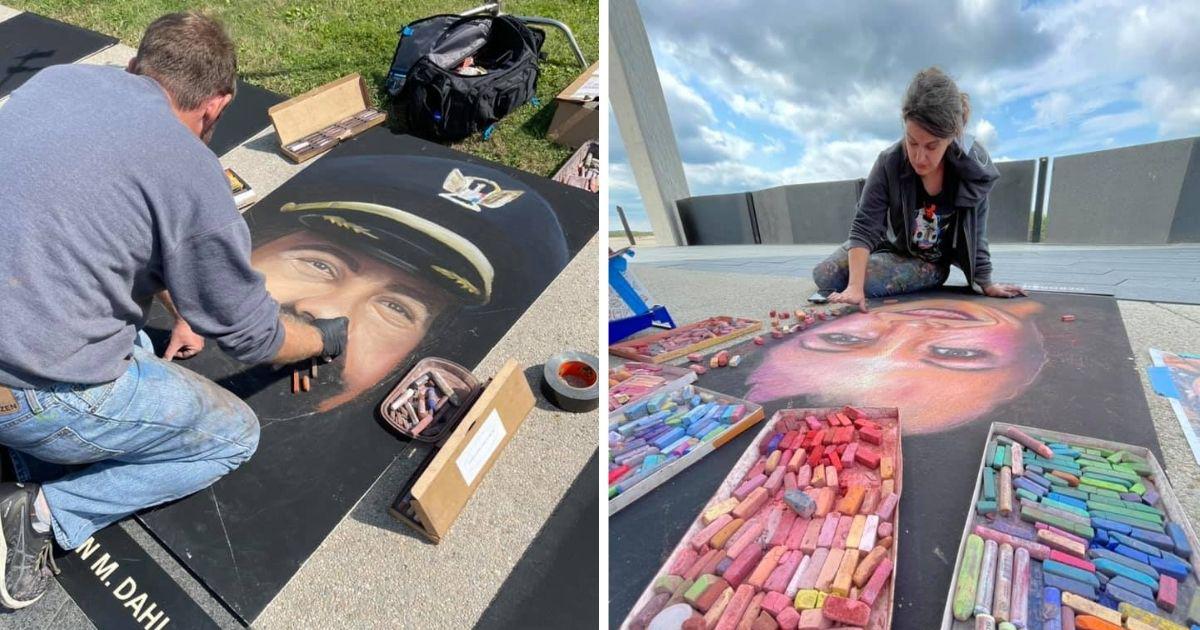
To honor those on board Flight 93, Pittsburgh-based chalk artist Erik Greenawalt (also known as The Chalking Dad) and a team of artists are creating chalk portraits of each passenger and crew member at the Flight 93 National Memorial site.

The Flight 93 National Memorial shared photos of some of the portraits in progress on Wednesday, and they are stunning.

The 10 artists are using photos from the National Parks Service to create the portraits on 3-foot by 5-foot charcoal-covered canvases, which can be moved under cover if inclement weather hits. Visitors to the memorial can watch the artists work while they tour the grounds.

“I think it gives people who walk by a chance to stop and sort of absorb a little bit more of who they were—to see them as individuals,” artist Shelley Brenner told the Pittsburgh Post-Gazette. “They were people with families, neighborhoods, their own lives.”

For those who knew the passengers and crew personally, the portraits honoring their loved ones are particularly mpactful.

https://twitter.com/nicoleperlroth/statuses/1435840637060796420

Art is a powerful tool for creating a collective experience, so a live art installation that commemorates the 40 individuals whose lives were lost while stopping a terrorist attack feels like a fitting tribute.

Thank you, artists, for always helping us process our emotions and experiences in the most beautiful way possible.


  • Harvard linguist explains perfectly logical reason Boomers insist on using ellipses in texts
    Photo credit: CanvaAn older woman uses a tablet computer.
    ,

    Harvard linguist explains perfectly logical reason Boomers insist on using ellipses in texts

    If you’ve ever gotten a text from your mom or grandma full of “…” and had no idea what it meant, you’re not alone.

    One generation’s texting habit that baffles every generation is the Boomers‘ seemingly excessive use of ellipses. Do you have more to say, Aunt Judy, or did you just accidentally press the period key too many times? Maybe it’s for a dramatic pause or to put emphasis on a point? This is truly a mystery that leaves every generation below them confused about what is meant by the dreaded “dot dot dot.”

    Texting etiquette differs with every generation. Gen X and most Millennials use fairly proper grammar and punctuation throughout a text message exchange. Every new sentence starts with a capital letter, there are strategically placed Oxford commas to ensure there’s little room for misunderstandings, and sentences end with an appropriate punctuation mark.

    How each generation texts differently

    When it comes to Gen Z, they find that ending text messages with proper punctuation indicates that the person they’re texting is being passive-aggressive. They also text in shorthand and emojis that can feel a bit like you need a special decoder ring to decipher the messages. But texting in an encrypted way can be chalked up to youth, though the same can’t be said when it comes to Boomers. Or can it?

    Harvard linguist and author of the New York Times bestseller Algospeak, Adam Aleksic, breaks down why so many Boomers use ellipses when texting. It’s surprisingly not as complicated or dramatic as one may imagine. In a viral 2024 TikTok video, Aleksic explains his theory for the texting etiquette of Boomers.

    linguist; boomers; gen x; millennials; gen z; text etiquette; boomer texting; gen z slang

    Two generations connecting through their smartphones. Photo credit: Canva

    “You know how older people tend to use the ‘Boomer ellipses’ whenever they’re texting? There’s always a random ‘dot dot dot’ in the middle of their messages?” Aleksic asks. “Well, that’s because they grew up following different rules for informal communication. Nowadays, if you want to separate an idea, you just press enter and start a new line with a new thought, but it made less sense to do that for writing postcards or letters, where you had to save space, so people back in the day learned to separate thoughts by using ellipses.”

    The pay-per-text era that changed everything

    Aleksic explains that this is also true for when phones first started allowing text messaging. You were charged by the message, so ellipses made it more efficient to convey all the thoughts in one message instead of multiple ones. SMS texting also had a character limit, unlike current phones, where you can essentially write a novella in a single message without your phone automatically breaking it up.

    Today’s texting standards typically mean people separate their thoughts by sending multiple messages for separate thoughts, though that annoys some people. If separating thoughts means you’ll be sending no less than five texts in quick succession, it’s likely best to just space down to make the text longer, rather than bombarding an unsuspecting friend.

    Why the boomer ellipsis causes so much confusion

    When it comes down to it, younger generations have adapted to the new standard, embracing the unlimited text option, while Boomers haven’t. Due to this discrepancy in text etiquette, the ellipses used by Boomers throw people for a loop.

    “That means the Boomer ellipses became redundant, which is why they cause confusion today. They violate what we call ‘the maximum quantity;’ they add more information than necessary, so they appear to imply something more than the intended meaning. Most of the time, that comes off to younger people as hesitation, annoyance, or passive aggressiveness because that’s how we use the ellipses,” the linguist shares.

    So, no, your grandma isn’t mad at you or avoiding telling you something; according to Aleksic, she’s just trying to send you multiple messages in one. There’s no hidden emotion behind the ellipses for Boomers; it’s simply a habit left over from their younger years.

    This article originally appeared one year ago. It has been updated.

  • Nate Bargatze reveals the true story behind his legendary George Washington SNL sketch
    Photo credit: SNL/NBCNate Bergatze as George Washington on Saturday Night Live
    ,

    Nate Bargatze reveals the true story behind his legendary George Washington SNL sketch

    Nate Bargatze’s George Washington SNL sketch has become an instant classic.

    America is definitely not afraid to do its own thing, even when its own thing is pretty weird. Ever stop to think how bizarre it is that the United States is one of the only countries to not use the metric system? Or how it uses the word “football” to describe a sport that, unlike fútbol, barely uses the feet at all?

    What must our forefathers have been thinking as they were creating this brave new world? Wonder no further. All this and more is explored in a Saturday Night Live sketch that folks are hailing as an “instant classic.”

    Why the sketch went viral

    The hilarious clip takes place during the American Revolution, where George Washington rallies his troops with an impassioned speech about his future hopes for their fledgling country…all the while poking fun at America’s nonsensical measurements and language rules.

    george washington, george washington's dream, snl sketch, nate bargatze

    Like seriously, liters and milliliters for soda, wine and alcohol but gallons, pints, and quarts for milk and paint? And no “u” after “o” in words like “armor” and “color” but “glamour” is okay?

    The inherent humor in the scene is only amplified by comedian and host Nate Bargatze’s understated, deadpan delivery of Washington. Bargatze had quite a few hits during his hosting stint, including an opening monologue that acted as a mini comedy set, but this performance takes the cake.

    The fans love it

    All in all, people have been applauding the sketch, noting that it harkened back to what “SNL” does best, having fun with the simple things.

    “This skit is an instant classic. I think people will be referencing it as one of the all time best SNL skits for years.”

    “Dear SNL, whoever wrote this sketch, PLEASE let them write many many MANY more!”

    “Instantly one of my favorite SNL sketches of all time!!!”

    “I’m not lying when I say I have watched this sketch about 10 times and laughed just as hard every time.”

    “This may be my favorite sketch ever. This is absolutely brilliant.”

    The sketch was so popular, they did another one when Nate Bargatze returned to SNL in October of 2024, and it’s every bit as hilarious as the first one. Again, the comedy focused on the idiosyncrasies of America, including our names for animal food products, the way we count grades in school, and the design of our currency.

    “A real American would never want to know what’s in a hot dog, just as they will never know why our money is called the ‘dollar’…” says Bargatze as Washington. “And if you think I’m worthy, put my portrait on the front of it.”

    “And what shall be on the back, sir?” asks Kenan Thompson’s character.

    “Everything, all of it,” Washington replies. “Crazy stuff, squiggles, Latin words, a pyramid with a floating eye on top.” 

    Behind the scenes of an SNL classic

    The sketches became so popular, people wanted to know more about how the idea for them came about and what the process of creating the original sketch was like. Jesse David Fox, the host of Good One: A Podcast About Jokes, sat down with Bargatze and SNL writers Mikey Day and Streeter Seidell to talk about the origins of the sketch and what it was like to co-create it in the week leading up to the live show. It’s a fascinating insight into the SNL writing process, which is largely done within that week.

    According to Day and Seidell, Seidell had actually written a near-complete draft of the sketch the prior season, originally envisioned for a dramatic actor. It had been sitting unfinished on his computer until Bargatze was tapped to host. Bargatze was on board with playing Washington, but apparently, the sketch landed flat at the table read earlier in the week and was placed dead last in the dress rehearsal lineup. But Bargatze said he really liked the sketch, and once he was in costume and in front of a live audience for dress rehearsal, everything came together to make the magic of a classic SNL bit.

    Bargatze has become one of the biggest names in stand-up comedy, known for his clean, family-friendly routines. He was the highest-grossing touring comedian in the world in 2024. You can catch even more of Bargatze’s “SNL” episodes here and here.

    This article originally appeared three years ago. It has been updated.

  • Debunking doesn’t stop misinformation online. But researchers found ‘pre-bunking’ can.
    Photo credit: CanvaSome helpful information to fight misinformation.

    The rise of misinformation on social media has been a monumental stress test for the world’s critical thinking skills. Misinformation has had a huge influence on elections, public health and the treatment of immigrants and refugees across the world. Social media platforms have tried to combat false claims over the years by employing fact-checkers, but they haven’t been terribly effective because those who are most susceptible to misinformation don’t trust fact-checkers.

    “The word fact-checking itself has become politicized,” Cambridge University researcher Jon Roozenbeek said, according to the Associated Press. Further, studies show that when people have incorrect beliefs challenged by facts, it makes them cling to their false assumptions even harder. These platforms have also attempted to remove posts containing misinformation that violates their terms of service, but this form of content moderation is often seen as insufficient and is often applied inconsistently.

    So what actually works against misinformation?

    How do we combat dangerous misinformation online if removing false claims or debunking them hasn’t been effective enough? A 2022 study published in the journal Science Advances by a team of university researchers and Jigsaw, a division of Google, found a relatively simple solution to the problem they call “pre-bunking.”

    Pre-bunking is an easy way of inoculating people against misinformation by teaching them some basic critical thinking skills. The strategy is based on inoculation theory, a communication theory that suggests one can build resistance to persuasion by exposing people to arguments against their beliefs beforehand.

    The researchers learned that pre-bunking was effective after conducting a study on nearly 30,000 participants on YouTube.

    “Across seven high-powered preregistered studies including a field experiment on YouTube, with a total of nearly 30,000 participants, we find that watching short inoculation videos improves people’s ability to identify manipulation techniques commonly used in online misinformation, both in a laboratory setting and in a real-world environment where exposure to misinformation is common,” the recently published findings note.

    The researchers uploaded videos into YouTube ad slots that discussed different types of manipulative communication used to spread false information such as ad hominem attacks, false dichotomies, scapegoating and incoherence.

    Here’s an example of a video about false dichotomies.

    Short videos with surprisingly big results

    Researchers found that after people watched the short videos, they were significantly better at distinguishing false information than they were before. the study was so successful that Jigsaw rolled out a prebunking campaign about scapegoating in Poland, the Czech Republic and Slovakia. Since that initial campaign, prebunking’s reach has only grown. These countries are all combating a significant amount of false information about Ukrainian refugees.

    Before the 2024 EU Elections, a Jigsaw-supported campaign reached more than 120 million YouTube users across 12 countries, with studies confirming the approach improved viewers’ ability to spot manipulation tactics.

    Many people talk about “critical thinking,” but a lot of people don’t really understand what the term means. Learning about the tropes and techniques used to spread misinformation is a vital part of developing critical thinking skills. It’s not just about thinking for yourself and determining what’s true based on what your brain tells you; it’s about recognizing when messaging is being used to manipulate your brain to tell you certain things. It’s learning about logical fallacies and how they work. It’s acknowledging that we all have biases that can be preyed upon and learning how propaganda techniques are designed to do just that.

    Teaching the skill beats playing whack-a-mole

    There’s an old saying, “If you give a man a fish, he’ll eat for a day. Teach that man to fish and he’ll eat forever.” Pre-bunking does something very similar. We can either play a game of whack-a-mole where social media platforms have to suss out misinformation on a minute-by-minute basis or we can improve the general public’s ability to distinguish misinformation and avoid it themselves.

    Further, teaching people to make their own correct decisions about misinformation will be a lot more effective than pulling down content and employing fact-checks. These tactics only drive vulnerable, incredulous people toward misinformation.

    This article originally appeared four years ago. It has been updated.

  • If you struggle with small talk, a simple acronym can make it a lot less painful
    Photo credit: via Gary Barnes/PexelsSmall talk can be painful, but the FORD method can help.

    Some people enjoy small talk and are naturally good at it. For others, it feels like mental and emotional torture. There are many reasons why people are nervous about entering social situations where they have to make small talk, such as a work event, a party where they don’t know many people, or at school. Some people don’t enjoy small talk because they get frustrated talking about seemingly unimportant topics.

    At the same time, others are shy and afraid they’ll say the wrong thing or run out of topics of conversation. Psychologists suggest those who are uncomfortable knowing what to say should use the FORD method of conversation starters. It’s an acronym that’s an easy way to remember four different topics of conversation that work with just about anyone.

    According to Nicole Arzt, M.S., L.M.F.T at Social Self, the FORD acronym stands for Family, Occupation, Recreation and Dreams. Here are some examples of questions that fall under each category.

    Family

    Just about everyone has a family, so it’s a great way to ask someone to share some information about their personal lives without being too forward. Arzt suggests the following questions when making small talk:

    family, small talk, ford method
    You can ask people about their parents, kids, siblings, grandparents, cousins, aunts and uncles, or just family in general. Photo credit: Canva

    Do you have any siblings?

    How did you two meet? (if you are meeting a couple for the first time)

    How old is your child?

    How is your____ (sister, brother, mother, etc.) doing since ____ (event that happened?)

    Occupation

    Just like a family, almost everyone has a job. Or, if they do not, that can be an interesting topic as well. Here are some starter questions you can ask someone about their job.

    jobs, occupations, ford method, small talke
    You can take questions about someone’s occupation beyond simply, Photo credit: Canva

    What do you do for a living?

    How do you like working at _____?

    What’s your favorite part of your job?

    What made you interested in becoming a _____?

    Recreation

    You can learn a lot about a person after knowing how they spend their free time. It’s also an excellent way to determine if someone is like-minded and shares the same interests. Here are some questions to get the ball rolling.

    It is fun to talk about, well…fun. Photo credit: Canva

    What do you like to do for fun?

    Have you watched (or read) ______(popular show/book)?

    What are you up to this weekend?

    Dreams

    Learning someone’s hope for the future can tell you much about who they are on a deeper level. They may have just told you about their current job or how they spend their time. But, ultimately, what do they wish to do with their lives? Here’s how to ask someone about their dreams.

    Everyone has hopes and dreams. Photo credit: Canva

    Where do you hope to be working in the next few years?

    Where would you like to travel?

    What’s something you’d like to try in the future?

    Would you ever consider trying _____ (particular hobby or activity)?

    Don’t just ask questions, share your own answers

    Arzt also notes that you shouldn’t just be an interviewer. You have to talk about yourself, too. In other words, you need a mutual give-and-take. “Pay attention to someone else’s answers and think about how you can draw from your own experience to connect,” she wrote. When you’re feeling socially anxious, it can be hard to listen to the other person while also thinking about your own responses, so thinking of the FORD acronym for yourself and having something to share in each category ahead of time can be a way to avoid the dreaded awkward silence that sometimes happens during small talk.

    It can also be tricky to know how much you should be talking vs. how much you should be listening. If you’re not sure how much to say during a conversation, follow the 43:57 rule. A numbers guy at Gong.io analyzed over 25,000 sales calls with AI and found the perfect speaking-to-listening ratio. Sales soared when the salesperson talked 43% of the time and listened for 57%.

    Even though this insight is from business calls, it applies to everyday social interactions. It’s really about listening and making the other person feel special. After all, who doesn’t love feeling heard and appreciated?

    Small talk doesn’t have to be torturous, even if it’s something you don’t look forward to. With a little preparation and some genuine curiosity, it might even become enjoyable as you make new connections with people.

    This article originally appeared three years ago. It has been updated.

  • Fox News viewers were paid to watch CNN and it actually changed their views
    Photo credit: via Wikimedia CommonsFox viewers changed their minds after watching CNN

    The prevailing logic in today’s political world is that polarization is worsening because people live in media echo chambers where they are only exposed to outlets that mirror their views. People who live in echo chambers come to distrust any opinions outside their bubbles, especially when they’re not exposed to conflicting information. This creates a scenario where the person becomes increasingly entrenched in their worldview.

    One would assume that after a person becomes fully entrenched in an echo chamber, they have little chance of changing their views. However, a new working paper by researchers at UC Berkley and Yale universities has found that when people are removed from their bubbles, there’s a chance they’ll change their minds.

    What happened when Fox News viewers watched CNN for a month

    David Broockman of UC Berkeley and Joshua Kalla of Yale conducted a study in fall 2020, publishing their findings in 2022, in which they paid regular Fox News viewers $15 an hour to watch CNN for around seven hours a week for a month. The researchers then surveyed them about their political beliefs and knowledge of current events.

    The study is titled “The manifold effects of partisan media on viewers’ beliefs and attitudes: A field experiment with Fox News viewers.” It was conducted in fall 2020, during the height of the COVID-19 pandemic and the lead-up to the presidential election.

    When the participants were polled, researchers found that they were five percentage points more likely to believe that people suffer from long COVID, 6 points more likely to think that other countries did a better job of controlling the virus, and 7 points more likely to support voting by mail.

    anderson cooper, cnn, cable news, cooper live, newscasters, news programming, liberals, conservatives
    Anderson Cooper and David Axelrod speaking in the spin room following the CNN Republican Presidential Debate at the Olmsted Center at Drake University in Des Moines, Iowa. via Gage Skidmore/Wikimedia Commons

    “CNN provided extensive coverage of COVID-19, which included information about the severity of the COVID-19 crisis and poor aspects of Trump’s performance handling COVID-19. Fox News covered COVID-19 much less,” said the study.

    How their views on Trump and police changed

    After Fox viewers switched to CNN, their opinions on the social justice protests happening at the time changed. The switchers were 10 points less likely to think that Biden supporters were happy when police got shot and 13 points less likely to believe that if Biden gets elected, “we’ll see many more police get shot by Black Lives Matter activists.”

    Many of the participants also realized that when it came to Trump, they weren’t getting the whole story. After switching to a steady diet of CNN they were less likely to agree that “if Donald Trump did something bad, Fox News would discuss it.”

    “Despite regular Fox viewers being largely strong partisans, we found manifold effects of changing the slant of their media diets on their factual beliefs, attitudes, perceptions of issues’ importance, and overall political views,” the authors of the study said.

    sean hannity, fox news, red state, news bias, political polarization.
    A Fox News van in New York City via Wikimedia Commons

    What the study means for political polarization in America

    The study shows that Fox News isn’t just a media outlet that affirms its viewers’ worldviews; it also feeds them a distorted version of reality that pushes them toward more extreme opinions. The good news is that some of these people can be changed when exposed to better information. It should also be noted that Fox News viewers aren’t the only ones living in information bubbles and that there are plenty of ideological traps that ensnare people on the left as well.

    “Partisan media aren’t just putting a thumb on the scale for their side,” Broockman said. “They’re also hiding information that voters need to hold politicians accountable. That’s not just good for their side and bad for the other side — it’s bad for democracy, and for all of us.”

    Two months after the study, it was found that the Fox News viewers reverted to their opinions before their exposure to CNN. Still, Broockman believes that the study offers some hope in a time of deep political polarization. “Even among the most orthodox partisans and partisan media viewers,” he said, according to Berkeley, “those who receive a sustained diet of information that helps them see the bigger picture actually are open-minded enough to understand that their side isn’t doing a perfect job, either.”

    The study should give everyone hope that all is not lost and that America’s political divide may not be impossible to bridge.

    This article originally appeared four years ago. It has been updated.

  • Woman discovers her husband’s been leaving love notes in her shoes for over six years
    Photo credit: via Anna Mellor/TikTokAnna Mellor can't belive she never noticed.
    ,

    Woman discovers her husband’s been leaving love notes in her shoes for over six years

    The patience he displayed in orchestrating this adorable prank is incredible.

    Anna Mellor is a popular TikTokker best known for making videos where she pranks her husband, Rory. In one hit video, she forces him to dress as Mrs. Claus for the family Christmas card. In another, they plan a romantic movie night and she pretends to fall asleep just as Rory’s entering the room with popcorn. Basically, they’re couple goals and it’s extremely obvious to anyone watching that they are best friends, even soulmates, despite the lumps Rory takes along the way. But poor Rory may have got the last laugh after a secretive long-con he played left her stupefied.

    The secret? He’s been leaving her love letters in her shoes for years.

    The six-year secret hidden inside her shoes

    Anna took to TikTok to share the tale with her near one million followers.

    “I just discovered a six-year secret my husband has been keeping from me,” Mellor captioned a post with the big reveal. The video has over 2.6 million views since it was posted in March, 2022.

    Anna got hip to her husband’s secret joke after she purchased a pair of used Fila shoes and found a secret message written in black Sharpie on the inside: “I Fila lot better when ur around.” (A love letter and a dad joke, to boot. We love to see it.)

    @mellorlite

    Me thinking it was a love letter for someone else has same energy as when Rory was proposing and I thought the ring was somebody else’s that got lost at the beach😂😂

    ♬ You – Petit Biscuit

    After making the discovery, she called her husband to tell him the strange news.

    “I was like, ‘I just found a love letter in my shoes,’” she explained. Rory acted confused to hear the news. “He’s like, ‘Are you being serious?’ Acting as if I should know what’s going on,” Anna said. But he couldn’t keep up the charade for long. “We have been married for six years. I have been writing in your shoes for six years and you just noticed for the first time” he admitted.

    Anna then opened up another sneaker that had “If your feet get tired I will carry you” written on the tongue.

    It makes you wonder how many pairs of shoes that she’s thrown out had secret messages in them?

    Anna was clearly shocked by the revelation and thought it was a wonderfully creative way for her husband to show his love. It also shows that the man has an incredible talent at keeping a secret. Not to mention the outstanding patience on display! Commenters on the video thought that Rory is definitely a keeper, with all the makings of an all-star husband and dad.

    “Immediately getting a divorce… none of my shoes say stuff!” TheMrsGarcia1111 wrote. “Where did you find him and how do I get one…asking for a friend,” Keelyn added.

    “Ughhh *getting up to take my shoes to my husband and start and argument*” another user joked.

    “It’s so much sweeter that he kept doing it even though you never praised him for it” added another.

    This isn’t even their first viral moment

    This isn’t the first time the couple has gone viral. Back in 2020, Anna posted a video on TikTok where she sent her husband a dirty text message, but it was intercepted by her mother-in-law.

    In the video, a horrified Anna can be heard saying, “Wait, wait, no… oh no” as she watches Rory’s mother reaching for the phone. “Did you read that?” Rory asks after taking a look for himself. “I thought it was my phone,” she responds. “That is so gross!”

    Talk about embarrassing.

    But, mostly, viewers love the pranks. They can’t get enough of the pranks.

    Why humor and small gestures matter so much in a relationship

    Research shows that good-natured ribbing, like the type that Anna and Rory share in their videos, is great for a couple. A meta-analysis of 39 studies found that couples who “create humor together” through inside jokes are more likely to last than those that don’t.

    “People say they want a sense of humor in a mate, but that’s a broad concept,” Professor Jeffrey Hall from the University of Kansas said according to The Daily Mail. “What is strongly related to relationship satisfaction is the humor that couples create together.”

    And little love notes and other small displays of affection? They’re key in a happy marriage. They seem small and maybe even silly, but they communicate a lot: Commitment, effort, and love. Anna and Rory are such an inspirational couple because beyond even love, it’s so obvious that they like each other. That’s a highly underrated aspect of a great relationship. If you’re trying to inject a little more of this playful fun in your own relationship, well, shoes might be a good place to start.

    This article originally appeared four years ago. It has been updated.

  • Singer raises $40K for his grandpa’s surgery by turning pop songs into ’emo’ epics
    Photo credit: @beavanzulu/TikTok, used with permissionBeavan Zulu performs emo-fied songs for his grandfather's surgery.

    When Los Angeles-based actor and singer Beavan Zulu found out his grandfather in Zambia was in urgent need of expensive medical treatment, he knew he’d do whatever he could to help…including singing emo covers of decidedly not-emo songs. 

    As Zulu explained, his grandfather, Mr. Rebby Malekani Chanda, required a type of surgery for his heart condition that isn’t provided in Zambia. The closest available area that could provide such treatment was in India, over 4,000 miles away. But Zulu’s family was already financially tapped out from Mr. Chanda’s previous medical care costs.  

    However, Zulu was determined to get his grandfather the help he needed. 

    @beavanzulu

    Please help in any way you can and INTERACT!!! https://www.gofundme.com/f/help-mr-malekani-get-lifesaving-heart-surgery #gofundme

    ♬ original sound – user16850017189

    “I love my grandpa so much, and he deserves this care.”

    Faced with this daunting financial hurdle, Zulu could have simply shared the GoFundMe created by his family. Instead, he leaned into something a little more personal, with a lot more attitude. Not to mention makeshift sideswept bangs. 

    Rather than simply ask for donations, Zulu wanted to get creative with his fundraising and put his singing skills to good use. That’s when he remembered entertaining his high school with an emo rendition of “Let it Go” from Disney’s Frozen. It worked once…it could work again, right? 

    “I took a leap of faith and posted the first video not thinking anything crazy would come from it,” Zulu recalled with Upworthy

    @beavanzulu

    Let’s save my grandpa!! Comment your fav Disney movie and tag @Idina Menzel so she can give me some pointers 🥴 #cover #disney

    ♬ original sound – Beavan Zulu

    That leap of faith paid off, literally

    Millions leaned into all of Zulu’s whiny, dramatic emoisms and commitment to eyeliner energy. Exceeding all expectations, Zulu received all of his $40K goal in a matter of four days. 

    That’s right, only three songs were sung (including “I’ll Make a Man Out of You” from Mulan, Zula’s personal favorite) before making all the money necessary to not only cover Mr. Chanda’s surgery and travel, but also tickets so that Zulu and his family could go be there with him during recovery. Turns out, if you sing like your heart is breaking while asking people to help fix your grandfather’s heart, people listen.

    @beavanzulu

    HOLY COW Y’ALL ARE THE BEST!! 😭 alright tell me in the comments where you would travel internationally with @Emirates @KLM Royal Dutch Airlines @fly.ethiopian @GoFundMe #cover #disney

    ♬ original sound – Beavan Zulu

    As a thank you, Zulu sang one extra bonus: “Fireflies” by Owl City. 

    Zulu shared with Upworthy, “My biggest takeaway is that with good faith, fun, and trust in yourself and your community, anything is possible. The Internet can really be a scary place, especially now, but it also grants us access to the world community and with the right intention, that community can really uplift you tenfold when you most need it.”

    @beavanzulu

    This is probably the peak of my year THANK YOU TO ALL OF YOU!!! Comment what bug you’d HATE to see 10 million of #cover #fireflies 🐞🐛

    ♬ original sound – Beavan Zulu

    Even in such a difficult time, Zulu leaned into joy, and it inspired complete strangers to rally for his cause. Sure, the fun nostalgia helped, but him putting his whole heart out on the line is what moved people. Laughter, music, and love really are wonderful tools for creating miracles. 

    Or, said a different way: even if we are all chronically online, people will still show up for sincerity, especially when it comes with a side of dramatic vocals and perfectly timed angst. 

    Be sure to give Zulu a follow to watch even more amazing emo covers (at the time of this writing, we’re up to six iconic songs featuring side bangs and fingerless gloves). 

  • A woman’s outrageously infectious laugh once left Robin Williams mesmerized during his own interview
    Photo credit: Instagram, Inside the Actors Studio, CanvaRobin Williams makes a woman laugh until she cries in interview clip.
    ,

    A woman’s outrageously infectious laugh once left Robin Williams mesmerized during his own interview

    “The best kinds of people are those who strive to make people happy and laugh.”

    Comedian Robin Williams never seemed to stop his lifelong quest to make people laugh. He succeeded so often that it must have simply felt like second nature to him. It was almost as if all he had to do was just wave a magic wand and poof! Laughter.

    This gift seemed to appear to Williams as a child, and he carried it with him most of his life. So when he heard the uproarious chuckles of one woman in the audience of an interview with James Lipton on Inside the Actors Studio, he couldn’t help but become the conductor of his own little laughter orchestra.

    On the History Clips Only Instagram page, a Reel is captioned, “Robin Williams paused his interview after hearing a woman laugh – only to make her laugh harder.” In the clip, Lipton brings up the phrase “legalized insanity” as a term he says Williams has used in order to help people “understand” him. This is followed by a loud giggle in the audience that immediately captures Williams’ attention.

    Lipton asks, “What is legalized insanity?” Williams leans in, and just as he’s about to answer, he seems to hear the woman in the audience scream-laughing. He leans back in his chair as though he’s being possessed by a demon. He then gets up and shimmies toward the laughter with a silly dance, while exclaiming, “You know you want it!”

    The woman, in a sea of laughter, stands out even more. She is now screeching. And the louder she gets, the more infectious it seems for the rest of the audience. He sits back down and says to Lipton, “I think that’s one example.”

    Robin Williams, Inside the Actors Studio, laughter
    Screenshot

    Her laugh becomes like staccato little yelps of joy. Williams gets up again and asks, “Are you okay?” We now see the face of the woman laughing in the audience, her cheeks glowing bright red. She covers her mouth as we see her eyes shut tighter with every guffaw. Williams can’t help himself. He too begins to laugh and tells her, “It’s okay. It’s alright.”

    But now the entire audience is in the palm of his hand, as they so often were. He switches gears and pretends to be a preacher with a southern accent. “Baby Jesus loves you,” he yells twice, to an applause break. “I know you believe! I’m gonna lay my hands on you, but first I’m gonna do this!”

    Now the woman decides to take part. “I believe,” she yells back. “I believe in the power!” He continues, “I’d lay my hands on you, but first, first, I’ve got to do THIS. A lot of times, people know the reverend will do that!” He then returns to his seat as the crowd continues going wild.

    We get a shot of the woman again, now wiping away tears of pure joy from her bright face.

    Robin Williams, Inside the Actors Studio, laughter
    A woman laughing during a Robin Williams interview. Photo Credit: @historyclipsonly, Instagram, Canva

    As was so often the case with Williams, people responded to the joy he brought much of the world with accolades. The clip has nearly a quarter of a million likes and over a thousand comments.

    One Instagrammer writes, “Laughing so good that you get a personal Robin Williams monologue is a life win.”

    Another shares a similar sentiment: “The best kinds of people are those who strive to make people happy and laugh. Robin did exactly that, making others happy before himself. RIP to a legend.”

    Someone who claims to have done the makeup for Williams in that particular segment shared, “Okay, so I was very lucky on that day since I had the honor of doing Robin Williams’ makeup on that particular segment. I had worked inside the Actors Studio for approximately 12 years. He was by far one of the most talented and the most humble. We lost a beautiful gift. RIP.”

Family

Single dad gets suspicious letter from his late wife and rushes to get a DNA test

Family

What parents teach kids when we allow them to take a ‘mental health day’

Pop Culture

Debunking doesn’t stop misinformation online. But researchers found ‘pre-bunking’ can.

Health

Doctor explains how to accurately predict your longevity with simple at-home test