

Teen pregnancy is down 40% in Colorado, and the reason is unbelievably simple: birth control.
A small change can make a very big impact.
Over the past several years, teen pregnancies and abortions in Colorado have been on a sharp decline.
The New York Times highlighted the state's success story, in which the teen pregnancy rate dropped by 40% and abortion rate among teens dropped by an astounding 42%.
Data from Colorado Department of Public Health & Environment.
Why the sudden drop? It's simple, really: The state made long-acting birth control free to those who wanted it.
Since 2008, Colorado has enabled more than 30,000 individuals to obtain long-acting reversible contraceptives (LARCs), typically intrauterine devices (IUDs) thanks to a state program called the Colorado Family Planning Initiative.
Photo by Jay Directo/AFP/Getty Images.
According to the Guttmacher Institute, IUDs are one of the most effective forms of reversible birth control, with a failure rate less than 1%.
It should come as no surprise that when you make extremely effective contraceptives available to women who don't currently want to have children, unplanned pregnancies and abortions decline.
Sounds like a win-win scenario for just about everyone in the political spectrum, right?
Whatever your opinion on abortion rights, I think most people would agree they'd rather not need one. By their very nature, unplanned pregnancies are, well, unplanned. In reducing the number of unintended pregnancies, this program was able to chip away at the number of women needing access to abortion services.
Photo by Brendan Smialowski/AFP/Getty Images.
But what about the cost of providing free birth control? There's some good news on that front, as well.
Fewer unplanned pregnancies also means fewer parents who aren't financially able to care for a child; as a result, the state and federal government actually save money as the number of people in need of aid programs declines. A Guttmacher study determined that for every dollar spent on family planning programs, the government saves $7.09 on other programs. Which means Colorado's program pays for itself and then some.
The state estimates that just between 2010 and 2012, anywhere between 4,300 and 9,700 unintended pregnancies were avoided, saving the state somewhere between $49 million and $111 million in Medicaid funds.
Making birth control accessible is just one way to reduce unintended pregnancies.
Colorado's program was effective, but it's not the only way proven to reduce unwanted pregnancies. One method that's been shown to reduce teen pregnancy and sexually-transmitted diseases is simply being armed with the knowledge that comes along with comprehensive sex education.
Photo by Saul Loeb/AFP/Getty Images.
Studies show that abstinence-only education is not an effective way to reduce teen pregnancy.
As of July 2015, just 18 states and the District of Columbia require that sex education courses provide information about contraception. 37 states require that these courses cover abstinence (with 25 of those states mandating that courses stress the importance of abstinence).
Photo by Ian Waldie/Getty Images.
Abstinence-only-until-marriage programs haven't been shown to drastically affect the age at which students become sexually active. In fact, studies show that students who only received abstinence sex education were more likely to not use contraceptives and were more likely to end up with unintended pregnancies and STDs.
Photo by Jeff Fusco/Getty Images.
All things considered, preventing unintended pregnancies is simple.
It's as easy as arming people with knowledge (comprehensive sex ed) and resources (contraceptives) to stave off unintended pregnancies. As we've seen, denying these resources to teens and adults proves to have a much more painful, expensive social and financial cost. Reducing those pregnancies will take a mix of both knowledge and resources.
As Colorado waits to find out the fate of its wildly successful program, it's helpful to look back on how simple the solution can be and why it's worth investing money and effort toward an effective public good. We should all be able to get behind that idea.

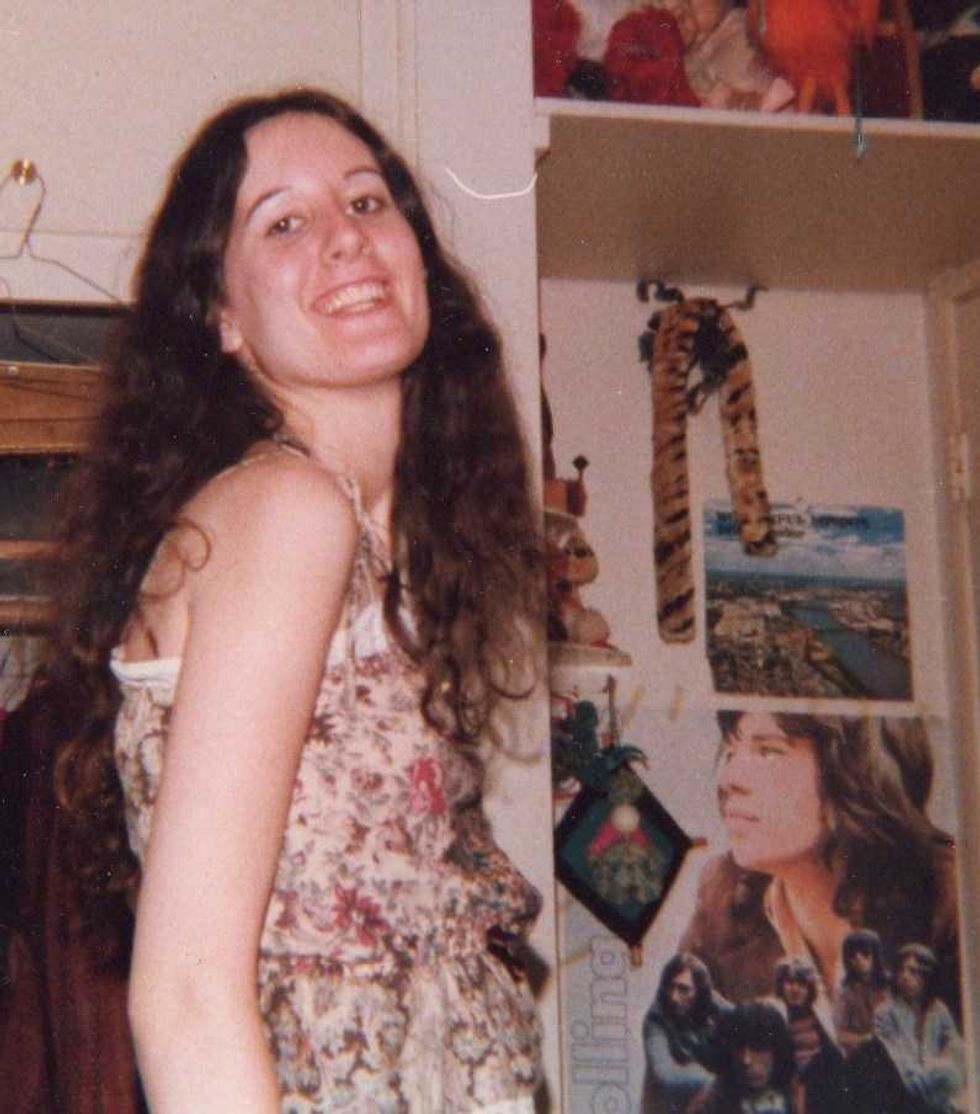 A Generation Jones teenager poses in her room.Image via Wikmedia Commons
 An office kitchen.via
  An angry man eating spaghetti.via
 At least it wasn't Bubbles.
  You just know there's a person named Whiskey out there getting a kick out of this.


An Irish woman went to the doctor for a routine eye exam. She left with bright neon green eyes.
It's not easy seeing green.
Did she get superpowers?
Going to the eye doctor can be a hassle and a pain. It's not just the routine issues and inconveniences that come along when making a doctor appointment, but sometimes the various devices being used to check your eyes' health feel invasive and uncomfortable. But at least at the end of the appointment, most of us don't look like we're turning into The Incredible Hulk. That wasn't the case for one Irish woman.
Photographer Margerita B. Wargola was just going in for a routine eye exam at the hospital but ended up leaving with her eyes a shocking, bright neon green.
At the doctor's office, the nurse practitioner was prepping Wargola for a test with a machine that Wargola had experienced before. Before the test started, Wargola presumed the nurse had dropped some saline into her eyes, as they were feeling dry. After she blinked, everything went yellow.
Wargola and the nurse initially panicked. Neither knew what was going on as Wargola suddenly had yellow vision and radioactive-looking green eyes. After the initial shock, both realized the issue: the nurse forgot to ask Wargola to remove her contact lenses before putting contrast drops in her eyes for the exam. Wargola and the nurse quickly removed the lenses from her eyes and washed them thoroughly with saline. Fortunately, Wargola's eyes were unharmed. Unfortunately, her contacts were permanently stained and she didn't bring a spare pair.
- YouTube youtube.com
Since she has poor vision, Wargola was forced to drive herself home after the eye exam wearing the neon-green contact lenses that make her look like a member of the Green Lantern Corps. She couldn't help but laugh at her predicament and recorded a video explaining it all on social media. Since then, her video has sparked a couple Reddit threads and collected a bunch of comments on Instagram:
“But the REAL question is: do you now have X-Ray vision?”
“You can just say you're a superhero.”
“I would make a few stops on the way home just to freak some people out!”
“I would have lived it up! Grab a coffee, do grocery shopping, walk around a shopping center.”
“This one would pair well with that girl who ate something with turmeric with her invisalign on and walked around Paris smiling at people with seemingly BRIGHT YELLOW TEETH.”
“I would save those for fancy special occasions! WOW!”
“Every time I'd stop I'd turn slowly and stare at the person in the car next to me.”
“Keep them. Tell people what to do. They’ll do your bidding.”
In a follow-up Instagram video, Wargola showed her followers that she was safe at home with normal eyes, showing that the damaged contact lenses were so stained that they turned the saline solution in her contacts case into a bright Gatorade yellow. She wasn't mad at the nurse and, in fact, plans on keeping the lenses to wear on St. Patrick's Day or some other special occasion.
While no harm was done and a good laugh was had, it's still best for doctors, nurses, and patients alike to double-check and ask or tell if contact lenses are being worn before each eye test. If not, there might be more than ultra-green eyes to worry about.