
upworthy
Add Upworthy to your Google News feed.
Google News Button
Popular

6 alternatives to saying 'let me know if you need anything' to someone in crisis

If someone is drowning, you don't wait for them to ask for help. You just take action.

woman crying with her hand on a rainy window

People going through major struggles don't always know what they need or how to ask for help.

When we see someone dealing with the loss of a loved one or some other major life crisis, it's instinctual for many of us to ask how we can help. Often, the conversation looks something like this:

Us: I am SO sorry you're going through this. What can I do to help?

Person in crisis: I honestly don't know right now.

Us: Okay…well…you let me know if you need anything—anything at all.

Person in crisis: Okay, thank you.

Us: I mean it. Don't hesitate to ask. I'm happy to help with whatever you need.

And then…crickets. The person never reaches out to take you up on the offer.

Was it that they didn't really need any help, this person going through a major life crisis? Unlikely. As sincere as our offer may have been, the problem may be that we didn't really offer them what they actually needed.

One of those needs is to not have to make decisions. Another is to not have to directly ask for help.

When a person is in a state of crisis, they can feel like they're drowning. They might be disoriented and fatigued, and doing anything other than keeping their head above water long enough to breathe can feel like too much.

If someone is drowning, you don't ask them what you can do to help or wait for them to ask. Youjust take action.

Here are some specific ways you can take action to help someone who you know needs help but isn't able or willing to ask for it:

1. Make them food

It may be tempting to ask if you can make them a meal and wait for them to say yes or no, but don't. Simply ask if they or anyone in their household has any dietary restrictions, and then start shopping and cooking.

Meals that can be popped in the refrigerator or freezer and then directly into the oven or microwave are going to be your best bets. Include cooking or reheating instructions if it's not obvious. Disposable aluminum trays are great for homemade freezer-to-oven meals and can be found at just about any grocery store. Casseroles. Stir fried rices. Soups. Comfort foods.

If you don't cook, you can buy them gift cards to local restaurants that deliver, or give them a DoorDash or UberEats gift certificate (large enough to cover the delivery, service fees and tip as well, which combined can be as much as a meal sometimes).

lasagna in the oven

Easy-prep meals people can throw in the oven are great.

Photo by Milada Vigerova on Unsplash

Even better—organize a meal train

If you want to make it a community-wide effort and no one else has done so yet, set up a "meal train," where different people sign up for different days to bring meals to spread out the food help over time. There are several free websites you can use for this purpose, including Give In Kind, Meal Train, and Take Them a Meal. These sites make it super easy for anyone with the personalized link to sign up for a meal.
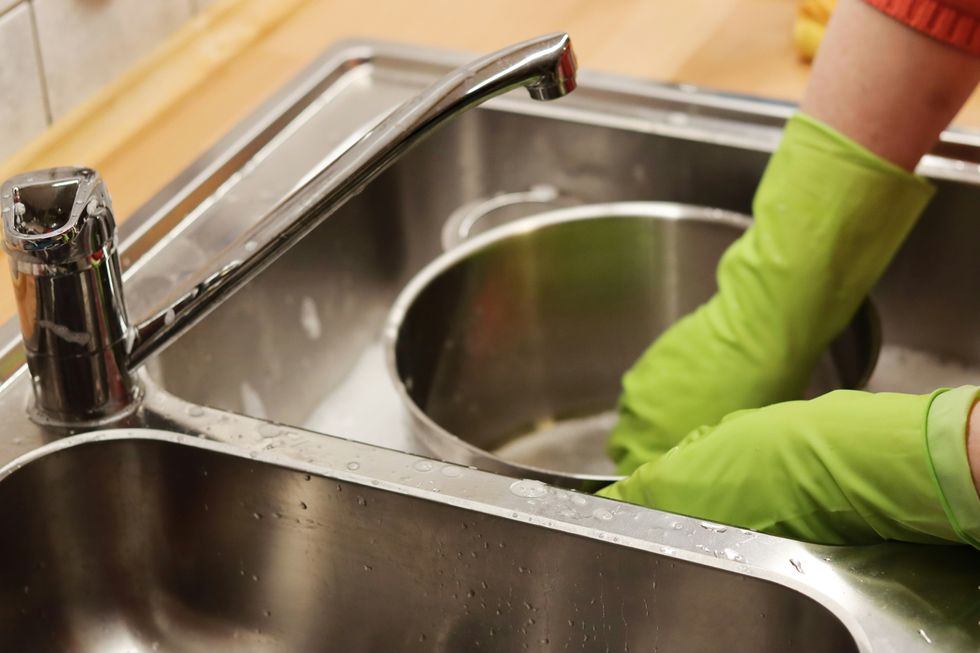
someone scrubbing a pot in a kitchen sink

There are always dishes to wash.

Photo by Marek Studzinski on Unsplash

2. Clean their kitchen and/or bathrooms

Kitchens are always in use, and keeping up with dishes, especially in a house full of people, is a challenge even under normal circumstances. Same with keeping the refrigerator cleaned out. Same with cleaning the bathroom.

Rather than asking if they want it done, as many people won't want to say yes even if they would appreciate the help, try saying something like, "I want to come and make sure your kitchen is ready for you to make food whenever you want to and that your bathroom is a clean space for you to escape to whenever you feel like it. Is Tuesday or Wednesday at 1:00 better for you?"

The fewer complex decisions a person in crisis has to make the better, so saying, "Is this or that better?" rather than offering open-ended possibilities can be helpful.

woman folding clothes

There is always laundry to fold, too.

Photo by Marek Studzinski on Unsplash

3. Do laundry

Offer to sit and chat with them, let them vent if they need to…and fold their laundry while you're at it.

Are they the kind of people who might be embarrassed by you seeing or handling their underclothes? Fine. Wash, dry and fold towels or bedsheets instead. Just keep the laundry moving for them.

And if it doesn't feel appropriate or desirable for you to do their laundry at their house, you can offer a pick-up laundry service, either yourself or an actual hired service. Tell the person to put bags or bins of laundry at the door and you (or the service) will come pick it up and bring it back clean and folded the next day. That's a great way to be of service without feeling like you're intruding.
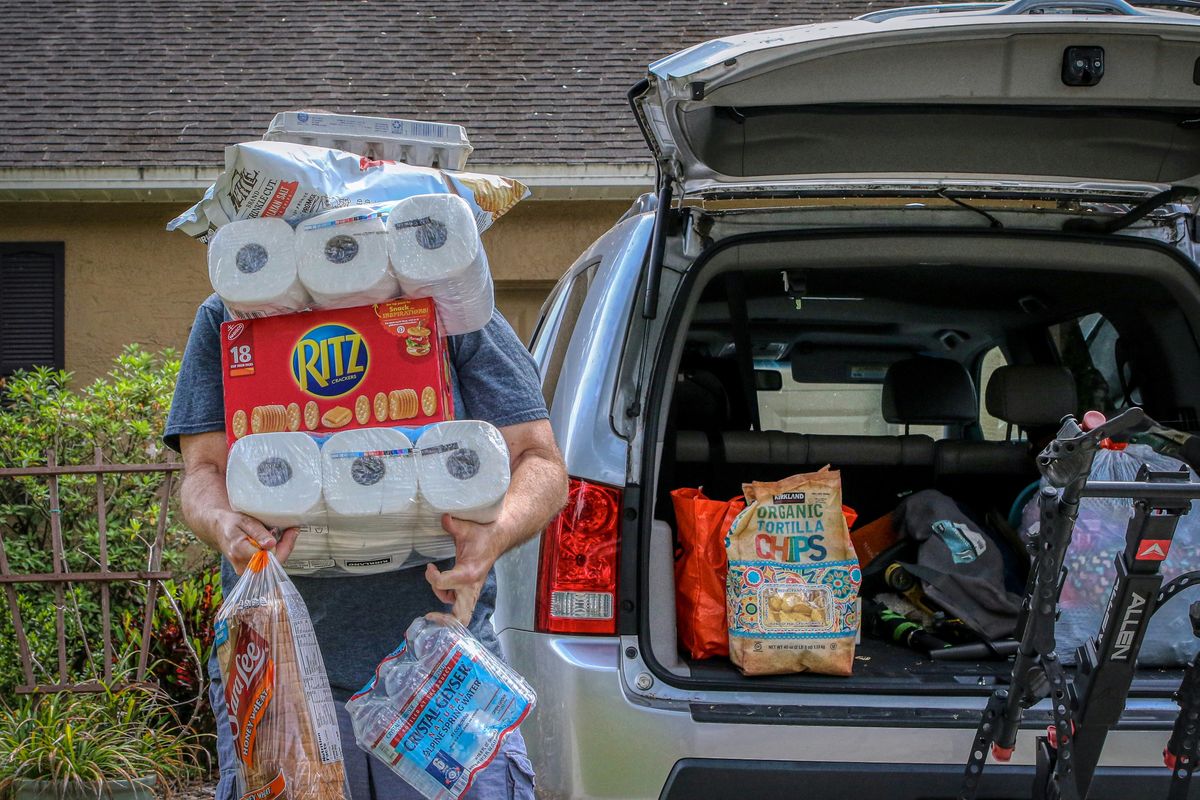
man pulling food and toilet paper out of the car

Offer to pick stuff up when you're on a grocery run.

Photo by Marek Studzinski on Unsplash

4. Run errands for them

"Hey, I'm heading out to the store, what can I grab you while I'm there?" is always a welcome phone call or text. Let them know when you're going to be running your own errands and see if there's anything they need dropped at the post office, picked up from the pharmacy, or anything else.

You can also offer to run errands with them. "Hey, I've got some errands to run. Do you want to join me?" They may have no desire to leave the house, or they may desperately want to leave the house, so be prepared for either answer, but the offer is solid. Even just not having to drive might be a relief if they have things they need to pick up or drop off places.

woman holding hands with a small child as they walk

Caring for someone's kids is one of the most helpful things you can do.

Photo by Kelli McClintock on Unsplash

5. Provide childcare

If the person is a parent, taking their kid(s) out for a chunk of the day can be a big help. Caring for yourself is hard when you're going through a difficult time, and the energy a person might use to actually do that often gets usurped by caring for others. Obviously, parents can't just neglect their children, so anything you can do to relieve them of that responsibility for a while is gold.

Offering to take the kids to do something fun—a day at the park, ice skating, etc. is even better. A parent knowing their kid is safe, occupied, and happy is its own form of relief.

6. Ask what they're struggling with and focus your help there

While all of these practical household things are helpful, there might be some people who find comfort or solace in doing those things themselves. If that's the case, talk with them about what their immediate needs are and what they're having a hard time dealing with. Then focus your energies there. "What can I do to help?" may not be as effective a question as "What are you having a hard time doing right now?" They may not know what kind of help they need, but they probably know how they're struggling.

One person might be lonely and just want some company. Another person might need a creative outlet or a mindless distraction or something physical like going for a walk or a hike. Someone else might have pets they need help caring for, a garden that needs tending, or the oil changed in their car. Someone might even need a person to serve as a shield or buffer between them and all the people coming to offer their condolences.

Note that many of these things are basic life maintenance stuff—those are often the things that get hard for people when they're dealing with the emotional and logistical stuff surrounding whatever they're going through, and they're often the easiest things other people can do for them. A time of crisis is not a normal time, so normal etiquette, such as asking if you can or should do something rather than just letting them know you're going to do it, doesn't always apply.

If there's a specific thing with specific tasks, such as planning a funeral, that might be a good opportunity to ask how you can help. But people deep in the throes of grief or struggle often need someone to take the reins on basic things without being asked to. Again, there's a good chance they feel like they're drowning, so don't wait for an invitation. Just grab the life preserver, put it around them and do whatever needs to be done to get them to shore.

Note: This advice is especially relevant now as Californians struggle with the Wildfire Crisis. In light of many losing their homes, possessions, and loved ones, knowing how to help and what to do might be even more difficult. Check out our Community Resource Guide for ways to offer aid and relief to those impacted.


This article originally appeared last year.

discussion, debate, disagreement, conversation, communication, curiosity

How do you get someone to open their minds to another perspective?

The diversity of humanity means people won't always see eye to eye, and psychology tells us that people tend to double down when their views are challenged. When people are so deeply entrenched in their own perspectives they're refusing to entertain other viewpoints, what do we do?

Frequently, what we do falls into the "understandable but ineffective" category. When we disagree with someone because their opinion is based on falsehoods or inaccurate information, we may try to pound them with facts and statistics. Unfortunately, research shows that generally doesn't work. We might try to find different ways to explain our stance using logic and reasoning, but that rarely makes a dent, either. So often, we're left wondering how on Earth this person arrived at their perspective, especially if they reject facts and logic.


According to Stanford researchers, turning that wondering into an actual question might be the key.

discussion, debate, disagreement, conversation, communication, curiosity Questions are more effective than facts when it comes to disagreements.Photo credit: Canva

The power of "Tell me more."

Two studies examined how expressing interest in someone's view and asking them to elaborate on why they hold their opinion affected both parties engaged in a debate. They found that asking questions like, "Could you tell me more about that?” and ‘‘Why do you think that?" made the other person "view their debate counterpart more positively, behave more open-mindedly, and form more favorable inferences about other proponents of the counterpart’s views." Additionally, adding an expression of interest, such as, ‘‘But I was interested in what you’re saying. Can you tell me more about how come you think that?” not only made the counterpart more open to other viewpoints, but the questioner themselves developed more favorable attitudes toward the opposing viewpoint.

In other words, genuinely striving to understand another person's perspective by being curious and asking them to say more about how they came to their conclusions may help bridge seemingly insurmountable divides.

discussion, debate, disagreement, conversation, communication, curiosity Asking people to elaborate leads to more open-mindedness.Photo credit: Canva

Stanford isn't alone in these findings. A series of studies at the University of Haifa also found that high-quality listening helped lower people's prejudices, and that when people perceive a listener to be responsive, they tend to be more open-minded. Additionally, the perception that their attitude is the correct and valid one is reduced.

Why curiosity works

In some sense, these results may seem counterintuitive. We may assume that asking someone to elaborate on what they believe and why they believe it might just further entrench them in their views and opinions. But that's not what the research shows.

Dartmouth cognitive scientist Thalia Wheatley studies the role of curiosity in relationships and has found that being curious can help create consensus where there wasn't any before.

“[Curiosity] really creates common ground across brains, just by virtue of having the intellectual humility to say, ‘OK, I thought it was like this, but what do you think?’ And being willing to change your mind,” she said, according to the John Templeton Foundation.

discussion, debate, disagreement, conversation, communication, curiosity Curiosity can help people get closer to consensus. Photo credit: Canva

Of course, there may be certain opinions and perspectives that are too abhorrent or inhumane to entertain with curious questions, so it's not like "tell me more" is always the solution to an intractable divide. But even those with whom we vehemently disagree or those whose views we find offensive may respond to curiosity with more open-mindedness and willingness to change their view than if we simply argue with them. And isn't that the whole point?

Sometimes what's effective doesn't always line up with our emotional reactions to a disagreement, so engaging with curiosity might take some practice. It may also require us to rethink what formats for public discourse are the most impactful. Is ranting in a TikTok video or a tweet conducive to this shift in how we engage others? Is one-on-one or small group, in-person discussion a better forum for curious engagement? These are important things to consider if our goal is not to merely state our case and make our voice heard but to actually help open people's minds and remain open-minded in our own lives as well.

Brendan Fraser, Saving Superman, Kelly Clarkson, autism
Images via Wikicommons and IMBD

Brendan Fraser and Jonathan Charbonneau

As an actor, Brendan Fraser can strip down to his core and expose the most vulnerable aspects of humanity. (His heart-wrenching work in Darren Aronofsky's film The Whale earned him a well-deserved Best Actor Oscar at the 2023 Academy Awards.)

So, it's not surprising when he gets emotional discussing things near and dear to his heart—like autism awareness. In past interviews, Fraser has been very open about his son Griffin's diagnosis and the unexpected beauty that came with it. In a 2022 piece for Interview Magazine, Fraser shared, "And because of the beauty of his spectrum—call it a disorder if you will, I disagree with you—he knows nothing of irony. He doesn't know what cynicism is. You can't insult him. He can't insult you. He's the happiest person and is, in my life and many others', also the manifestation of love."


The documentary short film Saving Superman www.youtube.com, Switchboard Magazine

In 2024, Fraser co-executive produced the award-winning short documentary film Saving Superman. It tells the heartwarming story of Jonathan Charbonneau, a man in his fifties on the spectrum who loves to dress up as the DC comic book character. As seen in the film, he delightfully appears around his hometown of Glen Ellyn, Illinois, to play music and greet the community. In the movie, Charbonneau shares why he was specifically struck by Superman, which he learned about on Sesame Street. "I believe in the ideals he represents. There's only one reason why he does 'no mischief,' let alone anything criminal or evil. He chooses not to out of respect for morale."

On an recent appearance on The Kelly Clarkson Show in November 2025, Fraser tearfully discusses the film and explains how the community in Glen Ellyn wholesomely came together to raise money for Charbonneau after finding out he was not going to be able to afford rent once his apartment building got sold. (In the film, it's relayed that his dear friend started a GoFundMe which went viral around the world.)

Fraser tells Clarkson, "I'm the dad of a son with special needs. I want to be a part of it and for that reason—we need to do well by everyone who has a family on the spectrum. We need more services available to them. And I do know that he's the hero that we need right now." Getting choked up, Fraser then tearfully hugs Clarkson.

This has struck such a deep chord in the community, as exemplified by the comments on The Kelly Clarkson Show (@KellyClarksonshow) Instagram Reel. Many people praise Fraser for his kindness, but also relay tales of Jonathan firsthand. One fan writes, "I grew up and came back to live in Glen Ellyn. Everyone knows Jonathan aka Superman here. He's a staple in our community and we are lucky to have him. Glad he's getting the support he very much deserves."

Another commenter echoes this warm acknowledgement. "As soon as his picture came up in this video, I audibly went 'Superman!!' My family is from Glen Ellyn, and I worked in downtown in my late teenage years. Jonathan is a staple!" They later add, "While GE isn't my hometown, I have spent a lot of time there, and don't remember him NOT being in town."

This comment reflects pure love for Fraser: "And I was thinking I couldn't love this man more. He just proved me wrong! He is simply wonderful!"

And this Instagrammer is especially impressed with Fraser using his platform to effect change, writing, "Thank you for using your voice & speaking for those that need it the most 💙 we have more that united us than divides us after all."

Science

Her groundbreaking theory on the origin of life was rejected 15 times. Then biology proved her right.

Lynn Margulis had the audacity to challenge Darwin. And we're lucky she did.

lynn margulis, lynn margulis symbiosis, biology, scientific breakthroughs, darwin, darwinism, women in science
Facts That Will Blow Your Mind/Facebook

A photo of Lynn Margulis.

Throughout her prolific and distinguished career, biologist Lynn Margulis made several groundbreaking contributions to science that we take for granted as common knowledge today. For example, she championed James E. Lovelock’s “Gaia concept,” which posited that the Earth self-regulates to maintain conditions for life.

But by far, her most notable theory was symbiogenesis. While it was first written off as “strange” and “aesthetically pleasing” but “not compelling,” it would ultimately prevail, and completely rewrite how we viewed the origin of life itself.


In the late 1960s, Margulis wrote a paper titled "On the Origin of Mitosing Cells," that was quite avant-garde. In it, she proposed a theory: that life evolved through organisms merging together to become inseparable.

In essence, cooperation is the driver of life, not competition and domination. This directly went against Darwin’s “survival of the fittest” principle that was considered gospel in scientific circles. Margulis’ paper was rejected by fifteen journals before getting accepted into the Journal of Theoretical Biology.

- YouTube www.youtube.com

Time would be on Margulis’ side, however. By the late ‘70s and early ‘80s, research proved that the two major building blocks of plants and animals, chloroplasts and mitochondria were at one time independent bacteria. This solidified the fact that on a biological level, connection trumps autonomy for longevity. And now that fact is written in textbooks, with no real story of the adversity it overcame to get there.

While it is customary for most new scientific theories to be met with criticism, especially those that completely shift the current narrative, many have noted that sexism played a key part in Margulis’ initial lack of acceptance. On more than one occasion, she herself had hinted that women were seen as mothers and wives first, and scientists second. She recalled that while married to fellow scientist Carl Sagan that “Carl would finish his sentence, unperturbed” while she was expected to “handle all the duties of a 1950s housewife, from washing dishes to paying the household bills.”

And yet, Margulis would have other ideas that were controversial that had nothing to do with her gender. Most famously, she did not believe that AIDS was caused by HIV, and instead believed it was cause by a syphilis-causing type of bacteria, despite there already being decades of research proving otherwise. That view was seen as an endorsement of AIDS denialism, which undermined prevention and treatment effort. Then later in life, Margulis became a vocal proponent of 9/11 conspiracy theories suggesting government involvement the in Twin Towers attacks.

And yet, perhaps this is one of those “you gotta take the good with the bad” situations. Margulis’ inherent contrarian nature gave us both these unfounded, even harmful stances, in addition to entirely new paradigms that altered our understanding of life itself.

And if nothing else, it illuminated the need for science to include multiple points of view in order to unlock the truth. It seems life is, after all, about coming together.

Pop Culture

In 1968, Vanilla Fudge played a blistering, dark cover of The Supremes' 'You Keep Me Hangin' On'

It's the musical version of an athlete "leaving it all out on the field."

vanilla fudge, vanilla fudge live, ed sullivan show, rock music, the supremes

Vanilla Fudge on "The Ed Sullivan Show" in 1968.

In 1966, The Supremes scored a massive hit with "You Keep Me Hangin' On," written by Brian Holland, Eddie Holland, and Lamont Dozier. The Supremes' arrangement has an iconic Motown bounce, even though the song is about a woman who's heartbroken after being breadcrumbed by her man.

Vanilla Fudge, a psychedelic rock band from Long Island, New York, had a history of slowing down pop tunes to expose their true meaning, and "You Keep Me Hangin' On" was a perfect song to dig deeper into.


"We used to slow songs down and listen to the lyrics and try to emulate what the lyrics were dictating," drummer Carmine Appice said, according to Far Out Magazine. "That one was a hurtin' song; it had a lot of emotion in it."

Vanilla Fudge plays "You Keep Me Hangin' On" on The Ed Sullivan Show

The band gave an electrifying performance of the song in January 1968 on The Ed Sullivan Show, and it was not only a thoroughly inventive take on The Supremes' song, but also one that featured elements of early heavy metal, driven by Appice's bombastic drumming. The take-no-prisoners performance is raw, emotional, and dark for a family TV show in the '60s. It's the musical version of an athlete "leaving it all out on the field."

- YouTube www.youtube.com

Appice recalled being incredibly nervous after an elevator operator at the studio told him the show was watched by around "50 million" people. But he quickly relaxed once the band kicked in.

"Then afterwards, it went off so amazing, everyone was claiming, and there were reviews in the newspapers and radio, even TV, was saying that it was the most amazing performance that anyone ever did on Ed Sullivan," he told Music Night At The Majestic. "Because it was so dynamic. So emotional."

"You Keep Me Hangin' On" made a comeback on TV and in film

Vanilla Fudge's version of the classic has enjoyed a renaissance over the past few decades, playing a pivotal role in the final episode of The Sopranos and in season seven of Mad Men. The song perfectly captures the tortured spirit of Don Draper as he contemplates how he lost his way while sitting in the cold.

- YouTube www.youtube.com

The song also set the emotional tone for the climactic encounter between Brad Pitt's character, Cliff Booth, and the Manson Family in Quentin Tarantino's masterpiece, Once Upon a Time… in Hollywood.

"That was pretty cool! And it definitely helped with our streaming numbers. A lot of young people found out about the song that way," vocalist and keyboardist Mark Stein told Houston Press. "And Tarantino did his own edit on it. He's a real music guy."

Tarantino has a long history of taking fantastic songs from the '60s and '70s that weren't necessarily classic rock or oldies staples and bringing them back into the public consciousness. He reintroduced Stealers Wheel's "Stuck in the Middle with You" after it was featured in a horrific scene in Reservoir Dogs.

- YouTube www.youtube.com

Tarantino put the spotlight back on Chuck Berry's "You Never Can Tell" in Pulp Fiction during the Jack Rabbit Slim's Twist Contest.

- YouTube www.youtube.com

In Jackie Brown, "Across 110th Street" by Bobby Womack plays during the film's opening credits as we're introduced to the titular character.

- YouTube www.youtube.com

Vanilla Fudge's rendition of "You Keep Me Hangin' On" is a great reminder that some songs are so great they can be interpreted in multiple ways—either as a pop radio hit by a girl group or as a dirty freak-out by a proto-metal band. Some songs have such strong DNA that they can be powerful in any context.

spray tans, spray tan, spray tan care, hygiene after spray tan, how to make spray tan last, truth behind spray tans
Photo credit: Canva
Woman is disgusted after learning the truth behind lasting spray tans.

Spray tans are seemingly the perfect answer for people who want a summer glow year-round. Not only is the application time quick (some take as little as 5 minutes), sprays tans also deliver sun-kissed skin without excessive UV exposure, essential for reducing the risk of skin cancer and premature excess wrinkles.

If you've never had a spray tan before, you may have lots of questions like: how long does a spray tan last? How do you care for your skin after getting a spray tan? And how can you make your spray tan last longer?


These are exactly the queries a woman on TikTok named Miss Redacted had after getting her first spray tan. But when given the instructions for how to extend the life of her spray tan through "proper care," she was left flabbergasted.

Spray tan aftercare

Spray tans take time to "develop" on the skin, so she was not surprised to receive the rundown on making sure her skin remained glowingly sun-kissed for as long as possible. What she wasn't expecting was the lack of care. Or maybe the better description would be the lack of hygiene required to maintain her newly tanned skin.

"Recently I got a spray tan for the first time because I really like being tan but I don't want to have wrinkles later because I'm obviously very vain. So I went the first time and I expected that I wouldn't be able to shower normally for the first 12-24 hours, and that didn't bother me that much because I'm like, okay, I understand the tan has to set in. I can be gross for a half a day, a day max, whatever, it's not that serious," Miss Redacted says before explaining the woman who did her spray tan began talking her through the process.

- YouTube www.youtube.com

The confused woman recalls a roommate in college who used to get spray tanned all the time as she put the pieces together on hygiene and spray tans. She tells the person doing her spray tan that she generally showers twice a day using soap and a silicone scrubber to wash her entire body, to which the spray tan artist immediately tells her not to use the scrubber on her body because it will take her tan off.

"I was like, 'Oh so don't use it the first shower?' and she was like 'No, like not at all.' And I was like 'What should I use instead of that?'" the first-time customer explains.

She was shocked to hear the artist tell her that she needed to switch to a washcloth and only use it to wash her, "underarms, your bikini area, and under your bra line." Again, Miss Redacted clarifies that means for the first shower only, but the artist reiterates not to put soap on your body "at all" for the first shower, only using a washcloth in the areas she previously mentioned. Once again, the woman was dumbfounded and asks again, what the spray tan artist means.

spray tan spray tans, spray tanning, fake tan, how long do spray tans last A woman gets a spray tan applied to her skin.Photo credit: Canva

"Because I got down this rabbit hole, I started reading about it on Reddit and some of the ways that girls were saying they maintained their spray tans is absolutely insane. Absolutely insane. Like y'all need a bath. Y'all need a...actually a hose down. Let's like put you in the yard with some Dawn, like you're one of the ducks in an oil spill. I think that's what's needed at this point," the woman jokes before clarifying that she doesn't think every woman getting spray tanned is avoiding bathing.

But when it comes to the ick factor over the ones who have been skipping the shower for weeks at a time, the woman isn't the only one feeling the heebie jeebies. Commenters are also shocked and a little grossed out.

This article originally appeared two years ago. It has been updated.