10 super simple acts of self care that make a big difference—especially in times of stress
Doing even one of these things could turn a bad day around.

Feeling overwhelmed? Take a walk outside.
Regardless of what you're going through, self-care is important.
I once read something that said, "It's not the hard times that define you, it's how you respond." One important tool when it comes to dealing with personal challenges is self-care.
What is self-care? The University of Kentucky's Student Affairs Center describes self-care as "[A]ny intentional actions you take to care for your physical, mental, and emotional health."
In times of stress, trauma, or crisis, practicing self-care can help manage your health.
While self-care isn't the be-all and end-all to dealing with stress, it can be a valuable recovery tool. Here are a few self-care suggestions from Crisis Clinic.
1. Exercise — even a little bit.

A woman stretches on a yoga mat.
Photo by Dane Wetton on UnsplashDon't worry, we're not talking about running a marathon here. Your form of exercise can be as light or as intense as you want it to be. Don't have access to a gym? No problem! Take a walk around the block, try a yoga routine on YouTube, climb the bleachers at your local high school track, go window-shopping at the mall, or give your home a speedy power clean. There are tons of ways to get your endorphins pumping, and any number of them can have a positive impact on your mood.
2. Give yourself permission to focus on someone outside yourself.
Making someone else feel good is a great way to lift your own spirits. Try volunteering or call up an old friend or family member you haven't talked to in a while and brighten their day.
3. Give and get physical touch: A hug can do wonders.

Good hugs require you to really get in there.
Photo by Tani Eisenstein on Unsplash4. Give yourself permission to feel bad: Schedule it in your day. Remind yourself that your reactions are normal.
Sometimes the worst thing you can do when you're feeling down is to beat yourself up for feeling down. Remember you're human and everyone has good days and bad days.
5. Give yourself permission to feel good.
Everyone's feel-good solution is different. Just be careful and make sure not to partake in activities that could cause harm to yourself or anyone else. Get some ice cream, watch your favorite movie, or laugh at a fart joke! Sometimes when we're going through something difficult, we keep ourselves from experiencing joy because we don't think it's appropriate or we think we don't deserve it. Remember that it's OK to laugh and feel good during times of sadness, even if it's only for a moment.
6. Structure your time and develop a routine.
Finding time for friends, family, work, play, and everything in between can be difficult, even on your best days. Too often when we're extremely busy or stressed, we forget to make time for even simple things like lunch or quiet time. To make things easier on yourself, try setting alarms on your phone or online calendar for everything from meetings and appointments to taking your vitamins. There are also tons of productivity apps you can use to set for daily, weekly, and even hourly goals if needed. Not a fan of digital scheduling? Try a paper planner or giant laminated calendar to help organize and structure your days.
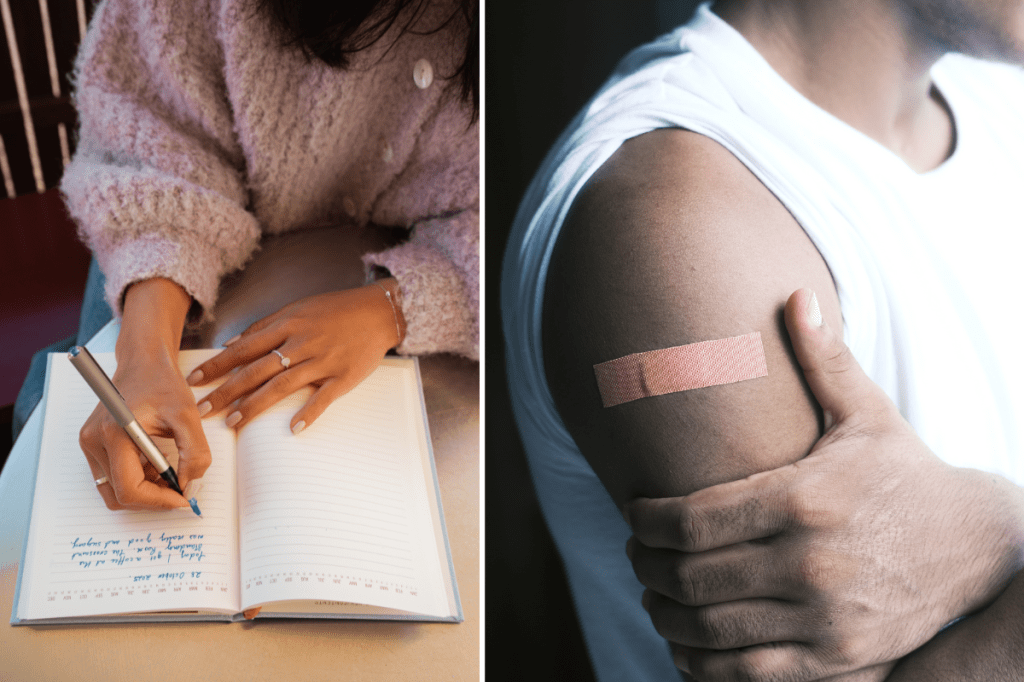
7. Engage in practices that are meaningful to you, such as prayer, walking in the woods, sitting quietly, reading inspirational material, taking a bath, or writing in a journal.

It's always a good time to check in with yourself.
Photo by Darius Bashar on Unsplash8. Take breaks from periods of isolation.
Everyone needs alone time now and then, but try setting a timer for yourself so you can get some fresh air and connect with others.
9. Talk it out — even with a professional.
Don't have health insurance or access to a health care professional? There are tons of free resources that can connect you with someone online or by phone. Check out yourlifeyourvoice.org for videos, articles, and local resources for people struggling with depression. Also, the Crisis Clinic (the wonderful organization behind this self-care list) has a 24-hour hotline.
10. Get plenty of rest so that you feel refreshed and relaxed.
Don't underestimate the power of a good night's sleep! If you have trouble sleeping at night, try turning off the TV and electronic devices like your cell phone and computer at least one hour before you want to go to bed. A cup of hot (decaf) tea before bed can be helpful. Also, things like regular exercise, stretching, and calming music can help your body successfully power down before bedtime.
Self-care shouldn't just be for the tough times. Make it a habit worth keeping.
The tricky thing about self-care is that when you're feeling down, exercising or going to see a doctor is usually the last thing on your mind. That's why it's important to make self-care a part of your daily life. Self-care can be an important tool for times of crisis, but it's much easier to implement if you're taking care of yourself during the good times, too.
This article originally appeared on 12.22.15
- Using just a glass of water, a professor teaches a powerful lesson about letting go ›
- How pilots deal with stress can teach us all something about the importance of self-care. ›
- Stress is an epidemic among our kids. 7 experts give 8 tips on how to help. ›
- What to say instead of 'let me know if you need anything' - Upworthy ›
- Wellness experts breaks down myths about spending money on self-care - Upworthy ›
- Wellness expert explains what 'self-care' really is and it's far from what we've been sold - Upworthy ›
- Why certain sounds don't just annoy me, they enrage me. Here's how I learned to cope with my Misophonia - Upworthy ›
- What to say instead of 'let me know if you need anything' - Upworthy ›


A woman is getting angry at her coworker.via
A man with tape over his mouth.via
A husband is angry with his wife. via 
a man sitting at a desk with his head on his arms Photo by
Can a warm cup of tea help you sleep better? If you believe it, then yes. Photo by 
Three women sit on a blanket in the park. 
Two women engaging in a pleasant conversation inside a coffee shop
Two men engaging in a peaceful disagreement.
Resurfaced video of French skier's groin incident has people giving the announcer a gold medal
"The boys took a beating on that one."
Downhill skiing is a sport rife with injuries, but not usually this kind.
A good commentator can make all the difference when watching sports, even when an event goes smoothly. But it's when something goes wrong that great announcers rise to the top. There's no better example of a great announcer in a surprise moment than when French skier Yannick Bertrand took a gate to the groin in a 2007 super-G race.
Competitive skiers fly down runs at incredible speeds, often exceeding 60 mph. Hitting something hard at that speed would definitely hurt, but hitting something hard with a particularly sensitive part of your body would be excruciating. So when Bertrand slammed right into a gate family-jewels-first, his high-pitched scream was unsurprising. What was surprising was the perfect commentary that immediately followed.
This is a clip you really just have to see and hear to fully appreciate:
- YouTube youtu.be
It's unclear who the announcer is, even after multiple Google inquiries, which is unfortunate because that gentleman deserves a medal. The commentary gets better with each repeated viewing, with highlights like:
"The gate the groin for Yannick Bertrand, and you could hear it. And if you're a man, you could feel it."
"Oh, the Frenchman. Oh-ho, monsieurrrrrr."
"The boys took a beating on that one."
"That guy needs a hug."
"Those are the moments that change your life if you're a man, I tell you what."
"When you crash through a gate, when you do it at high rate of speed, it's gonna hurt and it's going to leave a mark in most cases. And in this particular case, not the area where you want to leave a mark."
Imagine watching a man take a hit to the privates at 60 mph and having to make impromptu commentary straddling the line between professionalism and acknowledging the universal reality of what just happened. There are certain things you can't say on network television that you might feel compelled to say. There's a visceral element to this scenario that could easily be taken too far in the commentary, and the inherent humor element could be seen as insensitive and offensive if not handled just right.
The announcer nailed it. 10/10. No notes.
The clip frequently resurfaces during the Winter Olympic Games, though the incident didn't happen during an Olympic event. Yannick Bertrand was competing at the FIS World Cup super-G race in Kvitfjell, Norway in 2007, when the unfortunate accident occurred. Bertrand had competed at the Turin Olympics the year before, however, coming in 24th in the downhill and super-G events.
As painful as the gate to the groin clearly as, Bertrand did not appear to suffer any damage that kept him from the sport. In fact, he continued competing in international downhill and super-G races until 2014.
According to a 2018 study, Alpine skiing is a notoriously dangerous sport with a reported injury rate of 36.7 per 100 World Cup athletes per season. Of course, it's the knees and not the coin purse that are the most common casualty of ski racing, which we saw clearly in U.S. skier Lindsey Vonn's harrowing experiences at the 2026 Olympics. Vonn was competing with a torn ACL and ended up being helicoptered off of the mountain after an ugly crash that did additional damage to her legs, requiring multiple surgeries (though what caused the crash was reportedly unrelated to her ACL tear). Still, she says she has no regrets.
As Bertrand's return to the slopes shows, the risk of injury doesn't stop those who live for the thrill of victory, even when the agony of defeat hits them right in the rocks.