
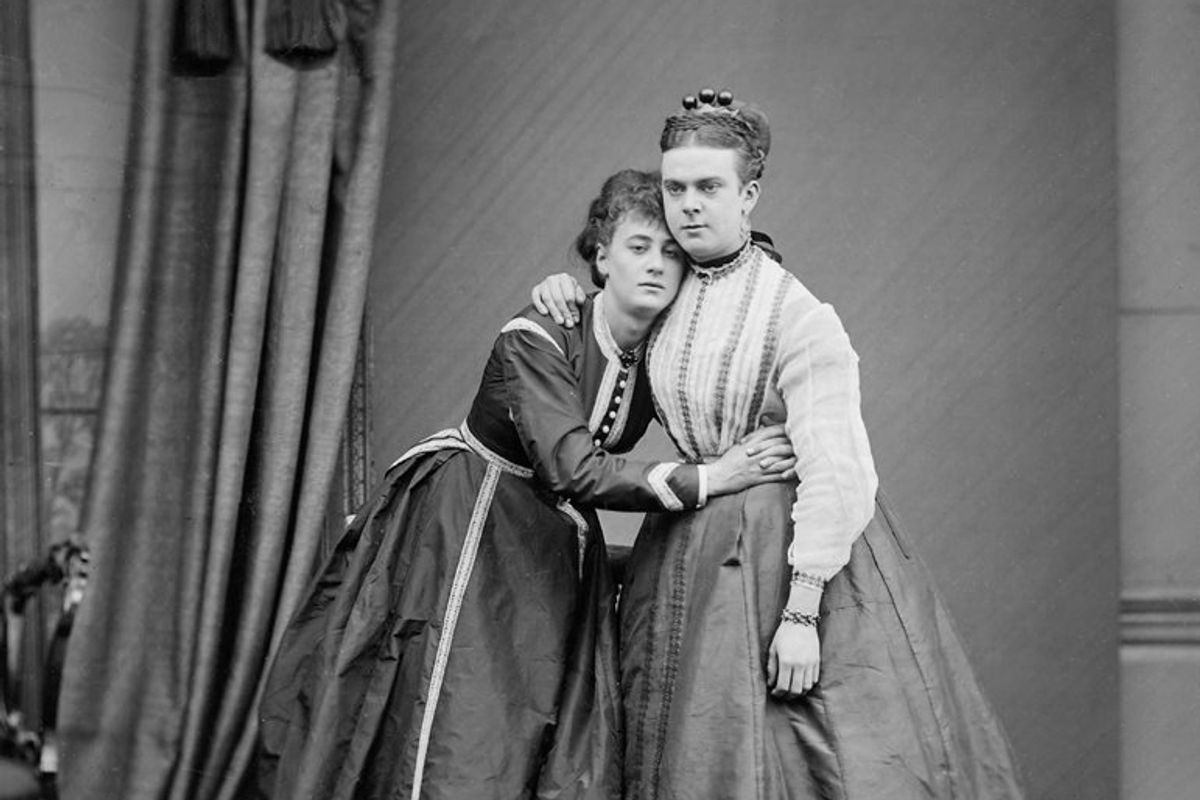
Frederick William Park and Thomas Ernest Boulon, aka Fanny and Stella.
Officially, there were no homosexual men in Victorian England.
But that's just because the word "homosexual" didn't enter the language until the mid-to-late 1890s. ("Transsexual" and "transgender" would catch on even later.)
There were, however, men who engaged in sexual and/or romantic relationships with each other. They just didn't identify with the same words we use today; in fact, many of them used a special cant-like, crypto-language called Polari in order to communicate without exposing themselves in public.
While the rest of society was struggling to define and understand them, they went about with their usual business, living their lives regardless of words.
Consider the case of Frederick William Park and Thomas Ernest Boulton — also known as Fanny and Stella, respectively.
The duo met while working as actors around London, where there was a longstanding tradition in the theater of men cross-dressing to perform as women. Fanny and Stella appeared onstage as sisters, but Park and Boulton carried these identities offstage as well, cavorting at parties and in public.
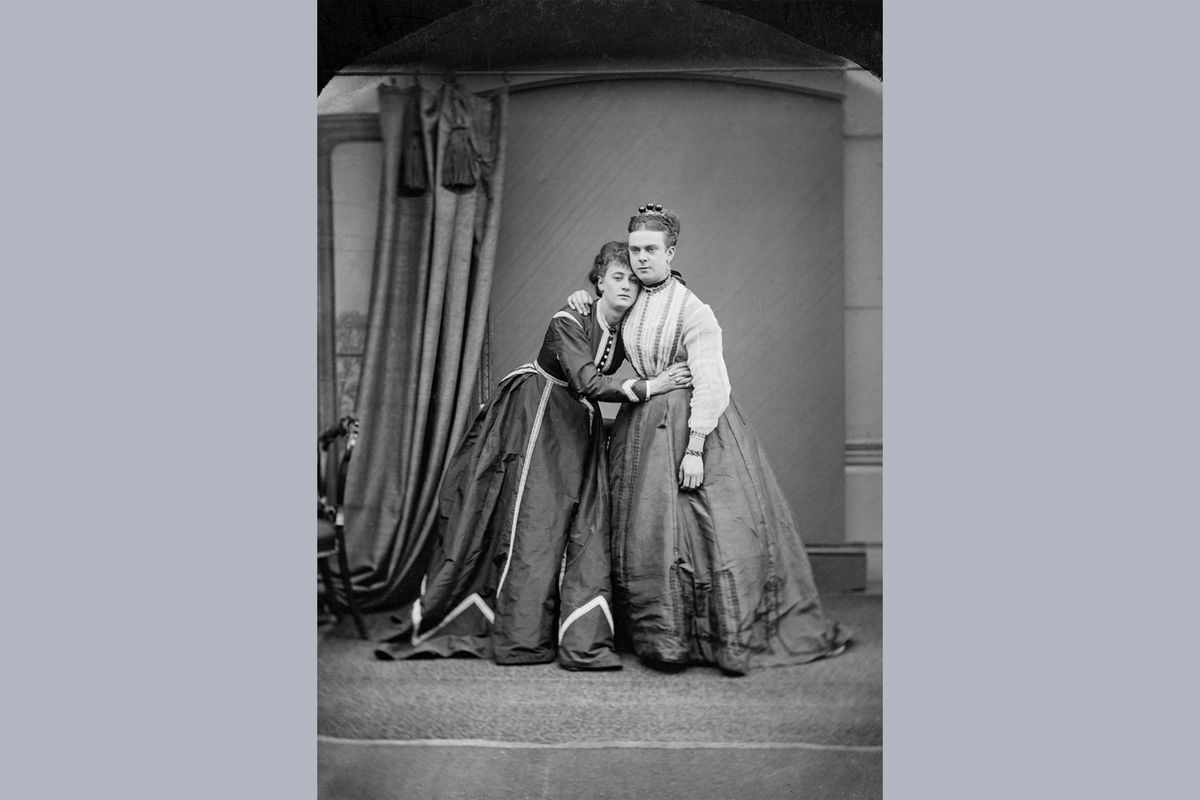
Fredrick and Thomas pose in an embrace as Fanny and Stella.
Photo via Frederick Spalding/Wikimedia Commons.
Boulton, whose affinity for women's clothing and dreams of femme stardom stretched back to childhood, had a live-in relationship with Lord Arthur Clinton, a naval officer and the son of the 5th duke of Newcastle. Park, on the other hand, was the son of a judge. While it's not clear whether he was involved sexually with either Boulton or Clinton, he was known to have a written correspondence with Clinton in character as Fanny.
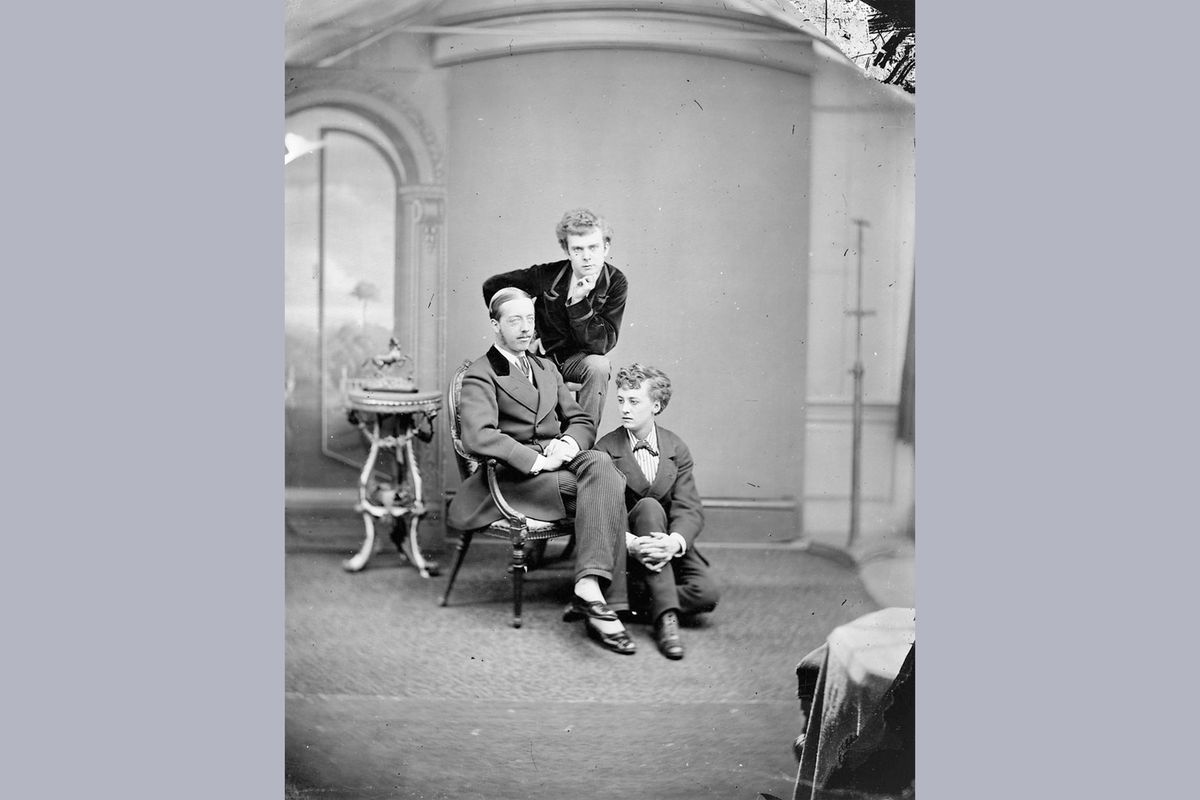
Clinton, Boulton, and Park pose for a photograph.
Clinton, Boulton, and Park. Photo via Frederick Spalding/Wikimedia Commons.
Things started to get messy when Fanny and Stella were arrested outside of London's Royal Strand Theatre on April 28, 1870.
Their alleged crime? "Conspiring and inciting persons to commit an unnatural offense" with the other men they were accompanying. Lord Clinton was also indicted in the scandal but tragically died before it went to trial, possibly by suicide.
When the case reached the court, the prosecution faced a difficult challenge. There was nothing technically illegal about a man wearing a dress in public, and it was impossible to prove someone guilty of "being gay or transgender" when the words didn't yet exist. Thus, the only potentially punishable offense for which Fanny and Stella could be tried was sodomy.
Fanny and Stella stood before a judge in their best evening gowns while doctors presented physical evidence of sodomy. Even the public at the time thought the spectacle was ridiculous, and the two were ultimately acquitted by a jury.
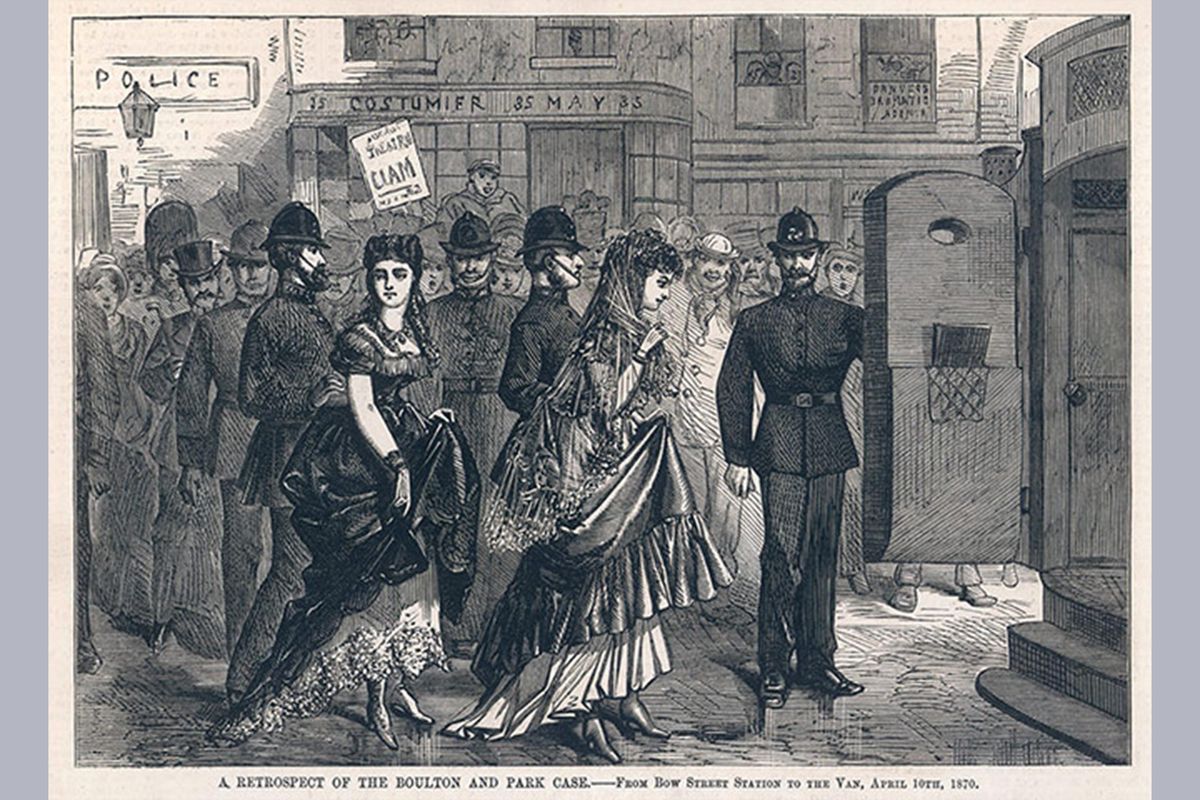
A drawing depicting both Fredrick and Thomas being arrested in 1870.
Image via The Illustrated Police News/Wikimedia Commons.
In 1880, Victorian values were once again scandalized by the "disgraceful proceedings" of a so-called "drag ball" in Manchester.
The private event on Sept. 24, 1880, at the city's Temperance Hall was organized by a group calling themselves the Pawnbrokers' Assistants' Association. They took numerous precautions to protect the guests' identities, including a bouncer at the door dressed as a nun, black paper on the windows, and a blind accordion player to provide the party's music with plausible deniability.
Somehow, Detective Jerome Caminada, who's believed to be the inspiration for Sherlock Holmes, caught wind of the occasion. The sneaky sleuth reportedly observed "men dressed in the most fantastic fashion, and eight of them in the garb of women."
The police waited until the early hours of the morning to raid the party and ended up arresting nearly 50 people for the crime of "having solicited and incited each other to commit an unnameable offense" — again, because there was nothing explicitly illegal about "being queer and dancing the can-can."
In the end, most of the defendants were forced to pay a bond in a promise to the court for 12 months of "good behavior."
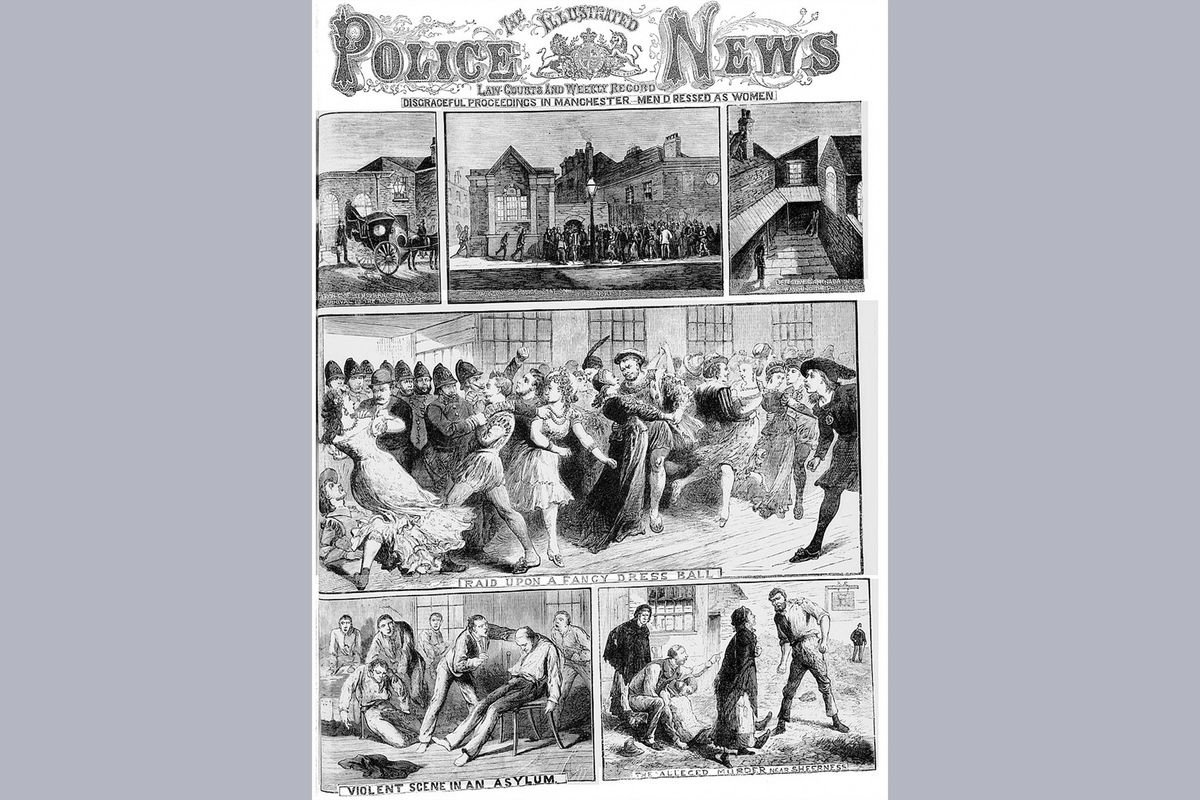
A cartoon published in the Police News talking about the incident.
Image via Wikimedia Commons.
Five years later, the U.K. passed the Criminal Law Amendment Act of 1885, which made "gross indecency" punishable by prison time.
Member of Parliament Henry Labouchère realized that if they were ever going to bring charges against queer men, trying to legally prove they engaged in sodomy wasn't the answer.
Labouchère came up with the vaguely defined term gross indecency, which basically meant any kind of physical sexual contact between two people with penises that the court deemed "gross." (There was no comparable law against queer women.) The new law was tacked onto an amendment about the age of consent.
Perhaps the most famous charge of gross indecency was against Oscar Wilde, who served two years hard labor in Reading prison, from which he never quite recovered. The British codebreaker and computer science progenitor Alan Turing was also charged with gross indecency in 1952. As punishment, he was chemically castrated; 50 years later, the British government acknowledged the action was grossly inhumane.
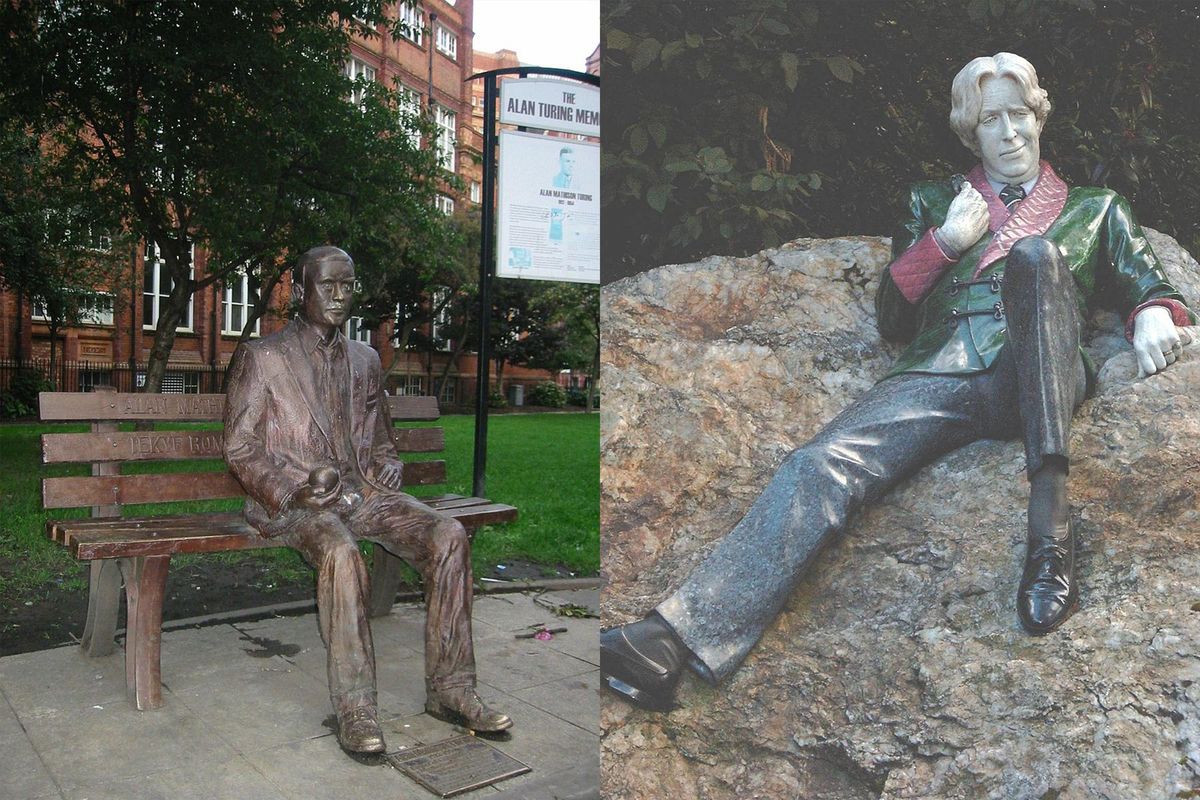
Statues made in honor of mathematician Alan touring and writer Oscar Wilde respectively.
Photos via Lmno/Wikimedia Commons and Sandro Schachner/Wikimedia Commons.
(Left) The Alan Turing memorial in Sackville Park, Manchester, and the Oscar Wilde memorial in Merrion Square, Dublin.
Sex between two consenting British males was finally decriminalized in 1967 — but anti-gay laws stayed on the books in Scotland and Northern Ireland until the 1980s.
It still took until 2010 for the U.K. to secure most other rights for LGBTQ people, including adoption, marriage, and protection from discrimination.
The fight for sexual and gender equality has been long and arduous, but one thing is certain: Queer people have always been here, regardless of what they were called at various times in history.
Naming things is how we give them power. The words we use today make it easier for us to see and to accept identities that have always been present for what they truly are: essential parts of the human experience.
This article originally appeared on 12.21.16

 A Baby Boomer garage filled with stuff.


 A van travels down the road.
  A person plays the guitar.
  A man smiles.
  A damaged vehicle sits on the side of a road.