

In 2012 — when he was just 18 — Dutch inventor and entrepreneur Boyan Slat gave his first TEDx Talk about cleaning up the ocean .
In his talk, he laid out his idea for cleaning up the Great Pacific Garbage Patch, an enormous and still-growing island of plastic and other trash hanging out in the north Pacific ocean between California and Hawaii.
The Great Pacific Garbage Patch was first discovered in 1997 by sailor and ocean researcher Charles Moore when he was participating in the Transpacific Yacht Race.
Trash collects in that particular spot because of a gyre — a swirling vortex of ocean currents — in the north Pacific that draws marine debris together. A recent Ocean Cleanup study found that the patch, consisting largely of plastic pieces, fishing nets, and other human refuse, is 4 to 16 times larger than previous estimates. It is now twice the size of Texas, or three times the size of France.
Charles Moore estimated that it would take 79,000 years to clean it up. Boyan Slat, however, said he believed that with the right technology and approach, the garbage patch could be gone in just five years.
Not only that, but he could clean it in way that had minimal environmental impact and was actually profitable when all was said and done.
Boyan Slat's Ocean Cleanup Foundation will officially begin cleaning up the Great Pacific Garbage Patch in summer 2018. Photo via Ocean Cleanup Foundation.
Was this remarkable claim youthful naivety? Wishful thinking? Idealism run amok?
Apparently not. Slat's foundation is set to launch the largest ocean trash collection ever this summer.
Since starting the Ocean Cleanup Foundation in 2013, Slat has been working tirelessly to study the issue and develop the technology to clean it up.
It's one thing to come up with an idea — it's something else entirely to see that idea through in the long term.
Slat has spent the past six years studying the ocean's gyres and the Great Pacific Garbage Patch to better understand the scope of the issue and develop the most effective means for collecting the trash. The Ocean Cleanup Foundation is an impressive full-time operation with more than 70 engineers, researchers, scientists, and computer modelers working daily to rid the ocean of plastics.
Did I mention Slat was 18 when he founded the project? I don't remember exactly what I was doing when I was 18, but it definitely wasn't building a foundation to solve a major global problem. This young man's intelligence, ingenuity, and initiative blows my mind.
And I'm not the only one. In 2014, Slat became the youngest-ever recipient of the UN's highest environmental award, Champion of the Earth. And Time magazine named the Ocean Cleanup's Ocean Vacuum prototype as one of the Best Inventions of 2015.
The official cleanup is scheduled to begin in the summer of 2018. Slat predicts they'll be able to collect half the plastic in the patch in just five years.
Yes, he originally said he thought the whole thing could be cleaned up in five years, but considering the exponential growth of the garbage patch in the past six years and the additional information they've collected since then, I think half in five years ain't bad.
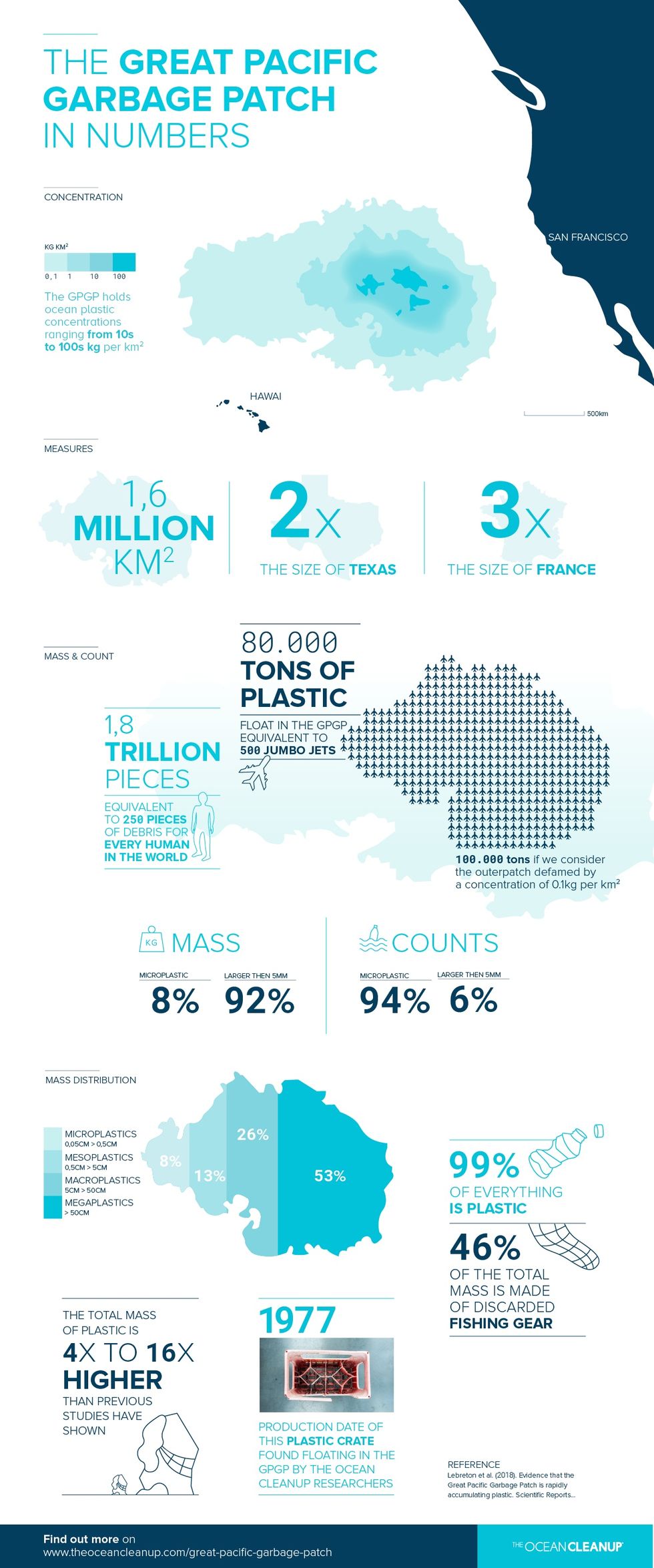 Image via The Ocean Cleanup Foundation.
Slat and his team have found that the Great Pacific Garbage Patch contains approximately 1.8 trillion pieces of plastic. That's 241 pieces for every human on Earth. Some of it breaks down into smaller pieces, but it always remains, threatening marine life, birds, and ultimately humans as we consume seafood.
"It's really quite safe to say," said Slat, "that it's worse than we thought."
However, Slat remains optimistic and upbeat as he describes the process the foundation has gone through to get to where they are now.
One thing they've learned is that "to catch the plastic," you have to "act like the plastic." The Ocean Cleanup machinery uses the ocean's own currents and the physics of how plastic gathers and moves in order to collect it passively, without using unnecessary energy, effort, or resources.
I'm not a scientist, and I'm not going to begin to describe the cleanup technology beyond that, but you can check out the details here and in this unveiling of the Ocean Cleanup prototype, where Slat explains how it all works:
As a person who loves the ocean — not to mention inspiring people — I'll be following Slat's cleanup project closely. With so many environmental protections being dismantled in the U.S., it's refreshing to see people focused on solving problems — and it's especially awesome to see it being done so well.
Here's to the dedicated folks working to save the environment and better our world. And here's to the young people who keep showing us how it's done.
- Moms are sharing what their homes really look like - Upworthy ›
- This company lets you eliminate plastics from your cleaning, beauty, and personal care products - Upworthy ›
- 13-year-old accepted into medical school - Upworthy ›
- The Ocean Cleanup uses a fence to catch tsunami of trash - Upworthy ›
- Great Pacific Garbage Patch has become home to marine life - Upworthy ›
- Mom of world’s youngest Mensa member reveals the 3 ways they realized they had a mini-genius - Upworthy ›

 A Generation Jones teenager poses in her room.Image via Wikmedia Commons
 A van travels down the road.
  A person plays the guitar.
  A man smiles.
  A damaged vehicle sits on the side of a road.


 Welcome to North Carolina State Line!
 Smiling together: "The Lord Willing and the Creek Don’t Rise."
 Surprised cat faces an idiom shock!
 Feeling under the weather with a warm cup in hand.
 "Fluffy biscuits and a sassy Southern saying!"
 Two women in a park having a tense conversation.
 "Tight pants, revealing every curve and thought."
 "Bright as a Box of Black Crayons" - a humorous twist on brightness.