upworthy
Add Upworthy to your Google News feed.
Google News Button
Pop Culture

People are sharing the adult problems that 'nobody prepared you for' and they're so true

Here are 21 of the most relatable.
being an adult, adult lessons, growing up
via PixaBay

Being an adult is tough.

Nothing can ever fully prepare you for being an adult. Once you leave childhood behind, the responsibilities, let-downs and setbacks come at you fast. It’s tiring and expensive, and there's no easy-to-follow roadmap for happiness and success. A Reddit user asked the online forum, “What’s an adult problem nobody prepared you for?” and there were a lot of profound answers that get to the heart of the disappointing side of being an adult.

One theme that ran through many responses is the feeling of being set adrift. When you’re a kid, the world is laid out as a series of accomplishments. You learn to walk, you figure out how to use the bathroom, you start school, you finish school, maybe you go to college, and so on.

However, once we’re out of the school system and out from under our parents’ roofs, there is a vast, complicated world out there and it takes a long time to learn how it works. The tough thing is that if you don’t get a good head start, you can spend the rest of your life playing catch-up.

Then, you hit middle age and realize that life is short and time is only moving faster.

Adulthood also blindsides a lot of people because we realize that many adults are simply children who grew older. The adult world is a lot more like high school than a teenager could ever imagine.

The Reddit thread may seem a bit depressing at first, but there are a lot of great lessons that younger people can take to heart. The posts will also make older people feel a lot better because they can totally relate.

Being an adult is hard, exhausting and expensive. But we’re all in this together and by sharing the lessons we’ve learned we can help lighten each other's load just a bit.

Here are 21 of the most powerful responses to the question: “What is an adult problem nobody prepared you for?”

1. Lack of purpose

"Lack of purpose. All your young life you are given purpose of passing exams and learning, then all of a sudden you are thrown into the world and told to find your own meaning," — Captain_Snow.

2. No bed time

"You can stay up as late as you want. But you shouldn't," — geek-fit

3. Friendships

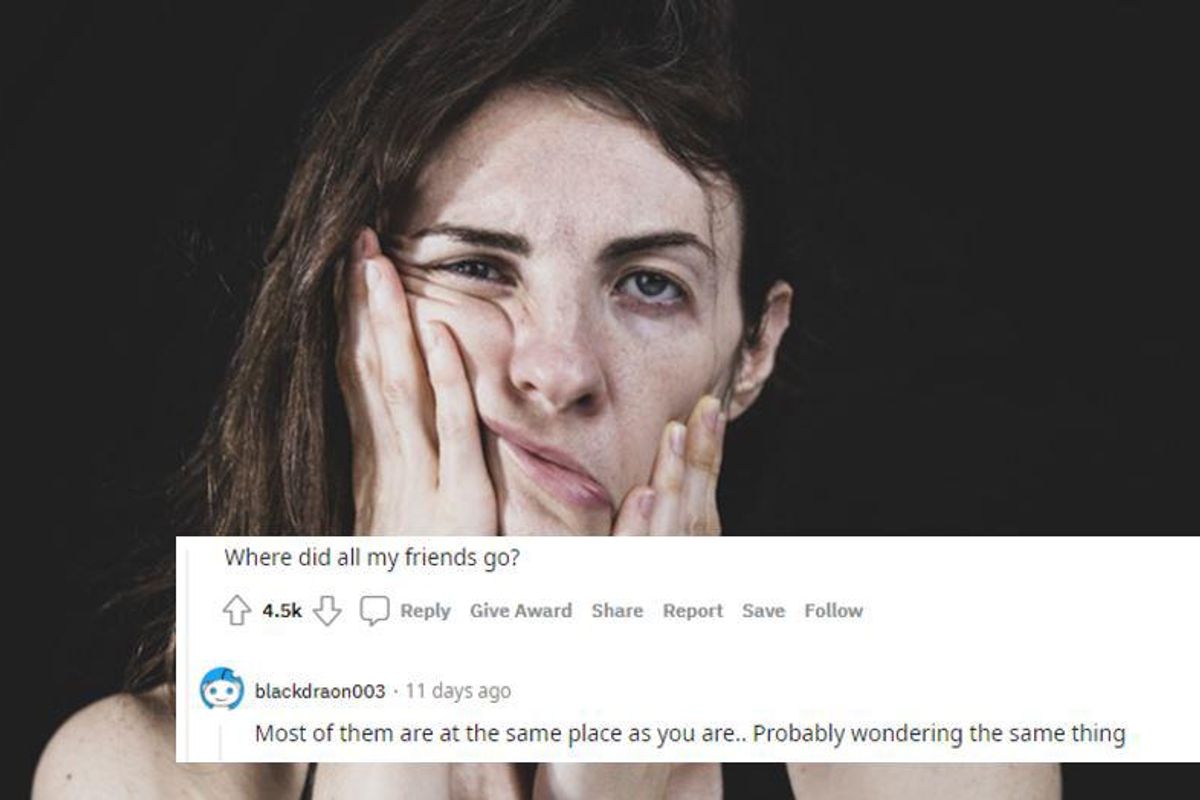
"Where did all my friends go?" — I_Love_Small_Breasts

Most of them are at the same place as you are ... Probably wondering the same thing," — Blackdraon003

4. Bodily changes

"I'm closer to fifty than forty, would have been nice to be better prepared for some of the ways your body starts to change at this point that don't normally get talked about. For instance your teeth will start to shift from general aging of your gums," — dayburner.

5. People don't change

"Didnt know that other adults have the emotional intelligence of teenagers and its almost impossible to deal with logically," — Super-Progress-6386

6. Money

"$5K is a lot to owe, but not a lot to have," — Upper-Job5130

7. Our parents age, too

"Handling the decline and death of your parents," - Agave666

8. Free time

"Not having a lot of free-time or time by myself," — detective_kiara

9. No goals

"Not having a pre-defined goal once I was out of college. Growing up my goals were set for me: get through elementary school! then middle school! Then high school, and get into college and get a degree, then get a job, and then...? Vague "advance in your career, buy a house, find a spouse, have a kid or multiple, then retire." At 22 I had no idea how to break that down more granularly," — FreehandBirdlime

10. Constant upkeep

"Life is all about maintenance. Your body, your house, your relationships, everything requires constant never ending maintenance," — IHateEditedBGMusic

11. Exhaustion

"Being able to do so many things because I'm an adult but too tired to do any of them," — London82

12. Loneliness

"Being an adult feels extremely lonely," — Bluebloop0

13. Dinner

"Having to make dinner every. Fucking. Day," — EndlesslyUnfinished

14. Time changes

"The more life you’ve lived, the faster time seems to go," — FadedQuill

15. You're responsibile, even if you didn't mean it

"You are held to account for bad behaviour for which you are negligent even if you had no intention to cause harm. As a lawyer, I see this all the time. People don't think they're responsible for mistakes. You are," — grishamlaw

16. Work is like high school

"The intricacies of workplace politics," — Steve_Lobsen writes. "

"When you're in school, you think that you won't have to deal with gossiping and bullying once you leave school. Unfortunately, that is not true," — lady_laughs_too_much

17. Nowhere to turn

"How easy it is to feel stuck in a bad situation (job, relationship, etc) just because the cost and effort of getting out can seem daunting. And sometimes you just have to accept a figurative bowl full of shit because you can't afford to blow up your life," — movieguy95453

18. The happiness question

"Figuring out what makes you happy. Everyone keeps trying to get you to do things you're good at, or that makes you money, but never to pursue what you enjoy," — eternalwanderer5

19. Constant cleaning

"The kitchen is always dirty. You’ll clean it at least three times every day," — cewnc

20. Life costs money

"One adult problem nobody prepared me for is how expensive everything is. I always thought that as an adult I would be able to afford the things I wanted, but it turns out that's not always the case! I've had to learn how to budget and save up for the things I want, and it's been a difficult process," — Dull_Dog_8126

21. Keeping above water

"All of it together. I was relatively warned about how high rent is, car bills and repairs, how buying healthy food is expensive as hell but important for your health, how to exercise and save what you can, my parents did their best to fill in my knowledge about taxes and healthcare and insurance that my schooling missed, about driving and cleaning a household, about setting boundaries at work but working hard and getting ahead if you can, about charity and what it means to take care of a pet and others, about being a good partner if you were lucky enough to have one, about how dark and messed up the world is when you just read the news and what all that means to me and my community… I was reasonably warned about all of it.

"No one could have ever prepared me for how hard doing all of it at the same time and keeping your head above that water would actually be," — ThatNoNameWriter


This article originally appeared two years ago.

time, neil degrasse tyson, time flies, perception of time. clock, science,

A clock and Neil deGrasse Tyson.

When you’re a kid, time passes a lot more slowly than when you’re an adult. At the age of seven, summer seems to go on forever, and the wait from New Year’s Day to Christmas feels like a decade. As an adult, time seems to go faster and faster until one weekend you’re putting up your Christmas lights though you swear you just took ‘em down a month ago.

Why does time seem to speed up as we get older? Astrophysicist Neil deGrasse Tyson recently explained the phenomenon in a video posted to Instagram. He also offered tips on how to slow the passage of time as you age. DeGrasse Tyson is one of the most popular science communicators in the world and the host of 2014's Cosmos: A Spacetime Odyssey and 2020’s Cosmos: Possible Worlds.


Why does time appear to speed up as we get older?


“When you're young, everything is new. Your brain is constantly recording fresh memories, and the more memory your brain stores, the longer the experience feels. But then something changes. As you get older, routines take over. Your brain stops saving so much detail. It switches to autopilot because everything feels familiar and predictable,” deGrasse Tyson explains. “And when your brain stores fewer new memories, your perception of time compresses. That's why childhood feels long, and adulthood feels like a blur.”


Steve Taylor, PhD, author of many best-selling books including Time Expansion Experience, The Leap, and Spiritual ScienceThe Leap, and Spiritual Science, agrees with deGrasse Tyson.

“This is mainly because, as children, we have so many new experiences, and so process a massive amount of perceptual information,” Taylor writes at Psychology Today. “Children also have an unfiltered and intense perception of the world, which makes their surroundings appear more vivid. However, as we get older, we have progressively fewer new experiences. Equally importantly, our perception of the world becomes more automatic. We grow progressively desensitized to our surroundings. As a result, we gradually absorb less information, which means time passes more quickly. Time is less stretched with information.”

How do we make time slow down?

There’s something a little depressing about the idea that time speeds up as we age because we have fallen into predictable routines. The good news is that we can break this cycle by changing our habits and having new experiences. The more novel information we can process and the less routine our lives become, the slower time will move.

DeGrasse Tyson believes that with some change in our behaviors, we can get back to longer summers and Christmases that aren’t perpetually around the corner.

“You can actually slow time down again. Do something unfamiliar,” deGrasse Tysons says. "Travel somewhere new. Break a routine you've repeated for years. Learn a skill your brain hasn't mapped yet. Because the more new memories your brain forms, the slower time feels as it passes. So if life feels like it's accelerating, it's not your age. It's your brain, and you can reboot it.”

women's volleyball, sports, athletes, hair ties, ponytails

It's hard to keep a ponytail in place through a whole volleyball game—or at least it used to be.

Over a decade ago, head coach Jerritt Elliott noticed a problem with his volleyball players. Frequently, during practices, the women would have to stop and adjust their hair, pulling their ponytails tighter, replacing a broken hair tie, or otherwise fixing an issue.

According to ESPN, rather than complain about the problem, Elliott decided to tackle it head on. In 2013, he set out to learn everything he could about long hair and the challenges of keeping a ponytail in place through intense athletic activity. He interviewed friends, former players, and even Olympic athletes about their experiences with hair ties. Some complained about how they didn't hold. Others complained about headaches or damaged hair. Elliott spent $80 buying every kind of hair tie his athletes might use to see how they were made and how they functioned.


"People that know me know that I have a wild brain," he told ESPN. "I'm very entrepreneurial."

Through all of this research, he came up with an idea: A very long, thin elastic that could be wrapped around a ponytail as many times as necessary to get the desired hold. He didn't know if he had a great idea or not, but he soon found out.

Around the time Elliott was developing the idea, he met the woman he would later marry—Italian volleyball player Andrea Nucete. Elliott gave her a prototype of his hair tie idea, which she tossed into her car's glove compartment and forgot about.

"I was like, 'Why would I tie my own hair tie? What is the benefit? I don't trust the bald guy,'" she told ESPN.

But after two hair ties broke during a beach volleyball game, she remembered Elliott's tie in her car and gave it a try.

"I used the entire 34-inch version of the product, put it in my hair, called him right after," she said. "I say, 'We have something here. 100%. This is different.'"

The couple worked for four more years to perfect the product, trying out various combinations of elastic and fabric to see what would meet the desired criteria of strong enough to hold the hair securely yet soft enough not to cause damage. They ultimately landed on a rubber core covered in a woven fabric sheath that would expand and retract without grabbing individual hairs.

- YouTube www.youtube.com

In 2018, Elliott and Nucete got married and officially launched their TIY Products business.

The TIY hair tie comes in two lengths, 34 inches and 51 inches, the latter of which is designed to be used with the Pro 2.0 cutting case, which allows users to trim their TIY ties to any size they wish. The cost is significantly higher than a standard hair tie—$8.50 for one standard-length TIY—but Nucete-Elliott told ESPN she knows players who have used the same TIY through all four years of their NCAA volleyball careers. It's not something one can say for your average hair tie.

Players seem to love it.

"You put it in at 8 a.m. one day, and the rest of the day, through a game, it stays in place. You don't have to think about it," TCU middle blocker Sarah Sylvester told ESPN.

"I feel like it's definitely made the process easier and made my hairstyles look cleaner," said Louisville setter Nayelis Cabello. "And it matches my game-day outfit, so that makes it 10 times better." (The TIY comes in 35 different colors.)

The TIY has been making its way around to other women's sports, partially thanks to players sharing them on TikTok.

@sydney_parrishh

TIY making its way to womens basketball 👀👀👀 #tyi #hairtok #hairstyle #wbb #womensbasketball #volleyball #indiana #iu #hair #hairtie #ponytailtutorial

In a 2019 PureWow review of hair ties, the TIY got strong ratings from editors who struggled to get a good fit out of other hair ties. "The adjustable sizing is a game changer, especially for working out or if you need something strong," said one editor. The only complaint was that it was hard to make it look neat: "It’s tricky to master, so the finished result can look unkempt." That may not matter as much on the court, though, and it seems that the less-polished look of the tie has become standard to see in women's sports.

"As women, we have different hair textures and hair types," says Nucete-Elliott in a TIY video, "so we created something that is 13 times stronger, twice as stretchy than a regular elastic, and it's customizable so that you can adapt it to your hair and be able to be used in any aspect of your life."

It's pretty wild that one of the best products we've seen for long hair originated with a man who doesn't even have any.

You can find TIY Products and learn more about them here.

snl, christmas, holidays, satire, comedy, kristen wiig, saturday night live, humor, youtube, christmas presents, moms
SNL/YouTube

Classic SNL Christmas sketch has people rethinking the holiday dynamics in their family.

Five years ago, one of the most iconic Christmas sketches ever aired on Saturday Night Live. It's called simply, "Christmas Robe," and it depicts an average American family excitedly waking up on Christmas morning, running to the tree, and opening their presents. In song form, each member of the family takes turns rapping about their own gift haul: A hat, a drone, a pinball machine...

Except for poor mom, played perfectly by Kristen Wiig, who only got a robe—that was 40% off. Things only get worse for Mom as she discovers that her stocking is also empty and she must now go make the family breakfast while everyone plays with their new gifts.


If you haven't seen it, here it is. It's well worth watching in its entirety:


- YouTube www.youtube.com

The sketch got a lot of laughs and resonated deeply with people—especially moms—who watched it.

It's no big secret that moms are the primary makers of Christmas magic in most Western families. While they get joy out of making the holidays special for their families, it's a lot of exhausting work, made worse when it goes unnoticed and unappreciated. It's implied, of course, that Kristen Wiig's character bought everyone their presents while no one in the family bothered to think of her at all.

Jessica Cushman Johnston writes for Motherly: "[Making Christmas magic] is not something my husband or my kids put on me, it’s my own deal. It’s also a tinsel-covered baton handed down from generation to generation of women. As a kid, I just thought the warm fuzzy feelings I felt on Christmas morning 'happened.' Now I know that the magic happens because someone is working hard, and now that someone is me."

Kristin Wiig's character beautifully says it all with the dead-inside expression as she feigns excitement over her lonely robe. In just two and a half minutes, the cast and writers managed to capture a frustrating feeling that millions of women relate to.

The sketch spawned discussions, think pieces, and even parodies when it aired in 2020. Real moms took to social media to "show off" their own robes in an act of solidarity. The sketch had, one could say, a moment. And then, quietly, it retired and took its place in the SNL holiday hall of fame, destined to be re-watched for years to come.

And then something funny happened. People kept tuning in. The skit continued to reach new viewers, and somewhere along the line, a few people actually learned something from the extremely silly sketch.

Saturday Night Live's YouTube and social media are full of comments from viewers who say the sketch opened their eyes in a very real way. And even better, that they're changing their behavior because of it:

"As a retail worker, I actually heard multiple people reference this sketch while buying presents for their wife/mom this year. Thanks SNL!"

"This skit changed Christmas in our house. The year it aired my husband made sure I didn’t get a robe and since this aired (okay, two Christmases have gone by) it’s a joy to see boxes under the tree and a full stocking- now in our house when I’m forgotten my husband says, “you got a robe” and adjusts the situation. Never thought a skit could change my life."

"I just saw this first time. I'm definitely going to buy better present next Christmas to my mom."

"A few years ago, I got a robe. This year, I got a new iPad plus all the accessories. SNL doing all the moms a solid."

"As a grown man, this skit is the first time I've realized how true this is. And now I feel so damn awful :( Gonna bombard moms with the presents this year"

"Seriously! I got a bunch more stuff for my mom after seeing this! It's so accurate. No more robes for mom!"

"I was laughing at this, then realized my mom's stocking was empty and ran out and bought her a truckload of stuff. Love you Mom!"

"Thanks, SNL. After watching this with the family, I had the most bountiful Christmas ever!! And the gifts were wrapped instead of left in the bags the came in."

"This video did more to stimulate spending on Moms this year than almost anything else, guaranteed. Look at SNL actually making a difference with their humor"

The comments go on and on, with the video now reaching over 12 million views. Some moms changed their behavior, too, after seeing the sketch:

"This is spot on, and exactly why I now buy myself Christmas presents, without feeling guilty about it."

The trouble of moms unfairly shouldering too much labor around the holidays (and, well, most other times of the year) is not a new problem. Not by a long shot. So why has this skit reached people when other forms of messaging has failed to sway them?

Marie Nicola, a pop culture historian and cultural analyst, says that no amount of deeply serious essays or shrugged off "mom is complaining again" can fix what satire easily addresses. That's the power of comedy at its best:

"It allows the audience see what was historically unseen or ignored, and it validates the labour as visible and concrete, without being accusatory because it wraps the whole thing up in camp comedy and exaggeration. The skit makes it safe to laugh. This is what psychologists call benign violation," she says. "SNL is showing viewers that something is wrong but they have made it safe enough that people can laugh at it instead of feeling attacked. Once the defenses drop, then recognition can flow through that opening."

The Humor Research Lab writes that humor occurs when an accepted "norm" is violated in a benign way—that's the benign violation Nicola's referring to. "Jokes ... fail to be funny when either they are too tame or too risqué."

The best pieces of satire—the ones that reach the highest levels of cultural relevance—thread that needle perfectly. The norm, in this case, according to Nicola, is that it is "a privilege to curate the perfect holiday experience for the family, the gift is the joy in the moment and their memories for years to come." We're not allowed to talk about the dejection and exhaustion that come from all that hard work. This sketch gave a lot of people permission for the first time to do so.

It’s not the first time that SNL’s comedy and satire have had a palpable effect on how we view the world.


- YouTube www.youtube.com

Once SNL performed the "More Cowbell" sketch, none of us could look at the bizarrely overproduced "Don't Fear the Reaper" the same way again. An old Eddie Murphy sketch got a lot of laughs out of the idea of "white privilege" long before it became a commonly known concept. And people had a hard time taking Sarah Palin seriously after Tina Fey's spot-on yet over-the-top impersonation, with studies later investigating the "Tina Fey Effect's" impact on the election.

And now, the more than 12 million people who have seen "Christmas Robe" are going to have a hard time looking at Mom’s empty stocking without being reminded of Kristen Wiig’s pitch-perfect performance.

Of course, "Christmas Robe" continues to land and connect with viewers today in part because it has not solved the problem of household inequities. The phenomenon continues to exist in spades. But the fact that it’s made even a small dent is pretty remarkable for a two-and-a-half-minute parody rap song.

grandma, family, prank, humor, funny

Wholesome, harmless pranks can bring a family together.

An entire extended family pranked their matriarch in a way that's making hundreds of thousands of people celebrate. It's not an easy feat, as pranks can often come off as insensitive or they simply don't work out as intended, but in the case of Paige Kampsen's family, it was utter perfection.

Kampsen shared a video with the explanation, "Seeing how long it takes Grandma to notice us wearing her clothes." In the video, we see a large family preparing Thanksgiving dinner, milling about, chatting, and doing puzzles together while also surreptitiously going into Grandma's bedroom one by one. Every family member takes an item of clothing from her closet, puts it on, and rejoins the family in the dining room and kitchen area. Meanwhile, Grandma is bustling around, completely oblivious to her family’s antics.


That is, until she notices one unmistakable item from her closet.

The robe was too much to miss. Grandma's "What the hell?!" as she began noticing her clothing on the rest of the family was hilarious, and the way she laughed as hard as everyone else speaks to the joy of a close family with a good sense of humor.

People in the comments of the video, which has been liked over a million times, absolutely loved it:

"I'm so glad her genuine reaction was recorded. This is going to live rent free in her mind forever!! This is the best kind of carrying on 😂😂"

"Grandmas just thought everyone was finally well dressed 😂"

grandma, family, prank, humor, funny An elderly woman. Photo credit: Canva

"This is that healing laughter! You guys are rich. 💕 This kind of family connection isn’t something everyone gets to experience."

"The cutest and sweetest prank ever. What a blessed woman!"

"Formally requesting an invitation to next year’s dinner! This is hilarious!!"

"I love how it wasn't at ALL obvious until one of them wore her robe 😂"

"It took her awhile because grandmas are too busy looking at the beautiful faces to notice the clothes. ❤️"

grandma, grandparents, aging, elderly, humor Grandma power Giphy

Naturally, no family is perfect or gets along all the time, but this example of a big crew going all in to bring a smile to Grandma's face is simply delightful. People who have lots of family to spend holidays with may forget that not everyone has that in their lives, and many people wish they did.

And grandparents aren't just nice to have around (absent problematic family dynamics). Research shows that grandparents have a profound effect on the development of kids' cognitive and verbal abilities, mental health, and overall well-being.

"Recent research suggests that grandparent involvement during childhood, conceptualized as the amount of contact and emotional closeness, is positively linked to emotional development, cognitive functioning, and social adjustment in early adulthood," writes Dr. Thomas R. Verny. "The lessons learned from grandparent-grandchild relationships in childhood, especially those related to spirituality and moral development, persist into early adulthood."

And the benefits often flow both ways. Grandparent involvement in kids' lives can stave off the loneliness and isolation that is often experienced by aging adults, according to Michigan Medicine, which is a link to the mental health and overall well-being of elderly folks.

Of course, it helps if you have a grandparent who is as playful and quick to laugh as Grandma Kampsen. What a wonderful holiday memory for all of them.

Family

After 10 years of 'gentle' parenting, mother of two admits why she got it all wrong

"High warmth is beautiful. But without structure? It creates anxiety."

frustrated mom, homework, upset mom, gentle parenting, homework, child homework

A frustrated mom helps her daughter with homework.

Over the past 15 years or so, a trend known as gentle parenting has gained popularity among mostly millennial parents. The parenting style emphasizes emotional validation, empathy, respect, and understanding over punishment. Proponents of gentle parenting say it promotes healthy bonds between parent and child as well as emotional intelligence and confidence.

However, critics of gentle parenting say that it can easily slip into becoming permissive parenting, where boundaries erode. It can also lead to children growing up with difficulty following orders or anyone telling them "no."


Jaclyn Williams, a graduate student in clinical mental health counseling who specializes in child and adolescent therapy, recently kicked the parenting hornet’s nest with a viral Instagram reel in which she laments raising her two children with gentle parenting over the past 10 years.

What's wrong with gentle parenting?

In the comments, Williams recounts her journey, admitting she backslid from gentle to permissive parenting. This led to a lack of boundaries and had profound impacts on her children. One child became a people-pleaser who suppressed their real feelings, absorbed everyone’s emotions, and became withdrawn. The other became anxious, insecure, neglected, and emotionally dysregulated.

The changes became profound after Williams moved her family across the country and began easing up on the rules. "I felt like I was protecting them or really just letting them feel all their feelings, but what ended up happening was they were looking at me to help them regulate and for safety and security, not join them in their feels," Williams told Newsweek. "My kids were longing for the safety, security, and structure—a leader, so to say."

frustrated mom, child behavior, problem child, mom and phone, pulling hair A mom has her hair pulled by her child.via Canva/Photos

Seeing the results of her parenting style, Williams shifted to an authoritative style, emphasizing high warmth (connection, validation, empathy) and high structure (clear boundaries, consistent limits, natural consequences). Soon she saw her kids become less anxious, more confident, less entitled, and better at regulating their emotions.

Williams' post received significant criticism from parents who practice gentle parenting, many of whom argued that her issues stemmed from being too permissive. "Thank you for acknowledging the fact that what you did was permissive parenting, not gentle parenting. Gentle parents still hold hard boundaries," BareFootNTP wrote. But Williams stuck by her post, adding that it’s very easy for gentle parents to backslide.

Gentle parenting can become permissive parenting

"The point is to show how easily it is to slip into permissive parenting, especially when life happens. Everyone is so quick to defend gentle parenting; nobody is seeing the human side. A first-time mom trying her best, dealing with their own childhood issues, guilt, shame, anxiety, depression, and trying to raise those sweet babies better.... the point is to help others and create space for understanding, empathy, and compassion," she wrote in the comments.

Williams posted a follow-up video to double down on her change in parenting style.


In the comments, Williams noted that many gentle parents who achieved similar outcomes reached out to her. "Here's what I want you to know: You didn't mess it up," Williams wrote. "High warmth is beautiful. But without structure? It creates anxiety. And nobody told you that."