

Why lawns are pretty much the worst, and what these Nebraskans are doing about it.

money on the lawn
Have you ever thought about how much time and money you put into maintaining your lawn without getting anything back?
Grass lawns are so ubiquitous in America that they often — no pun intended — blend into the landscape. We rarely take time to consider how much of our personal and global resources lawns absorb — or why we even have them to begin with.
Lawns are actually an out-of-date cultural hangover from French aristocratic societies, a status symbol used to prove that one could afford to tend to a completely useless crop.
Though we rarely realize it, lawns are an exorbitant expense. The water consumption numbers alone are astronomical: The Environmental Protection Agency estimates that lawn care accounts for nearly 9 billion gallons of our national usage per day. Beyond water, an average American spends 73 hours on lawn and garden care every year. We also spend about $40 billion on our lawns annually while spilling over 17 million gallons of fuel refilling our equipment and using almost 10 times more chemical pesticides per acre than farmers use on crops — nearly 80 million pounds a year. All of the effort we put into our lawns makes Americans some of the world's most fastidious farmers. We're obsessed with growing a crop that yields nothing.
In the Hawley neighborhood of Lincoln, Nebraska, one resident decided to do something about all of that wasted lawn space: He tore it up.
In 2009, Tim Rinne was having second thoughts about his grass lawn — and about the possibility of food scarcity as climate change intensifies. Relying entirely on his local grocery store for food made him uncomfortable, so he decided to take matters into his own hands.
"My wife and I converted our entire property into an edible landscape. We got rid of every blade of grass and planted it with edibles or pollinator-friendly flowers," says Rinne.
After some trial and error ("a lot of it," Rinne laughs), the couple was growing potatoes, strawberries, peas, and lettuce in their home garden. They then decided to purchase two foreclosed properties on their block to expand their efforts. Thus, their new communal gardening project (affectionately dubbed the "Hawley Hamlet" after the neighborhood's name) was born.
Nearly 10 years later, more than 20 families have vegetable plots in their own yards and contribute to the community fruit plots on the Rinnes' shared property.
Hawley Hamlet is proof that edible landscaping is something anyone can do.
When asked for his best advice to those considering growing edible plants, Rinne says simply: "Start. Just get out there and try."
Even if you're not quite ready to tear up your entire lawn and go full-food on it, cordoning off a small section of your property to try your hand at an edible landscape can be just as rewarding. "Plant potatoes," says Rinne. "Just stick them in the ground and they'll grow." Or you can plant red lettuce, which thrives easily and will blend right in with the rest of the decorative plants in your front yard. "And it looks beautiful in the bowl!"
In Hawley, every trial and error along the way helped bring residents together to try something new, which was its own reward. As for making mistakes, Rinne recommends doing a modicum of research before getting started to find out what will grow best in your area. "But then again," he says, "that is why there are instructions on the seed packages."
If sustainable gardening isn't your thing, there are alternatives to lawns that require significantly fewer resources and are much friendlier to the environment than grass.
Switching a grass yard for an edible garden repurposes lawn maintenance efforts for crops that produce food. But you can also replace grass with landscaping that requires almost no maintenance. Xeriscaping is outfitting a yard with non-grass plants that subsist on very little water or even on rainfall alone.
Succulents and other dry-weather plants can be interspersed with decorative rocks as a water-efficient alternative to grass lawns.
As spring approaches, it's time to turn a critical eye on our own lawns.
For decades, Americans have accepted lawns as part of suburban life simply because it is what we've always known. But as our climate continues to change and we're required to change with it, it may be time to bid goodbye to our backyards as we know them. As Hawley Hamlet has shown, there's a fun, energy-efficient alternative waiting for us just as soon as we're willing to give it a shot.

 A Generation Jones teenager poses in her room.Image via Wikmedia Commons
 An office kitchen.via
  An angry man eating spaghetti.via
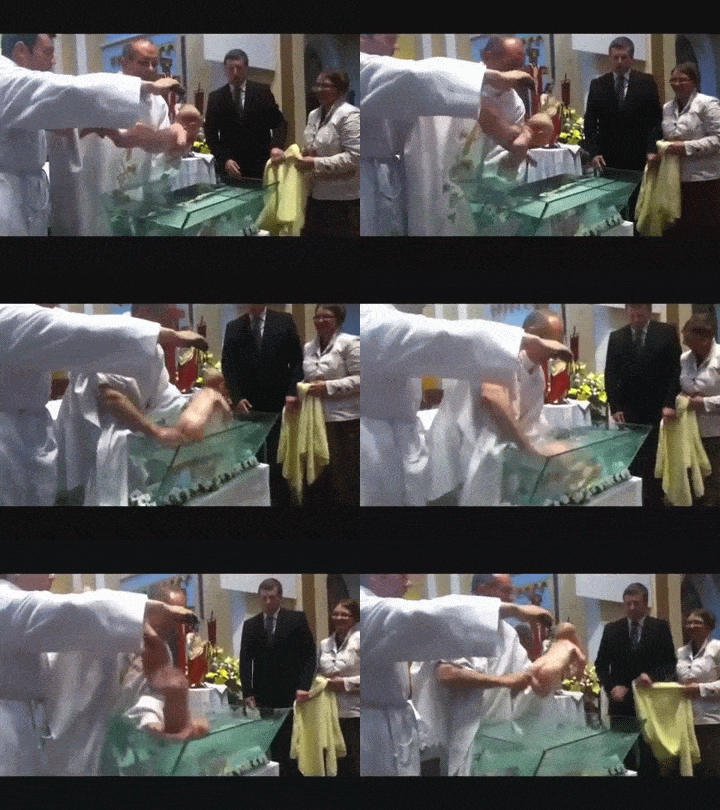 Gif of baby being baptized
 Woman gives toddler a bath Canva


An Irish woman went to the doctor for a routine eye exam. She left with bright neon green eyes.
It's not easy seeing green.
Did she get superpowers?
Going to the eye doctor can be a hassle and a pain. It's not just the routine issues and inconveniences that come along when making a doctor appointment, but sometimes the various devices being used to check your eyes' health feel invasive and uncomfortable. But at least at the end of the appointment, most of us don't look like we're turning into The Incredible Hulk. That wasn't the case for one Irish woman.
Photographer Margerita B. Wargola was just going in for a routine eye exam at the hospital but ended up leaving with her eyes a shocking, bright neon green.
At the doctor's office, the nurse practitioner was prepping Wargola for a test with a machine that Wargola had experienced before. Before the test started, Wargola presumed the nurse had dropped some saline into her eyes, as they were feeling dry. After she blinked, everything went yellow.
Wargola and the nurse initially panicked. Neither knew what was going on as Wargola suddenly had yellow vision and radioactive-looking green eyes. After the initial shock, both realized the issue: the nurse forgot to ask Wargola to remove her contact lenses before putting contrast drops in her eyes for the exam. Wargola and the nurse quickly removed the lenses from her eyes and washed them thoroughly with saline. Fortunately, Wargola's eyes were unharmed. Unfortunately, her contacts were permanently stained and she didn't bring a spare pair.
- YouTube youtube.com
Since she has poor vision, Wargola was forced to drive herself home after the eye exam wearing the neon-green contact lenses that make her look like a member of the Green Lantern Corps. She couldn't help but laugh at her predicament and recorded a video explaining it all on social media. Since then, her video has sparked a couple Reddit threads and collected a bunch of comments on Instagram:
“But the REAL question is: do you now have X-Ray vision?”
“You can just say you're a superhero.”
“I would make a few stops on the way home just to freak some people out!”
“I would have lived it up! Grab a coffee, do grocery shopping, walk around a shopping center.”
“This one would pair well with that girl who ate something with turmeric with her invisalign on and walked around Paris smiling at people with seemingly BRIGHT YELLOW TEETH.”
“I would save those for fancy special occasions! WOW!”
“Every time I'd stop I'd turn slowly and stare at the person in the car next to me.”
“Keep them. Tell people what to do. They’ll do your bidding.”
In a follow-up Instagram video, Wargola showed her followers that she was safe at home with normal eyes, showing that the damaged contact lenses were so stained that they turned the saline solution in her contacts case into a bright Gatorade yellow. She wasn't mad at the nurse and, in fact, plans on keeping the lenses to wear on St. Patrick's Day or some other special occasion.
While no harm was done and a good laugh was had, it's still best for doctors, nurses, and patients alike to double-check and ask or tell if contact lenses are being worn before each eye test. If not, there might be more than ultra-green eyes to worry about.