upworthy
Add Upworthy to your Google News feed.
Google News Button
Pop Culture

People share the 18 things that are a 'subtle sign' someone is really smart

"They effortlessly communicate complex concepts in a simple way."

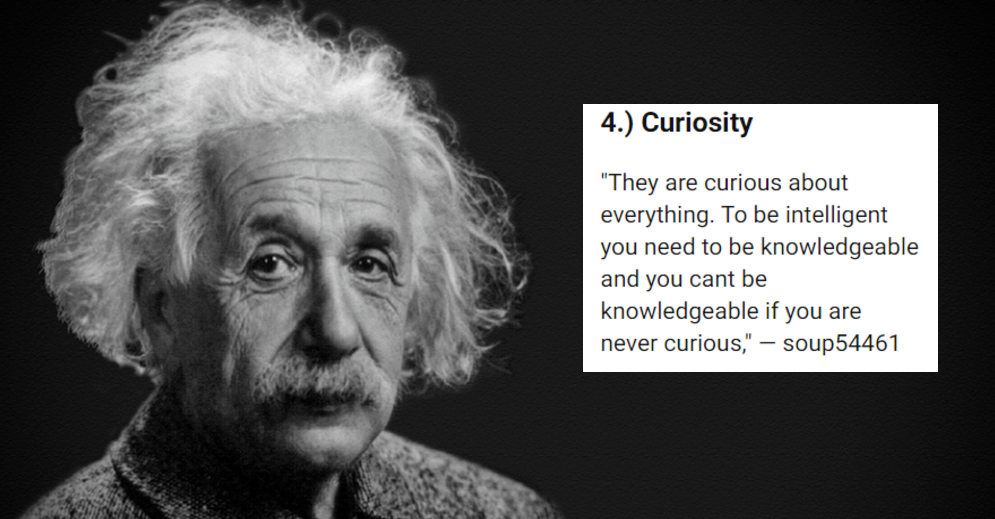
Albert Einstein beside a comment

Albert Einstein

One of the strangest things about being human is that people of lesser intelligence tend to overestimate how smart they are and people who are highly intelligent tend to underestimate how smart they are.

This is called the Dunning-Kruger effect and it’s proven every time you log onto Facebook and see someone from high school who thinks they know more about vaccines than a doctor.

The interesting thing is that even though people are poor judges of their own smarts, we’ve evolved to be pretty good at judging the intelligence of others.


“Such findings imply that, in order to be adaptive, first impressions of personality or social characteristics should be accurate,” a study published in the journal Intelligence says. “There is accumulating evidence that this is indeed the case—at least to some extent—for traits such as intelligence extraversion, conscientiousness, openness, and narcissism, and even for characteristics such as sexual orientation, political ideology, or antigay prejudice.”

Reddit user Gisgiii posed a question to the AskReddit subforum: “What is a subtle sign that someone is really intelligent?”

The answers painted a clear picture of how smart people behave: They tend to be great communicators who understand their audience and are more concerned with getting things right than being right.

Here are 18 of the best answers.

1. They draw wisdom from multiple sources.

"They draw wisdom from multiple sources. Wait but that might be more wise than intelligent... But I guess those two tend to be seen together a lot," — Puzzlehead-Engineer

2. They know their audience.

"They can switch up the way they talk to match the person they're talking to without sounding condescending. They listen to how others learn and explain it in that person's language of understanding," — Wynonna99

3. They develop a keen sense for their job.

"I used to work with a doctor - Tom Howard - and the day I realized he was a genius was the time he guessed every single condition a patient of mine had based on minute pieces of information about him," — Yodei_Mon

4. Curiosity.

"They are curious about everything. To be intelligent you need to be knowledgeable and you can't be knowledgeable if you are never curious," — soup54461

5. They're great at conveying ideas.

"When they explain something they make you feel intelligent," — gwoshmi

6. Considerate questions.

"They spend time thinking before asking a question," — ParkMan73

7. They make hard ideas simple.

"They effortlessly communicate complex concepts in a simple way," — joculator

8. They know what they don't know.

"They know when their knowledge ends and say something to the extent of 'i don't know and anything else i say on this topic is ignorant speculation,'" — blutoboy

9. They ask great questions.

"They can ask really good questions."

"Edit: to anyone not understanding what mean, I’m talking about people who ask “really good questions”, not just any questions, really good ones. I don’t know how one would achieve this skill(I know I haven’t)," — milkmanbran

10. They don't pretend to know everything.

"They aren’t afraid to say they don’t know the answer to a question," — xchernx

11. They change their minds with new information.

"They admit to changing their mind about something," — FarAwayAdventure

12. They pivot well.

"They apply knowledge from one realm into a new and relevant situation," — soubestitch

13. They are open-minded.

"They can genuinely consider an idea which opposes their worldview without necessarily accepting it," — paidshill29

14. They use analogies.

"People who use analogies to explain concepts to others. It’s a form of code-switching and integrating concepts on the fly and is a clear indicator someone is both socially and conceptually intelligent," — SwimmerAutomatic2488

15. They don't argue.

"I think intelligent people are more willing to calmly debate/discuss, rather than argue. Like, you explain to them why you disagree, and they listen to you and ask further questions about your viewpoint before offering a different perspective; as opposed to an unintelligent person, who would just resort to insults when other people disagree with them," — AngelicCinnamonBun

16. They learn from mistakes.

"Admitting when they're wrong and being willing to learn from mistakes," — siyl1979

17. A sense of humor.

"Humor. I think that truly funny people are often very smart and cognizant of the different ways an idea can be humorous on several levels. They also know their audience. I think the difference between say a Jeff Foxworthy and a Dave Chappelle and a Bo Burnham is their audience and their interests," — biscuitboi967

18. A love of learning.

"They say they love learning and they learn something new every day. Then they listen more than talk," — throwingplaydough


This article originally appeared three years ago.

shhh, quiet, zip it, mouth closed, say nothing, be quiet

A woman zipping up her lips.

There are times to speak up, moments when it’s best to say nothing, and opportunities be very considerate in your response. But when you’re on the receiving end of a back-handed compliment, a foolish remark, or a coworker takes you down a peg, and your emotions are up, it can be hard to have a thoughtful response. Often, we say something we shouldn’t.

How is it that some folks fly off the handle and say things they’ll later regret, while others can stay calm and remove themselves from the situation or take the high ground? One way to be less impulsive with your words is to use the “name it to tame it” neuroscience hack, originally coined by author and psychiatrist Dr. Dan Siegel. When used properly, it allows you to step back from the moment and choose the best response in a challenging situation.


shhh, quiet, zip it, mouth closed, say nothing, be quiet A man saying "be quiet."via Canva/Photos

How to use the ‘name it to tame it’ hack

When someone upsets you, the first thing to do is to go inside yourself and describe the emotion that you feel in your body. Are you angry? Are you sad? Are you afraid? Do you feel rejected? Are you disappointed? The moment you name the emotion, it will begin to subside and give you the emotional and mental room to respond to the person who caused the negative emotion, rather than impulsively reacting.

How to respond to a reactive emotion so you don’t fly off the handle:

Event happens:

1. Your body stiffens up

2. You feel an intense emotion

3. You examine the emotion and give it a name: “My body is telling me I am angry.”

4. You should feel the emotion beginning to subside

5. Choose your response instead of being impulsive

shhh, quiet, zip it, mouth closed, say nothing, be quiet A woman zipping up her mouth.via Canva/Photos

Why does ‘name it to tame it’ work?

“Name it to tame it” works because, when we have a strong emotional reaction, our lizard brain kicks in, and we go into fight, flight, or freeze mode. The lizard brain is not known for giving thoughtful and strategic responses to challenging situations. When we name the emotion, our prefrontal cortex, or the thinking brain, kicks in. The thinking brain looks at the situation and says, “Alright, we don’t need to run or fight here. It's best to give a strategic response.”

When we tune into the negative emotions by naming them, they relax because they feel heard, like when a child has hurt their knee or a loved one has real concern and you gives them undivided attention. Once the emotions are named, they are tamed. Then, you are more likely to respond to the negative person with grace and speak from the best part of yourself.

Dr. Dan Siegel, who coined the phrase “Name it to tame it,” explains the brain science behind the technique in the video below. He does a great job of explaining how it allows us to transfer our thoughts from the downstairs brain (the lizard brain) to the upstairs brain (the thinking brain), so we can calm down and respond appropriately to the situation.

- YouTube www.youtube.com

Joy

A man tried to fix a female golfer's swing. He didn't know she was a PGA pro.

“What you are doing there … you shouldn’t be doing that.”

mansplaining, golf, swing change golf, humor, golfing, sports, athletes, female athletes, womens sports, sexism
Representative Image from Canva

A man tried to tell a pro golfer she was swing too slow.

We’re all probably familiar with the term “mansplaining,” when a man explains something to a woman in a condescending or patronizing way. Often, this takes the form of a man explaining a subject to a woman who already knows it at an expert level. The female neuroscientist who was told by a man that she should read a research paper she actually wrote comes to mind.

Often, mansplaining can show up in small interactions that minimize or infantilize a woman's knowledge and expertise. It can be a man spouting off facts because he thinks it makes him seem interesting, or giving unsolicited fitness advice at the gym in a poorly disguised flirting attempt. But sometimes the irony at play is just too much to bear. Frankly, it's often delicious.


In 2024, some next-level mansplaining was caught in the wild. Georgia Ball, a professional golfer and coach who’s racked up over 3 million likes on TikTok for all her tips and tricks of the sport, was minding her own business while practicing a swing change at the driving range.


golf, practice tee, driving range, range balls, golf clubs People practicing on the driving range. via Canva/Photos

A man tries to give a female PGA pro golf tips

It takes all of two seconds on Google to see that when it comes to incorporating a swing change, golfers need to swing slower, at 50-75% their normal speed…which is what Ball was doing. And this is what prompted some man to insert his “advice.”

In the clip, we hear the man say “What you are doing there … you shouldn’t be doing that.” Exhibiting the patience of a nun, Ball simply tells him that she’s going through a swing change. But her attempts at reason are unfortunately interrupted, multiple times, when the man repeatedly assures her that, since he’s been playing golf for 20 years, he knows what he’s talking about.

He then insists, repeatedly cutting her off, that she’s going too slow on her swing and should be following through. Cue Ball’s incredulous look to the camera.

Watch the whole, cringe-inducing interaction here:

@georgiagolfcoach

Can you believe he said this? 😳⛳️👀 #golf #golfswing #golflife #golftok #golftiktok #golfer #golfing #golfgirl #golfpro #golftips #golfclub #drivingrange


Hoping to appease him, Ball finally gives a hearty swing, writing “I knew I had to make this a good one” on the onscreen text. As the ball sails through the air, the man says, “See how much better that was?" completely taking credit for her swing. Which is hilarious because she didn't change a thing she was doing.

Poor Ball then tries to tell him that even the “best players in the world” slow down their swing when going through a swing change. And she'd know. Not only is she a golf coach, but she's also a certified PGA professional. “No, I understand what you’re saying, but I’ve been playing golf for 20 years,” the man repeats. At this point, Ball is just “trying to keep it together.”

golf group, fiarway, co-ed golf group, tee time, links A group of people playing golf. via Canva/Photos

People in the comments couldn't handle the mansplaining

Sure, this guy might not have known who Ball was, but it’s pretty evident that the last thing she needed was this guy’s “advice.” And thus, the “mansplaining” jokes commenced in the comments section.

Here’s a small sampling:

“As a guy, this is the first time I’ve ever seen ‘mansplaining’ happen.”

“The way he took credit for your next swing.”

“But did you consider that he’s been playing golf for 20 years?”

“*implement nothing he says* ‘See how much better that was’ HAHAHAHAH.”

“My hope is that he comes across this video and it keeps him up at night."

Others couldn’t help but praise Ball for keeping her cool.

“He doesn’t even give you a chance to explain, just forces his opinion and advice onto you. Goon on you for staying calm and polite,” one person wrote. Of course, others felt Ball was being “too nice” to the man. One even exclaimed, “there’s no reason to be so polite!”

Ball told BBC that it wouldn't be in her nature to shut the man down harshly, even if that's what he deserved. "I wouldn't interrupt and say that," she says. "I suppose it's just the humble side of me."


@georgiagolfcoach

Play a hole with me ⛳️🏌🏽‍♂️25mph wind 🤯🤣 #golf #golftiktok #golftok #golfer #golfswing #golfing #golflife #golftips #golfcourse #golfclub #golfgirl #golfdrills #playaholewithme #golfpro


Perhaps worst of all, this kind of behavior is pretty common, especially for female athletes. A fellow female golfer even commented, “So glad you posted this because it is my BIGGEST frustration when I’m at the driving range. Unfortunately, men always feel the need to comment on my swing or want to coach me. Guys take note: Please don’t.”

On the bright side: as annoying as it is that Ball had to endure that (not to mention what it says about the very real b.s. that women in general have to put up with on the regular), she laughed it off and just went on about her life being awesome at what she does. Just like the other smart, capable women of the world. It’s almost like…maybe women don’t need advice, so much as they need

Ball isn't holding onto any grudges over the incident

"I have a lot of interaction with males and females every single day [on the course]. And I'd say it's mostly always positive," she says. "I'm just glad I can look back at it now and laugh about it because the majority of people and golfers are all just out to help each other."

Even though her time on the golf tee with the mansplainer was uncomfortable, the reaction to her discomfort has been positive. "The reaction has been so positive," she told the BBC. "All the support, the comments, the messages, it's just been so good. And I'm just so grateful for everything that's come through."

This article originally appeared two years ago. It has been updated.


arthur c. brooks, harvard, psychology, happiness research, bucket list

Harvard researcher Arthur C. Brooks studies what leads to human happiness.

We live in a society that prizes ambition, celebrating goal-setting, and hustle culture as praiseworthy vehicles on the road to success. We also live in a society that associates successfully getting whatever our hearts desire with happiness. The formula we internalize from an early age is that desire + ambition + goal-setting + doing what it takes = a successful, happy life.

But as Harvard University happiness researcher Arthur C. Brooks has found, in his studies as well as his own experience, that happiness doesn't follow that formula. "It took me too long to figure this one out," Brooks told podcast host Tim Ferris, explaining why he uses a "reverse bucket list" to live a happier life.


bucket list, wants, desires, goals, detachment Many people make bucket lists of things they want in life. Giphy

Brooks shared that on his birthday, he would always make a list of his desires, ambitions, and things he wanted to accomplish—a bucket list. But when he was 50, he found his bucket list from when he was 40 and had an epiphany: "I looked at that list from when I was 40, and I'd checked everything off that list. And I was less happy at 50 than I was at 40."

As a social scientist, he recognized that he was doing something wrong and analyzed it.

"This is a neurophysiological problem and a psychological problem all rolled into one handy package," he said. "I was making the mistake of thinking that my satisfaction would come from having more. And the truth of the matter is that lasting and stable satisfaction, which doesn't wear off in a minute, comes when you understand that your satisfaction is your haves divided by your wants…You can increase your satisfaction temporarily and inefficiently by having more, or permanently and securely by wanting less."

Brooks concluded that he needed a "reverse bucket list" that would help him "consciously detach" from his worldly wants and desires by simply writing them down and crossing them off.

"I know that these things are going to occur to me as natural goals," Brooks said, citing human evolutionary psychology. "But I do not want to be owned by them. I want to manage them." He discussed moving those desires from the instinctual limbic system to the conscious pre-frontal cortex by examining each one and saying, "Maybe I get it, maybe I don't," but crossing them off as attachments. "And I'm free…it works," he said.

- YouTube www.youtube.com

"When I write them down, I acknowledge that I have the desire," he explained on X. "When I cross them out, I acknowledge that I will not be attached to this goal."

The idea that attachment itself causes unhappiness is a concept found in many spiritual traditions, but it is most closely associated with Buddhism. Mike Brooks, PhD, explains that humans need healthy attachments, such as an attachment to staying alive and attachments to loved ones, to avoid suffering. But many things to which we are attached are not necessarily healthy, either by degree (over-attachment) or by nature (being attached to things that are impermanent).

"We should strive for flexibility in our attachments because the objects of our attachment are inherently in flux," Brooks writes in Psychology Today. "In this way, we suffer unnecessarily when we don't accept their impermanent nature."

What Arthur C. Brooks suggests that we strive to detach ourselves from our wants and desires because the simplest way to solve the 'haves/wants = happiness' formula is to reduce the denominator. The reverse bucket list, in which you cross off desires before you fulfill them, can help free you from attachment and lead to a happier overall existence.

This article originally appeared last year.

maikon alves, maykon alves, agt, dance, robot dance, dance tutorials, tiktok dance, agt dance
Maikon Alves | Instagram

Maikon Alves has people shook over is robotic style dancing.

"The Robot" is a classic dance move that's been seen on dance floors since the early 1900s, according to Vox. The mechanical move was also mastered and brought to the mainstream by dance legend Michael Jackson.

And a dancer from Brazil has put his own modern (and humorous) twist on the dance technique. Maikon Alves has been turning heads on social media with moves so fluid and robotic that people around question if he's human.


Alves got a big break after a dance to to "Boom Boom Pow" by the Black Eyed Peas went viral back in 2024—to say his moves are impressive would be an understatement. Alves popped his chest to the beat while slowly stepping in place making it look like he was gliding from move to move. Some movements were crisp and sharp like a robot while others were so fluid it was nearly unbelievable that it could be coming from a human.

Viewers respond to Maikon's moves

Comments on the video ranged between being in awe of his abilities to questioning if he was truly part robot.

"Loved. I like how everything is in sync - from the music to the moves to face expressions. 👏👏👏 and your cool personal style," one person writes.

"Doesn’t even look real it’s that good..!! Love this," someone says.

"You will be the dance instructor for the children of our AI overlords someday," a commenter thinks.

"Nah, this is God-level pop-locking," someone compliments.

"You are a legend!" Nicole Scherzinger, actress, singer and former member of the pop group and dance ensemble, Pussycat Dolls, wrote.

@maykonreplay

Minha apresentacao no AGT para vocês com as musicas originais… heheh. 🤖❤️ #agt #robot #talent

Alves' uncanny robot dance even made its way to Season 19 of America's Got Talent in 2024. His audition routine included pretending to play the violin and a fun moonwalk to robotic themed music.

During a June 2024 interview with Chupim Metropolitana, he shared about his experience on the show. "It was a dream come true because since I was a child I watched videos of the dancers I used as inspiration from there," he said. "It was magical."

Where is Maikon Alves now?

Since then, Alves has continued to display his unique robot dances on social media. Another robot dance he posted in July 2025 garnered over 60 million views on TikTok (@maykonreplay), where he has grown a strong following of fans in awe of his moves.

@maykonreplay

Hahahahahahaha

"I know it's talent but it low-key scares me," one viewer commented. And another added, "this gives me uncanny valley vibes. like great job, but I'm uncomfortable 😅."

How did Maikon Alves start dancing?

Alves shared more about how he got into dancing during his interview with Chupim Metropolitana.

"Since I was a kid I watched Michael Jackson videos in the living room. My mom would put them on," he said. "I watched the Michael Jackson videos and I took them as a reference. As I grew up, I saw other dancers too, like Chris Brown and Usher. And then I mixed everything, adding humor too. And I just kept growing."

- YouTube www.youtube.com

Alves also explained that his style of robotic dancing has taken lots of "dedication", and it started by learning Michael Jackson's classic Moonwalk dance.

"I was very shy, so dancing with humor helped me a lot," he shared. "I watched his videos and practiced a lot. In the beginning it was very difficult. I did a lot of mime."

This article originally appeared two years ago. It has been updated.

letter, secret letter, love letter, fatherhood, secret child
via SHVETS production/Pexels and Suzy Hazelwood/Pexels

A letter found after his wife's death changed Tony Trapani's life.

Handwritten letters were a standard feature of human civilization for centuries, but the art of letter-writing has been lost in the digital age. Gone are the days when you would write down something important, send it off, and wait for a reply that may or may not ever come. Unlike modern-day "ghosting" or being "left on read," if someone didn't respond to a letter, it might mean they never even received it.

Such was the case of a letter sent to Tony Trapani in 1959 that his wife never showed him. Tony and his wife were married for 50 years despite the heartache of being unable to have children. "She wanted children,” Trapani told Fox 17. "She couldn't have any. She tried and tried." Even though they endured the pain of infertility, Tony's love for his wife never wavered, and he cherished every moment they spent together.


When Tony was 81 years old, his wife passed away. He undertook the heartbreaking task of sorting out all of her belongings, including a mountain of papers stuffed into filing cabinets. Trapani diligently went through every single one.

pile of letters, old letters, handwritten letters, secret letter, fatherhood People used to save letters they received. Photo credit: Canva

That’s when he stumbled upon a carefully concealed letter in a filing cabinet, hidden for over half a century.

The letter was addressed to Tony and dated March 1959, but this was the first time he had seen it. His wife must have opened it, read it and hid it from him. The letter came from Shirley Childress, a woman Tony had once been close with before his marriage. She had reached out, reminiscing about their past and revealing a secret that would change Tony's world forever.

"Dear Tony, I bet you are surprised to hear from me after so many years. I was just thinking about you tonight like so many other nights. But I thought I would write you and find out how you are," the letter reads. "Tony, please don't be angry or surprised to hear this. I have a little boy. He is five years old now—grey eyes and beautiful black hair. What I am trying to say Tony is he is your son."

handwriting, writing a letter, secret letter, love letter, secret child Tony Trapani found a letter saying he had a son decades after it was sent.Photo credit: Canva

"Please, Tony if you can find it in your heart to forgive me, please come and see him," Shirley wrote in the letter. "Every day he asks me where is his daddy and believe me Tony I can't even answer him anymore. I would be forever grateful to you if you would just see him. ... I'll close now hoping and praying you will answer. P.S. His name is Samuel Duane."

Now, Tony faced the fact that he had a son that would be around 60 years old and he set out to find him.

For over a year, Trapani’s sister tried to track down the mysterious Samuel Duane Childress, until she finally contacted his wife, Donna.

Tony and Samuel met in January 2015 and he felt like a new dad. After meeting his father, Samuel said his mother told him she sent the letter, but Tony never responded. "Why my wife didn't tell me," said Trapani, "I don't know. She wanted children. She couldn't have any. She tried and tried."

It's easy to understand why it may have been hard for Trapani's late wife, Dolly, to pass along that sort of news. Though we'll never know what exactly must have been in her heart and mind when she hid the letter all those years ago.

"I always asked my mom, I said, 'Well what does he look like?'' Samuel said. "She said, 'Well, go look in the mirror."

The two met and caught up on a lifetime of memories with the understanding that they could never change the past. "Just to know him now is so important to me. It's going to fill that void," Samuel said.

But just to be sure, Tony took a paternity test to ensure they were father and son. Stunning everyone involved, the test came back negative. Tony was not the father after all.

The news upset Tony and Samuel, but they still had a unique bond. They shared a relationship with Samuel’s mother and both have been on an incredibly wild ride after Tony found the mysterious letter.

handwriting, writing a letter, secret letter, love letter, secret child Letter-writing is a lost art in the digital age.Photo credit: Canva

“They're keeping that bond,” Donna said. “That paper doesn't mean anything to him. That bond has been made—and we're going to move on from here.”

Tony Trapani passed away in 2017, leaving him just two short years to connect with the man he once believed to be his son. If he'd seen the letter earlier, maybe they would have had more time. But that's all in the past, and by all accounts, the men treasured the time they got together and the relationship that they did have — even if it was not the one they wished for.

This article originally appeared two years ago. It has been updated.