
In a 2023 TEDx Talk at Laguna Blanca School, Dino Ambrosi made a startling revelation that perfectly underlines the big question of the smartphone era: What is my time worth? Ambrosi is the founder of Project Reboot and an expert at guiding teens and young adults to develop more empowering relationships with technology.
Assuming the average person now lives to 90, after calculating the average time they spend sleeping, going to school, working, cooking, eating, doing chores, sleeping, and taking care of personal hygiene, today’s 18-year-olds have only 334 months of their adult lives to themselves.
“How you spend this time will determine the quality of your life,” Ambrosi says. However, given the tech habits of today’s young people, most of those months will be spent staring at screens, leaving them with just 32 months to leave their mark on the world. “Today, the average 18-year-old in the United States is on pace to spend 93% of their remaining free time looking at a screen,” Ambrosi says.
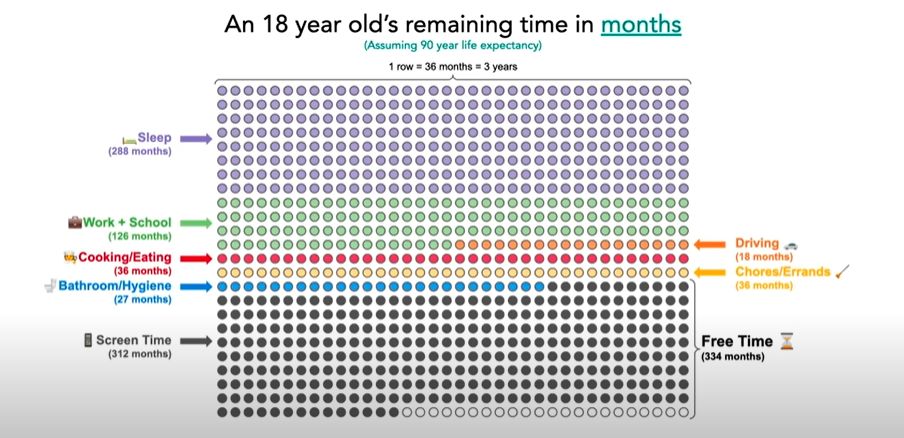
The idea that an entire generation will spend most of their free time in front of screens is chilling. However, the message has a silver lining. Sharing this information with young people can immediately impact how they spend their time.
How to get teens to reduce their screentime
Ambrosi says his work with Project Reboot through on-campus initiatives, school assemblies, and parent workshops has taught him that teens are more concerned about time wasted on their phones than the damage it may do to their mental health. Knowing the topic that resonates can open the door for an effective dialogue about a topic that’s hard for many young people to discuss. When teens realize they are giving their entire lives away for free, they are more apt to reconsider their relationship with smartphones.
“I actually don’t get through to a lot of teens, as well as when I help them realize the value of their time and then highlight the fact that that time is being stolen from them,” Ambrosi told Upworthy.
A Common Sense Media study shows that the average 13 to 18-year-old, as of 2021, spent an average of 8 hours and 39 minutes a day on entertainment screentime.
“It’s important to get them to view time as their most valuable resource that they can use to invest in themselves or enjoy life and tick the boxes on their bucket list. I really want them to see that that’s something they should take control of and prioritize because we’re all under the impression that social media is free, but it’s actually not free. We just pay for it with our time.”

Ambrosi believes that young people are less likely to hand their time to tech companies for free when they understand its value. “I find that kids really respond to that message because nobody wants to feel manipulated, right? And giving them that sense of being wronged, which I think they have been, by tech companies that are off operating on business models that are not aligned with their well-being, is important.”
He also believes parents should be sympathetic and nonjudgmental when talking to young people about screentime because it’s a struggle that just about everyone faces and feels shame about. A little understanding will prevent them from shutting down the conversation altogether.
How to reduce my screentime
Ambrosi has some suggestions to help people reduce their screentime.
The ClearSpace app
ClearSpace forces you to take a breathing delay before using a distracting app. It also asks you to set a time limit and allows you to set a number of visits to the site per day. If you eclipse the number of visits, it sends a text to a friend saying you exceeded your budget. This can help people be accountable for one another’s screentime goals.
Don’t sleep with your phone
Ambrosi says to charge your phone far away from your bedside stand when you sleep and use an alarm clock to wake up. If you do have an alarm clock on your phone, set up an automation so that as soon as you turn off the alarm, it opens up an app like Flora or Forest and starts an hour-long timer that incentivizes you to be off your phone for the first hour of the day.
“In my experience, if you can stay off screens for the last hour and the first hour of the day, the other 22 hours get a lot easier because you get the quality rest and sleep that you need to wake up fully charged, and now you’re more capable of being intentional because you are at your best,” Ambrosi told Upworty.
Keep apps in one place
Ambrosi says to keep all of your social apps and logins on one device. “I try to designate a specific use for each device as much as possible,” he told Upworthy. “I try to keep all my social media time and all my entertainment on my phone as opposed to my computer because I want my computer to be a tool for work.”
Even though there are significant challenges ahead for young people as they try to navigate a screen-based world while keeping them at a healthy distance, Ambrosi is optimistic about the future.
“I’m really optimistic because I have seen in the last year, in particular, that the receptiveness of student audiences has increased by almost an order of magnitude. Kids are waking up to the fact that this is the problem. They want to have this conversation,” he told Upworthy. “Some clubs are starting to address this problem at several schools right now; from the talks I’ve given this semester alone, kids want to be involved in this conversation. They’re creating phone-free spaces on college and high school campuses by their own accord. I just think we have a huge potential to leverage this moment to move things in the right direction.”
For more information on Ambrosi’s programs, visit ProjectReboot.School.
This article originally appeared last year.