The surprisingly simple parenting advice that almost always works, even when all else fails
It's meant for babies and toddlers but works like a charm on kids of all ages.

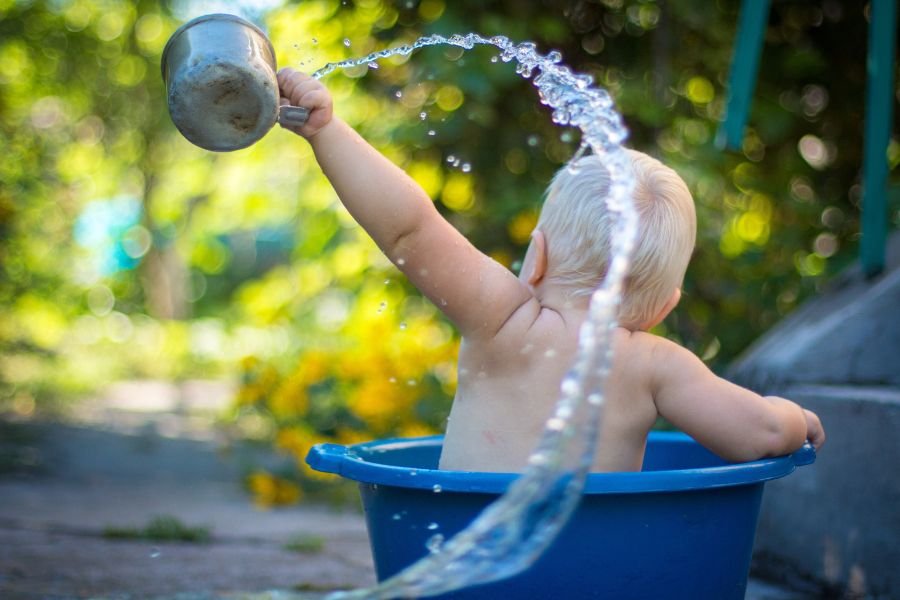
Baby playing with water in a bucket.
Becoming a parent is many things—exciting, scary, joyful, messy, wonder-filled, smelly—but mostly it's a bit overwhelming. Even if you are thrilled with having a baby, there's a lot you have to learn and figure out as you go. To help you through that learning process, there are about a thousand parenting books filled with "expert" advice, at least half of which simply won't work for you or your kid.
Genuinely universally helpful parenting advice is a unicorn; it simply doesn't exist. But occasionally, a golden piece of age-old child-rearing wisdom manages to break through the noise—something that works most of the time for most kids and parents. Something your grandma or auntie passed along that sounds too simple to be effective, yet works like a charm. Something that few if any people could possibly find controversial or problematic.
Something like: "Put them in water or take them outside."
This advice was highlighted by The Motherhood Project in 2021 and has been shared on Facebook more than 123,000 times.
The "water or outside" advice is generally used for babies or toddlers who are inconsolable, as wee ones are known for screaming like banshees for no apparent reason and throwing conniption fits with no apparent prompting.
"Apparent" is the key here, of course—logically, there must be some reason for wailing as if being tortured—but most babies and most toddlers aren't able to verbally articulate their issue, and sometimes that issue might be as simple as "I don't want to be where I am or doing what I'm doing."
Once you've determined the kiddo is not injured in some way, "Put them in water or take the outside" is solid advice that often works when all else fails. And thankfully, it's effective for tiny people as well as older kids (and honestly, sometimes even teenagers). A bath, pool or shower is often just the distraction or soothing sensory experience needed to snap them out of whatever mood they're in. And fresh air and sunlight are simple human needs that many of us neglect too often—a reality that becomes all too clear when you take kids outside and the drama all melts away within minutes.
Of course, there are caveats here. Some babies absolutely hate the bath. Some kids have sensory issues that are triggered by certain outdoor environments. So it's not universally foolproof, but it's definitely worth trying.
Countless commenters testified to the efficacy of the "put them in water or take them outside" advice.
"I didn't hear this until after I had my 2nd baby," wrote one mom. "I used it with my 3rd often, and it truly does work. So mad I heard a lot of terrible advice before learning this one!"
"Yes!! And I even give my daughter a bath during dinner time and feed her in the bath sometimes cause she gets so hangry she can’t calm down enough to eat. But in the bath, she naturally calms down enough to eat while she’s playing. She’s almost 5 and we’ve been doing this most of her life. Even did it tonight again," shared another mother.
One mom shared that it works with her older autistic son: "When my 12 year old autistic son gets overly fractious he either goes in the bath or goes outside....... always works
."
Another expanded the idea to "just add water," including things like watercolor, playing in the sink, etc.: "I have heard the phrase 'just add water' as well. When things are crazy just think of ways to add water to it. Waterpaints, playing with the hose outside, taking a bath, filling the sink up and adding toys, fill small Tupperware bowls with water and let their imagination go wild, taking a drink, giving them a wet paper towel for ouchies, etc. It's one of my favorite pieces of advice I've gotten."
Some parents shared that holding their colicky newborn in the shower was the only thing that helped calm them down. Others said that baths were a sanity saver for their kids' entire early childhoods. Some said that simply stepping outside with a cranky baby was enough to get them to stop fussing most of the time.
It's good advice for us adults, too, when we're feeling frazzled. Soaking in a tub or going for a walk seem like such simple things, but they really can make a huge difference in how we feel and how we view things.
Add water or go outside: A solid tip for new parents and a great life hack for all ages.

- A newly single mom gets inspiring life advice from an internet 'Bubbie' who's been there ›
- John Stamos shares parenting advice given by Bob Saget and parents can relate ›
- Developmental scientist shared her 'anti-parenting advice' and parents are relieved ›
- Woman's first crochet projects in adorably inspiring video - Upworthy ›
- Mom shares why she showers with her kids - Upworthy ›
- Sabrina Benaim's 'Explaining Depression to My Mother' poem - Upworthy ›


A woman is getting angry at her coworker.via
A man with tape over his mouth.via
A husband is angry with his wife. via 
a man sitting at a desk with his head on his arms Photo by
Can a warm cup of tea help you sleep better? If you believe it, then yes. Photo by 
Three women sit on a blanket in the park. 
Two women engaging in a pleasant conversation inside a coffee shop
Two men engaging in a peaceful disagreement.
Resurfaced video of French skier's groin incident has people giving the announcer a gold medal
"The boys took a beating on that one."
Downhill skiing is a sport rife with injuries, but not usually this kind.
A good commentator can make all the difference when watching sports, even when an event goes smoothly. But it's when something goes wrong that great announcers rise to the top. There's no better example of a great announcer in a surprise moment than when French skier Yannick Bertrand took a gate to the groin in a 2007 super-G race.
Competitive skiers fly down runs at incredible speeds, often exceeding 60 mph. Hitting something hard at that speed would definitely hurt, but hitting something hard with a particularly sensitive part of your body would be excruciating. So when Bertrand slammed right into a gate family-jewels-first, his high-pitched scream was unsurprising. What was surprising was the perfect commentary that immediately followed.
This is a clip you really just have to see and hear to fully appreciate:
- YouTube youtu.be
It's unclear who the announcer is, even after multiple Google inquiries, which is unfortunate because that gentleman deserves a medal. The commentary gets better with each repeated viewing, with highlights like:
"The gate the groin for Yannick Bertrand, and you could hear it. And if you're a man, you could feel it."
"Oh, the Frenchman. Oh-ho, monsieurrrrrr."
"The boys took a beating on that one."
"That guy needs a hug."
"Those are the moments that change your life if you're a man, I tell you what."
"When you crash through a gate, when you do it at high rate of speed, it's gonna hurt and it's going to leave a mark in most cases. And in this particular case, not the area where you want to leave a mark."
Imagine watching a man take a hit to the privates at 60 mph and having to make impromptu commentary straddling the line between professionalism and acknowledging the universal reality of what just happened. There are certain things you can't say on network television that you might feel compelled to say. There's a visceral element to this scenario that could easily be taken too far in the commentary, and the inherent humor element could be seen as insensitive and offensive if not handled just right.
The announcer nailed it. 10/10. No notes.
The clip frequently resurfaces during the Winter Olympic Games, though the incident didn't happen during an Olympic event. Yannick Bertrand was competing at the FIS World Cup super-G race in Kvitfjell, Norway in 2007, when the unfortunate accident occurred. Bertrand had competed at the Turin Olympics the year before, however, coming in 24th in the downhill and super-G events.
As painful as the gate to the groin clearly as, Bertrand did not appear to suffer any damage that kept him from the sport. In fact, he continued competing in international downhill and super-G races until 2014.
According to a 2018 study, Alpine skiing is a notoriously dangerous sport with a reported injury rate of 36.7 per 100 World Cup athletes per season. Of course, it's the knees and not the coin purse that are the most common casualty of ski racing, which we saw clearly in U.S. skier Lindsey Vonn's harrowing experiences at the 2026 Olympics. Vonn was competing with a torn ACL and ended up being helicoptered off of the mountain after an ugly crash that did additional damage to her legs, requiring multiple surgeries (though what caused the crash was reportedly unrelated to her ACL tear). Still, she says she has no regrets.
As Bertrand's return to the slopes shows, the risk of injury doesn't stop those who live for the thrill of victory, even when the agony of defeat hits them right in the rocks.