

The term “Merry Christmas” is one of the most wholesome phrases known to man. But did you know it was once condemned as sacrilegious? And while we’re at it, why do we only say “Merry Christmas” and not “Merry Easter,” or “Merry Birthday,” and so on? And why do the Brits use “Happy Christmas” instead of “Merry Christmas”? Are the two synonymous?
All these questions shall be answered below.
First off, it’s important to note that “merry” and “happy” do not have the same etymology, nor do they share the exact same connotations. Merry came about first via the Germanic language around the 12th century, meaning “joyful,” “cheerful,” “pleasant” etc. Happy, on the other hand, didn’t come into the scene until the 14th century, and meant “luck,” “chance,” or “fortunate.”
Both “Merry Christmas” and “Happy Christmas” were used interchangeably for Yuletide greetings all throughout history. That is, until we get to the Victorian era.
It used to mean something very different
As historian and host of the Who Did What Now? podcast Katie Charlwood explained, up until this point, Christmas was often a much “rowdier” affair. And by this time, merry had evolved to also describe more raucous, debaucherous, alcohol-induced behavior.
Many folks didn’t exactly appreciate this association with what was seen as a sacred, holy holiday. The criticism predates Victorian times. As early as 1772, one person called the use of “Merry Christmas” “wicked,” writing, “We celebrate the festivity of our Savior, as if we were ministering the mad orgies of Bacchus.”
Then, in 1864, a reverend named Gordon Calthrop called for the exclusive use of “Happy Christmas,” arguing that merriment, essentially, is but a noisy cover-up for internal turmoil.
“The boisterous gaiety which many put on, is oftentimes only a mask. It covers a sad, sad face,” he said. “And if a man tries to reassure me, or to persuade himself, by extravagant demonstrations of delight, that he is exceedingly happy, I always feel disposed to take the liberty to doubt the statement. True happiness is not a noisy and boisterous, but a quiet thing.”
Then Dickens settled the argument
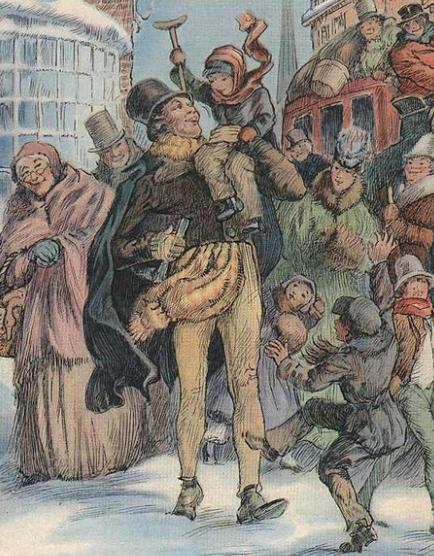
Nevertheless, “Merry Christmas” took over the era’s pop culture, including the first commercial Christmas card, multiple carols, and, of course, Charles Dickens’ A Christmas Carol…which had around 20 “Merry Christmases,” and not one “Happy Christmas.” Even the famous last line of The Night Before Christmas was changed from its original “a Happy Christmas to all, and to all a good night.”
After that, “Merry Christmas” won the title as the go-to holiday greeting—in America, at least. Across the pond, “Merry Christmas” was often seen as a little too low-brow, especially given its popularity in America. One critic even said it had a “ridiculous amount of sentiment” (most British statement ever). Then, when King George V wished everyone a “Happy Christmas” during a radio broadcast (and George VI after that, then Elizabeth II), it was solidified as the preferred, classier option.
Clearly, the conversation about whether or not Christmas should be a somber, contemplative, religious affair or a fun and festive party is not a new one. Nor is the conversation about how to properly send someone our best holiday wishes. But this certainly makes a case for “Merry Christmas and Happy New Year” covering all the bases, doesn’t it?
This article originally appeared last year. It has been updated.








.jpg)