The Kenguru is the first electric vehicle to truly put wheelchair users in the driver's seat

The Kengura featured on Translogic.
We live in a modern world full of technological wonders. Just look at the way we get from A to B—electric vehicles that need no gas, Teslas that drive themselves … it’s an interesting time to be alive.
And yet, even with all these advancements, transportation remains an issue for many drivers with disabilities. Though many vehicles offer wheelchair access, for example, it can still take considerable time and effort to simply get in and out.
That’s where the Kenguru comes in.
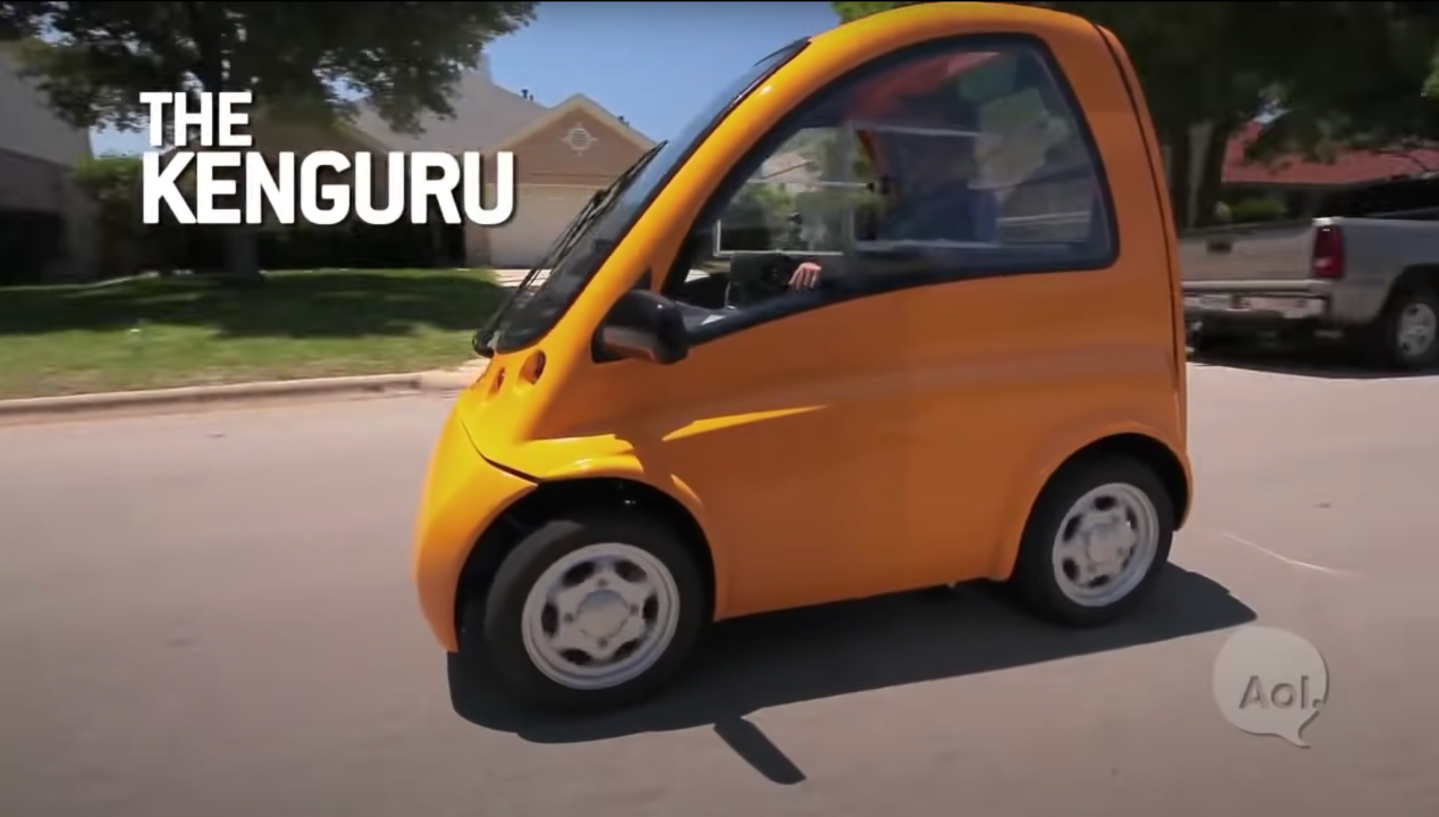
The Kenguru (pronounced like Australia’s most popular marsupial) is not just another smart car. It’s making a splash in the electric vehicle world for being the very first EV created specifically with wheelchair users in mind.
Instead of multiple side doors, the Kenguru has one large door that takes up the entire back panel. With the punch of a button, the door opens for direct access. No seats, no trunk. Just freedom.
Driving is equally simple. Motorcycle-style handlebars replace the traditional steering wheel, and the company is currently working on a joystick version for those who have more limited upper body strength. There are only three gears: forward, neutral and reverse. And, according to The Next Web, it’s technically considered an electric scooter, meaning there’s no driver’s license required to operate it, making things even more accessible.
The Kenguru only clocks about 25 mph and has a 60 mile range, but speed and distance aren’t really the main point—inclusivity is. With this kind of vehicle, drivers can easily enjoy a quick trip to the store, an impromptu movie, meeting with friends … simple pleasures that are easily taken for granted.
Plus, there’s the Kenguru’s affordability. An article for Startup Selfie reports that where the car is priced around $25,000, buyers qualify for a federal “green incentive,” which offers a rebate discount. Some drivers will qualify for the “vocational rehabilitation incentive,” if the Kenguru is considered a work vehicle. In other words, these vehicles could shoot down to anywhere from $20,000 to a flat zero.
Stacy Zoern, an attorney in Texas, discovered Kenguru after purchasing—then totaling—a fully modified $80,000 van … all within only a few months of having it. Yikes.
Zoern tells Translogic that for some time after the accident, she depended on others to get around. On a whim, she searched the internet to see if the technology had improved over the years. She was pleased to discover that it had.
There was only one issue: The Hungary-based company that developed the Kenguru lost its bank loan and was relying solely on fundraising. But Zoern was so impassioned by what Kengura had to offer disabled drivers, she decided to give them a call, and the rest appears to be a partnership destined for success.
Zoern joined forces with Istvan Kissaroslaki (the vehicle’s original creator) to move the company to Austin, Texas, and has worked diligently to gain investors. By 2014, Kengurus were fully produced in the U.S. You might have already seen one cruising nearby.
And beyond supply chain challenges (not having the funding to build enough cars for such a heavy demand), Zoern says that the plan is for Kenguru to go worldwide, with dealerships in Spain and Germany showing interest.
This is an exciting example of how technology can help connect us—all of us—to life, and make the world a better place.

- Man who now uses a wheelchair explains ableism, and it's a must ... ›
- Students design a wheelchair attachment so dad can take son on a ... ›
- Wheelchair user shares advice for interacting with them in public ... ›
- French company creates exoskeleton for wheelchair users to walk - Upworthy ›
- Georgia launches all-terrain wheelchairs in 11 of its state parks - Upworthy ›
- Electric cars reduce asthma attacks - Upworthy ›


A woman is getting angry at her coworker.via
A man with tape over his mouth.via
A husband is angry with his wife. via 
a man sitting at a desk with his head on his arms Photo by
Can a warm cup of tea help you sleep better? If you believe it, then yes. Photo by 
Three women sit on a blanket in the park. 
Two women engaging in a pleasant conversation inside a coffee shop
Two men engaging in a peaceful disagreement.
Resurfaced video of French skier's groin incident has people giving the announcer a gold medal
"The boys took a beating on that one."
Downhill skiing is a sport rife with injuries, but not usually this kind.
A good commentator can make all the difference when watching sports, even when an event goes smoothly. But it's when something goes wrong that great announcers rise to the top. There's no better example of a great announcer in a surprise moment than when French skier Yannick Bertrand took a gate to the groin in a 2007 super-G race.
Competitive skiers fly down runs at incredible speeds, often exceeding 60 mph. Hitting something hard at that speed would definitely hurt, but hitting something hard with a particularly sensitive part of your body would be excruciating. So when Bertrand slammed right into a gate family-jewels-first, his high-pitched scream was unsurprising. What was surprising was the perfect commentary that immediately followed.
This is a clip you really just have to see and hear to fully appreciate:
- YouTube youtu.be
It's unclear who the announcer is, even after multiple Google inquiries, which is unfortunate because that gentleman deserves a medal. The commentary gets better with each repeated viewing, with highlights like:
"The gate the groin for Yannick Bertrand, and you could hear it. And if you're a man, you could feel it."
"Oh, the Frenchman. Oh-ho, monsieurrrrrr."
"The boys took a beating on that one."
"That guy needs a hug."
"Those are the moments that change your life if you're a man, I tell you what."
"When you crash through a gate, when you do it at high rate of speed, it's gonna hurt and it's going to leave a mark in most cases. And in this particular case, not the area where you want to leave a mark."
Imagine watching a man take a hit to the privates at 60 mph and having to make impromptu commentary straddling the line between professionalism and acknowledging the universal reality of what just happened. There are certain things you can't say on network television that you might feel compelled to say. There's a visceral element to this scenario that could easily be taken too far in the commentary, and the inherent humor element could be seen as insensitive and offensive if not handled just right.
The announcer nailed it. 10/10. No notes.
The clip frequently resurfaces during the Winter Olympic Games, though the incident didn't happen during an Olympic event. Yannick Bertrand was competing at the FIS World Cup super-G race in Kvitfjell, Norway in 2007, when the unfortunate accident occurred. Bertrand had competed at the Turin Olympics the year before, however, coming in 24th in the downhill and super-G events.
As painful as the gate to the groin clearly as, Bertrand did not appear to suffer any damage that kept him from the sport. In fact, he continued competing in international downhill and super-G races until 2014.
According to a 2018 study, Alpine skiing is a notoriously dangerous sport with a reported injury rate of 36.7 per 100 World Cup athletes per season. Of course, it's the knees and not the coin purse that are the most common casualty of ski racing, which we saw clearly in U.S. skier Lindsey Vonn's harrowing experiences at the 2026 Olympics. Vonn was competing with a torn ACL and ended up being helicoptered off of the mountain after an ugly crash that did additional damage to her legs, requiring multiple surgeries (though what caused the crash was reportedly unrelated to her ACL tear). Still, she says she has no regrets.
As Bertrand's return to the slopes shows, the risk of injury doesn't stop those who live for the thrill of victory, even when the agony of defeat hits them right in the rocks.