upworthy
Add Upworthy to your Google News feed.
Google News Button
Pop Culture

19 super-specific memories that are giving people instant childhood nostalgia

Certain sensations bring up incredible memories.

1980s kids, 1980s nostalgia, 1990s nostalgia

Memories of childhood get lodged in the brain, emerging when you least expect.

There are certain pleasurable sights, smells, sounds and tastes that fade into the rear-view mirror as we grow from being children to adults. But on a rare occasion, we’ll come across them again and it's like a portion of our brain that’s been hidden for years expresses itself, creating a huge jolt of joy.

It’s wonderful to experience this type of nostalgia but it often leaves a bittersweet feeling because we know there are countless more sensations that may never come into our consciousness again.

Nostalgia is fleeting and that's a good thing because it’s best not to live in the past. But it does remind us that the wonderful feeling of freedom, creativity and fun from our childhood can still be experienced as we age.

A Reddit user by the name of agentMICHAELscarnTLM posed a question to the online forum that dredged up countless memories and experiences that many had long forgotten. He asked a simple question, “What’s something you can bring up right now to unlock some childhood nostalgia for the rest of us?”

It was a call for people to tap into the collective subconscious and bond over the shared experiences of youth. The most popular responses were the specific sensory experiences of childhood as well as memories of pop culture and businesses that are long gone.

Ready to take a trip down memory lane? Don’t stay too long, but it’s great to consider why these experiences are so memorable and still muster up warm feelings to this day.

Here are 19 of the best responses.

1. 

"An eraser that looks and smells like a very fake strawberry." — zazzlekdazzle

2. 

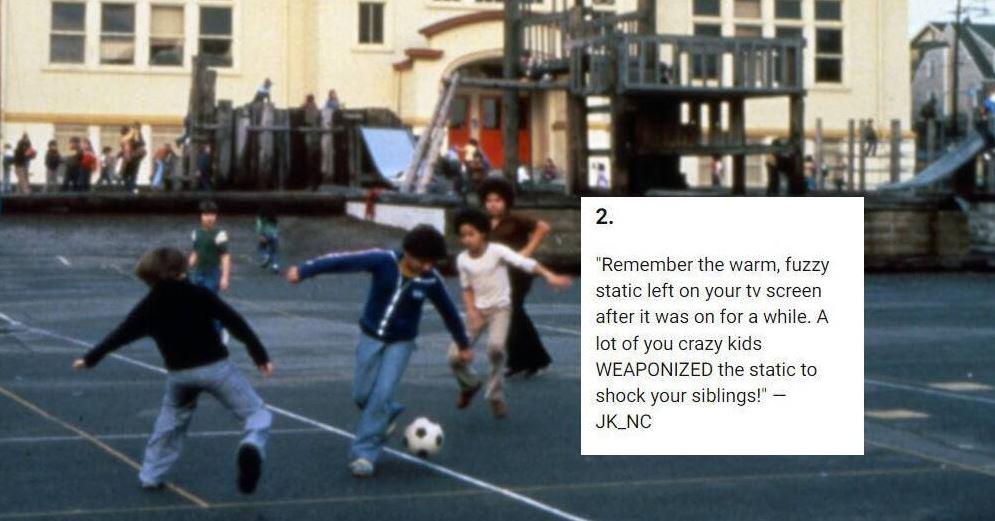
"Remember the warm, fuzzy static left on your tv screen after it was on for a while. A lot of you crazy kids WEAPONIZED the static to shock your siblings!" — JK_NC

3. 

"Waking up super early on Saturday morning before the rest of the family to watch cartoons." — helltothenoyo

4. 

"When you'd watch a vhs and it would say 'and now your feature presentation.'" — Mickthemmouse

5. 

"Eating one of those plastic-wrapped ice pop things after a long day of playing outside in your backyard with your friends." — onyourleft___

6. 

"Scholastic book fairs." — zazzlekdazzle

"The distinctive newspaper-y feel of those catalogues, the smell of them. Heaven. I would agonize over what books to get, lying on my living room floor, circling my options in different colored gel pens, narrowing it down to 2-4 from a dozen in an intense battle royale between slightly blurry one-line summaries. I know my mom's secret now. She would've bought me the whole damn catalogue. But she made me make my choices so that I really valued the books. I'd read them all immediately, reading all night if I had to, hiding in a tent under my covers with a flashlight I stole from the kitchen. I thought I was getting away with something. As an adult, I notice, now, that the flashlight never ran out of batteries." — IAlbatross

7. 

"Watching 'The Price Is Right' when you were sick at home." — mayhemy11

8. 

"That feeling of limitless freedom on the first day of summer vacation. That feeling of dreaded anticipation on the last day of summer vacation." —_my_poor_brain_

9. 

"Blockbuster." — justabll71

10. 

"The noise when picking up the phone when someone was surfing the web." — OhAce

11. 

"The TV Guide channel. You had to sit through and watch as the channels slowly went by so we could see what was on. It blew getting distracted by the infomercial in the corner and then realizing you barely just missed what you were waiting for so had to wait for it to start all over." — GroundbreakingOil

12. 


"Light Bright. I barely remember it myself but you’d take a charcoal-black board and poke different colored pegs through it. You plug it in to the electrical outlet and all the pegs light up creating whatever shape you made in lights." — 90sTrapperKeeper

13. 

"You knew it was gonna be a good day when you walk into PE class and see that huge colorful parachute." — brunettemountainlion

14. 

"Ripping handfuls of grass at recess and putting them on your friend." — boo_boo_technician

15. 

"In 1972, a crack commando unit was sent to prison by a military court for a crime they didn't commit. These men promptly escaped from a maximum-security stockade to the Los Angeles underground. Today, still wanted by the government they survive as soldiers of fortune. If you have a problem if no one else can help, and if you can find them....maybe you can hire The A-Team." — Azuras_Star8

16. 

"Watching 'Mister Rogers' Neighborhood.' There was something so special about the intro where he would sing Won't You Be My Neighbor while he changed his jacket and shoes. I loved every second of it, and would watch in utter content and fascination each time as if I'd never before seen him zip his cardigan up and back down to the right spot and change his shoes with the little toss of a shoe from one hand to the other." — Avendashar

17. 

"Somewhere between blowing on some cartridges and pressing the cartridge down and up in the NES to get it to play." — autovices

18. 

"That feeling when you are going as high as you can go on the swings. Power? Freedom? Hard to describe." — zazzlekadazzle

19. 

"Cap guns. But smashing the entire roll of caps at once with a hammer." — SoulKahn90


This article originally appeared three years ago.

Science

Her groundbreaking theory on the origin of life was rejected 15 times. Then biology proved her right.

Lynn Margulis had the audacity to challenge Darwin. And we're lucky she did.

lynn margulis, lynn margulis symbiosis, biology, scientific breakthroughs, darwin, darwinism, women in science
Facts That Will Blow Your Mind/Facebook

A photo of Lynn Margulis.

Throughout her prolific and distinguished career, biologist Lynn Margulis made several groundbreaking contributions to science that we take for granted as common knowledge today. For example, she championed James E. Lovelock’s “Gaia concept,” which posited that the Earth self-regulates to maintain conditions for life.

But by far, her most notable theory was symbiogenesis. While it was first written off as “strange” and “aesthetically pleasing” but “not compelling,” it would ultimately prevail, and completely rewrite how we viewed the origin of life itself.


In the late 1960s, Margulis wrote a paper titled "On the Origin of Mitosing Cells," that was quite avant-garde. In it, she proposed a theory: that life evolved through organisms merging together to become inseparable.

In essence, cooperation is the driver of life, not competition and domination. This directly went against Darwin’s “survival of the fittest” principle that was considered gospel in scientific circles. Margulis’ paper was rejected by fifteen journals before getting accepted into the Journal of Theoretical Biology.

- YouTube www.youtube.com

Time would be on Margulis’ side, however. By the late ‘70s and early ‘80s, research proved that the two major building blocks of plants and animals, chloroplasts and mitochondria were at one time independent bacteria. This solidified the fact that on a biological level, connection trumps autonomy for longevity. And now that fact is written in textbooks, with no real story of the adversity it overcame to get there.

While it is customary for most new scientific theories to be met with criticism, especially those that completely shift the current narrative, many have noted that sexism played a key part in Margulis’ initial lack of acceptance. On more than one occasion, she herself had hinted that women were seen as mothers and wives first, and scientists second. She recalled that while married to fellow scientist Carl Sagan that “Carl would finish his sentence, unperturbed” while she was expected to “handle all the duties of a 1950s housewife, from washing dishes to paying the household bills.”

And yet, Margulis would have other ideas that were controversial that had nothing to do with her gender. Most famously, she did not believe that AIDS was caused by HIV, and instead believed it was cause by a syphilis-causing type of bacteria, despite there already being decades of research proving otherwise. That view was seen as an endorsement of AIDS denialism, which undermined prevention and treatment effort. Then later in life, Margulis became a vocal proponent of 9/11 conspiracy theories suggesting government involvement the in Twin Towers attacks.

And yet, perhaps this is one of those “you gotta take the good with the bad” situations. Margulis’ inherent contrarian nature gave us both these unfounded, even harmful stances, in addition to entirely new paradigms that altered our understanding of life itself.

And if nothing else, it illuminated the need for science to include multiple points of view in order to unlock the truth. It seems life is, after all, about coming together.

washing sheets, bedding, how often should you wash your sheets, making the bed, wash sheets, how often should you wash bed sheets
Photo credit: Canva
The rest of your bedding doesn't need to be washed as often.

There's nothing better than hopping into bed with clean sheets. But let's be honest: washing your sheets can be a pain. From stripping the bed to putting sheets back on post-washing, it's a chore. But you may want to re-think how often you should be washing your bed sheets.

According to a survey of 1,000 Americans conducted by Mattress Advisor, the average time between sheet changings or washings in the U.S. is 24 days—or every 3 1/2 weeks, approximately. The same survey revealed that 35 days is the average interval at which unwashed sheets are "gross."


If that sounds about right to you, prepare to be shocked. According to experts, you should be washing your sheets *a lot* sooner than that for hygiene reasons.

- YouTube www.youtube.com

How often should you wash your sheets?

Hint: It's a lot more frequent than 24 days.

While there is no definitive number of days or weeks, most experts recommend swapping out used sheets for clean ones every week or two.

Dermatologist Alok Vij, MD told Cleveland Clinic that people should wash their sheets at least every two weeks, but probably more often if you have pets, live in a hot climate, sweat a lot, are recovering from illness, have allergies or asthma, or if you sleep naked.

We shed dead skin all the time, and friction helps those dead skin cells slough off, so imagine what's happening every time you roll over and your skin rubs on the sheets. It's normal to sweat in your sleep, too, so that's also getting on your sheets. And then there's dander and dust mites and dirt that we carry around on us just from living in the world, all combining to make for pretty dirty sheets in a fairly short period of time, even if they look "clean."

Maybe if you shower before bed and always wear clean pajamas you could get by with a two-week sheet swap cycle, but weekly sheet cleaning seems to be the general consensus among the experts. The New York Times consulted five books about laundry and cleaning habits, and once a week was what they all recommend.

Sorry, once-a-monthers. You may want to step up your sheet game a bit.

sheets, bed sheets, clean sheets, how often should you wash your sheets, how often should you wash your bed sheets Experts agree that this is how often you should wash your bed sheets.Photo credit: Canva

What about the rest of your bedding? Blankets and comforters and whatnot?

Olivia Parks, Owner + Lead Organizer at Nola Organizers, told Upworthy that duvet covers should be cleaned every week or so.

"Even though the cover protects the insert, the insert still collects body odor, sweat, body oils from lotions or other body products, crumbs if you eat in your bed, dog hair or cat hair, and more," she explained.

Somewhere between the Gen X and Millennial eras, young folks stopped being about the top sheet life, just using their duvet with no top sheet. If that's you, wash that baby once a week. If you do use a top sheet, you can go a couple weeks longer on the duvet cover.

For blankets and comforters and duvet inserts, Sleep.com says every 3 months. And for decorative blankets and quilts that you don't really use, once a year washing will suffice.

What about pillows? Pillowcases should go in with the weekly sheet washing, but pillows themselves should be washed every 3 to 6 months. Washing pillows can be a pain, and if you don't do it right, you can end up with a lumpy pillow, but it's a good idea because between your sweat, saliva and skin cells, pillows can start harboring bacteria.

@suzieqssss

Baking soda absorbs moisture and or odor and breaks down any residue that builds up! If you have allergies you should be doing this more often! #cleaning #lifehack #tiktokshopcybermonday #tiktokshopblackfriday #mattressvacuumcleaner

Finally, how about the mattress itself? Home influencers on TikTok can often be seen stripping their beds, sprinkling their mattress with baking soda, brushing it into the mattress fibers and then vacuuming it all out. Architectural Digest says the longer you leave baking soda on the mattress, the better—at least a few hours, but preferably overnight. Some people add a few drops of essential oil to the baking soda for some extra yummy smell.

If that all sounds like way too much work, maybe just start with the sheets. Pick a day of the week and make it your sheet washing day. You might find that climbing into a clean, fresh set of sheets more often is a nice way to feel pampered without a whole lot of effort.

This article originally appeared two years ago. It has been updated.

fathers, dads, women, dating, family, love, relationships, parenting, kids, cultural differences, sweden, america

A woman holding back her laughter.

Parenting is the ultimate test of a romantic partnership, and not all relationships can survive its rigors. One of the biggest topics in parenting these days is the mental and physical drain that comes with being the default parent in a family. The default parent is the one who is first in line to take responsibility for parenting duties, whether that means making doctor’s appointments, ensuring homework is done, or making sure the child has enough socks to make it through the week.

Being the default parent can lead to fatigue and burnout, and the parent can experience incredible anxiety when their attention turns away from the household or family. The situation is even worse when the default parent’s partner only does the bare minimum. Unfortunately, in American society, fathers are often the parents who do just enough to get by and are praised for it.


The notion that men don’t have to pull their equal weight in American family life is so ingrained that when Emma Hughes, a travel nanny with over one year of experience in childcare and family support, visited Sweden for two weeks, she experienced extreme culture shock.

A nanny shares why she'd never marry an American man


"I've been in Sweden now, and I think I've been ruined for American men," the 24-year-old said in a viral Instagram video. "Specifically, raising a child with an American man in America, because these Scandinavian dads? Chef's kiss …"

"I'm actually embarrassed to talk about this because all of the observations that I've made have really revealed to me how deeply ingrained [expletive] dads have become like in my brain, and it's just like the default,” she continued.

fathers, dads, dating, family, love, relationships, parenting, kids, cultural differences, sweden, america A Scandanavian man and his child.via Canva/Photos


The notion that fathers only have to do the bare minimum was so ingrained in Hughes’ psyche that she couldn’t understand seeing so many involved fathers in Sweden.

"When I see more dads pushing their strollers in the park on a Saturday morning than moms, what does my brain think … That's weird, there is something abnormal about that,” Hughes said. “When I see dads at the grocery store with their kids. When I see dads out at restaurants or in public. It is so deeply telling of a lot of subconscious stuff that I have going on in my brain after working with so many families."

She said that even the best dads she's worked with in America would be considered the "Scandinavian bare minimum." She applauded one Swedish father who bought a new size of diapers for his baby without his partner telling him to.

"Like I watched a Swedish dad go to the grocery store and come home with like four bags of groceries and in that trip he had bought size two diapers for a baby that had previously been wearing size one and was ready to move into size two, but that conversation had not happened between the mom and the dad,” she said.

Given Swedish dads' dedication to their parenting responsibilities, it’s fair to assume that their partners are much happier and less stressed than those in the States. But what about their kids? Researchers at the United Nations who studied “child well-being in rich countries” found that Swedish fathers also ranked high by their children. The survey asked children in 28 countries if it was easy to talk to their dads, and while 67% of children in the study said their parents were easy to talk to, Swedish fathers scored higher at 72.4%. Meanwhile, the U.S ranked 25, out of 28, at just 59.7%.

fathers, dads, dating, family, love, relationships, parenting, kids, cultural differences, sweden, america A Scandanavian man and his child.via Canva/Photos


Scandanavian and Nordic countries offer generous benefits to parents

It's also worth noting that many foreign countries, like Sweden, have far better cultural infrastructure in place for parents — dads included. Parental leave for new parents in Sweden makes American policies seem like an absolute embarrassment.

They also have far better work-life balance. So dads are getting involved earlier, more often, and spending more time outside the office as part of the family. All Nordic countries pay parents for their loss of income during the last few weeks before the child is born and for the first few months afterwards. Plus, all Nordic countries offer fathers time off and compensate them for the income loss.

Ultimately, Hughes makes an important point: Scandinavian men have set a high bar for fatherhood, and American men need to step up. The positive sign is that in America, the discussion around default parenting has been getting louder and louder, and hopefully, that will prompt more American men and women to set higher expectations so that one day, American men can catch up to Sweden’s.

This article originally appeared last year. It has been updated.

pigs, pets, homework, school, teachers, kids, dog ate my homework, excuses, funny, humor
By Andrew Watson/Wikimedia Commons & Canva

An Arizona girl claimed "My pig ate my homework!" Luckily, she had proof.

Believe it or not, "the dog ate my homework" excuse is over 100 years old. The first known anecdote involving a dog eating important documents came about around 1905. A professor was later recorded in 1929 writing, "It is a long time since I have had the excuse about the dog tearing up the arithmetic homework," suggesting the phrase had been around for some time.

In the century since, teachers the world over have heard every variation of excuse about why a student can't turn in their homework. But, in 2026, we may have fortuitously stumbled on a new one most teachers have never dreamed of.


Jacey Tinsley, a mom from Arizona, recently posted a story to social media that has to be seen to be believed. In the now viral post, she explains that her daughter Taylee was unable to turn in her homework for multiple subjects... because their pet pig ate it.

Yes, the Tinsleys have racked up quite a following on social media documenting life with their three mini-pigs, so it is certainly in the realm of possibility that one of the pigs could have gotten into Taylee's homework.

But would the teachers buy it?

Luckily, Tinsley was able to catch the whole thing on video via indoor Ring cam. In the footage, their pig Polly is caught red-handed snatching the backpack off of the counter, dragging it to the floor, and rifling through it—destroying several papers in the process. Tinsley took the initiative to email her daughter's teachers and school administrators with the indisputable photographic evidence.

Jacey Tinsley took full accountability for her daughter's missing work. "If/when you see any work that's partially eaten/chewed, that is 100% on us, not Taylee," she confessed.

Then, she hoped for the best.

The school staffers had no choice but to accept Jacey's ludicrous tale, and they got quite a kick out of it, too.

Taylee's principal was first to reply: "Okay, I have to admit this is a first for me!! I'm trying not to laugh hysterically..."

The science teacher chimed in next: "This is a first time in my teacher career to hear this and I find it hilarious."

The math teacher was a person of few words: "Oh my goodness, that is so funny."

Over two million people viewed the reel on Instagram and TikTok combined. Commenters were delighted by the ridiculous footage and had plenty of their own hard-to-believe stories of lost homework:

"I turned in homework once that was half eaten by my rabbits but all the answers weren't eaten so I got an A"

"That happened with my piggy she ate three page, so I sent a picture of our piggy Then the damn teacher wanted me to bring her to show and tell her"

"Had a classmate who brought in his homework that was literally eaten by his dog. My teacher thought it was so funny that he displayed the chewed up paper on his wall"

"My baby sister ate my homework once. I wish I was joking"

"My dog ate my homework which was a book I picked to read and it was about lying and saying that your dog ate your homework. I told my teacher and got yelled at so my Dad had to come in with the torn up book to prove I wasnt lying"

If there's anything to learn from the massive response to Tinsley's post, it's that, sometimes, the dog really does eat your homework. And if not the dog, then the rabbit, cat, or even pig.

Pigs can make terrific pets in the right home. They are surprisingly intelligent, playful, affectionate, and can be trained to do many of the tricks and tasks dogs can do.

- YouTube www.youtube.com

Pigs can, however, be quite destructive. Because they're so smart, any hint of boredom can drive them into a frenzy of activity; a favorite activity of many pigs is rooting. Rooting is when they use their powerful snout to push and dig at the ground—or whatever items happen to be around (like a backpack that smells like yesterday's lunch). It's an instinctual behavior that calms them and helps them find snacks.

Taylee got lucky this time that the whole incident was caught on camera. "The pig ate my homework," doesn't seem like the kind of excuse that's going to fly more than once without proof.

ups driver, ups, hero, house fire, elderly woman, orange county, california, local news, good news, ktla

A delivery driver with a determined expression; a house on fire.

Fate often tests our courage at the most unexpected times. For UPS driver Willy Esquivel, that moment came on January 15 while he was completing a delivery in Orange County, California.

According to KTLA, Esquivel was on his routine route in Santa Ana when he noticed neighbors attempting to smother a blaze coming from the condo of Ann Edwards, a 101-year-old woman who lives alone.


Esquivel wasted no time entering the smoke-filled building to rescue Edwards, who seemed "very disoriented" and reluctant to leave. Nevertheless, Esquivel "picked her up and carried her safely outside," according to KTLA and a statement from the Orange County Fire Authority (OFCA).

A video posted on the OFCA's X account showed just how thick the smoke was pouring from Edwards' condo as firefighters arrived. The OFCA also acknowledged the resourceful neighbors who aided in the rescue.

"At the same time, the neighbors used fire extinguishers to knock down the kitchen fire," the OCFA wrote on X. "One of them, a roofer by trade, grabbed his ladder, climbed to the roof, and used a garden hose to spray water into the kitchen vent."

Thankfully, while Edwards was taken to the hospital, she was expected to make a full recovery. Her son, Rick, told KTLA that he was grateful to Esquivel for "sticking with her and getting her out of there."

As for Esquivel, rather than seeing himself as a hero, he told KTLA that he was "just a UPS driver who was in the right place at the right time."

"I just did what I thought was right," he added. "At the end of the day, she's someone's mother, someone's grandmother, great-grandmother."

- YouTube www.youtube.com

Moments like this rarely announce themselves ahead of time. They unfold in the middle of ordinary days, on familiar streets, while people are simply doing their jobs or moving through their routines. Delivery drivers like Esquivel travel through neighborhoods every day, often unnoticed, yet uniquely positioned to sense when something is wrong. On this day, being present and paying attention made all the difference.

Just as striking as Esquivel's bravery was the way neighbors instinctively sprang into action. Without hesitation, they grabbed fire extinguishers, ladders, and garden hoses, each contributing whatever they had in the moment. Together, their quick thinking and collaboration helped prevent an even greater tragedy.

"A remarkable outcome made possible by quick action, teamwork, and people looking out for one another in a moment of need," the OCFA wrote on X.

It's easy to assume someone else will step in. That it's not your fight. That it's not your responsibility. Heroism requires the opposite mindset. And at a time when the world can feel increasingly short on that quality, this story is a refreshing reminder that yes, there are still good people out there willing to help, even when it means helping complete strangers while on the job.