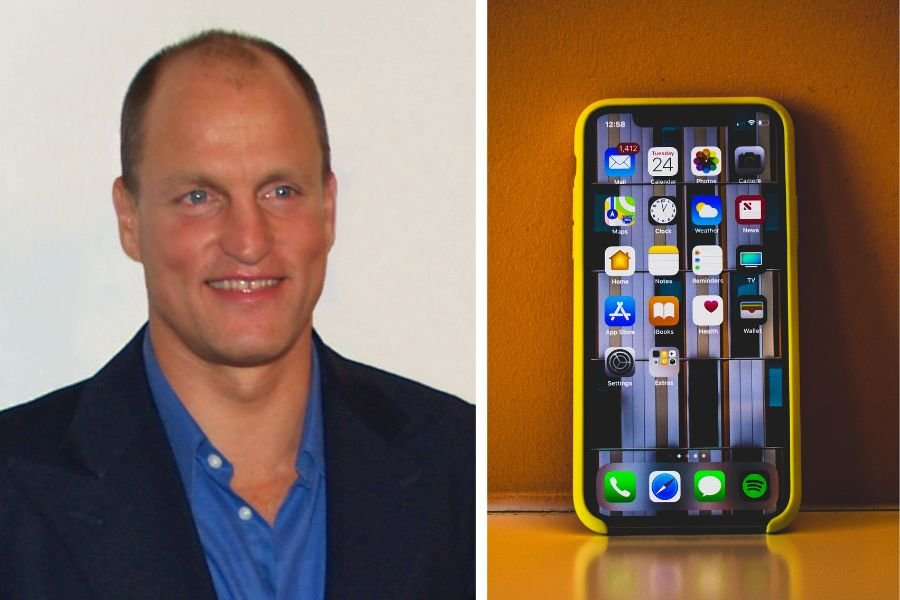
On a recent episode of his “Where Everybody Knows Your Name” podcast, Ted Danson noted that Woody Harrelson doesn’t have a phone. He even joked that the “Hunger Games” star was “one of those bullies in life that make other people carry his phone for him.”
Harrelson quickly clarified that Danson’s jape wasn’t “exactly true,” sharing what really led him to ditching his device three and a half years ago.
“Well, I just don’t like to have, you know, to be readily available to any human being at any time,” he told Danson. “I like to be in touch with people in a way, but I don’t like the appendage on my appendage.”Harrelson’s sentiment is certainly a relatable one. But it’s his failed attempts to “limit” his screen time that really resonate.
“Back then I was like, ‘Okay, I’m going to set this limit. Two hours,’ ” Harrelson reflected. “It’s like 9:30. You know, I’ve already hit my limit at 9:30, so I woke up, and I’ve been on it two hours already because, cuz you know how it can just keep going and going.”
Goodness, how many of us have tried—and failed—to limit our screen time?
Even with little alerts that say “you have five more minutes” on various apps, those alerts are easy to ignore once you do it a couple of times. Another strategy might be putting our phones on “Do Not Disturb” to ward off notifications, or setting it to “Night Mode” so that the screen is less bright and eye-catching. But anecdotally, all of these hacks seem to only do so much.
Harrelson also explained that he would find himself at dinner and and instantly reaching for his phone once there was a lull in the conversation. Who among us hasn’t been guilty of this modern day social faux pas? It even ignited the seemingly short-lived “phone stacking” movement, where friends going out to dinner would all stack their phones on the table, and whoever reached for their device first would have to cover the tab.
Lastly, Harrelson admitted he only ever used the phone to send texts, rather than make phone calls. According to Statista, texting is by far the most common phone activity, followed by emails, app usage, online shopping, internet, etc. Making phone calls didn’t even seem to make the list.
All this to say—phone addiction might not be on the same level as substance addiction, but its addictive qualities are incredibly hard to shake. And this is partially due to the fact that our society enables and encourages phone usage, much in the same way that alcohol is a fully ingrained aspect of our culture.
Paul Graham, famed Silicon Valley investor, notes that often society forms “antibodies” against addictive new things, coming first in the form of a change in public opinion, followed by a change in legislation. He uses the example of smoking, and how it went from being “totally normal” to something “seedy,” and eventually laws were created to match societal change. Even with alcohol we have seen this, with alcohol-free bars even becoming mainstream.
What makes “technology addiction” different, however, is how rapidly it evolves. “Unless the rate at which social antibodies evolve can increase to match the accelerating rate at which technological progress throws off new addictions, we’ll be increasingly unable to rely on customs to protect us. Unless we want to be canaries in the coal mine of each new addiction—the people whose sad example becomes a lesson to future generations—we’ll have to figure out for ourselves what to avoid and how. It will actually become a reasonable strategy (or a more reasonable strategy) to suspect everything new,” he writes.
So, if our current world really doesn’t offer any buffers between us and our devices, Harrelson’s cold turkey approach does make some sense. Not that his approach is in any way feasible for 99% of us. But still, it offers some food for thought. Without agreed upon collective changes to our phone behavior, what chance does an individual really have of breaking free of this widely common habit? Is the only option to opt out entirely? These are questions thus far without answers. But what an important conversation to have moving forward.