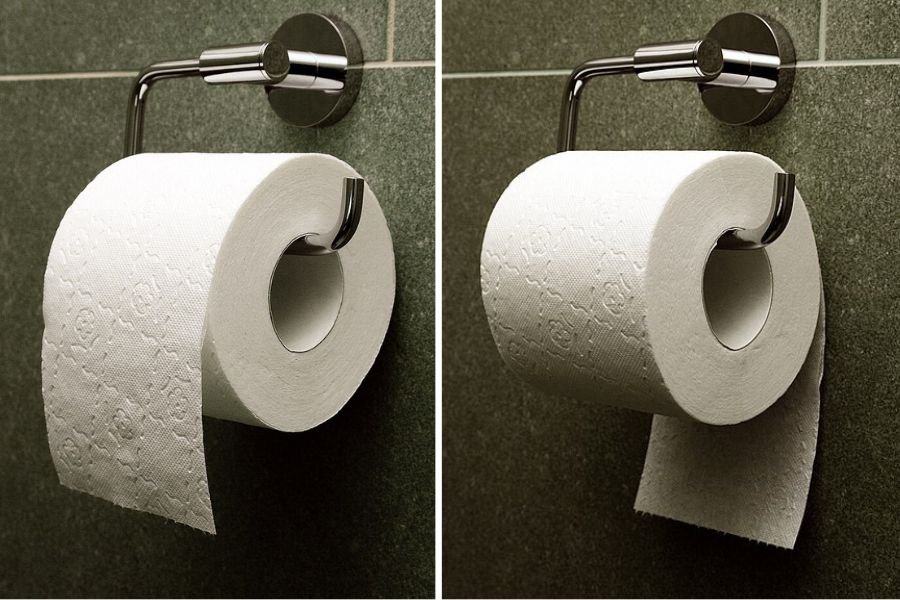
Over or under? Surprisingly, there actually is a 'correct' way to hang a toilet paper roll.
Let's settle this silly-but-surprisingly-heated debate once and for all.

Should you hang the toilet paper roll over or under?
Humans have debated things large and small over the millennia, from the democracy to breastfeeding in public to how often people ought to wash their sheets. But perhaps the most silly-yet-surprisingly-heated household debate is the one in which we argue over which way to hang the toilet paper roll.
The "over or under" question has plagued marriages and casual acquaintances alike for over 100 years, with both sides convinced they have the soundest reasoning for putting their toilet paper loose end out or loose end under. Some people feel so strongly about right vs. wrong TP hanging that they will even flip the roll over when they go to the bathroom in the homes of strangers.
Contrary to popular belief, it's not merely an inconsequential preference. There is actually a "correct" way to hang toilet paper, according to health experts as well as the man who invented the toilet paper roll in the first place.
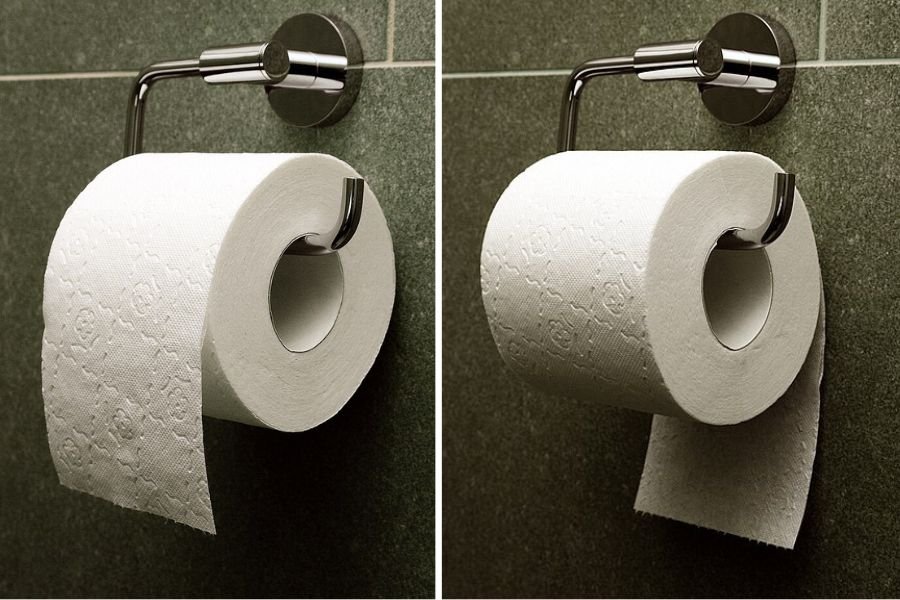
First, let's be clear about what we're even talking about here with a visual. In the image below, left is "over" and right is "under."

Toilet paper hung "over" (left) and "under" (right)
Elya/Wikimedia Commons
So which one is the right way? According to health experts, "over" is the way to go.
"One key to maintaining a hygienic washroom is minimising contact between people and surfaces," Dr. Christian Moro, associate professor of health sciences and medicine at Bond University on Australia's Gold Coast, told Australian Broadcasting Corporation. "Depending on the type of roll holder, [hanging the toilet paper "over"] often lowers the chance that a user will touch the wall behind when fishing for paper, leaving germs behind on that surface which can be spread to the next user."
Picture it: Grabbing the end of the toilet paper when it's hung "over" means you only touch the part of the toilet paper you're going to use. When it's "under," you sometimes have to fish for it or scrape your fingers on the wall in order to grab the loose end. In addition to whatever might be on people's hands already, think about all the people who wipe twice, potentially transferring fresh fecal matter or other bacteria to the wall on the second pass, which then get picked up by other people who inadvertently touch that wall when trying to grab their TP.
Theoretically, we all should have become better hand washers during the pandemic, scrubbing with soap for the full 20 seconds it takes to remove bacteria. But I wouldn't be willing to bet on it.
And touching any surface in a bathroom is pretty nasty, according to a study from the University of Colorado. As Inc. reported: "Using a high-tech genetic sequencing tool, researchers identified 19 groups of bacteria on the doors, floors, faucet handles, soap dispensers, and toilets of 12 public restrooms in Colorado — six men’s restrooms and six women’s restrooms. Many of the bacteria strains identified could be transmitted by touching contaminated surfaces."
Bacteria means things like e.coli, which is a common source of food poisoning and one of the most common bacteria found on bathroom surfaces in the study. If you've ever had a bout of food poisoning, I'm sure you'll agree that a toilet paper roll hanging preference isn't worth risking it.
But sanitary health concerns aren't the only argument for the "over" camp. After all, the original patent for the toilet paper roll, issued in 1891, clearly shows the TP in the "over" position. Thank you for the clarity right from the get go, Mr. Wheeler.
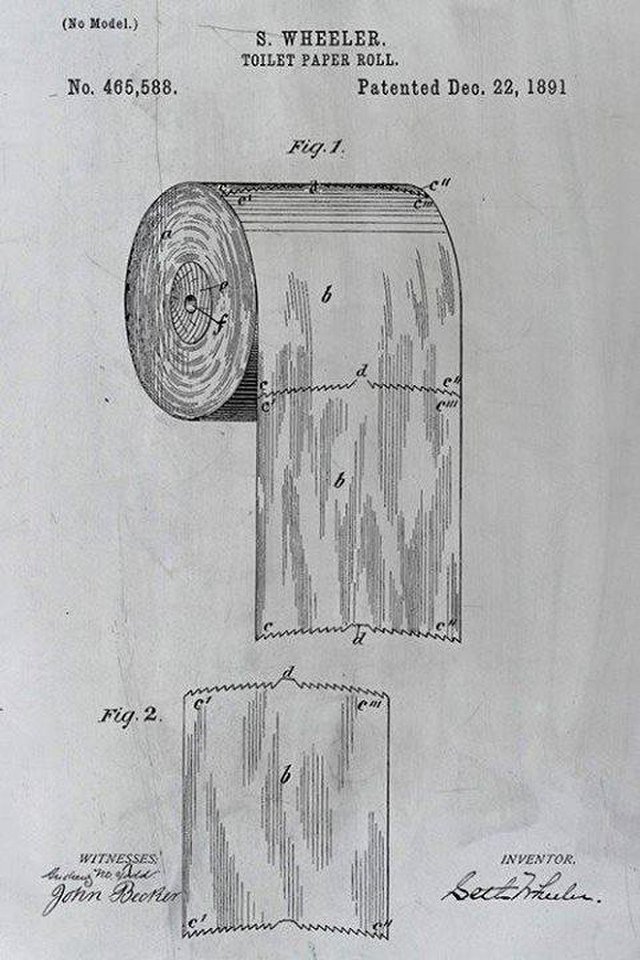
The toilet paper roll was patented by Seth Wheeler in 1891.
Now, before the "under" folks come running with their pitchforks, there are some understandable exceptions to the "over" rule. Namely: cats and kids.
If you have a furry friend or a tiny toddler who likes to unroll the toilet paper roll, "over" makes it super fun for them, while "under" stops them in their tracks. For many people, cats and kids are the primary motivator of their TP hanging habits.
That doesn't change the fact that "over" is actually the "correct" way to hang toilet paper according to health science and the inventor's intention, of course, but "under" is certainly preferable to having a pile of TP on the floor.
Now go forth, do that with information as you will, and try to make peace with your over vs. under rivals.
This article originally appeared last year.

- One woman had a strange, eye-opening encounter in a Target bathroom. ›
- More people are using Bamboo toilet paper, a sustainable alternative to traditional TP. ›
- Popular life hack has people putting their toilet paper in the refrigerator ›
- Why dark towels are superior to white towels - Upworthy ›
- Countries where you aren't supposed to flush toilet paper - Upworthy ›
- Why is it the closer you get to home, the more you have to pee? - Upworthy ›
- Under or over? There actually is a 'right' way to hang a toilet paper roll. - Upworthy ›


A woman is getting angry at her coworker.via
A man with tape over his mouth.via
A husband is angry with his wife. via 
a man sitting at a desk with his head on his arms Photo by
Can a warm cup of tea help you sleep better? If you believe it, then yes. Photo by 
Three women sit on a blanket in the park. 
Two women engaging in a pleasant conversation inside a coffee shop
Two men engaging in a peaceful disagreement.
Resurfaced video of French skier's groin incident has people giving the announcer a gold medal
"The boys took a beating on that one."
Downhill skiing is a sport rife with injuries, but not usually this kind.
A good commentator can make all the difference when watching sports, even when an event goes smoothly. But it's when something goes wrong that great announcers rise to the top. There's no better example of a great announcer in a surprise moment than when French skier Yannick Bertrand took a gate to the groin in a 2007 super-G race.
Competitive skiers fly down runs at incredible speeds, often exceeding 60 mph. Hitting something hard at that speed would definitely hurt, but hitting something hard with a particularly sensitive part of your body would be excruciating. So when Bertrand slammed right into a gate family-jewels-first, his high-pitched scream was unsurprising. What was surprising was the perfect commentary that immediately followed.
This is a clip you really just have to see and hear to fully appreciate:
- YouTube youtu.be
It's unclear who the announcer is, even after multiple Google inquiries, which is unfortunate because that gentleman deserves a medal. The commentary gets better with each repeated viewing, with highlights like:
"The gate the groin for Yannick Bertrand, and you could hear it. And if you're a man, you could feel it."
"Oh, the Frenchman. Oh-ho, monsieurrrrrr."
"The boys took a beating on that one."
"That guy needs a hug."
"Those are the moments that change your life if you're a man, I tell you what."
"When you crash through a gate, when you do it at high rate of speed, it's gonna hurt and it's going to leave a mark in most cases. And in this particular case, not the area where you want to leave a mark."
Imagine watching a man take a hit to the privates at 60 mph and having to make impromptu commentary straddling the line between professionalism and acknowledging the universal reality of what just happened. There are certain things you can't say on network television that you might feel compelled to say. There's a visceral element to this scenario that could easily be taken too far in the commentary, and the inherent humor element could be seen as insensitive and offensive if not handled just right.
The announcer nailed it. 10/10. No notes.
The clip frequently resurfaces during the Winter Olympic Games, though the incident didn't happen during an Olympic event. Yannick Bertrand was competing at the FIS World Cup super-G race in Kvitfjell, Norway in 2007, when the unfortunate accident occurred. Bertrand had competed at the Turin Olympics the year before, however, coming in 24th in the downhill and super-G events.
As painful as the gate to the groin clearly as, Bertrand did not appear to suffer any damage that kept him from the sport. In fact, he continued competing in international downhill and super-G races until 2014.
According to a 2018 study, Alpine skiing is a notoriously dangerous sport with a reported injury rate of 36.7 per 100 World Cup athletes per season. Of course, it's the knees and not the coin purse that are the most common casualty of ski racing, which we saw clearly in U.S. skier Lindsey Vonn's harrowing experiences at the 2026 Olympics. Vonn was competing with a torn ACL and ended up being helicoptered off of the mountain after an ugly crash that did additional damage to her legs, requiring multiple surgeries (though what caused the crash was reportedly unrelated to her ACL tear). Still, she says she has no regrets.
As Bertrand's return to the slopes shows, the risk of injury doesn't stop those who live for the thrill of victory, even when the agony of defeat hits them right in the rocks.