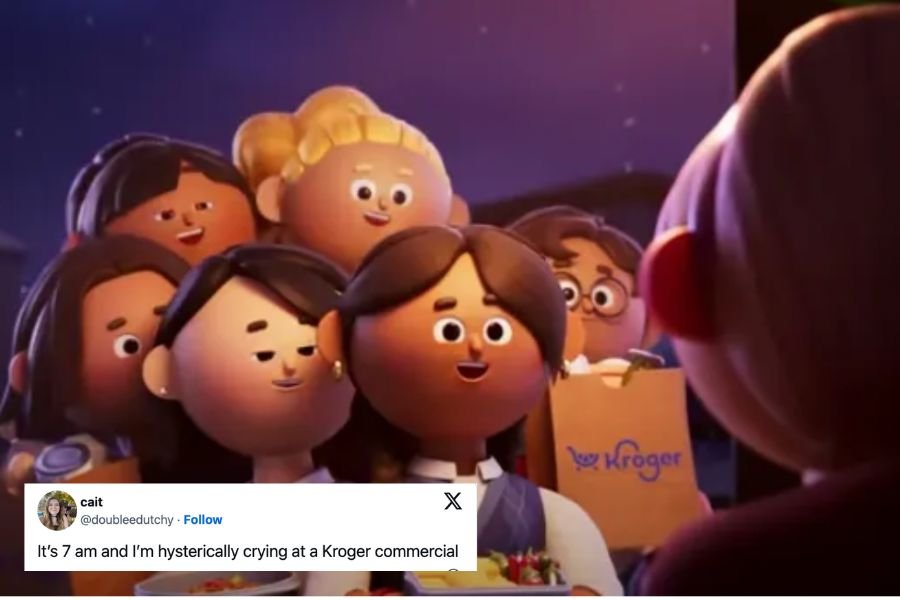
Kroger’s new holiday ad is an unexpected tearjerker

So much emotion packed into just a few seconds.

kroger, kroger commercial. kroger holiday commercial
Kroger's new commercial has viewers in tearsPhoto credit: Kroger/Youtube

Look, we know that commercials often take aim at our emotions. But certain commercials transcend clever marketing strategy and become something so much more human.

Apparently, a Kroger holiday ad, titled “Cuisine Exchange,” is one of those commercials.

“Cuisine Exchange” tells the story of a childless couple who choose to become hosts for foreign exchange students.

Ed Sheeran’s “Photograph” plays in the background as their first student arrives— a young girl from Mexico named Valentina. The couple cook Valentina pozole, a Mexican stew, which instantly makes her feel more at home.


During Valentina’s stay, the household enjoys hot cocoa with marshmallows, chili peppers (with plenty of milk nearby in case of emergency) and tamales before she returns to Mexico.

More visits follow, and with them more comfort meals: a Japanese student with soba noodles, another from Denmark with aebleskiver, a classic Christmas treat, and a kid from Italy making panettone, just to name a few.

Photographs pile onto the fridge as the years go by. And now we see the wife, with a few more wrinkles and gray hairs, yearning to see those students once again.

This prompts the husband to surprise her with truly the most thoughtful gift. As they sit by the fire, a Christmas tree twinkling beside them, suddenly there’s a knock at the door. When the wife goes to open it, she is greeted by all the exchange students they’ve ever hosted, and they all share a feast of all their favorite meals.

The ad ends with an undeniably fitting tagline: “Food connects us all.”

Reactions to the ad have been emotional to say the least, but positive nonetheless.

“Not a Kroger ad making me SOB??? I’m going to bed. ?,” one viewer wrote on X.

“cried over a Kroger ad it’s time to pack it up everybody,” another added.

Meanwhile on Youtube, several folks who had been hosts to exchange students noted how spot on the commercial was.

“This hits home,” one person wrote. “We had seven exchange students between when I was 5 and 19. Two of them stayed for an extra year and one of them even went to a college two hours away. I learned so much about them and their cultures and we always tried to make food from their home.”

Of course, this isn’t the first time Korger unleashed a holiday ad tearjerker. Just last year, the grocery brand had viewers sobbing with its “Magical Cookbook” spot, which wove similar themes of food bringing us back to precious memories.

Sometimes, it doesn’t take much to get us into our feels. Even something as simple as a quick commercial can remind us of how beautiful life really is. And that’s fine—we could all use a good cry now and then.


  • Kevin Nealon shares the big lie he told Robin Williams so that he could be his friend
    Comedians and old friends Robin Williams and Kevin Nealon.Photo credit: Canva, Darsie, sarahinvegas, Wikimedia Commons, Flickr

    Comedian Kevin Nealon and the late, great Robin Williams first became friends in 1979 in Los Angeles. But according to Nealon, as kind and lovely as Williams was, it took a little bit of maneuvering on his part to make it happen. In fact, Nealon claims he had to outright lie to lock the friendship in.

    He recently took to X and Threads to recount a heartwarming memory of pretending he knew anything about cars just to spend a little time with the brilliant comic.

    X user @ISScottDavenport shared this Ellis Rosen cartoon. Photo credit: Scott DavenPort, X

    “Robin Williams had done his set and left the comedy club. Soon after, he walks back in annoyed.

    I said, what’s going on?

    He said his car wouldn’t start.

    I go, maybe I can help. I know absolutely nothing about cars. He doesn’t know that. I just wanted to make him think I was helping him.

    So we go outside. He’s got a Range Rover.

    We open the hood. He’s leaning in, swearing.

    I’m looking around. Nodding. Like I’m a mechanic.

    I have no idea what any of it is.

    After a minute, I say, ‘Yeah… I don’t have my tools with me. You might need a mechanic.’

    Then I said…’Robin, can I give you a ride home?’”

    @jeff.rock

    #robinwilliams #80s #snl #jeffrock #comedyvideo @Adorkable Ora @Leigh Ann🍻 @Jerald Branch @ᘺσσԃყ🫶🏼Dσρρҽʅɠαɳɠҽɾ.ԃσʂ @🎭❤️Jodi ❤️📺 @Emiliya R. R. @BlueMoon

    ♬ original sound – Jeff.Rock

    The simplicity and honesty in this one post have so many fans of both comedians truly engaged. Some share their own funny takes. “A technical comedian is an oxymoron,” jokes one X user. Another writes, “The classic mechanic technique: nod seriously and suggest a mechanic.”

    Another commenter notes how wholesome Nealon’s story is: “‘I don’t have my tools with me’ is the perfect punch line for a guy who knows nothing about cars. You gave a legend a ride home and a great story to tell. That’s a win-win.”

    This person shared their own story of seeing Williams when he dropped in as a surprise guest at the San Francisco Punch Line: “I saw him do a surprise, unannounced set at Punch Line SF, right after Brett Butler. He was a whirling dervish across the tiny stage, blessing us in the front seats with his frenetic sweat. It was amazing, and I’ll never forget it.”

    One Threads user shared how much they love stories like these, writing, “I could listen to people recount stories about Robin Williams for hours and hours. That’d be such a great podcast (or something). Just actors sharing stories about their good friend, Robin.”

    In past social media posts, Nealon has heaped praise and love on his old friend.

    On Instagram, he shared a painting he made of Williams, relaying how their friendship began and blossomed over decades:

    “My caricature painting of the brilliant Robin Williams. This was the Robin I first met in 1979 in a Los Angeles comedy club. (Before ‘Mork and Mindy.’) No one was quicker or funnier! I was absolutely floored by his wit, movement, improv skills, characters, and voices. Pure genius on the level of Jonathan Winters. As much as I laughed, I also found myself depressed because I knew I could never be that funny.

    He was Amadeus Mozart, and I would be Antonio Salieri at best. But, I eventually realized that Robin couldn’t be everywhere at once (but almost), so I would probably, at least, get some work. It was always a thrill for me whenever Robin hosted SNL when I was a cast member. Absolutely brilliant! So missed!”

  • Tech strategist shares why algorithms killed ‘taste’ and where to find it now
    A woman at the bookstore and another on her phone.Photo credit: Canva
    ,

    Tech strategist shares why algorithms killed ‘taste’ and where to find it now

    There has been a cultural shift over the past year or so: being at the forefront of social media and Internet culture—or being “chronically online”—is now frowned upon. It’s similar to the ’90s, when bragging about how much TV you watched could get you accused of lacking personality or having lowbrow taste. These days, bragging…

    There has been a cultural shift over the past year or so: being at the forefront of social media and Internet culture—or being “chronically online”—is now frowned upon. It’s similar to the ’90s, when bragging about how much TV you watched could get you accused of lacking personality or having lowbrow taste. These days, bragging about bed-rotting and doomscrolling is akin to being a proud couch potato.

    Why are the chronically online backing away from their iPhones and calling TikTok trend followers tacky? It all comes down to the delivery system.

    In a viral Instagram post, Carmen Vicente, a social strategist in tech, says the shift began when the Internet changed from a place where savvy people pursued their interests on their own to one where culture was spoon-fed through algorithms. There’s a huge difference between sitting at the cultural trough and waiting to be fed by Meta and going out to discover what you authentically enjoy.

    The point is simple: You will never cultivate authentic taste in culture, art, movies, music, fashion, or food if your appetite is curated algorithmically.

    “Fifteen years ago, it required effort and curiosity to discover cool stuff on the Internet,” Vicente says. “But now, and since the advent of algorithms that hinge on economic metrics of success, looking away or elsewhere is the thing that requires effort and curiosity.”

    Vicente continues:

    “Personally speaking, I think taste is the result of your cultural inputs. And to develop good taste, we need to consume a diversity of inputs beyond just the confines of our modern suggestion engines. Simply put, the algorithms are controlled by the institutions. The institutions need to maximize shareholder value. And the more time you spend drinking the Kool-Aid from these fire hoses, the looser your grasp becomes on what is truly interesting, substantive, or moving.”

    A woman scrolling in bed. Photo credit: Canva

    There are myriad definitions of taste, but it’s generally seen as the ability to appreciate things that are culturally and aesthetically valuable.

    In his essay “Of the Standard of Taste,” philosopher David Hume argues that taste is a byproduct of a life rich in experience: “Strong sense, united to delicate sentiment, improved by practice, perfected by comparison, and cleared of all prejudice, can alone entitle critics to this valuable character.”

    Therefore, true taste can’t be developed without real-world experience and cultural inputs that go far beyond what’s delivered via smartphone.

    taste, books, culture, scrolling, algorithms, internet
    A woman at an exercise class. Photo credit: Canva

    The lesson here isn’t hard to figure out: it’s about a life lived shopping in brick-and-mortar stores, spending time outdoors, practicing hobbies that don’t involve screens, and reading books while in the dentist’s waiting room. There are so many incredible cultural treasures we can experience only by being in physical places with real people—where you can stumble upon life-changing culture by accident.

    Taste is a touchy subject, hard to separate from social status, because it often requires resources and connections to access many aspects of culture. However, that’s not an excuse to judge those who strive for an expansive, more refined sense of taste—or who hope others will join them on that journey—as merely performative.

  • Anthony Hopkins composed a waltz at age 26. It took nearly 50 years for him to hear it played.
    Anthony Hopkins had his waltz premiered by the Johann Strauss Orchestra, led by André Rieu.Photo credit: gdcgraphics (left), Bert Knottenbeld (right)
    ,

    Anthony Hopkins composed a waltz at age 26. It took nearly 50 years for him to hear it played.

    People know Sir Anthony Hopkins best for his film performances, and for good reason. With two Oscars and multiple other awards, the 88-year-old Welsh actor has earned his accolades for his work on screen. But Hopkins’ first artistic love was not acting—it was music. And that first love received a moving moment of recognition in…

    People know Sir Anthony Hopkins best for his film performances, and for good reason. With two Oscars and multiple other awards, the 88-year-old Welsh actor has earned his accolades for his work on screen.

    But Hopkins’ first artistic love was not acting—it was music. And that first love received a moving moment of recognition in 2011, when the Johann Strauss Orchestra premiered a waltz Hopkins composed in 1964 at age 26.

    “I have been writing music and composing for many years, but I never did anything with it,” Hopkins told The Independent in late 2012. “I’d wanted to be a musician when I was younger, but I wasn’t a good student as a kid, so I just dabbled around and wrote this piece, ‘And the Waltz Goes On,’ in 1964.”

    Years later, Hopkins and his wife were watching a concert by Dutch violinist and conductor André Rieu on TV. Hopkins mentioned that he’d love to have his waltz played in Vienna.

    “Some time later, I got a call from André and he said, ‘I got your waltz,’” said Hopkins. “I said, ‘What?’ He said, ‘I’ve just performed it with my orchestra in rehearsal.’ I didn’t know it, but my wife had sent him the score.”

    Rieu was surprised to receive Hopkins’ composition.

    A violin lying on top of sheet music
    A violin lying atop sheet music. Photo credit: Canva

    “A lot of people send me their waltzes – every week, in fact,” Rieu told The Independent. “But when I got a call from my office early last year, I was surprised when they said Sir Anthony Hopkins was sending me one, as I didn’t know he had a musical side. But I figured a man like him wouldn’t send me a bad waltz. I can imagine it must have been a struggle for him thinking, ‘Shall I give it to the world?’”

    Hopkins and Rieu had never met, but Hopkins flew to Rieu’s studio in Maastricht, Netherlands, in April 2011 to hear the piece rehearsed live.

    “Everyone was so excited–and nervous,” said Rieu. “But he was so gentle and kind; he embraced everyone and gave them all autographs, too. After we played it to him live, he was like, ‘I love it, I love it, and I have tears in my eyes!’”

    Naturally, anyone would be moved to hear a composition they wrote nearly 50 years earlier performed by top-tier musicians. After all, just a few years before, Hopkins told Gramophone magazine, “Music was my first desire, my first wish.”

    Close up photo of people playing the cello in an orchestra
    A musician playing the cello. Photo credit: Canva

    Vienna has been home to many famous composers, including Joseph Haydn, Wolfgang Amadeus Mozart, Ludwig van Beethoven, Franz Schubert, Johannes Brahms, Gustav Mahler, and the Strauss family. So the fact that Rieu premiered Hopkins’ piece there made the moment especially meaningful.

    What a gift it must have been to hear his waltz performed live in one of the world’s most iconic venues by the largest private orchestra in the world, led by one of its most renowned conductors.

    “Playing his waltz for the first time in one of the most beautiful halls in Vienna was like a dream for both of us,” Rieu said.

    Rieu toured with the piece, which is how we have this full performance of Hopkins’ waltz from André Rieu – Under the Stars: Live in Maastricht 5:

    Hopkins has made a name for himself far more successfully as an actor than as a musician, but people loved his waltz nonetheless. Some commenters on the video also noted how sad it would have been if the composition had remained unplayed:

    “There’s drama, passion, love and anger, sadness and boldness, a perfect waltz. And imagine, if Lady Hopkins never convinced Sir Hopkins to release this, we wouldn’t have this amazing masterpiece. Utmost respect for the two of them.”

    “Never asked anyone to play it, and yet it’s absolutely hauntingly beautiful. How much magnificent art is out there that never sees the light of day?”

    “This guy didn’t produce this waltz earlier in his life because he was afraid that nobody would like it. And you hear how beautiful this waltz is. Imagine how many artists have been too afraid to share their work. Imagine the wonderful pieces of music we could have if we would just lighten up a bit.”

    It’s a good reminder for all of us to share the talents we have.


  • Bridgerton’s Luke Thompson shared his favorite French phrase. We need something like it in English.
    France isn't the only country with a saying like "un ange passe."Photo credit: Canva

    Luke Thompson has achieved heartthrob status as Benedict Bridgerton, the free-spirited, second-born son of the noble family featured in the popular Bridgerton television series. The show’s fourth season focuses on Benedict’s Cinderella-esque love story with a servant named Sophie, played by Yerin Ha.

    In an interview promoting season four, Thompson and Ha read questions from Bridgerton fans. One person asked Thompson, who grew up in France and speaks fluent French, to share his favorite French phrase.

    @etalkctv

    We can’t think of a better French teacher! 🇫🇷 Luke Thompson revealed what his favourite French phrase is and taught Yerin the language of love in the process! Watch the FULL video of Yerin Ha and Luke Thompson texting fans at the link in our bio. 🔗 Part 1 of ‘Bridgerton’ season 4 is streaming NOW on @Netflix. #LukeThompson #YerinHa #Bridgerton #French #BenedictBridgerton @Yerin Ha

    ♬ original sound – etalk

    “My favorite French phrase is probably…Oh! ‘Un ange passe,’” he said.

    Ha asked what it meant, and Thompson helped her decipher it. Un = a/an. Ange = angel. Passe = pass(es). In English, “Un ange passe” means “An angel passes.”

    “What it means is, when you’re having a conversation, or like just in a group, it’s a nice way of expressing awkward silence,” Thompson explained. “But it’s just those moments where like, just, there’s a bit of a lull and no one says anything. And you say, ‘Un ange passe.’”

    “You say, ‘An angel passes,’” Ha said. “That’s really nice.”

    It is nice. And it appears to be a glaring omission from the English language, since people in the comments shared that they have similar phrases for awkward silences in their cultures:

    “OMG we say the same thing in Arabic!”

    “We say the same in Portuguese… ‘passou um anjo’ ☺️”

    “In Spanish we say that, at least in Chile ‘pasó un angel or ‘un angel pasó.’”

    “In Spanish we say the same thing!! México 🇲🇽”

    “In Philippines we have this too! Haha may dumaang anghel 😂”

    “In Malay we said: malaikat lalu.”

    “We have that phrase in Danish too. But it’s more an angel went through the room.”

    “The Dutch also have this, but a reverend walks by instead of the angel 🙈 Angel is much nicer.”

    “We say that too in Nigeria. ‘Ndị muozi na agafe.’”

    It seems that many cultures have handy phrases like this to make a conversational lull feel mystical or magical instead of uncomfortable and awkward. The wording may differ from place to place—apparently, in Russia and Kazakhstan they say, “A cop was born”—but why don’t we have anything even close to it in English?

    When silence falls over a group of English speakers, we just stand there and shift our gaze, feeling the heavy seconds tick by. Occasionally, someone might acknowledge the silence by saying, “Well, this is awkward…” but that only emphasizes the awkwardness.

    The irony here is that English speakers tend to be particularly uncomfortable with silence, at least compared to cultures in which silence is viewed more positively.

    In his research, linguist Haru Yamada found that Americans consider the length of silence in Japanese speakers’ conversations to be “unbearably long.” Unlike many other cultures, we have no sweet, playful saying to slice through the pregnant pause.

    Not all silence is uncomfortable, of course. It becomes awkward when we expect others to speak—or when we are expected to speak—and no one does.

    According to Rebecca Roache, associate professor of philosophy at the University of London, the awkward feeling of silence comes from fear of how it might be interpreted: “Specifically, we worry about one or both of two things: having others misinterpret our silence, and having others correctly interpret our silence.”

    In other words, we might worry that people think we’re boring if we don’t have something to say, which would be a misinterpretation of our silence. Then again, we might worry that people will think we’re nervous, which may be a totally correct interpretation of our silence—but just not the impression we want to give others.

    The beauty of having a standard phrase like “un ange passe” is that it allows everyone to acknowledge that lulls in conversation are a normal, universal phenomenon. It says, “This is so common, we even have a saying for it.” That alone helps lessen the awkwardness. The English language’s lack of such a phrase now feels like a big, gaping hole in our social lives.

    Where did the idea of saying “un ange passe” come from in the first place? According to the Lawless French website:

    “No one seems to know the origin of the expression, whether the angel’s passing is what causes the silence or if she is attracted by the tranquility, but either way, un ange passe is a nice way to break the tension and continue chatting.”

    Can we just start saying “an angel passes” now? Do we need to ask anyone’s permission for this? It appears to be pretty universal, so maybe we English speakers just missed the boat somewhere along the centuries. It feels well past time to remedy that.

  • Henry Cavill shared a delightful story about a boy’s teacher who refused to believe his uncle was Superman
    Henry Cavill February 10, 2013Photo credit: Sean Reynolds via Wikimedia Commons

    When Henry Cavill was cast as Superman in 2011, most people were thrilled. His nephew Thomas was thrilled too, and he wanted everyone to know about it.

    At school, during a “talk about your family” day, Thomas told his class: “My uncle is Superman.” His classmates were stunned. Nobody believed him. His teacher, less than impressed, told him plainly: “Thomas, we don’t lie in school.”

    Thomas did not back down. “My uncle is Superman,” he insisted.

    The teacher, now genuinely concerned, raised the issue with Thomas’s mother when she came to collect him that afternoon. She walked her through the whole incident, explaining that the school did not encourage children to make things up in front of their peers. Thomas’s mother listened patiently, then delivered the news as gently as she could.

    “I hate to tell you this,” she said, “but it’s all true.”

    Cavill told the story on The Tonight Show with Jay Leno in June 2013, and it got so much mileage that he retold it on Live with Kelly and Ryan in 2018. Both times, audiences loved it for the same reason: Thomas never wavered. He knew what he knew, and no amount of adult skepticism was going to change it.

    “My uncle is Superman” is not the kind of claim most teachers are prepared to receive. But from Thomas’s perspective, it was simply a fact about his life, one that happened to be harder to verify than most. As Cavill told the story, there was no drama, no grand reveal. Just a small boy, stubbornly telling the truth, and a mother who had to gently correct a teacher’s assumptions at school pickup.

    The clip from the Live with Kelly and Ryan appearance has amassed over nine million views, with fans delighting in the specifics. “I hope the teacher replied by saying ‘I’m going to need you to prove that,’” one commenter wrote. “If my uncle was Superman I would brag about it every single day,” said another.

    Thomas, for his part, appears to have handled the whole thing with exactly the composure you’d expect from someone whose uncle saves the world for a living.

    This article originally appeared last year.

  • His classmates wouldn’t sign his yearbook. He signed it himself. Then Paul Rudd got involved.
    Photo of a high school; (Inset) Paul Rudd Photo credit: Gage Skidmore via Wikimedia Commons

    When Brody Ridder came home from school on May 24, 2022, his mom took one look at his yearbook and felt her heart crack open. He’d asked all kinds of kids to sign it. Two had. Two teachers had. And then, on one of the pages, in his own handwriting: “Hope you make some more friends. — Brody Ridder.”

    He had signed his own yearbook. And then wished himself better luck next year.

    Cassandra Ridder posted a photo of the page to the school’s private Facebook parent group that night. She didn’t ask Brody first, but as she told the Washington Post, she knew he’d be fine with it. “Brody has always told me he wants to be part of the solution.” Her message to other parents was simple: talk to your kids about kindness. She had no idea what was about to happen.

    Other parents showed the post to their kids. Seventeen-year-old Joanna Cooper got a text from her mom with a screenshot and made a decision on the spot, as she told KDVR. “We’re going to sign his yearbook,” she said, “because no kid deserves to feel like that.” She started texting friends. Meanwhile, Simone Lightfoot, also an 11th grader, was doing the same thing. “When I was younger, I was bullied a lot like him,” she told the Washington Post. “We walked in and we were like, ‘Where’s Brody at? Is Brody Ridder in here?’ And they’re like, ‘Yeah, he’s in the back.’ And we’re like, ‘Brody! We’re here to sign your yearbook, bud.’”

    The older kids didn’t just sign their names. As Goalcast reported in its coverage, they asked Brody about his hobbies, which turned out to include chess and fencing, and gave him a pep talk. Many of them had been in similar situations at his age. Once the upperclassmen started filling pages, the kids in Brody’s own class started getting up from their seats to sign it too. “It was like a domino effect,” Cassandra told Fox News. “It was beautiful.” By the end of the day, Brody had collected more than 100 signatures, paragraphs of encouragement, and a handful of phone numbers.

    “It just made me feel better as a person,” Brody told KDVR. “I don’t know how to explain it. It just makes me feel better on the inside.”

    The story didn’t stay local for long. After Cassandra posted an update to her personal Facebook, it spread widely. Letters started arriving at the Ridders’ P.O. Box from people across the country and around the world, people of all ages who recognized something in Brody’s story. By July, at least 600 letters had arrived, with more still coming, including one dictated by a three-year-old to his mom.

    Among those who reached out was Paul Rudd. According to the Denver Post, Rudd’s sister saw Cassandra’s post and contacted her to say the actor would love to connect with Brody. Rudd FaceTimed him and sent a care package that included a signed Ant-Man helmet and a handwritten note telling Brody that things get better and that many people, Rudd included, thought he was “the coolest kid there is.”

    Cassandra and Brody have since partnered with The UGLI Foundation, an anti-bullying nonprofit, to keep the conversation going, according to the Denver Post. Cooper, the 11th grader who organized the original yearbook visit, said she planned to push for a schoolwide signing event the following year so no student would face an empty book again.

    Brody said he’s not sure all the kids who refused to sign will become his friends. But something shifted. “It made me feel like there’s hope for the school,” Cassandra said, “there’s hope for humanity, and there are a lot of good kids in this world.”

    This article originally appeared two years ago.

  • 21 years ago, Halle Berry made history by turning a Razzie into one of her most iconic performances
    Halle Berry made history by turning a Razzie into one of her most iconic performances.Photo credit: Razzie Channel/YouTube & Canva

    In 2004, the film Catwoman (directed by a French visual effects supervisor known simply as Pitof) was unleashed on the world, and it did not go well. The movie received scathing reviews, landing at 8% on Rotten Tomatoes (with an audience score of 18%). This didn’t go unnoticed by the Golden Raspberry committee, which bestowed seven nominations on the film, including Worst Picture, Worst Screenplay, and Worst Actress for Halle Berry.

    Did this stop Berry from having a good time? Absolutely not. In 2005, she created one of the most iconic power moves Hollywood has ever seen.

    For those unaware, the Golden Raspberry Awards (better known as the Razzies) began in 1981 as a satirical antithesis to the Oscars. The idea was that if filmmakers received prizes for “good work,” they should also have to accept awards for the “best worst” movies.

    So when Berry “won,” she didn’t just take it in stride. She used it as a reminder that she’s one of the entertainment business’ most incredible performers.

    Posted on the Razzie YouTube page, we see two presenters announce her name: “Halle Berry for Catwoman.” The crowd claps and laughs as we see a clip of Berry in the film, sniffing catnip manically.

    “Ladies and gentlemen—Halle Berry.” The crowd erupts as Berry, clad in a beautiful black dress, comes roaring onto the stage holding both her Razzie and her Oscar, which she received in 2002 for her work in Monster’s Ball. She feigns shock and excitement as the crowd jumps to its feet for a standing ovation.

    Berry’s speech

    “Oh my gosh,” she yells into the mic while milking every cheer. She pretends to hyperventilate, perhaps even tearing up a bit. “Thank you, guys! Thank you so much! I never in my life thought I’d be up here winning a Razzie.” The crowd laughs uproariously. “I mean, it’s not like I ever aspired to be here, but thank you!”

    What she does next is on another level. She holds up her Oscar and screams, “And no, I don’t have to give this back—it’s got my name on it!” Now the audience knows she’s in charge. She composes herself and says, “Ya know? I’ve got so many people to thank, because you won’t win a Razzie without a lot of help from a lot of people. So please indulge me and let me go through this.”

    Spoofing an Academy Award acceptance speech, she begins her list of “gratitude.” “First of all, I want to thank Warner Bros. Thank you for putting me in a piece-of-s–t, God-awful movie! It was just what my career needed, ya know? I was at the top, and then Catwoman just plummeted me to the bottom. Love it!”

    She pauses, then says, “It’s hard being on top. It’s much better being on the bottom.” The list continues. “I want to thank my manager, Vincent Cirrincione,” she says, and ushers him onto the stage. Cirrincione humbly listens while she kids, “This guy loves me. He loves me so much that he tells me I’m the greatest actress who ever was. He loves me so much that he convinces me to do projects even when he knows they’re s–t!”

    He humbly nods and plays along. “My only advice to you, Vinnie, is next time I do a movie—if I get a chance to do another movie—maybe you should read the script? Just counting the zeroes behind the one really isn’t enough. You’ve really got to read the script. Love you, man. Love you!”

    Berry is far from done.

    “I want to thank my agent and lawyers, who obviously don’t give a s–t. They’re not here tonight, but love you guys! I want to thank the writers—all twenty of them—for thinking this was a good idea.” She adds, “You tried, hey.”

    She couldn’t do it alone

    Now it’s time for her fellow actors to receive some love.

    “I want to thank the cast. You know, it’s really important. In order to give a bad performance like I did, you need a lot of bad actors around. So I want to thank all of them for being bad right along with me! One of them is here—Alex Borstein. Come on out!”

    Borstein, who played Sally, the “sassy best friend,” mugs and chews the scenery onstage as she stumbles out with fake tears. The crowd cheers. After they calm down a bit, Berry gets more serious. “One of the best things about Catwoman is I got to make some really wonderful lifelong friendships, and this lady is one of them.”

    Borstein composes herself and gazes into Berry’s eyes. She continues, “And you know what? I want to thank you for every single day looking up at me and telling me I was doing a great job—that I was the best Catwoman you ever saw. I want to thank you for lying straight to my face every day. You know, in Hollywood they lie behind your back, but she lied straight to my face!”

    Again, the crowd goes wild as Berry refocuses her energy. “I also want to thank our director, Pitof—you know, that one-name French guy? Thank you very much.” She admits his accent made it hard to take direction. “I mean, I didn’t know what the hell he was saying, but I’m sure it showed in my performance. But it was truly a joy and a pleasure.”

    Her acting coach is now on deck: “I want to thank my acting coach, Ivana Chubbuck. She just wrote a book called The Power of the Actor. You all should rush to get it. It could change your life too.”

    Berry ends on a serious note, saying, “When I was a kid, my mother told me that if you could not be a good loser, then there’s no way you could be a good winner. If you weren’t able to take criticism, then you were not worthy of getting your praise.”

    She then shares a story of having begun in beauty pageants and learning to control her rage when she lost. “So as you can imagine, I wanted to slap the s–t out of the Razzie people that brought me here tonight. But I won’t do that. I’ll do what my mother taught me and I’ll stand here graciously. I’ll take the criticism—take it as a lesson learned—and hope to God I never see these people ever again. Thank you all!”

    The response

    The audience claps with joyous applause. So did the comment section. On the official YouTube page, there are over 4,000 comments, with one reading, “This lady is classy as hell! Anyone who accepts their Razzie in person has my respect, and the delivery was absolutely priceless!”

    Another comment references the time Adrien Brody gave a six-minute speech for his Best Actor win for the film The Brutalist. The YouTuber jokes, “This speech is longer than Adrien Brody’s 6-minute speech, and hers is undeniably not a second wasted.”

    A clip circulating on Instagram has nearly 18,000 likes and a heap of support for her talent and her sense of humor. One person jokes, “The fact that she brought her Oscar…”

  • The real-life love story of Maria and Georg Von Trapp we didn’t see in ‘The Sound of Music’
    Maria Von Trapp was not in love with Georg when they got married, but that changed.Photo credit: Public domain

    The Sound of Music has been beloved for generations, partially for the music (and Julie Andrews’ angelic voice), partially for the historical storyline, and partially for the love story between Maria and Georg Von Trapp. The idea of a nun-in-training softening the heart of a curmudgeonly widower, falling in love with him, and ultimately becoming a big, happy family is just an irresistible love story.

    But it turns out the real love story behind their union is even more fascinating.

    maria von trapp, georg von trapp, the sound of music, love story, history
    Maria Von Trapp (left) was played by Julie Andrews and her husband Georg was played by Christopher Plummer in Photo credit: Public domain

    The National Archives has collected information about what’s fact and what’s fiction in The Sound of Music, which is based on a real family in Austria named Von Trapp. The film was generally based on the first section of Maria Von Trapp’s 1949 autobiography, The Story of the Trapp Family Singers, with some of the details being true and others fictionalized for a movie audience.

    For instance, Maria was actually hired on as a tutor for just one of Georg’s children, not as a governess for all of them. The children, whose names, ages and sexes were changed, were already musically inclined before Maria arrived. Georg was not the cold, grumpy dad he was portrayed as in the beginning of the film, but rather a warm and involved parent who enjoyed making music with his kids. Maria and Georg were married 11 years before leaving Austria, not right before the Nazi takeover. The Von Trapps left by train, not in a secret excursion over the mountains.

    But perhaps the most intriguing detail? Maria was not in love with Georg at all when they got married.

    gif, the sound of music, von trapp family, movie, true events

    Sound Of Music Flag GIF by The Rodgers & Hammerstein Organization Giphy

    It doesn’t initially make for a great Hollywood romance, but the Von Trapp love story began with marriage for other reasons and evolved into a genuine love story. Maria wrote that she fell in love with Georg’s children at first sight, but she wasn’t sure about leaving her religious calling when Georg asked her to marry him. The nuns urged her to do God’s will and marry him, but for Maria it was all about the children, not him. When Georg proposed, he asked her to stay with him and become a second mother to his children. “God must have made him word it that way,” Maria wrote, “because if he had only asked me to marry him I might not have said yes.”

    “I really and truly was not in love,” she wrote. “I liked him but didn’t love him. However, I loved the children, so in a way I really married the children.”

    However, she shared that her feelings for Georg changed over time. “…[B]y and by I learned to love him more than I have ever loved before or after.”

    The idea of marrying someone you don’t love is antithetical to every romantic notion our society celebrates, yet the evolution of Maria’s love for Georg has been a common occurrence across many cultures throughout history. Romantic love was not always the primary impetus for marriage. It was more often an economic proposition and communal arrangement that united families and peoples, formed the basis of alliances, and enabled individuals to rise through social ranks. Some cultures still practice arranged marriage, which limited research has found has outcomes identical to love-first marriage in reports of passionate love, companionate love, satisfaction, and commitment. The idea of marrying someone you don’t already love is anathema to modern Western sensibilities, but the reality is that people have married over the centuries for many reasons, only one of which is falling in love.

    Maria’s marriage to Georg actually was about falling in love, but not with him. She loved his children and wanted to be with them. It definitely helped that she liked the guy, but she wasn’t swept off her feet by him, there were no moonlit confessions of love a la “Something Good,” and their happily ever after love story didn’t come until much later.

    Ultimately, Maria and Georg’s love story was one for the ages, just not one that fits the Hollywood film trope. And it’s a compelling reminder that our unwritten rules and social norms determining what love and marriage should look like aren’t set in stone. Do marriages for reasons other than love always evolve into genuine love? No. Do marriages based on falling in love first always last? Also no. Should a marriage that starts with “like” and develops into to a genuine, deep love over years be considered “true love” in the way we usually think of it? Who can say? Lots to ponder over in this love story.

    But Maria’s description of learning “to love him more than I have ever loved before or after” is a pretty high bar, so clearly it worked for them. The Von Trapps were married for 20 years and had three more children together before Georg died of lung cancer in 1947. Maria would live another four decades and never remarried. She died in 1987 at age 82 and is buried next to Georg on the family’s property in Vermont.


    This article originally appeared last year It has been updated.

Wholesome

Women’s wrestling champion earns praise for going easy on a terrified new wrestler

Family

Mom shares daughter’s epic response to girls who bullied her, and people are applauding

Wholesome

A woman was surprised with a party bus for her 60th birthday. She immediately took it to see her own mom battling dementia.

Identity

A woman didn’t think she had an accent. A linguist proved her wrong with just one word.