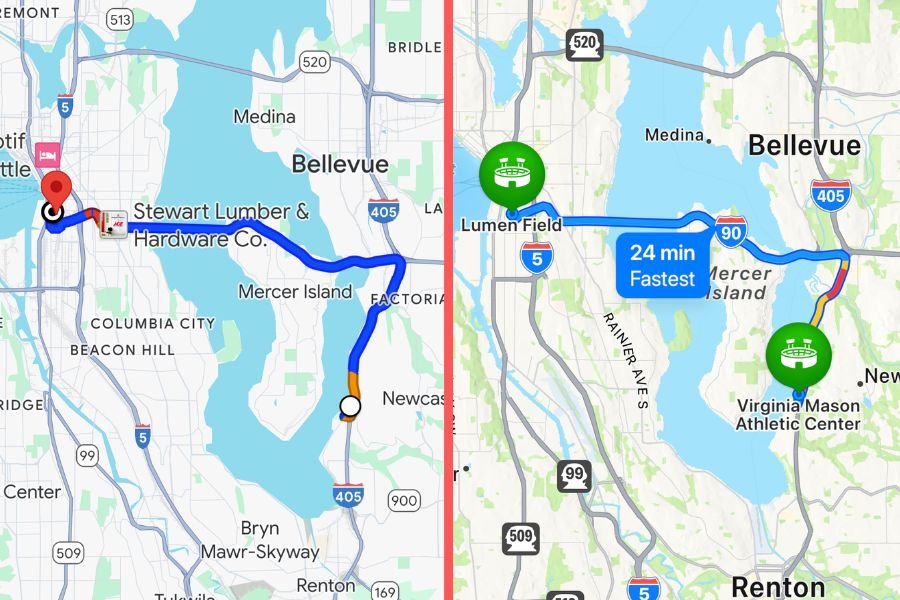
Former Uber employee ranks Google Maps, Apple Maps and Waze, prompting map app debate
Do you agree?

Which map app is the best for what uses?
Those of us of a certain age remember asking for directions and keeping two-inch thick road atlases in our cars to find our way around. Then with the internet came the miracle of Mapquest, followed by the how-did-we-ever-live-without-this GPS systems you could attach to your dashboard.
Then smartphones kicked the road trip game up a notch with map apps that not only give up step-by-step directions but also real-time traffic conditions and the ability to find a gas station or restaurant with gluten-free options along your route. Even those of us who grew up with paper maps struggle to recall how we ever got anywhere before Google Maps.
Now we're so deep into the map app era that we're past the wow stage and into the nit-picky stage. It's no longer good enough to have a handheld computer tell us how to get someplace in real time. Now we have expectations, preferences, opinions and complaints. We also have data and anecdotes with which to compare different apps and discuss which ones do what best.
And hoo boy do people have thoughts on that front.
Former Uber employee Flo Crivello shared some info on X about the analysis they did with three of the most popular map apps—Google Maps, Apple Maps and Waze—using a dataset with millions of trips.
The big winner? Apple Maps.
Google came in second, and Waze was a distant third (worst "by far").
"The research also included which apps people *thought* was worse, and the order came in the exact opposite order," Crivello shared. "We understood why Apple Maps got a bad rap given how bad it was at launch — it rapidly got better, but the brand stuck. Waze was more of a mystery, and we ended up realizing that people thought its routes were best because it was exposing them to so much info on traffic, construction, police presence etc… Everyone thinks they want a minimalist UI, but in practice, when they see all this info, they subconsciously conclude 'wow, these guys really have their sh*t together' — even when the routes were actually the worst ones."
Crivello said the results "may be shocking," presumably because Apple Maps started with the worst reputation. In fact, Apple CEO Tim Cook famously apologized for Apple Maps in 2012 and recommended people use Google Maps instead.
However, in the years since, Apple Maps has redeemed itself while Google Maps has lost a bit of its initial luster. Then Waze came along, which people in cities with variable traffic touted as more accurate for timing and real-time updates, becoming some people's favorite. But according to his data eight years ago, Apple was the winner.
Do those results still hold? Some people in the replies said Google Maps was the best, hands down, while other said they preferred Apple or Waze.
It might depend on where you live and what you look for in a map app (and whether you even have access to Apple Maps). Discussions about these apps abound, with some common threads throughout. Many people agree that the U.S. is where Apple Maps shines, but Google Maps works better abroad. Apple Maps offers more natural navigation directions, such as "Not at this stop sign, but at the next one, turn right," instead of Google Maps' assumption that everyone knows how far 300 feet is. Google maps has great searchability and is easier to check reviews of places compared to Apple Maps. So opinions might vary on "best" depending on what you're using it for.
Waze has loyal users and people who love to joke about where it reroutes you when there's traffic.
These are not the only three map apps available, either. People who travel internationally and use public transportation seem partial to the CityMapper app, which makes finding train and bus routes simple with a user-friendly interface, so again, a lot depends on why you're using the app in the first place.
As far as popularity goes, Google Maps boasts a whopping 1 billion monthly users. While Apple Maps usage doesn't have any hard numbers, there is data that shows younger generations are partial to iPhones, on which Apple Maps is a native app, so its usage may be growing.
What's your experience? Which map app do you prefer?
This article originally appeared last year.

- When I Hear 'Tougher State Gun Laws,' I Think Of These 3 Maps. They're Burned Into My Mind. ›
- This Is The Most Depressing Version Of Google Maps I’ve Ever Seen ›
- Where's the best place on earth to be a woman? These maps try to help you figure it out. ›
- Woman's rant about 'pirate' directions is going viral - Upworthy ›
- Gen Zer asks Gen X how they got around without GPS and the answers are perfectly accurate - Upworthy ›


a man sitting at a desk with his head on his arms Photo by
Can a warm cup of tea help you sleep better? If you believe it, then yes. Photo by 
A woman is getting angry at her coworker.via
A man with tape over his mouth.via
A husband is angry with his wife. via 
Three women sit on a blanket in the park. 
Two women engaging in a pleasant conversation inside a coffee shop
Two men engaging in a peaceful disagreement.
Resurfaced video of French skier's groin incident has people giving the announcer a gold medal
"The boys took a beating on that one."
Downhill skiing is a sport rife with injuries, but not usually this kind.
A good commentator can make all the difference when watching sports, even when an event goes smoothly. But it's when something goes wrong that great announcers rise to the top. There's no better example of a great announcer in a surprise moment than when French skier Yannick Bertrand took a gate to the groin in a 2007 super-G race.
Competitive skiers fly down runs at incredible speeds, often exceeding 60 mph. Hitting something hard at that speed would definitely hurt, but hitting something hard with a particularly sensitive part of your body would be excruciating. So when Bertrand slammed right into a gate family-jewels-first, his high-pitched scream was unsurprising. What was surprising was the perfect commentary that immediately followed.
This is a clip you really just have to see and hear to fully appreciate:
- YouTube youtu.be
It's unclear who the announcer is, even after multiple Google inquiries, which is unfortunate because that gentleman deserves a medal. The commentary gets better with each repeated viewing, with highlights like:
"The gate the groin for Yannick Bertrand, and you could hear it. And if you're a man, you could feel it."
"Oh, the Frenchman. Oh-ho, monsieurrrrrr."
"The boys took a beating on that one."
"That guy needs a hug."
"Those are the moments that change your life if you're a man, I tell you what."
"When you crash through a gate, when you do it at high rate of speed, it's gonna hurt and it's going to leave a mark in most cases. And in this particular case, not the area where you want to leave a mark."
Imagine watching a man take a hit to the privates at 60 mph and having to make impromptu commentary straddling the line between professionalism and acknowledging the universal reality of what just happened. There are certain things you can't say on network television that you might feel compelled to say. There's a visceral element to this scenario that could easily be taken too far in the commentary, and the inherent humor element could be seen as insensitive and offensive if not handled just right.
The announcer nailed it. 10/10. No notes.
The clip frequently resurfaces during the Winter Olympic Games, though the incident didn't happen during an Olympic event. Yannick Bertrand was competing at the FIS World Cup super-G race in Kvitfjell, Norway in 2007, when the unfortunate accident occurred. Bertrand had competed at the Turin Olympics the year before, however, coming in 24th in the downhill and super-G events.
As painful as the gate to the groin clearly as, Bertrand did not appear to suffer any damage that kept him from the sport. In fact, he continued competing in international downhill and super-G races until 2014.
According to a 2018 study, Alpine skiing is a notoriously dangerous sport with a reported injury rate of 36.7 per 100 World Cup athletes per season. Of course, it's the knees and not the coin purse that are the most common casualty of ski racing, which we saw clearly in U.S. skier Lindsey Vonn's harrowing experiences at the 2026 Olympics. Vonn was competing with a torn ACL and ended up being helicoptered off of the mountain after an ugly crash that did additional damage to her legs, requiring multiple surgeries (though what caused the crash was reportedly unrelated to her ACL tear). Still, she says she has no regrets.
As Bertrand's return to the slopes shows, the risk of injury doesn't stop those who live for the thrill of victory, even when the agony of defeat hits them right in the rocks.