upworthy
Add Upworthy to your Google News feed.
Google News Button
Health

Harvard psychologist explains how to achieve happiness—and it's actually simple

It's time to stop giving awfulness the power to bend our lens. Here's how.

secret to happiness explained
YouTube

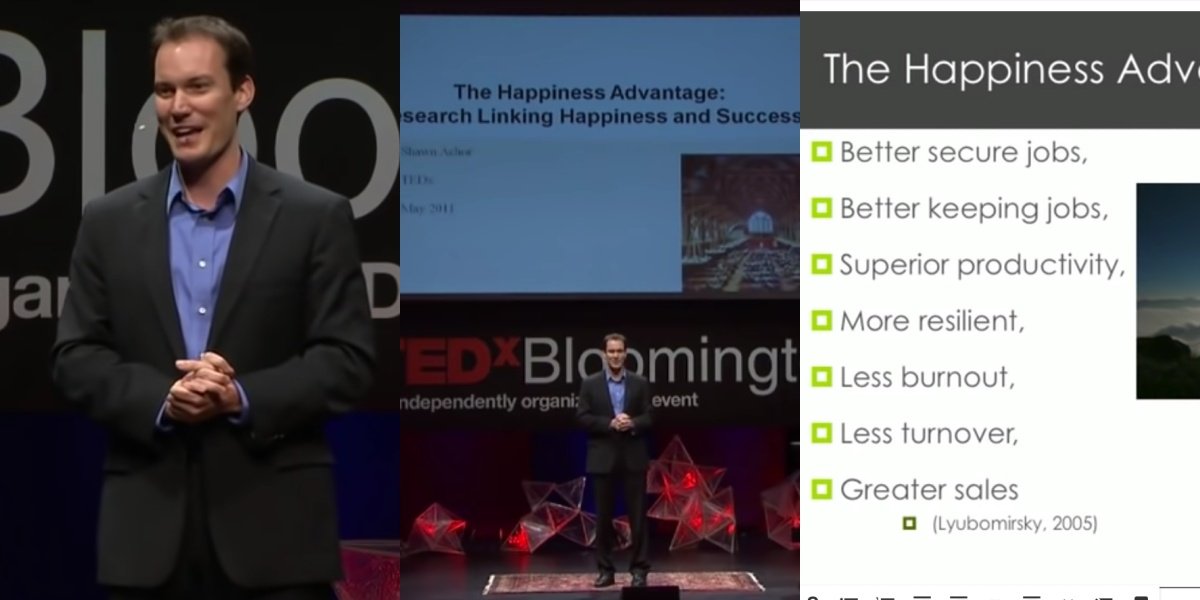
Shawn Achor explains "The Happiness Advantage"

Anytime you look at the news, it's about death, destruction, abductions, natural disasters...

That kind of thing can mess us up. It makes the world look scarier than it is. It's like wearing the opposite of rose-colored glasses.

Feel like you've fallen into the Matrix yet?

It's time to stop giving awfulness the power to bend our lens. Here's how.


Shawn Achor studied happiness at Harvard.

When he tells people this, they say: "Shawn, why do you waste your time studying happiness at Harvard? Seriously, what does a Harvard student possibly have to be unhappy about?"

But the crazy truth is, Harvard kids are as unhappy as anyone else. What's going on in your life — from health, to money, to relationships, to prestige — predicts only about 10% of your happiness.

So ... if I had a million dollars ... I wouldn't be any happier?

Shawn's work flips our understanding of happiness inside out.

You don't get happy by achieving success. You achieve success by getting happy.

Dopamine, which your brain makes when you're happy, has one important side effect: It makes you smarter. A positive brain is 31% more productive. It's better at sales, faster and more accurate at diagnosing problems.

So how can you up your dopamine?

Take two minutes every day and do one of these things:

  1. Write down three new things that you're grateful for.
  2. Journal about one positive experience you've had in the last 24 hours.
  3. Try meditation, to teach your brain to focus.
  4. Use the first email you write every day to praise or thank someone you know. Spread the happy.

And it wouldn't hurt to disrupt the endless barrage of bad news by sharing this with your friends, right? Everyone needs a little more happiness.

Remember...

Watch Shawn Achors' Ted Talk in the video below:

This article originally appeared on 04.10.15

Planet

Our favorite giveaway is back. Enter to win a free, fun date! 🌊 💗

It's super easy, no purchase or donation necessary, and you help our oceans! That's what we call a win-win-win. Enter here.

Our favorite giveaway is back. Enter to win a free, fun date! 🌊 💗
True

Our love for the ocean runs deep. Does yours? Enter here!

This Valentine’s Day, we're bringing back our favorite giveaway with Ocean Wise. You have the chance to win the ultimate ocean-friendly date. Our recommendation? Celebrate love for all your people this Valentine's Day! Treat your mom friends to a relaxing spa trip, take your best friend to an incredible concert, or enjoy a beach adventure with your sibling! Whether you're savoring a romantic seafood dinner or enjoying a movie night in, your next date could be on us!

Here’s how to enter:


  • Go to upworthy.com/oceandate and complete the quick form for a chance to win - it’s as easy as that.
  • P.S. If you follow @oceanwise or donate after entering, you’ll get extra entries!

Here are the incredible dates:

1. Give mom some relaxation

She’s up before the sun and still going at bedtime. She’s the calendar keeper, the lunch packer, the one who remembers everything so no one else has to. Moms are always creating magic for us. This Valentine’s Day, we’re all in for her. Win an eco-friendly spa day near you, plus a stash of All In snack bars—because she deserves a treat that’s as real as she is. Good for her, kinder to the ocean. That’s the kind of love we can all get behind.


Special thanks to our friends at All In who are all in on helping moms!

2. Jump in the ocean, together

Grab your favorite person and get some much-needed ocean time. Did you know research on “blue spaces” suggests that being near water is linked with better mental health and well-being, including feeling calmer and less stressed? We’ll treat you to a beach adventure like a surfing or sailing class, plus ocean-friendly bags from GOT Bag and blankets from Sand Cloud so your day by the water feels good for you and a little gentler on the ocean too.

Special thanks to our friends at GOT Bag. They make saving the ocean look stylish and fun!

3. Couch potato time

Love nights in as much as you love a date night out? We’ve got you. Have friends over for a movie night or make it a cozy night in with your favorite person. You’ll get a Disney+ and Hulu subscription so you can watch Nat Geo ocean content, plus a curated list of ocean-friendly documentaries and a movie-night basket of snacks. Easy, comfy, and you’ll probably come out of it loving the ocean even more.

4. Dance all day!

Soak up the sun and catch a full weekend of live music at BeachLife Festival in Redondo Beach, May 1–3, 2026, featuring Duran Duran, The Offspring, James Taylor and His All-Star Band, The Chainsmokers, My Morning Jacket, Slightly Stoopid, and Sheryl Crow. The perfect date to bring your favorite person on!

We also love that BeachLife puts real energy into protecting the coastline it’s built on by spotlighting ocean and beach-focused nonprofit partners and hosting community events like beach cleanups.

Date includes two (2) three-day GA tickets. Does not include accommodation, travel, or flights.

5. Chef it up (at home)

Stay in and cook something delicious with someone you love. We’ll hook you up with sustainable seafood ingredients and some additional goodies for a dinner for two, so you can eat well and feel good knowing your meal supports healthier oceans and more responsible fishing.

Giveaway ends 2/15/26 at 11:59pm PT. Winners will be selected at random and contacted via email from the Upworthy. No purchase necessary. Open to residents of the U.S. and specific Canadian provinces that have reached age of majority in their state/province/territory of residence at the time. Please see terms and conditions for specific instructions. Giveaway not affiliated with Instagram. More details at upworthy.com/oceandate

Pets

Vet demonstrates 'squish the cat' method of safe cat handling in delightfully helpful video

There's a reason Dr. Burstyn's "How to pick up a cat" video has been viewed 23 million times.

cats, pets, cat handling, veterinarian, feline behavior

Handling a cat may seem like a delicate matter, but being delicate isn't actually the way to go.

If you've ever tried to make a cat do something it doesn't want to do, you've likely experienced the terror that a cat's wrath can invoke. Our cute, cuddly feline friends may be small, but the razor blades on their feet are no joke when they decide to utilize them. Even cats who love us can get spicy if we try to manhandle them, so we can imagine how things will go with cats who don't know us well. But sometimes it's necessary to handle a cat even if it's resistant to the idea.

This is where Vancouver veterinarian Dr. Uri Burstyn comes in. His "How to pick up a cat like a pro" video, in which he demonstrates a few ways of picking up and handling a cat, has been viewed over 23 million times since he shared it in 2019. Unlike many viral videos, it's not humorous and nothing outrageous happens, but the combo of Burstyn's calm demeanor and his repeated instructions to "squish that cat" has endeared him to the masses.


- YouTube www.youtube.com

The video truly is helpful; he shows the ways to pick up a cat that make them feel the most secure using his cats, one-year-old Claudia and 14-year-old Mr. Pirate. He explains that cats spook very easily and it's best to introduce yourself to them gently. Let them sniff your fingers, keeping your fingers curled in, and once they've sniffed you, you can often give them a light rub on the cheek or under the chin.

Picking them up is a different story. The reason many cats will claw or scratch you when you try to pick them up is because they feel unsupported or unsafe, so they'll scramble around trying to get some footing. Burstyn shows how he picks up Claudia with one hand under the chest and one hand under her abdomen. If he needs to carry her around, he squishes her into his body so she feels "nice and supported." He may even put a hand under her front paws.

cats, pets, cat handling, veterinarian, feline behavior Cats can be finicky about how they're held. Photo credit: Canva

Then came the best part of the video: "Squish That Cat"

"Now if we do have a cat who's trying to get away from us?" Burstyn said. "We always squish that cat. If you're trying to hold the cat down, whether it's to trim their nails or to give them a pill, or whether you just want to have a cat not run off for a moment, squish that cat. All you need to know about cat restraint is to squish that cat."

Burstyn explains that cats generally feel very secure being squished, even if they're really scared.

"Sometimes cats come to me in the clinic, and they're quite afraid," he said. "And you just gently squish them, and they'll sit there and kind of not hurt themselves, not hurt us. Just hang out and let us do our thing."

He demonstrated putting a towel over the cat, explaining, "If you have a towel handy, this is one of the best cat restraint tools around. You can just throw a towel on the catty and squish her with the towel, that way they won't get a claw into you if they are scrambling about a bit. Very safe and gentle, and generally cats are very, very happy to be squished like that."

cats, pets, cat handling, veterinarian, feline behavior Squish that cat. Photo credit: Canva

Dr. Burstyn also showed how to do a "football hold," tucking the cat under your arm with them facing backwards. "So this is kind of an emergency way if you really need to carry a cat somewhere in a hurry," he said. Scooping up Claudia, he explained, "Little head's under your arm, butt in your hand, and you squish her tight to your body. And with that little football carry, you can basically hold a cat very securely and very safely, because it's really hard for them to rake you with their hind legs."

If you're worried about over-squishing your cat, Dr. Burnstyn says don't. "You don't have to worry about hurting a cat," he said. "They're very, very tough little beasts. You know, just squishing them against your body's never going to do them any harm. In fact, they tend to feel more safe and secure when they're being held tightly."

Dr. Burnstyn also demonstrated how to pick up and set down a "shoulder cat" who insists on climbing onto people's shoulders and hanging out there, as Mr. Pirate does. It's highly entertaining, as Mr. Pirate is a big ol' chonky kitty.


@yozron

she loves my shoulders i guess #catcore #kittendad #kittensoftiktok #cat #fyp

People in the comments loved Dr. Burnstyn's demonstration, with several dubbing him the Bob Ross of veterinary medicine. Even people who don't have cats said they watched the whole video, and many loved Claudia and Mr. Pirate as well.

"This is just proof that cats are liquid."

"12/10 cat. Excellent squishability."

"So essentially, cats love hugs? That's the most wonderful thing i've heard all day."

"This cat is so well mannered and looks educated."

"Mr Pirate is an absolute unit."

"S q u i s h . T h a t . C a t ."

"I need 'Squish that cat' shirt.

"Dang, that actually helped with my female cat. She has been through at least two owners before me and had some bad expriences which obviously resulted in trust issues. She has now been with me for two years and it had gotten loads better, but she still did not want me to hold her. Normally I simply would have let her be, but for vet visits and such it was not an ideal situation. But then I saw this video and tried to squish the cat. And she loves it! She is turning into quite the snuggly bug. Thank you!"

So there you go. When all else fails, squish that cat and see what happens.

You can follow Dr. Burstyn on YouTube at Helpful Vancouver Vet.


Pets

Yes, even cats have a favorite person. How they choose and how to tell they've picked you.

Just because they seem uninterested doesn't mean they don't pick favorites.

cat; cats; pets; cat's favorite; people and cats; cat snuggles; cat behavior

Even cats have a favorite person. Here's how they choose.

Cats may be persnickety at times or appear aloof to the presence of humans, but that doesn't mean they don't have their favorites. Just like dogs, cats also fancy having a human best friend, but unless the feline companion is overly affectionate, one may not know they've been chosen.

Some cats live up to the expectation that they will give the most attention to the person who likes them the least. But most cats are particular about who they choose to give their attention to. In a one-person household, there could be a real possibility that the human in the equation isn't the favorite. After all, cats are not dogs who will be excited by their humans' mere existence. Cats are much more like broke royalty who expect their humans to be grateful for the opportunity to scoop out their litter boxes.


cat; cats; pets; cat's favorite; people and cats; cat snuggles; cat behavior Curious cat and baby share a gentle moment on the grass.Photo credit: Canva

Due to the imaginary royal title, a cat is much more discerning about who they give their priceless attention to. Usually, it's easy to tell who kitty has designated as their favorite person in a multi-person household. But the question remains, how do they pick their person?

According to Union Lake Veterinary Hospital, "People who communicate with their cat by getting to know their cues and motives are more attractive to their cat companions." They added, "Another reason behind their preference is the cat’s breed or personality. If your cat is the type who wants to be chill and relax, they will probably gravitate towards the family member who is calm and quiet. Playful, energetic cats who love to stay active will likely choose a friend who gives them this exercise and attention. In fact, it may be that your cat is revealing something about you in why they choose to love you best."

cat; cats; pets; cat's favorite; people and cats; cat snuggles; cat behavior Feline friends sharing a tender moment by the window.Photo credit: Canva

Certified Feline Training and Behavior Specialist and founder of Cat Behavior Solutions, Molly DeVoss, explains to Rover that cats prefer people who have a calming presence, feed them, and play with them. She also shares how trauma in a cat's early life influences how they form attachments to humans. "If a cat (or kitten) were in an abusive or neglectful situation with a certain demographic, they’re more likely to feel uncomfortable and unsafe around some types of people."

How can you tell if a cat has chosen you as their favorite human?

Cats will let you know that you might be their favorite person by doing a few things. According to DeVoss, if a cat is keen on you being their number one human, they'll do things like headbutt your hands, legs, and even forehead. They'll bring you their toys, rub their scent on you, rub their teeth or mouth on you, and groom you by licking your hair. DeVoss also says that when a cat exposes their belly or flops around briefly, it displays a deep level of trust.

cat; cats; pets; cat's favorite; people and cats; cat snuggles; cat behavior A sweet moment shared with a fluffy friend.Photo credit: Canva

To become your cat's favorite person, you may need to start sharing some common interests. That doesn't mean you have to stalk bugs or start knocking things off of counters, but if your cat likes watching out the window, you can make it a shared activity. Cats can also be trained to perform tricks, especially those that are active and attentive to their surroundings. You can even get a cat play yard or "catio" for the ones that seem as if they're longing to do some porch sitting with you.

You can also bond with them by talking to them throughout the day, even if they don't know what you're saying, Union Lake Veterinary Hospital says. Being affectionate with your cat more often, with pets, hugs, and scratches, will make them feel loved and safe. Doing some of these things will have your feline companion purring their little hearts out in no time.

This article originally appeared last year.

guitar, learning a skill, neuroscience, music, exposure, passive exposure, gardening

A woman learning how to play guitar.

Learning a new skill, such as playing an instrument, gardening, or picking up a new language, takes a lot of time and practice, whether that means scale training, learning about native plants, or using flashcards to memorize new words. To improve through practice, you have to perform the task repeatedly and receive feedback so you know whether you’re doing it correctly. Is my pitch correct? Did my geraniums bloom? Is my pronunciation understandable?

However, a new study by researchers at the Institute of Neuroscience at the University of Oregon shows that you can speed up these processes by adding a third element to practice and feedback: passive exposure. The good news is that passive exposure requires minimal effort and is enjoyable.


"Active learning of a... task requires both expending effort to perform the task and having access to feedback about task performance," the study authors explained. "Passive exposure to sensory stimuli, on the other hand, is relatively effortless and does not require feedback about performance."


woman reading, woman book, young woman, studying, new skills A woman reading a book.via Canva/Photos

How to pick up new skills faster?

So, if you’re learning to play the blues on guitar, listen to plenty of Howlin’ Wolf or Robert Johnson throughout the day. If you’re learning to cook, keep the Food Network on TV in the background to absorb some great culinary advice. Learning to garden? Take the time to notice the flora and fauna in your neighborhood or make frequent trips to your local botanical garden.

If you’re learning a new language, watch plenty of TV and films in the language you are learning. The scientists add that auditory learning is especially helpful, so listen to plenty of audiobooks or podcasts on the subject you’re learning about.

But, of course, you also have to be actively learning the skill as well by practicing your guitar for the recommended hours each day or by taking a class in languages. Passive exposure won't do the work for you, but it's a fantastic way to pick up things more quickly. Further, passive exposure keeps the new skill you're learning top-of-mind, so you're probably more likely to actively practice it.

What is passive exposure?

Researchers discovered the tremendous benefits of passive exposure after studying a group of mice. They trained them to find water by using various sounds to give positive or negative feedback, like playing a game of “hot or cold.” Some mice were passively exposed to these sounds when they weren't looking for water. Those who received this additional passive exposure and those who received active training learned to find the water reward more quickly.

gardening, woman gardening, gardening shears, leaning gardening, weeds A woman tending to her garden.via Canva/Photos


“Our results suggest that, in mice and in humans, a given performance threshold can be achieved with relatively less effort by combining low-effort passive exposure with active training,” James Murray, a neuroscientist who led the study, told University of Oregon News. “This insight could be helpful for humans learning an instrument or a second language, though more work will be needed to better understand how this applies to more complex tasks and how to optimize training schedules that combine passive exposure with active training.”

The one drawback to this study was that it was conducted on mice, not humans. However, recent studies on humans have found similar results, such as in sports. If you visualize yourself excelling at the sport or mentally rehearse a practice routine, it can positively affect your actual performance. Showing, once again, that when it comes to picking up a new skill, exposure is key.

The great news about the story is that, in addition to giving people a new way to approach learning, it’s an excuse for us to enjoy the things we love even more. If you enjoy listening to blues music so much that you decided to learn for yourself, it’s another reason to make it an even more significant part of your life.

- YouTube www.youtube.com

This article originally appeared last year.

Education

Stop struggling with small talk by using the easy 'COST method'

This simple acronym will make your next social gathering a lot more enjoyable.

small talk, woman at party, chatting , conversation, drinks, dinner party

A man and woman chatting at a dinner party.

There are several reasons why people are hesitant to engage in small talk at a party or around the water cooler at work. Some people simply avoid it because they don’t find chatting about the weather, sports, or what they saw on television the night before very interesting.

Others are afraid that they may run out of things to say or that there will be an awkward pause that makes them want to hide their head in the sand, like an ostrich. Mary, a friendship educator with a degree in interpersonal communication, has a solution for those of us who want to be friendly and meet people but abhor small talk; she calls it the COST method.


What is the COST method for making small talk?

According to Mary, who goes by @better.social.skills on TikTok, COST stands for Compliment, Observation, Story, and Tip. These are four options you can turn to when you're in need of a conversation topic.

@better.social.skills

Remember the acronym C.O.S.T. and you’ll always have something to talk about at parties or events. C stands for compliment. Tell somebody you like their shirt or shoes, for example, and see where the conversation leads. O stands for observation. Remark on something happening around you, like if you enjoy the music or feel a certain way about the weather. A stands for story, in which you share a little anecdote about yourself. For example, maybe you were late to the party for some reason, or you’re excited to get home and watch a show you’re loving. T stands for tip, in which you give a small recommendation to someone. For example, where the shortest bathroom lines are, which food is particular particularly delicious, or point out an interesting person they might want to talk to. What do you think? Would you use these? #creatorsearchinsights #conversationstarters

1. Compliment

“Tell somebody you like their shirt or shoes, for example, and see where the conversation leads,” Mary says.

“Oh, I like your shoes.”

“I like your shirt.”

“You have such a soothing voice.”

2. Observation

“Remark on something happening around you,” Mary says.

“This song is amazing.”

“I really love how Jeanie decorated this room.”

“There’s a lot more people here than last night.”

3. Story

“Share a little anecdote about yourself. For example, maybe you were late to the party for some reason, or you’re excited to get home and watch a show you’re loving,” she said.

4. Tip

“Give a small recommendation to someone. For example, where the shortest bathroom lines are, which food is particularly delicious, or point out an interesting person they might want to talk to,” Mary said.

“I don’t know if you’ve tried the new Mexican place on South Street yet…”

“I’d have one of Jeanie’s margaritas now, before they are all gone.”

“Be careful if you talk to Brian. He can get a bit long-winded.”

chatting before movie, popcorn, movie theater, snacks, small talk Three people chatitng before a movie.via Canva/Photos

The great thing, if you’re a little shy about making small talk, is that studies show that you definitely don’t need to do all the heavy lifting in the conversation. In fact, a Gong.io study found that the best way to make a connection with someone is to speak 43% of the time and let your new friend talk for the other 57% of the conversation.

Further proof that the best way to make a great first impression is a study published in the Journal of Personality and Social Psychology. It found that when meeting someone for the first time, ask them a question and then be sure to ask two additional follow-ups before discussing yourself. This has been found to dramatically increase your likability.

“We identify a robust and consistent relationship between question-asking and liking,” the authors of the study write. “People who ask more questions, particularly follow-up questions, are better liked by their conversation partners.”

For those of you who have always felt that you're bad at making small talk. while others seemed to do it naturally, realize that people aren’t born great communicators; it’s a skill that can be learned just like anything else. With a few tips from the experts, you can go from dreading small talk to enjoying striking up a conversation with just about anyone.

This article originally appeared last year.

guitar, learning, young woman, laptop, acoustic guitar, strumming

A woman learning how to play guitar.

Learning a new skill means studying and then practice, practice, practice. That might mean learning how to read music and then playing “Für Elise” by Beethoven over and over again. Or, if you’re learning to speak French, you have to memorize the words and then hone your pronunciation through repetition. But what would happen if you gave your brain a moment during practice to really soak in what it was doing instead of a nonstop information dump?

How to learn things faster

A 2021 study from the National Institutes of Health found that when you’re studying a new skill and practicing, you can speed up your progress by taking short breaks. Instead of keeping your head in the piano and playing for 45 minutes straight, your brain does a better job at encoding new information if you drop in a series of 10-second breaks.


The strategy makes a lot of sense for this simple reason: your brain has difficulty encoding and learning new information simultaneously. So why not give it a second to catch up?

golf, golf teacher, golf instructor, wedge, golf course A man getting golf lessons.via Canva/Photos

"Our results support the idea that wakeful rest plays just as important a role as practice in learning a new skill. It appears to be the period when our brains compress and consolidate memories of what we just practiced," the senior author of the study said, according to Fox 13 Seattle. "Understanding this role of neural replay may not only help shape how we learn new skills but also how we help patients recover skills lost after neurological injury like stroke."

How to use the 10-second memory technique

There isn’t any official time limit between when you should take a break and let your mind encode the new information. Still, neuroscientist Andrew Huberman suggests that “every few minutes” you stop what you’re doing, clear your mind, and let your brain encode the information for 10 seconds. “Now, you actually have to do the work, and how many of these to insert? It should be random,” Huberman said.

- YouTube www.youtube.com

So, if you were playing “Für Elise” on the piano, set a time for five minutes of intense playing, then when the alarm goes off, sit still for ten seconds and clear your mind of everything, almost like a meditation. Then your brain will kick into action, like a computer booting up, and encode what you just learned. Next, set a timer for three minutes; after the next encode break, set a timer for seven minutes, and so on.

sign language, learning to sign, learning a langiage, classroom, sign language teacher Students learning sigh language.via Canva/Photos

The researchers tested their hypothesis by placing a brain-scanning cap on right-handed participants who were shown a series of numbers on a computer screen and asked to type them as many times as possible with their left hand. The gains were even greater for those who did the 10-second breaks than for those who had just had a great night’s rest.

Ultimately, the 10-second technique makes a lot of sense because it’s a lot harder to concentrate on something when doing two things at the same time. You’ve got to give your brain a moment to jot down notes instead of learning and writing at the same time.

At the end of the day, what’s not to like about the 10-second technique? You get to take a break and improve your skills at the same time.