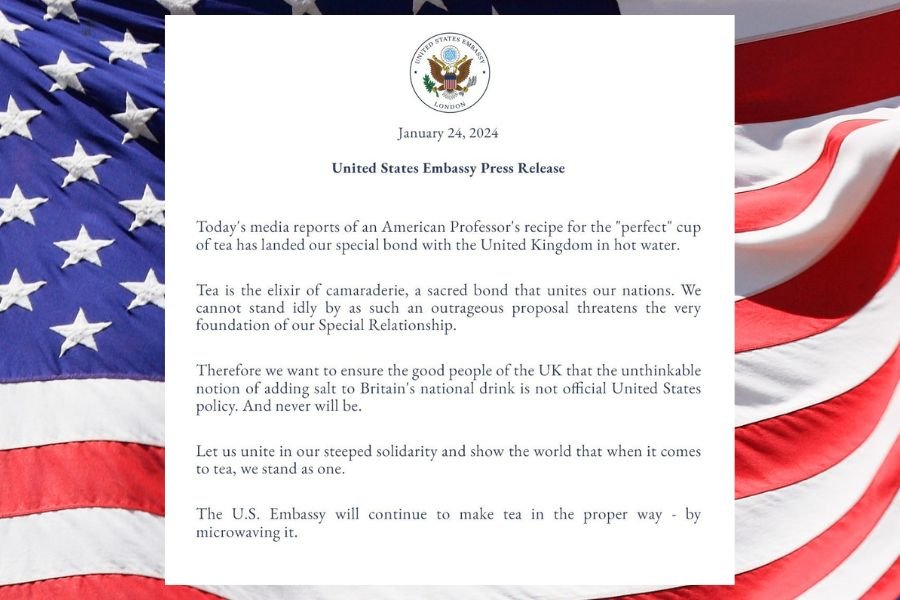
The U.S. Embassy put out a press release addressing the tea controversy threatening our "Special Relationship" with the U.K. – Photo credit: Canva, U.S. Embassy London/X
If there’s one thing British culture is universally known for, it’s tea. And if there’s one thing Americans are known for in Britain, it’s mucking up tea.
Admittedly, Americans’ relationship with the U.K. and its tea is a bit…complicated. After all, it was Britain’s taxation of imported tea that served as both a symbol and catalyst for the Revolutionary War, made famous by the so-called Boston Tea Party in 1773. (For those not steeped in American history, colonists famously dumped tea from British ship in Boston Harbor overnight in protest over being taxed without representation. They also tried to pin it on Native Americans, dressing as Mohawk Indians to disguise their identities, but that’s another story for another time.)
Our complicated tea relationship just took an unexpected turn, as an American scientist dared to suggest that the secret to a perfect cup of tea is to add a bit of salt to it, which naturally caused the entire United Kingdom to lose its everlovin’ mind.
Michelle Francl, a chemistry professor at Bryn Mawr College in Pennsylvania, argues in her book, “Steeped: The Chemistry of Tea,” that sodium in salt can counteract the chemical process that causes tea to taste bitter, to which the British say, “Rubbish! Poppycock!”
“A scientist from the country where you can find tea being made with lukewarm water from the tap claims to have found the recipe for a perfect cuppa,” British newspaper The Guardian quipped.
The Brits take their tea-making seriously, using a kettle to heat the water to just the right temperature and steeping their tea for a set amount of time, while Americans dare to pop a mug of water in the microwave and haphazardly leave their tea bag for however long they feel like. (It’s kind of a perfect example of ingrained American rebellion against monarchical tradition, really.)
Folks at the U.S. Embassy in the U.K. recognized that salt-in-tea controversy had landed the nation in some hot water, so they issued an official response. And naturally, it includes some lighthearted trolling of our friends across the pond.
“An important statement on the latest tea controversy,” the Embassy wrote on X, with an image of an official United States Embassy Press Release.
It begins by explaining that media reports of an American professor’s “perfect” cup of tea recipe “has landed our special bond with the United Kingdom in hot water.”
“Tea is the elixir of camaraderie,” it continues, “a sacred bond that unites our nations. We cannot stand idly by as such an outrageous proposal threatens the very foundation of our Special Relationship.”
Ohhh, somebody at the Embassy had their cookies today.
“Therefore we want to ensure the good people of the UK that the unthinkable notion of adding salt to Britain’s national drink is not official United States policy. And never will be,” reassured the Embassy. “Let us unite in our steeped solidarity and show the world that when it comes to tea, we stand as one.”
A perfectly diplomatic response, followed by the ultimate American tea troll:
“The U.S. Embassy will continue to make tea in the proper way—by microwaving it.”
Oh yes, they did.
Now, some may lament that an official government agency would have the time to troll an entire country over a cup of tea, but it’s not like the U.S. Embassy in the U.K. is on a complex diplomatic mission. Our countries have been close friends and allies for a long time, despite our fight for independence in the 18th century, so a little friendly banter is just what we should expect.
For their part, the U.K. government officially responded with a quintessentially understated retort.
“We appreciate our Special Relationship, however, we must disagree wholeheartedly… Tea can only be made using a kettle.”
In response, to the statement put out by the US Embassy in the UK:
We appreciate our Special Relationship, however, we must disagree wholeheartedly…
In a small village in Pwani, a district on Tanzania’s coast, a massive dance party is coming to a close. For the past two hours, locals have paraded through the village streets, singing and beating ngombe drums; now, in a large clearing, a woman named Sheilla motions for everyone to sit facing a large projector screen. A film premiere is about to begin.
It’s an unusual way to kick off a film about gender bias, inequality, early marriage, and other barriers that prevent girls from accessing education in Tanzania. But in Pwani and beyond, local organizations supported by Malala Fund and funded by Pura are finding creative, culturally relevant ways like this one to capture people’s interest.
The film ends and Sheilla, the Communications and Partnership Lead for Media for Development and Advocacy (MEDEA), stands in front of the crowd once again, asking the audience to reflect: What did you think about the film? How did it relate to your own experience? What can we learn?
Sheilla explains that, once the community sees the film, “It brings out conversations within themselves, reflective conversations.” The resonance and immediate action create a ripple effect of change.
MEDEA Screening Audience in Tanzania. Captured by James Roh for Pura
Across Tanzania, gender-based violence often forces adolescent girls out of the classroom. This and other barriers — including child marriage, poverty, conflict, and discrimination — prevent girls from completing their education around the world.
Sheilla and her team are using film and radio programs to address the challenges girls face in their communities. MEDEA’s ultimate goal is to affirm education as a fundamental right for everyone, and to ensure that every member of a community understands how girls’ education contributes to a stronger whole and how to be an ally for their sisters, daughters, granddaughters, friends, nieces, and girlfriends.
Sheilla’s story is one of many that inspired Heart on Fire, a new fragrance from the Pura x Malala Fund Collection that blends the warm, earthy spices of Tanzania with a playful, joyful twist. Here’s how Pura is using scent as a tool to connect the world and inspire action.
A partnership focused on local impact, on a global mission
Pura, a fragrance company that recognizes education as both freedom and a human right, has partnered with Malala Fund since 2022. In order to defend every girl’s right to access and complete 12 years of education, Malala Fund partners with local organizations in countries where the educational barriers are the greatest. They invest in locally-led solutions because they know that those who are closest to the problems are best equipped to solve and build durable solutions, like MEDEA, which works with communities to challenge discrimination against girls and change beliefs about their education.
But local initiatives can thrive and scale more powerfully with global support, which is why Pura is using their own superpower, the power of scent, to connect people around the world with the women and girls in these local communities.
The Pura x Malala Fund Collection incorporates ingredients naturally found in Tanzania, Nigeria, Pakistan, and Brazil: countries where Malala Fund operates to address systemic education barriers. Eight percent of net revenue from the Pura x Malala Fund Collection will be donated to Malala Fund directly, but beyond financial support, the Collection is also a love letter to each unique community, blending notes like lemon, jasmine, cedarwood, and clove to transport people, ignite their senses, and help them draw inspiration and hope from the global movement for girls’ education. Through scent, people can connect to the courage, joy, and tenacity of girls and local leaders, all while uniting in a shared commitment to education: the belief that supporting girls’ rights in one community benefits all of us, everywhere.
You’ve already met Sheilla. Now see how Naiara and Mama Habiba are building unique solutions to ensure every girl can learn freely and dare to dream.
Naiara Leite is reimagining what’s possible in Brazil
Julia with Odara in Brazil. Captured by Luisa Dorr for Pura
In Brazil, where pear trees and coconut plantations cover the Northeastern Coast, girls like ten-year-old Julia experience a different kind of educational barrier than girls in Tanzania. Too often, racial discrimination contributes to high dropout rates among Black, quilombola and Indigenous girls in the country.
“In the logic of Brazilian society, Black people don’t need to study,” says Naiara Leite, Executive Coordinator of Odara, a women-led organization and Malala Fund partner. Bahia, the state where Odara is based, was once one of the largest slave-receiving territories in the Americas, and because of that history, deeply-ingrained, anti-Black prejudice is still widespread. “Our role and the image constructed around us is one of manual labor,” Naiara says.
But education can change that. In 2020, with assistance from a Malala Fund grant, Odara launched its first initiative for improving school completion rates among Black, quilombola, and Indigenous girls: “Ayomidê Odara”. The young girls mentored under the program, including Julia, are known as the Ayomidês. And like the Pura x Malala Fund Collection’s Brazil: Breath of Courage scent, the Ayomidês are fierce, determined, and bursting with energy.
Ayomidês with Odara in Brazil. Captured by Luisa Dorr for Pura
Ayomidês take part in weekly educational sessions where they explore subjects like education and ethnic-racial relations. The girls are encouraged to find their own voices by producing Instagram lives, social media videos, and by participating in public panels. Already, the Ayomidês are rewriting the narrative on what’s possible for Afro-Brazilian girls to achieve. One of the earliest Ayomidês, a young woman named Debora, is now a communications intern. Another former Ayomidê, Francine, works at UNICEF, helping train the next generation of adolescent leaders. And Julia has already set her sights on becoming a math teacher or a model.
“These are generations of Black women who did not have access to a school,” Naiara says. “These are generations of Black women robbed daily of their dreams. And we’re telling them that they could be the generation in their family to write a new story.”
Mama Habiba is reframing the conversation in Nigeria
Centre for Girls' Education, Nigeria. Captured by James Roh for Pura
In Mama Habiba’s home country of Nigeria, the scents of starfruit, ylang ylang and pineapple, all incorporated into the Pura x Malala Collection’s “Nigeria: Hope for Tomorrow,” can be found throughout the vibrant markets. Like these native scents, Mama Habiba says that the Nigerian girls are also bright and passionate, but too often they are forced to leave school long before their potential fully blooms.
“Some of these schools are very far, and there is an issue of quality, too,” Mama Habiba says. “Most parents find out when their children are in school, the girls are not learning. So why allow them to continue?”
When girls drop out of secondary school, marriage is often the alternative. In Nigeria, one in three girls is married before the age of 18. When this happens, girls are unable to fulfill their potential, and their families and communities lose out on the social, health and economic benefits.
Completing secondary school delays marriage, and according to UNESCO, educated girls become women who raise healthier children, lift their families out of poverty and contribute to more peaceful, resilient communities.
Centre for Girls’ Education, Nigeria. Captured by James Roh for Pura
To encourage young girls to stay in school, the Centre for Girls’ Education, a nonprofit in Nigeria founded by Mama Habiba and supported by Malala Fund and Pura, has pioneered an initiative that’s similar to the Ayomidê workshops in Brazil: safe spaces. Here, girls meet regularly to learn literacy, numeracy, and other issues like reproductive health. These safe spaces also provide an opportunity for the girls to role-play and learn to advocate for themselves, develop their self-image, and practice conversations with others about their values, education being one of them. In safe spaces, Mama Habiba says, girls start to understand “who she is, and that she is a girl who has value. She has the right to negotiate with her parents on what she really feels or wants.”
“When girls are educated, they can unlock so many opportunities,” Mama Habiba says. “It will help the economy of the country. It will boost so many opportunities for the country. If they are given the opportunity, I think the sky is not the limit. It is the starting point for every girl.”
From parades, film screenings to safe spaces and educational programs, girls and local leaders are working hard to strengthen the quality, safety and accessibility of education and overcome systemic challenges. They are encouraging courageous behavior and reminding us all that education is freedom.
Experience the Pura x Malala Fund Collection here, and connect with the stories of real girls leading change across the globe.
An X user from Japan shared a photo of a glass with peanuts floating atop what appears to be cola, writing (auto-translated from Japanese):
“About 30 years ago, I read in a Haruki Murakami essay that in America, it’s popular to drink cola with peanuts in it. I was like, ‘Huh,’ and a long time has passed since then, but I finally tried it. What the hell is this? It’s ridiculously delicious, damn it. It’s on a level where I won’t want to drink cola any other way anymore.”
Peanuts in Coke is one of the most accidentally perfect food pairings in history, and the chemistry explains why this guy can't go back.
Coca-Cola sits at pH 2.5, roughly the same acidity as stomach acid. When you drop roasted peanuts into that, the phosphoric acid partially… https://t.co/viykRGEwaJ
Are peanuts and Coke really an American tradition?
Apparently, this “American” tradition has been gaining traction in Japan, with people sharing their experiences on social media. But many Americans may be surprised to see Coke with peanuts described as a “popular” combo. It’s not really a common or widespread snack choice. For some, however, it’s a flash from the past.
“Southern kids did this all the time,” wrote one commenter. “Our folks would buy us an ice cold Coke in a bottle and a bag of peanuts, we’d drink some Coke, then funnel in some peanuts. Delicious and fun.”
“I learned this from my father, but it was Dr Pepper. He was stationed in Texas when he was in the Army. That’s where he learned about it.”
“My very southern high school AP US History teacher swore by peanuts and Coke but was adamant that the only way to do it was in the little glass bottles that you only really now see at weddings and other functions. Not sure if there’s science to back that up.”
According to a few commenters, the combo also became popular in parts of Norway after people emigrated to the U.S. and then brought the idea back to Norway with them.
Where did peanuts and Coke come from?
How did it get started? According to The Local Palette, which explores the food culture of the South, the combo was known as “farmer’s Coke” and was a workingman’s beverage:
“Its fizzy refreshment bore sweet and salty satisfactions that could be savored during a work break. Some trace it back to the early decades of the twentieth century when ‘dope wagons’ roamed the grounds of textile mills before the advent of the vending machine. These food and beverage carts sold bottles of ‘dope,’ a nickname for Coca-Cola that was perhaps a reference to the days when the popular soda contained trace amounts of cocaine.“
Have you ever heard of salted peanuts in Coke? This Japanese guy just introduced me to this Southern tradition. I’m in Southern Florida and I’ve never heard of it. I looked it up and it’s a real thing from the 1920s among Southern farmers and workers for a quick sweet-salty… https://t.co/tAPt2DvtgSpic.twitter.com/gcXYuFCf1d
For farmers, pouring the peanuts into the soda bottle made sense. For one, it kept them from touching the nuts with dirty hands. It also meant they could eat and drink with just one hand.
There are multiple variations on the theme. Many people insist on taking a few sips from a bottle of Coke and then dumping the nuts straight into the bottle. Some say it has to be Mexican Coke, since it uses sugar instead of corn syrup. Others swear by RC Cola or Dr. Pepper instead of Coke. People disagree on whether the peanuts should be roasted or boiled.
Why peanuts and Coke make such a delicious combination
Sweet and salty is generally known to be an irresistible combination of flavors, so there’s that. But according to X user’s Aakash Gupta’s analysis, the chemistry that happens when you drop the nuts into the soda provides another layer of flavor:
“Coca-Cola sits at pH 2.5, roughly the same acidity as stomach acid. When you drop roasted peanuts into that, the phosphoric acid partially denatures the surface proteins on the nut, releasing free glutamate. You’re generating umami in real time inside the glass.
The salt on the peanuts suppresses bitter taste receptors on your tongue, which amplifies your perception of sweetness without adding a single gram of sugar. Coca-Cola already has 39g of sugar per can. Your brain registers it as even sweeter because the salt is clearing the noise from competing flavor signals.
Then carbonation does two things. CO2 dissolved in liquid forms carbonic acid, which triggers pain receptors (TRPA1), not taste receptors. That mild irritation resets your palate between sips so you never get flavor fatigue. Every sip hits like the first. Second, the bubbles physically agitate the peanut surface, accelerating the protein breakdown and glutamate release. The longer the peanuts sit, the more umami you extract.
The fat content seals it. Peanuts are 49% fat by weight. Fat is the only macronutrient that activates CD36 receptors, which your brain interprets as richness and satisfaction. Mix that with sugar, salt, acid, umami, and carbonation and you’ve accidentally triggered every major reward pathway in the human taste system simultaneously.“
Sounds fancy. Perhaps it’s worth a try. If nothing else, the trend is creating some fun intercultural exchanges with our fellow humans on the other side of the world.
There are bad bosses, good bosses, and sometimes, there are even great bosses. LinkedIn, infamously, is home to all three, and when scrolling through the randomly curated feed, you’re never quite sure what you’re going to get.
That’s why Stephanie Barney, CEO of Girls on the Go, raised some serious eyebrows with one of her recent posts.
CEO “doesn’t allow” mental health days
Barney spends her days running Girls on the Go, a health and wellness community for women that focuses on in-person, girl-only events that help members “combat loneliness, stay active, socialise and make new friends.“
As CEO, Barney is in charge of a small but growing team. And she recently took to LinkedIn to share one key element of her management style.
“I don’t allow my employees to take mental health days,” she wrote in the post. That provocative opening line is what the kids would call textbook “rage-bait.”
People were ready to go off on Barney in the comments. That is, of course, until they kept reading.
“I don’t care if you need a break. I don’t care if you can’t get out of bed. I don’t care if you have a doctors appointment,” the post continued.
And then came the punchline: “Because I TRUST my employees.”
The Gen Z CEO went on to explain that her wording was very intentional and not purely there to grab eyeballs. “I don’t ‘allow them’ to do anything. I trust that they know when they feel most productive and when they work the best.”
Read the whole post here:
Approach has yielded great results in a short amount of time
Barney is only in her early twenties and doesn’t have the management experience of a lot of her peers on LinkedIn, but her bona-fides are already beginning to speak for themselves.
The founder of the award noted at the time, “What Stephanie has built in such a short time and at such a young age is nothing short of remarkable. Not only has she built a safe, inclusive and diverse community of women and girls that is actively tackling the issue of loneliness and isolation, she has made it financially sustainable [while], delivering social impact.”
There’s more going on here than just the Gen Z passion for better work-life balance. Turns out, trusting your employees is a strong management style.
Thousands of people Liked Barney’s post, with hundreds more chiming in in the comments section:
“Congrats on being a fabulous boss and striving to create work environments and experiences empowering your team”
“Most bosses throughout my 35 year career haven’t gotten it. No latitude. “
“When people feel safe to manage their own time and energy, they don’t just survive at work, they thrive.”
“Reminds me of high school vs college where the professors were like you’re all adults don’t ask to use the restroom just go. Be a post-college workplace, not a high school workplace”
The stigma of mental health days
Barney’s post taps into an unspoken stigma about “mental health days.” Sometimes, we all need one to be at our best. But asking for one feels weak and vulnerable, even though one in five Americans receive treatment for their mental health, according to MIT’s Sloan School of Management. It’s not uncommon, weird, or unnecessary. And yet, the stigma persists.
“In reality, talking about mental illness or asking for a mental health day at many offices is risky,” writes Talkspace. “Only the most progressive companies provide mental health days or create an environment where it is safe to ask for one.”
An incredibly innovative solution: Don’t make anyone ask, or worse, lie.
Research is conclusive that vacation, or even just a rest day at home, makes us better and more productive employees. Barney is right: CEOs shouldn’t “allow” this time off. They should trust their colleagues to know when it’s needed and act accordingly.
Remember the time shortly before the internet, when “scrolling” looked like flipping channels on the TV to see what was on? After passing up news, reruns, game shows, an old movie, and the public access station, you’d land on The Weather Channel. Suddenly, you’d find yourself checking the forecast and zoning out to whatever smooth jazz tunes accompanied the text on screen.
If that description triggered some cozy, comfy nostalgia for you, you’re in for a treat. The Weather Channel has launched a “retro forecast” option on its website that lets you see your local forecast as it looked way back when.
Go to weather.com/retro and click on the “START RETROCAST” button. This is what it looks (and sounds) like, customized to your local area:
It almost feels like time travel, doesn’t it? People who remember this simpler time are expressing how much they love the RetroCast:
“That scream you just heard was millions of millennial hearts reawakening to sounds we haven’t heard but missed.”
“Ohh… that makes me miss my grandpa. He had that channel on 24/7 when it first came out. It was the theme song to ‘Staying with Grandpa and Grandma.’”
“I used to like during Christmas time, they would play the entire album of A Charlie Brown Christmas by The Vince Guaraldi Trio. They’d also play classic Christmas Tunes as well but I will always remember them play Charlie Brown Christmas.”
“The only way my 1999 baby would sleep. Now we are getting ready to welcome her baby.”
No this is not a joke…Retro Weather Channel is officially back! 🎶 Head to https://t.co/sJgpOSHVgR enjoy RetroCast Now for your forecasts in the way you know and love. 💙🎷☀️
— The Weather Channel (@weatherchannel) April 2, 2026
“World needs more of this. I love seeing history being respected and represented this way.”
“That was a nostalgic feel-good ride if I do say so myself!! Thank you for that whoever found this!!! Weather channel needs to make this an app lol.”
“This is also a time-traveling machine. It instantly took me back to my junior year in high school in South Bend, IN, a place where keeping track of the weather matters more (out here it’s just hot, slightly cold, and maybe a few drops fall now and then). All sorts of good time memories came ‘flooding’ in. Peak nostalgia!”
“If you brought this back as a TV channel, you’d have the highest-rated channel with Gen X and Millennials.”
Today, The Weather Channel is…different. Not necessarily in a bad way, but it’s definitely busier. Weather forecasting has come a long way in the last 30 years, but so have television production, graphics, visual effects, and even fonts. Sometimes, that can be great. But it can also be a lot.
There’s something to be said for simple utility, and that’s what this retro forecast provides. No fancy graphics and multiple chyrons. No commentary. Just some cheesy music and dropshadowed fonts informing us about current conditions, sunrise and sunset times, and the local forecast.
The enthusiastic response to the retro forecast echoes the growing movement toward slower, more analog experiences. The digital age has its benefits, no doubt. But digital fatigue is real, our attention spans have taken a beating, and there’s a sense that something has to change. For many, that change looks like revisiting the habits of a simpler time, which this retro weather forecast offering represents.
Obviously, watching a retro Weather Channel forecast isn’t going to solve anyone’s issues with technology overwhelm. But the desire for it is a signal that deserves our attention. Nostalgia isn’t just a sweet feeling of remembrance in the modern era, after all. It’s also a yearning for simplicity in an increasingly complex world.
And perhaps zoning out to smooth jazz for a bit gives us a much-needed respite from the digital storm we’re living in.
When the Apollo 11 space shuttle launched in 1969, millions of people gathered around their TVs to watch it live. The idea that humans could land on the moon a mere 66 years after the Wright Brothers’ first flight here on Earth inspired awe around the world.
Since then, we’ve seen countless rocket launches. But that doesn’t make a historic mission any less awe-inspiring to witness in person, as evidenced by BBC Science Editor Rebecca Morelle’s giddy reaction to watching the Artemis II shuttle launch in person.
Morelle reported on the launch as it happened with refreshing, childlike joy. Journalists are trained to be dispassionate, and Morelle is a seasoned professional. But her spontaneous “Oh my goodness, that is spectacular!” and the tears in her eyes as she described what she was seeing revealed the emotion of the moment.
Morelle’s awe and wonder were palpable. They were also understandable. The historic Artemis II mission will take astronauts around the moon, farther from Earth than any humans have ever gone before. And as Morelle said, Artemis is the most powerful rocket NASA has ever built. That’s worth getting excited about, especially if you love science as much as she does.
However, some can’t help but question the authenticity of moments like this. Some have become cynical from the chaos in the world. Younger generations may see such emotional expression as “cringe.” Some may be skeptical of taking this science reporter’s emotions at face value.
But the tears in her eyes and her gasps of wonder tell a story of genuine joy. And many of the comments demonstrate people’s need for positivity:
“They sent the right reporter! 👍👍 Love her excitement.”
“I’m glad they sent someone as excited as her to be there.”
“Her excitement is literally so amazing during these dark dark times.”
“She is the sweetest. Life needs more joy.”
“Adorable. Protect her at all costs.”
“Agreed. I like watching people who enjoy their job. Makes me enjoy it more!”
“Yeah, it is important to always align work with people’s passions. She loves being there. Good work, BBC.”
I’m so glad the BBC sent her to be the reporter on this! She appreciated every moment of the #Artemis launch so much!! 🚀 pic.twitter.com/Rbh6rXcn91
“Having watched a rocket launch in person from the Saturn V center (which is where they’re at) it’s honestly impossible to NOT get excited. The feeling is electrifying and you really feel the force of your rocket through your bones.”
“Watching any launch is insane, being there is an event. She’s 1000% justified and I love her not being modest for performance sake.”
“Dear world. It’s okay to celebrate and be happy.”
“Sadly, it’s a sign of the times we live in. People have lost their joy and view everything through a lens of negativity. Unfortunately, we’re bombarded with assaults against humanity on a daily basis and people have become desensitized to their natural emotions and have become guarded. It is what it is unfortunately.”
Oh I love reaction it’s infectious!! That’s how excited you should be!!
It’s also so nice to see someone speaking and acting in a positive way on the news ❤️🙏👏
So many people are weary of negativity and thirsty for genuine joy. Seeing Morelle’s pure, wholesome display of emotion feels like a balm for our battered spirits. Indeed, joy is good for both our physical and mental health, so indulging it makes good sense. If cynicism is a poison, this video is the antidote.
Thank you, Rebecca Morelle, for letting this moment take you for an emotional ride, and for bringing us all along with you. So many of us needed that.
There’s a great line in Who Framed Roger Rabbit?, where the sultry Jessica Rabbit is asked why she loves her husband, Roger, a manic comedian with a penchant for mischief, who’s half her size. Her answer: “He makes me laugh.”
Although that may seem like an exaggeration, there’s a lot of truth to Jessica’s perspective; heterosexual women consistently rank sense of humor as one of the most attractive traits that a man can have. Heterosexual men also find women with a sense of humor attractive, but to a lesser extent.
A new research paper by Wayne State University linguist Ljiljana Progovac suggests that when it comes to human evolution, the phrase “survival of the fittest” could be replaced by “survival of the wittiest.” Her research shows that in the caveman era, humans shifted from a might-makes-right tribal culture, where physically dominant people had the most opportunities to reproduce, to one where a sense of humor was the sexiest trait you could have.
Why did cavedwellers find a sense of humor sexy?
The big changes came when early humans realized that inter-tribal violence did more harm than good. Therefore, being a physical threat was out of style as it was more advantageous to be “groupish.” Those who could cooperate within their tribe to ensure they could compete with other tribes then started getting all the action.
Even though early humans treated those in their tribe with greater civility, within this friendly society, those who were verbally fluent became dominant and more attractive to potential mates.
“From the very first moment that our ancestors started combining two words together, those combinations opened up a new kind of competition. Not physical. Verbal,” the Science Blog writes. “The ability to coin a devastating nickname, to skewer a rival with a phrase, to make the tribe laugh at someone else’s expense; these skills, she argues, were subject to sexual selection just as surely as the peacock’s tail or the bowerbird’s elaborate stick construction.”
It seems that even though language developed over a hundred thousand years ago, things haven’t changed all that much since.
Progovac posits that early humans could insult one another or express their sense of humor by using simple two-word verb-noun compounds such as “killjoy” or “pickpocket.” According to the author, people who knew how to throw around those compounds in clever ways had higher reproductive fitness than those who weren’t as adept. The children born to witty individuals could then go on to create even more complicated grammatical rules to show off their wit. This, in turn, led to the evolution of more complex languages.
Progovac’s paper also notes that, on one hand, being quick-witted is an advantage when it comes to sexual selection, while those who aren’t as funny are less likely to be selected.
“In addition to positive selection due to superior language skills and eloquence, it is also important to acknowledge the role of negative selection with respect to these skills, as even minor language disturbances or ‘disorders’ can have a detrimental effect on selection,” Progovac writes. “Especially damning seem to be insults that directly refer to such skills, such as dim-witted, half-witted, f**kwit, slow, and dull, indicating the value that is still placed on wit and quick-wittedness. This suggests that quick-wittedness plays a role both in positive and negative selection in humans, even today.”
This study is a wonderful example of two inspiring ideas. The first is that even if you aren’t genetically blessed with traditionally great looks, a sense of humor can go a long way towards helping you find a romantic partner. Second, humans evolved an incredible sense of humor because it was better to make fun of each other than to beat them with a club.
There are two kinds of teachers, and we’ve all had our fair share of both. There’s the “strict” teacher that rules with an iron fist, holds fast to classroom rules, and demands excellence. And then there’s the “cool” teacher that plays things a little looser, has fun with the kids, and finds creative ways to inspire them to learn.
At least, that’s the way it used to be. More and more, there seems to be a new kind of educator that’s able to bring together the best of both worlds when teaching Gen Z.
One such teacher is Katy Johnson, who has been sharing a behind-the-scenes look at her career as an educator for years on social media. She’s racked up nearly a million followers in the process.
High school teacher goes viral
In a recent TikTok, Johnson went viral after beginning: “Let’s talk about some things I simply do not care about as a high school teacher.”
First up? Drinking and eating in class.
“I don’t care,” she says in the video. “I do not care at all. Literally last week I had a kid eating a rotisserie chicken. Don’t care. He got his work done. Doesn’t bother me.”
Next up: “Dress code. That is not my worry.”
She adds that, unless it’s offensive, she will let almost anything go. “Girl, wear your crop top and your shorts, I don’t care.”
Being a minute or two late to class, before instruction has begun
Charging phones
Sitting in assigned seats
Talking in class
Basically, Johnson says she doesn’t get bothered by behaviors unless they interrupt the classroom. She doesn’t want kids talking while she’s speaking, but doesn’t mind if they chat with friends while finishing assignments, for example. And she’d rather have a teen’s phone plugged into the wall, charging, than for them to be using it during class.
15 million people viewed Johnson’s TikTok and many were quick to praise her relaxed approach:
“see she gets it,” wrote one commenter
“You should teach teachers,” added another.
“Agree with this. Some teachers care so much about things that don’t matter and it ends up wasting so much time,” someone added.
Multiple people chimed in with their suspicions that Ms. Johnson is likely every kid’s “favorite.”
But lest anyone think she’s a pushover, Johnson followed up with another video. This time, she covered some eyebrow raising behaviors she’s surprisingly strict about:
“I do have some things that I actually, really care about,” she says, starting with her no-nonsense bathroom policy.
“I do not let kids leave my classroom during my lesson. No.” She adds that if it’s a true emergency, she’ll make an exception, but she’s had to repeat lessons one too many times to be any more lenient than that.
Number two: No laptops in her math class.
“I firmly believe that math is best taught with pen and paper. We do not use Chromebooks. I care about that a lot,” she says.
The next is, in a surprise twist, phone usage. She says she does not allow students to use their phones at all during class, and even locks them away during instruction time. The only exception is, of course, that she will allow students to charge their devices as long as they’re not using them.
“Oh so she is a normal teacher after all,” wrote one disappointed commenter.
Replying to @Kiaha gilbert the #1 think I care about is THEM!! & their learning!!!! I don’t have a lot of rules, but the rules I have, I expect them to follow #teacher#teachertok#highschoolteacher
The series was so popular that Johnson followed it up with a part two with more things that “doesn’t care about,” including kids listening to music with one AirPod in and turning in work late.
“If you got your work done… I do not care what the kids do as long as they stay in this room and stay respectful.”
Traditionalists would probably say Ms. Johnson is far too permissive with when it comes to teaching Gen Z students. Eating messy meals? Drinking Starbucks? Straying from their assigned seats whenever they feel like it?
However, it’s the teachers who are willing to think outside the box that are seeing the best results with Gen Z. They’re a generation that spent a good chunk of their most formative years in COVID lockdown learning on laptop screens. They’re the first generation to have the kind of access to cell phones and social media that teens have today. And they’re at the bleeding edge of an age where AI can do all of your work for you even faster than a Google search.
Keeping them engaged in the learning process is key, and it’s a battle. Crucially, Johnson’s classroom rules challenge kids in the ways that really matter. Being accountable to themselves and others, finishing their work independently, and having the autonomy to succeed or fail based on their own merit.
Johnson may have left one thing off her list, however. She does care about her students, deeply. That much is obvoius.
In a time when inflation is forcing people to make their dollars go as far as possible, an Instagram video by Jose Rojas shows how a little creativity can help families stretch their food budget a long way. In the video, Rojas nearly does the impossible: he makes a tasty, healthy meal for two for exactly $1.
Rojas is the creator of Beyond Food Market, which teaches people in underserved communities and food deserts how to make affordable, nutritious meals. Roajs was inspired to help his community after he lost 90 pounds and kept it off. “Because food did so much for me. It changed my life. It transformed my life. I’m like, I gotta share this,” Rojas said.
Rojas makes a really smart move when buying the ingredients for his meal by weighing exactly what he needs, so he doesn’t pay for what he doesn’t need. He purchased a medium russet potato, a small tomato, and a small onion for just $0.65 at the Jimenez Fresh Market on Belmont Ave. in Chicago. He also got a break because the cashier threw in the serrano pepper for free.
Sometimes, making your dollar stretch means going to more than one store (we’ll forget the cost of gas right now). Rojas remembered seeing that pinto beans were just $0.69 a pound at his local Jewel Osco, and he bought half a pound for $0.35, bringing the total cost of his meal to $1.
Rojas’ bill at Jimenez and Jewel Osco. Credit: BeyondFoodMarket (used with permission)
How to cook Rojas’ simple $1 recipe
½ lb pinto beans
1 medium russet potato
1 small tomato
1 small onion
1 serrano pepper
Total cost: $1.00
To cook the meal, Rojas used a pressure cooker, soaking beans in water along with chunks of the potato cut about 1/2” thick. While the beans and potatoes cooked, he made pico de gallo by mixing tomatoes, onions, and serrano pepper. (Is he cheating by including the pepper that he should have paid for? That’s for you to decide.)
The final dish was delicious-looking and could be marketed as a Southwest Burrito Bowl or a Vegan Mexican Bowl if you bought it at a Chipotle-style restaurant. The meal is healthy, too. “The recipe was very simple and inspired by the way many of our families have cooked for generations,” Rojas told Upworthy.
This $1 meal is:
High protein
Extremely high in fiber
Loaded with potassium, iron, and vitamins
100% gluten-free & plant-based
Made from real, whole ingredients
The video has gone viral across multiple platforms, and the response has been overwhelmingly positive. “The best reaction has been people telling me that the video reminded them of how their parents or grandparents used to cook during tough times. Others have said the video gave them hope that they can still cook something warm and nourishing even when money is tight,” Rojas told Upworthy.
Ultimately, Rojas’ desire to help people everywhere change their eating habits is a natural extension of his lived experience. “I learned to be resourceful from my upbringing and life experiences. I grew up in a working-class family, and later in life, I had to completely change the way I ate to improve my health,” he told Upworthy. “I ended up losing 90 pounds by going gluten-free and focusing on simple, whole foods like beans, vegetables, and traditional ingredients. Those experiences taught me that good food doesn’t have to be expensive.”
Fashion designer Betsey Johnson was punk rock before punk rock was even a thing. In the 1960s, she won the Mademoiselle Guest Editor contest. By 1969, she had her own store with Andy Warhol favorite Edie Sedgwick as one of her top models. By the ’70s, Johnson was the go-to for many rockers, and by the 1980s…she was a household name.
Turning 83 does not seem to have slowed her down. In a fabulous speech posted recently on Advanced Style’s Instagram page, Johnson does the splits to prove that age really is just a number. She stands in her signature black and white striped low-waisted dress, with punk golden blonde spiky bangs and red lipstick, while she dives deep into what it means to be over 80.
In hot pink lettering, the chyron on the video reads, “Betsey Johnson on aging and acceptance at 83.” Johnson begins by sharing that one’s 80s are an amazing time. “You finally gel. Whatever, you’re cooked! You’re done. And hopefully, you have the confidence to enjoy the cooking process all the years.”
We hear a gasp as Johnson then flings herself into her signature splits. (Note: she has often been known to do these at the end of fashion shows and on red carpets.) Of the fact that she can do them with such ease, she says, “Of course I do, darling. I swore that I always would. I was an aerialist. I never wanted to stiffen up. So I promised, I just said ‘ya know, if you can do the splits every year, that would be a good thing.’”
She then confesses that one of her signature looks is an absolute must for her to function. “Everyone knows I can’t work, I can’t talk, I can’t think, I can’t do anything but sleep without lipstick. I’m always putting lipstick on.” She admits, however, that there’s not much more to her youthful vibe. “But I have no beauty regime. No nothing.”
What’s the secret?
The interviewer asks what the secret is to “looking so fab.” Johnson is now wearing a gold crown and begins to pull on her face. At first, she mentions needing a lot of “work,” but then she stops herself. “I have to live with what’s happening now.” While she says she tweaked a little in her 60s and 70s, she’s “finally at the point where I have to accept I feel good. That to me is the major thing. I really feel great!”
She reiterates that she doesn’t “feel” old. “I don’t feel my age at all. I feel maybe 32, 35, something like that. And 80 doesn’t mean that I can’t wear anything that I wouldn’t wear at 20.”
Betsey’s closet
Speaking of, she shows off her incredible closet. “I have the designer closet from hell,” she says, confessing that she only wears about five outfits and no longer “bothers with clothes.” In a sense, this is how it’s always been. “I’ve always liked what I’ve liked, and if it’s fashionable, great, if it isn’t, great! That’s why my favorite stuff is years old.” She holds up an oddly shaped, colorful dress. “This is from 1983,” she shares.
She continues, “I think there’s a real need for ‘weird.’ You know, just off-center. You just don’t expect it. You’ve never seen it. It’s brand new, it’s a surprise! You feel young again. You’re seeing something new. Well, weird is something great on top of ‘new.’”
Johnson then shows off some incredible items from the closet, one of which is a dress made out of old hair extensions! There are also blue sequined ’60s vintage vests, and an old Vivienne corset. It all makes sense when she explains she always wanted to be a Rockette. “All my dancing costumes were my entire inspiration for all my stuff.” “
She finishes by reiterating how important it is to own who you are. “If you don’t celebrate now, it’s a different kind of celebration. I like that I’m free from the memories. It’s not this, it’s not that, I can be brand new. Whatever!”
Her fans adore her
There are over 185,000 likes and 11,000 comments from other celebrities and fans. Musician Annie Lennox enthusiastically shares, “Absolutely BRILLIANT, Betsey!”
Another fan writes that Johnson continues to serve as an inspiration. “She’s always so kind and full of excitement for life. It’s no surprise she’s in such great health. I aspire.”
And this fan is moved by Johnson’s sentiment, writing, “Besides loving your over-the-top sense of fashion, and the products you have created, seeing this raw interview of you is absolutely priceless and SO INSPIRING! My mother is a spry artist 84 years young. Her positive outlook is what keeps her going. My job is to keep her looking fabulous at every time. Doing splits at 80? I will definitely share this with her! – Your Drag Queen Fan”