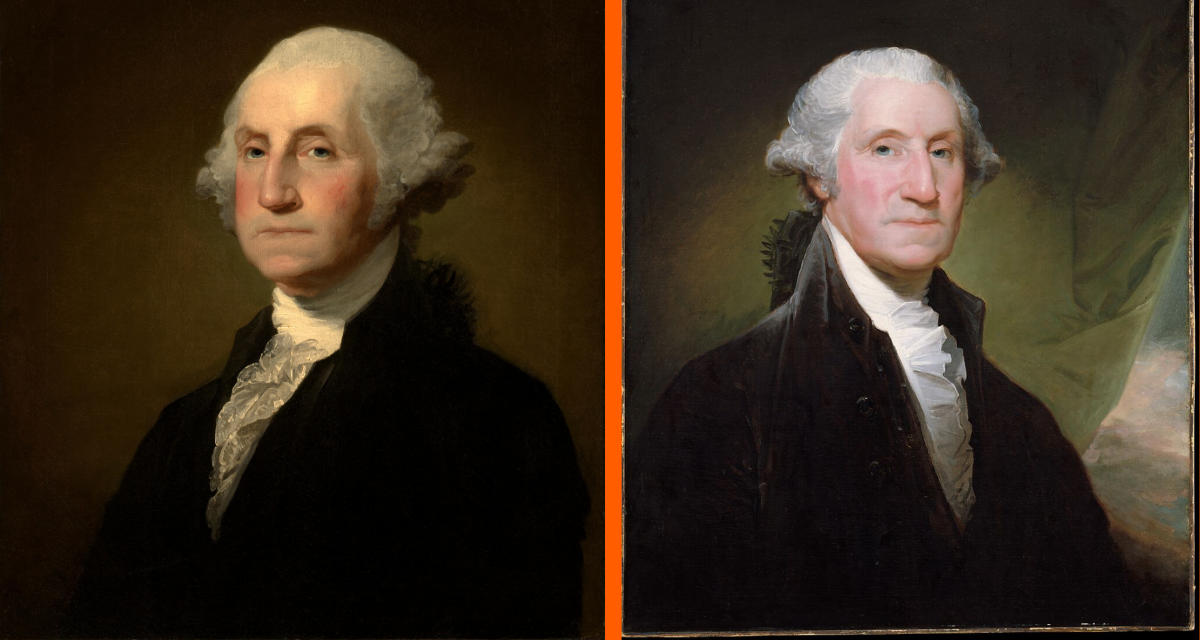
George Washington offered wise advice on why friendships should develop like ‘a plant of slow growth’

He shared his wisdom with nephew Bushrod Washington in 1783.

george washington, president george washington, george washington quote, george washington quotes, friendship
https://en.wikipedia.org/wiki/George_Washington#/media/File:Gilbert_Stuart_Williamstown_Portrait_of_George_Washington.jpgGeorge Washington shared his advice on building friendships.

George Washington became the first President of the United States on April 30, 1789. Born in 1732, he was raised in Virginia and dedicated to the formation of the United States of America (after previously being called the ‘United Colonies‘.)

Both his military and political service led to Washington developing many deep friendships throughout his life. He died at his Mount Vernon estate in 1799.

“Among his friends, Washington also showed a capacity for intimacy and playfulness that was largely absent from his public persona as Commander-and-Chief and later president,” noted Cassandra Good, Ph.D. Assistant Professor of History Marymount University.

Washington offered his wisdom on developing and maintaining friendships in his personal letters.

George Washington’s friendship advice

Washington had a large family and often shared his sage life experience with his many nieces and nephews. In the early 1780s, his nephew Bushrod Washington was studying law in Philadelphia. He would go on to become an Associate Justice of the Supreme Court, and inherited Mount Vernon (Washington’s famed estate in Virginia) after his uncle’s death.

Washington offered his wisdom on friendship to his nephew Bushrod Washington in a letter dated January 15, 1783:

“Be courteous to all, but intimate with few, and let those few be well tried before you give them your confidence—true friendship is a plant of slow growth, and must undergo & withstand the shocks of adversity before it is entitled to the appellation.”

George Washington’s friendships

Washington friendships were described as “selective, but often long-lasting, loyal, and integral to his public life.”

In a letter dated June 15, 1790 to David Stuart (a man who became Washington’s close friend after he married his step-daughter-in-law), he wrote

“I can truly say I had rather be at Mount Vernon with a friend or two about me, than to be attended at the Seat of Government by the Officers of State and the Representatives of every Power in Europe… “

Washington gained friends through many outlets, including his Virginia social circle and his military service in the Revolutionary War. During the American Revolution, Washington met and became close friends with General Henry Knox, who would become Secretary of State.

The two maintained a 25-year friendship, and Washington wrote of Knox: “there is no man in the United States with whom I have been in habits of greater intimacy, no one whom I have loved more sincerely, nor any for whom I have had a greater friendship.”

Washington’s friendship with Thomas Jefferson

One of Washington’s most notable friendships was with fellow Founding Father Thomas Jefferson. According to author Francis D. Cogliano’s book A Revolutionary Friendship (published by Harvard University Press), the two were friends for 30 years.

Washington seemed to take his own advice on friendship when it came to Jefferson. They bonded over their love of theater, agriculture and architecture.

“Their relationship evolved slowly, but they became close friends,” Cogliano wrote. “Each respected the other’s qualities, and they worked productively together for twenty years.”

Unfortunately, the two would become estranged in 1797 after a letter Jefferson wrote a friend with “unflattering references to Washington” was ultimately published in Europe and America.


  • After the death of his wife, C.S. Lewis shared exactly how he dealt with grief
    https://en.wikipedia.org/wiki/C._S._Lewis#/media/File:CS_Lewis_photo_on_dust_jacket.jpgC.S. Lewis and wife Helen Joy Davidman.

    Author and lay theologian C.S. Lewis (short for Clive Staples Lewis), lived a full life steeped in education and literature. A prolific writer, Lewis authored more than 30 books across genres, including popular fantasy saga, The Chronicles of Narnia. Born in 1898 in Northern Ireland, Lewis would become one of the most esteemed writers of the 20th century.

    Professionally successful, C.S. Lewis found love later in life. He fell deeply in love with American poet Helen Joy Davidman. The two married in 1956 when Lewis was 58 years old and Davidman was 41.

    However, their marriage was short-lived. Davidman passed away from cancer in 1960 after struggling with tumors in her breasts that spread to her bones.

    Lewis’ resulting grief turned into one of his most personal works that he had no intent on publishing: a journal he kept following her death that would later be titled A Grief Observed. Lewis used a pseudonym to publish it, N.W. Clerk, which is a pun on the Old English for “I know not what scholar,” according to the C.S. Lewis Institute.

    Who was C.S. Lewis’ wife?

    Helen Joy Davidman was born into a Jewish family in New York City in 1915, and went by “Joy.” She was extremely intelligent (called a ‘prodigy), and graduated high school at just 14. She went on to attend Hunter College for her undergraduate degree and Columbia University for her master’s degree.

    She became a teacher and writer, and discovered her love and talent for poetry. She married a man named William Lindsay Gresham in 1942, and they had two boys. They officially divorced in 1954.

    Davidsman was an atheist but searching for God, and became a Christian thanks in part to reading many of Lewis’ books, including: The Great Divorce, Miracles, and The Screwtape Letters. When she read an article on C.S. Lewis in The New York Times by a writer named Chad Walsh in 1948, her connection to Lewis began.

    Walsh ultimately became her mentor, and he encouraged her to write to Lewis. She did in January 1950, and love eventually blossomed. They married on April 23, 1956.

    She had battled health issues for years, and discovered in 1957 that she had serious cancer. She passed in July 1960 at the age of 45.

    But their love had sustained them both. She wrote him romantic sonnets and he wrote to a friend, “It’s funny having at 59 the sort of happiness most men have in their twenties. . . [ellipses his] ‘Thou has kept the good wine till now.’”)

    Lewis’ grief journey

    Davidson’s death absolutely gutted Lewis. He wrote a beautiful epitaph for her:

    Here the whole world (stars, water, air,
    And field, and forest, as they were
    Reflected in a single mind)
    Like cast off clothes was left behind
    In ashes, yet with hopes that she,
    Re-born from holy poverty,
    In lenten lands, hereafter may
    Resume them on her Easter Day.

    Lewis famously compared grief to fear. He wrote in A Grief Observed:

    No one ever told me that grief felt so like fear. I am not afraid, but the sensation is like being afraid. The same fluttering in the stomach, the same restlessness, the yawning. I keep on swallowing.

    He candidly expressed his process through grief in relation to fear, explaining that he feared going to “our favorite pub, our favorite wood.”

    Lewis also wrote on fearing the future with grief: “This is one of the things I’m afraid of. The agonies, the mad moments, must, in the course of nature die away. But what will follow? Just this apathy, this dead flatness?

    A Grief Observed is revered for Lewis’ brutal honesty about grief, including his anger and questioning of God:

    “But go to Him when your need is desperable, when all other help is vain, and what do you find? A door slammed in your face, and a sound of bolting and double-bolting on the inside. After that, silence.”

    As former president of the C.S. Lewis Institute Arthur W. Lindsley wrote in 2001, “the process was not pretty or easy. The path was much clouded by fear, doubt, and anger before the gradual lifting of the darkness and breaking through of the sun.”

    Lightness did come back to Lewis unexpectedly and gradually:

    “It came this morning, early … my heart was lighter than it had been for many weeks… like the warming of a room or the coming of daylight. When you first notice them, they have been already going on for some time.

  • Wife prepares tongue-in-cheek slideshow for husband who ‘just got home from golfing’

    Photo Credit: Canva Photos

    A woman made a helpful presentation for the Dos and Don'ts when her husband gets home from golf.
    ,

    Wife prepares tongue-in-cheek slideshow for husband who ‘just got home from golfing’

    “The hobby that is supposed to uplift you has made you tired and extremely grouchy.”

    In a relationship, sometimes you wish there was a tactful, helpful, and non-confrontational way to tell your partner exactly what you need from them.

    It turns out there is a way, and it’s been hiding right under our noses for decades: The humble Powerpoint presentation.

    In viral skit, wife makes instructional presentation for golfing husband

    The Dashleys—that is, husband and wife Dallin and Ashley—seem to really have their pulse on modern marriage. They’ve racked up nearly half a million followers on Instagram alone with extremely relatable and hilarious Reels that perfectly capture the universal frustrations people have with their partners.

    Charmingly, it’s all done with care, love, and a lot of laughs that help soften the blow.

    Recently, Ashley took some time to prepare a little slideshow for her husband on something that had been bugging her: how he came home from a round of golf with friends.

    “So you got home from golfing… now what?” the opening slide read.

    “What is this? he asks.

    “This is to help you golf more, without me getting annoyed,” she responds.

    Covered topics include coming home tired or cranky from a bad round. “At this point, the hobby that is supposed to uplift you, has made you tired and extremely grouchy,” she writes.

    The next slide covers what Ashley would like to hear when her husband walks through the door, featuring, “I missed you guys!!” and “What are we going to do today??”

    Finally, she asks him to devote a short monologue to memory, expressing his gratitude: “Thank you so much … is there anything that you need to do for yourself that I can facilitate now that I’m home? …My cup is full and boy did I ever have fun. Let’s make a plan and have the best day ever.”

    The skit is tongue-in-cheek, but has commenters nodding along in recognition

    All people in partnered relationships, even busy parents, deserve a little time to fill their own cup with hobbies they enjoy. That usually involves the other partner picking up the slack with the household and the kids; a trade-off many partners willingly make for one another.

    But men who golf on the weekends, at three to five hours per round in particular, seems to be a source of great frustration for many women who are left holding the bag.

    The Dashleys’ video racked up over a million views and tons of comments:

    “Oh so this is a universal experience”

    “Can we buy this PowerPoint presentation from you? I’d like to preset it to my husband”

    “Golf has to be up there as the most selfish hobby that ever existed”

    One commenter, in particular, did not hold back: “Mine actually does come home and go ‘what are we doing today????’ And nothing irks me more. Sir you’ve been gone from 6a-1p. Kids got up at 6:13a we did breakfast and I put in laundry, then walked/scootered to get me coffee and the girls got cake pops, then the nature center, then 2 different playgrounds, lunch, backyard crafts, and the 4 year old watered the inside plants so I had to clean, I’ve also done two loads of laundry and tidied so you don’t come back to a disaster because I’m considerate. You will be taking the kids out and leaving me alone now byeeeeee “

    It’s no bias against golf: many women chimed in to note that other “husband hobbies” like cycling or hunting should require similar rules.

    The Gender Equity Policy Institute describes the “free-time gender gap,” like this: “Across every group studied, men spend more time than women socializing, watching sports or playing video games, or doing similar activities to relax or have fun.  …The group with the least amount of free time is 35- to 44-year-old women. Men their age have a full hour per day more free time, and the free-time gender gap is near its peak at this time of life. “

    Joke presentation gives serious ideas for how to communicate

    A few observant commenters picked up on the fact that, while the video is a skit and the presentation isn’t meant to be taken literally, these are the kinds of conversations couples should be having with each other.

    While being the clueless “golfing husband” who doesn’t do his share with the house and kids is a recipe for disaster, so is resentment without communication.

    The Dashleys had a similar hit video about “What mom doesn’t want for mothers day.” It’s hilarious, but also full of helpful insights that couples should be sharing regularly.

    One commenter summed the golf presentation up perfectly: “All jokes aside, this is an amazing way to ask your partner for what you want while supporting each other as individuals!”

  • The ‘Michelangelo Effect’ is a phenomenon that can positively strengthen all relationships
    Photo credit: Wikimedia CommonsA portrait of Michelangelo and one of his artworks.
    ,

    The ‘Michelangelo Effect’ is a phenomenon that can positively strengthen all relationships

    “I think in life, you want to be finding people who believe in you more than you believe in you.”

    The beloved sculptor Michelangelo once said, “Every block of stone has a statue inside it, and it is the task of the sculptor to discover it.”

    Some have taken this idea and applied it to our psychological sense of self and to those around us. The idea is that when someone in our lives (a friend, family member, or romantic partner) sees our greatest potential, it can have an immeasurable impact on who we become.

    It’s called the “Michelangelo Effect,” or the “Michelangelo Phenomenon.” In a clip from the Modern Wisdom podcast that has been making the rounds on social media, Chris Williamson explains the theory to his guest, Matthew McConaughey:

    “The Michelangelo Effect describes a situation in a relationship, friendship, or intimate partnership where each partner sees the best in the other—and tries to help bring that out. So the sum of the parts is greater than it is individually. I think in life, you want to be finding people who believe in you more than you believe in you. That holds you to higher standards.”

    McConaughey agrees

    McConaughey, ever the philosopher, agrees: “I think that’s a definition of a good friend. I think that’s the definition of a good partner. A good husband. Wife. They remind us of the best of ourselves.”

    One Facebook user asked a question that many were perhaps thinking: “What does Michelangelo have to do with it?” The answer came quickly: “Because, as a sculptor, he was able to see his subject inside of the marble before he sculpted.”

    We sculpt one another

    In a research paper co-authored by Caryl E. Rusbult, Eli J. Finkel, and Madoka Kumashiro, the authors note that those closest to us can help “sculpt” us:

    “The Michelangelo model suggests that close partners sculpt one another’s selves, shaping one another’s skills and traits and promoting versus inhibiting one another’s goal pursuits. As a result of the manner in which partners perceive and behave toward one another, each person enjoys greater or lesser success at attaining his or her ideal-self goals. Affirmation of one another’s ideal-self goals yields diverse benefits, both personal and relational.”

    In a piece for Psychology Today, Sara Eckel also explains the phenomenon using the example of a couple, Wendy and James, who saw the best potential in one another and were open to seeing themselves as they were seen.

    “By acknowledging and accepting each other’s help, Wendy and James experienced what University of Pittsburgh psychologist Edward Orehek calls ‘mutual perceived instrumentality,’” Eckel wrote. “Orehek’s research, with Amanda Forest, indicates that when partners feel instrumental to each other, they are more satisfied with their relationship—though he admits that the word instrumental can sound off-putting.”

    Romantic relationships

    Essentially, it’s suggested that who we surround ourselves with can change the way we see ourselves. Eckel notes another author who explains how this can manifest in romantic relationships:

    “Aaron Ben-Ze’ev, a professor at the University of Haifa and the author of The Arc of Love: How Our Romantic Lives Change Over Time, says that our partner’s beliefs and behavior toward us can bring us closer to the person we would like to become—the ‘ideal self’—in a process called the Michelangelo Phenomenon.

    ‘Just as Michelangelo saw his process of sculpting as releasing the ideal forms hidden in the marble,’ says Ben-Ze’ev, ‘close partners sculpt one another to bring each individual nearer to the ideal self, thus bringing out the best in each other. In such relationships, we see personal growth and flourishing reflected in statements like: ‘I’m a better person when I’m with her.’”

    On the Armani Talks podcast, the idea is summed up quite poetically: “The Michelangelo Phenomenon is a psychological principle that human beings are sculpted by those who we deem important.”

  • The one question Nietzsche believes everyone should ask themselves before getting married
    https://www.canva.com/photos/MAGZQRzJFsM-an-marriage-proposal-scene-in-a-field/Friedrich Nietzsche's advice on one important question to ask before marriage.
    ,

    The one question Nietzsche believes everyone should ask themselves before getting married

    Getting married is one of the biggest life-changing decisions most people have to make—and also one of the most stressful, according to the Holmes-Rahe Life Stress Inventory (also known as the Life Change Index Scale.) Even before getting engaged, much thought, time and care are required before exchanging vows. Deciding to commit your life to…

    Getting married is one of the biggest life-changing decisions most people have to make—and also one of the most stressful, according to the Holmes-Rahe Life Stress Inventory (also known as the Life Change Index Scale.) Even before getting engaged, much thought, time and care are required before exchanging vows.

    Deciding to commit your life to someone in marriage is something German philosopher Friedrich Nietzsche (1844-1900) spent a lot of time thinking about. He offered his wise thoughts on marriage to others during his life.

    Nietzsche’s advice on whether someone should marry their partner comes down to one simple question. His advice is applicable to anyone debating getting engaged, newly married, or simply dating someone they might consider as a life partner. Nietzsche’s straightforward question can help people decide if one should walk confidently (or not) into marriage.

    Friedrich Nietzsche’s important marriage question

    Nietzche shared his wisdom with people wondering whether their partner is truly “the one.” He summed up his thoughts with this simple quote and question:

    “[D]o you believe you are going to enjoy talking with this woman [or partner] up into your old age? Everything else in marriage is transitory, but most of the time you are together will be devoted to conversation.”

    According to Nietzsche, the most important thing that will hold a marriage together is not attraction, money, or compatibility. It simply comes down to: do you enjoy talking to this person?

    Response to Nietzsche’s marriage advice

    Mark Manson, author of The Subtle Art of Not Giving a F*ck Mark Manson shared why he strongly believes the advice is the secret for a happy marriage on a recent episode of the Pursuit of Wonder podcast.

    He shared, “My favorite quote that I’ve ever heard about marriage came from the philosopher Friedrich Nietzsche.”

    After reciting the quote, he explains why Nietzsche’s advice is so impactful:

    “Looks come and go. Interests come and go. Finances come and go. Family problems come and go. But at the end of the day, can you spend the rest of your life in this conversation?” he says. “To me this is so profound because all the things that we care about when we’re young, when we meet somebody 99% of them will not matter anymore once we hit old age. Careers come and go. Money comes and goes. Families come and go. But if you can sustain that conversation through everything else, you can always have a great marriage.”

    Nietzsche’s additional thoughts on marriage

    Although Nietzsche never married, he wrote often about marriage and offered many theories on it meant to challenge and provoke thought. Nietzsche believed that friendship was paramount to a strong marriage as opposed to romance.

    He wrote in Human, All Too Human (Aphorism 378), “The best friend will probably acquire the best wife, because a good marriage is founded on the talent for friendship.”

    Nietzsche also wrote, “It is not a lack of love, but a lack of friendship that makes unhappy marriages.”

    As researcher Skye Nettleton explains in her 2009 paper on Nietzsche and marriage, she notes the philosopher also wrote, “Sensuality often makes love grow too quickly, so that the root remains weak and is easy to pull out.”

  • Lesbian couple shares news of their breakup with a funny photoshoot
    Photo credit: CanvaA photographer shooting a model.
    ,

    Lesbian couple shares news of their breakup with a funny photoshoot

    “The level of maturity it takes to split amicably and still find and maintain a friendship is something a lot of people wouldn’t understand.”

    Back in the day, when a couple broke up, you either heard about it firsthand or had to endure an uncomfortable moment at an event where you asked someone where their significant other happened to be. However, in the social media era, many people choose to announce the breakup with a somber post or simply change their relationship status.

    Chris and Tenia, a couple in the Columbia, South Carolina area, decided to have some fun with their breakup by doing a funny photoshoot and announcing it on a letter board, like a child starting a new grade at school. At first glance, it seems strange, but if people announce their engagement with a photoshoot, why not mark the pivotal moment when the couple goes their separate ways with some commemorative shots?

    The photos, posted to Threads, are great because Chris and Tenia are posed as if they still love each other, wearing deadpan smiles as they stand back-to-back. “The relationship has ended, but the jokes will never!” Chris wrote in the caption. “We are returning each other back to the streets respectfully…”

    Couple announces breakup with a funny photoshoot

    The photoshoot post. Photo credit: Chris Salam/Threads

    The photoshoot was definitely a surprising way to announce their breakup, but many commenters praised the couple for their emotional maturity. While a lot of people in their situation would be at each other’s throats, they’re having fun with it.

    “Take notes, lesbians. We can absolutely go our separate ways in peace,” cde_esq wrote.

    “The level of maturity it takes to split amicably and still find and maintain a friendship is something a lot of people wouldn’t understand. All jokes aside, this is dope and a prime example that just because it ends romantically doesn’t mean it has to end platonically,” _shell_bell_22 wrote.

    “Love this! This gives me faith in humanity lol, I love the idea of two nice folks realizing it doesn’t work romantically and it not becoming a toxic situation,” beetsoda wrote.

    couples, laughing couple, lgbtq couple,
    A couple laughing together. Photo credit: Canva

    Chris and Tenia’s relationship ended after four and a half years because, according to Chris, they “realized recently we weren’t really happy, just going with the routine instead. We are on two different journeys but have the most respect and love for each other,” she told Queerty.

    The breakup photos showed emotional maturity because they were clear and announced that the relationship was officially over. And as Brené Brown says, “Clarity is kindness.”

    A couple holding each other. Photo credit: Canva

    How to end your relationship with maturity

    “When ending a relationship, it’s tempting to soften the blow with lines like, ‘Maybe in the future,’ or ‘I just need some time.’ But emotionally mature people know that dangling false hope only prolongs the pain,” relationship counselor Tina Fey writes in Eluxe Magazine. “Kindness doesn’t mean sugarcoating. It means balancing empathy with clarity. … It’s not about easing your guilt—it’s about giving them the gift of closure.”

    Ultimately, it’s hard to see a relationship end, but Chris and Tenia seem to be handling it the best way possible. They used their breakup to show others that you can end a relationship and still treat each other with respect and a whole lot of humor.

  • A cartoonist wrote his wife a love letter in 1913. It unfolds into a tiny art gallery built just for her.
    Photo credit: Alfred Frueh via Wikimedia Commons(L) A man writing a letter; (R) American cartoonist Alfred Frueh in 1920.
    ,

    A cartoonist wrote his wife a love letter in 1913. It unfolds into a tiny art gallery built just for her.

    A cartoonist sent his wife a love letter in 1913. It wasn’t just a note, it unfolded into a tiny art gallery he built to prepare her for a Paris exhibition.

    In 1913, American cartoonist Alfred Joseph Frueh sat down to write his wife a love letter. What he actually made was something else entirely.

    The letter, which Frueh sent to his wife Giuliette Fanciulli, unfolds into an L-shaped miniature art gallery. There are tiny paintings on the walls, cursive text scrolled across the surfaces, and a coat check station at the entrance with a sign reading: “Leave your hats and umbrellas at home. I ain’t got time to check them.” Above a cut-out door trimmed in black: “This way in.”

    The reason for all this was practical, in the most romantic way possible. Frueh was preparing his wife for an upcoming gallery marathon in Paris, and he built her a small preview of the space so she wouldn’t feel lost or overwhelmed when she arrived. He used collage, geometric folds, and careful cuts to simulate the experience of actually being in the gallery.

    Frueh was already known for working drawings and creative elements into his personal correspondence as he contributed to the New York World and later The New Yorker, and also made children’s furniture, pop-up cards, and cutouts. But this letter, originally a private thing between two people, is now preserved in the Smithsonian’s Archives of American Art.

    It’s worth sitting with the gesture for a moment. Not just the craft involved, but the attentiveness behind it. He knew his wife well enough to anticipate that a big Paris gallery marathon might be overwhelming, and instead of just saying “you’ll be fine,” he built her a map.

    That’s the whole love letter. It’s just that the love letter happens to be a museum.

  • People who got out of toxic relationships share the red flag they wish they’d taken seriously from the start
    Photo credit: CanvaCouple arguing
    ,

    People who got out of toxic relationships share the red flag they wish they’d taken seriously from the start

    “If it feels weird, IT IS WEIRD.” People who got out of bad relationships share the one thing they noticed early and wish they hadn’t explained away.

    There’s a particular kind of clarity that comes after leaving a bad relationship. Things that seemed explainable at the time suddenly line up into an obvious pattern. The warning was always there. It just didn’t look like a warning yet.

    Across social media thousands of people have shared the specific ‘red flag‘ moments they noticed early on but later regretting ignoring.

    The “jokes” that weren’t jokes

    “Constantly ‘joking’ about other people being better looking or smarter,” wrote one person on Reddit. “At first, I brushed it off as humor, but over time it became clear that those ‘jokes’ were actually digs at my self-esteem. Should’ve realized earlier that a relationship where someone makes you feel less than isn’t healthy.” The camouflage of humor is one of the most common delivery mechanisms for contempt, it gives the person plausible deniability while the cumulative damage adds up.

    The tip thief

    “When we first started dating, we went to a restaurant, and he spotted the server’s tip on the table and pocketed the money with a smug look on his face,” one person shared with BuzzFeed. “He proceeded to do it to two of her tables.” She stayed. He turned out to be “broke, lazy, and entitled.” How someone treats a stranger, especially one who can’t push back, tends to be a more reliable window into their character than how they treat you when they’re trying to impress you.

    The convenient indifference

    “Being indifferent to everything,” wrote another Reddit user. “They do not want to give an opinion on anything or be a part of decision-making, no matter how major it is.” It can feel easygoing at first, low-maintenance, drama-free. What it often turns out to be is a way of remaining unaccountable. You can’t be blamed for outcomes you never weighed in on.

    When the weirdness gets explained away

    “His ex-wife showed up at one of our first dates and made a big scene,” shared one person on BuzzFeed. “He kept assuring me she was just having a hard time moving on.” She interrupted more dates, pranked the writer at work, and broke into their car. “He dumped me to go back to her. As people say, if it feels weird, IT IS WEIRD.”

    The target of unspecified anger

    From Bored Panda: “She was always angry with me about something. Some way that she felt mistreated, unseen, etc. It was so consistent that I realized it had nothing to do with me. She just needed someone to be the target of her anger, and I wasn’t interested in being that someone.” Chronic, diffuse anger that lands on you regardless of what you do isn’t about you, but staying in it is a choice that gets harder to reverse the longer you make it.

    The gaslighting that didn’t look like gaslighting yet

    “She would say that I was yelling when I wasn’t,” shared one person. “She would say I had said hurtful things and that I ‘don’t even realize what I was saying.’ I ended up seeing a psychiatrist at her suggestion and was put on medication for seven years.” The insidious thing about gaslighting is that it works precisely because the person experiencing it assumes the confusion is their fault. If you find yourself constantly questioning your own memory of conversations, that’s worth examining.

    The love-bombing

    Psychology Today notes that a 2021 Reddit survey on early warning signs of abusive relationships repeatedly surfaced one pattern: intensity that arrives too soon. “You’re the only one who understands me. I never met anyone like you before.” A whirlwind of attention and validation (like constant messages and declarations of connection after a few weeks) can feel like finally being truly seen. It can also be a way of establishing emotional debt before the dynamic shifts.

    What people notice after

    The most common thread across thousands of these accounts isn’t that the red flags were invisible. It’s that they were visible and felt in real time, but were talked out of taking them seriously by the other person and by the relationship’s good moments, or by the internal voice that says you’re being too sensitive, too suspicious, too demanding.

    “If it feels weird, it is weird” is not a perfect heuristic. But checking in with that feeling, rather than immediately explaining it away, appears to be one of the more consistent pieces of advice from people who wish they’d done it sooner.

  • Philosopher Leo Tolstoy was married nearly 50 years. His marriage advice still stands today.
    Photo credit: WikipediaLeo and Sophia Tolstoy were married 48 years.

    Russian writer and philosopher Leo Tolstoy created many literary masterpieces during his lifetime, including Anna Karenina and War and Peace. Works of love and tragedy, Tolstoy’s real life mirrored the full spectrum of the human experience—including in his marriage.

    Tolstoy married his wife Sophia Bers (also ‘Sofia’ and ‘Sofya’, as well as ‘Sonya‘, which is the common Russian diminutive for Sofya), in 1862. He was 34, she was 18. Her father was a successful doctor in Moscow. Their marriage was famously tumultuous, but lasted 48 years.

    Tolstoy shared his insights into marriage, summing up his wisdom in a single sentence that holds true in modern day life:

    What counts in making a happy marriage is not how compatible you are but how you deal with incompatibility.”

    Despite their differences, Tolstoy and his wife put his advice into practice.

    Leo Tolstoy’s marriage

    Tolstoy’s marriage to Sophia began like many: happy. Leah Bendavid-Val, author of Song Without Words: The Photographs and Diaries of Countess Sophia Tolstoy, told NPR that, “They were madly in love when they got married in 1862, and they shared everything, including their diaries. They used their diaries to talk to each other.”

    The couple had 13 children together, with eight making it into adulthood. Sofia was an asset to Tolstoy’s writing.

    “She copied his manuscripts and he listened to her opinions, which was very gratifying to her,” Bendavid-Val said.

    However, their relationship evolved into one described as “love-hate.” Bendavid-Val explained that their relationship was “very emotional, very passionate, and their love was full and passionate and deep and rich—and so was their hatred. And unfortunately, the hatred seems to have won out in the end.”

    Who was Sophia Tolstoy?

    According to The New York Times, Sophia served as “secretary, copy editor and financial manager” for her husband. In 1869, she copied the manuscript for War and Peace by hand eight times for him.

    A devoted wife, she struggled to meet Tolstoy’s demands and principles. She honestly journaled about her feelings, and many have been translated.

    “All the things that he preaches for the happiness of humanity only complicate life to the point where it becomes harder and harder for me to live,” she wrote in a diary in 1865, per The Guardian. “His vegetarian diet means the complication of preparing two dinners, which means twice the expense and twice the work. His sermons on love and goodness have made him indifferent to his family, and mean the intrusion of all kinds of riff-raff into our family life. And his (purely verbal) renunciation of worldly goods has made him endlessly critical and disapproving of others.”

    Toward the end of his life, an argument over Leo’s will resulted in him leaving their family home called Yasnaya Polyana. Although their relationship had its challenges, the couple did remain married until her husband’s death shortly after he left their home in 1910.

    “They needed each other. Neither of them could have lived as full and rich a life without the other,” Bendavid-Val said.

Relationships

Wife prepares tongue-in-cheek slideshow for husband who ‘just got home from golfing’

Nature

Hair salons in Europe are dumping their clippings into forests and it’s miraculous

Identity

Former KKK Grand Wizard shares the life-changing moment when he knew he was being lied to

Modern Families

Newlywed couple has their families compete to see who takes their partner’s last name