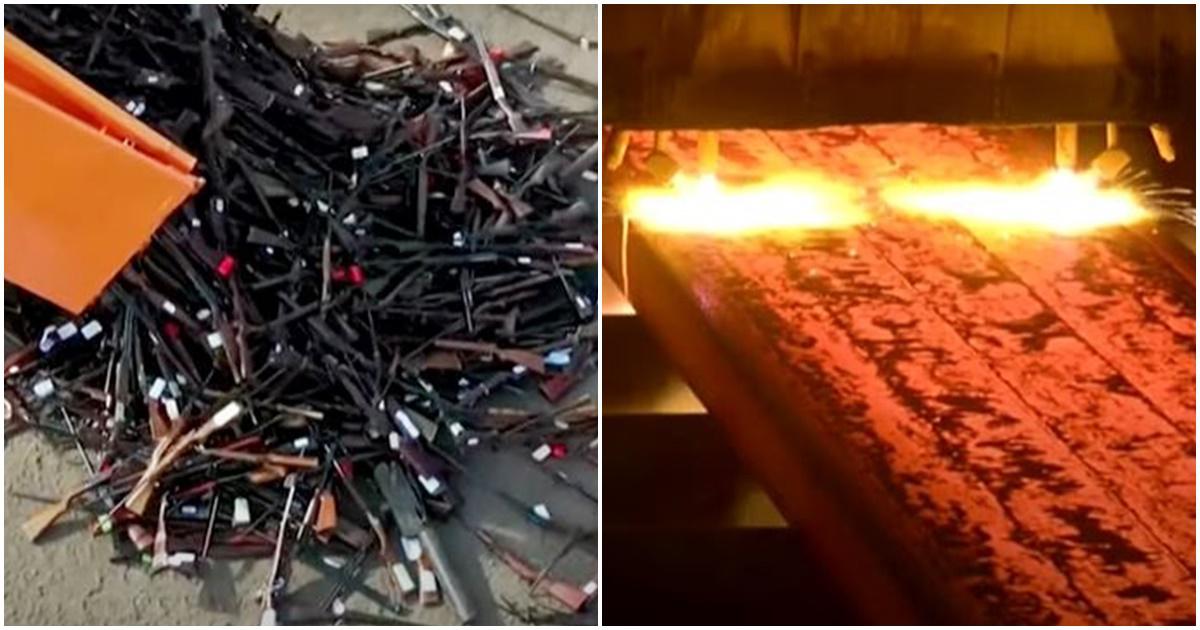
Satisfying video shows the Belgian government melting 22,000 guns into recycled steel

Belgian police collected over 22,000 firearms and decided to do something useful with them by melting them back into usable metal. After being rendered, the guns were turned into 60 tons of recycled steel.
Around half of the guns were handed in by owners from across the country, many of them had inherited guns and didn't want them anymore. The other half were old guns used by the police.
Belgium melts more than 22,000 guns into recycled steelwww.youtube.com
The guns were melted down by steel giant ArcelorMittal at a plant in Ghent. The covert operation took three days. This is the third time the Belgian government and the steel company have partnered to meltdown firearms.
"The result is impressive: 22,457 firearms have disappeared from our society," Carina van Cauter, the governor of East Flanders province, said in a statement. "It is obviously positive for the security of our citizens that these weapons are no longer in use."
Multiple studies show that van Cauter is right, the fewer the guns, the safer the people. This belief counters the notion held by many Americans that an armed society is a safer one.
A famous study from the late 1980s and 1990s by Arthur Kellermann, now dean of the F. Edward Hébert School of Medicine at the Uniformed Services University of the Health Sciences, studied 444 people who had been murdered in their homes.
"They found that a gun in the home was associated with a nearly threefold increase in the odds that someone would be killed at home by a family member or intimate acquaintance," Melinda Wenner Moyer writes in Scientific American.
Over 30 subsequent studies have confirmed the findings.

"There is really uniform data to support the statement that access to firearms is associated with an increased risk of firearm-related death and injury," Garen Wintemute, a physician and noted gun violence researcher at the University of California, concludes.
One reason that owning a gun makes people less safe is that it raises the chances of a situation escalating. "The fact that you have a gun may mean that you do things you shouldn't be doing: you take chances you shouldn't otherwise take; you go to places where it's really not safe, but you feel safe," says David Hemenway, director of the Harvard Injury Control Research Center.
So the added risk of owning a firearm may override the positive benefits of self-protection.
Belgium is home to restrictive gun laws. The country prohibits fully automatic weapons and only allows automatic weapons in certain situations. People can only own handguns if they get expressed permission from the government. The only guns not restricted by the state are long guns.
It's estimated that only 5% of Belgium citizens own a gun. The country's rate of homicides caused by firearms is 0.7 per 100,000 deaths.
However, in contrast with America, Belgium is much safer. In the U.S. the rate is much higher, with an average of 4.4. homicide deaths by firearm per 100,000 people. In the U.S. there are an estimated 400 million guns. How many tons of steel could that create?

- I compared America's gun laws to laws in 5 other countries. This is ... ›
- A guy with a gun license offers 5 common-sense laws that might ... ›
- We don't need other countries to prove gun laws work. Our own ... ›
- Sammie's Buddy Bench project spreads kindness and helps the planet - Upworthy ›
- People are loving these satisfying manufacturing videos - Upworthy ›


Student smiling in a classroom, working on a laptop.
Students focused and ready to learn in the classroom.
Fish find shelter for spawning in the nooks and crannies of wood.
Many of these streams are now unreachable by road, which is why helicopters are used.
Tribal leaders gathered by the Little Naches River for a ceremony and prayer.

Communications expert shares the perfect way to gracefully shut down rude comments
Taking the high ground never felt so good.
A woman is insulted at her job.
It came out of nowhere. A coworker made a rude comment that caught you off guard. The hair on the back of your neck stands up, and you want to put them in their place, but you have to stay tactful because you're in a professional setting. Plus, you don't want to stoop to their level.
In situations like these, it helps to have a comeback ready so you can stand up for yourself while making making sure they don't disrespect you again.
Vince Xu, who goes by Lawyer Vince on TikTok, is a personal injury attorney based in Torrance, California, where he shares the communication tips he's learned with his followers. Xu says there are three questions you can ask someone who is being rude that will put them in their place and give you the high ground:
Question 1: "Sorry, can you say that again?"
"This will either make them have to awkwardly say the disrespectful remark one more time, or it'll actually help them clarify what they said and retract their statement," Xu shares.
Question 2: "Did you mean that to be hurtful?"
The next step is to determine if they will repeat the disrespectful comment. "This calls out their disrespect and allows you to learn whether they're trying to be disrespectful or if there's a misunderstanding," Xu continues.
Question 3: "Are you okay?"
"What this does, is actually put you on higher ground, and it's showing empathy for the other person," Xu adds. "It's showing that you care about them genuinely, and this is gonna diffuse any type of disrespect or negative energy coming from them."
The interesting thing about Xu's three-step strategy is that by gracefully handling the situation, it puts you in a better position than before the insult. The rude coworker is likely to feel diminished after owning up to what they said, and you get to show them confidence and strength, as well as empathy. This will go a lot further than insulting them back and making the situation even worse.
Xu's technique is similar to that of Amy Gallo, a Harvard University communications expert. She says that you should call out what they just said, but make sure it comes out of their mouth. "You might even ask the person to simply repeat what they said, which may prompt them to think through what they meant and how their words might sound to others," she writes in the Harvard Business Review.
More of Gallo's suggested comebacks:
“Did I hear you correctly? I think you said…”
“What was your intention when you said…?”
“What specifically did you mean by that? I'm not sure I understood.”
“Could you say more about what you mean by that?”
Ultimately, Xu and Gallo's advice is invaluable because it allows you to overcome a negative comment without stooping to the other person's level. Instead, it elevates you above them without having to resort to name-calling or admitting they got on your nerves. That's the mark of someone confident and composed, even when others are trying to take them down.