The 'world's slowest experiment,' going for nearly 100 years, is still endlessly fascinating
It takes nearly a decade for one drop of this liquid to fall.

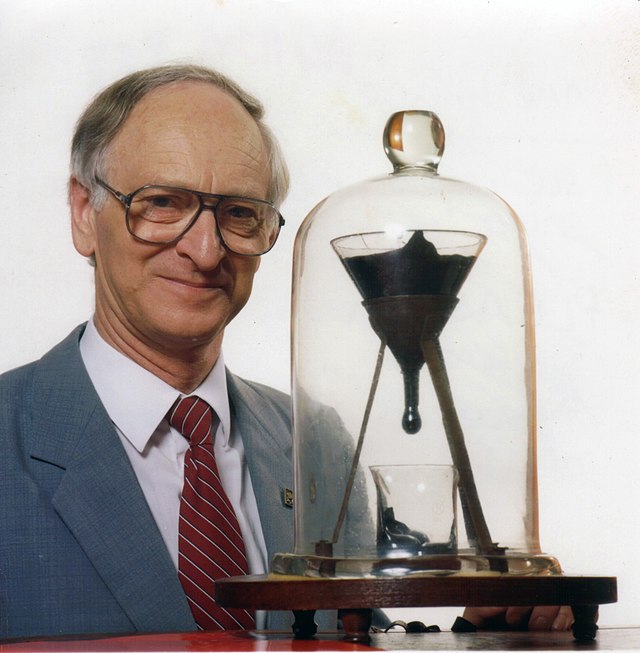
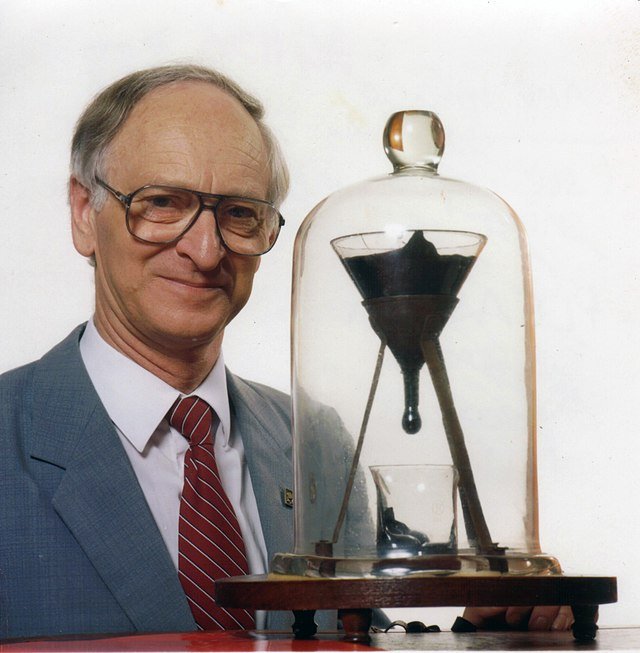
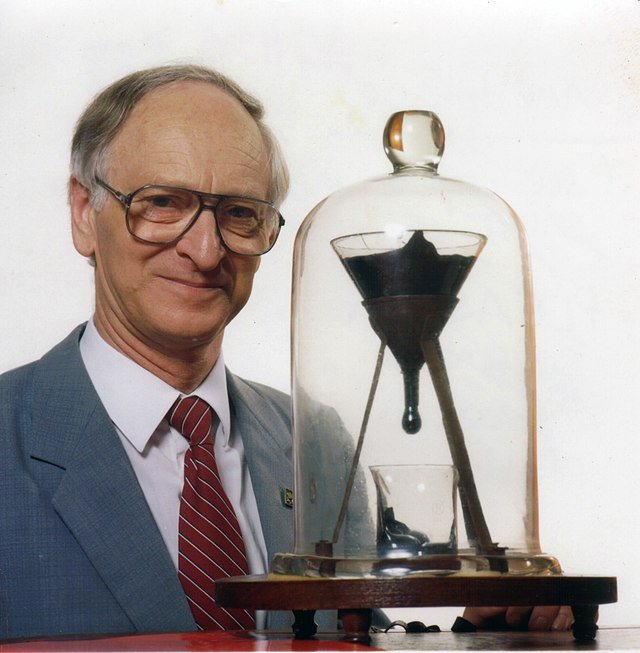
John Mainstone was the custodian of the Pitch Drop Experiment for 52 years.
Because we use water all the time, most of us have an intuitive sense of how long it takes a drop of water to form and fall. More viscous liquids, like oil or shampoo or honey, drop more slowly depending on how thick they are, which can vary depending on concentration, temperature and more. If you've ever tried pouring molasses, you know why it's used as a metaphor for something moving very slowly, but we can easily see a drop of any of those liquids form and fall in a matter of seconds.
But what about the most viscous substance in the world? How long does it take to form a falling drop? A few minutes? An hour? A day?
How about somewhere between 7 and 13 years?
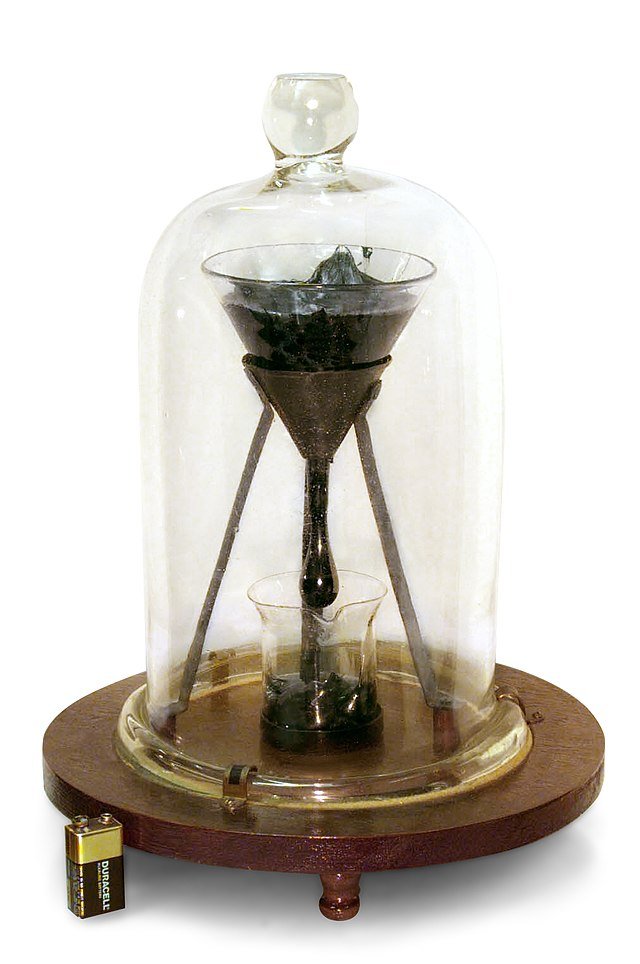
The Pitch Drop Experiment began in 1927 with a scientist who had a hunch. Thomas Parnell, a physicist at the University of Queensland in Australia, believed that tar pitch, which appears to be a solid and shatters like glass when hit with a hammer at room temperature, is actually a liquid. So he set up an experiment that would become the longest-running—and the world's slowest—experiment on Earth to test his hypothesis.
Parnell poured molten pitch it into a funnel shaped container, then let it settle and cool for three years. That was just to get the experiment set up so it could begin. Then he opened a hole at the bottom of the funnel to see how long it would take for the pitch to ooze through it, form a droplet, and drop from its source.
It took eight years for the first drop to fall. Nine years for the second. Those were the only two drops Parnell was alive for before he passed away in 1948.
- YouTubewww.youtube.com
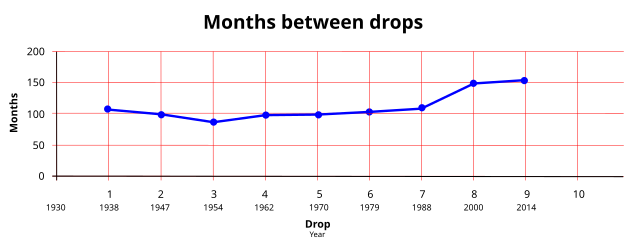
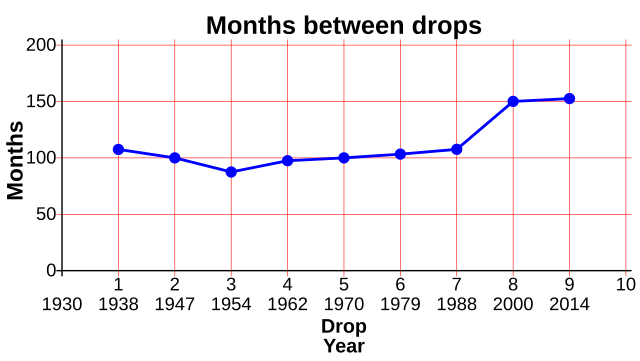
In total, there have been nine pitch drops in the University of Queensland experiment. The first seven drops fell between 7 and 9 years apart, but when air conditioning was added to the building after the seventh drop, the amount of time between drops increased significantly. The drops in 2000 and 2014 happened approximately 13 years after the preceding one. (The funnel is set up as a demonstration with no special environmental controls, so the seasons and conditions of the building can easily affect the flow of the pitch.)
The next drop is anticipated to fall sometime in the 2020s.
Though Parnell proved his hypothesis well before the first drop even fell, the experiment continued to help scientists study and measure the viscosity of tar pitch. The thickest liquid substance in the world, pitch is estimated to be 2 million times more viscous than honey and 20 billion times the viscosity of water. No wonder it takes so ridiculously long to drop.
One of the most interesting parts of the Pitch Drop Experiment is that in the no one has ever actually witnessed one of the drops falling at the Queensland site. The drops, ironically, happen rather quickly when they do finally happen, and every time there was some odd circumstance that kept anyone from seeing them take place.
The Queensland pitch drop funnel is no longer the only one in existence, however. In 2013, Trinity College in Dublin, Ireland, managed to capture its own pitch drop on camera. You can see how it looks as if nothing is happening right up until the final seconds when it falls.
- YouTubewww.youtube.com
Today, however, with the internet and modern technology, it's likely that many people will be able to witness the next drop when it happens. The University of Queensland has set up a livestream of the Pitch Drop Experiment, which you can access here, though watching the pitch move more slowly than the naked eye can detect is about as exciting as watching paint dry.
But one day, within a matter of seconds, it will drop, hopefully with some amount of predictability as to the approximate day at least. How many people are going to be watching a livestream for years, waiting for it to happen?
PoorJohn Mainstone was the custodian of the experiment for 52 years, from 1961 to 2013. Sadly, he never got to witness any of the five drops that took place during his tenure. Neither did Parnell himself with the two that took place while he was alive.
Sometimes science is looks like an explosive chemical reaction and sometimes it's a long game of waiting and observing at the speed of nature. And when it comes to pitch dripping through a funnel, the speed of nature is about as slow as it gets.
- This science fair winner is taking on global drought using oranges and avocados. ›
- A small boat made by middle schoolers sailed across the ocean all the way to Norway ›
- The Most Disgusting Science Experiment I've Ever Seen, Or A Terrifying Wake-Up Call? ›
- A controversial scientist created a 'utopia' for mice. 19 months in, it all went haywire. - Upworthy ›
- In 1879 a scientist buried bottles filled with seeds. Every 20 years, one is dug up and studied. - Upworthy ›
- Fascinating 'Dark-fly' experiment has finally allowed scientists to measure evolution in real time - Upworthy ›


A woman is getting angry at her coworker.via
A man with tape over his mouth.via
A husband is angry with his wife. via 
a man sitting at a desk with his head on his arms Photo by
Can a warm cup of tea help you sleep better? If you believe it, then yes. Photo by 
Three women sit on a blanket in the park. 
Two women engaging in a pleasant conversation inside a coffee shop
Two men engaging in a peaceful disagreement.
Resurfaced video of French skier's groin incident has people giving the announcer a gold medal
"The boys took a beating on that one."
Downhill skiing is a sport rife with injuries, but not usually this kind.
A good commentator can make all the difference when watching sports, even when an event goes smoothly. But it's when something goes wrong that great announcers rise to the top. There's no better example of a great announcer in a surprise moment than when French skier Yannick Bertrand took a gate to the groin in a 2007 super-G race.
Competitive skiers fly down runs at incredible speeds, often exceeding 60 mph. Hitting something hard at that speed would definitely hurt, but hitting something hard with a particularly sensitive part of your body would be excruciating. So when Bertrand slammed right into a gate family-jewels-first, his high-pitched scream was unsurprising. What was surprising was the perfect commentary that immediately followed.
This is a clip you really just have to see and hear to fully appreciate:
- YouTube youtu.be
It's unclear who the announcer is, even after multiple Google inquiries, which is unfortunate because that gentleman deserves a medal. The commentary gets better with each repeated viewing, with highlights like:
"The gate the groin for Yannick Bertrand, and you could hear it. And if you're a man, you could feel it."
"Oh, the Frenchman. Oh-ho, monsieurrrrrr."
"The boys took a beating on that one."
"That guy needs a hug."
"Those are the moments that change your life if you're a man, I tell you what."
"When you crash through a gate, when you do it at high rate of speed, it's gonna hurt and it's going to leave a mark in most cases. And in this particular case, not the area where you want to leave a mark."
Imagine watching a man take a hit to the privates at 60 mph and having to make impromptu commentary straddling the line between professionalism and acknowledging the universal reality of what just happened. There are certain things you can't say on network television that you might feel compelled to say. There's a visceral element to this scenario that could easily be taken too far in the commentary, and the inherent humor element could be seen as insensitive and offensive if not handled just right.
The announcer nailed it. 10/10. No notes.
The clip frequently resurfaces during the Winter Olympic Games, though the incident didn't happen during an Olympic event. Yannick Bertrand was competing at the FIS World Cup super-G race in Kvitfjell, Norway in 2007, when the unfortunate accident occurred. Bertrand had competed at the Turin Olympics the year before, however, coming in 24th in the downhill and super-G events.
As painful as the gate to the groin clearly as, Bertrand did not appear to suffer any damage that kept him from the sport. In fact, he continued competing in international downhill and super-G races until 2014.
According to a 2018 study, Alpine skiing is a notoriously dangerous sport with a reported injury rate of 36.7 per 100 World Cup athletes per season. Of course, it's the knees and not the coin purse that are the most common casualty of ski racing, which we saw clearly in U.S. skier Lindsey Vonn's harrowing experiences at the 2026 Olympics. Vonn was competing with a torn ACL and ended up being helicoptered off of the mountain after an ugly crash that did additional damage to her legs, requiring multiple surgeries (though what caused the crash was reportedly unrelated to her ACL tear). Still, she says she has no regrets.
As Bertrand's return to the slopes shows, the risk of injury doesn't stop those who live for the thrill of victory, even when the agony of defeat hits them right in the rocks.