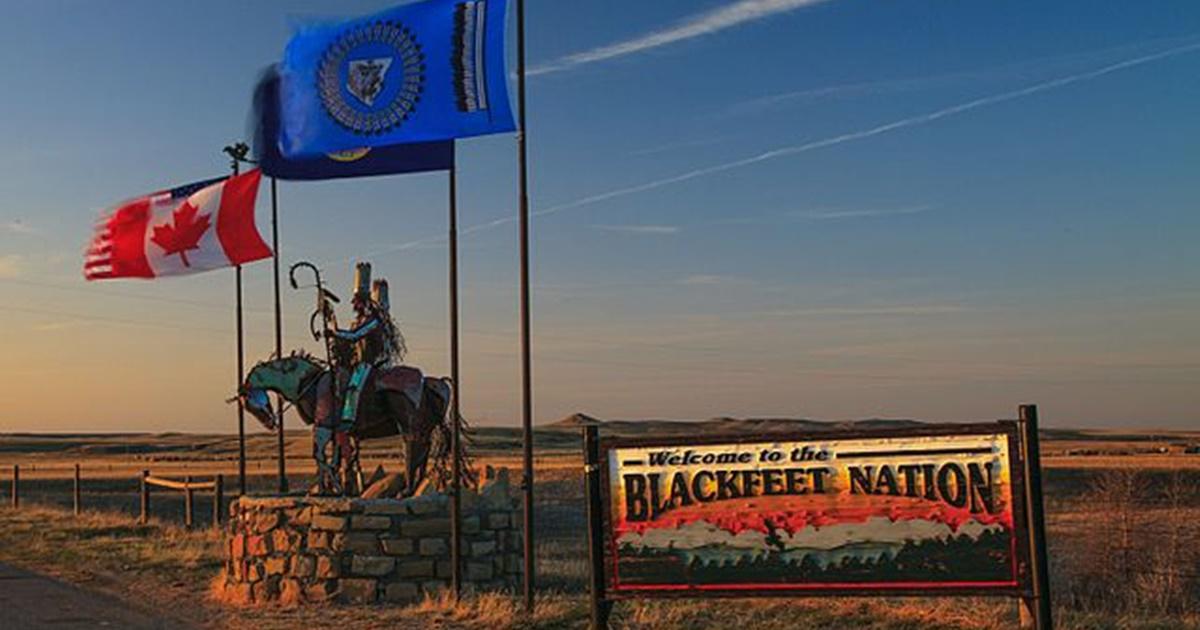
Montana's Blackfeet Tribe has gifted hundreds of COVID vaccines to its Canadian neighbors
via Wikimedia Commons

Native Americans have been especially hard-hit by the COVID-19 pandemic. In Montana, Native Americans account for 6.6% of the population but are 17% of the state's total COVID-19 cases.

The Blackfeet Nation Reservation in northwestern Montana is no exception. The reservation is home to just under 10,000 people but in less than a year, it recorded a total of 1,3838 COVID-19 cases.

At the pandemic's height, there were 390 cases of the virus on the reservation and the number tripled over just 10 days. The tribe lost 47 members to the virus.


Given the devastation the pandemic has on the Blackfeet Tribe, it has taken vaccination seriously. As of late April, 98% of the tribe was vaccinated.

In an act of goodwill, the tribe has decided to donate its leftover vials of Pfizer and Moderna vaccine to their neighbors on the other side of the border in Canada. The tribe calls the donation is a "gift" of "reconciliation" between governments, nations, and tribe members.

"We started having some discussion about that about a month ago," Piita'hkotokii James McNeely, the public information officer with the Blackfeet Tribe, said in late April. "We threw this together in the last seven, eight days and it really fell together."

Over the past month, the tribe has held multiple clinics that have drawn hundreds of people from all over Canada to get vaccinated. The first clinic in late April vaccinated over 450 people. A follow-up clinic on Monday provided many with their second doses.

Ken Sawartzy drove nearly 400 miles from Calgary to make sure he got his booster shot. His wife is a cancer patient, so he had no problem going the extra mile for his final shot. "This will make sure we're both safe, because I'm her caregiver, too. I think it's a great thing," Sawatzky told the CBC.

"It's absolutely beautiful. The Blackfoot Indians are just coming through (for us)," Dave and Cathy Goodbrand from Calgary, who just got their second shots, told the CBC.

The long lines of Canadians flocking to the reservation highlight the difference in vaccine availability between the two countries.

"I had a hard time believing it was that hard to get a shot in Canada," Bonnie Healy, health director for the Blackfoot Confederacy, said.

America has vaccinated its population at a faster rate than Canada, but Canada will eventually surpass the U.S. in the percentage of citizens who've got the jab. A major reason for the difference is vaccine hesitancy.

Thirty-four percent of Americans have said they will not be getting the shot, versus just 12% of Canadians.

Blackfeet Tribal leaders are happy that their gift has been so well-received.

"I am actually brought to tears today hearing that the efforts to assist our relatives and folks across the medicine line with vaccines has been awesome! Many of the folks cried today when they were able to get vaccinated," McNeely said.

True

When Sue Hoppin was in college, she met the man she was going to marry. "I was attending the University of Denver, and he was at the Air Force Academy," she says. "My dad had also attended the University of Denver and warned me not to date those flyboys from the Springs."

"He didn't say anything about marrying one of them," she says. And so began her life as a military spouse.

The life brings some real advantages, like opportunities to live abroad — her family got to live all around the US, Japan, and Germany — but it also comes with some downsides, like having to put your spouse's career over your own goals.

"Though we choose to marry someone in the military, we had career goals before we got married, and those didn't just disappear."

Career aspirations become more difficult to achieve, and progress comes with lots of starts and stops. After experiencing these unique challenges firsthand, Sue founded an organization to help other military spouses in similar situations.

Sue had gotten a degree in international relations because she wanted to pursue a career in diplomacy, but for fourteen years she wasn't able to make any headway — not until they moved back to the DC area. "Eighteen months later, many rejections later, it became apparent that this was going to be more challenging than I could ever imagine," she says.

Eighteen months is halfway through a typical assignment, and by then, most spouses are looking for their next assignment. "If I couldn't find a job in my own 'hometown' with multiple degrees and a great network, this didn't bode well for other military spouses," she says.

She's not wrong. Military spouses spend most of their lives moving with their partners, which means they're often far from family and other support networks. When they do find a job, they often make less than their civilian counterparts — and they're more likely to experience underemployment or unemployment. In fact, on some deployments, spouses are not even allowed to work.

Before the pandemic, military spouse unemployment was 22%. Since the pandemic, it's expected to rise to 35%.

Sue eventually found a job working at a military-focused nonprofit, and it helped her get the experience she needed to create her own dedicated military spouse program. She wrote a book and started saving up enough money to start the National Military Spouse Network (NMSN), which she founded in 2010 as the first organization of its kind.

"I founded the NMSN to help professional military spouses develop flexible careers they could perform from any location."

"Over the years, the program has expanded to include a free digital magazine, professional development events, drafting annual White Papers and organizing national and local advocacy to address the issues of most concern to the professional military spouse community," she says.

Not only was NMSN's mission important to Sue on a personal level she also saw it as part of something bigger than herself.

"Gone are the days when families can thrive on one salary. Like everyone else, most military families rely on two salaries to make ends meet. If a military spouse wants or needs to work, they should be able to," she says.

"When less than one percent of our population serves in the military," she continues, "we need to be able to not only recruit the best and the brightest but also retain them."

"We lose out as a nation when service members leave the force because their spouse is unable to find employment. We see it as a national security issue."

"The NMSN team has worked tirelessly to jumpstart the discussion and keep the challenges affecting military spouses top of mind. We have elevated the conversation to Congress and the White House," she continues. "I'm so proud of the fact that corporations, the government, and the general public are increasingly interested in the issues affecting military spouses and recognizing the employment roadblocks they unfairly have faced."

"We have collectively made other people care, and in doing so, we elevated the issues of military spouse unemployment to a national and global level," she adds. "In the process, we've also empowered military spouses to advocate for themselves and our community so that military spouse employment issues can continue to remain at the forefront."

Not only has NMSN become a sought-after leader in the military spouse employment space, but Sue has also seen the career she dreamed of materializing for herself. She was recently invited to participate in the public re-launch of Joining Forces, a White House initiative supporting military and veteran families, with First Lady Dr. Jill Biden.

She has also had two of her recommendations for practical solutions introduced into legislation just this year. She was the first in the Air Force community to show leadership the power of social media to reach both their airmen and their military families.

That is why Sue is one of Tory Burch's "Empowered Women" this year. The $5,000 donation will be going to The Madeira School, a school that Sue herself attended when she was in high school because, she says, "the lessons I learned there as a student pretty much set the tone for my personal and professional life. It's so meaningful to know that the donation will go towards making a Madeira education more accessible to those who may not otherwise be able to afford it and providing them with a life-changing opportunity."

Most military children will move one to three times during high school so having a continuous four-year experience at one high school can be an important gift. After traveling for much of her formative years, Sue attended Madeira and found herself "in an environment that fostered confidence and empowerment. As young women, we were expected to have a voice and advocate not just for ourselves, but for those around us."

To learn more about Tory Burch and Upworthy's Empowered Women program visit https://www.toryburch.com/empoweredwomen/. Nominate an inspiring woman in your community today!

via idiehlpare / Flickr and ESPN

An innocent tweet by sports reporter Marcel Louis-Jacques erupted into a great discussion where people tried to describe the indescribable. "There's an unnamed media member in here who has never had a Dr. Pepper and asked what it tastes like," he tweeted.

"I have no idea how to describe it -- how would y'all do it?" he asked.

Marcel Louis-Jacques covers the Miami Dolphins for ESPN and appears on NFL Live, SportsCenter, ESPN Radio, and more.

The question feels like a Zen koan such as "What is the sound of one hand clapping?" or "What do you call the world?"

Keep Reading Show less
Photo courtesy of Macy's
True

Did you know that girls who are encouraged to discover and develop their strengths tend to be more likely to achieve their goals? It's true. The question, however, is how to encourage girls to develop self-confidence and grow up healthy, educated, and independent.

The answer lies in Girls Inc., a national nonprofit serving girls ages 5-18 in more than 350 cities across North America. Since first forming in 1864 to serve girls and young women who were experiencing upheaval in the aftermath of the Civil War, they've been on a mission to inspire girls to kick butt and step into leadership roles — today and in the future.

This is why Macy's has committed to partnering with Girls Inc. and making it easy to support their mission. In a national campaign running throughout September 2021, customers can round up their in-store purchases to the nearest dollar or donate online to support Girls Inc. and empower girls throughout the country.


Kaylin St. Victor, a senior at Brentwood High School in New York, is one of those girls. She became involved in the Long Island affiliate of Girls Inc. when she was in 9th grade, quickly becoming a role model for her peers.

Photo courtesy of Macy's

Within her first year in the organization, she bravely took on speaking opportunities and participated in several summer programs focused on advocacy, leadership, and STEM (science, technology, engineering and math). "The women that I met each have a story that inspires me to become a better person than I was yesterday," said St. Victor. She credits her time at Girls Inc. with making her stronger and more comfortable in her own skin — confidence that directly translates to high achievement in education and the workforce.

In 2020, Macy's helped raise $1.3 million in support of their STEM and college and career readiness programming for more than 26,000 girls. In fact, according to a recent study, Girls Inc. girls are significantly more likely than their peers to enjoy math and science, to be interested in STEM careers, and to perform better on standardized math tests.

Keep Reading Show less