upworthy
Add Upworthy to your Google News feed.
Google News Button
Humor

Jimmy Fallon asked people to share funny, weird or embarrassing stories from their bad summer jobs

The things we do for a summer paycheck.

jimmy fallon worst summer job hashtag twitter

His face is all of us after that first summer job paycheck.

Call it a rite of passage, a baptism by fire, or simply a necessary evil, but a terrible summer job is pretty much a staple of young adulthood. Those concert tickets aren’t gonna pay for themselves, after all. Some summer jobs are heinous by the sheer amount of manual labor involved. Others are just plain weird. I remember one year working as a “live strolling table.” Yep, just walking around attached to an elaborately dressed table offering hors d'oeuvres and champagne. A human-furniture hybrid. How do you put that on a resume?

No matter the role, there is one thing all summer jobs have in common: They teach us humility in one way or another … especially once we see that first paycheck. There’s simply no way to prepare for seeing two weeks worth of hard work equate to a (usually) paltry sum. Hopefully that experience alone makes generous tippers of us all.

worst jobs jimmy fallonResponsibility. Yay. Giphy


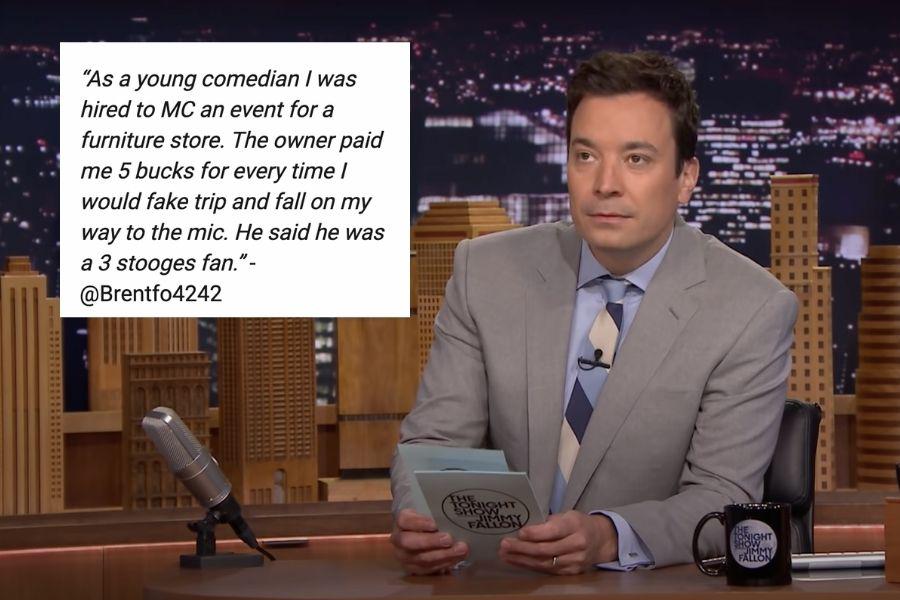
Jimmy Fallon recently asked people to share their own “funny, weird, or embarrassing story about a bad summer job” as part of his iconic #hashtags challenge.

Here are 15 that might make your own summer job memory feel a little less dreadful:

1.

“I planted trees for the US Forest Service one summer in HS. Our foreman would go through our lunches, eat our cookies and chips, and take bites out of our sandwiches. We were all about 15 so too afraid to tell.” – @dumpster_diva

2.

“One summer I worked at Taco Bell during lunch and Furr’s cafeteria during dinner. People would see me at both and ask if I was twins.” – @kerrikgray

3.

“As a young comedian I was hired to MC an event for a furniture store. The owner paid me 5 bucks for every time I would fake trip and fall on my way to the mic. He said he was a 3 stooges fan.” – @Brentfo4242

4.

“I applied for a job while in high school at a toy store. I called back days after the interview asking if they had any news for me. They told me I got the job, and they forgot to tell me. They had me scheduled for that day and was told ‘you’re late.’” – @RockerSam91

5.

“In high school, I worked at an insurance agency...let’s just say the bus ride to and from work was the best part of the job.” – @SharonZurcher

6.

“In high school I worked at a bounce house company. My first day working was an elementary school field day and the huge inflatable slide starting deflating and collapsing with kids at the top…angry parents staring at me like I had an answer for this at 16 years old.” – @calamari_carly

7.

“In middle school my friend and I got paid to fill, lick and seal about 500 envelopes with documents for a lawyer - a penny per envelope. 3 hours later, we asked for 2 cans of soda from his cooler. He said sure, and took $2 each from our pay. We made a dollar.” – @CameronFontana

8.

“I worked at a dog kennel. A guy brought in 2 dogs to stay a month. He told me to give a pill every morning to dog #1. So, I did for the month. When he returned, I brought out dog #1 and he said, ‘Hi, dog #2!’ My face turned so red. Oh, well. The dog survived.” – @TheTomeWebster

9.

“I babysat identical twin boys where one constantly screamed and got into mischief but potty trained early while the other was quiet, well behaved but always blowing out diapers. They never did anything ‘identical’. I'm shocked that I still wanted kids after that!” @overbaughs

10.

“Worked at Crumbl in high school. One coworker had the exact same shifts as me, and she was a theater kid. Like MAJOR theater kid, was cracked out 24/7, randomly performing theater at work. I am not proud to say I memorized 10 Shakespeare monologues because of her.” – @itstherealmeboo

11.

“I held human hearts with a white cotton glove during open heart surgeries, so they didn’t ‘slip’.…No pressure! That’s why l am now a planetary medium and asteroid deflector. Much less stress.” – @rosamalvaceae

12.

“I worked for a local sweet corn farm. I had to sort the corn into boxes for their stands around the state or local grocery stores. It came off the truck onto a conveyor belt by the 1000s. I literally saw thousands of corn cobs in my dreams at night.” – @jdianemiller

13.

“In high school my mom got me a job working with the city to clean an island in the local lake that ducks lived on. Everyday I had to fight a duck, and everyday I needed a bandaid after getting bit by a duck. It was a nightmare and I still hate ducks 30 years later.” – @KingSergioS

14.

“Hired at an amusement park for the summer, taking summer college classes at the same time…Show up for my 1st day to a supervisor who says ‘Oh, the girl who didn’t show up!’ Proceeds to show me the previous week’s schedule where I had 40 hours during my class time. He rolls his eyes when I explain and gives me every crappy task he can find....

jimmy fallon hashtagsGiphy

...I left after the 2nd day, never picked up my check, but kept my employee ID & got in for free all summer!” – @trixiebelle47


This article originally appeared three years ago.

ups, ups driver, delivery driver, ups deliveries, cookout, family, food, hospitality, kindness
Relaxed008/YouTube
UPS driver invited to family's cookout.

UPS drivers are always on the grind delivering packages around the clock—even on holidays. And one family took notice of the hard-working UPS driver in their neighborhood who had his nose to the grindstone as they enjoyed a cookout together. Rather than simply let him pass by, they decided to flag him down and extend an invite to join them in a move that proved community and hospitality are still alive and well.

TikToker @1fanto shared a touching video with his followers from Easter weekend where his family invited a UPS driver making rounds in their neighborhood to come to their cookout and 'make a plate.'


"Everybody family around here 😭," he captioned the video. "Everybody invited to the cookout.😂"

@1fanto

Everybody family around here 😭 #easter #cookout #wherethefunction

In the video, the UPS driver is seen standing in the family's driveway, and a group of cookout attendees warmly welcome him to join them. The uncle of @1fanto says to the driver, "You've been working hard all day man, you can go on in there!" He calls out for a woman named Stephanie to "take care of him!"

The UPS driver walks up the driveway, and they encourage him to go inside and get his fill as he enters the garage. After securing a plate of food and a drink, the driver walks back outside to mingle with guests, shaking hands with the uncle who invited him.

"You good?" the uncle asks, and the driver responds, "Yeah I'm good. They hooked me up. Thank you so much. Appreciate y'all for inviting me out." On his way back to his truck, the uncle encourages the driver to invite other workers to stop by as well.

- YouTube www.youtube.com

In a follow up video, @1fanto explained more about how the invite went down. He shares that the UPS driver was driving by the family's house on the Saturday before Easter, and at the time the family was enjoying a big fish fry cookout together. His uncle flagged the driver down, and he pulled over.

He shares that his uncle told the driver, "Go inside and get you a plate!" The driver asked him, "Are you sure?" But he reassured him, adding that the family made sure to ask the driver what he wanted and didn't want on his plate to "make sure he was good and got everything he needed".

"I saw it had a positive impact. That's what my family do. That's not something that we just do for social media," @1fanto shared. "That's something that we do on a regular basis that doesn't just happen when the camera's on. It happens when the camera's off, too. We're all equal. We all bleed the same."

ups, ups truck, united parcel service, ups delivery, ups deliveries, ups driver A UPS truck with package deliveries.Image via Wikipedia

Viewers had lots of positive things to say in the comment section.

"I am a UPS driver and that makes our day. People showing love to us"

"Your family represents the best of America🫶🏼 Your uncle is now all of our uncle."

"Working the holidays suck. But they made that man’s entire day. Love it."

"I love when people are nice for no reason. You’re so real ♥️thank you for being so kind."

"Being a delivery driver is grueling, often thankless work. It's awesome to see a family that remembers those hardworking folks are essential parts of our communities."

This article appeared last year. It has been updated.

diy, frugal tips, money saving tips, money saving tips 2026, finance, saving money, how to save money, quitting subscriptions, quitting amazon, amazon alternatives

A woman fanning her face with money.

In 2025, so many conversations revolved around saving money. And while we’re only a fraction of the way into 2026, it seems that we’ll still be having those conversations for the foreseeable future.

Thankfully, we can take some lessons learned from the previous year and put them into practice today, knowing that they will actually help in the long run.


Recently, someone on Reddit asked, "What frugal practice has saved you the most money in 2025?" They mentioned that their most impactful “frugal practices” included stocking up on meats that were on sale and doing at-home repairs on household items (apparently, a little “gluing and sewing can go a long way.)

Pretty soon, other folks were sharing their own DIY fixes, grocery hacks, and other innovative strategies that quite literally gave them more bang for their buck.

Check out some of our favorites below:

1. Shopping every 3 days

diy, frugal tips, money saving tips, money saving tips 2026, finance, saving money, how to save money, quitting subscriptions, quitting amazon, amazon alternatives A man at a grocery store in the produce aisle.Photo credit: Canva

"I discovered that buying food for only three days at a time saves me money. If I buy a week's worth of FRESH food, I end up tossing at least half of it. By the time the fourth day comes around, I'm so tired of looking at what's still left. I call it visual fatigue, for lack of a better explanation. So, I buy only three days of fresh food. If needed, I restock the staples, canned goods, or freezer meats."

2. No new health or beauty products

"Last year, I didn't buy any health or beauty products until I was 100% sure I was completely out of it. I went from January to mid-November before I had to buy deodorant because I had so many partially used sticks stashed in my cabinets. I still haven't had to buy shampoo, conditioner, or makeup because of the sheer quantity I had that I would then decide to try the newest product out there. It's been a game-changer!"

3. Forgoing unhealthy habits

"I quit vaping. That saved $30-$60 per week."

"I quit drinking alcohol. Since I bought most of it at gas stations, I didn't realize how much I would save on the other stuff I would grab while I was in there for beer. The chips, jerky, and other nonsense."

"Reduced snacking. I didn't realize how much I snacked. Somehow it's easy not to snack when you don't buy any! Eventually, I found healthier alternatives like some fresh fruit, some toasted nuts (no salt), and making my own granola bars."

4. Opting for at-home eats and treats

diy, frugal tips, money saving tips, money saving tips 2026, finance, saving money, how to save money, quitting subscriptions, quitting amazon, amazon alternatives A close-up of hands prepping baking ingredients. Photo credit: Canva

"Only drinking water and making my own tea/coffee at home."

"Baking from scratch. I started making all baked goods instead of buying them. Have saved a ton of money by not having to buy bread, hamburger/hot-dog buns, tortillas, pizza dough, bread crumbs, pie crust, etc. I didn't realize just how easy it is to make these things and so much better for you without all the added crap! And the taste difference is incredible! There's also a great sense of satisfaction in making it yourself! An added bonus is way fewer quick trips to the store because we're out of bread or we're having burgers and need buns!"

"Never go out to eat...ever...overpriced garbage should be free."

"I eat before going out."

5. Library > subscriptions

"I read 60+ books last year and borrowed most of them from the library — it saved me hundreds of dollars. Because I was reading, I didn't have much time to watch streaming services, so I saved a bit of money there as well. I only ever had one subscription at a time."

6. Grocery pick-up instead of shopping

"Ordering my groceries for pickup. Started it when my toddler was in her feral stage, and it just eliminated the meltdowns while on long shopping trips. Now she's older, but I still use it. I only buy what's on sale/have coupons for, and it stopped all my impulse shopping. I plan the meals each week around the circular for our store or what we've already have in the freezer/cupboards."

"Ordering for grocery pick up costs $4.99 at my favourite supermarket. Like you, I buy what is on sale and a few essentials I may need. I figured spending the $5 ends up saving me more in the long run because I'm not impulse buying and looking for those unadvertised 'manager specials.'"

7. No more Amazon

diy, frugal tips, money saving tips, money saving tips 2026, finance, saving money, how to save money, quitting subscriptions, quitting amazon, amazon alternatives A warehouse full of stacked boxes. Photo credit: Canva

"Cold turkey stopped using Amazon."

"Whenever I think I need something from Amazon, I put it in my cart and leave it for a while. If I come into a little money, I go to my cart and buy the thing that makes the most sense."

8. Cutting back on driving

"I biked 144 times last year. Worked out to around $2,300 saved on cab fares."

"We're retired and went to one car. I pay for a few annual delivery services; our senior center offers subsidized ride shares; Walmart Plus offers free shipping and return pickup; our area has discounted public transportation passes for seniors; and charities come around regularly for donations and e-waste pickup. Using all those, we only need one car, and even with that one car, our maintenance costs decreased from driving less."

9. Creating—and sticking to— a meal plan

"Setting up a meal plan for each day and sticking to it. Saturday: homemade pizza, Sunday: a stew, etc. It has brought my food bill for four people down from $650 a month to $320. We're also eating healthier, homemade food. Prior to this, we were eating processed frozen crap and always struggling to decide what to eat each evening. Now if I could just come up with a breakfast and lunch plan, I'd be set."

10. Learning how to take care of what you already own

diy, frugal tips, money saving tips, money saving tips 2026, finance, saving money, how to save money, quitting subscriptions, quitting amazon, amazon alternatives A yellow shirt with a stain, lemon, and baking powderPhoto credit: Canva

"Learned how to properly remove stains from clothes"

11. At-home beauty treatments

"Stopped getting my highlights redone every six to eight weeks and embraced my natural brown. I still get color treatments to match my natural color, but only every three or four months. I also stopped getting gel manicures every two weeks. Saves an insane amount of money."

12. Alternative protein sources

"Beans. I replaced meat as the main protein source in meal planning with beans."

13. No spending Monday-Friday

"I try to avoid spending money on the weekdays."

14. Not using the dryer

"Hang drying my clothing. It has cut my electric bill by 60%."

And lastly…

15. Vacuum sealing

"I bought a vacuum sealer and Souper Cubes, and both have changed our grocery game. I love to cook, so I cook big (buying what's on sale) and then portion and freeze in Souper Cubes. Once frozen, I pop them out and vacuum-seal them. We have a chest freezer full of portioned homemade meals that we can either reheat in the oven or pop into the microwave."

Here’s to a fruitful 2026, everyone.

crowd, unique, personality type, nonconformist
Photo Credit: Canva

A person stands out in a crowd.

So many of us have the desire to compartmentalize our personality traits into neat little boxes. "Oh, she's such an INFJ. Oh, he's such a Gemini." Some of it is rooted (well sort of) in psychology, such as the Myers-Briggs Type Indicator, based loosely on Jungian ideas. Others rely on arguably less scientific data like stars and "rising signs." Humans aren't usually that simple.

That said, there's still value in understanding one's own personality and inclinations. Here's a confession: I've taken countless personality tests because I just couldn't figure out if I was an extrovert or an introvert. Neither description quite fit, and as someone constantly trying to understand what makes me tick, this has been frustrating.


Turns out, there are other options. The term "ambivert" got popularized in the 1930s (after being coined by Edmund S. Conklin in 1923), and it refers to a person "who has features of both an introvert (someone who prefers to spend time alone) and an extrovert (someone who prefers to be with other people) in their personality."

@tedtoks

Replying to @Factura🛄 now knowing what an ambivert is, how would you describe yourself? #ambivert #introvert #extrovert #adamgrant #psychology #TEDTalk #worklife

But for those who still don't quite relate, meet the otrovert. Just recently, psychiatrist Rami Kaminski published The Gift of Not Belonging, in which he discusses his coined term to describe a whole new type of personality. In an Insta-reel captioned "What is an Otrovert?" Kaminski mentions the polarization of introverts and extroverts. "When Jung invented the terms extrovert and introvert, he saw them as two fundamental orientations of the personality. I see the otrovert in the same way. A personality trait that faces away from the group."

He continues, "Extroverts and introverts are inherently communal, while the otrovert is an outsider to the group. In itself, it is not a problem or condition, nor is it a diagnostic label. It simply means that while most people learn to develop a sense of belonging to a specific group through social conditioning, otroverts remain social but not communal."

In writer Sarjna Rai's piece, "Struggle to Fit the Mold? The 'Otrovert' Personality Explains Why" for Business Standard, they write: "Unlike introverts or extroverts, otroverts are not defined by where they draw their social energy. Instead, the concept captures people who constantly feel like outsiders, and tend to look in a different direction altogether, not necessarily aligned with the rest of the group."

While it's impossible to group people into perfect categories, Rai explains that Kaminski claims the main thing that sets otroverts apart is their "reluctance to conform to group norms."

Writer Avery White lists signs one might be an otrovert in the article "7 Signs You Might Be an Otrovert" for VegOut. Among them is preferring "high-signal conversations and low-maintenance relationships." They give this as an example: "You’ll happily spend three hours exploring one idea with one person—and then not speak for weeks without either of you taking it personally. In other words, low pressure, low expectations, high connection.

Another on the list—and this is a big one according to Kaminski—is: "You can look extroverted in public—yet feel fundamentally 'other.'" This is actually the crux of the term, and in fact, what Kaminski formed The Otherness Institute for: as their website says, "those who feel they don't belong."

The site also shares that recognizing aspects of this type in yourself and others (if it applies) will help "balance between your individuality and your function as part of the social matrix that determines your well-being. The experience of otherness in a togetherness-minded world can be emotionally bruising. Often misunderstood and misdiagnosed, otherness may lead individuals to feel strange, lonely, and unwelcome in groups. Left unidentified, otroverts' non-belonging can result in a frustrating, futile lifetime effort of trying to 'fit in.'"

Some Redditors are scrambling to figure out if they fit into this category. In the subreddit r/INTP (referencing one of the Myers-Briggs personality types), the OP asks, "Maybe I am an 'otrovert?'" Under this, they write, "Dr. Kaminski described the otrovert child as 'neurotypical, friendly, curious, well-adjusted, and often popular' yet 'they resist being pressured into group activities.'"

While this can seem inconsequential in childhood, joining the peer group "becomes critically important" in adolescence, said the psychiatrist, and teens "start to gauge their self-worth based on the group’s ranking of popularity (or unpopularity).'

"Membership in a group, no matter how lowly, is better than being an outsider," he added. "Otroverts, however, are comfortable with being outsiders and find it impossible to feel like insiders, regardless of how welcome they are.'

There are a handful of commenters who feel seen, but many push back, claiming the term could easily apply to other personality traits. One writes, "I think it's easy to resonate with this description... but as some warning noted, there aren't enough studies done about this term that people should be running to adopt it. I resonated with it after reading about it... But I have ADHD and persistent depressive disorder... both of which coincide with the descriptions of an otrovert."

Time will tell if this new term sticks, but for now, it's helping a lot of people feel more understood.

This article originally appeared last year.


nikola tesla, tesla coil, inventor, intelligence, tesla photos, tesla inventions

Inventor Nikola Tesla.

Nikola Tesla was one of the most brilliant people who ever lived. He invented alternating current (AC), which still powers most homes around the world today. A true maverick, Tesla also experimented with radio waves, robotics, and wireless energy. He was also famously eccentric, known for his preference for solitude, fear of germs, and obsession with the number three.

Julian de Medeiros, a TikToker and Substack writer who shares his thoughts on philosophy, recently explained how Tesla believed he could tell if someone was highly intelligent—an observation that sheds light on how the exceptionally gifted often see the world very differently from the rest of us.


Signs someone is highly intelligent

"Here's a simple sign that somebody is highly intelligent, and this is a rule that was formulated by the inventor Nikola Tesla, who once said: 'The more intelligent somebody is, the fewer friends they have,'" de Medeiros said.

While, at first glance, that may seem tragic, de Medeiros went on to explain why it wasn't as bad as it seemed: "He meant that intelligent people don't need to be liked by everybody; instead, they have a small group of trusted friends, confidants, people they can rely upon no matter what."

@julianphilosophy

Tesla on intelligence #friends #intelligence #work #power

Tesla believed that, by definition, intelligence attracted fewer people, de Medeiros explained, adding: "He said that to be intelligent was to speak and think independently in a world of conformists. This meant you couldn't appeal to everybody. Instead, an intelligent person selected their friends carefully. They wanted friends who brought out the best in them to have intellectual discussions and debates with."

According to modern research, highly intelligent people often flip the script when it comes to socializing and happiness. For most people, frequent social interaction with close friends is linked to greater happiness. However, for those with abnormally high IQs, the opposite tends to be true: they report being happier in solitude than when spending time with friends.

Why do highly intelligent people prefer solitude?

"The findings in here suggest (and it is no surprise) that those with more intelligence and the capacity to use it ... are less likely to spend so much time socializing because they are focused on some other longer-term objective," Carol Graham, a Brookings Institution researcher who studies the economics of happiness, told The Independent.

nikola tesla, inventor nikola tesla, tesla inventions, tesla photos Nikola Tesla with his equipment. via Wikimedia Commons

This perspective makes sense when considering someone like Tesla. He was known for being an incredibly introspective and deeply introverted person, performing complex experiments in his mind rather than drafting, writing, or drawing them on paper. He also shut out distractions, including other people, so he could focus on discovering new things.

Tesla's passion for his work was so intense that it kept him from having intimate relationships. "[An] inventor's nature is so forceful, so wild and passionate, that by giving himself to a woman, he would give everything and nothing would be left for his chosen field," he once said.

Tesla's remarks suggest that, for some people, having a small circle of friends and a robust inner world are enough to get them through life, and research seems to bear that out. For most people, having only a few friends would likely feel like a curse. But when you're Tesla, and your ideas occupy your time and passion as fully as other people's friendships do, you don't need many.

Follow Julian de Medeiros on Substack.

conversation tips, life hack, conversation framework, communication, public speaking tips

Get to the point.

Ever get into a conversation and either lose your place, have trouble expressing your thoughts, or end up meandering around your point? This could happen during a work meeting, an interview, or when you and your friends are trying to decide on restaurant for dinner. If this sounds like you, there’s a conversation framework that could help.

Communication expert and speech coach Vinh Giang shared a conversation framework to help you be clear and confident in your points without waffling or beating around the bush with extra verbiage. He presents the acronym "P.R.E.P.": point, reason, example, and point.


- YouTube youtu.be

P.R.E.P. helps you declare your idea, express why it’s important, provide an example of how it can or has already worked, and then reiterate your point to hammer it home. This is a great way to help you distill what you want to communicate while filtering out all the other noise buffering in your brain.

Here’s an example of how it could work in a conversation with your friends about where to meet for dinner:

Point: “We should get tacos again from that place by Christine’s apartment.”

Reason: “We spend so much time choosing a restaurant that we lose time hanging out, but when we got tacos it was delicious, quick, and convenient.”

Example: “Last time, we debated for over an hour where to eat and it took 30 minutes to drive there and find parking, but when we got tacos it was a short drive and Christine only had to walk from her apartment to get there.”

Point: “I really think that taco spot can be our go-to place to eat and hang out.”

In that example, the person clearly laid out their idea so others could fully understand and either 1) agree or 2) provide clear counterpoints to the idea. As you can see, P.R.E.P. can be an effective and clean conversation framework.

@ko.communication

Replying to @wlove1967 What the PREP framework can sound like. #communication #communicationcoach #corporatelife

Communication experts offer their take on P.R.E.P.

Speech and communication professionals reached out to Upworthy to offer their thoughts on the P.R.E.P. framework.

“I find the P.R.E.P. framework helpful when answering questions or sharing perspectives, especially in large group settings, because it helps ensure your point comes across clearly and concisely,” said public relations expert and Vice President of SKDK, Vishakha Mathur. “The structured approach also leaves little room for miscommunication, as long as the audience is actively listening.”

“Something that Vinh Giang brings up in the video that is a good point is that most people just go out and try to ‘wing it’ in conversations or when they're trying to communicate an idea,” said communication coach Jeff Callahan. “One huge positive that Giang doesn't touch on is that giving someone a reason after making a point gives them a reason to go along with the idea. This prevents defensiveness and allows the other person an easy on-ramp to get on board with your idea.”

@gordonwilliams.co

Understanding the PREP framework when answering questions #fyp #publicspeaking #publicspeakingtips

“A core of confident public speaking is filtering information so your brain doesn't go haywire in the uncertainty. This is even more true for ADHDers,” said public speaking trainer and ADHD coach Sammie Walker Herrera. “P.R.E.P. is a simple, solid framework for organizing one's spoken answer on the spot.”

“We literally use P.R.E.P. daily with clients that we coach for public speaking one-on-one and in workshops,” said LaQuita Cleare, founder of Clear Communication Academy.

The one primary critique that experts have for the P.R.E.P. is when speakers follow the framing too strictly. If P.R.E.P. is clung to tightly, it could stifle natural conversation.

“One problem that I see with clients is that they can become too robotic if they take P.R.E.P. too literally,” said Cleare. “So it's important that it feels natural and fluid.”

The next time you’re having trouble expressing yourself or explaining a point, try P.R.E.P. out. It could make conversations clearer and quicker, making you feel more understood.