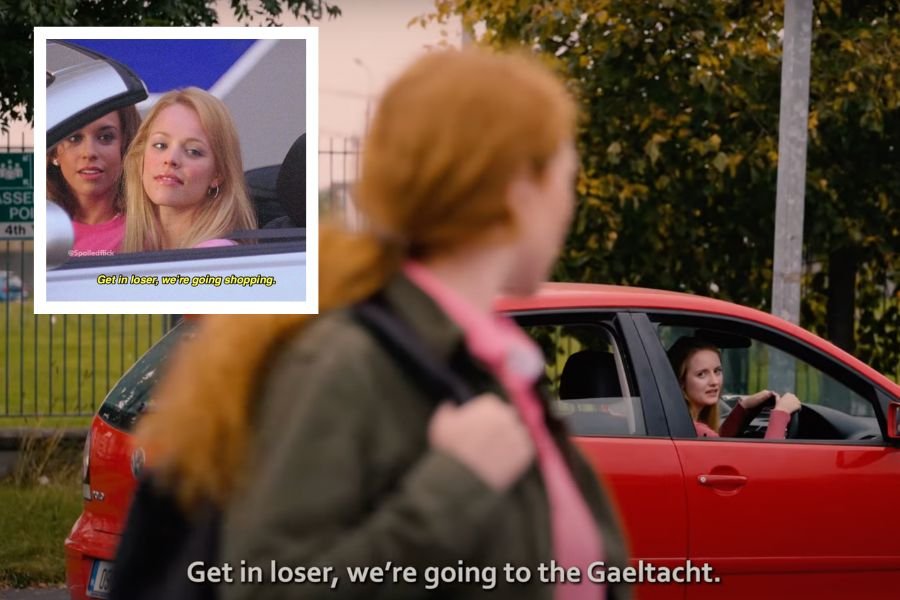
People are loving this Irish language short film based on 'Mean Girls'
Cailíní Gránna celebrates the vibrancy of the Irish language in such a fun way.

Never knew we needed this version.
The enduring appeal, relatable themes, and oh-so quotable lines of Mean Girls has not only made it a pop culture mainstay, but the inspiration for countless recreations—from musicals, to movie musicals (still pretty baffled by that) to hilarious skits. Still, even the most avid Internet consumer has probably never seen a Mean Girls parody quite like this one.
In honor of the iconic film’s upcoming 21st anniversary, as well as Seachtain na Gaeilge, the largest annual celebration of Ireland’s native language and culture, a drama company called Mumbro Top released a 10 minute short version of the movie, spoken entirely in Gaelic.

Cailíní Gránna (Mean Girls in Irish) certainly achieves both those goals—paying tribute to Tina Fey’s sharp and witty comedy, while championing the Irish language. You especially see this in some of the added fresh touches, like incorporating St. Brigid’s Day, having the Plastics wear green Irish garb instead of Santa suits for the talent show, and (my personal favorite) swapping Gretchen Weiner’s infamous “fetch” for “coolah boolah.”
Even the end credits play out over a lovely Irish cover to Chappell Roan’s hit ‘Hot to Go!!’ (aka Mhac Go Deo).
Watch:
- YouTubewww.youtube.com
Since its release, Cailíní Gránna has been met with glowing praise by viewers, many of whom gained a newfound appreciation for Gaelic because of it.
“Well... I'll never forget the irish word for ‘to die.’"
“I do not speak a hint of Irish and I'm not even from a place at all related to the country, nevertheless I watched all of this and it was great!!”
“help ‘an queercail cómhra’ is too good i'm definitely stealing that.”
“I don't speak a lick of gailge but this was so fun to watch & super well-made… I love how well you adapted gags from the original movie into an Irish context!!”
Gaelic (or Gaeilge) is one of the oldest and most historical languages in the world, dating back to as early as the 4th century. However, it was heavily suppressed during the English colonization of Ireland in the 1600s. In the 1800s and 1900s, there was a big revival movement, resulting in the establishment of Irish language schools, as well the creation of new literature, poetry and theatre trí Ghaeilge (through Irish).
Seachtain na Gaeilgem which translates to "Irish Language Week" was part of this movement. Back when it first began in 1902, it was indeed just a single week and limited to Ireland. However, over time it became a global event that couldn’t really be contained to a mere seven days, so festival organizers decided to extend the ‘seachtain’ to 17 days, but kept the original name due to its worldwide recognition.
Nowadays, Seachtain na Gaeilge (or ‘SnaG’, as it’s also known) is a truly global event, beginning on 1 March (St. David's Day) and running until St Patrick's Day on 17 March each year, with community-organized events including traditional céilís, concerts, quizzes, competitions, parades, history tours, lectures, and poetry nights intended to encourage the use of Gaelic.
Besides Cailíní Gránna, there have been a few recent pop culture moments that have also thrown Gaeling into the spotlight. Back 2023, two Irish-centric films, The Banshees of Inisherin and An Cailín Ciúin (The Quiet Girl) received Oscar noms. That same year, Paul Mescal received a bualadh bos (round of applause) for using his cúpla focal (few words) of Irish in an interview on the red carpet.
@dublinsfm104 “Go out there and use your cúpla focail.” ☘️ Paul Mescal talk about speaking Irish 😍 #paulmescal #dublin #diff #fyp #irish #ireland #normalpeople #aftersun #godcreatures #irishfilm
Point being, all these efforts to keep the mother tongue alive seem to be working, and that’s so coolah boolah.




Student smiling in a classroom, working on a laptop.
Students focused and ready to learn in the classroom.
Fish find shelter for spawning in the nooks and crannies of wood.
Many of these streams are now unreachable by road, which is why helicopters are used.
Tribal leaders gathered by the Little Naches River for a ceremony and prayer.

Communications expert shares the perfect way to gracefully shut down rude comments
Taking the high ground never felt so good.
A woman is insulted at her job.
It came out of nowhere. A coworker made a rude comment that caught you off guard. The hair on the back of your neck stands up, and you want to put them in their place, but you have to stay tactful because you're in a professional setting. Plus, you don't want to stoop to their level.
In situations like these, it helps to have a comeback ready so you can stand up for yourself while making making sure they don't disrespect you again.
Vince Xu, who goes by Lawyer Vince on TikTok, is a personal injury attorney based in Torrance, California, where he shares the communication tips he's learned with his followers. Xu says there are three questions you can ask someone who is being rude that will put them in their place and give you the high ground:
Question 1: "Sorry, can you say that again?"
"This will either make them have to awkwardly say the disrespectful remark one more time, or it'll actually help them clarify what they said and retract their statement," Xu shares.
Question 2: "Did you mean that to be hurtful?"
The next step is to determine if they will repeat the disrespectful comment. "This calls out their disrespect and allows you to learn whether they're trying to be disrespectful or if there's a misunderstanding," Xu continues.
Question 3: "Are you okay?"
"What this does, is actually put you on higher ground, and it's showing empathy for the other person," Xu adds. "It's showing that you care about them genuinely, and this is gonna diffuse any type of disrespect or negative energy coming from them."
The interesting thing about Xu's three-step strategy is that by gracefully handling the situation, it puts you in a better position than before the insult. The rude coworker is likely to feel diminished after owning up to what they said, and you get to show them confidence and strength, as well as empathy. This will go a lot further than insulting them back and making the situation even worse.
Xu's technique is similar to that of Amy Gallo, a Harvard University communications expert. She says that you should call out what they just said, but make sure it comes out of their mouth. "You might even ask the person to simply repeat what they said, which may prompt them to think through what they meant and how their words might sound to others," she writes in the Harvard Business Review.
More of Gallo's suggested comebacks:
“Did I hear you correctly? I think you said…”
“What was your intention when you said…?”
“What specifically did you mean by that? I'm not sure I understood.”
“Could you say more about what you mean by that?”
Ultimately, Xu and Gallo's advice is invaluable because it allows you to overcome a negative comment without stooping to the other person's level. Instead, it elevates you above them without having to resort to name-calling or admitting they got on your nerves. That's the mark of someone confident and composed, even when others are trying to take them down.