upworthy
Add Upworthy to your Google News feed.
Google News Button
Joy

15 of the politest ways to tell someone to ‘screw off’ that sting worse than foul language

You really can kill with kindness.

angry man, pointing finger, curse words, bad words, middle finger, you do you,

An angry man pointing his finger.

There are many situations we all have where we would love to tell someone to screw off (to use a more polite term) but it would cause more trouble thatn it’s worth, whether you’re at work, stuck in traffic or at your child’s soccer game and one of the parents on the opposite side is being obnoxious. But that doesn’t mean there aren’t plenty of phrases and gestures that mean the same thing, but they can be a more artful and less confrontational way of making your point.

Sometimes, using a euphemism for a curse word can hurt your desired target even more because it shows that you put some thought into the insult and that you chose a more intelligent way to put them down without having to resort to foul language. The fact that the insult is veiled also gives you plausible deniability so that the issue doesn’t become an HR problem.

What phrases can we all keep in our backpockets in case a situation arises where you have to tell someone to shove it? A Reddit user asked the AskReddit subforum for people to share the “polite” ways to say “screw” you and there were a lot of great responses. We made a list of the best ones to give you plenty of ways to skillfully respond to someone who is being a real pain in the keister.

Here are 15 of the best “polite” ways to say “screw” you.

What are some classy ways to tell someone off?

1. "I said good day"

"I started using this after seeing Gene Wilder as Willie Wonka say it to Charlie."

"Sometimes when people ask me for something at work I will explode into 'YOU GET NOTHING. GOOD DAY SIR.' Even if they asked super casually. I often have to clarify this gag with new people but i like it too much."

"Fun fact : Gene Wilder had not rehearsed this explosion with the actor playing Charlie. He wanted the poor boy to have a genuine look of terror on his face. And it worked."

- YouTubewww.youtube.com

2. Blow a kiss

"If I’m driving, I never flip off anyone. I just blow a kiss and usually that pisses them off more."

"My wife gives them a thumbs up."

"Right? Middle finger says, 'You got to me and I'm angry.' Thumbs down is 'I judge you unworthy'"

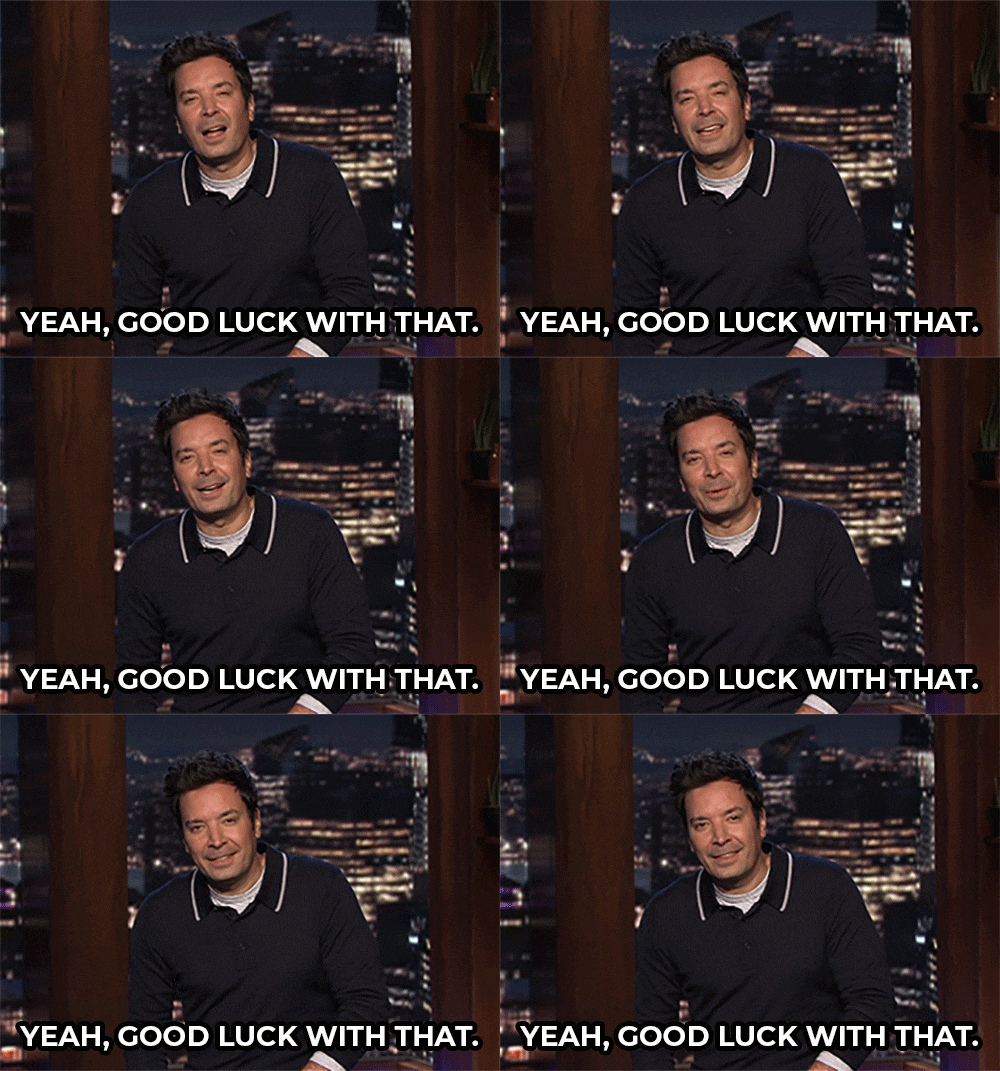
3. "Good luck with that"

"My pizza restaurant manager said this to me as a 'f**k you' in regard to my decision to go to college rather than train to be a manager. Now I make 100k/year. I do miss the free pizza though."

4. "Be that as it may"

"After some stupid sh*t is said politely state, 'be that as it may' and then continue with whatever you were saying."

"The classier version of 'Anyway…'"

5. "As per my previous email"

'"As per my previous email' sends the corporate types into conniptions."

6. "You're really being yourself today"

"I’ve used it twice and it can go a couple different ways. It either goes completely over their head and they don’t understand the insult, or it ruins them for the rest of the day, even if you’re 'joking' when you say it."

7. "Noted"

"I once had a guy coming in for an interview who completely flipped out on me and sent me this whole ranting, long email. I replied with 'Your comments have been noted.' He went absolutely apesh*t."


8. "You do you"

"'You do you' is the white collar 'bless your heart.'"

"This one's a good replacement for 'go f**k yourself.'"

9. "Bless your heart"

"In the hands of a truly gracious southerner, 'Bless your hearts' is particularly nuanced in that it is frequently given in complete sincerity to express gratitude 'oh, bless your heart,, that ice tea is just what I need.' Or sympathy: 'that child lost her mother, bless her heart', or deep admiration: 'he donated a kidney to his sister, bless his heart.' The same person can then turn it and use it with equal sincerity to cut deep but in sympathy for someone's lack of capacity (but with the presumption that they are doing their best, bless'em) as a lady should: 'he can't dress himself, bless his heart,' 'she should scare a crow with that face, bless her heart,' 'he's dumber than a bag of rocks, bless his heart.' Usually, the first part is unspoken, so all the recipient sees is a sweet smile and 'oh, bless your heart,' never to know if he has been quite admirable or made a hopeless blunder."


10. "Wow"

"One 'wow,' turn around and walk away."

11. “How amusing for you”

"I like what the late Queen would say in response if someone said something inappropriate."

"Every single report of Queen Elizabeth II has her as a very sharp wit. I wish I could find the clip, but on Mock the Week, comedian Ed Byrne tells a story where, in his words, he got owned by her and to match wits with a comedian takes some smarts."

12. "I'll pray for you"

"While you may mean it, unless the person is sick or grieving or asked for prayers, it is self-righteous and condescending to tell someone you'll pray for them. Especially if that person is not Christian."

13. "Good afternoon!"

In the 1800s, "Good afternoon" was an insult, evidenced by Ebenezer Scrooge's use of it in Charles Dickens' A Christmas Carol. He dismisses his nephew, who wants to repair his damaged relationship with him and become friends.
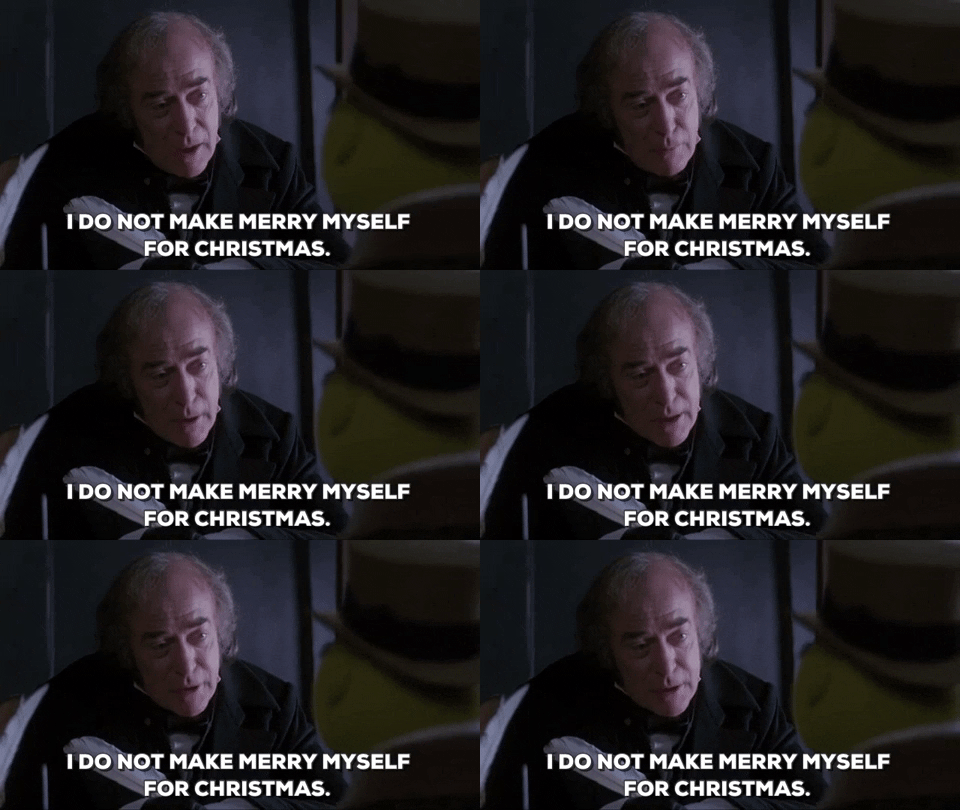

14. "May you encounter people as helpful as you have been."

"As a bonus, it also works for 'you have genuinely been wonderful."

This insult would probably work best in a situation where you've had to deal with someone in customer service who wasn't very helpful. Or, when walking away at a car dealership when the person doing the financing tries to scam you with some very bad math to get you to a higher payment.

15. "Have the day you deserve"

"I heard an employee at Canadian Tire say this one day to a customer after he was done arguing with her about something. I’ve remembered it ever since."


shhh, quiet, zip it, mouth closed, say nothing, be quiet

A woman zipping up her lips.

There are times to speak up, moments when it’s best to say nothing, and opportunities be very considerate in your response. But when you’re on the receiving end of a back-handed compliment, a foolish remark, or a coworker takes you down a peg, and your emotions are up, it can be hard to have a thoughtful response. Often, we say something we shouldn’t.

How is it that some folks fly off the handle and say things they’ll later regret, while others can stay calm and remove themselves from the situation or take the high ground? One way to be less impulsive with your words is to use the “name it to tame it” neuroscience hack, originally coined by author and psychiatrist Dr. Dan Siegel. When used properly, it allows you to step back from the moment and choose the best response in a challenging situation.


shhh, quiet, zip it, mouth closed, say nothing, be quiet A man saying "be quiet."via Canva/Photos

How to use the ‘name it to tame it’ hack

When someone upsets you, the first thing to do is to go inside yourself and describe the emotion that you feel in your body. Are you angry? Are you sad? Are you afraid? Do you feel rejected? Are you disappointed? The moment you name the emotion, it will begin to subside and give you the emotional and mental room to respond to the person who caused the negative emotion, rather than impulsively reacting.

How to respond to a reactive emotion so you don’t fly off the handle:

Event happens:

1. Your body stiffens up

2. You feel an intense emotion

3. You examine the emotion and give it a name: “My body is telling me I am angry.”

4. You should feel the emotion beginning to subside

5. Choose your response instead of being impulsive

shhh, quiet, zip it, mouth closed, say nothing, be quiet A woman zipping up her mouth.via Canva/Photos

Why does ‘name it to tame it’ work?

“Name it to tame it” works because, when we have a strong emotional reaction, our lizard brain kicks in, and we go into fight, flight, or freeze mode. The lizard brain is not known for giving thoughtful and strategic responses to challenging situations. When we name the emotion, our prefrontal cortex, or the thinking brain, kicks in. The thinking brain looks at the situation and says, “Alright, we don’t need to run or fight here. It's best to give a strategic response.”

When we tune into the negative emotions by naming them, they relax because they feel heard, like when a child has hurt their knee or a loved one has real concern and you gives them undivided attention. Once the emotions are named, they are tamed. Then, you are more likely to respond to the negative person with grace and speak from the best part of yourself.

Dr. Dan Siegel, who coined the phrase “Name it to tame it,” explains the brain science behind the technique in the video below. He does a great job of explaining how it allows us to transfer our thoughts from the downstairs brain (the lizard brain) to the upstairs brain (the thinking brain), so we can calm down and respond appropriately to the situation.

- YouTube www.youtube.com

tipping culture debate, server tip note receipt, Lionell Carr Threads viral, restaurant tipping 2026, tipping etiquette US, Pew Research tipping survey, server minimum wage tips, cash tip restaurant, tipping fatigue America, viral restaurant receipt
Canva

A restaurant customer looks at his bill

Lionell Carr (@lionellsaidit2) stopped for breakfast while traveling over the holidays. His bill came to $33.06. He paid on the card, leaving the tip line blank because he planned to leave cash on the table. Before he could, the bill came back.

Written on the receipt in bold red letters: "Learn to TIP. It's not my job to serve you FOR FREE!"


Carr posted a photo of it to Threads last December, with a caption that summed up his reaction: "On my holiday travels, I stopped and had breakfast. this occurred afterwards. I was gonna leave a cash tip......" He added, "These servers are out of control, a lot of times they blocked their blessings for greed!"

The post has since pulled in 4.5 million views, according to Newsweek, and the comment section became exactly what you'd expect: a full-scale argument about one of the most reliably combustible topics in American public life.

On one side, people who felt the server crossed a line. "If you're not getting paid by your EMPLOYER, that's your fault. Tipping is OPTIONAL," wrote @gaga.looie. @trice_the_bea added, "U.S.A. should start learning how to pay its workers. Tips should be a reward for kind service, not their paycheck."

On the other, people who felt the server's frustration was completely understandable given the economic reality behind it. "greed? in U.S. servers get a base salary of $2.13/hour on average," wrote @lucy.vard. "The majority of the money they make is tips. We can argue that the system is broken, and restaurant owners should pay their employees, and, while valid, it's a different point. This is how system works, and we shouldn't punish people for the system's imperfection."

tipping culture debate, server tip note receipt, Lionell Carr Threads viral, restaurant tipping 2026, tipping etiquette US, Pew Research tipping survey, server minimum wage tips, cash tip restaurant, tipping fatigue America, viral restaurant receipt YouTube

Both responses capture something true, which is probably why this post keeps spreading.

The structural reality is that the American tipping system puts servers and customers in an uncomfortable position that neither of them created. According to a 2023 Pew Research Center survey, 72% of U.S. adults say they are being asked to tip in more places than five years ago. More Americans oppose businesses suggesting tip amounts (40%) than support it (24%). And 77% of diners say the quality of service is their primary factor in deciding how much to tip, which means a server's income is perpetually attached to variables outside their control.

That pressure is real. So is the frustration of a customer who genuinely intended to leave cash and got a lecture in red ink before he had the chance.

What makes this story harder to resolve than it looks is that the server's note wasn't wrong about the economics. It was just aimed at the wrong person. The broken part of the system isn't the customer who leaves cash instead of a card tip. It's the system that pays servers $2.13 an hour and asks both parties to sort out the rest between themselves.

@azjohnsons put it plainly in the comments: "Tips are their salary. Not a blessing. They worked and should be paid. Sorry for the frustrated note but I get it."

That might be the most honest sentence in the whole thread.

tipping culture debate, server tip note receipt, Lionell Carr Threads viral, restaurant tipping 2026, tipping etiquette US, Pew Research tipping survey, server minimum wage tips, cash tip restaurant, tipping fatigue America, viral restaurant receipt YouTube

You can follow Lionell Carr (@lionellsaidit2) on Instagram Threads for more content on lifestyle.

This article originally appeared earlier this year.

arthur c. brooks, harvard, psychology, happiness research, bucket list

Harvard researcher Arthur C. Brooks studies what leads to human happiness.

We live in a society that prizes ambition, celebrating goal-setting, and hustle culture as praiseworthy vehicles on the road to success. We also live in a society that associates successfully getting whatever our hearts desire with happiness. The formula we internalize from an early age is that desire + ambition + goal-setting + doing what it takes = a successful, happy life.

But as Harvard University happiness researcher Arthur C. Brooks has found, in his studies as well as his own experience, that happiness doesn't follow that formula. "It took me too long to figure this one out," Brooks told podcast host Tim Ferris, explaining why he uses a "reverse bucket list" to live a happier life.


bucket list, wants, desires, goals, detachment Many people make bucket lists of things they want in life. Giphy

Brooks shared that on his birthday, he would always make a list of his desires, ambitions, and things he wanted to accomplish—a bucket list. But when he was 50, he found his bucket list from when he was 40 and had an epiphany: "I looked at that list from when I was 40, and I'd checked everything off that list. And I was less happy at 50 than I was at 40."

As a social scientist, he recognized that he was doing something wrong and analyzed it.

"This is a neurophysiological problem and a psychological problem all rolled into one handy package," he said. "I was making the mistake of thinking that my satisfaction would come from having more. And the truth of the matter is that lasting and stable satisfaction, which doesn't wear off in a minute, comes when you understand that your satisfaction is your haves divided by your wants…You can increase your satisfaction temporarily and inefficiently by having more, or permanently and securely by wanting less."

Brooks concluded that he needed a "reverse bucket list" that would help him "consciously detach" from his worldly wants and desires by simply writing them down and crossing them off.

"I know that these things are going to occur to me as natural goals," Brooks said, citing human evolutionary psychology. "But I do not want to be owned by them. I want to manage them." He discussed moving those desires from the instinctual limbic system to the conscious pre-frontal cortex by examining each one and saying, "Maybe I get it, maybe I don't," but crossing them off as attachments. "And I'm free…it works," he said.

- YouTube www.youtube.com

"When I write them down, I acknowledge that I have the desire," he explained on X. "When I cross them out, I acknowledge that I will not be attached to this goal."

The idea that attachment itself causes unhappiness is a concept found in many spiritual traditions, but it is most closely associated with Buddhism. Mike Brooks, PhD, explains that humans need healthy attachments, such as an attachment to staying alive and attachments to loved ones, to avoid suffering. But many things to which we are attached are not necessarily healthy, either by degree (over-attachment) or by nature (being attached to things that are impermanent).

"We should strive for flexibility in our attachments because the objects of our attachment are inherently in flux," Brooks writes in Psychology Today. "In this way, we suffer unnecessarily when we don't accept their impermanent nature."

What Arthur C. Brooks suggests that we strive to detach ourselves from our wants and desires because the simplest way to solve the 'haves/wants = happiness' formula is to reduce the denominator. The reverse bucket list, in which you cross off desires before you fulfill them, can help free you from attachment and lead to a happier overall existence.

This article originally appeared last year.

Joy

A man tried to fix a female golfer's swing. He didn't know she was a PGA pro.

“What you are doing there … you shouldn’t be doing that.”

mansplaining, golf, swing change golf, humor, golfing, sports, athletes, female athletes, womens sports, sexism
Representative Image from Canva

A man tried to tell a pro golfer she was swing too slow.

We’re all probably familiar with the term “mansplaining,” when a man explains something to a woman in a condescending or patronizing way. Often, this takes the form of a man explaining a subject to a woman who already knows it at an expert level. The female neuroscientist who was told by a man that she should read a research paper she actually wrote comes to mind.

Often, mansplaining can show up in small interactions that minimize or infantilize a woman's knowledge and expertise. It can be a man spouting off facts because he thinks it makes him seem interesting, or giving unsolicited fitness advice at the gym in a poorly disguised flirting attempt. But sometimes the irony at play is just too much to bear. Frankly, it's often delicious.


In 2024, some next-level mansplaining was caught in the wild. Georgia Ball, a professional golfer and coach who’s racked up over 3 million likes on TikTok for all her tips and tricks of the sport, was minding her own business while practicing a swing change at the driving range.


golf, practice tee, driving range, range balls, golf clubs People practicing on the driving range. via Canva/Photos

A man tries to give a female PGA pro golf tips

It takes all of two seconds on Google to see that when it comes to incorporating a swing change, golfers need to swing slower, at 50-75% their normal speed…which is what Ball was doing. And this is what prompted some man to insert his “advice.”

In the clip, we hear the man say “What you are doing there … you shouldn’t be doing that.” Exhibiting the patience of a nun, Ball simply tells him that she’s going through a swing change. But her attempts at reason are unfortunately interrupted, multiple times, when the man repeatedly assures her that, since he’s been playing golf for 20 years, he knows what he’s talking about.

He then insists, repeatedly cutting her off, that she’s going too slow on her swing and should be following through. Cue Ball’s incredulous look to the camera.

Watch the whole, cringe-inducing interaction here:

@georgiagolfcoach

Can you believe he said this? 😳⛳️👀 #golf #golfswing #golflife #golftok #golftiktok #golfer #golfing #golfgirl #golfpro #golftips #golfclub #drivingrange


Hoping to appease him, Ball finally gives a hearty swing, writing “I knew I had to make this a good one” on the onscreen text. As the ball sails through the air, the man says, “See how much better that was?" completely taking credit for her swing. Which is hilarious because she didn't change a thing she was doing.

Poor Ball then tries to tell him that even the “best players in the world” slow down their swing when going through a swing change. And she'd know. Not only is she a golf coach, but she's also a certified PGA professional. “No, I understand what you’re saying, but I’ve been playing golf for 20 years,” the man repeats. At this point, Ball is just “trying to keep it together.”

golf group, fiarway, co-ed golf group, tee time, links A group of people playing golf. via Canva/Photos

People in the comments couldn't handle the mansplaining

Sure, this guy might not have known who Ball was, but it’s pretty evident that the last thing she needed was this guy’s “advice.” And thus, the “mansplaining” jokes commenced in the comments section.

Here’s a small sampling:

“As a guy, this is the first time I’ve ever seen ‘mansplaining’ happen.”

“The way he took credit for your next swing.”

“But did you consider that he’s been playing golf for 20 years?”

“*implement nothing he says* ‘See how much better that was’ HAHAHAHAH.”

“My hope is that he comes across this video and it keeps him up at night."

Others couldn’t help but praise Ball for keeping her cool.

“He doesn’t even give you a chance to explain, just forces his opinion and advice onto you. Goon on you for staying calm and polite,” one person wrote. Of course, others felt Ball was being “too nice” to the man. One even exclaimed, “there’s no reason to be so polite!”

Ball told BBC that it wouldn't be in her nature to shut the man down harshly, even if that's what he deserved. "I wouldn't interrupt and say that," she says. "I suppose it's just the humble side of me."


@georgiagolfcoach

Play a hole with me ⛳️🏌🏽‍♂️25mph wind 🤯🤣 #golf #golftiktok #golftok #golfer #golfswing #golfing #golflife #golftips #golfcourse #golfclub #golfgirl #golfdrills #playaholewithme #golfpro


Perhaps worst of all, this kind of behavior is pretty common, especially for female athletes. A fellow female golfer even commented, “So glad you posted this because it is my BIGGEST frustration when I’m at the driving range. Unfortunately, men always feel the need to comment on my swing or want to coach me. Guys take note: Please don’t.”

On the bright side: as annoying as it is that Ball had to endure that (not to mention what it says about the very real b.s. that women in general have to put up with on the regular), she laughed it off and just went on about her life being awesome at what she does. Just like the other smart, capable women of the world. It’s almost like…maybe women don’t need advice, so much as they need

Ball isn't holding onto any grudges over the incident

"I have a lot of interaction with males and females every single day [on the course]. And I'd say it's mostly always positive," she says. "I'm just glad I can look back at it now and laugh about it because the majority of people and golfers are all just out to help each other."

Even though her time on the golf tee with the mansplainer was uncomfortable, the reaction to her discomfort has been positive. "The reaction has been so positive," she told the BBC. "All the support, the comments, the messages, it's just been so good. And I'm just so grateful for everything that's come through."

This article originally appeared two years ago. It has been updated.


maikon alves, maykon alves, agt, dance, robot dance, dance tutorials, tiktok dance, agt dance
Maikon Alves | Instagram

Maikon Alves has people shook over is robotic style dancing.

"The Robot" is a classic dance move that's been seen on dance floors since the early 1900s, according to Vox. The mechanical move was also mastered and brought to the mainstream by dance legend Michael Jackson.

And a dancer from Brazil has put his own modern (and humorous) twist on the dance technique. Maikon Alves has been turning heads on social media with moves so fluid and robotic that people around question if he's human.


Alves got a big break after a dance to to "Boom Boom Pow" by the Black Eyed Peas went viral back in 2024—to say his moves are impressive would be an understatement. Alves popped his chest to the beat while slowly stepping in place making it look like he was gliding from move to move. Some movements were crisp and sharp like a robot while others were so fluid it was nearly unbelievable that it could be coming from a human.

Viewers respond to Maikon's moves

Comments on the video ranged between being in awe of his abilities to questioning if he was truly part robot.

"Loved. I like how everything is in sync - from the music to the moves to face expressions. 👏👏👏 and your cool personal style," one person writes.

"Doesn’t even look real it’s that good..!! Love this," someone says.

"You will be the dance instructor for the children of our AI overlords someday," a commenter thinks.

"Nah, this is God-level pop-locking," someone compliments.

"You are a legend!" Nicole Scherzinger, actress, singer and former member of the pop group and dance ensemble, Pussycat Dolls, wrote.

@maykonreplay

Minha apresentacao no AGT para vocês com as musicas originais… heheh. 🤖❤️ #agt #robot #talent

Alves' uncanny robot dance even made its way to Season 19 of America's Got Talent in 2024. His audition routine included pretending to play the violin and a fun moonwalk to robotic themed music.

During a June 2024 interview with Chupim Metropolitana, he shared about his experience on the show. "It was a dream come true because since I was a child I watched videos of the dancers I used as inspiration from there," he said. "It was magical."

Where is Maikon Alves now?

Since then, Alves has continued to display his unique robot dances on social media. Another robot dance he posted in July 2025 garnered over 60 million views on TikTok (@maykonreplay), where he has grown a strong following of fans in awe of his moves.

@maykonreplay

Hahahahahahaha

"I know it's talent but it low-key scares me," one viewer commented. And another added, "this gives me uncanny valley vibes. like great job, but I'm uncomfortable 😅."

How did Maikon Alves start dancing?

Alves shared more about how he got into dancing during his interview with Chupim Metropolitana.

"Since I was a kid I watched Michael Jackson videos in the living room. My mom would put them on," he said. "I watched the Michael Jackson videos and I took them as a reference. As I grew up, I saw other dancers too, like Chris Brown and Usher. And then I mixed everything, adding humor too. And I just kept growing."

- YouTube www.youtube.com

Alves also explained that his style of robotic dancing has taken lots of "dedication", and it started by learning Michael Jackson's classic Moonwalk dance.

"I was very shy, so dancing with humor helped me a lot," he shared. "I watched his videos and practiced a lot. In the beginning it was very difficult. I did a lot of mime."

This article originally appeared two years ago. It has been updated.